Best Overall
15% off

Creality K2 3D Printer
Compact design fits in small spaces easily.
User-friendly interface simplifies printing process.
High precision delivers detailed print quality.
 Daniel Kenitz
Compact design fits in small spaces easily.
User-friendly interface simplifies printing process.
High precision delivers detailed print quality.
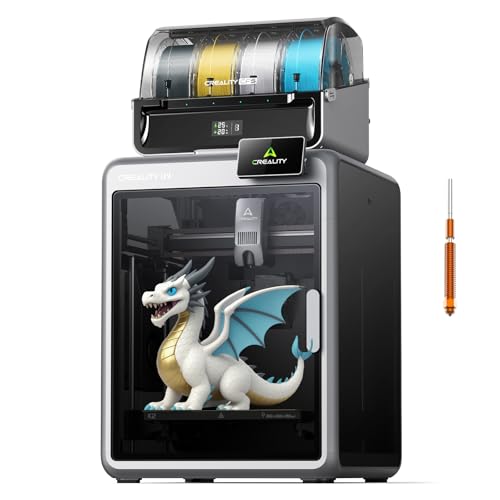
Multicolor printing with CFS enhances design versatility.
High-speed printing at 600mm/s saves time.
Smart auto leveling ensures precise prints.

Fast printing speed enhances productivity.
Easy one-click setup simplifies use.
Multicolor printing adds creative versatility.

Pre-loaded with 8,000+ diverse 3D models.
Operates at high speed, up to 400mm/s.
Includes 8 colorful PLA filaments for creativity.

High-resolution 10K mono LCD screen.
Fast printing speed at 70mm/h.
Stable LighTurbo light source enhances precision.

Safe enclosed design ensures kid-friendly operation.
AI-powered for easy, intuitive printing.
Offers over 8,000 fun toy models.

Fast 600mm/s printing speeds.
Convenient 1-click auto leveling feature.
High-quality 300°C direct drive extruder.

Fast and precise printing capabilities.
Easy to set up and use.
Supports native 7-color printing.

Easy multicolor printing for vibrant projects.
Beginner-friendly setup and operation process.
Reliable and consistent print quality results.

Multi-color printing enhances creative projects.
95% pre-assembled for quick setup.
AI photo-to-3D feature simplifies design conversion.
A printer works well for a beginner when the complete setup—not just the machine—supports repeatable first layers, understandable loading and calibration, reliable recovery from interruptions, and clear material limits. Automatic bed leveling can reduce one common setup task, but it does not prove accurate printing. Build volume determines the largest practical object: the supplied products range from roughly 100 mm cubes for small models to 260 mm cubes for larger parts. Nozzle temperature, heated-bed temperature, layer height, material compatibility, and print speed must be considered together. A headline such as 400, 500, or 600 mm/s is a maximum or optimized figure in several listings, not a guarantee of normal quality across materials and models. Independent testing in the supplied reviews sometimes used much lower everyday speeds and found that surface quality, bridging, layer adhesion, or dimensional results could change with settings.
For filament printers, look for exact-model documentation covering PLA, PETG, TPU, or other intended materials, along with a manual that explains setup, ventilation, loading, maintenance, fault response, cooling, and supervision. For resin printers, the buyer also needs a safe plan for uncured resin, gloves, eye protection, washing solvent, curing, spills, contaminated wipes, and disposal. A cover is not proof of emissions control, and a stated carbon filter or air purifier is not proof of particle or chemical capture.
The strongest safety evidence is traceable to the complete product and its power system. Check the exact model in UL Product iQ, Intertek's ETL directory, or the CSA product database for an applicable U.S. end-product listing, such as ANSI/UL 62368-1 where relevant. An FCC authorization confirms radio compliance; it does not establish protection from shock, overheating, or fire. For indoor air, look for an exact printer-and-material result in the UL SPOT or GREENGUARD databases, or testing within the scope of ANSI/CAN/UL 2904. A seller's badge, enclosure, low-odor statement, or “child-safe” wording cannot substitute for that evidence. CPSC recalls and SaferProducts.gov reports are also useful checks, but no recall finding is proof that a product is comprehensively safe.
For sustainability, compare failed-print controls, purge and support waste, material specifications, and whether the maker sells common replacement parts. Color systems can simplify multicolor printing while still producing substantial purge waste. Power ratings such as 60 W, 150 W, 350 W, or 450 W help with circuit planning, but they are not measurements of actual print or standby consumption. A repair-parts catalog, service instructions, firmware support, warranty terms, and a take-back or recycling route provide more useful lifespan evidence than a generic durability claim.
Recurring caveats are important. The supplied products repeatedly lack exact-model UL, ETL, or CSA end-product listings and independently verified low-emissions results. Open printers expose hot nozzles, heated beds, and moving parts; enclosed printers still require supervision and do not necessarily capture emissions. Filament printing can release particles and chemicals, while resin printing adds uncured resin, solvent, UV-curing, and contaminated-waste hazards. Do not place these products in bedrooms, nurseries, poorly ventilated living areas, or occupied classrooms without an appropriate ventilation or local-exhaust plan, and do not treat an enclosure as a substitute for adult supervision.
The scores below compare the supplied products against the same health, ecology, and evidence topics. A high score indicates stronger documentation or verification within that topic; it does not mean the product is risk-free. In particular, the reviews repeatedly distinguish manufacturer claims from independent testing and exact-model certification.
This measures whether the exact printer-and-material setup has independently verified low particle and chemical emissions or effective capture. It matters because both heated filament and resin workflows can release particles or chemicals. Among these products, the stronger scores are associated with clearer material guidance and better-supported controls, but no supplied product had a located exact-model UL 2904, GREENGUARD, or comparable emissions result. Enclosures and filters remain unverified unless tested.
This measures listing of the complete printer, power system, and heated components by an accredited U.S. safety laboratory. It matters because FCC compliance or a manufacturer declaration does not establish protection from shock, overheating, or fire. Scores are relatively close across the set: several products received around 68–74, reflecting partial documentation but no located exact-model UL, ETL, or CSA listing. A high score here means stronger traceability, not confirmed certification where the review found none.
This measures guards, interlocks, enclosed hot parts, moving mechanisms, and resin UV safeguards. It matters because filament printers can reach roughly 230–300°C at the nozzle and up to 110°C at the bed, while resin printers expose users to UV-curing equipment and uncured material. Enclosed child-oriented products scored in the mid-70s, while open printers commonly scored near 52–63. A cover reduces casual access but is not necessarily an interlock or emissions control.
This measures whether compatible materials and practical controls for filament additives, resin, solvents, cleanup, spills, curing, and disposal are clearly identified. It matters most for resin printers, which require gloves, ventilation, washing, curing, and controlled waste handling, but filament additives and higher-temperature materials also need care. Resin products scored as high as 78 when guidance was clearer; products with broader material claims but limited safety documentation scored closer to the low 60s.
This measures instructions for siting, ventilation, supervision, loading, maintenance, fault response, and unattended printing. It matters because automatic leveling or an assembled frame cannot replace safe operating procedures. The supplied products range from about 60 to 78. Higher-scoring examples provide guided setup, cooling and burn warnings, calibration, and maintenance instructions. Lower scores reflect missing ventilation or unattended-operation guidance, conflicting instructions, or reliance on marketing claims rather than a complete beginner protocol.
This measures whether claims about speed, precision, quietness, leveling, enclosure safety, filtering, AI features, and included content match the exact product and its documented conditions. It matters because maximum speed is often presented as normal performance, and child-safe or no-emissions wording can exceed the evidence. Scores range from 48 to 80. Higher-scoring products had fewer contradictions and better-qualified claims; lower scores reflected conflicting manuals, unsupported speed figures, or exaggerated emissions and safety language.
This measures whether safety, emissions, radio, and performance claims can be checked in credible third-party records for the exact product. It matters because a general badge or family-level statement may not cover the marketplace variation being sold. The supplied scores run roughly from 68 to 79. FCC records support radio traceability for some products, while independent hands-on testing strengthens performance evidence; neither substitutes for a U.S. electrical listing or exact-model emissions certification.
This measures whether speed, accuracy, layer quality, leveling, recovery, and material compatibility hold under repeatable, disclosed conditions. It matters because beginners need usable results without relying on peak settings or extensive tuning. The strongest supplied scores are 87 for the enclosed P1S and 85 for the compact A1 mini, supported by hands-on testing. Lower-scoring open printers had visible seams, inconsistent surfaces, or limited exact-model testing. A manufacturer's resolution or speed figure alone is not reproducibility evidence.
This measures failed prints, purge waste, supports, disposable consumables, and clarity about lower-impact materials. It matters because multicolor filament systems can create substantial purge material, while resin workflows generate supports, contaminated wipes, used film, uncured resin, and wash liquid. Higher-scoring products in this set reached 76 when testing or recovery features supported less waste. Lower scores commonly reflected unquantified purge waste or no independent efficiency evidence.
This measures replacement parts, repair instructions, firmware support, warranty terms, and end-of-life options. It matters because nozzles, hot ends, beds, belts, screens, fans, and power parts are ordinary failure or wear points. Products with official parts catalogs and detailed service guidance scored as high as 86; products with only customer-service promises or unclear exact-model parts scored closer to 68–70. No supplied review identified a clearly documented U.S. take-back program.
This measures disclosure of rated power, temperature limits, standby behavior, print-time assumptions, and required ventilation or filtration resources. It matters because a power-supply rating is not the same as measured energy use, and a filtration claim can imply additional operating resources. Scores in the supplied set generally range from 70 to 80. Higher scores reflect clearer technical ratings and resource assumptions, but the reviews repeatedly note that independent print and standby power measurements were not found.
This is an enclosed, filament-based 3D printer with a 260 x 260 x 260 mm build space. The Combo package includes one Creality Filament System, or CFS, which the manufacturer says can feed four spools for multicolor or automatic same-material refill printing. More CFS units can expand the system to 16 spools, but require separate purchases. Creality specifies a 300 C nozzle limit, 100 C heated bed, flexible PEI spring-steel plate, automatic leveling, a 720p chamber-monitoring camera, and a 450 W rating on 110 V power. Its 600 mm/s maximum speed is manufacturer-stated, while the same official page identifies 300 mm/s as the typical speed and gives a specific Hyper-ABS test condition for its peak-speed figure. An enclosed body and a stated carbon filter are useful controls, but no exact-product emissions certification or measured capture efficiency was located.
This product suits a beginner who wants an enclosed desktop filament printer for PLA, PETG, PET, ABS, or compatible carbon-fiber filament projects, and who has a stable, ventilated work area with a grounded outlet. Its 260 mm cubed build space is useful for medium-size functional parts, props, and multicolor models without assembling a printer from a kit. It also fits a user willing to follow a manual, learn slicer settings, keep children supervised, and treat the stated 600 mm/s figure as a conditional maximum rather than an everyday expectation.
It is not suited to bedrooms, tightly enclosed classrooms, or other occupied spaces that lack local exhaust or meaningful room ventilation. EPA and NIOSH guidance treats filament printing as a source of particles and chemicals, and the product has no independently verified low-emission configuration. It is also a poor fit for unattended use around unsupervised children, for users needing independently listed U.S. electrical and fire safety, or for buyers who need validated output accuracy and low material waste. Flexible TPU, softened BVOH and PVA, and warped cardboard spools are not supported by the CFS.
The product is a heated filament printer, not a resin printer, so it does not require resin washing, UV curing, or solvent handling. That does not make indoor emissions negligible. EPA states that 3D printers can generate particulate matter and VOCs, while NIOSH recommends controls such as enclosure, ventilation, lower-emission materials, and reducing time spent beside an operating printer. The enclosure and manufacturer-stated carbon filter are helpful features, but they are not a demonstrated substitute for ventilation. Creality documents PLA, PETG, PET, ABS, and PLA-CF compatibility for this model. ABS and fiber-filled materials deserve particular caution because the product has no exact-material emissions certification or published filter performance. The CFS can reduce abandoned prints by switching matching spools, but multicolor work creates purge waste. Creality supplies repair guides for several common parts, which supports longer use, although a U.S. take-back program and independently verified electrical safety listing were not located. No product-specific CPSC recall was located in the review.
This is an enclosed fused-filament 3D printer with a 260 x 260 x 260 mm build area, direct-drive extrusion, a 0.4 mm nozzle, and an included Creality Filament System for loading up to four spools. It makes solid plastic parts by heating 1.75 mm filament, rather than using liquid resin or UV curing. Creality lists PLA, PETG, ABS, PLA-CF, and PET as supported materials. The manufacturer rates the printer at up to 600 mm/s, with automatic leveling, a 300 C nozzle, a 100 C bed, Wi-Fi, cloud integration, and a built-in camera. An independent hands-on review found clean multicolor results on simple prints and successful PETG printing, but also reported a failed complex chainmail-style print and fan noise measured around 46 dB. The product has an exact FCC authorization for its 2.4 GHz radio, but no exact-model U.S. UL, ETL, CSA, or low-emissions certification was located.
It suits a first-time filament-printing user who has a stable, ventilated dedicated workspace, wants enclosed CoreXY printing, and expects to make medium-size functional parts, décor, prototypes, or multicolor models. The 260 mm cubic build space can avoid splitting many household-scale projects. It is also suited to a user willing to follow the setup video, run calibration, maintain the bed and motion system, replace the filter on schedule, and learn material-specific settings rather than assuming every supported filament will work identically.
It is not appropriate for a bedroom, nursery, tightly occupied classroom, or poorly ventilated room where users need independently verified low particle and chemical emissions. It is also a poor fit for buyers who require a documented U.S. electrical and fire-safety listing, validated filtration performance, or measured standby and print-energy data. Children should not operate it unsupervised. Users who need consistently successful complex prints with no tuning, or who are sensitive to fan noise, should account for the independent report of failed demanding geometry and audible fans.
The printer uses heated thermoplastic filament, not UV-cured resin, so it does not create the resin washing and curing workflow. That does not make indoor operation exposure-free. EPA and NIOSH state that filament printers can release ultrafine particles and volatile chemicals, with emissions affected by filament and nozzle temperature. Creality calls for a well-ventilated location, and the manual warns users not to touch the hot nozzle or bed, to avoid loose gloves near moving parts, and to supervise children. The enclosure and replaceable air-filter cartridge are useful design elements, but no exact-model emissions certification or independently verified capture result was found. Use ventilation or local exhaust, especially with ABS or carbon-fiber-filled materials. The product has exact FCC authorization for its Wi-Fi radio and an EU declaration of conformity, but no exact U.S. UL, ETL, or CSA end-product listing was located. Creality offers many replaceable components and repair guidance, which can extend service life, although no U.S. manufacturer take-back program was identified. Multicolor printing can also create purge waste, and no quantified waste disclosure was found.
This is an open-frame fused-filament 3D printer with a 260 x 260 x 260 mm build volume, a direct-drive hardened-steel nozzle, a PEI spring-steel plate, and native four-color feeding. It is intended for PLA, PETG, TPU, PVA, carbon-fiber-filled PLA or PETG, and ASA, with manufacturer-stated nozzle and bed limits of 300°C and 100°C. The maker states a recommended 300 mm/s speed, 600 mm/s maximum, auto leveling, camera-based failure detection, and remote monitoring. Independent hands-on testing found quick assembly, strong first-layer results, and an average 0.144 mm X and Y dimensional error in one stated test set. The same independent review confirms that the print area remains open and that multicolor printing still produces purge waste.
This product suits a supervised beginner or hobbyist who wants to make medium-size PLA, PETG, TPU, or PVA objects, especially multicolor decorative models, organizers, prototypes, and learning projects. It fits someone with a stable workbench, overhead clearance for four top-mounted spools, and a separate well-ventilated workspace. The independently observed quick assembly, automated calibration, and good dimensional results are useful for a user who can also learn basic bed cleaning, filament handling, and purge-waste cleanup.
It is not suited to unsupervised use around young children, pets, or anyone likely to touch the exposed nozzle, hot bed, belts, or moving print head. It is also a poor fit for bedrooms, classrooms, libraries, or poorly ventilated living areas unless the user adds effective containment and ventilation. Users planning frequent ABS, nylon, or other heat-sensitive engineering-material printing should avoid relying on this open design. It also does not suit buyers who require independently verified low emissions or an exact-product U.S. electrical safety listing.
The primary health issue is the open format. The manufacturer lists a 300°C nozzle and 100°C bed, while the independent review confirms an exposed print area. EPA notes that filament printers can release particles and volatile organic compounds, and recommends ventilation, lower-emission materials, lower nozzle temperatures where practical, less time nearby, and enclosure or local exhaust controls. Camera monitoring can help users check progress remotely, but it is not an emissions control or a substitute for supervision. The product uses filament rather than liquid resin, so it does not require resin washing or UV curing. Still, supported ASA and carbon-fiber-filled filaments warrant material-specific safety information and careful ventilation. The maker documents a shorter multicolor change path and claims less purge waste, but independent testing still found purge piles. A one-year warranty, maintenance documentation, and an official disposal instruction for electronic equipment support longer use, although a clear U.S. take-back program and exact-product safety or emissions certifications were not verified.
This is a compact, enclosed fused-filament 3D printer aimed at beginner home and classroom use. It uses 1.75 mm PLA only, connects over 2.4 GHz Wi-Fi, and is operated through the XMAKER app. The manufacturer documentation identifies a 120 x 120 x 120 mm build area, a 0.4 mm nozzle, and a supplied 200 g PLA spool for the standard setup. Its defining convenience features are manufacturer-stated pre-calibration, leveling-free first prints, filament break and tangle detection, a camera, and a quick-swap nozzle. The listing states a peak 400 mm/s print speed and an eight-filament bundle, but publicly available manufacturer specifications for the closely related JOY platform list 60 W rated power and a 265 C maximum nozzle temperature, not a verified emissions or safety-certification result. This is a small PLA-focused machine, not a resin printer or a general-purpose high-temperature materials platform.
It suits a parent, teacher, library, or beginner maker who wants a compact PLA-only printer for small toys, simple models, and introductory design activities. It is most appropriate where an adult can set it up, maintain it, supervise hot-tool and filament handling, and place it in a ventilated area away from routinely occupied seating. The guided app, pre-calibrated workflow, and documented troubleshooting make the operating path more approachable for users who do not want to begin with manual slicing and mechanical tuning.
It is not for unsupervised children, bedroom printing, or poorly ventilated classrooms. An enclosure alone does not demonstrate adequate capture of particles or gases, and the manufacturer advises adults to teach children about hot surfaces. It also does not suit users who need independently listed electrical safety, verified low-emission operation, validated precision at high speed, or a documented repair-parts and take-back system. Buyers needing ABS, resin, large builds, or engineering-grade materials should not treat this PLA-only compact printer as covering those use cases.
The useful material limitation is PLA-only operation. That avoids resin, solvent washing, and UV curing, and NIOSH identifies PLA as a lower-particle-emission substitution than ABS in many circumstances. It is not an emissions-free choice. NIOSH and EPA advise ventilation, reduced time near operating printers, and effective source controls or filtration because fused-filament printing can release ultrafine particles and VOCs. The enclosure and guided workflow help reduce direct access to moving parts and the hot print area, but no exact-product UL 2904 or GREENGUARD emissions result was found. No public UL, ETL, or CSA end-product listing was located for this product either. No AOSEED-specific CPSC recall was located in the public search performed. Ecology evidence is mixed: PLA is a renewable-source plastic, but color additives, failed prints, supports, and short product life still create plastic and electronic waste. Documented repair procedures are a positive, while a public parts catalog, take-back program, and measured energy-use data were not found.
This is a compact desktop vat-photopolymer printer. It uses 405 nm UV light to cure liquid resin layer by layer, then requires the user to remove, wash, dry, and post-cure each print. The manufacturer specifies a 153.4 x 87 x 165 mm build volume, a 7-inch 10K monochrome screen, 17 x 17 micrometer X-Y pixel resolution, a 0.39 L maximum resin vat, and USB-only file transfer. The manufacturer rates the power supply at 54 W and limits the stated 70 mm per hour speed to high-speed resin at 0.1 mm layers. It includes a resin exposure calibration file, but uses four-point manual leveling. Independent hands-on testing found generally usable detailed output, while also reporting that the advertised screen resolution alone did not consistently translate into sharper recessed detail.
This product suits an adult beginner who specifically wants to learn resin printing for small, high-detail objects such as tabletop miniatures, figurines, model parts, or jewelry prototypes. It is most appropriate for someone with a dedicated, well-ventilated work area, space for a separate wash and cure process, and willingness to wear suitable gloves and eye protection. The compact build volume, USB workflow, manual leveling, and calibration file fit a hands-on user who accepts tuning as part of the process.
It is not appropriate for bedrooms, shared living rooms, poorly ventilated apartments, classrooms without chemical controls, or households where children or pets can access resin, alcohol, contaminated tools, or uncured prints. It also does not suit users seeking a fully contained, independently verified low-emission setup or hands-off operation. Choose another format if you need large objects, automatic material handling, remote monitoring, or do not have a safe place to wash and UV-cure parts.
This product is a resin printer, not a low-exposure desktop appliance. CDC and NIOSH guidance for vat photopolymer printing calls for ventilation or effective particulate and gas filtration, protective gloves, UV eye protection, and controls appropriate for acrylates and isopropyl alcohol. The product's cover encloses the print area during ordinary operation, but no independently verified emissions performance, filtration performance, or U.S. electrical safety listing was identified for this exact product. The manufacturer provides resin safety data sheet access and the manual directs users to wear gloves and a mask when handling resin. Compatible standard resin documentation identifies skin and eye irritation and skin sensitization hazards. The manual provides ways to filter and reuse leftover vat resin, plus maintenance guidance that can prevent damage. Officially listed replacement vats, screens, adapters, UV modules, and build plates support repair. Cured resin is a thermoset material and routine supports, release films, contaminated wipes, and solvent waste still require careful local disposal.
This is a compact, app-connected PLA filament 3D printer intended for young creators and first-time household users. It arrives assembled, uses a 120 x 120 x 120 mm build area, and includes 200 g of white PLA according to the manufacturer. Its app offers a model library, AI-assisted design tools, camera viewing, and imports for outside model files. The defining physical safety feature is its enclosed print chamber. The manufacturer says hot components and moving parts remain inaccessible while printing, with a cool-touch exterior and a removable magnetic build plate. A public FCC equipment record independently identifies the product and includes 2.4 GHz and 5 GHz Wi-Fi test reports. That record is radio compliance evidence, not an electrical or fire-safety listing. No exact-model low-emission certification, emissions test, or UL, ETL, or CSA end-product safety listing was located.
This product suits a household, library, or supervised classroom seeking a small-format PLA printer for children aged 8 and older who want to make figurines, badges, keyrings, and simple school-project parts. It is particularly suited to users who value an assembled machine, app-led model selection, and remote camera viewing rather than learning desktop slicing software immediately. Use it in a ventilated, supervised location with an adult responsible for placement, maintenance, and print removal.
It is not suited to bedrooms, poorly ventilated playrooms, or classrooms that need independently verified indoor-air performance. It is also unsuitable where procurement policy requires a listed electrical and fire-safety certification, documented filtration performance, or independently tested print-quality data. Users wanting large models will exceed its 120 mm cube build space. It is not the appropriate format for resin printing, high-temperature engineering materials, or unsupervised printing by younger children.
The product is presented as a PLA-only, enclosed printer. PLA can be a lower-emission material choice than ABS in many printing situations, but PLA printing can still release ultrafine particles and chemicals. CDC and EPA guidance supports ventilation, separation from occupied areas, and reducing time near an operating printer. The enclosure may help prevent contact with hot parts, but the manufacturer does not document an exhaust path, HEPA filter, gas-phase filter, or exact-model emissions test. The public FCC record supports traceability for the Wi-Fi hardware only. No public UL, ETL, CSA, GREENGUARD, or UL SPOT listing was located for the complete printer. The manufacturer provides a 12-month limited printer warranty and a three-month nozzle warranty, but published repair parts, material safety data sheets, take-back terms, energy use, and end-of-life guidance were not located. A PLA spool is included, though failed prints and supports remain plastic waste.
This is an open-frame, single-nozzle fused-filament 3D printer with a 220 x 220 x 220 mm build area. It feeds up to four spools through its Intelligent Filament System to make multicolor prints, and uses a direct-drive hot end rated by the manufacturer to 300 C and a PEI-coated flexible steel build plate. The manufacturer rates the unit at 650 W, with a 110 C maximum bed temperature. Its defining tradeoff is that multicolor capability arrives in a bare, open machine. Independent hands-on testing found automatic leveling effective and output quality strong across several materials, but also found software problems and substantial purge waste during color swaps. The base product has no built-in enclosure, camera, lighting, or filtration. An enclosure is an optional kit that requires the user to print some of its own structural pieces.
It suits a beginner or hobby user who specifically wants multicolor filament prints, has room for an approximately 220 mm cube build area, and can operate the printer in a separately ventilated work area. It is particularly appropriate for decorative models, labels, toys, prototypes, and functional PLA or PETG parts where four loaded colors reduce manual swaps. The user should be comfortable learning slicing software, checking prints periodically, maintaining the nozzle and build plate, and treating the manufacturer’s maximum-speed claim as a travel-speed limit rather than an expected setting for every model.
It is not suited to bedrooms, occupied classrooms, poorly ventilated apartments, or households where children or pets can reach an operating printer. The open hot end and heated bed remain accessible, and no independently verified filtration or low-emission certification was identified. It is also a poor fit for unattended overnight printing, frequent ABS or ASA use without effective local exhaust, or buyers who need independently listed electrical safety. Users seeking predictable material use for many multicolor projects should account for purge waste and software limitations before planning production work.
This product uses filament rather than liquid resin, so it does not require resin washing, UV curing, or solvent baths. That removes a major category of post-processing exposure, but it does not make indoor use emission-free. EPA and NIOSH identify ultrafine-particle and chemical emissions from heated filament, with emission levels affected by material and printing conditions. The open base product includes neither built-in filtration nor an enclosure, while the manufacturer lists PLA, PETG, TPU, ABS, and ASA capability. Ventilation and physical separation from occupied areas remain important, especially for ABS and ASA. The 300 C nozzle and 110 C bed present clear burn hazards, and the open motion system leaves moving parts more accessible than an enclosed design. No exact-product UL, ETL, or CSA end-product listing was identified in the checked U.S. registers. The product does have an FCC authorization for its Wi-Fi radio, which confirms radio compliance rather than fire or electrical safety. No CPSC recall was located in the checked database. On lifespan, Flashforge documents nozzle and platform service procedures and sells replacement wear parts. Multicolor use can create considerable purge waste.
This is an open-frame fused-filament 3D printer with a 260 x 260 x 260 mm build area, a single 0.4 mm nozzle, and a separate ACE 2 Pro filament-management unit. The included configuration is intended for seven-color printing. Anycubic says additional hardware can expand the setup to as many as 19 colors. The manual lists PLA, PETG, TPU, PVA, and ABS among supported materials, with a heated bed rated to 100 C. Its defining design feature is color switching close to the nozzle. Independent testing of the related Kobra X platform measured roughly 35 seconds from filament cut to purge, and found reliable automatic leveling plus successful PLA printing out of the box. Independent lab testing also found good print quality, although some difficult geometries needed tuning. This is not an enclosed or filtered printer, so its multicolor capability does not make it an indoor-air-control solution.
It suits a supervised adult beginner, hobbyist, classroom technician, or family maker who wants medium-size PLA or PETG projects and frequent multicolor work without immediately building a complex machine. It is most appropriate where there is a dedicated, well-ventilated work area, a stable heat-resistant surface, and an adult who can follow setup, loading, cleaning, and maintenance procedures. The replaceable parts catalog is useful for owners prepared to maintain a filament printer over time.
It is not suited to unsupervised children, bedrooms, tightly occupied classrooms, poorly ventilated apartments, or households needing a printer with independently verified low emissions. It also does not fit users who need enclosure-based thermal stability or who expect safe unattended operation. People planning regular ABS printing should use a separately designed ventilation and capture setup rather than relying on this open machine. Users seeking zero-waste multicolor prints should also account for purge material from its single-nozzle process.
The central health issue is indoor air. The product is an open fused-filament printer without an exact-model GREENGUARD, UL SPOT, or ANSI/CAN/UL 2904 emissions certification located in the relevant public records. EPA and NIOSH guidance notes that heated filament can release ultrafine particles and volatile chemicals, and recommends lower-emission materials, distance, enclosure, and local exhaust or suitable particle and gas filtration. Its camera can help users monitor a print remotely, but it is not an emissions control. The manual identifies hot surfaces and directs users not to touch operating parts, to use heat-resistant gloves for service, and to keep the machine away from children. No exact-model UL, ETL, or CSA end-product listing was located. On lifespan, Anycubic offers many service parts and a one-year machine warranty, although printhead components and some wear parts have shorter coverage. The multicolor design may reduce changeover time, but it still creates purge plastic, and no take-back or U.S. recycling program for this product was identified.
The ELEGOO Centauri 2 Combo is an open-frame, fused-filament 3D printer with a 256 x 256 x 256 mm build volume and a separate CANVAS feeder for up to four colors. It uses 1.75 mm filament, a direct-drive extruder, a 0.4 mm nozzle, a heated flexible plate, touchscreen controls, USB and Wi-Fi connectivity. ELEGOO states a 350 C nozzle limit, 110 C bed limit, 500 mm/s maximum motion speed, automatic calibration, and PLA, PETG, PLA-CF and TPU support. Independent hands-on testing confirmed good PLA, PETG and multicolor output, as well as dependable automatic calibration under the reviewer's stated settings. The same testing found an open build, no integrated air filter, some spool-fit limitations, and a cumbersome filament-hub removal process when clearing a clog.
This product suits an adult beginner or hobby household that mainly wants colorful PLA or PETG models, small functional projects, toys, organizers and décor. It is best placed in a dedicated, ventilated work area where the user can supervise operation and can accommodate a roughly 500 x 480 mm footprint plus four filament spools. The independent test evidence supports users who value automatic calibration and want repeatable everyday prints without extensive manual bed setup. It also suits users prepared to learn basic clog clearing and slicer settings.
It is not suited to bedrooms, classrooms, shared living areas, or other occupied rooms without effective ventilation and a separate containment strategy. The open design exposes a 350 C nozzle, a heated bed and moving mechanisms, so it is not a hands-off appliance for young children or unsupervised use. Users needing verified low emissions, a listed electrical safety certification, or documented filtration should choose a product with those exact-model records. It is also a poor fit for routine ABS, ASA, nylon, PC or other enclosure-dependent materials.
The central health issue is the open architecture. The manufacturer does not include an air filter and does not recommend ABS, ASA, nylon, PC, or several fiber-filled engineering materials for this unit. EPA and NIOSH guidance notes that filament printing can release particles and volatile chemicals, and recommends lower-emission materials, ventilation, reduced time near operating printers, and enclosure or local-exhaust controls where feasible. PLA can be a lower-emission choice than ABS, but it is not an emissions-free choice. The product avoids resin, wash solvents and UV curing, which removes an important category of handling and disposal hazards. It still has substantial thermal and mechanical hazards because the manufacturer specifies a 350 C nozzle and 110 C heated bed in an open frame. Four-color printing can increase plastic purge waste. Independent testing observed that default purge values appeared improved, but no quantified waste figure or lifecycle assessment was found. ELEGOO provides a 12-month listed warranty for CANVAS components, while PTFE tubes, wipers and accessories are excluded from warranty coverage.
This is an open-frame fused-filament 3D printer supplied here as the Color Combo, which pairs the printer with Creality's CFS Lite for up to four-color work. Creality specifies a 260 x 260 x 255 mm build volume, 400 W rated power at 110 V, a moving heated bed, a quick-swap hotend, and support for PLA, PETG, PLA-CF, and TPU rated at Shore 64D or harder. Filament is sold separately. The Color Combo is manufacturer-stated to arrive fully assembled, while the brand provides a current manual, setup material, troubleshooting guides, firmware releases, and optional wear-part package. Independent hands-on testing found clean PLA output from the supplied test material and a 21-minute Benchy, although that does not establish repeatable results across all filaments, models, or speed settings. The printer remains an open machine, not an enclosed and filtered indoor-printing system.
It suits a first-time filament-printing hobbyist who wants a relatively large 260 x 260 x 255 mm work area and manufacturer-stated four-color capability without assembling the Color Combo. It is most appropriate for PLA and other documented compatible filaments, placed on a sturdy surface in a separately ventilated workspace. The buyer should be prepared to learn slicer settings, supervise heated printing, handle purge waste, and use the manufacturer's maintenance and firmware resources when needed.
It is not suited to bedrooms, classrooms, nurseries, or shared occupied rooms where effective local exhaust or separation from printer emissions cannot be provided. It is also unsuitable for buyers who require independently confirmed low emissions or an accredited U.S. electrical and fire-safety listing for the complete product. Avoid it for unattended operation around children or pets, for tightly controlled indoor-air needs, and for projects where multicolor purge waste or an open moving-bed layout is unacceptable.
This is a filament printer, not a resin printer, so it does not require resin washing, UV curing, or solvent handling. That does not make indoor emissions irrelevant. The documented compatible materials include PLA, PETG, TPU, and PLA-CF. NIOSH notes that filament printing can release particles and volatile chemicals, including added-material hazards such as carbon fiber, and recommends lower-emission materials plus ventilation or other engineering controls. The product is open-frame and Creality lists no air filter. No exact-product low-emissions certification was located. Creality provides replacement and maintenance resources, firmware updates, and an optional parts package for common wear items, which can support a longer service life. Its stated 50 percent multicolor waste reduction is compared with a prior-generation system, not proof of low absolute waste. Independent hands-on testing still found single-nozzle color changes wasteful at default settings. No U.S. recall or regulator warning specific to this product was located in the searched records.


