Best Overall

Nadex S540 Pro Coin Counter and Sorter
Efficiently sorts coins at 300 coins per minute.
Includes 48 preformed wrappers for convenience.
Simplifies coin organization with reliable performance.
 Daniel Kenitz
Efficiently sorts coins at 300 coins per minute.
Includes 48 preformed wrappers for convenience.
Simplifies coin organization with reliable performance.

Efficiently sorts and wraps coins automatically.
User-friendly design with easy setup.
Durable construction for long-lasting use.

Efficiently sorts up to 300 coins per minute.
Includes 5 coin bins and tubes for convenience.
Large capacity, holds up to 2000 coins.

Efficiently sorts up to 300 coins per minute.
Includes five coin tubes and trays for convenience.
Intuitive display simplifies coin counting process.

Easy sorting with clear coin denomination labels.
Compact design fits conveniently on any countertop.
Durable construction ensures long-lasting use.

Efficiently sorts and counts various coin denominations.
Large capacity holds up to 200 coins.
Durable design with thicker coin tubes and tray.

Efficiently sorts and counts all US coins.
Includes 48 preformed coin wrappers.
Comes with a protective dust cover.

Efficiently counts and sorts 250 coins per minute.
Compatible with printer for easy record-keeping.
Includes 6 bins and tubes for organized sorting.
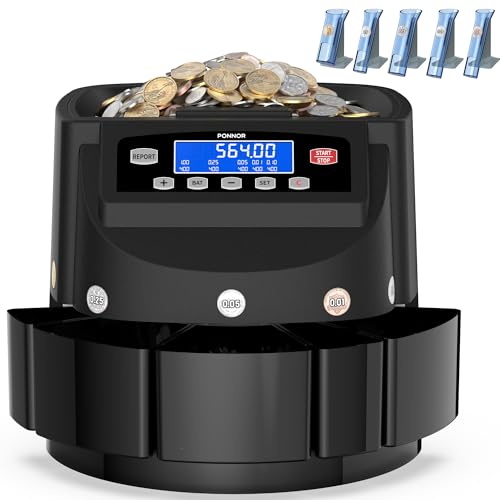
Fast sorting up to 300 coins/minute.
Automatically organizes and batches coins efficiently.
Compact design with easy-to-use interface.
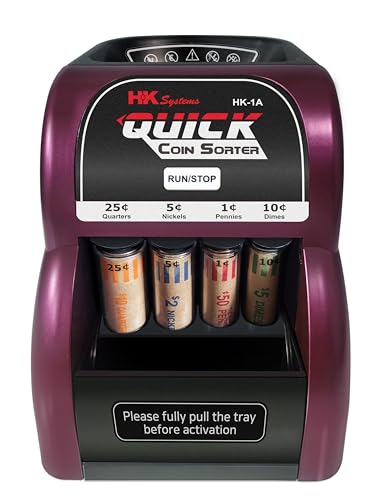
Efficiently sorts coins into separate trays.
Compact design fits small spaces easily.
User-friendly interface for simple operation.
Start with compatibility. Supplied products support either four denominations—pennies, nickels, dimes, and quarters—or five or six denominations that add dollar coins and, in some models, half dollars. Foreign coins, tokens, damaged, bent, sticky, dirty, or unusually worn coins commonly appear as exclusions or jam risks. A product claiming 300 coins per minute may still be unsuitable if it cannot process your coin mix, requires one-at-a-time feeding, stops frequently for full tubes, or performs poorly with circulated coins.
Treat capacity and speed as manufacturer-stated limits unless testing proves otherwise. The supplied listings claim rates from 200 to 350 coins per minute, hopper capacities from 200 to 2,000 coins, and differing capacities by denomination. Several reviews identify conflicting figures across listings or manuals. A meaningful performance comparison would use an independent report for the exact model, a published protocol, representative circulated U.S. coins, realistic hopper loads, stated exclusions, and raw count-error results. The U.S. Mint specifications can establish the denominations being tested, while the predetermined-coin principle in 25 CFR 542.41 provides a useful comparison concept: test against a known coin sample and reconcile the result.
A display is not proof of accuracy. Look for independently compared denomination counts, dollar totals, batch stops, reset behavior, and any printer output against a hand-counted and hand-valued reference. A report function or retained count can make checking easier, but none of the supplied products had an independent exact-product accuracy report. Claims such as “accurate,” “professional,” “anti-jam,” or “business grade” should be treated as marketing unless the listing, manual, and supporting test evidence agree.
For powered products, verify the complete machine—not just an adapter—with a traceable current U.S. safety listing. The relevant directories include UL Product iQ, Intertek’s ETL directory, CSA’s product listings, and TÜV Certipedia, with the certifier and exact model configuration identifiable. FCC, CE, RoHS, or similar language does not establish the complete product’s U.S. electrical-safety certification. No supplied powered product had a confirmed complete-model U.S. NRTL listing.
Also check the manual before buying. It should explain loading limits, accepted coin condition, cleaning, overflow, foreign-object handling, jam recovery, and when power must be disconnected. Repeated warnings across the supplied reviews include manual jam clearing, opening covers or removing screws, exposed moving parts, dirty sensors causing errors, and the need to unplug before maintenance. Several products had reported jams or misdirected coins, while many lacked a public manual, parts catalog, or clear repair route. These machines are not appropriate for audit-critical cash handling unless every result is independently checked. Keep powered units and loose coins away from children, use a stable dry surface, and route failed electronic products to reuse or responsible electronics recycling rather than ordinary trash.
The topics below separate basic convenience from evidence that matters for safe, repeatable, and lower-waste coin handling. Scores are relative signals from the supplied reviews, not independent certification or proof of performance.
This measures protection from shock, fire, pinch points, sharp edges, tip-over, and unsafe jam clearing. It matters because coin paths, covers, tubes, and moving mechanisms invite fingers and foreign objects. Supplied scores range from 62 to 76: higher-scoring products generally document dry, level use, closed covers, and unplug-before-maintenance steps; lower-scoring products lack manuals or require poorly documented access to the mechanism.
For a powered sorter, this asks whether the complete machine—not merely its adapter—has a traceable U.S. NRTL certification. It matters because all powered products reviewed lacked a confirmed complete-model UL, ETL, CSA, or TÜV listing, despite some displaying FCC, CE, RoHS, or similar claims. Scores range from 68 to 70 for powered models; the manual products score 92 or 100 because they have no mains-powered configuration.
This covers loading, emptying tubes and trays, wrapping, cleaning, noise, spills, and contact with dirty loose change. It matters when repeated batches turn a small inconvenience into hand strain, spills, or frequent exposure to contaminated coins. Supplied scores range from 60 to 74. Higher-scoring products provide practical tubes, trays, batch controls, or cleaning guidance; lower scores reflect difficult maintenance, forceful crimping, or less clear handling limits.
This measures correct denomination sorting, counts, batches, and dollar totals using representative circulated U.S. coins at realistic loads. A high score requires an independent exact-product report with protocol, sample, errors, and exclusions. Supplied scores range from 52 to 70, but no product had the required independent accuracy report. The higher scores reflect clearer controls or documentation, not proven error-free counting.
This covers misfeeds, overflow, foreign or damaged coins, jam frequency, and safe recovery without tools, exposed moving parts, or risky disassembly. It matters because several reviews report jams, misdirected coins, or manual clearing. Scores range from 52 to 74. Higher-scoring products document automatic reverse attempts or power-off procedures; lower-scoring products require hand clearing or provide no public recovery instructions.
This compares usable speed, hopper and output capacity, supported denominations, wrapper compatibility, and automatic stops with what the buyer actually needs. Scores range from 54 to 78. Higher-scoring products specify denomination support, tubes or trays, and batch behavior; lower scores reflect four-denomination limits, one-at-a-time feeding, or conflicting speed and capacity figures. Headline limits remain manufacturer claims unless independently timed.
This measures whether denomination subtotals, total value, batch stops, resets, retained results, and printer output can be checked without silently losing or duplicating money. It matters for deposits and cash reconciliation. Scores range from 54 to 76. Higher-scoring products document displays, reports, batch settings, or retained results; lower-scoring sorters provide no totals or audit trail. None had independent total-integrity testing.
This measures whether speed, accuracy, capacity, anti-jam, professional-grade, certification, and environmental claims are precise, consistent, and supported for the exact product. Scores range from 51 to 72. Higher-scoring products have manuals and listings that agree on supported functions; lower-scoring products show conflicting speeds, capacities, model references, unsupported certification language, or no manual. Even the stronger products still rely mainly on manufacturer-stated performance.
This measures warranty support, repair options, and availability of replacement tubes, trays, wrappers, adapters, or other wear parts. It matters because a minor failure should not automatically turn a powered sorter into e-waste. Scores range from 62 to 75. Higher-scoring products have stated warranties, support, or replacement accessories; lower-scoring products leave parts, repair procedures, or long-term service unclear.
This considers disposable-material use, durable or recyclable construction claims, packaging disclosures, and a practical electronics-recycling route. It matters because powered sorters combine electronics, plastics, and metal, while wrapper-based use adds recurring paper consumption. Scores are tightly grouped from 68 to 70: most products disclose little about recycled content, packaging, take-back, or model-specific recycling, so responsible reuse or electronics recycling remains the buyer’s responsibility.
The Nadex S540 is a powered tabletop coin counter, sorter, and wrapper for mixed U.S. pennies, nickels, dimes, quarters, and dollar coins. Coins are loaded into the hopper, then sorted into denomination bins. The unit can also use tube attachments and preformed wrappers to make rolls. Half dollars and foreign coins are explicitly excluded by the manufacturer. Nadex states a maximum speed of 300 coins per minute, a hopper capacity of 2,000 dimes, denomination-specific bin capacities, an LCD with count and value totals, custom batch settings, and automatic stopping when a wrapper is full. It includes 48 wrappers and carries a one-year limited warranty for authorized purchases. These operating and capacity figures are manufacturer-stated. No independent, model-specific laboratory report was located for count accuracy, throughput, jam rate, or displayed-total integrity.
This product suits a small organization that regularly accumulates mixed, ordinary U.S. circulation coins and needs sorted bins or bank-ready rolls without hand-counting every coin. Examples include school fundraising teams, charities, small retailers, laundromats, and office cash handlers. It is most suitable where staff can pre-screen the coin supply for wet, sticky, foreign, damaged, or oversized pieces, use a stable work surface, and hand-check important deposits because independent accuracy validation was not located.
It is not suited to users who need independently demonstrated count accuracy for controlled cash operations, audit-sensitive deposits, or high-consequence reconciliation. It also does not fit collections containing half dollars, foreign coins, tokens, heavily contaminated coins, or unknown objects, because these are excluded or may jam the mechanism. Households with children should not treat it as a hands-off appliance. Users needing documented electrical certification, measured noise data, or a published safe jam-clearing procedure should select a product with those records available.
This is a powered machine that handles loose circulation coins, so the practical exposure issue is dirty change and the possibility of jams, rather than a health ingredient or consumable. Nadex provides support material for error codes and fuse replacement, but public documentation located for this product does not provide a detailed cleaning routine, noise measurement, or safe jam-clearing procedure. Users should switch it off and disconnect power before any inspection or maintenance. Searches of CPSC recall and public incident resources did not locate a record specifically naming this product. No traceable U.S. NRTL certification for the complete product could be confirmed from public certification resources. Nadex offers a one-year limited warranty and describes repair or replacement for qualifying defects, which can support continued use. However, no material composition, recycled-content, packaging, take-back, or product-specific e-waste plan was disclosed. At end of life, reuse, repair, or an appropriate electronics recycler is preferable to disposal with household trash.
This is a compact, corded electric coin sorter and wrapper for loose U.S. pennies, nickels, dimes, and quarters. It uses four denomination tubes and a pull-out overflow tray, and retailer specifications state a 200-coin hopper and sorting speed up to 200 coins per minute. Starter preformed wrappers are listed as included. The most important limitation is scope. A retailer description explicitly says the product sorts coins but does not count them, so it does not provide a running value total, denomination subtotals, or an auditable cash total. The claimed speed, hopper capacity, and sorting performance are manufacturer-supplied retail specifications, not independently tested results. Available buyer feedback includes reports of frequent jamming, coins scattering outside the tubes, and early failure, although these reports do not establish a controlled failure rate.
This product suits a home user, fundraiser organizer, or small cash-handling task that mainly needs mixed pennies, nickels, dimes, and quarters separated into tubes for rolling. It is most appropriate when the user can supervise the machine, has a stable counter near an outlet, and is willing to verify rolls or totals manually. The stated 200-coin hopper fits occasional batches rather than an operation that needs an independently validated cash-control record or continuous high-volume processing.
It is not suited to a business that needs dependable denomination counts, dollar totals, batch records, or a traceable audit trail, because this product is described as a sorter rather than a counter. It is also a poor fit for unattended operation, users who cannot safely manage a jam or spilled loose coins, or settings where recurring interruptions create a safety or cash-loss issue. Buyers needing confirmed electrical certification, service parts, formal performance testing, or a repair pathway should use a product with that documentation.
The unit is corded electric, yet no traceable listing for the complete product was located in the public UL, Intertek ETL, CSA, or TÜV certification searches. Its instructions and product documentation available through retailers do not provide detailed electrical protection, cleaning, or safe jam-clearing guidance. Use it on a stable surface, keep foreign objects out of the hopper, and supervise loading and overflow removal. Reports of jams and scattered coins make eye and hand awareness around the operating area important. No material composition, recycled-content claim, packaging disclosure, manufacturer take-back route, or replacement-parts catalog was located. That leaves durability and repairability poorly documented. If the product becomes unusable, it should not be placed in curbside recycling. EPA guidance identifies electronics reuse and dedicated e-waste recycling as the appropriate route for recovering materials and reducing pollution.
This is a mains-powered desktop coin counter and sorter for U.S. pennies, nickels, dimes, quarters, and dollar coins. It uses five drawers or the included tube attachments to separate coins, while its display provides count information and its controls provide start, stop, batch, clear, and report functions. It is intended for loose-change processing at home, in an office, or at a cash register. VEVOR states a maximum sorting rate of 300 coins per minute, a 15 W power draw, and a 2,000-coin hopper. Those performance figures were not supported by an independent timed or accuracy test located in this review. Its own instruction manual supports the availability of per-channel batch settings and a report function, but it lists a 1,500-coin hopper, not 2,000. That documentation conflict is important when planning unattended loads.
It suits a home, club, small office, or low-volume cash-handling user who wants coins separated into five common U.S. denominations and can remain present while the machine runs. The documented batch and report controls are useful for a user willing to hand-check a first run, particularly when preparing standard wrappers. It is also better suited to a dry, level work surface with a grounded outlet and enough clearance to remove drawers or fit the supplied tube attachments.
It is not well suited to a business that needs independently demonstrated count accuracy, auditable dollar totals, or a validated high-volume duty cycle. It should not be used where children may access it, in damp locations, or by anyone unable to follow the manual's unplug-before-service instructions. Users who need a confirmed electrical safety listing, readily orderable repair parts, explicit e-waste support, or dependable handling of dirty, foreign, damaged, or unusual coins need more documentation than is available here.
The instruction manual provides meaningful operating precautions. It says to use the machine only in dry conditions, connect it to a grounded outlet, keep fingers away from the hopper and channels while running, and unplug it before clearing, cleaning, or opening covers. It also identifies a fuse and warns against damaged cords. The manual declares FCC Part 15 compliance, which concerns interference control. No current listing for the complete product was located in the major U.S. NRTL certification directories checked. The manual describes dust cleaning and lists internal components, but it does not establish consumer access to replacement tubes, drawers, sensors, motors, or boards. VEVOR states a 12-month warranty, yet no product-specific materials, recycled-content, recyclable-packaging, take-back, or electronics-recycling disclosure was located. At end of life, the practical route is a local electronics recycler that accepts small powered equipment, rather than disposal with ordinary household waste.
This powered countertop coin sorter is a 9.7-pound, 120 V, 20 W machine with a hopper, five output trays, five coin tubes, a display, and controls for start, stop, batch, report, clear, and print. It is intended to separate five U.S. coin types, show counts by channel, and help users transfer sorted coins into standard paper wrappers. The documented footprint is about 13.4 by 11.8 by 11.0 inches. The manufacturer states a maximum 300 coins per minute and storage for up to 2,000 coins. Its manual confirms per-channel batch settings from 0 to 999, retained batch settings, and a report screen for totals or counts by channel. No independent laboratory count-accuracy, timed-throughput, or endurance test for this exact product was located. The manual gives practical jam and sensor-cleaning instructions, but these require unplugging the unit and opening its back cover for some faults.
This product suits a home, small office, fundraiser, or cash-handling counter that periodically accumulates mixed U.S. pennies, nickels, dimes, quarters, and dollar coins, and has enough stable counter space for a roughly 13.4 by 11.8 inch machine. It is most appropriate for a user who can pre-screen loose change for foreign objects, stay nearby while it runs, and hand-check important deposits. The documented batch controls and coin-tube setup are useful where standard paper rolls are prepared repeatedly rather than where a formally audited cash count is required.
It is not suited to anyone who needs independently documented count accuracy for bank deposits, regulated gaming, high-value till reconciliation, or other audit-sensitive work. Those users need an exact-model validation protocol and traceable results, neither of which was located. It is also unsuitable for unsupervised use around children, for wet or damp locations, or for users unable to unplug and access the rear cover when a jam or blocked sensor occurs. Do not use it for foreign coins, debris-contaminated change, or coin types outside its stated U.S. five-coin scope.
The manual identifies the key handling controls. Keep the machine dry, use the matching supply voltage and fuse rating, keep fingers out of the hopper and channels while operating, place it level, and unplug it before cleaning, maintenance, or jam clearing. It also directs users not to run the machine with the rear cover open. A check of public recall resources did not identify a recall specific to this coin sorter. A separate VEVOR ice-crusher recall does not apply to this product. The manual documents a fused, 20 W powered device and tells users to clean blocked sensors, but it does not identify enclosure materials, recycled content, packaging materials, a take-back program, or a model-specific recycling route. VEVOR states that it provides a 12-month warranty, defect repair, technical support, and paid repair after warranty. However, a dedicated public catalog for replacement trays, tubes, sensors, or other sorter parts was not located. Use an electronics recycler when the unit cannot be repaired.
This product is a compact, plastic, hand-cranked coin sorter and wrapper. It separates pennies, nickels, dimes, and quarters into four tubes, where standard preformed wrappers can be inserted and removed. An independent retailer lists a 200-coin hopper, tube capacities of 50 pennies, 40 nickels, 50 dimes, and 40 quarters, plus no electrical cord, batteries, display, or automatic stop. Nadex's current product page describes a manual crank design and markets anti-jam sorting, speeds up to 350 coins per minute, wet-or-dry coin use, and all U.S. coins. Those claims are not supported by an independent test for this product. They also conflict with the retailer specification of 200 coins per minute and four supported denominations. Available customer reports include jamming, mis-sorts, and a broken handle, so sorted rolls and denomination contents should be checked before banking or using them for cash reconciliation.
This product suits a household user who periodically sorts a manageable jar of ordinary U.S. pennies, nickels, dimes, and quarters and is comfortable turning a crank. It is most appropriate where access to an outlet is inconvenient and the user can work on a stable table, load coins gradually, and inspect each filled tube before sealing wrappers. It can also fit a user who values physical sorting and simple storage over a digital total, batch controls, or a printed record.
It is not suited to businesses, clubs, fundraisers, or anyone who needs dependable cash totals, denomination subtotals, batch stops, or an auditable count. It is also a poor fit for people with hand, wrist, or repetitive-motion limitations, since sorting requires sustained cranking and handling of full tubes. Keep it away from young children unless closely supervised because loose coins are ingestion hazards. Do not rely on it for half dollars, dollar coins, foreign coins, bent coins, or wet coins without hand-checking results.
The main health advantage is that this is a manual product. Independent retailer specifications confirm it uses a winding mechanism rather than mains power or batteries, so there is no electrical plug, adapter, charging system, or electrical safety listing to assess. Stable tabletop placement, gradual loading, and keeping fingers clear of the crank and moving mechanism remain important. Coin handling also involves contact with dirty loose change, so washing hands afterward and wiping the product with a dry cloth are sensible precautions. The retailer identifies the primary material only as plastic. Nadex provides a one-year limited warranty and support contact, which may help keep a defective unit in use, but no parts catalog, recycled-content claim, packaging-material disclosure, take-back program, or product-specific recycling instructions were located. The manual mechanism avoids battery and electronic waste, although the plastic body and disposable paper wrappers still create material waste.
This is a compact, corded desktop coin sorter for U.S. pennies, nickels, dimes, and quarters. It uses four removable tubes, can accept paper coin wrappers, and has an LCD that the supplied instruction manual describes as showing denomination, quantity, amount, and total amount. The manufacturer states a maximum hopper capacity of 200 coins, a maximum sorting rate of 230 coins per minute, and a 3.95-pound unit measuring about 9.1 by 7.1 by 9.5 inches. The supplied manual says the sorter stops when a tube reaches 50 pennies or dimes, or 40 nickels or quarters. It also says bent, sticky, damaged, or foreign items can jam it. There is no independent published accuracy or endurance test located for this exact product. Documentation is not fully clean, because the product page identifies the unit as KSW350 LCD while the supplied manual identifies its model as SS1380.
This product suits a home user, small office, school group, or occasional cash-handling task that needs loose pennies through quarters separated into tubes and optionally wrapped. Its compact footprint and stated 200-coin hopper fit periodic jar-emptying rather than continuous commercial processing. It is most appropriate when the user can inspect coins first, keep the sorter on a stable level surface, and hand-check the displayed amount before depositing or reconciling cash.
It is not well suited to businesses that need independently verified totals, audit-ready cash controls, or dependable throughput across heavy daily coin volumes. It is also a poor fit where coins may contain debris, tokens, foreign coins, or many bent or sticky pieces, because the manual identifies those as jam causes. Children should not operate or clear it unsupervised, since the instructions warn against placing fingers in the hopper or channel during operation and persistent jams involve opening the hopper.
The supplied instructions include useful basic safeguards. They direct the user to use the correct 120-volt supply, place the machine on a level surface, keep fingers out of the hopper and channel while operating, and turn off and unplug it before maintenance. The manual also says not to run the unit with its back cover open. These are manufacturer instructions, not independent product safety certification. No traceable U.S. NRTL electrical-safety listing for the complete product was located. The manual's FCC language concerns radio-frequency interference, not electrical shock or fire certification. VEVOR's current recall page does not list this coin sorter, although VEVOR has listed recalls for other product categories. VEVOR states a 12-month warranty and post-warranty paid repair service, but no product-specific spare-parts or recycling route was located. Reuse through repair and local e-waste handling are therefore more substantiated than any broad environmental claim.
This is a corded desktop coin counter, sorter, and wrapper for loose U.S. change. Retailer specifications identify a plastic unit measuring about 14 by 12 inches, with a 4-foot cord and a listed 2,015-coin output capacity. It is intended to sort pennies, nickels, dimes, quarters, dollar coins, and half dollars into trays or optional tube positions. The manufacturer-stated operating features are denomination counts and value totals on the display, custom batches, automatic stopping when a roll is full, and 48 preformed wrappers with a dust cover. Listed tray capacities are specific by denomination. No independent accuracy, throughput, endurance, or electrical-safety test report for this exact product was located. A retail listing also carries a California cancer and reproductive-harm warning.
This product suits a small retailer, community organization, collector, or household that periodically accumulates mixed U.S. coins and wants to make standard rolls without hand-counting every denomination. It is most appropriate where staff can hand-check completed rolls or reconcile the displayed value against a known float. The stated half-dollar and dollar-coin support is useful for users who handle those less common denominations. Allow a stable counter area and time to reload tubes carefully, because available consumer reports describe alignment sensitivity during wrapping.
It is not well suited to operations that need independently validated counts for deposits, auditing, gaming, or other cash-accountability work. Those users need documented accuracy testing and a clear reconciliation procedure, neither of which was located here. It is also unsuitable where a documented U.S. electrical safety listing is mandatory, or where Proposition 65 warnings cannot be accepted without chemical details. Avoid relying on it unattended during roll filling, because reported tube misalignment can spill coins and interrupt the count.
The product is a plastic, corded countertop appliance with moving coin-handling parts. No recall or public CPSC safety report specific to this product was located in the searched CPSC resources. However, no traceable listing for the complete product was found in the searched U.S. NRTL certification directories. Users should keep it on a stable surface, disconnect power before cleaning or clearing a fault, and avoid reaching into operating areas. A Target retail page displays a California Proposition 65 cancer and reproductive-harm warning, but does not name the chemical or describe the exposure route. No manufacturer disclosure was located for packaging materials, recycled content, take-back, electronics recycling, replacement parts, or repair instructions. The listed one-year limited warranty provides some support after purchase, but the lack of a parts catalog leaves repairability and end-of-life planning unsubstantiated.
This powered desktop coin sorter is intended for mixed U.S. change. The manufacturer says it handles pennies, nickels, dimes, quarters, half dollars, and dollar coins, then directs them to six bins or optional tubes. It lists a 2,000-coin hopper, 250 coins per minute, 150-coin bin capacity, 50-coin tube capacity, LED value display, add mode, batch mode, and optional receipt-printer connection. Those capacity and speed figures are manufacturer-stated, not independently tested. The maker documents that the product can retain the latest cleared count and save up to nine manually recorded count groups. It also identifies an optional compatible printer that can print denomination counts and total value. No independent laboratory report was found for count accuracy, real throughput, jam rate, or reconciliation accuracy on this exact product. Its published specification table also contains apparently inapplicable banknote-counterfeit and banknote-sorting claims, which weakens confidence in the documentation.
This product suits a small cash-handling operation or household that periodically processes substantial quantities of ordinary U.S. circulating coins and can dedicate stable counter space to a powered sorter. It is most practical when the operator can pre-screen change for debris, tokens, foreign coins, bent pieces, and sticky coins. The documented batch controls, tubes, denomination display, recent-result function, and optional printout are useful for preparing rolls or checking a register count, provided final deposit totals are hand-verified.
It is not suited to operations that need independently demonstrated accuracy for audited cash controls, high-volume daily reconciliation, or unattended processing. Buyers who require a traceable U.S. electrical safety listing for the complete machine should choose a product with that listing confirmed in the certifier's directory. It is also a poor fit where coins are routinely wet, damaged, heavily dirty, mixed with tokens, or where users cannot safely pre-sort and clean them. Children should not load, clear, or operate this powered machine.
The manufacturer identifies the housing construction as ABS plastic plus metal and directs users to remove debris and unsuitable coins before loading. Its support materials say to follow the manual before opening or clearing the internal mechanism. No CPSC recall or public SaferProducts report specific to this product was located in the checks performed. However, no traceable U.S. NRTL electrical certification for the complete powered product was found in the major listing directories checked. The maker's stated CE, FCC, RoHS, and ECB entries do not substitute for a confirmed U.S. NRTL safety listing. MUNBYN states a two-year quality-protection period and lifetime technical support, which may help keep a repairable unit in service. The verification found no product-specific replacement-parts catalog, take-back program, recycled-content disclosure, packaging-material disclosure, or end-of-life recycling plan. Treat the product as electronic waste at end of life and use a responsible local electronics recycler. The ABS-and-metal construction is disclosed, but no substantiated environmental benefit is claimed.
This is a powered tabletop sorter for mixed U.S. pennies, nickels, dimes, quarters, and dollar coins. Coins go into a top hopper, then the machine routes them to five collection bins or five included tubes for wrapper filling. It has an LCD display, report control, clear control, and denomination batch settings. The documented unit weight is about 11.3 pounds and its stated footprint is 13.6 by 10.8 by 10.2 inches. The accessible product manual states a maximum rate of 300 coins per minute, a 500-coin hopper, and 2,000 coins of total bin capacity. Those are manufacturer-stated specifications, not independently timed or capacity-tested results. The same documentation describes real-time values and denomination counts, but no independent count-error study, hand-count comparison, or published accuracy percentage was located for this product.
This product fits a home, club, school fundraiser, or small cash-handling operation that periodically accumulates ordinary mixed U.S. circulation coins and can verify a final count before deposit. It is suited to users who want both loose-coin bins and tube-based roll preparation, and who have a dry, level counter for an approximately 11-pound machine. It is most appropriate when the stated 500-coin loading limit and occasional bin emptying are acceptable parts of the workflow.
It is not well documented for banks, high-volume retailers, laundromats, vending routes, or any operation that needs audited totals without a hand-check. Those settings need independently verified error rates, durable service support, and a traceable electrical certification for the exact product configuration. It is also unsuitable for use near water, by anyone likely to clear jams while powered, or where children may reach the hopper or moving sorting path without close adult supervision.
The available manual includes useful basic controls: use the specified power supply, keep the machine dry, place it on a stable level surface, unplug before cleaning, and switch off and unplug before removing a jam. It also advises users not to force stuck coins or attempt self-repair. These instructions reduce avoidable shock and moving-part risks, but they do not substitute for independently verified electrical testing. No traceable U.S. NRTL listing for the complete powered unit was located in the searched certification registers. Loose change can carry dirt, and the manual directs users to use clean, dry coins and clean the exterior only with a dry cloth. It does not state the housing materials, recycled content, packaging composition, spare-parts availability, warranty length, or an e-waste take-back route. At end of life, the machine should be directed to an appropriate electronics recycler rather than discarded with ordinary trash.
This compact, mains-powered desktop sorter separates pennies, nickels, dimes, and quarters into four removable wrapper tubes. It has a Run/Stop button, a hopper, an overflow tray, and clear plastic tubes. The manufacturer-hosted manual specifies a 3.53-pound unit, 9.6 W AC synchronous motor, 120 V power, and fixed full-wrapper quantities of 50 pennies, 40 nickels, 50 dimes, and 40 quarters. The maker states a maximum 260-coin-per-minute speed and includes 16 starter wrappers. Those performance claims have not been independently tested for this product. Documentation also conflicts on usable load. The product page claims a 400-coin hopper, while the current manual recommends loading up to 200 coins for fast, jam-free sorting. It is a mechanical sorter rather than an auditable value counter, with no display, denomination subtotal, or printed record described in the manual.
This product fits a home, school activity, small fundraiser, or low-volume counter where the goal is to put ordinary U.S. pennies, nickels, dimes, and quarters directly into standard wrappers. It is most practical for a user comfortable checking each filled wrapper against the manual's stated count and handling only clean, undamaged coins. Its compact size, simple button control, removable tubes, and included starter wrappers support occasional sorting rather than formal cash reconciliation.
It is not suited to businesses that need an auditable dollar total, denomination subtotals, batch programming, printed records, or independently demonstrated count accuracy. Do not use it for dollar coins, foreign coins, bent, sticky, or damaged coins, since the manual identifies these as jam risks or unsupported inputs. Households with young children should keep loose coins and the powered appliance supervised. Users who require verified electrical certification or frequent-service parts availability need documentation this product does not provide.
The current manual gives useful baseline operating safeguards. It directs users to use a level surface, keep liquids out, avoid damaged cords, keep fingers out of the opening, and switch the unit off before manual jam retrieval. It also warns against inserting dollar coins, foreign coins, damaged coins, clips, screws, paper, glass, or pins. These instructions reduce foreseeable shock, pinch, and jam hazards, but do not substitute for independently confirmed electrical safety certification. No traceable U.S. NRTL listing for the complete powered product was confirmed in the UL, ETL, CSA, or TÜV certification registers searched. No current CPSC recall or public warning for this exact product name was located. The maker identifies clear plastic tubes, but does not disclose housing materials, recycled content, packaging composition, take-back service, or an electronics recycling route. The disposable paper wrappers also create recurring consumable waste.


