Best Overall
27% off

NETVUE Birdfy Smart Bird Feeder Camera
Captures high-quality bird videos automatically.
Motion detection enhances bird watching experience.
Wireless design offers easy installation and setup.
 Daniel Kenitz
Captures high-quality bird videos automatically.
Motion detection enhances bird watching experience.
Wireless design offers easy installation and setup.

Captures videos and detects motion automatically.
Solar-powered for eco-friendly, continuous operation.
Ideal gift for bird enthusiasts.

Solar-powered design for uninterrupted birdwatching.
AI technology identifies over 10,000 species.
Real-time app alerts enhance birdwatching experience.

Crystal clear 4K video captures bird details.
Real-time app alerts for bird visits.
Weatherproof design ensures durability outdoors.

AI identifies bird species automatically.
Captures 8MP photos and 4K UHD video.
Live streaming enhances real-time bird watching.

Solar-powered for eco-friendly, continuous operation.
AI identifies and captures bird videos automatically.
2K live feed offers clear, detailed viewing.

Durable all-metal design ensures long-lasting use.
Solar-powered for eco-friendly operation.
AI technology identifies and captures bird activity.

Solar-powered for eco-friendly operation.
AI recognition identifies bird species accurately.
Bamboo wood design blends with natural surroundings.

Ultra HD live stream with 4K camera.
Solar powered for eco-friendly outdoor use.
Enhanced AI for accurate bird identification.
Solar-powered for eco-friendly birdwatching.
Includes pole for easy feeder setup.
Captures clear images of visiting birds.
The most useful buying decision is not the headline resolution. Look for a clear model number, a named manufacturer, exact charging and battery information, stated Wi-Fi requirements, mounting instructions, and a realistic explanation of what is included without a subscription. A product that claims IP65 or IP66 weather resistance should ideally have an exact-model ingress test report to IEC 60529. A radio device should be traceable through the FCC Equipment Authorization System. Electrical and battery claims are stronger when the exact product appears in UL Product iQ, Intertek’s ETL directory, or the CSA Group database. An FCC record confirms radio authorization; it does not by itself prove electrical safety, battery safety, mounting strength, or weather sealing.
AI bird identification deserves particular caution. Claims such as “6,000-plus” or “10,000-plus” species do not show how accurately the system identifies birds in ordinary U.S. yards. Stronger evidence would include independent exact-model field testing, a reproducible accuracy report, a supported-species list, information about false matches and uncertainty, and clear disclosure of trials, regions, and subscription limits. A bird label from an app should not be treated as a confirmed observation when the supplied reviews found no model-specific validation for most products.
Camera figures can also mislead. “4K” describes a recording setting, not guaranteed detail in shade, night, motion, or compressed cloud clips. Claimed battery life and solar operation depend on sunlight, temperature, Wi-Fi strength, motion frequency, and charging conditions. “Free cloud storage” may mean only a short retention period, while AI, older clips, alerts, or expanded storage require payment. Local microSD recording can reduce cloud dependence, but only some products support it, and the card may be sold separately.
The feeder’s placement and maintenance matter as much as its electronics. Choose a secure wall, pole, tree, or hanging support appropriate to the supplied hardware; do not assume a product has a tested wind or load rating when none is documented. Keep children and pets away from seed, droppings, and cleaning materials. Clean outdoors with disposable gloves, wash hands afterward, remove wet or moldy seed, and pause feeding when sick or dead birds appear. Place feeders either very close to windows or well away from them to reduce collision risk, and manage spills that may attract rodents, raccoons, or predators.
Across the supplied products, recurring limitations are the absence of exact-model UL, ETL, or CSA electrical listings and accredited ingress reports; built-in batteries without a clear replacement or recycling route; incomplete disease-control instructions; cloud footage and limited privacy or security documentation; and unvalidated AI identification. Several products also require 2.4 GHz Wi-Fi, so they are unsuitable for 5 GHz-only networks. These are not automatically unsafe products, but buyers needing independently certified outdoor electrical protection, local-only recording, replaceable batteries, validated species identification, or documented mounting limits should treat the missing evidence as a decisive limitation.
A camera feeder brings together a wildlife feeding station and a connected outdoor electronic device. The scores below reflect how well the supplied products address exposure, durability, bird hygiene, wildlife impacts, privacy, and evidence quality—not popularity or price.
This measures whether instructions and design reduce contact with droppings, contaminated seed, and sick wildlife, while keeping children and pets away. For this category, high scores such as 76 reflect clearer handling and siting support; lower scores around 68-70 reflect sparse or missing glove, handwashing, pet-separation, and sick-bird guidance. The feeder still needs outdoor cleaning and careful placement.
This covers rechargeable batteries, solar panels, charging, water entry, overheating, shock, and fire risk. The strongest supplied score was 76, but even higher-scoring products generally lacked an exact-model NRTL listing or accredited ingress report. Lower scores near 68-70 indicate more uncertainty around the charger, battery, weather claim, or operating limits. An IP65 or IP66 claim alone is not independent safety evidence.
This measures whether the feeder, camera, solar panel, and hardware can be installed without foreseeable falling, sharp-edge, entanglement, or breakage hazards. High scores, including 78, correspond to documented mounting choices and supplied hardware; lower scores around 69-70 reflect missing load, wind, fastener, or inspection limits. A wall, tree, pole, or hanging option is useful only when the support and installation are suitable.
This measures whether resolution, night vision, motion capture, battery life, solar charging, and Wi-Fi claims hold up in ordinary outdoor use. Scores ranged from 70 to 82; the higher results had exact-model hands-on testing or clearer operating evidence, while lower results rested mainly on listing claims. Resolution does not guarantee sharp footage, and 2.4 GHz compatibility remains a practical limit for many products.
This measures tested identification accuracy, uncertainty, false matches, likely U.S. species coverage, and access costs. Scores ranged from 52 to 78. The higher-scoring Kiwibit evidence included limited independent support, while most products had no reproducible validation study. A trial or “lifetime” label does not establish accuracy, and some products require subscriptions after a short trial or restrict related cloud features.
This measures whether weatherproofing, solar operation, video, squirrel resistance, AI, cloud storage, and subscriptions are described accurately and completely. Scores ranged from 52 to 77. Higher scores had clearer retention or subscription disclosures; lower scores reflected conflicting materials, hidden trial-to-paid transitions, or unsupported “free,” “dual solar,” or species-count claims. Check app pricing and storage terms before treating a feature as included.
This measures whether weatherproofing, solar operation, video, squirrel resistance, AI, cloud storage, and subscriptions are described accurately and completely. Scores ranged from 52 to 77. Higher scores had clearer retention or subscription disclosures; lower scores reflected conflicting materials, hidden trial-to-paid transitions, or unsupported “free,” “dual solar,” or species-count claims. Check app pricing and storage terms before treating a feature as included.
This measures whether seed-contact parts can be emptied, washed, disassembled, drained, and dried, and whether guidance addresses sick birds. The best supplied scores reached 80 where trays, bins, roofs, perches, or mesh were accessible; lower scores near 66-69 reflect harder cleaning or limited instructions. Regardless of score, remove wet or moldy seed, clean regularly, dry fully, and pause feeding when sick birds appear.
This covers spilled or moldy feed, rodents, raccoons, predators, squirrel access, and window-strike risk. Higher scores, such as 76, reflect tested or documented ways to limit seed loss and manage placement; lower scores around 64-69 reflect spill, alarm, predator, or siting limitations. A squirrel-resistant grate is not necessarily squirrel-proof, and a larger hopper can increase the consequences of neglected or contaminated seed.
This measures construction durability, repairability, battery replacement, responsible-material evidence, warranty support, and end-of-life handling. The strongest supplied score was 76, helped by independent evidence of a removable battery and solar charging; lower scores around 67-69 reflect built-in batteries, uncertain repair paths, or unsupported material claims. Battery-containing electronics should use appropriate battery or e-waste collection rather than household trash.
This is a battery-powered outdoor seed feeder with a camera, app connection, motion alerts, night viewing, and optional cloud-based bird recognition. The manufacturer lists a 1.5 L seed bin, PC plus ABS construction, a 5,200 mAh rechargeable lithium-ion battery, 2.4 GHz Wi-Fi, and an IP65 weather rating. It can be wall, pole, or tree mounted with included hardware. An independent four-month use report confirmed workable app pairing, detailed 1080p footage, night capture, and rain exposure in normal outdoor use. That report also recorded one incorrect bird identification. Birdfy says recognition is server based and can require a subscription or one-time payment, depending on the product version. The required app sends recorded motion footage to its servers for AI analysis.
This product suits a backyard or balcony bird watcher who wants remote viewing and motion clips, has reliable 2.4 GHz Wi-Fi at the mounting spot, and is willing to maintain a seed feeder regularly. It is particularly relevant for someone who can use a solid wall, pole, or mature tree and can periodically recharge the camera if solar power is not included. It also fits users who regard automated species labels as a convenience rather than a wildlife record requiring verified identification.
It is not suited to households that cannot keep children and pets away from spilled seed, droppings, and feeder-cleaning areas. It is also a poor fit where a feeder must be placed near untreated windows, where outdoor cats regularly hunt, or where rodents and raccoons are already a persistent problem. Users who need locally stored video, documented encryption, independently validated bird identification, or an independently certified outdoor charging system should choose a product with those exact records.
The camera has an FCC equipment authorization trail for the Birdfy Smart Feeder family, and the manufacturer specifies an IP65 rating, 5,200 mAh lithium-ion battery, DC 5V charging, and a 14°F to 113°F operating and charging range. No exact-model NRTL electrical listing or independently published ingress test report was located. The product is primarily PC plus ABS plastic, and a two-year warranty is manufacturer-stated, but no battery-replacement or electronics-recycling program was found. The feeder is designed to come apart for cleaning, but its manual only says not to use bleach. CDC guidance calls for regular cleaning, gloves, handwashing, keeping pets away, and removing feeders for two weeks if sick or dead birds are found. Federal wildlife guidance also advises cleanup of old and spilled seed, predator management, and placement within three feet of a window or well away from it to reduce collision risk. Those practical protections are not supplied in the product instructions.
This is a plastic seed feeder with an integrated Wi-Fi camera, a 1.5-liter seed bin, motion alerts, night vision, and app-based live viewing and clip storage. The manufacturer lists 2K high-quality mode, 1080P standard mode, infrared or white-light night vision, two-way audio, and 5V/1.5A charging. The camera uses the Birdfy app and needs a compatible home network for normal connected features. The catalogued configuration includes solar power, although the manufacturer’s current product page describes the solar panel as an option, so buyers should confirm the box contents. The manufacturer also says cloud clips are retained for 30 days and that AI bird recognition may be either subscription-based or included for life, depending on the product version. Independent reviewers have found the original feeder camera usable outdoors, while noting that AI identification is imperfect.
This product suits a homeowner or renter with a reachable outdoor mounting point, reliable 2.4 GHz Wi-Fi, and a willingness to clean a seed feeder regularly. It is most appropriate for someone who values remote viewing and short video clips more than a fully local camera setup. It also fits households that want to share bird visits with relatives or friends while keeping device settings under the owner’s control. The user should be comfortable checking the included solar configuration and manually charging the camera when weather or shade limits solar input.
It is not well suited to households that need independently documented outdoor electrical certification, a stated IP test report, or published mounting load limits before placing powered equipment outdoors. It is also a poor fit for users who cannot clean and dry the feeder at least every week or two, or who need explicit disease-control instructions for sick birds. Avoid relying on it for authoritative species records, because the bird-ID accuracy claim lacks a published validation report and independent testing found errors. Privacy-sensitive households should also consider the app’s cloud storage, sharing, and declared tracking practices.
The feeder has a removable camera and manufacturer cleaning instructions that call for mild soap, water, and complete drying before reassembly. That supports routine sanitation, but the instructions located do not tell users to wear gloves, clean at a defined interval, remove the feeder when sick birds appear, or manage droppings and spilled seed. CDC advises disposable gloves for cleaning bird feeders, while Cornell recommends cleaning seed feeders every week or two and more often in wet weather or heavy use. The manufacturer identifies weather-tested plastic construction and offers a two-year warranty, with support documentation for replacement accessories. Its support page lists FCC, RoHS, WEEE, lithium-battery transport, and other certifications, while an FCC authorization record confirms a Netvue Birdfy smart-feeder radio family. No exact-product UL, ETL, or CSA listing, repair guide, battery-removal procedure, recycling program, or independent weather-ingress test report was located. No CPSC recall was identified in the records searched.
This is an outdoor seed feeder with an integrated camera, solar-panel lid, adjustable circular perch, and a stated 1.25-liter seed hopper. It can be mounted on a stake, tree, pole, or wall, and is intended to send viewing and bird-arrival alerts to a phone. A separately published copy of the product manual identifies rechargeable lithium-polymer batteries, USB-C charging, and 2.4 GHz Wi-Fi only. The 2K video, solar operation, weatherproof construction, AI bird identification, and two-person live viewing are manufacturer-stated features reproduced in the available manual. The manual says solar charging needs at least four hours of direct sun daily, with USB-C charging as a fallback. No exact-product ingress rating, electrical-safety listing, FCC record, accredited test report, or independent field test of video or bird-identification accuracy was located.
This product suits a backyard birdwatcher who wants a compact seed feeder with phone viewing, has dependable 2.4 GHz Wi-Fi at the installation point, and can place the solar lid in direct sun for roughly four or more hours a day. It is better suited to someone prepared to refill, inspect, and clean a feeder routinely, rather than someone expecting a maintenance-free wildlife station. It also fits a household that wants two people to check the same live feed.
It is not suited to homes needing independently certified outdoor electrical equipment, documented water-ingress protection, or a verified safety record for a rechargeable battery outdoors. Avoid relying on it where only 5 GHz Wi-Fi is available, where the mounting surface cannot securely accept supplied hardware, or where the feeder would be inaccessible for frequent cleaning. It is also a poor fit for users who need validated bird-identification accuracy, clear cloud costs, or documented privacy and security controls before placing a camera near neighbors.
The feeder combines ABS plastic, electronics, a solar panel, and rechargeable lithium-polymer batteries. A separate retail record also identifies ABS as the body material, but no repair program, replacement-battery instructions, parts catalog, recycled-content claim, or manufacturer takeback path was found. At end of life, the battery and camera should not go in household trash or curbside recycling. EPA guidance directs consumers to separate battery or e-waste collection instead. No exact-product recall, public safety warning, or regulatory action was located in the reviewed U.S. sources. That is not the same as independently verified electrical safety. The available instructions do not match public-health feeder guidance on gloves, handwashing, disinfection, drying, and temporarily removing feeders when multiple sick birds appear. Owners should keep spilled or wet seed cleaned up, keep pets away from sick or dead wild birds, and site the feeder close to a window or well away from it to reduce collision risk.
This is a connected outdoor seed feeder with a 1.8-liter bin, metal body, wood perch, solar panel, rechargeable 9,000 mAh battery, and a removable camera. It is intended for wall, pole, tree, hanging, or pole-top installation, then sends motion-triggered clips to the Birdfy mobile app. The manufacturer states 4K recording, infrared and color night modes, dual-band 2.4 and 5 GHz Wi-Fi, IP66 weather protection, and a two-year warranty. The camera radio is traceable to a Federal Communications Commission authorization under Netvue, the app developer. An independent hands-on review confirmed the product format, dual-band Wi-Fi, weather rating, and solid metal construction, but found the delivered video less impressive than its headline resolution suggests. Birdfy states that this version includes lifetime AI bird recognition, although no independent accuracy study or validation data for its species matches was located.
This product suits a homeowner or gift recipient who wants a substantial outdoor feeder with app-based bird clips, has dependable Wi-Fi reaching the intended feeder location, and is comfortable maintaining both a feeder and a connected camera. It is particularly suited to someone who can use a stable pole, wall, or mature tree mounting point, can clean the feeder routinely, and values the stated included lifetime bird-ID service. The 1.8-liter capacity and metal construction fit a regular backyard feeding setup rather than a small balcony arrangement.
It is not well suited to households that cannot keep children and pets away from seed, droppings, and the area beneath the feeder. It also is a poor fit for sites near hazardous windows, active outdoor cats, frequent raccoon activity, or locations without a secure mounting surface and usable Wi-Fi. Buyers who need independently certified electrical safety, documented camera cybersecurity controls, local video storage, replaceable batteries, or independently measured AI identification accuracy will need more documentation than is publicly available for this product.
The practical hygiene positives are a removable camera and feeder parts that Birdfy says can be cleaned with a brush and water. Its instructions also tell owners to replace damp seed, keep seed dry, and clean every one to two weeks. That helps, but it is not a complete wildlife-health protocol. CDC recommends gloves and handwashing after cleaning, keeping pets away, and removing feeders for two weeks if sick or dead birds are found. Federal wildlife guidance also recommends sweeping spilled seed and managing window-collision risk. The metal body, stated two-year warranty, and identifiable radio authorization are constructive durability and traceability signals. However, no public repair, battery-removal, or manufacturer take-back route was found. The built-in lithium-ion battery should not enter household trash or curbside recycling at end of life. Use a dedicated battery or e-waste collection route. No U.S. recall or regulator warning specific to this product was located in the sources checked.
This is a battery-powered, app-connected seed feeder with a built-in solar roof, removable dual seed hopper, feeding tray, perch, camera, microphone, speaker, and microSD card slot. It is supplied with wall, tree-strap, and pole-mount hardware. The product documentation specifies 5V, 1.5A charging, a removable battery, and a 1-inch compatible pole, which is not included. Kiwibit states that the feeder is IP65 water resistant, UV resistant, compatible only with 2.4 GHz Wi-Fi, and can identify over 10,000 bird species. Independent outdoor testing of the Beako feeder found straightforward assembly, solid Wi-Fi performance at about 15 metres with line of sight, removable hopper and tray parts that ease cleaning, and good well-lit video. The same testing found close birds can be soft in focus, low-light detail declines, and downloaded stills may be cropped below the stated 8MP image size.
This product suits a birdwatcher who wants an app-based outdoor camera feeder, has a reliable 2.4 GHz Wi-Fi signal at the intended site, and is willing to maintain it routinely. The removable hopper, tray, and battery are practical for someone who will empty old seed, clean and dry parts, and monitor battery status. It also fits a yard where a wall, sound tree trunk, or separately purchased 1-inch feeder pole can provide a secure mounting point with direct sunlight for the solar roof.
It is not suited to households that need independently verified electrical safety certification, a documented exact-model ingress test report, or detailed privacy and cybersecurity commitments before putting a camera outdoors. It is also a poor fit for locations near neighbors where an audible squirrel alarm could be disruptive, or for buyers expecting a squirrel-proof feeder. Avoid casual placement near windows, pet areas, or places with frequent wildlife activity unless the feeder can be cleaned, spilled seed removed, and wildlife-safety siting practices followed consistently.
The feeder has useful hygiene-oriented hardware, including a removable hopper, removable tray, feed-control valve, and instructions to empty it or close the valve before cleaning. Independent testing supports that these parts are easier to clean than fixed designs. However, the supplied instructions do not match the level of hygiene detail recommended by CDC and U.S. Fish and Wildlife Service guidance. Cleaning should include gloves, handwashing afterward, complete drying before refilling, outdoor cleaning away from food-preparation areas, and removing the feeder if multiple sick birds appear. The housing is stated to use ABS and polycarbonate. The product has a removable rechargeable battery and a one-year limited warranty, which can reduce unnecessary replacement of the whole unit. Kiwibit states IP65 water resistance and UV resistance, but no independently verifiable exact-model safety or ingress certification was located. The solar roof can reduce manual charging, although its output depends on sunlight, weather, motion activity, and placement. Sweep fallen seed to limit mold, rodents, raccoons, and other unintended wildlife visits.
This is an outdoor ABS plastic seed feeder with an integrated camera, solar panels, a claimed 1.8-liter seed capacity, and 2.4 GHz Wi-Fi connectivity. It can be mounted to a tree, wall, fence, or pole using supplied straps, screws, anchors, and clips. The available model-specific manual describes 2K live video, 5 MP photos, motion alerts, local microSD storage up to 128 GB, and cloud storage. The camera and solar performance figures are manufacturer-stated, not independently tested for this exact product. Onlyfly's support material usefully clarifies that solar charging extends battery life rather than replacing initial USB charging, and specifies a 5V/1A or 5V/2A adapter. AI identification has a 30-day trial according to the available manual, while live viewing is stated to remain available without a subscription.
This product suits a backyard bird watcher who wants app-based live viewing and is comfortable managing a 2.4 GHz Wi-Fi device. It is most appropriate for someone who can install it on a solid pole, wall, fence, or tree, keep the solar panels exposed to sun, and periodically recharge it by USB when sunlight is inadequate. It also suits users willing to use a separately purchased microSD card and to verify AI and cloud terms in the companion app before relying on those services.
It is not well suited to households that need independently certified outdoor electrical equipment, documented ingress testing, or a clearly documented privacy and security program. Avoid placing it where children or pets can reach contaminated seed, droppings, cables, or a falling feeder. It is also a poor fit for users with 5 GHz-only Wi-Fi, weak outdoor signal, or no willingness to clean feeders outdoors, manage spoiled seed, and remove feeding stations when sick birds are observed.
The feeder's seed-contact body is stated to be ABS plastic, and its available instructions say to clean it regularly and keep the camera module sealed during cleaning. That is useful but incomplete for a bird feeder. CDC recommends disposable gloves and handwashing after cleaning, while U.S. Fish and Wildlife Service advises cleaning seed feeders at least every two weeks, removing old or moldy seed, and taking feeders down if birds appear sick. Those more specific hygiene measures are not provided in the product guidance. Onlyfly provides charging guidance, but independent electrical certification and an exact-model water-ingress test report were not located. The manufacturer says the solar panel extends battery life and is not the primary power source. No battery removal or electronics recycling pathway was found. At end of life, rechargeable batteries and the camera should not go in household trash or curbside recycling. EPA advises using a dedicated battery or household hazardous-waste collection option.
This is a seed feeder with an integrated outdoor camera, solar panel, perch, and hardware for wall, tree, pole, or fence installation. The product page states a 1.8-liter capacity, metal construction, solar power, 2K live video, automatic video capture, and AI bird identification. An external resale listing corroborates that this particular product has a metal feeder body and identifies it as a 2K camera feeder. Onlyfly's support material for its camera-feeder range says operation requires 2.4 GHz Wi-Fi, not 5 GHz. The exact product has not been located in an independent performance test, accredited water-ingress report, electrical-safety listing, or published AI accuracy validation. Its camera, weatherproofing, and solar claims should therefore be treated as manufacturer statements rather than demonstrated field performance.
This product suits a backyard bird watcher who has reliable 2.4 GHz Wi-Fi at the intended mounting point, can install and inspect a mounted feeder, and is prepared to clean it regularly. It is most appropriate for someone seeking a metal-bodied feeder with basic app-based live viewing and who treats solar charging, AI identification, and weather resistance as features to verify during the return period. The stated 1.8-liter capacity also fits a modest seed-feeding setup where refilling and checking for wet or spoiled seed are routine tasks.
It is not a good fit for households that need independently certified outdoor electrical protection, a documented water-ingress rating, or clear battery replacement and recycling instructions. Avoid using it where Wi-Fi is limited to 5 GHz, where the feeder must be placed far beyond stable router coverage, or where mounting hardware cannot be checked periodically. It also needs careful consideration near children, free-roaming pets, poultry, or food-preparation areas because bird feeders and spilled seed can carry contamination. Buyers needing predictable, subscription-free species identification should seek clearer terms.
No exact-product recall or public CPSC regulatory action was identified in the recall sources searched. That is not equivalent to safety certification. No exact electrical listing, IP-rating test record, or radio authorization record was located, so the solar-powered camera should be installed where its cable connections can remain protected and inspected. Metal construction is a useful longevity attribute, but there is no located documentation for replacement batteries, replacement camera parts, repair, or end-of-life electronics handling. The product also lacks located hygiene guidance. CDC advises gloves and handwashing when cleaning feeders, keeping pets away from feeders and spilled seed, and removing and cleaning feeders if sick or dead birds appear. Cornell advises taking feeders apart, cleaning them regularly, fully drying them, and avoiding the 3 to 30 foot window-placement zone to reduce strikes.
This is a large bamboo smart bird feeder with a removable camera, an external solar panel, a 3.5 L seed bin, and hardware for wall, pole, or tree installation. It uses the Birdfy phone app over 2.4 GHz Wi-Fi for motion alerts, live viewing, cloud-recorded clips, and optional AI bird naming. Manufacturer specifications list a 5,200 mAh lithium-ion battery, 3W solar panel, IP65 rating, 2K high-quality mode, and a 14 to 113 F operating range. The most defining practical feature is service access. Birdfy’s instructions show that the perch, metal guard, camera, and bottom mesh can be removed for cleaning and drying. Independent testing of this Bamboo version found prompt 2.4 GHz setup and usable HD footage, but also found the bamboo vulnerable to squirrel gnawing. No public accredited safety listing, exact-model ingress test report, or published AI accuracy validation was located.
This product suits a backyard birder who wants a large-capacity feeder and app-based bird clips, has dependable 2.4 GHz Wi-Fi at the mounting point, and is willing to inspect, clean, dry, and reseal bamboo as conditions require. It is especially practical for someone able to mount it securely on a wall or pole, keep the solar panel in usable light, and remove the camera for initial charging. The buyer should also be comfortable checking which AI service version is included before ordering.
It is not well suited to yards with persistent squirrels or other chewing wildlife, because independent testing found the bamboo can be damaged. It is also a poor fit for households that cannot routinely clean feeders outdoors, keep pets and children away from seed debris and droppings, or promptly stop feeding when sick birds appear. Choose another type of product if dual-band Wi-Fi is required, if local-only recording is essential, or if independently verified electrical and weather-safety certification is a requirement.
The useful hygiene feature is the removable seed-contact assembly. Birdfy instructs users to remove the perch, guard, camera, and mesh, brush away debris, and dry the feeder thoroughly. Its support material also advises replacing old seed every few days in humid weather and cleaning every one to two weeks. Those steps matter because damp seed and soiled feeding surfaces can promote disease spread. There is no public evidence of an exact-product UL, ETL, or CSA listing, nor a public accredited report supporting the stated IP65 weather rating. The manufacturer identifies bamboo and PC as main materials and says the bamboo is carbonized and sealed, but no FSC certification was located. The removable camera may reduce whole-product disposal after a camera fault, yet no battery-removal or formal end-of-life recycling instructions were found. The bamboo is not squirrel-resistant, and independent testing documented chewing damage.
This is a weather-exposed, app-connected bird feeder with a camera, solar panel, rechargeable removable battery, dual seed hopper, tray, and wall, pole, or tree-strap mounting hardware. The supplied manual specifies 2.4 GHz Wi-Fi, USB-C charging at 5V/1.5A, a nine-hour stated charging time, and use between -4°F and 122°F, with charging limited to 32°F through 113°F. Independent testing of this exact product found that setup, mounting, removable hopper, and removable tray were practical, and that 4K footage showed fine feather detail in good light. The same test found the output did not always look meaningfully better than HD because of focus-distance limits. Live view, motion video, downloads, and basic local history are manufacturer-stated free functions. Species identification, 60-day cloud history, and several alert tools currently require the optional Kiwibit Plus subscription.
This product suits a backyard birdwatcher who wants a camera feeder with several installation choices and is willing to perform regular outdoor cleaning. It is most suitable where there is dependable 2.4 GHz Wi-Fi, a stable mounting surface, and enough sunlight to assist the solar panel. It also fits someone comfortable using an app and reviewing downloaded clips. The free functions cover live viewing, motion-triggered video, downloads, and basic history, while buyers who want automated species labels should account for the optional subscription.
It is not well suited to households that need documented third-party electrical and water-ingress certification for an outdoor battery device, or to locations with harsh freezing-charge conditions. It also needs extra caution around young children, pets, immunocompromised people, and backyard poultry because the supplied guidance does not fully address safe handling of contaminated seed and droppings. Choose another approach if you need a feeder with published mounting load limits, verified AI accuracy data, or fully local operation without a cloud-connected app.
The product has an FCC-authorized Wi-Fi and Bluetooth radio, and its manual includes charging-temperature limits, a warning against incorrect battery replacement, and instructions to keep the outdoor power cover closed. Those are useful safeguards, but no model-specific U.S. electrical safety listing or independent water-ingress test report was located. The manual also states a minimum 20 cm separation distance for radio-frequency exposure compliance. For bird health, the removable hopper and tray support cleaning, but the instructions fall short of public-health guidance. CDC advises gloves and handwashing when cleaning feeders, while U.S. Fish and Wildlife Service advises cleaning at least every two weeks, sweeping spilled or moldy seed, and taking feeders down if sick birds appear. The product includes a removable battery and has a one-year limited warranty with replacement parts for verified defects, but it lacks a published U.S. battery take-back or repair-parts program. No product-specific CPSC recall was located in this review.
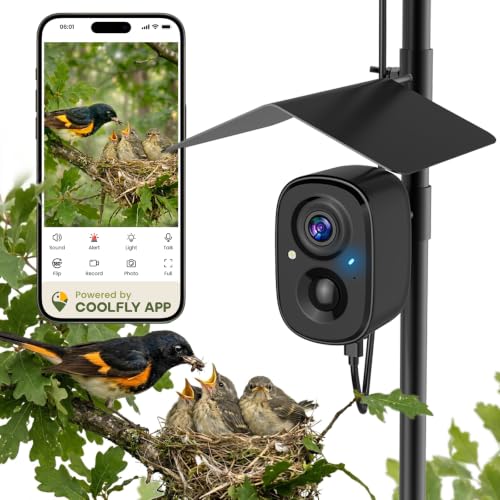
RichBird Reelook is a solar-powered, app-connected outdoor camera on a tall ground stake. It is intended to sit beside an existing bird feeder or bird bath rather than function as the feed container itself. The product is used through the COOLFLY mobile app over 2.4 GHz Wi-Fi, with live viewing, motion alerts, local microSD support, two-way audio, and species-recognition features. The manufacturer states that this unit provides 2.5K video, a 130-degree field of view, full-color night vision, and solar-supported operation. Those are manufacturer claims, not independently tested results. The companion app is an active App Store listing with recent software releases and optional paid memberships. No independent exact-product field test, accredited ingress report, electrical safety listing, or published bird-recognition accuracy validation was located.
This product fits a birdwatcher who already has a compatible feeder or bird bath and wants a camera that can be placed separately on a ground stake. It is most suitable for someone comfortable setting up a 2.4 GHz Wi-Fi device, using a smartphone app, monitoring a solar-powered battery camera, and managing local storage or optional app services. It also suits users who can install it in a stable, sunny spot away from windows, pets, and children.
It is not well suited to households that need independently certified outdoor electrical safety, verified weather testing, or documented privacy and encryption controls. It is also a poor fit for buyers expecting a complete, easy-clean feeder, because this is a camera-and-pole accessory that must be paired with another feeder or bath. Avoid placing it where the stake can be struck, pulled over, or accessed by children or pets. It also demands extra caution in locations with local wildlife-disease advisories or frequent sick birds.
This product creates a bird-contact setting without supplying the hygiene infrastructure of a washable feeder. CDC advises regular cleaning of feeders and baths, use of disposable gloves while cleaning, and handwashing afterward. Users should stop treating the camera as a hands-off installation. The paired feeder or bath still needs routine emptying, cleaning, drying, seed management, and removal from service if sick or dead birds are observed or local authorities issue guidance. The manufacturer describes solar operation and all-weather use, but no exact-product independent ingress report or recognized U.S. electrical safety listing was located. No recall or regulator warning specific to this product was found in the checked U.S. sources. The product contains an electronics battery system, yet no battery-removal or recycling instructions were located. Used lithium batteries should not go in household trash or curbside recycling. The companion app has privacy disclosures and optional subscriptions, but clear published documentation of camera encryption, security-update commitments, retention controls, and end-of-support policy was not found.


