Best Overall
10% off
Ecarke Cordless Brad Nailer Tool
Lightweight design ensures easy maneuverability.
Cordless feature offers increased portability.
Fast and efficient for quick project completion.
 Daniel Kenitz
Lightweight design ensures easy maneuverability.
Cordless feature offers increased portability.
Fast and efficient for quick project completion.

Convenient cordless design for easy mobility.
Lightweight build reduces user fatigue.
Versatile with adjustable depth settings.

Lightweight design allows for easy handling.
Cordless operation offers greater mobility.
Quick jam release feature enhances efficiency.

Durable, long-lasting construction for heavy-duty use.
Easy depth adjustment for precise nail placement.
Lightweight design reduces user fatigue.

Versatile with 2-in-1 brad nailer function.
Powerful enough for heavy-duty projects.
Compatible with 18 gauge nails.

Efficient, powerful brushless motor design.
Lightweight for comfortable, easy handling.
Cordless convenience without compressor hassle.

Precise nailing with Smart Point technology.
Easy jam release for uninterrupted work.
Lightweight design for comfortable handling.

Lightweight design for easy maneuverability.
Brushless motor for efficient performance.
Tool-free depth adjustment for precision control.
Compatible with Dewalt 20V battery system.
Includes 2000 nails for immediate use.
Versatile 2-in-1 nail and staple function.

No need for compressors: fully cordless design eliminates the need for compressors, hoses, and costly gas cartridges
Convenience: belt hook for easy access
Powerful motor: drives up to 420 nails per charge**
The first practical question is whether the tool accepts the fastener you need. Look for a model-specific manual or specification sheet that consistently states gauge, length range, magazine capacity, collation, firing modes, operating pressure or battery requirements, and intended materials. In this set, common ranges run from 5/8 inch to 2 inches or 2-1/8 inches, but those limits are not interchangeable. A listing that says “2-in-1” may refer to brads and staples without clearly stating staple crown width, exact compatible fasteners, or magazine capacity.
Firing behavior matters more than speed claims. A safer full-sequential sequence requires the work-contact tip to be pressed, then the trigger pulled, with both controls released before the next nail. Contact or bump firing allows faster repeated shots but has a greater foreseeable unintended-discharge risk. A visible safety nose is not proof of full-sequential operation, and a listing’s phrase “single-shot” is not enough when the manual does not explain the complete reset sequence. Check whether the model-specific manual covers trigger testing, double-fire prevention, battery or air disconnection, jam clearing, dry-fire protection, and compatible fasteners.
For cordless tools, verify the complete powered system rather than only the nailer. The exact tool, battery, and charger should have traceable certification in a current UL Product iQ, Intertek ETL, or CSA Group listing, or another applicable NRTL record. A battery-platform compatibility claim does not establish that the separately selected battery and charger are safe together. For pneumatic tools, check the stated pressure range, air demand, hose and fitting requirements, and the prohibition on oxygen, combustible gas, or bottled gas where the manual provides it.
Headline figures can mislead. Runtime or “nails per charge” may apply only to a named battery, nail length, wood, and test setup. Included fastener counts can conflict across listings, and “battery powered” may still mean battery and charger are excluded. A high customer rating does not replace a manual, certification record, recall search, or service pathway. Similarly, a work-contact safety claim does not prove full-sequential firing, and a low-nail window does not necessarily establish a dry-fire lockout.
Across the supplied reviews, buyers should treat contact or bump modes as a recurring safety concern and use sequential operation for controlled placement. Eye protection, training, stable positioning, keeping hands and bystanders out of the firing path, and disconnecting air or removing the battery before loading, adjustment, service, or jam clearing also recur. Several cordless products are tool-only, so battery and charger selection remains the buyer’s responsibility. None of these products should be treated as suitable for structural fastening, children, untrained users, wet or flammable environments, or work where the required fastener compatibility and firing behavior cannot be confirmed.
A brad nailer’s useful life and injury risk depend on more than driving force. The topics below distinguish documented controls, complete powered-system safety, repair and disposal pathways, and evidence that can be checked beyond a seller’s headline claims. Scores are used comparatively within this supplied group; they do not replace reading the exact manual and checking the exact product configuration.
This measures full-sequential firing, a functioning work-contact safety, and safeguards against double fires. It matters because brad nailers can puncture hands or strike bystanders, especially in contact or bump mode. The CRAFTSMAN CMCN618B scored highest among the supplied products at 91, with documented sequential operation; products with available contact firing or unclear reset behavior scored lower, including the Makita AF506 at 48.
This measures safety evidence for the complete cordless power system, including protection against shock, overheating, and battery fire. A high score requires traceable, model-specific certification rather than simple battery-platform compatibility. Pneumatic products scored 100 here because they have no onboard battery or charger; cordless scores were lower when the tool-only configuration left the eventual battery and charger unverified.
This measures protection against dry firing, unintended discharge during jam clearing, unsafe power use, and incompatible fasteners. It matters because clearing a jam or loading a nailer creates a direct opportunity for discharge. High-scoring products document battery or air removal, lock-off steps, tool-free jam access, and fastener limits; the Makita XNB04 and CRAFTSMAN CMCN618B each scored 88 or higher, while less documented products scored nearer 70.
This measures whether the manual gives usable advice on eye and hearing protection, debris direction, exhaust, positioning, training, and dusty work. These controls matter even when the firing system works as intended. Higher-scoring products such as the DEWALT pneumatic model and CRAFTSMAN CMCN618B provide detailed PPE and work-positioning guidance; lower scores reflect sparse listing material rather than proof that the tool is quieter or cleaner.
This measures whether materials, coatings, lubricants, and California exposure warnings are specific and accessible. It matters because maintenance oil and dust from wood, treated lumber, paint, or masonry can create exposures around nailer use. Scores were generally middling: the Makita AF506 scored 78 because its supplied oil has safety information, while broad or unidentified California warnings lowered transparency for several cordless and pneumatic products.
This measures whether runtime, speed, capability, included accessories, safety claims, and configuration statements match the manual and what the buyer receives. It matters because “battery powered” may mean tool-only, runtime may use a specific battery and test setup, and fastener counts can conflict across listings. Higher scores went to products with consistent manuals and specifications, while ReliaRoads scored 52 because battery compatibility conflicted across product copies.
This measures whether certificates, test reports, or listings identify the exact model and can be checked through an NRTL directory or an accredited laboratory. It matters particularly for cordless tools, where the battery and charger complete the electrical system. Scores stayed moderate because no exact UL, ETL, or CSA record was located for many products; the presence of a manufacturer manual alone is not independent certification.
This measures the traceability of the exact model, brand, importer, and corrective-action path, including unresolved serious safety actions. It matters because a buyer needs a way to identify and respond to a defect after purchase. Supplied scores ranged around 70 to 80: several reviews found no matching CPSC recall, but the absence of a located recall is not the same as a guarantee of a clean safety history.
This measures whether gauge, length, collation, firing mode, capacity, pressure or battery needs, and intended materials are stated consistently. High scores reduce the risk of using incompatible nails or power equipment. Makita’s AF506 scored 94 with consistent 18-gauge, 5/8-to-2-inch, 100-nail, and 70-to-120-PSI limits; lower scores reflected conflicting listings or missing crown, capacity, or manual details.
This measures replacement parts, service instructions, warranty support, and authorized repair routes. Repairability matters because a worn trigger, seal, magazine, or other component need not end the tool’s life. The Makita AF506 scored 92 with a published parts breakdown and service network; Bostitch and DEWALT products also scored strongly where exploded diagrams, parts channels, warranties, and repair routing were documented.
This measures whether cordless tools use replaceable batteries and provide a practical U.S. recycling route, while also considering consumable and accessory disposal guidance. Pneumatic products scored 100 because they avoid lithium-ion battery disposal. Cordless products scored higher when brands directed users to Call2Recycle or service and retail collection; products without brand-specific recycling instructions scored lower.
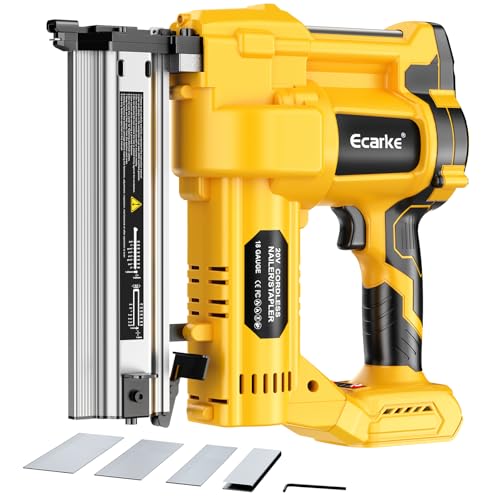
This product is a cordless 18-gauge brad nailer and narrow-staple gun. It is sold as a bare tool for compatible DeWalt battery packs, so a battery and charger are not included. The manufacturer page for this product number states a 100-fastener magazine, brads from 3/4 inch to 2 inches, and staples from 3/4 inch to 1-9/16 inches. The manufacturer also states that the nose must be fully pressed before firing, that the tool has single-shot and contact modes, a depth wheel, and LED status indication for low battery and overheating. Contact firing is a meaningful safety limitation because public NIOSH guidance identifies sequential firing as the lower-risk arrangement. No exact-product listing in a public UL, ETL, or CSA register was located, and no independently published performance test or accessible model-specific manual was found during verification.
This product suits a home user or hobby woodworker who already owns compatible DeWalt battery packs and needs a cordless tool for occasional light fastening. Its stated 18-gauge brad and staple capability fits tasks such as attaching trim, assembling light furniture, making crafts, repairing upholstery, or fastening decorative wood. The tool-only format is most practical when the buyer already has a compatible battery and charger, and can first practice single-shot operation on scrap material while wearing eye protection.
It is not suited to users needing documented third-party electrical safety certification, a supplied matched battery and charger, or readily available repair documentation. It is also not appropriate for structural framing, decking, load-bearing subfloors, or any work governed by a fastening schedule that calls for larger structural fasteners. Inexperienced users, ladder users, and anyone working close to other people should avoid contact firing and select single-shot operation. Keep it inaccessible to children and never use it around hands placed behind the workpiece.
The key health issue is firing mode. The manufacturer states that the nose must be fully pressed before firing, but also advertises contact mode. CDC and NIOSH guidance recommends full sequential or single-shot firing because contact firing can increase unintended-discharge and double-fire risk. Use eye protection, keep hands clear of the possible nail path, remove the battery before clearing a jam, and avoid firing toward knots, edges, or concealed people. The removable compatible battery pack can be replaced separately from the tool, which may avoid discarding the nailer when a battery ages. Ecarke does not provide product-specific battery disposal instructions on the reviewed material. EPA guidance says lithium-ion batteries must not go in household trash or curbside recycling. Tape terminals or isolate the pack and take it to a dedicated battery recycler or household hazardous-waste program. No exact-product CPSC recall or safety warning was located during this review.
This is a cordless 18-gauge, 2-in-1 brad nailer and staple gun for light finish work, upholstery, cabinetry, and similar wood projects. It is sold as a bare tool, so the battery is not included. The product listing states that it accepts an 18V Milwaukee-style battery, drives brads up to 2 inches, and includes 1,600 fasteners plus a nail puller. Those are manufacturer-stated specifications, not independently validated performance results. An external reseller describes the same product family as a 2-in-1 nailer and stapler, but its copied specifications instead say DeWalt 20V MAX battery compatibility. That material conflict is important because using an incompatible battery can create fit, electrical, and warranty risks. No model-specific manual, parts diagram, safety certification listing, or independent test report was located.
This product most plausibly suits a homeowner doing occasional, low-volume trim, paneling, crafts, upholstery, or cabinetry work who already owns the exact battery platform confirmed by the seller before ordering. The stated 18-gauge format and 2-inch maximum brad length point to finish fastening rather than structural work. It also suits someone who values a tool-only package with a starter supply of fasteners, provided they are prepared to confirm the battery fit, operating instructions, and safe firing mode directly from the seller.
It is not well suited to professional crews, shared workshops, inexperienced users, or jobs where a documented full-sequential firing mode and independently listed electrical system are required. It is also unsuitable for structural fastening, framing, or any task that needs a clearly specified fastener chart and repeatable depth performance in hard materials. Households with children should store the bare tool and battery separately, with the battery removed. Do not select it when the available battery is uncertain, because public product copies conflict on platform compatibility.
Nail guns can cause serious puncture and struck-by injuries. CDC and OSHA guidance identifies full-sequential or single-shot firing as safer than contact firing, and calls for eye protection, training, finger-off-trigger carrying, and battery removal before adjustments or jam clearing. A similar generic manual found online describes a work-contact tip and eye protection, but it is not an exact ReliaRoads manual, so those safeguards cannot be treated as confirmed for this product. No public NRTL listing, model-specific safety certificate, recall notice, or California chemical warning was located in the checked sources. No replacement-parts or repair documentation was found either. The battery is removable and sold separately, which avoids an integral battery becoming tool waste, but disposal guidance from the brand was not located. EPA advises keeping lithium-ion batteries out of household trash and curbside recycling, protecting terminals with nonconductive tape or separate bags, and using a dedicated battery or household hazardous-waste collection point.
This is a pneumatic 18-gauge brad nailer for 5/8-inch to 2-inch brads. It connects to a compressed-air hose and is intended for finish tasks such as decorative molding, casing, crown, and shoe molding. The kit includes the nailer, air fitting, carrying case, and manual. It does not include a battery, charger, or compressor. DEWALT's manual documents a contact safety tip, an included sequential-action trigger, adjustable depth control, rear exhaust, a low-nail viewing window, and a tool-free jam release. The sequential trigger is the most important safety feature, because CDC and NIOSH guidance identifies sequential firing as safer than contact firing for reducing unintended discharge. A contact or bump-action trigger conversion kit is also available, so the trigger installed on a used or modified product should be checked before use.
This product suits a trained DIY woodworker, trim installer, or cabinet and finish-work user who already has a regulated compressor and wants to fasten 18-gauge brads from 5/8 inch through 2 inches. It is especially suited to intermittent, placement-focused work such as casing, molding, shoe molding, and similar finish tasks. The included sequential trigger is useful where accurate placement and reduced unintended-firing risk matter more than rapid repeated firing. Users should be prepared to follow air-pressure, hose-disconnection, eye-protection, and hearing-protection instructions.
It is not suited to someone needing a self-contained tool for work away from compressed air, because a compressor, hose, and regulated air connection are required. It is also not appropriate for untrained users, children, or anyone unable to consistently keep hands and bystanders outside the firing path. Avoid using it from unstable ladders, in cramped body positions, or for structural framing work. Users who find a black bump-action trigger installed should understand that this changes the firing risk and requires heightened training and controls.
The strongest health feature is the supplied sequential-action trigger and work-contact safety. CDC and NIOSH guidance supports sequential firing because contact firing can cause unintended discharge and double fires. The manual also directs users to wear ANSI-rated eye protection and hearing protection, use respiratory protection where dust requires it, direct debris away from the body, inspect the contact trip, and disconnect the air supply before servicing or clearing a jam. This pneumatic product contains no supplied battery or charger, so it avoids battery fire, charging, and end-of-life battery disposal issues. DEWALT provides an official exploded diagram, parts channel, authorized-service pathway, and stated warranty support, which can help extend service life. Public CPSC recall records located for DEWALT nailers concerned different framing-nailer products, not this product. Material and chemical disclosure remains limited, and no detailed model-specific public composition or exposure documentation was identified.
This is a corded 120V electric 2-in-1 fastening tool for 18-gauge brad nails and crown staples. The product page positions it for light woodworking, upholstery, picture framing, interior decoration, carpet assembly, and similar DIY work. It is not a cordless tool and does not use a removable battery pack. The manufacturer states that it accepts 5/8 to 1-1/4 inch brad nails and 5/8 to 1 inch crown staples, has six depth settings, and includes 1,500 nails, 500 staples, and gloves. It also states that firing requires both the on-off switch and full work-contact safety engagement. Those are manufacturer claims, not independently verified specifications. No product manual, model-specific NRTL certification listing, independent test report, or detailed repair documentation was located during verification.
This product fits a DIY user doing occasional, light indoor fastening who specifically wants a plug-in tool rather than a battery system. Its stated use cases include trim-like brad work, picture frames, upholstery, carpet assembly, and small woodworking projects. It is most appropriate for someone able to test fasteners on scrap material first, verify that their brads or staples match the stated ranges, and use eye and hearing protection even though the available product page does not provide comprehensive PPE instructions.
It is not well suited to professional or frequent job-site users who need independently verified electrical safety certification, a full operating manual, traceable service support, or documented replacement parts. It is also a poor fit for users who need confirmed full-sequential firing behavior, detailed jam-clearing instructions, or exact staple crown and magazine specifications before work begins. Do not treat the listed gloves as a substitute for safety glasses, hearing protection, training, secure work positioning, and keeping hands clear of the firing path.
The main safety-positive claim is a two-part activation arrangement. The manufacturer says the switch must be on and the nose contact fully pressed before the tool fires. That is useful information, but it does not establish full-sequential operation or independently confirm resistance to double fires. OSHA notes that multi-shot contact-trigger nailers carry a higher injury risk than single-shot sequential-trigger tools. No model-specific NRTL listing, independent test report, manual, chemical disclosure, or Proposition 65 warning was found in the available product materials. The corded format avoids rechargeable battery waste, but it does not eliminate electronic waste. No parts diagram, authorized repair channel, or exact warranty terms were located, which limits confidence that a worn or malfunctioning tool can be repaired rather than discarded. No matching CPSC recall or public incident record was located in the searches performed.
This is an 18V cordless, brushless 18-gauge brad nailer for finish and trim work in wood. It uses compatible Makita slide batteries, sold separately, and accepts 5/8-inch to 2-inch brad nails. The manufacturer manual specifies a 110-nail magazine and a 6.0 to 6.6 pound operating weight, depending on battery. Its most important safety feature is a documented full sequential mode, which drives one fastener per actuation sequence. A contact mode is also available for faster repeated fastening, so safe operation depends on deliberately selecting sequential mode when careful placement is needed. The manual also documents an anti-dry-fire lockout, a tool-free jam access point, battery removal before loading or clearing jams, and overload, overheat, and over-discharge shutdowns. Publicly checkable independent certification for this exact tool was not located.
This product suits trained finish carpenters, installers, and serious home users already using compatible Makita 18V batteries and chargers. It is sized for brad-nail tasks such as trim, baseboard, casing, light cabinetry, and other wood finishing where 18-gauge nails from 5/8 inch to 2 inches are appropriate. It is especially suited to users who will intentionally select full sequential firing for controlled placement, follow the documented battery-removal steps before clearing jams, and have access to authorized repair support.
It is not for inexperienced users who may leave it in contact actuation or do not have training in nail-gun positioning, trigger discipline, and workpiece penetration hazards. It is also unsuitable for structural framing, heavy fastening, or jobs requiring nails outside the stated 18-gauge, 5/8-inch to 2-inch range. Buyers without compatible batteries and an approved charger should account for the separate powered system. It should not be used where eye protection, controlled work positioning, and bystander exclusion cannot be maintained.
The safety documentation is stronger than a bare product listing. It specifies full sequential and contact actuation modes, requires battery removal before loading, nose-adapter changes, maintenance, and jam clearing, and describes a low-fastener lockout. Full sequential mode matters because OSHA reports a higher injury risk with multi-shot contact triggers. Eye protection, safe positioning, training, and keeping hands clear of possible nail exit paths remain necessary, regardless of mode. The specified Makita battery packs are replaceable rather than built in. Makita directs users to factory service centers, local recycling facilities, or Call2Recycle for battery disposal, which provides a practical end-of-life route. Makita also maintains authorized service centers and direct repair service. No recall specific to this product was located in the reviewed CPSC recall material. The manual includes a California construction-dust warning, including possible exposure from lead, crystalline silica, and treated wood dust, but it does not identify a specific chemical in the nailer itself.
This product is an oil-free, pneumatic 18-gauge brad nailer for finish and trim work. It uses 18-gauge brads from 5/8 inch to 2-1/8 inches, has a 100-brad magazine, and requires regulated compressed air at 70 to 120 psi. The manufacturer manual lists a 3.1-pound tool weight and 1.15 cfm air use at 80 psi when driving 60 fasteners per minute. Its most consequential design feature is a selectable contact or sequential trip. The model-specific manual states that sequential operation requires nose contact before trigger pull and avoids the recoil second-fire risk described for contact mode. It also documents a trigger lockout, tool-free jam access, depth adjustment, rear exhaust, and a required post-drop function check.
This product suits a trained home renovator, trim carpenter, or woodworker who already has a regulated compressed-air setup and needs to place 18-gauge brads for trim, molding, cabinetry, and similar finish work. It is particularly appropriate where accurate placement matters, because the manual documents a sequential firing mode, a compact nose-contact arrangement, and depth adjustment. It also suits users prepared to inspect the contact trip after a drop, disconnect air before adjustments, and use specified 18-gauge brads within the stated length range.
It is not for anyone without a properly regulated compressor, suitable hose, quick-disconnect fitting, eye protection, and a safe work area. It is also unsuitable for untrained users, children, or households where the connected tool could be accessible. Users doing placement work near their hands or other people should not rely on contact-trip mode, because that mode permits rapid repeated firing and raises foreseeable unintended-discharge risk. It is not a substitute for a heavier framing or structural fastening tool, and it should never be powered with oxygen, combustible gas, or bottled gas.
The manufacturer provides unusually detailed operating controls for a pneumatic brad nailer. Its manual specifies sequential and contact firing modes, requires disconnecting air before adjustment or jam clearing, and gives a functional test after a drop or suspected damage. It calls for ANSI-rated side-shield eye protection and notes that hearing protection may be necessary. OSHA guidance independently supports preferring sequential firing because contact-trigger nailers carry greater injury risk. The product avoids battery charging, battery-fire, and battery disposal issues because it is pneumatic. Repair prospects are comparatively strong, as Bostitch ServiceNet offers model-specific documentation, exploded art, parts access, rebuild components, and repair routing. Chemical disclosure is less complete. The manual warns about dust from surrounding construction materials, such as lead paint, silica masonry, and treated lumber, but does not provide a specific materials or coating disclosure for the tool itself. A search of CPSC recall resources did not identify a recall for this exact model.
This product is a cordless, straight-magazine 18-gauge brad nailer for driving 5/8 to 2-1/8 inch brads into wood. Its 110-nail magazine and tool-free depth adjustment suit finish tasks such as molding, casing, crown, and shoe molding. The listed product is tool-only, so a compatible 20V MAX battery and charger must be obtained separately. The manufacturer documents 20V as maximum initial voltage and 18V as nominal voltage. ([dewalt.com](https://www.dewalt.com/en-us/product/dcn680b/20v-max-xr-18ga-cordless-brad-nailer-tool-only?bvstate=pg%3A2%2Fct%3Ar&utm_source=openai)) Its most consequential safety feature is a selectable sequential or bump firing mode. Sequential firing is the safer mode for controlled placement, while bump firing retains a faster mode with a known higher unintended-discharge risk. The manual also directs users to remove the battery before adjustment, service, or accessory changes. These are manufacturer-documentation findings, not independent product testing. ([dewalt.com](https://www.dewalt.com/GLOBALBOM/QU/DCN680B/1/Instruction_Manual/EN/N496636_DCN680.pdf?utm_source=openai))
This product fits an experienced trim carpenter, installer, or serious home user who already uses compatible 20V MAX battery packs and needs hose-free fastening for wood trim, casing, molding, or similar finish work. It is particularly suited to users who will deliberately select sequential firing for placement tasks, wear eye and hearing protection, and follow the manual’s battery-removal procedure before clearing jams or making adjustments. Its documented brad range and straight 110-nail magazine make it appropriate for predictable finish-fastening work rather than general construction framing. ([dewalt.com](https://www.dewalt.com/GLOBALBOM/QU/DCN680B/1/Instruction_Manual/EN/N496636_DCN680.pdf?utm_source=openai))
It is not appropriate for children, untrained users, or anyone unable to consistently keep hands and bystanders out of the line of fire. Buyers who expect a complete ready-to-run package should look elsewhere, because this configuration excludes both battery and charger. It is also unsuitable for wet locations, flammable atmospheres, non-wood workpieces, or framing and structural fastening outside its specified 18-gauge brad range. Users who do not need rapid bump firing should avoid selecting that mode because sequential operation provides the lower-risk firing sequence. ([dewalt.com](https://www.dewalt.com/GLOBALBOM/QU/DCN680B/1/Instruction_Manual/EN/N496636_DCN680.pdf?utm_source=openai))
The manual supports several practical injury controls, including battery removal before adjustments or service, a work-contact safety arrangement, selectable firing modes, jam-clearing directions, and warnings consistent with eye and hearing protection. The key limitation is that bump firing remains selectable. CDC and OSHA guidance identifies sequential firing as the safer choice because contact-style firing can increase unintended discharge and double-fire risk. ([dewalt.com](https://www.dewalt.com/GLOBALBOM/QU/DCN680B/1/Instruction_Manual/EN/N496636_DCN680.pdf?utm_source=openai)) The replaceable battery pack is an ecological advantage over an integrated battery design. DEWALT directs U.S. users to lithium-ion battery recycling through Call2Recycle and local disposal guidance, rather than household trash. The product also has a published exploded diagram, authorized-service references, and warranty support that can help extend service life. A search of CPSC recall records did not identify a recall naming this product, although older DEWALT nailer recalls show why lock-off and contact-tip function should be checked before use. ([dewalt.com](https://www.dewalt.com/en-us/support/product-and-battery-recycling?utm_source=openai))
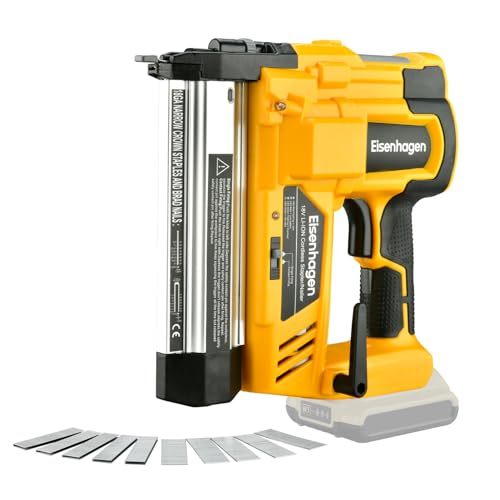
This is a bare, cordless 2-in-1 fastening tool intended for light woodworking, trim, interior repairs, and similar projects. It is marketed to run on DeWalt 20V MAX battery packs, but neither a battery nor charger is included. A separate retailer listing for the same apparent tool configuration identifies it as an 18-gauge brad nailer and crown stapler, with brads from 3/4 to 2 inches and staples from 3/4 to 1-9/16 inches. The product description for this configuration states that it has single-shot and contact-fire modes, adjustable depth, an LED, a tool-free jam release, and a 100-fastener magazine. Those are seller or manufacturer-stated features, not independently tested findings. No model-specific manual, NRTL certification listing, parts diagram, or verified service pathway was located. Fastener counts also vary across listings, so included consumables should be checked on delivery.
This product fits a homeowner or occasional DIY user who already owns compatible DeWalt 20V MAX batteries and chargers, and needs a compact cordless tool for intermittent brad nailing or narrow crown stapling in wood. Suitable tasks are trim touch-ups, light interior finishing, decorative panels, fence-slat repairs, and craft or furniture work within the stated 18-gauge fastener range. The user should be comfortable checking fastener fit, testing depth on scrap material, and confirming included accessories before starting work.
It is not suited to users who need documented electrical certification, a clearly verified full-sequential firing system, or formal job-site safety documentation. It is also a poor fit for households without a compatible battery and charger, because this is sold as a bare tool. Avoid relying on it for structural framing, production fastening, overhead work, ladder work, or projects where a misfire could cause serious injury. Buyers who need repair parts, warranty clarity, or established service support should choose a product with those resources published.
The main health concern is evidence quality rather than a confirmed defect. Retailer descriptions for the matching configuration state that it offers both single-shot and contact-fire modes, but no model-specific manual was found to confirm the trigger sequence or work-contact safety. NIOSH identifies full-sequential firing as the safer nail-gun trigger approach. Eye protection, hearing protection, stable positioning, and keeping hands clear of the discharge path remain important. No publicly verifiable NRTL listing or model-specific chemical warning was located. Searches also did not identify a CPSC recall for Eisenhagen nailers, although the seller and importer trail is limited. The tool uses a replaceable battery pack rather than an integrated pack, which can reduce tool waste when a pack wears out. Used lithium-ion packs should not go in household trash or curbside recycling, and should instead go to an appropriate battery recycler.
This is a bare cordless 18-gauge brad nailer for fastening trim, cabinetry, furniture, and similar woodwork with 5/8-inch to 2-inch brad nails. It uses removable V20 lithium-ion battery packs, but the battery and charger are sold separately. The official manual specifies a contact-trip and trigger sequence for each fastener, rather than a contact-actuation mode. The manufacturer states up to 420 nails per charge when using a 1.5 Ah battery, 2-inch nails, and 2-by-4 pine. That figure is a defined manufacturer test condition, not independently located runtime testing. Verified documentation provides a tool-free jam door, stall release, depth wheel, trigger lock-off, jam indicator, compatible battery and charger list, authorized-service route, and three-year limited tool warranty.
This product suits an adult DIY user or finish-work user who already owns compatible V20 batteries and chargers, and needs a portable nailer for baseboards, casing, small cabinetry, furniture work, or other light brad-nail tasks. It is particularly suited to someone who can follow the documented sequence of placing the nose on the workpiece, pulling the trigger once, then fully releasing both controls before the next fastener. It also fits users who value tool-free jam access and an authorized repair route.
It is not suited to children, untrained users, or anyone likely to bypass a contact trip, trigger lock-off, or battery-removal instruction. It is also a poor fit for users who need a supplied, fully documented charging system, because this is a bare product and compatible batteries and chargers must be chosen separately. Avoid it for fastening into concrete, stone, very hard woods, knots, or materials too hard for the fastener to penetrate, which the manual specifically warns against.
The manual has strong practical injury-prevention content. It requires sequential contact-trip operation, directs daily checks for free movement of the trigger and contact trip, and says not to disable or tape either control. It also requires side-shield safety glasses meeting ANSI Z87.1, calls for hearing protection and respiratory protection where dust warrants it, and gives a battery-out jam-clearing procedure. A California Proposition 65 warning is displayed for the product, but it only states cancer and reproductive harm and does not identify the relevant chemical or exposure route. The manual separately warns that construction dust can contain lead, crystalline silica, arsenic, and chromium depending on the work material. The removable lithium-ion packs can be recycled through Call2Recycle or participating service and retail locations. The tool has service diagrams, authorized repair support, and a three-year limited warranty, though the battery pack and charger are not user-serviceable.


