Best Overall
$30 Coupon

TP-Link Deco XE75 Tri-Band WiFi 6E Mesh System
Covers up to 7200 sq. ft. seamlessly.
New 6GHz band reduces network congestion.
Easy setup and management with AI-driven mesh.
 Daniel Kenitz
Covers up to 7200 sq. ft. seamlessly.
New 6GHz band reduces network congestion.
Easy setup and management with AI-driven mesh.

Covers large areas up to 8,100 sq.ft.
Supports high-speed 14Gbps for seamless browsing.
Connects up to 200 devices effortlessly.

Covers up to 7000 sq.ft effortlessly.
Supports over 160 devices seamlessly.
Easy replacement for traditional routers.

Covers large areas up to 8,000 sq. ft.
Supports high-speed internet up to 11Gbps.
Connects up to 100 devices seamlessly.

Supports high-speed internet up to 2.5 Gbps.
Covers large areas up to 6,000 sq. ft.
Easy setup with user-friendly app integration.

Covers up to 6,500 square feet seamlessly.
Supports fast 3.6 Gbps Wi-Fi speeds.
Features AI-Roaming for stable connections.

Covers large areas up to 6,000 sq.ft.
Supports up to 70 devices seamlessly.
Fast 5 Gbps speed with 2.5GB port.

Strong signal coverage with 4x8dBi antennas.
Durable design with IP67 weatherproof rating.
Supports PoE for flexible installation options.
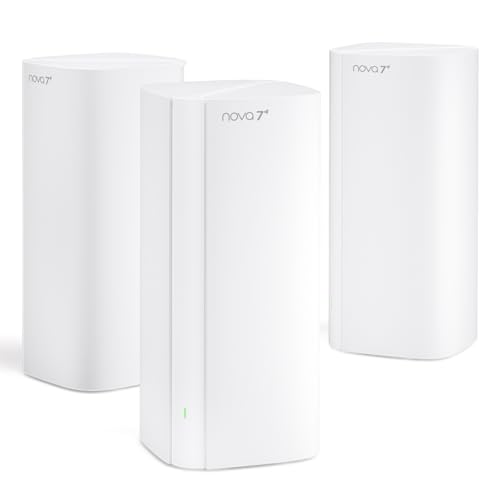
Extensive coverage up to 6,600 sq. ft.
Supports seamless roaming with MLO technology.
EasyMesh and VPN ready for flexibility.

Easy setup with user-friendly app interface.
Handles multiple devices without slowing down.
Excellent coverage for large homes.
What determines whether a mesh system works well is not its combined headline speed or square-foot number alone. Placement, walls, floors, interference, client devices, internet service, and the distance between nodes all matter. A dual-band system shares its 2.4 GHz and 5 GHz radios between household devices and wireless backhaul, so satellite speed and latency can fall. A tri-band system may have more capacity, but that does not guarantee consistent performance at every node. A wired backhaul is often the more predictable option where Ethernet is available.
Look for independent testing of the exact model or hardware revision. Useful reports identify the firmware, number and placement of nodes, client hardware, distances, topology, and whether the test used wireless or wired backhaul. Results for throughput, range, latency, roaming, stability, and recovery after a node or backhaul problem are more informative than a theoretical link rate. A claim such as 5 Gbps or 14 Gbps usually describes an aggregate radio rate, not the speed available to one device or across an entire home. Coverage figures such as 4,500, 6,600, or 8,100 square feet are planning estimates unless supported by disclosed real-home testing.
For standards and safety, check the exact product in the FCC Equipment Authorization System and confirm its radio bands and exposure conditions. FCC authorization addresses lawful radio operation; it is not the same as electrical-safety certification. For the nodes and every supplied adapter, look for a genuine listing in an OSHA-recognized NRTL directory, such as UL Solutions, Intertek ETL, CSA, or TÜV. WPA3, Wi‑Fi generation, 6 GHz, EasyMesh, and other feature claims should be traceable through the Wi‑Fi Alliance Product Finder, certification records, FCC exhibits, or model-specific manuals. A badge or standards label without an identifiable product record is not equivalent evidence.
Security also depends on the support policy and the defaults. Prefer a model-specific minimum security-support end date, automatic firmware delivery, vulnerability fixes, signed updates, modern encryption, guest and IoT separation, firewalling, and no universal default password. Check whether WPS, UPnP, remote management, port forwarding, or similar features are enabled by default. Privacy-sensitive buyers should examine whether setup requires an account, whether local administration works without the cloud, and what network, device, location, diagnostic, or usage data the app and service collect.
Across the supplied reviews, recurring cautions include account-led or cloud-dependent setup, unclear model-specific security end dates, wireless-satellite speed or latency losses, and no independently measured whole-kit power figure. Several products also lacked publicly traceable NRTL listings for supplied adapters. One older system had a disclosed high-severity hard-coded-credential vulnerability and a reported guest-network administration weakness; that product should not be treated as a safe choice for sensitive or shared networks without clear remediation. These are material checks, not reasons to assume every mesh system has the same defect.
For mesh Wi‑Fi, health and ecology include both conventional product-safety evidence and the less visible effects of network security, privacy, electricity use, and product life. The scores below reflect the supplied reviews; a higher score means the review found stronger, clearer evidence against that topic’s stated standard.
This measures whether every node and supplied adapter has lawful U.S. radio authorization, exposure conditions, and a genuine NRTL safety listing, with no unresolved recall or enforcement issue. For mesh kits, a radio record for one model does not prove safety certification for every adapter. Higher-scoring products had traceable FCC records and stronger documentation; lower scores commonly reflected missing public NRTL matches or incomplete grant evidence.
This measures whether the maker gives the exact product a minimum security-support end date and provides automatic firmware and vulnerability fixes. Mesh systems remain connected continuously, so an unclear support lifetime matters even when current updates exist. The strongest supplied result was the eero 7’s published support date through August 31, 2031; lower-scoring products offered downloads or releases but no model-specific end date.
This measures modern encryption, safe administration, guest and IoT separation, firewalling, signed updates, non-universal passwords, and control of unsafe remote features. These protections matter because one compromised mesh node can expose many household devices. Higher-scoring products documented WPA3, isolation, firewall controls, and safer administration; lower scores reflected WPS, UPnP, remote management, weak defaults, subscription-dependent protections, or unverified update safeguards.
This measures how much household, device, browsing, and diagnostic data is collected and whether essential setup and administration work without a compulsory cloud account. App-led systems can link network details to identity or usage records. Higher-scoring products offered local setup or limited remote exposure, as with Linksys; lower scores involved required accounts, cloud-linked administration, location or telemetry collection, or broad privacy-policy permissions.
This measures whether an identifiable independent lab tested the exact product or hardware revision for throughput, range, roaming, latency, stability, and security. It separates repeatable evidence from manufacturer speed claims. Higher-scoring products had disclosed testing from outlets such as RTINGS or Tom’s Guide; lower scores relied on hands-on impressions or had no independent test of the exact kit.
This measures usable speed, latency, roaming, stability, and recovery across realistic distances and obstructions, including wireless and wired backhaul. A large coverage claim does not show how a satellite behaves through walls or after a node problem. Higher-scoring products had multi-node or multi-floor results and documented backhaul options; lower scores lacked failure-recovery data or showed marked satellite slowdown and latency increases.
This measures whether Wi‑Fi generation, WPA3, 6 GHz, multi-link operation, EasyMesh, and port features are certified or documented for the exact model. It matters because a generation label can conceal a dual-band design or missing feature. Higher-scoring products had clearer model-specific documentation and certification evidence; lower scores involved marketplace specification conflicts, unsupported feature claims, or ambiguous hardware limits.
This measures whether advertised speeds, coverage, device counts, security features, and subscription benefits disclose their assumptions and agree with ports, radios, manuals, and independent results. High scores came from qualified claims that distinguished theoretical aggregate rates from real performance. Lower scores reflected conflicting coverage figures, unclear test conditions, unsupported device counts, or features described as pending or subscription-dependent.
This measures whether each material badge can be traced to an independent issuer and the exact product, while distinguishing FCC authorization from voluntary safety or interoperability certification. High-scoring products had identifiable FCC, UL, Wi‑Fi Alliance, or similar records. Lower scores relied on manufacturer-listed badges that could not be matched publicly to the complete node-and-adapter package or exact hardware revision.
This measures electricity use for the complete operating mesh and useful power-management controls. Three continuously powered nodes can consume more than a single router, so measured kit or per-node results are more useful than adapter wattage ratings. Higher-scoring products included independent or laboratory results, such as eero 6+ at roughly 4.5–4.9 watts per node; lower scores had only maximum adapter or node ratings and no wall-power measurement.
This measures whether the system can remain useful safely and be recycled responsibly through support, manuals, replaceable accessories, spare parts, repair information, and a credible take-back or certified recycling route. Higher-scoring products combined clearer support or warranty evidence with recycling options; lower scores commonly lacked model-specific support dates, spare parts, take-back programs, or repair routes. Certified electronics recycling remains the stated fallback where available.
This product is a three-node, tri-band Wi-Fi 6E mesh system for replacing a router and extenders in a larger home. Each compact node has three auto-sensing gigabit Ethernet ports, and the system can use the 6 GHz radio for wireless mesh backhaul or client connections. Ethernet backhaul is also supported. The stated 7,200 square foot and 200-device figures are manufacturer claims, not a guarantee for every building. Independent testing of the exact model found strong three-node transfer rates through five drywall walls over 15 meters, using the 6 GHz band for mesh backhaul. The product has only gigabit wired ports, so it cannot pass internet service faster than 1 Gbps through a single Ethernet connection. Current model-specific firmware releases and a published support commitment through at least December 31, 2028 are meaningful lifecycle evidence.
This product fits a household with roughly three placement areas, gigabit or slower internet, and a need to carry reliable Wi-Fi beyond a single router location. It is particularly suited to homes where nodes can be placed with a reasonably clear wireless path, or preferably linked by Ethernet. Buyers should be comfortable using a phone app and TP-Link account for setup and administration. It also suits homes that need separate guest or IoT access and want a 6 GHz radio available for mesh backhaul or compatible Wi-Fi 6E devices.
It is not suited to households that need more than 1 Gbps at the router or at wired devices, because every Ethernet port is gigabit only. Homes with dense masonry, concrete, foil insulation, detached structures, or difficult node placement should not treat the stated coverage area as a measured outcome. It is also a poor fit for buyers who require account-free initial setup, minimal app-linked telemetry, publicly verifiable safety certification for every supplied adapter, or a clearly published U.S. repair-parts and manufacturer recycling program.
For U.S. radio compliance, relevant Deco XE75 hardware revisions have traceable FCC grants, including RF exposure and 6 GHz test exhibits. No matching CPSC recall or product safety warning was found in the recall database search. However, FCC authorization is not the same as independent electrical safety certification. The supplied adapter model is identified in FCC exhibits, but an accessible UL, ETL, CSA, or TÜV directory listing for that exact adapter was not confirmed. This is an always-on three-node system. Independent measurements found about 7.1 watts per node at idle with a wired device connected, suggesting roughly 21 watts for three nodes before traffic increases. Firmware for some revisions adds Eco Mode, Wi-Fi scheduling, and automatic updates. The documented security-support period through at least December 31, 2028 supports continued use, but a clear U.S. manufacturer take-back or spare-parts route was not located. Certified electronics recycling remains the responsible end-of-life option.
This product is a three-node, tri-band Wi-Fi 7 mesh system for replacing or supplementing a home router. Each upright node has 2.4 GHz, 5 GHz, and 6 GHz radios, plus one 10 Gbps, one 2.5 Gbps, and one 1 Gbps Ethernet port and a USB 3.0 port. It is set up and managed through the Deco mobile app. TP-Link states a 14 Gbps combined wireless link rate, support for up to 200 devices, and up to 8,100 square feet for the three-node package. Those are manufacturer claims rather than home-specific results. Independent testing of a two-node version found exceptional peak speed, strong range, and the ability to serve multi-gig internet up to about 3 Gbps. The same testing found that wireless satellite connections add some latency and jitter, with wired backhaul reducing that penalty. Advanced HomeShield security and parental-control functions require a subscription.
This product fits a large or multi-level home with multi-gig internet, several wired devices, and a realistic place to position three nodes. It is particularly suited to households that can run Ethernet between nodes, because wired backhaul reduces the latency and jitter added by a wireless satellite. It also suits users who want app-led setup and value 6 GHz capacity for newer Wi-Fi 6E or Wi-Fi 7 devices. Its port layout is useful where one node needs to serve a fast local wired device as well as the internet connection.
It is not well suited to privacy-sensitive households that do not want a required mobile app and TP-Link account for setup and management, or that are uncomfortable with cloud-linked diagnostics, identifiers, and parental-control browsing records. It is also a poor fit for competitive wireless gaming through a satellite node, since independent testing found added latency and jitter there. Households with modest broadband, no multi-gig wired devices, or no practical node placement plan may not use much of its high-throughput hardware. Buyers needing a documented long-term security-support date should look for that commitment elsewhere.
TP-Link lists FCC and RoHS among the product certifications, and the U.S. product documentation specifies radios operating on 2.4 GHz, 5 GHz, and 6 GHz. A direct match to an FCC grant for this exact product, a public NRTL listing for the supplied adapters, and a voluntary Wi-Fi Alliance certificate was not located during verification. No product-specific CPSC recall or FCC enforcement action was found. The manufacturer should still be the source for a replacement adapter, since safety certification applies to the supplied unit rather than to an arbitrary substitute. The manufacturer continues to publish firmware for the current U.S. hardware line and provides a two-year limited warranty. It does not state a minimum security-support end date or a product-specific take-back route. Energy documentation gives a 31 W maximum per node without its adapter, but does not provide measured idle or typical whole-system wall power. For disposal, use a certified electronics recycler rather than household trash.
This is a three-node, dual-band Wi-Fi 6 mesh system intended to replace a conventional router and spread one home network across a larger property. Each node has three gigabit Ethernet ports, four internal antennas, and a 12 V power adapter. It can be managed through a local web interface or the Tenda WiFi app. Tenda documents WPA3 or WPA2 wireless security, a guest network, router and access-point modes, and Ethernet backhaul. The AX3000 figure is a combined link-rate claim, 574 Mbps on 2.4 GHz plus 2402 Mbps on 5 GHz, not a measured internet-speed result. The claimed 7,000 square foot coverage and 160-device capacity are manufacturer figures without disclosed home layout, client mix, or multi-node test method. FCC authorization was located for the MX12 hardware family, with a 20 cm RF-exposure separation condition.
This system suits a household that needs several wired connection points in addition to broader Wi-Fi coverage, especially where Ethernet can be run between nodes. It is also suited to users comfortable opening the local web interface, changing the administrator password, reviewing guest-network settings, and applying firmware manually when Tenda posts it. The three-node format is practical for a multi-room home with a modem or gateway that can be placed at one node, rather than a small apartment where one access point may already cover the space.
It is not well suited to households that need independently measured whole-home throughput, roaming, latency, or failure-recovery results before deployment. Buyers who require a published security-support end date, documented automatic security patching, and a public vulnerability-response record should seek a product with those commitments. It is also a weaker fit for people who want minimal data collection through a companion app, or who cannot safely place all nodes with the FCC-required 20 cm separation from people during normal operation.
For U.S. radio compliance, an FCC equipment authorization was found for the MX12 hardware family. The authorization covers the relevant Wi-Fi bands and specifies installation at least 20 cm from people, without co-location with another transmitter. Tenda's product documentation also identifies FCC, CE, and RoHS, but CE and RoHS are not U.S. electrical-safety certifications. A matching public NRTL listing for the supplied power adapters was not located during verification, so adapter safety certification remains unclear. No product-specific CPSC recall or FCC enforcement action was identified in the sources checked. Tenda publishes model-specific firmware and manuals, which can extend usable life, but it does not state a minimum support end date. The three adapters are rated up to 18 W each, while measured operating consumption, low-power controls, a manufacturer take-back program, and a model-specific recycling route were not established.
This is a three-node home mesh Wi-Fi system, with one router and two satellites. Each unit uses tri-band Wi-Fi 7 radios, and the router has one 2.5Gbps internet port plus three 2.5Gbps LAN ports. Each satellite has two 2.5Gbps LAN ports. It can be managed through a local web interface or the companion app. NETGEAR states that the package can cover up to 8,000 square feet, serve up to 100 devices, and reach an aggregate wireless link rate of up to 11Gbps. Those are conditional figures, not measured home throughput. Independent testing is a stronger point. One lab-style review measured 199.2Mbps at 75 feet, while other independent reviewers reported stable service across a multi-node home setup. Firmware updates and a June 2026 security fix are documented, but NETGEAR does not publish a model-specific minimum security-support end date.
This product suits a large home that can place three nodes with clear separation, especially where some rooms have Ethernet cabling for wired backhaul. It is relevant for households with multi-gig internet service, several high-bandwidth wired devices, and newer Wi-Fi 6E or Wi-Fi 7 clients that can use the 6GHz band and newer radio features. It also fits someone willing to check firmware status, change administration credentials, and review cloud-management settings rather than leaving the initial configuration untouched.
It is not well suited to buyers who need a published multi-year security-support commitment before connecting cameras, work devices, or other sensitive equipment. It also does not fit a privacy-first household that wants app administration without an account or wants remote cloud management disabled by default. Homes without practical node placement, or with dense masonry, foil insulation, and other heavy obstructions, should not treat the stated coverage area as a prediction. It is also unnecessary for internet plans and devices limited to much lower speeds.
The radio hardware is traceable to an FCC authorization record for the included router and satellites, including RF-exposure filings. NETGEAR also publishes RF-exposure placement guidance for this family. A search of the CPSC recall database did not identify a product-specific recall or safety warning at the time checked. However, a public U.S. NRTL directory match for every included power adapter was not confirmed, so the electrical-safety evidence is less complete than the radio authorization evidence. The system is always-on equipment. An independent measurement reported roughly 260Wh per day for the router, about 10.8W average, but it did not measure both satellites, so total household energy use remains uncertain. NETGEAR describes corporate recycling and reuse efforts and participates in battery recycling, but a clearly documented product-specific U.S. mail-back route for this product was not established. The one-year limited warranty and missing model-specific support end date also limit confidence about its longest useful life.
This is a three-node indoor mesh Wi-Fi system. Each compact node is a dual-band Wi-Fi 7 router with 2.4 GHz and 5 GHz radios, two auto-sensing 2.5 GbE ports, and a 15 W USB-C power supply. It is managed through the required iOS or Android eero app and can operate as the gateway or an added mesh node. The maker states that each node covers up to 2,000 square feet and supports more than 120 devices, making the three-node 6,000-square-foot figure an aggregate placement claim. Independent lab testing confirms the two 2.5 GbE ports and measured strong close-range 5 GHz throughput, but it also found a material speed drop at 25 feet. This product has no 6 GHz band, so Wi-Fi 6E and Wi-Fi 7 clients cannot use that band here.
This product suits an app-first household that needs three indoor nodes for dead spots and can place them with reasonably strong links, ideally using Ethernet backhaul where practical. It fits internet service up to 2.5 Gbps and homes that benefit from multi-gig wired ports at more than one location. It also suits owners who value a published security-update horizon through September 2031, automatic over-the-air updates, a built-in firewall, and Thread, Zigbee, and Matter controller functions for compatible smart-home devices.
It is not well suited to households that require local, account-free router administration or want to minimize cloud collection of device and network telemetry. It is also a weaker fit for layouts where nodes must communicate through several dense walls or over long wireless hops, since independent testing showed lower 5 GHz speed at distance and this system lacks a dedicated 6 GHz band. Competitive online gaming, latency-sensitive work, and very high-throughput Wi-Fi 7 use may need wired connections or a network design with stronger backhaul capacity.
The exact router model is traceable to an FCC authorization for 2.4 GHz and 5 GHz operation, with FCC test exhibits and RF-exposure documentation. No product-specific CPSC recall or FCC enforcement action was identified in the reviewed United States sources. The maker specifies indoor use and a 15 W USB-C supply. A public matching NRTL directory record for every supplied adapter and node was not located, so the available evidence is stronger for radio authorization than for independently searchable electrical-certification documentation. For continuous power, eero reports 7 W typical consumption per node under the CTA 2049-A method, or roughly 21 W for three nodes before network load and adapter losses. Eco Efficiency mode is available, though an independent wall-power measurement for this exact three-node kit was not located. The three-year warranty and security support through September 30, 2031 support continued use. Recycling is referenced through eero and Amazon options, but public spare-parts and repair documentation is limited.
This is a three-node, dual-band Wi-Fi 7 mesh system for a home internet connection. Each compact node has two auto-sensing 2.5 Gbps Ethernet ports, and the system can operate in router or access-point mode. Setup and ongoing management are performed through TP-Link's Deco mobile app. TP-Link states that it uses 2.4 GHz and 5 GHz radios, supports WPA3, guest and isolated IoT networks, optional Ethernet backhaul, and Wi-Fi 7 features such as Multi-Link Operation where client support is available. It does not include 6 GHz Wi-Fi. Its 6,500 square foot coverage figure and 150-device figure are manufacturer laboratory claims, not guarantees. Independent testing is unusually substantial for this product. One test measured 1.449 Gbps at 15 feet and useful results through 90 feet. Another exact-product test found good main-router performance but lower node throughput and spotty wireless backhaul.
This product suits households that can place three nodes sensibly, especially homes with Ethernet or MoCA available for wired backhaul. It is also suited to users with a gigabit-class internet plan, recent Wi-Fi 6 or Wi-Fi 7 client devices, and a preference for app-based setup rather than a detailed browser administration interface. The two 2.5 Gbps ports on every node make it practical to connect a wired device at a satellite location while retaining a fast wired mesh link. Users should enable automatic firmware updates after setup.
It is not well suited to households that need 6 GHz Wi-Fi, 320 MHz channels, or a dedicated wireless backhaul for demanding multi-node use. Large homes with dense plaster, brick, concrete, or difficult node placement should be cautious because independent testing found inconsistent node and wireless-backhaul performance. It is also a poor fit for people who require cloud-free local setup and administration, since Deco setup and management depend on the mobile app and TP-Link account services. Privacy-sensitive households should avoid enabling parental controls unless browser-history collection is acceptable.
The radio hardware has traceable FCC equipment-authorization documentation for the BE3600 hardware family that includes this model, with RF test and exposure exhibits. No product-specific CPSC recall or FCC enforcement action was identified in the checks performed. However, FCC authorization is not the same as electrical safety certification. TP-Link lists FCC, CE, and RoHS on its product page, but a matching public UL, ETL, CSA, or other NRTL certification record for the included power adapters was not verified. Electricity use is a relative strength for an always-on three-node network. Independent testing measured 10.4 watts for the main unit and 5.9 watts for a satellite, though it did not provide a full three-node wall-power measurement. TP-Link provides a two-year limited warranty and an RMA route, and maintains an end-of-life page, but it does not publish a model-specific security-support end date or a clearly identified take-back program for this product. Use a certified electronics recycler when the system is retired.
This is a three-unit dual-band Wi-Fi 7 mesh system, with one router and two satellites. It uses 2.4 GHz and 5 GHz radios, and each unit has a 2.5 Gbps Ethernet connection. The router also has a separate 2.5 Gbps internet port. It can use wireless links between nodes or Ethernet backhaul, and local browser-based administration is available alongside the Orbi app. NETGEAR states up to 6,000 square feet of coverage and up to 5 Gbps combined Wi-Fi speed. Those are conditional maximum claims, not measured household results. RTINGS independently tested the shared Orbi 370 platform in a two-unit configuration and found strong range and 5 GHz throughput, with reasonable wireless latency for everyday use. Its review also found no 6 GHz radio and no multi-link operation, which conflicts with NETGEAR's stated multi-link-operation claim.
This product suits a household that needs three placement points across a larger or multi-level home, has gigabit or multi-gigabit internet, and can place nodes in open indoor locations. It is especially relevant where Ethernet can be run to one or both satellites, because the documented wired-backhaul options preserve more wireless capacity for phones, computers, streaming devices, and smart-home equipment. It also fits owners who will leave automatic updates enabled and actively configure distinct passwords and encryption for main, IoT, and guest networks.
It is not well suited to households seeking 6 GHz Wi-Fi, verified multi-link operation, or the lowest possible wireless latency for competitive gaming. It is also a poor fit for people unwilling to manage security settings, because the optional guest network starts without encryption when enabled and a recent local authentication-bypass flaw required firmware version 12.1.3.11 or later. Privacy-sensitive users who need account-free app setup and minimal diagnostic or usage-data collection should examine the account requirement and app disclosures carefully.
The included router and satellites match an FCC authorization for the RBE371 and RBE370 hardware, with radio test documentation in the authorization record. No current product-specific CPSC recall or FCC enforcement action was identified in the verification work. The supplied adapters are part of the package, but an exact public NRTL listing for every adapter was not located, so their independent electrical-safety certification is not clearly traceable from public records. NETGEAR has a U.S. e-waste route through ERI and directs customers to local recycling locations. The product has a one-year limited warranty, and NETGEAR provides a full manual plus current firmware support. However, the manufacturer has not set out a public model-specific security-support end date, and no independent whole-kit wall-power measurement or ENERGY STAR certification was located. Leaving automatic updates enabled is important because NETGEAR has already patched a 2026 local-network authentication-bypass issue affecting this model.
This is a pole or wall mounted outdoor Wi-Fi 6 access point, repeater, router, or proprietary mesh extender. It has four detachable 8 dBi omnidirectional antennas, one gigabit PoE Ethernet port, and a plastic enclosure. WAVLINK states that it supports 2.4 GHz and 5 GHz Wi-Fi 6, with about 1,775 Mbps combined theoretical link rate, plus active 802.3af or 802.3at PoE and passive 54 V PoE. The product is intended to extend a wired network or an existing compatible WAVLINK mesh into a yard, outbuilding, patio, camera area, or small business exterior. Its IP67 enclosure and 200 to 300 m coverage statement are manufacturer claims, not independently reproduced results. The product page documents local browser management, wired and wireless backhaul, and an SPI firewall. No identifiable independent laboratory throughput, roaming, latency, range, or resilience test for this exact product was located.
This product fits a technically capable user who needs to carry an existing wired internet connection outdoors, such as to a detached garage, patio, yard camera area, pool area, farm structure, or RV site. It is most appropriate where a single weather-resistant access point can be mounted high on a wall or pole and powered through Ethernet. It also suits an existing compatible WAVLINK mesh owner who accepts a vendor-specific mesh system and can change the administrator password, review firmware availability, and configure network separation independently.
It is not suited to households that need independently verified whole-home mesh performance, predictable roaming between several nodes, or compatibility with another brand's mesh system. It is also a poor fit for users who will leave the initial administrator credential unchanged, need WPA3-only security clearly documented, or expect a published multi-year security-support commitment. Locations requiring confirmed NRTL certification of the included power equipment, measured low energy use, or a manufacturer recycling and spare-parts program need documentation that was not available for this product.
The enclosure is manufacturer-stated IP67 and rated for operation from minus 20 to 50 C. That can reduce exposure of the radio hardware to rain and dust when it is correctly installed. The outdoor PoE converter is specifically not waterproof, so it needs protected placement. A public FCC filing located during verification was for a later related application and did not provide a clean, exact authorization match for this product. A matching public NRTL listing for the supplied power equipment was not located. The unit uses ABS plastic and detachable external antennas. WAVLINK provides a downloadable manual and documents automatic and OTA firmware functions, but it does not publish a model-specific support end date, measured operating power, spare-parts program, or take-back route on the product material reviewed. Its privacy policy permits collection of identifiers, IP address, location-related data, diagnostic data, firmware-update data, and usage data for products and services. Local web management is documented, which can limit reliance on an app for ordinary configuration.
This is a three-node, dual-band Wi-Fi 7 mesh system for indoor home networking. Each upright node has one 2.5 Gigabit Ethernet port and two Gigabit Ethernet ports, and Tenda documents router, access point, WISP, and client-plus-access-point modes. The advertised 6,600 square foot coverage is manufacturer-stated, not an independently reproduced whole-home result. Independent testing of the same three-node hardware identified usable Wi-Fi 7 performance, including roughly 1.5 to 1.7 Gbps in multistream 5 GHz client testing. The same test found that multi-link operation across 2.4 GHz and 5 GHz did not improve results over 5 GHz alone. Tenda documents WPA3, a guest network, firewall settings, Ethernet backhaul support, and online firmware upgrades. It does not publish a model-specific security-support end date or measured whole-kit operating power.
This system suits a larger home that needs three access points, has some Ethernet wiring or intends to add wired backhaul, and can benefit from a 2.5 Gigabit connection at each node. It is also suited to a household with a current Wi-Fi 6 or Wi-Fi 7 laptop or desktop that can use the independently measured higher 5 GHz throughput. It fits users willing to manage settings in a browser or app and to disable unnecessary remote-management features during setup.
It is not a strong fit for buyers who specifically need 6 GHz capacity, a dedicated wireless backhaul band, or clearly documented interoperability certification for every advertised Wi-Fi feature. Privacy-sensitive households that want cloud-free administration and minimal collection of network metadata should examine the app permissions and policy closely. It is also less suitable for buyers who require a published long-term security-support date, verified automatic security updates, independently measured standby power, or a confirmed safety-lab listing for every included power adapter.
The radio hardware has a matching FCC test record for the ME6 Pro family, and Tenda lists FCC and RoHS among the product certifications. The supplied adapter specification is 12 V, 2 A. However, no public NRTL directory entry was located for the included adapter, so its independent U.S. electrical-safety listing could not be confirmed. No product-specific CPSC recall or safety warning was located in the reviewed sources. Tenda's cloud privacy policy describes collection of device identifiers, network details, connected-device information, traffic statistics, logs, and configuration data for cloud monitoring and management features. It says certain monitoring data is collected when the user actively views it, with exceptions for fault analysis. The product has LED scheduling and TWT controls, but no independent full-kit energy measurement or ENERGY STAR listing was located. Tenda also does not provide a clearly identified product take-back or repair-parts route in the reviewed materials.
This product is a three-node indoor mesh Wi-Fi 6 system. Each compact node has dual-band 2x2 radios, 160 MHz support on 5 GHz, two auto-sensing gigabit Ethernet ports, and a 15 W external USB-C power supply. One node connects to the modem, while the other nodes can extend coverage by wireless or Ethernet backhaul. Setup and ongoing management require the eero app and an account. The most consequential verified strength is unusually clear software support, with security updates guaranteed through September 30, 2031. Independent RTINGS testing of a two-node configuration found good speeds for connections up to 700 Mbps and more consistent long-range performance when using a satellite, although wireless mesh use imposes a speed penalty. The advertised 4,500-square-foot coverage, 75-plus-device count, and gigabit-plan suitability remain manufacturer claims that depend heavily on placement, client hardware, interference, and backhaul.
This product suits a household with a broadband plan below roughly 700 Mbps that needs to extend Wi-Fi through a medium or larger home, particularly where one or more nodes can be connected by Ethernet. It is also suited to users who prefer app-led setup, automatic firmware maintenance, guest-network capability, and basic smart-home radio support. The documented security-update commitment through September 2031 is useful for households that expect to keep networking equipment in service for several years rather than replace it frequently.
It is not well suited to privacy-sensitive households that require account-free setup, local-only administration, or minimal collection of network telemetry. It is also a weaker fit for users with multi-gigabit internet, Wi-Fi 6E or Wi-Fi 7 clients, many wired devices, or demanding wireless backhaul conditions. The two ports per node can require an extra Ethernet switch, and dual-band wireless mesh operation sacrifices some throughput at satellite locations. Anyone who needs WPA3 enabled by default should confirm that setting during installation.
For RF and electrical use, the manufacturer publishes the model, operating conditions, and a 15 W USB-C power specification. The verification review found public FCC authorization evidence for eero radio equipment, but did not establish a matching public NRTL directory record for every node and supplied adapter in this package. No product-specific U.S. recall or enforcement action was identified in the reviewed public safety sources. Keep nodes indoors, use the supplied adapter, and stop using damaged power equipment. The energy profile is relatively modest for an always-on three-node network. eero reports 4.5 W typical use per node under CTA-2049-A, which implies about 13.5 W for the nodes before any variation in use. The company provides a defined security-support date through September 30, 2031 and points some customers to Amazon trade-in or recycling options. The hardware warranty, however, is only one year, and no repair parts program or product-specific take-back route was established.

