Best Overall
ABNEMEN Robotic Pool Cleaner 2000 Sq.ft
Long battery life ensures thorough cleaning.
Self-parking feature for convenient storage.
Effective wall climbing for comprehensive coverage.
 Daniel Kenitz
Long battery life ensures thorough cleaning.
Self-parking feature for convenient storage.
Effective wall climbing for comprehensive coverage.

Durable metal frame ensures long-lasting stability.
Easy setup and maintenance with included pump.
Complete set with ladder and pool cover.

Sturdy steel frame ensures long-lasting durability.
Includes essential accessories for easy setup.
Spacious design perfect for family use.
Quick and easy assembly process.
Includes efficient robot vacuum cleaner.
Durable materials for long-lasting use.
SuperTough material resists punctures effectively.
Rust-resistant frame ensures long-lasting durability.
Easy assembly process saves time and effort.

Easy assembly and sturdy metal frame.
Includes flow control valve for draining.
Spacious design for family enjoyment.
Easy setup with detailed instructions.
Durable steel frame construction.
Includes filter pump and ladder.

Quick setup with included ladder and pump.
Durable materials ensure long-lasting enjoyment.
Spacious size perfect for family gatherings.

Easy to set up and fold away.
Provides shade with included canopy.
Spacious design accommodates multiple adults.

Long battery life up to 1 hour.
Powerful suction at 18.5 gallons per minute.
Effective for leaves and debris removal.
Start with the physical requirements. A filled pool places a large load on the ground and frame, so the installation instructions should specify level, firm, well-drained ground, fill limits, water depth, and what to do if legs shift or the ground settles. A stated capacity should identify the fill percentage or usable water volume. Dimensions can describe the outside frame rather than the swimming area, and a gallon figure does not by itself establish suitable filtration, safe water depth, or structural strength. Do not treat a stated “rust-proof,” “puncture-resistant,” or multi-layer construction claim as test evidence unless the material, seam, pressure, puncture, or UV-aging basis is identified.
Filtration and sanitation are separate questions. Look for pump flow under operating conditions, filter type, pool-volume range, maintenance intervals, filter-media capacity, and backwash or cartridge-replacement requirements. Pump flow can be listed as a higher pump rating or a lower system-flow figure; those are not interchangeable. A nominal turnover calculation also does not replace routine chlorine or bromine and pH testing. A pool cleaner collects debris but does not sanitize water or substitute for circulation and filtration.
Electrical claims deserve specific verification. A pump should have an independently checkable listing from an organization recognized through OSHA’s Nationally Recognized Testing Laboratory program, such as UL, Intertek ETL, or CSA, and should be appropriate to the relevant pool-pump standard, including UL 1081 where applicable. The installation instructions should require GFCI protection, grounding or bonding where required, safe outlet placement, and testing procedures. A manufacturer statement that a pump “meets UL/CSA standards” is weaker than a model-specific record in UL Product iQ, the Intertek ETL directory, or the CSA listing database.
Access protection is not supplied by height alone. A 30-, 33-, 42-, or 52-inch wall does not replace a compliant barrier, controlled gate, secured or removed ladder, suitable alarms where used, and active supervision. A cover should not be called a safety cover unless its applicable performance and labeling basis is identified, such as ASTM F1346. Above-ground pools with external compression straps require particular attention: the supplied reviews identify CPSC recalls in certain 48-inch-and-taller Bestway and Intex configurations because straps can create a child foothold. Check the actual delivered configuration and complete any applicable remedy before filling.
Finally, compare support and evidence rather than star ratings alone. Useful signs include model-specific manuals, warranty terms, replacement liners, fittings, pumps, legs, hoses, seals, filters, and repair instructions. Check the CPSC Recalls Database and SaferProducts.gov, and look for current, model-specific certification or accredited laboratory records. Across the supplied products, several serious limitations recur: covers are not documented safety covers, ladders and walls do not reliably control child access, and owners remain responsible for barriers and supervision. Several products lack independent structural, liner, pump, or certification evidence; some have conflicting capacity, flow, runtime, or dimension claims. Pools and equipment also require level sites, electrical precautions, chemical testing, filtration maintenance, and seasonal drainage or storage. One pool-only product leaves pump selection and sanitation entirely to the buyer, while one filter system has conflicting guidance about use with storable pools. These are material contraindications for buyers who cannot provide the required site, access control, electrical installation, or ongoing water care.
The scores below are comparative signals from the supplied reviews, not certification results. Higher scores indicate stronger documented performance or evidence within this set; they do not prove that a product meets a standard.
This measures whether the pool, ladder, cover, warnings, and instructions limit unsupervised child access. It matters because a pool wall or ordinary cover is not automatically a barrier. Among the supplied products, stronger scores were associated with clearer access guidance or fewer included access hazards; the lowest scores were attached to recalled or poorly controlled strap, ladder, and cover arrangements.
This measures resistance to collapse, wall failure, liner blowout, and instability when filled and used correctly. Buyers should want stated fill limits, level-ground requirements, credible design-load information, and instructions for shifting legs or leaks. Scores were generally moderate across the set because manufacturers described steel frames and layered liners, but model-specific accredited structural testing was not located.
This measures protection from shock, fire, and unsafe pump operation, including independent listing and GFCI-protected installation instructions. It is especially important because pool water and outdoor electricity are a dangerous combination. Higher-scoring products documented GFCI procedures or had stronger listing evidence; lower-scoring products relied mainly on manufacturer statements or provided no pump at all.
This measures whether circulation and filtration are realistically sized and documented for the stated pool volume. A high score requires transparent flow, filter type, capacity, turnover assumptions, and maintenance limits, but filtration still does not sanitize water. The better-scoring sets paired a stated pool volume with a plausible pump and clear maintenance guidance; low scores reflected missing equipment or conflicting flow claims.
This measures resistance to punctures, seam failure, UV damage, and water loss, including material construction, repair support, and test documentation. Layer counts and “puncture-resistant” wording are not the same as seam or puncture testing. Scores clustered in the moderate range: some products included patches or replacement parts, but no model-specific independent liner test was located.
This measures ladder or step stability, load limits, corrosion resistance, removable access, and entrapment controls. It matters because entry equipment can become a route into the pool for children or create instability during use. Higher scores came from products with clearer ladder-control guidance or no included electrical/access equipment; ordinary ladders and undocumented covers kept several scores low.
This measures product-specific guidance for leveling, filling, drainage, electrical installation, chemical care, supervision, and storage. Good instructions help an owner recognize shifting legs, leaks, unsafe ground, or GFCI problems before use. The strongest documentation in this set gave concrete fill checks, level-ground warnings, GFCI tests, and chemical guidance; the weakest listings lacked an accessible manual.
This measures disclosure of liner, frame, coating, and treatment-chemical materials, together with relevant warnings and safety information. It matters because generic low-toxicity or “safe material” language cannot establish exposure conditions. Scores were mostly moderate: some products identified PVC or polyethylene, while the reviews often found no formulation, additive disclosure, safety data sheet, or included-chemical documentation.
This measures whether dimensions, capacity, pump flow, runtime, setup, resistance, and included components are specific and consistent across the listing and manual. It matters because pump flow may differ from system flow and capacity may depend on fill percentage. Higher scores went to products with corroborated dimensions or qualified figures; lower scores reflected conflicting specifications and implausible listing fields.
This measures current, model-specific third-party testing, certification listings, and a traceable recall record. Buyers should be able to check relevant UL, ETL, CSA, NSF, accredited-laboratory, and CPSC records where applicable. The strongest score in the set belonged to the sand-filter system with a cETLus-marked manual and available parts evidence; many pool sets lacked independently searchable certification or structural reports.
This measures water replacement, pump electricity, filter-media use, drainage, backwashing, and leak prevention. Large pools can require thousands of gallons, while pumps and backwashing add ongoing resource use. Higher scores reflected smaller volumes, documented flow or timer controls, or lower-energy spot cleaning; lower scores reflected large fills, unclear run times, cartridge waste, or backwash water sent to waste.
This measures whether liners, pumps, fittings, legs, hoses, seals, filters, and other parts can be repaired or replaced instead of discarding the product. Higher-scoring products had official replacement catalogs, repair patches, reusable media, or clear service support. Low scores reflected short or unclear warranties, discontinued configurations, and no documented replacement-part or repair pathway.
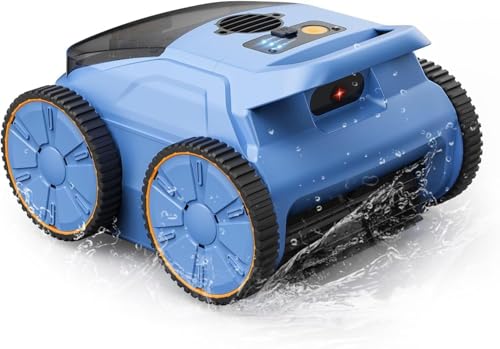
This is a cordless, battery-powered robotic pool cleaner intended to travel across pool floors and climb walls, then collect debris in a removable top-loading basket. The product documentation describes floor-only, wall-only, and combined modes, plus low-battery parking at the pool edge for retrieval with a hook. These are manufacturer-stated operating features, not independently performance-tested results. The published source manual tied to this product carries substantially more specific safety guidance than the sales copy, including GFCI-protected charging, a charger placed at least 12 feet from the pool, dry charging connections, and removing the cleaner before swimmers enter. That manual identifies the underlying unit as a Seauto-built SAT 20, with a 7,800 mAh battery, 300-micron filtration, and a stated 1.5 to 2.5 hour cycle. Those specifications conflict with several ABNEMEN claims, including 180-minute runtime and other listed dimensions and performance figures.
This product fits an owner of a relatively simple above-ground or in-ground pool who wants a cordless debris collector for routine floor and wall cleaning, can remove it before swimming, and has a suitable GFCI-protected charging location well away from the water. It is most appropriate where the pool bottom is smooth, unobstructed, and free of sharp steps or raised drain features that could trap the unit. The owner should be comfortable rinsing the basket after cycles and following battery storage instructions.
It is not for households that need a product to improve drowning prevention or restrict unsupervised child access. A robotic cleaner cannot substitute for compliant barriers, covers, supervision, or safe ladder access. It is also a poor fit for pools with sharp steps, pronounced raised drains, uneven floors, or features that can trap a moving cleaner. Buyers requiring independently listed electrical equipment, a clearly documented warranty, verified replacement parts, or consistent model-specific specifications should not rely on the available documentation alone.
The strongest safety information comes from the source manual rather than the sales claims. It calls for GFCI-protected charging, a dry charging port, the original charger only, a charger at least 12 feet from the pool, and removal of the cleaner before swimmers enter. It also warns against damaged batteries, crushing or opening the battery casing, and extension-cord use. The manual says the battery should go to a certified battery electronics recycler, not household waste. Material disclosure remains limited. ABNEMEN describes PVC brushes in one document, while its site describes an ABS and PC shell for a different or broadly presented pool vacuum. No model-specific third-party electrical listing, material safety documentation, or verified repair-parts catalog was identified. Cleaning and reusing the basket may reduce disposable filter use, but the lithium battery, unclear spare-parts access, and conflicting product specifications limit confidence about long-term service life and end-of-life handling.
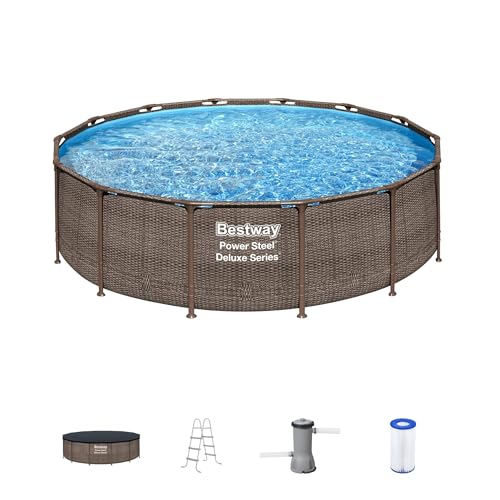
This is a round, 48-inch-deep above-ground framed pool intended for seasonal outdoor use. The product is stated to hold 4,024 gallons at 90 percent fill and includes a cartridge filter pump, a 48-inch ladder, and a debris cover. Bestway documents a comparable 14-foot by 48-inch Steel Pro MAX configuration with a 1,000 gallon-per-hour pump, Type III cartridge compatibility, a steel frame, and a three-layer reinforced liner. Its safety documentation is unusually detailed for this format. The manual specifies level-ground checks, a 90 percent fill line, seam and valve leak checks, barriers, GFCI-protected electrical supply, and ladder removal or securing when unattended. However, this product is from the 48-inch Steel Pro family and sales period covered by Bestway's 2025 compression-strap drowning recall. The owner must use the liner information and strap position to determine recall eligibility before use.
This product suits a seasonal backyard user with a genuinely level, well-prepared site, enough clear space for a 14-foot pool and a code-compliant barrier plan. It is appropriate only for a household prepared to manage testing, chlorine or other sanitizer selection, cartridge cleaning or replacement, and pump operation. The buyer should also be able to place the ladder on a solid base, use a grounded GFCI-protected outlet, and verify the product's recall status from the liner marking before filling it.
It is not suitable for a home where young children can reach the yard or pool area without continuous adult control, a compliant barrier, and secured or removed access equipment. Do not treat the included cover as child protection. It is also unsuitable for sloped, settling, soft, or poorly drained ground, for installations lacking correctly located GFCI-protected power, or for users seeking an independently certified filtration system. Anyone unable to confirm and complete any applicable compression-strap recall remedy should not put the pool into service.
The strongest health positive is the documentation. It calls for barriers, close supervision, no diving, secure or removed ladders, GFCI protection, grounded outlets, dry footing around electrical equipment, and inspection for unequal water height, leaks, sinking legs, or bulging walls. The ladder manual also specifies a solid base, one person at a time, and routine screw and corrosion checks. The central safety issue is the July 21, 2025 CPSC recall of certain Bestway 48-inch and taller Steel Pro pools with an external compression strap. That strap can become a child foothold, even if the ladder is removed. Confirm eligibility using the liner marking and Bestway's recall process. Ecologically, a 4,024-gallon fill and cartridge-filter operation create meaningful water, electricity, and filter-media demand. Repair is more practical than with a fully disposable pool because Bestway lists multiple replacement components, although detailed material chemistry and independent environmental certifications were not found.
This is a round, 15-foot by 48-inch framed outdoor pool set. Bestway states a 4,231-gallon capacity at 90% fill, a steel frame, a three-layer Tritech liner, a 1,000-gallon-per-hour cartridge filter pump, a ladder and a cover. Its product-specific manual gives detailed instructions for a level, load-bearing surface, water level, drainage, barriers, electrical clearance and daily water care. A critical fact defines this product: it is named in a 2025 U.S. recall list for 48-inch Bestway pools with an external compression strap. CPSC says that configuration can provide a foothold for a young child, even if the ladder is removed, creating a drowning hazard. The listed remedy is a free repair kit that replaces the strap’s structural function before the strap is removed.
It suits a household that can prepare a genuinely flat, firm outdoor site and can manage routine cartridge cleaning, water testing, chemicals and daily pump operation. It is also only appropriate where the owner can install and maintain the required local barrier protections, supervise swimmers closely and verify the pool’s recall status from the liner information. A buyer should be prepared to obtain the recall repair kit immediately if the pool has the affected external compression-strap layout.
It is not suitable for homes with young children or unsupervised access to the yard unless a compliant barrier, controlled entry and constant adult supervision are already in place. The included cover is not a safety cover, and removing the ladder alone does not address the recalled foothold hazard. It also does not suit sites with soft, sloped, poorly drained or uncertain load-bearing ground, or users unwilling to test water, maintain filtration and replace disposable cartridges regularly.
The key health issue is the active 2025 recall affecting this product. The recalled external compression strap can let a child climb into a 48-inch pool, and CPSC associates this hazard category with fatal drownings. Confirm the strap arrangement and the liner information before filling the pool, then obtain the free repair remedy if it is affected. The manual correctly emphasizes barriers, ladder removal or securing, supervision, GFCI-protected electrical connections and no diving. The pool uses a three-layer PVC liner and a corrosion-resistant steel frame, according to Bestway. Water treatment chemicals are not included, but the manual calls for chlorine, pH and related water management and warns that poor chemical handling can harm people and damage the liner. Its 4,231-gallon fill volume creates a substantial seasonal water burden. Cartridge filtration also requires regular cleaning and replacement, though repair patches and several pump replacement parts are available.
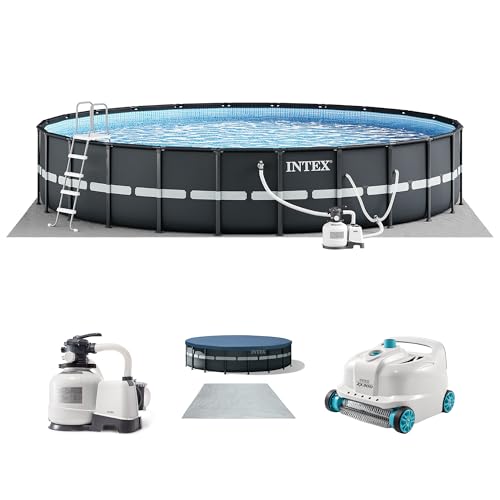
This is an 18-foot round, 52-inch-high framed outdoor pool. Intex states that it holds 6,981 gallons at its specified fill level and includes a ladder, cover, ground cloth, and a 110 to 120 volt sand-filter system. The catalog record's 700-gallon capacity is inconsistent with Intex's product page and should not be used for planning water, chemical, or electricity needs. Intex describes the structure as galvanized, powder-coated steel with composite T-joints and a 3-ply liner. Those are manufacturer claims, not published third-party structural or liner test results. The included SX2100 system is stated to provide 2,100 GPH pump flow and 1,600 GPH system flow, with a built-in GFCI and a claim of UL and CSA compliance. The listing includes no independently searchable certificate number.
This product suits a household with a large, level outdoor site, adult capacity to manage several thousand gallons of water, and a plan for code-compliant pool access control. It is most appropriate for users who will install the frame exactly to the manual, use the supplied sand filter, obtain the required filter media and water-treatment supplies, and routinely test chlorine and pH. It also suits owners who value the ability to obtain manufacturer replacement components instead of treating a damaged fitting or pump as disposable.
It is not suited to homes with unsupervised young children, frequent child visitors, or no practical way to add and maintain a perimeter barrier and secure or remove the access ladder. A standard pool cover is not enough access control. It is also unsuitable for sloped, soft, unstable, or poorly drained sites, renters without permission for a large temporary pool, and buyers seeking a low-maintenance product. Households unable to monitor water chemistry, filter condition, electrical setup, and seasonal storage should choose another arrangement.
The most important health issue is access control. CPSC guidance calls for barriers around above-ground pools and for ladders to be locked, secured, or removed when the pool is not in use. Intex's current recall notice also covers certain 48-inch and taller pools with exterior compression straps that can create a child foothold. The public notice does not establish that every product of this model is affected, so owners should check recall eligibility directly with Intex. Intex displays a Proposition 65 warning for BPA on both the pool and pump product pages. California identifies BPA as a reproductive toxicant, while the product pages do not identify the relevant part or exposure level. The pump's GFCI and stated UL and CSA compliance are favorable manufacturer claims, but an issuer-register result was not located. Sand media may last up to five years according to Intex, which can reduce filter-media waste, but this large pool still has a high water and electricity burden and requires ongoing disinfectant and pH control.
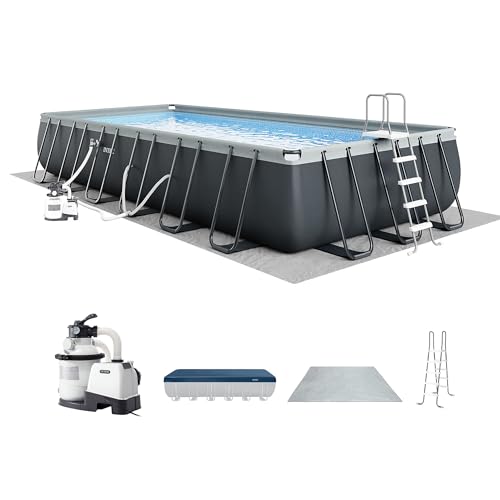
This is a 24 by 12 foot, 52-inch-deep framed outdoor pool with a stated 8,403-gallon capacity at 90 percent fill. Intex states that the set includes a ladder, cover, ground cloth, 3-ply liner, galvanized and powder-coated steel frame, and a 110 to 120V sand-filter system. The stated 2,100 GPH pump flow is not the same as delivered system flow. The compatible pump documentation lists 1,600 GPH system flow, a 12-inch sand tank, and a maximum pool capacity of 12,800 gallons. The central safety concern is access control. In July 2025, the CPSC recalled certain 48-inch and taller Intex pools with external compression straps because a strap can act as a child foothold. This product has been sold across several years, and Intex says post-2013 pools with straps inside leg sleeves are not included. The exact unit and sale revision must be checked against Intex's recall tool.
This product suits an owner with a large, level, compact outdoor site who can accommodate a 24 by 12 foot pool, perimeter clearance, drainage planning, and a compliant barrier. It is most appropriate where an adult can manage water chemistry, regular filtration, sand-filter backwashing, seasonal storage, and electrical setup. The owner should confirm that the specific pool revision is not affected by the compression-strap recall, or complete the free recall remedy before normal use.
It is not suited to households that cannot maintain locked child barriers and continuous close supervision around water, especially homes with toddlers or visiting young children. It is also unsuitable for uneven, soft, sloped, or poorly drained ground, or where local pool permits and barrier rules cannot be met. Do not treat the cover as fall protection. Users unable to provide a correctly grounded GFCI-protected electrical connection and routine chemical testing need a different arrangement.
The product manual addresses important foreseeable hazards, including barriers, supervision, level-ground installation, chemical handling, drainage, and winter storage. The pump documentation states built-in GFCI protection and UL and CSA standards compliance, although a model-specific listing was not independently located in a public certifier register during this review. Intex also posts a Proposition 65 BPA reproductive-harm warning. It does not disclose the affected component or quantified exposure. The pool requires a large initial fill of 8,403 gallons. Its sand filter avoids frequent disposable cartridge replacement, and Intex states that the sand can be replaced at five-year intervals. Backwashing, draining, evaporation, and seasonal water management still create meaningful water use. Repairability is a relative strength, because Intex currently lists replacement liners and many frame, hose, valve, and fitting components for this product. A 2025 CPSC recall covering certain tall pools with external compression straps remains the most important safety record to check before use.
This is a 33-inch-deep, rectangular above-ground pool with a steel frame and a separate PVC-polyester liner. Manufacturer documentation identifies a 450 x 220 x 84 cm footprint and a 7,127-liter water capacity. It is supplied as a pool-only configuration, without a pump, ladder, cover, ground cloth, or water-treatment supplies. The current product manual gives specific safety, leveling, fill-height, drainage, filtration, chemical-care, and seasonal-storage instructions. It warns that an uneven site or overfilling can collapse the pool and throw occupants out. The manufacturer also documents 32 mm pump connections and recommends a compatible filter pump with at least 1,250 liters per hour of flow, but does not include that equipment. Official replacement listings support repair of the liner, rails, legs, joints, pins, and drain fittings.
This product suits households that want a seasonal, shallow above-ground pool with a rectangular swim and play area, and that have a genuinely level outdoor site with room around all sides. It is most appropriate for buyers prepared to separately select a compatible filter pump, sanitation tools, ground protection, and access controls. Its documented 7,127-liter capacity and 33-inch wall height fit supervised family use better than diving or serious lap swimming. The owner should be ready to follow daily water-care and seasonal drying and storage procedures.
It is not suited to homes with unsupervised young children, pets, or uncontrolled yard access unless a compliant barrier, locked or removable entry arrangement, alarms where appropriate, and continuous supervision are already in place. It is also unsuitable for sloped, rocky, flood-prone, or poorly drained ground, because the manual links uneven installation and overfilling with wall damage and collapse risk. Buyers wanting an all-in-one package should look elsewhere, since filtration, a ladder, cover, ground cloth, chemicals, and testing supplies are not included.
The product manual contains meaningful pool-safety content. It calls for adult supervision, barriers, removal of toys, clear water, rescue equipment, and keeping climbable items away from the pool. It also requires level ground, limits the fill height, and says filtration should turn over the water at least once daily. These are instructions, not built-in protective hardware. A cover or barrier does not replace supervision, and this pool does not include either a cover or a ladder. The liner is manufacturer-described as three-layer laminated PVC-polyester, with epoxy-finished steel framing. No included sanitizer means there is no treatment-chemical exposure from the package itself, though chlorine or other chemicals will be needed in use and must be stored safely. The 7,127-liter capacity creates a substantial fill and drainage burden. The manual instructs owners to follow local drainage rules, dry the product before storage, and use replacement parts where needed. Official parts availability can reduce premature disposal.
This is a round, seasonal above-ground pool with a metal frame, a 14-foot diameter, and 42-inch wall height. The product set is described as including a cartridge filter pump, ladder, cover, liner, and repair patch. Bestway's archived product information describes corrosion-resistant metal framing, a Seal and Lock pipe connection system, a three-layer PVC and polyester wall construction, and a drain valve that accepts a garden-hose adapter. Those are manufacturer statements, not published third-party test results. The manufacturer source gives a 90 percent-fill capacity of 3,440 gallons. That conflicts with the 2,941-gallon figure in the marketplace record, so owners should use the fill line and product manual rather than relying on the listing's capacity number. The set is shallow enough that diving is inappropriate, and it needs a properly level, well-drained outdoor site.
This product suits a household seeking a temporary warm-weather pool with a roughly 14-foot round footprint and room to prepare a genuinely level site. It fits users ready to manage water testing, sanitizer, cartridge cleaning, drainage, and seasonal storage themselves. It is also better suited where adults can control access every time the pool is unattended, and where the local pool-barrier and electrical requirements have been checked before installation.
It is not suited to homes with toddlers, wandering children, or unsupervised visitors unless a compliant access barrier and secured or removed ladder are added. The supplied cover should not be treated as a child safety cover. It also does not suit uneven, soft, poorly drained, or sloped yards, because the instructions require square verticals and extra load spreading on soft surfaces. Choose another arrangement if dedicated electrical protection, routine cartridge maintenance, and seasonal teardown are impractical.
The key health issue is access control. CPSC guidance says above-ground pool ladders should be secured, locked, removed, or enclosed when the pool is not in use. The available product information confirms a cover and ladder, but does not verify an ASTM F1346 safety-cover rating or a child-resistant ladder mechanism. A 2025 Bestway recall covered certain 48-inch and taller pools with exterior compression straps. This 42-inch product is outside that stated height range. Bestway describes the liner as PVC with polyester reinforcement and offers compatible replacement support legs, which can extend service life after a component failure. No sanitizer is identified as included, so chemical selection and safe dosing remain the owner's responsibility. The pool holds thousands of gallons and uses disposable cartridge filtration. Published pump wattage, realistic energy use, and replacement-water expectations were not found, so its operating resource burden cannot be quantified reliably.
This is a seasonal, soft-sided rectangular above-ground pool with a stated 18 by 9 foot swim area and 47 inch wall height. Seller materials state a 3,848 gallon capacity, galvanized steel frame, 3-ply PVC liner, removable ladder, cover, repair patches, and a 300 GPH filter pump. The outside footprint is stated as about 20 feet 11 inches by 11 feet 3 inches. The key limitation is evidence depth. The construction and accessory details are seller or manufacturer-stated, not supported by a published model-specific test report, installation manual, warranty, or identifiable third-party certification. The stated pump flow would equal roughly 12.8 hours for one theoretical full-volume turnover at 3,848 gallons, before real installation losses. That makes disciplined water testing, sanitizer control, and filter maintenance especially important.
It suits a household with a level, appropriately prepared outdoor area that wants a seasonal rectangular pool for supervised family recreation and has room for an outside footprint near 21 by 11 feet. It is most appropriate for an owner prepared to add the missing safety layers, including a compliant local barrier plan, secure ladder storage, GFCI-protected electrical supply, water-test supplies, sanitizer, and routine cartridge or filter maintenance. The listed repair patches may also be useful to a buyer comfortable handling minor liner repairs.
It is not appropriate for homes where young children can access the yard without a separate, code-compliant barrier and reliable ladder control. A removable ladder alone is not a complete drowning-prevention system. It also does not suit buyers who need documented electrical listing of the pump, independently published structural testing, or a verified safety-rated cover. Avoid this format where the ground cannot be made level and stable, where electrical installation cannot use suitable GFCI protection, or where the owner cannot test and manage pool chemistry routinely.
The stated PVC liner and galvanized-steel frame are conventional pool materials, but no material safety data, Proposition 65 disclosure, seam-test data, UV-aging report, or product-specific independent chemical certification was located. No sanitizer or other treatment chemical is identified as included. The manufacturer-stated removable ladder is useful only when it is secured or removed while the pool is unattended. Federal guidance also calls for a surrounding barrier and active supervision. The included cover is not documented as a safety cover. The listed 3,848 gallon capacity represents a meaningful water commitment. At the stated 300 GPH pump rating, one theoretical turnover takes about 12.8 hours, without accounting for filter loading or plumbing resistance. No pump wattage, flow curve, cartridge specification, replacement-parts catalog, or run-time guidance was found, so energy use and filter waste cannot be quantified. No SunSwell-specific CPSC recall or warning was located in the sources checked, but the absence of a found record is not independent certification of this product.
This is a large, non-inflatable, rectangular backyard pool with a removable canopy. The product record states a 167 by 81 by 26 inch water area and 1,522-gallon capacity. An independent marketplace listing for the same Pool002 model confirms PVC construction, a foldable format, a canopy, and a claimed four-to-six-person use case. The product is supplied as a pool, canopy, and manual, with no pump, filter, ladder, cover, sanitizer, or electrical equipment identified in the available component information. That keeps its supplied electrical risk limited, but leaves water circulation, sanitation, and access control to the owner. No model-specific laboratory report, safety certification, warranty terms, replacement-parts catalog, or verified structural load and seam-testing documentation was located.
This product fits a household that wants a temporary, large-format splash and lounging pool without inflation, and that has a genuinely level outdoor area large enough for the stated footprint. It is most appropriate for adults or supervised older children in a controlled yard where the owner can provide a compliant barrier, active supervision, water testing, sanitation, and a drainage plan. The foldable PVC format may also suit seasonal users who need to store the pool when drained and dry.
It is not suited to homes where young children, visiting children, or unsupervised pets can reach the yard, unless a separate local-code-compliant barrier and access plan are already in place. It is also a poor fit for buyers expecting an all-in-one swimming-pool system, because no filtration, pump, ladder, safety cover, or sanitation package is identified. Avoid using it on sloped, soft, uneven, or poorly drained ground, or where its large water volume cannot be safely filled, treated, drained, and stored.
The material is identified as PVC by both the product record and an independent marketplace listing. No treatment chemicals, pump, filter, or electrical equipment are identified as included. That avoids unverified claims about chemical systems or electrical certifications, but it also means the owner must establish safe water maintenance. CDC guidance calls for routine chlorine and pH testing, and a pool of this stated volume should not be treated as disposable splash water after repeated use. No product-specific CPSC recall or public exposure warning was located in the sources reviewed. That is not independent proof of safety. No NSF pool-equipment certification, third-party structural report, PVC chemical disclosure, repair-parts catalog, or warranty terms were found for this model. The large claimed capacity can create substantial water-use and drainage burdens, especially if water must be replaced because filtration and sanitation are not added.
This is a battery-powered, handheld pool vacuum for manually collecting leaves, sand, and other settled debris. It uses a vacuum head, reusable filter bag, and telescoping pole rather than connecting to the pool’s circulation plumbing. The available product manual identifies a 9.37-inch vacuum head, a pole adjustable from 35.8 to 87.5 inches, and a unit weight of 6.38 pounds. Those are manufacturer documentation, not independently tested performance figures. The stated 20-volt, 36 Wh lithium-ion battery, 18.5 gallon-per-minute maximum flow, 1.5-liter debris capacity, 1.5-hour charge time, and up to 60-minute runtime are manufacturer claims. A model-specific manual with safety, assembly, charging, troubleshooting, and maintenance sections was located. No model-specific UL, ETL, CSA, NSF, or other independently searchable certification was found in the reviewed sources.
This product suits an above-ground pool owner who needs manual spot cleaning of leaves, grit, or small debris from the floor and corners, especially where connecting a hose vacuum to the existing filter system is inconvenient. It is most relevant for a buyer able to lift and guide a 6.38-pound tool on a pole, empty and rinse its filter bag, and follow the documented charging precautions. The claimed one-hour runtime may fit periodic debris pickup, rather than unattended whole-pool cleaning.
It is not for households seeking a product that provides child-access control, drowning prevention, pool-wall stability, entry safety, or water sanitation. It also does not replace a correctly sized circulation pump, filter, sanitizer, testing routine, or local pool-barrier requirements. Buyers who require independently listed electrical equipment, independently verified performance, a clearly documented material chemistry, or confirmed availability of replacement batteries and parts should not treat the available documentation as sufficient proof. Children should not operate or charge it without responsible adult supervision.
The available manual directs users to keep people and animals out of the pool during operation, to use the supplied charger, keep the charging connection dry, and charge away from water. These are meaningful operational precautions for a rechargeable device used around a pool. The product’s battery-powered format also avoids running a separate mains-powered cleaning motor in the water during use. However, no model-specific listing in the reviewed UL, ETL, CSA, or NSF sources was identified, and no independent laboratory report was located for electrical safety, suction performance, battery safety, or filtration. Searches did not identify a product-specific CPSC recall or Proposition 65 exposure warning. Plastic and polypropylene are disclosed, but detailed polymer, coating, and chemical information is absent. The manual describes filter-bag maintenance and a limited warranty, while replacement-part availability and battery end-of-life support remain unverified.


