Best Overall
13% off

Bestway Steel Pro MAX 15' Round Pool Set
Sturdy steel frame ensures long-lasting durability.
Includes essential accessories for easy setup.
Spacious design perfect for family use.
 Daniel Kenitz
Sturdy steel frame ensures long-lasting durability.
Includes essential accessories for easy setup.
Spacious design perfect for family use.

Durable steel frame ensures long-lasting use.
Easy setup with minimal tools required.
Spacious design accommodates family fun.

Easy assembly and sturdy metal frame.
Includes flow control valve for draining.
Spacious design for family enjoyment.

Easy-to-use automatic timer simplifies pool maintenance.
High-efficiency filtration with 3000 GPH flow rate.
Durable construction ensures long-lasting performance.
Durable metal frame ensures long-lasting use.
Easy setup and maintenance with filter pump.
Includes pool cover and extra filter cartridges.

Sturdy metal frame ensures long-lasting durability.
1500 GPH filter pump keeps water clean.
Includes ladder and cover for convenience.
Easy to assemble and disassemble quickly.
Sturdy, puncture-resistant materials for long-lasting use.
Includes efficient 530 GPH cartridge filter pump.

Easy setup with pre-assembled core.
Efficient filtration for large pools.
Durable, leak-resistant design.

Retains heat effectively for warmer pool water.
Durable 12 mil thickness enhances longevity.
Fits both inground and above ground pools.

Easy to set up and fold away.
Provides shade with included canopy.
Spacious design accommodates multiple adults.
Start with the installation requirements. A pool needs a firm, level, prepared site, and the supplied reviews repeatedly warn that uneven or unsuitable ground can stress seams, bend frames, or cause collapse. Compare the stated capacity with the actual fill level and the pump’s **system flow**, not only its headline pump-flow number. A nominal turnover calculation can be misleading: restrictions from hoses, fittings, dirty cartridges, sand, and elevation reduce real-world flow. Filtration also does not disinfect water. Owners still need a compatible filter, regular disinfectant and pH testing, and clear chemical-use instructions.
Electrical equipment deserves separate scrutiny. A GFCI, or ground-fault circuit interrupter, helps reduce shock risk, but it is not the same as independent certification. For an included pump, filter, or chlorinator, look for a current, model-specific listing in **UL Product iQ**, the **Intertek ETL Listed Product Directory**, or the **CSA Group Product Listing database**. The relevant safety standard is **UL 1081**, alongside **NFPA 70 Article 680** and locally adopted electrical rules. A manufacturer’s statement that a product is “UL,” “CSA,” or “ASTM compliant” is weaker than a traceable listing for the exact electrical model or pool configuration.
Physical access control is another essential distinction. A cover is not automatically a safety cover, and a pool wall, removed ladder, or floating solar blanket is not a four-sided barrier. Look for a documented barrier and access solution that fits local residential-pool code, conspicuous warnings, secure ladder control, and instructions for missing or damaged suction covers. Buyers should also check the **CPSC Recalls** database and **SaferProducts.gov**, particularly for tall frame pools with exterior compression straps. The supplied reviews identify a July 2025 recall involving certain 48-inch-and-taller Bestway, Intex, and Polygroup pools whose straps could form a foothold for children.
For structural claims, credible evidence means an exact-model report or certification addressing the stated configuration, not just descriptions such as “puncture resistant,” “corrosion resistant,” or “heavy duty.” Relevant reference points include **ASTM F2666-16(2024)** and **ANSI/APSP/ICC-4**, supported where possible by an **ISO/IEC 17025-accredited laboratory** report. Material claims should identify the liner, frame coating, and accessories clearly; a trade name alone does not establish chemical composition or swimmer-contact safety.
Common headline figures also need context. Capacity may be quoted at 80% or 90% fill, dimensions may conflict across a listing, pump flow may be stated before system losses, and a large pool may include only a basic filter with no test kit or sanitizer. “Solar” covers can reduce evaporation when used properly, but they are not child barriers and must be completely removed before swimming.
Across the supplied products, the recurring safety caveats are substantial: every pool requires active supervision and a separate, code-compliant access barrier; no included cover should be assumed to prevent drowning; water treatment requires testing and disinfection; treated water should not be discharged untreated to storm drains or waterways; and several products lack publicly traceable exact-model electrical, structural, or material testing. The recalled tall-pool configurations require particular caution and completion of the stated repair before use.
The supplied reviews assess pools and related equipment against access control, containment, electrical safety, water care, material disclosure, environmental handling, durability, and evidence quality. Scores are most useful for comparing documented strengths and weaknesses; they do not remove the need to follow the exact manual, local code, recall instructions, and water-treatment requirements.
This measures whether the pool, ladder, warnings, and included access controls reduce unsupervised child entry. High-scoring products in the set generally had clearer warnings or lower recall exposure, while low-scoring 48-inch products were affected by the July 2025 compression-strap recall. No supplied pool included a complete substitute for a code-compliant barrier, supervision, and controlled ladder access.
This covers resistance to collapse, leaks, punctures, and corrosion under filled-pool loads. The stronger supplied scores were associated with stated steel frames, multilayer liners, repair information, or more consistent specifications, but even those reviews often lacked exact-model independent load or puncture testing. Marketing terms such as “durable” or “puncture resistant” do not establish performance without configuration-specific evidence.
This measures whether drains, suction fittings, and pumps are configured to reduce hair, limb, or body entrapment. Higher-scoring products provided clearer warnings about missing or damaged suction covers or included documented suction-related information. Lower-scoring pool-only and incomplete systems leave the buyer to verify compatible fittings, covers, flow, and installation; filtration alone does not prove entrapment protection.
This measures whether included electrical equipment has a current, exact-model independent safety listing and suitable GFCI-compatible installation instructions. The supplied scores were generally higher for products with stated GFCI protection, but several reviews could not trace a UL, ETL, or CSA directory record for the exact pump. A GFCI feature or compliance statement is useful, but it is not the same as a verified NRTL listing.
This measures whether pump flow, filtration, turnover guidance, testing, and disinfection instructions match the pool’s actual volume. The best-supported systems included concrete system-flow figures and serviceable cartridges or sand filters. Lower-scoring or pool-only products required the buyer to supply circulation and sanitation equipment. Even the better-equipped sets did not make a chemical dispenser or filter a substitute for measured chlorine and pH control.
This measures disclosure of swimmer-contact materials, frame coatings, accessories, warnings, and supporting test information. The supplied scores were modest to moderate because products commonly identified PVC, vinyl, steel, or a trade-name material without detailed formulations or accredited chemical testing. A higher score reflects clearer basic material disclosure and warnings; it does not mean that every additive or exposure route has been independently characterized.
This measures whether capacity, dimensions, depth, flow, materials, and safety claims are specific, consistent, and supported. Higher-scoring products had corroborated dimensions, manufacturer manuals, or internally consistent flow calculations. Lower scores reflected conflicting marketplace dimensions, contradictory pump ratings, unsupported health or durability claims, and capacity figures that did not explain fill level or real-world operating conditions.
This measures whether a qualified independent body verifies the exact pool or electrical component. The supplied products generally scored lower to moderate because reviews often found no publicly traceable model-specific certification or accredited laboratory report. A statement of ASTM, ANSI, UL, or CSA compliance is not equivalent to a current directory entry or an ISO/IEC 17025 report identifying the exact tested model and configuration.
This measures whether the manufacturer or importer, model, safety documents, and corrective-action history can be identified and checked. Higher-scoring products had clearer manufacturer identity, model information, parts support, or no located recall match. Lower scores were associated with products directly implicated in the July 2025 tall-pool compression-strap recall. A recall search is necessary but cannot establish that an unlisted product is fully safe.
This measures whether the product provides capacity-matched draining, dechlorination, and discharge guidance. The stronger scores came from products with clearer seasonal drainage or general water-care instructions, while many reviews noted that local rules still had to be checked. Treated pool water, backwash water, chlorine, bromine, and salt should not be released casually to soil, storm drains, or waterways.
This measures quantified pump operation, duty-cycle, power, flow, cover, evaporation, and heat-retention claims. The solar cover scored relatively well because EPA supports the general evaporation-reduction benefit of properly used pool covers, although its specific temperature claim lacked testing. For pools, a timer or nominal flow number is not proof of low energy use without rated power and operating guidance.
This measures whether liners, pumps, filters, frames, seals, patches, and other parts can be repaired or replaced instead of discarding the pool. The strongest supplied scores belonged to products with model-specific parts catalogs, replacement cartridges, or repair patches. A warranty alone is weaker evidence when it excludes punctures, chemical damage, fading, or installation problems, and several products had little or no documented repair pathway.
This is a round, seasonal above-ground pool with a stated 15-foot diameter, 48-inch wall height and 4,231-gallon capacity at 90% fill. The set includes a 1,000-gallon-per-hour cartridge filter pump, ladder and cover. Bestway states that the frame is corrosion-resistant steel with ClickConnect joints and that the liner is a three-layer Tritech material. Those durability comparisons are manufacturer claims, not publicly traceable independent test results. The supplied product manual gives unusually detailed installation, barrier, suction and electrical instructions, including GFCI guidance and a warning not to use the pool if a suction cover is missing. A critical qualification applies to this older 48-inch Steel Pro family. A July 21, 2025 CPSC recall covers affected 48-inch and taller Steel Pro pools sold through 2024 with exterior compression straps, because the strap can form a child foothold. Confirm the strap layout and obtain the repair if applicable.
This product suits a household seeking a large, temporary backyard pool and able to prepare a level, firm site, manage roughly 4,231 gallons of water, test and disinfect that water regularly, and follow local fencing and electrical rules. It is most appropriate where responsible adults can supervise every use, a compliant access barrier can be installed, and the exterior frame can be inspected to confirm whether the 2025 compression-strap recall remedy is needed. Buyers should also be prepared to maintain or replace a cartridge filter.
It is not suitable for homes where young children could reach the pool without a four-sided barrier, locked or removed ladder, and close adult supervision. Do not use an affected exterior-compression-strap version until the recall repair has been obtained and installed. It also does not suit sites with soft, sloped or poorly drained ground, locations near overhead electrical lines, or households unable to maintain disinfectant and pH testing. Anyone expecting a permanent pool, long component warranty, or independently documented liner performance should choose a different format.
The manual contains meaningful safety information. It calls for barriers, direct supervision, ladder removal or securement, GFCI-protected electrical supply, dry footing around electrical equipment, and immediate avoidance of the pool when a drain or suction cover is absent. The manual also states that the supplied circulation equipment should be NRTL-tested to UL 1081, but a public certification record for the exact included pump was not located. The major health issue is the July 21, 2025 CPSC recall of certain 48-inch and taller Steel Pro pools with exterior compression straps. The strap can act as a foothold even after the ladder is removed. For water quality, filtration alone is insufficient. CDC guidance calls for routine chlorine and pH testing and adjustment. The product has a drain valve, but its instructions do not explain dechlorination. Treated water should not be directed to storm drains or waterways, where chlorine can harm aquatic life.
This is a pool-only, rectangular above-ground pool with a steel tube frame and a 32-inch wall height. Bestway’s current catalog identifies this configuration as 13 feet 1 inch by 6 feet 11 inches by 32 inches, with a stated 1,506-gallon capacity at 90 percent fill. The catalog lists no filter pump, ladder, cover, or electrical equipment for this version. The liner is described by Bestway as DuraPlus, a three-layer PVC construction, and the frame as corrosion-resistant steel using FrameLink joints. Those are manufacturer disclosures, not independently published material or load tests for this exact configuration. The product includes a repair patch according to the product documentation. It needs a level, prepared site and separately selected circulation, filtration, sanitation, testing, and access-control measures before regular use.
This product suits a household seeking a seasonal, modest-depth splash and play pool in a limited outdoor area, where an adult can prepare a genuinely level base and manage separate water-care equipment. It is most appropriate when the buyer already has a concrete plan for a compatible pump and filter, disinfectant, testing supplies, local barrier requirements, and end-of-season storage. The pool-only format can also suit users who prefer to select those accessories separately rather than accept a bundled electrical system.
It is not suitable as an unattended water feature or for homes that cannot create effective child access control. Households with toddlers, visiting children, or pets need a code-compliant barrier strategy, restricted access, and constant capable adult supervision, not reliance on the pool wall. It also does not suit buyers expecting a complete ready-to-swim system. Without separately sourced circulation, filtration, water testing, and disinfection supplies, the stated water volume cannot be managed responsibly for repeated use.
The key health limitation is that this is a pool-only package. Bestway’s catalog shows no bundled pump or electrical component, so there is no listed pump certification to verify. That avoids risks associated with an included electrical appliance, but it transfers the important decisions about circulation, filtration, compatible suction fittings, and installation to the owner. CDC guidance calls for routine chlorine and pH testing, with the right equipment and chemical labels followed closely. The July 21, 2025 CPSC recall for certain Bestway pools concerned pools 48 inches and taller with external compression straps. This 32-inch product is outside that height scope, but it still needs local barrier compliance and supervision. Bestway publishes a 180-day Steel Pro warranty and parts support, while the included repair patch may help with small liner damage. Treated pool water should not be sent to storm drains or waterways. EPA guidance notes that chlorine, bromine, and salt can harm aquatic life, so drainage should follow local rules and appropriate dechlorination practices.
This is a rectangular, seasonal above-ground pool with a steel support frame and a 33-inch wall height. The product is supplied as the pool and frame only, not as a working filtration package. Intex's catalog for this exact size states a 7,127-liter, or 1,883-gallon, capacity at 90% fill. The manufacturer also describes heavy-duty PVC and polyester three-ply side walls and a flow-control drain valve. The documented size is 14 feet 9¼ inches by 7 feet 2⅝ inches by 33 inches. Its manual calls for a firm, level site, adult supervision, a separate child-access barrier, water treatment and seasonal draining and storage. No publicly traceable independent structural test report, exact-product certification, or electrical listing applies to this pool-only configuration. A filter, pump, compatible suction fittings, testing supplies and disinfection system must be selected separately.
This format suits a household that wants a seasonal, shallow recreational pool with a defined rectangular footprint and has a genuinely level, cleared setup area. It is most appropriate where an adult can actively supervise use and where the owner is prepared to add a compatible, safety-listed circulation and filtration system, water-test equipment and disinfectant. It also fits buyers who can drain, disassemble and store the pool before freezing conditions, while retaining the manual and proof of purchase for parts or warranty support.
It is not suitable as an unattended water feature, or for homes that cannot create and maintain an effective local-code-compliant barrier around the pool. Families with toddlers, wandering children or unauthorized neighborhood access need a documented access-control plan before filling it. It is also unsuitable for anyone expecting an all-in-one pool system, because no pump or filtration equipment is included. Avoid this format where the ground cannot be made level, where seasonal draining is restricted, or where the owner cannot routinely test and maintain disinfectant and pH.
The central health issue is access control. The manual calls for continuous adult supervision and a safety barrier, but neither a barrier nor a pump is included. The July 21, 2025 CPSC recall involved Intex and other 48-inch-and-taller pools with external compression straps that could form a child foothold. This 33-inch product is not within that height-defined recall, but its lower wall still cannot substitute for a controlled barrier. Water quality is owner-dependent. CDC guidance calls for routine chlorine and pH testing, yet this product requires separately selected circulation, filtration and sanitation equipment. The stated liner material is PVC and polyester three-ply construction, with no publicly traceable exact-product material test report found. Seasonal storage guidance can reduce freeze damage, and replacement frame parts are cataloged. For ecological handling, treated water should not simply be sent to a storm drain. EPA materials support dechlorination and compliance with local discharge rules.
This product is an above-ground-pool sand-filter pump package, not a swimming pool. It includes a 16-inch sand tank, a 0.75 HP pump, a six-function valve, two 1.5-inch connector hoses, and two additional replacement hoses in the marketplace bundle. It is intended to circulate water through sand or compatible glass media, with filter, backwash, rinse, recirculate, drain, and closed settings. Intex states a pump flow of 3,000 gallons per hour and a system flow of 2,450 gallons per hour, for pools holding 5,500 to 19,600 gallons. The manufacturer also states that the 110 to 120 V unit has an integrated GFCI and meets UL and CSA standards. Those certification claims could not be independently matched to a publicly traceable listing for this exact product. The catalog's 25 GPM figure conflicts with Intex's stated 3,000 GPH pump flow, about 50 GPM.
This product suits an owner of a compatible above-ground pool with 1.5-inch connections and roughly 5,500 to 19,600 gallons of water who wants a sand-media circulation system with scheduled daily operation. It is most appropriate for a household prepared to install it on a correctly protected outdoor electrical supply, follow the setup manual, monitor pressure and flow, clean the strainer basket, and independently manage disinfectant, pH, and water testing. The available replacement-part support also matters for an owner expecting to maintain the system over multiple seasons.
It is not for someone buying a complete pool or a child-safety solution. It includes no barrier, alarm, compliant ladder-control feature, or supervision substitute, and local pool-barrier rules still apply. It is also unsuitable for pools outside the stated capacity range, pools without compatible 1.5-inch plumbing, or installations lacking a suitable GFCI-protected outdoor electrical arrangement. Buyers who need independently public, model-specific certification records, full material disclosure, or detailed dechlorination and wastewater instructions will find important evidence gaps.
Intex identifies this as a 110 to 120 V pump with a built-in GFCI and states that it meets UL and CSA standards. The product documentation also describes a strainer arrangement and installation steps intended to keep large debris from reaching the pump. However, the exact electrical certification could not be independently confirmed through a publicly accessible listing, so the manufacturer statement should not be treated as a substitute for checking the product label and installation instructions. Filtration and circulation can support cleaner water, but they do not disinfect it. CDC guidance calls for routine disinfectant and pH testing, with chlorine or bromine maintained within appropriate ranges. The drain function also creates an environmental responsibility. Chlorinated or otherwise treated pool water should not be sent to storm drains or waterways, and local disposal rules should be checked. Intex maintains replacement parts and a two-year limited warranty, which can reduce premature replacement. A major 2025 Intex pool recall concerned certain separate 48-inch and taller pools with external compression straps, not this pump product.
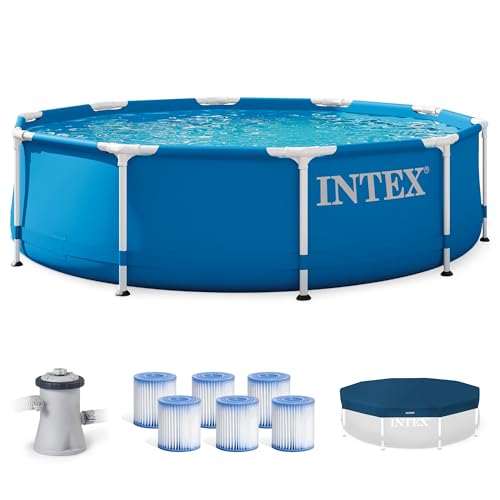
This is a round, steel-frame outdoor pool with 30-inch walls, a cartridge filter pump, a cover, and six replacement cartridges. Intex identifies the pool as a 10-foot by 30-inch model, intended for users age 6 and older. Its manufacturer-stated water capacity is 1,185 gallons at 90 percent fill, not the 1,718 gallons stated in the catalog record. Intex states that the included 100-120V pump has a 330-gallons-per-hour flow rating and an integrated GFCI. The pool uses powder-coated steel framing and laminated sidewalls, according to Intex. Publicly traceable, model-specific independent structural test reports and electrical listing records were not located during this review.
This product suits a household seeking a compact seasonal pool for supervised play by swimmers age 6 and older, with level ground, a nearby properly grounded outdoor electrical setup, and a plan to test and treat water. It is most appropriate where the owner can install any locally required fence or barrier separately, monitor children continuously, clean or replace cartridges regularly, and store the pool at season end. The available replacement-part catalog is useful for owners willing to repair common wear items rather than discard the pool after a fitting or frame-part failure.
It is not suited to homes with unsupervised young children, open yard access, or no practical way to add a compliant barrier and follow local pool rules. The cover should not be treated as an anti-drowning device. It is also a poor fit for buyers who need independently traceable electrical certification, documented material testing, or fully specified chemical-discharge and energy-use guidance. Households unable to test disinfectant and pH regularly, safely handle pool chemicals, or keep ill swimmers out of the water should not rely on this product as a low-maintenance water feature.
The pump documentation and Intex product page describe GFCI protection, and the pump manual calls for a grounded outlet, testing the GFCI, keeping the pump away from the pool, and avoiding extension cords. The 2025 CPSC recall involving Intex covered pools 48 inches and taller with external compression straps. This 30-inch product is outside that stated size scope, but it still needs a separate access barrier and continuous supervision. Healthy operation depends on owner maintenance, not filtration alone. CDC advises routine disinfectant and pH testing, with pool pH of 7.0 to 7.8 and at least 1 ppm free chlorine, or at least 2 ppm when cyanuric acid is used. Intex posts a Proposition 65 BPA reproductive-harm warning for the pool and cartridges. Replacement parts and cartridges are available, which can reduce premature disposal, but public guidance specific to dechlorinating and responsibly discharging this pool's water was not located.
This is a 20 by 12 foot, 48-inch-deep oval framed pool for outdoor seasonal use. Manufacturer materials describe roughly 5,347 gallons at the stated fill level, a steel frame, PVC-based liner, ladder, cover, and a cartridge filter pump. The stated system flow is 1,050 gallons per hour, which works out to about 5.1 hours for one nominal full-volume circulation under rated conditions. Its defining safety fact is a confirmed CPSC recall announced July 21, 2025. Bestway Power Steel pools 48 inches and taller sold from 2008 through 2024 are recalled when compression straps run outside and over the support legs. The straps can act as child footholds, even with the ladder removed. The exact product needs visual confirmation of its strap layout and, if affected, the free recall repair before use.
This format fits an adult household that has a genuinely level, well-drained outdoor site, enough clearance for the full oval frame, and a practical routine for testing water chemistry, cleaning or replacing cartridges, and supervising every swim. It is most appropriate where the exterior compression strap has been inspected, or the applicable recall repair has been completed. The stated 5,347-gallon capacity offers a substantial seasonal swimming space without excavation, but it also requires planned circulation, chemical handling, and end-of-season drainage.
It is not suitable for homes where toddlers or other unsupervised children can reach the yard, unless a compliant barrier, controlled access, and the applicable recall remedy are already in place. Removing the ladder alone is not enough for an affected exterior-strap design. It also does not suit sites with uneven, soft, poorly drained, overhead-wire, or tree-obstructed ground. Households unable to test disinfectant and pH frequently, maintain the cartridge filter, or manage several thousand gallons of treated water should not treat this as a low-maintenance setup.
The central health issue is the July 21, 2025 CPSC recall for certain 48-inch and taller Power Steel pools sold through 2024. An exterior compression strap can become a foothold for a young child. The remedy replaces its structural role with a ground-level rope, then requires removing the exterior strap. A ladder and cover do not substitute for supervised use and a local-code-compliant barrier. The manufacturer manual for the supplied pump specifies GFCI protection and testing, but independent public confirmation for the exact pump certification was not established. Steel and PVC are identified, yet no exact-product accredited material report or detailed swimmer-contact chemical disclosure was found. A cover and replaceable accessories can reduce premature disposal, though the 180-day warranty is short. Maintain disinfectant and pH, clean filtration, and do not release chlorinated water to a gutter or storm drain.
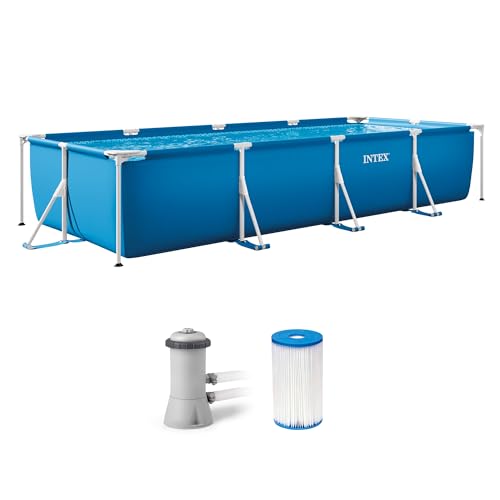
This is a rectangular, soft-sided above-ground pool with a steel support frame, PVC-based three-ply liner, and a 33-inch wall. The manufacturer catalog states a 14-foot 9-inch by 7-foot 2-inch footprint, 1,883-gallon capacity at 90 percent fill, and a supplied 110-120V, 530-gallon-per-hour cartridge pump with GFCI protection. The pump is a practical size for the stated water volume, although healthy water still depends on owner-supplied disinfectant, pH control, and frequent testing. Intex lists replaceable Type A cartridges and a currently available substitute pump motor. The product does not include a barrier, cover, ladder, test kit, or treatment chemicals. Its 33-inch height puts it outside the scope of the July 21, 2025 CPSC recall, which covered certain 48-inch-and-taller pools with exterior compression straps.
This product fits a household that wants a seasonal, shallow family pool on a level outdoor site and can manage routine pool care. It is most suitable where an adult can install code-appropriate access barriers, supervise every swim, test chlorine and pH at least twice daily, clean or replace cartridges, and drain water responsibly at season end. The rectangular footprint suits play and lounging better than serious lap swimming, while the 33-inch wall keeps entry simpler than a tall frame pool.
It is not suitable for homes with young children or unsupervised visitors unless a compliant four-sided barrier, self-closing gate, and reliable access control are already in place. A 33-inch wall is not a substitute for a barrier. It also does not suit buyers seeking a complete water-care package, independently published structural testing, a supplied cover, or low-maintenance filtration. Avoid installing it on uneven ground, near unprotected electrical connections, or where local pool, drainage, HOA, or rental rules prohibit it.
The key health issue is access control, not the 33-inch wall or the pump. CDC guidance calls for a four-sided fence that separates a backyard pool from the house, self-closing and self-latching gates, close supervision, and routine chlorine and pH testing. This product supplies none of the barrier or testing equipment. Its supplied pump is manufacturer-stated to have GFCI protection, but no public NRTL registry record was located for the exact supplied configuration. The liner is disclosed as three-ply PVC, while fuller chemical and coating disclosure was not found. Intex has official replacement support for the filter cartridge and pump motor, which can reduce disposal after routine component failure. The July 21, 2025 CPSC compression-strap recall applied to certain 48-inch-and-taller pools, not this 33-inch product. For drainage, treated water should be dechlorinated or allowed to dissipate disinfectant before discharge, and local stormwater rules still apply.
This is a compact, above-ground-pool sand filter and circulation pump, built around a 12-inch polypropylene filter tank and a six-way valve. VEVOR identifies the unit as model HCP370A and states a 0.33 HP motor, 3,000 GPH maximum flow, 30-foot maximum head, and 1.5-inch NPT ports. Filter media are not included. The available manufacturer documentation supports routine filtration, backwashing, rinsing, waste discharge, winterizing, and closed-valve modes. It also gives installation and pressure-related warnings, including placing equipment where it cannot be used as a child’s route into the pool. The important limitation is verification. No current, exact-model UL, ETL, CSA, ASTM, or accredited third-party performance record was publicly traceable in the registers and sources checked.
This unit suits an owner of a small or medium above-ground pool who already has compatible 1.5-inch plumbing or can correctly use the supplied adapters, and who wants a sand-media filtration system rather than a disposable cartridge setup. It is most appropriate for a hands-on owner able to install it on a firm, level base, confirm GFCI-protected electrical supply and local code requirements, add the correct filter media, and routinely test disinfectant and pH rather than relying on circulation alone.
It is not appropriate for anyone seeking a fully independently certified pump package with a publicly traceable UL, ETL, or CSA listing for this exact model. It also does not solve child-access safety, pool barrier compliance, or drain-cover safety, which depend on the separately chosen pool and installation. Households unable to provide GFCI-protected outdoor power, proper bonding and local-code installation should use a qualified pool or electrical professional instead of treating this as a plug-and-play safety solution.
The product documentation contains useful safety directions, including grounding, level-base placement, ventilation, pressure precautions, and locating filtration equipment so it cannot serve as a child’s climbing aid. Those instructions matter, but they do not substitute for a four-sided pool barrier, self-latching access control, continuous supervision, or compliant pool suction fittings. CPSC guidance identifies drain entrapment and unsupervised access as distinct hazards that must be addressed by the pool system and site design. For water health, the pump can provide circulation and sand filtration, but it includes no disinfectant or water-testing system. CDC recommends routinely testing free chlorine and pH, with pH maintained at 7.0 to 7.8. The waste function may simplify backwashing or lowering water level, yet users should not release chlorinated water to soil or storm drains without allowing disinfectant to dissipate or dechlorinating it as required locally. No exact-model independent electrical or performance certification was found.
This is a floating, blue bubble solar blanket for a nominal 32 by 16 foot pool surface. VEVOR identifies the product as 12 mil polyethylene, model 300-32*16, weighing about 28.3 pounds. It sits directly on the water, can be trimmed to shape, and is intended to limit evaporation, retain heat, and keep loose debris out. The material, dimensions, and 12 mil thickness are manufacturer-stated. EPA independently supports the general mechanism that consistently used pool covers can substantially cut evaporation and help retain heat. VEVOR's specific claim of an 8 to 15°C water-temperature increase was not accompanied by a product-specific test method or independent report. This is a solar blanket, not a load-bearing safety cover, and it includes no pump, filter, ladder, drain component, or pool barrier.
This product suits an owner of a roughly 32 by 16 foot above-ground or in-ground pool who wants a manually handled, trim-to-fit floating blanket for periods when nobody is swimming. It is most relevant where evaporation and overnight cooling are practical concerns, and where the owner already has suitable circulation, filtration, water testing, disinfection, and a compliant local pool barrier. The owner should be able to remove the large cover completely before anyone enters the water and store it out of direct sun when not in use.
It does not suit households that need protection against unsupervised child access, pets entering the pool, or a cover that can support weight. A solar blanket must not substitute for fencing, self-closing gates, alarms, supervision, or a properly rated safety cover. It is also unsuitable for anyone expecting a bundled pump, filter, sanitation system, or verified heating output. Buyers unable to fully remove the blanket before swimming should avoid this format because CPSC has warned about entrapment beneath partially deployed solar covers.
The main environmental benefit is credible at the category level. EPA reports that pool covers, when used properly, can prevent up to 95% of evaporation, which can reduce refill water and associated heating demand. VEVOR identifies this blanket as 12 mil PE, but public documentation reviewed did not include an accredited material analysis, recycled-content disclosure, or chemical screening for the blue film and its additives. This product contains no pump, electrical connection, drain, or sanitizer, so it neither creates electrical-pump hazards nor provides filtration or disinfection. Water still needs routine testing and treatment, as CDC recommends. VEVOR's chlorine and pH use limits are manufacturer guidance, not an independent compatibility certification. CPSC specifically warns not to swim with a solar cover partly in place, because a swimmer can become trapped beneath it. No product-specific CPSC recall or regulatory action was located in the reviewed sources.
This is a rectangular, above-ground, non-inflatable folding pool with an included overhead canopy. The current marketplace listing describes a 167 by 81 by 26 inch water area, a 1,522-gallon capacity, room for four to six people, and a foldable setup that does not require an air pump. It lists the pool, canopy, and instruction manual as the included components. The most important limitation is evidence quality. The listing makes manufacturer-stated claims of a widened support structure and three-layer reinforced mesh, but no model-specific independent structural test, safety certification, pump specification, filtration system, replacement-parts catalog, or readable safety manual was publicly available in the verification work. Its product-dimensions field also says 167.3 by 26.4 by 80.7 inches, which conflicts with the stated 167 by 81 by 26 inch pool size and makes the dimensions less usable without clarification.
It suits a household seeking a temporary, shallow backyard soaking and splash pool with a large stated footprint, overhead shade, and the convenience of a non-inflatable, foldable format. The intended user should have a level site, enough space for a 167 by 81 inch pool area plus a compliant external barrier, and be prepared to obtain water-testing, sanitation, drainage, and access-control equipment separately. It is most appropriate where adults can supervise continuously and the pool can be emptied or secured when not in use.
It is not suited to homes with unsupervised young children, or to any setting where a four-sided barrier with self-closing, self-latching access cannot be installed. It is also unsuitable for buyers expecting an included filter pump, documented water-turnover plan, independently verified wall-strength testing, or established replacement-parts support. People who cannot manage chlorine or bromine, pH testing, safe chemical storage, and compliant draining should not treat this as a ready-to-use long-term swimming-pool system.
The listing presents this as a PVC pool with a canopy and manufacturer-stated reinforced mesh construction, but it does not provide a material composition breakdown, an accredited material test report, or chemical-exposure documentation for the liner, coatings, canopy, or supports. No certification claim was found on the current listing, and no model-specific listing was located in the independent safety-verification work. A search of CPSC recall material did not identify this product in the named above-ground-pool recalls. Water care remains a significant owner responsibility. CDC guidance calls for routine disinfectant and pH testing, while the listing does not disclose filtration, pump flow, turnover, or chemical instructions. If chemicals are used, treated water should not be sent to storm drains or waterways. EPA guidance notes that chlorinated, brominated, and salt-treated discharges can harm water quality and aquatic life, and local disposal rules can differ. Foldable storage may reduce space demands, but no repair parts, patch support, or end-of-life guidance was documented.


