Best Overall

YNAK 16-in-1 Indoor Air Quality Monitor
Comprehensive air quality analysis with 16 key metrics.
Large 7" display for easy readability.
Real-time alerts for quick response to pollutants.
 Daniel Kenitz
Comprehensive air quality analysis with 16 key metrics.
Large 7" display for easy readability.
Real-time alerts for quick response to pollutants.
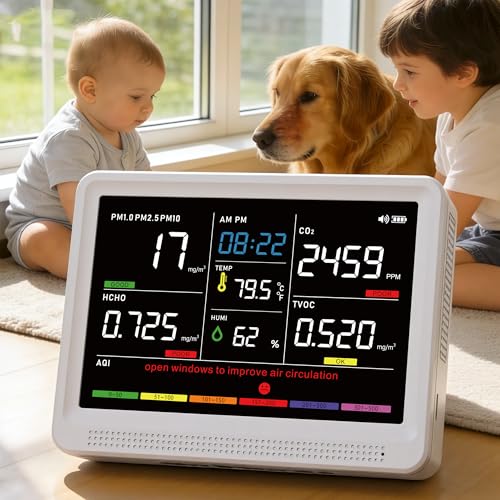
Monitors 16 essential air quality parameters.
High-precision CO2 detection technology.
Easy-to-read HD screen display.

Comprehensive monitoring of eight air quality metrics.
User-friendly app for real-time data access.
Compact design suitable for any home environment.

Comprehensive air quality insights with 16 metrics.
Large, clear 7" display for easy readability.
Real-time alerts enhance indoor safety management.
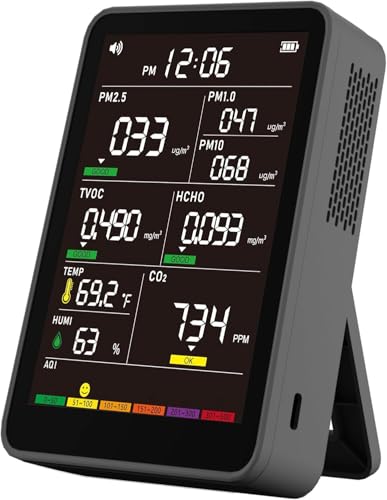
High-precision measurements for accurate air quality insights.
Portable design for easy use anywhere.
Real-time color screen for instant data visibility.
High-precision readings for multiple air quality parameters.
Real-time HD color screen for easy monitoring.
Portable design for versatile use in various locations.

High-precision readings ensure accurate air quality assessment.
Portable design allows easy use in various locations.
Real-time color screen enhances data visibility.

Comprehensive 11-in-1 air quality monitoring.
Real-time alerts for multiple pollutants.
User-friendly design with convenient stand.

Measures 16 air quality parameters accurately.
Features an HD real-time color display.
Portable design for versatile use anywhere.
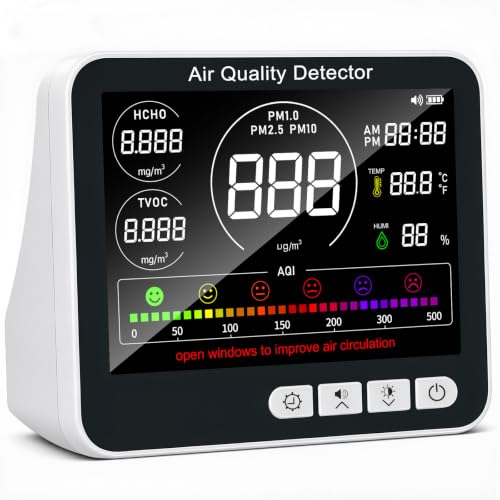
Comprehensive monitoring with 10-in-1 sensors.
Large display for easy readability.
AQI alert ensures timely air quality updates.
What separates a useful product from a persuasive listing is specific, exact-model evidence. For PM2.5, look for a stated measurement range, concentration accuracy, repeatability, response time, and performance under realistic temperature and humidity. For true carbon dioxide, check that the product identifies a direct CO2 sensor—such as NDIR—and gives the same details. A claim such as “0.001 accuracy,” “professional-grade,” or “high precision” is not meaningful without an analyte, unit, range, test method, uncertainty, and conditions. A refresh rate describes how often the display changes; it does not prove that the reading is accurate.
Gas claims need especially careful reading. TVOC is generally a combined or relative signal, not an identification of individual chemicals. Formaldehyde and VOC values should be accompanied by the sensing method, cross-sensitivity and interference information, humidity effects, and whether the result is directly measured or estimated. A displayed number is not proof of a toxic-gas concentration. Carbon monoxide readings on a general monitor are not equivalent to a residential CO alarm, and carbon dioxide is not carbon monoxide.
Buyers should also look for a usable maintenance plan: warm-up instructions, field or baseline calibration, drift expectations, sensor life, cleaning, replacement options, firmware support, and what happens when a sensor fails or readings fall outside its operating range. Placement matters just as much. Good instructions explain how to avoid direct airflow, vents, windows, heat, sunlight, moisture, strong odors, air cleaners, and corners, and how to interpret alerts. An AQI color or buzzer is more credible when its pollutant, threshold, calculation method, and recommended response are identified.
Independent verification is a major dividing line. The strongest evidence names the exact retail model and firmware in a South Coast AQMD AQ-SPEC or Lawrence Berkeley National Laboratory evaluation, a UL 2905 validation, or an ISO/IEC 17025-accredited laboratory report. A brand-issued certificate, a radio authorization, or a general platform brochure does not independently establish sensor accuracy. For electrical safety, look for an exact-product listing in UL Product iQ, Intertek ETL, or CSA directories; FCC authorization addresses wireless compliance, not measurement accuracy or complete electrical safety.
Across the supplied products, the recurring safety boundary is clear: none should replace certified carbon-monoxide or smoke alarms, radon testing, or professional investigation of suspected exposure, building problems, or serious symptoms. Several products also lack independent performance testing, sensor identity, calibration or drift evidence, and meaningful VOC or formaldehyde selectivity disclosures. A single monitor reading should not be used for medical, occupational, compliance, remediation, or high-consequence wildfire-smoke decisions. Mold culture kits require separate caution: growth on a plate cannot establish indoor health risk or prove that a space is safe.
The scores distinguish products that disclose useful limits and maintenance details from products that mainly present a long list of readings. Higher-scoring products in this set generally provide clearer safe-use boundaries, more specific operating information, or better lifecycle documentation; independent exact-model performance evidence remains limited across the category.
This measures whether a monitor targets relevant indoor conditions and clearly says that readings are informational, not a diagnosis, emergency alarm, or replacement for certified CO, smoke, or radon protection. High-scoring products explicitly state important limits and suggest ventilation, filtration, or source-control responses. Low-scoring products use broad safety or wildfire language without clear boundaries.
This measures whether exact-model PM and true CO₂ claims include accuracy, range, repeatability, response time, and indoor temperature and humidity conditions. It matters because buyers may use readings to judge ventilation or filtration. Higher scores in the supplied set go with defined methods or sensor details; lower scores rely on vague accuracy claims or omit performance evidence.
This measures whether gas readings identify a suitable sensing method and disclose cross-sensitivity, humidity effects, and estimated-versus-direct measurement. It matters because TVOC and HCHO displays can look more precise than they are. Higher-scoring products explain that a gas trend is not a specific toxic-gas concentration; lower-scoring products provide numbers without analyte or interference details.
This measures warm-up, baseline or field calibration, drift, sensor life, cleaning, firmware effects, replacement options, and failed-sensor behavior. These details determine whether a monitor remains useful after months of use or relocation. Higher scores in the set reflect documented calibration, cleaning, warranty, or support procedures; lower scores lack a maintenance or service-life path.
This measures whether alerts and colors have identified thresholds, placement instructions, and clear explanations of what action a reading justifies. It matters because a buzzer or red display can otherwise create false reassurance or unnecessary alarm. Higher-scoring products provide practical siting and response guidance; lower-scoring products advertise alerts without naming the AQI method or actions.
This covers adapters, batteries, charging, overheating protection, wireless electronics, recalls, and independent safety listings. It matters because many monitors are powered continuously or contain lithium batteries. Higher scores reflect clearer power documentation, FCC records where applicable, or stronger safety disclosures. Low scores commonly lack an exact UL, ETL, or CSA record, battery details, or charger information.
This measures whether advertised accuracy, “professional” labels, AQI claims, and health statements are specific, qualified, and tied to the exact product. High scores in the set reflect defined ranges, accuracy conditions, or candid exclusions. Low scores accompany unitless claims such as “0.001 accuracy,” inconsistent specifications, or feature counts that exceed the documented measurement set.
This measures whether an independent laboratory or public program tested the exact retail model and firmware against reference instruments using a disclosed method and complete results. It is one of the strongest ways to check marketing claims. The supplied products generally score modestly here because no AQ-SPEC, LBNL, UL 2905, or identified accredited-laboratory report was located.
This measures substantiated information about materials, recycled content, packaging, energy use, batteries, take-back, and recycling. It matters because monitors are electronic waste and rechargeable batteries need appropriate handling. The highest supplied score belongs to the product with stated recycled plastic, fiber-based packaging, carbon-footprint information, and a recycling route. Lower scores provide little product-specific lifecycle evidence.
This measures warranty, manuals, firmware support, replacement batteries or consumables, repair access, and parts availability. These features can extend useful life and reduce electronic waste. Higher-scoring products provide meaningful warranty or support material and practical calibration instructions. Low-scoring products have unclear service life, no replacement route, or no repair and firmware policy.
This product is a tabletop indoor air monitor with a 7-inch LED display, USB-C charging, and a manufacturer-stated 2500mAh rechargeable battery rated for up to eight hours of cordless use. Its documentation says it displays PM1.0, PM2.5, PM10, carbon dioxide, TVOC, formaldehyde, temperature, humidity, AQI, and time, with visual or audible AQI alerts. The key limitation is evidence quality. No exact-product independent performance report, sensor part number, calibration record, or PM and carbon dioxide accuracy specification was located. The manufacturer-style documentation lists only a nonspecific “0.001” air-sensor accuracy claim, which is not a usable concentration accuracy statement. It also contains conflicting power descriptions, with one document describing a rechargeable lithium battery and another referring to a D battery. Treat readings as trend information for ventilation or filtration decisions, not as proof of a safe concentration or as emergency protection.
This product suits a household user who wants a large, portable screen for watching broad changes in indoor particles, carbon dioxide, temperature, and humidity while cooking, cleaning, opening windows, or operating filtration. It is most appropriate when the user understands that the readings are screening and trend data, not laboratory measurements. The stated cordless runtime also fits occasional checks in several rooms. It can help prompt practical responses such as reducing a pollution source, increasing ventilation when appropriate, or running particle filtration.
It is not suited to anyone who needs dependable numerical measurements for health-sensitive decisions, formaldehyde investigation, wildfire exposure management, workplace compliance, or building commissioning. The exact product has no located independent validation, no disclosed sensor architecture, and no usable PM or carbon dioxide accuracy specification. It also should not be used for carbon monoxide, smoke, gas-leak, or radon protection. Homes with combustion appliances, infants, older adults, or people with serious respiratory disease should retain the appropriate certified alarms and seek professional assessment when there is a suspected exposure problem.
The product covers several health-relevant indoor indicators, especially PM2.5, carbon dioxide, temperature, and humidity. EPA notes that lower-cost monitors can help identify changes and support source control, ventilation, and filtration decisions, but their accuracy can vary with placement, temperature, humidity, time in use, and other contaminants. This product's instructions do include sensible siting cautions, but its own documentation does not establish measurement accuracy or a safe exposure threshold. The formaldehyde and TVOC displays deserve particular caution. Consumer VOC sensors can respond to only part of the VOC mixture, and VOC sensor responses may be affected by humidity, temperature, and interfering gases. No material, packaging, take-back, battery recycling, repair-parts, firmware-support, or independently listed electrical-safety information was located for this product. No product-specific recall was identified in the public recall search, but that is not equivalent to an independent electrical-safety certification.
This is a tabletop indoor air monitor with a large color display. It is marketed to show carbon dioxide, PM1.0, PM2.5, PM10, TVOC, formaldehyde, temperature, humidity, an AQI value, and time. An independently accessible retailer page repeats the 7-inch display and nine environmental readings, but these are seller-provided specifications, not performance validation. The available product documentation describes audible and visual poor-air alerts, a mute control, basic cleaning guidance, and a reset described as recalibration. It does not identify the sensor parts, measurement ranges, test method, error limits, or third-party performance results. Documentation also conflicts about the power system, with one source describing a rechargeable 2500 mAh battery while another describes USB power and a D-cell backup. Treat it as a trend display for ordinary indoor observations, not as a safety alarm or a precise analytical instrument.
This product suits a user who wants one stationary screen for observing broad, directional changes in a bedroom, home office, or living area, such as a rise in displayed carbon dioxide during occupancy or a particle spike while cooking. It is most appropriate when the readings are used to prompt practical checks, including ventilation, source control, or filtration, rather than to establish compliance or diagnose an exposure. The large display and claimed portable operation can be useful for informal room-to-room comparisons.
It is not suited to households that need a certified life-safety device for carbon monoxide, smoke, or radon. It also is not suited to people making health, remediation, workplace, legal, or building-performance decisions that require documented accuracy. Buyers who need dependable formaldehyde or VOC concentration data should not treat this product's displayed gas values as compound-specific measurements, because the sensor chemistry, cross-sensitivities, calibration method, and exact-product validation are not disclosed. It is also a poor fit where warranty, repair access, and electrical certification documentation are required.
The measured categories are relevant to indoor-air decisions, particularly particulate trends and carbon dioxide as a possible ventilation indicator. EPA notes that low-cost monitors may help identify when to improve indoor air quality, but they measure only the contaminants they are designed for and do not replace protection for hazards they do not measure. CDC also cautions that a carbon dioxide reading is context-dependent and is not a direct measure of infection risk. No exact-product third-party accuracy report, public safety listing, recall, or public environmental certification was located in the reviewed sources. The accessible instructions advise keeping sensor openings clear and avoiding strong odors, which acknowledges that conditions can affect readings, but they do not provide sensor-life, drift, replacement, take-back, packaging, or battery-recycling information. The unresolved battery documentation makes responsible end-of-life planning harder, especially if the shipped version uses a rechargeable battery.
This compact, rechargeable indoor air-quality monitor measures PM1, PM2.5, PM10, carbon dioxide, TVOC, formaldehyde, temperature, and relative humidity. It has a screen, audible alerts, 2.4 GHz Wi-Fi, a mobile app, USB-C charging, and a stated 1,000 mAh lithium-ion battery. The manufacturer lists a 3.3 by 2.8 by 1.4 inch body and a two-year warranty. The manual gives manufacturer-stated accuracy claims for PM and CO2, including plus or minus 50 ppm plus 5 percent for CO2, and requires an outdoor or well-ventilated calibration before first use. The company explicitly says it is not a carbon-monoxide alarm, which is important. No independent exact-product laboratory evaluation, public UL 2905 validation, or public safety-listing record was located in the reviewed sources.
This product suits a household, classroom, or small office that wants a compact trend monitor for ventilation and particle events, rather than a life-safety instrument. It is particularly relevant for users who want to see whether occupancy raises CO2, whether cooking or wildfire smoke raises particle readings, and whether opening windows or running filtration changes conditions. It also fits users willing to perform the specified initial calibration, keep it away from moisture, and treat TVOC and formaldehyde results as screening signals rather than definitive exposure measurements.
It is not suitable as the only protection in homes with fuel-burning appliances, attached garages, fireplaces, or any carbon-monoxide risk. Use a dedicated certified carbon-monoxide alarm for that purpose. It is also not the right instrument for decisions requiring verified quantitative PM, CO2, formaldehyde, or VOC measurements, including occupational exposure investigations, real-estate remediation disputes, medical decisions, or formaldehyde clearance after renovation. Users needing documented electrical safety listing or long-term repair parts should seek a product with those records.
The useful health framing is the manufacturer’s explicit statement that this product does not measure carbon monoxide and cannot replace a dedicated certified carbon-monoxide alarm. Its PM, CO2, temperature, and humidity channels can support practical checks of cooking pollution, smoke infiltration, and ventilation patterns. The formaldehyde and TVOC figures need more caution because the manufacturer does not disclose sensor chemistry, interference behavior, accuracy, or calibration details. They are better used to flag changes for follow-up than to confirm a specific pollutant concentration. The product contains a rechargeable lithium-ion battery and should be treated as electronic waste at end of life, not placed in household trash. The reviewed manufacturer materials did not provide product-specific battery recycling, take-back, packaging, materials, energy-use, replacement-part, or repair disclosures. No product-specific U.S. recall or regulatory warning was located in the reviewed sources. Water protection is not claimed, and the manufacturer advises avoiding wet conditions and showering bathrooms.
This is a tabletop, rechargeable indoor air monitor with a 7-inch display. The product is marketed for room-to-room use and is stated to show carbon dioxide, PM1.0, PM2.5, PM10, TVOC, formaldehyde, temperature, humidity, an AQI display, and time. Retailer copies of the product description state a 2,500 mAh battery and up to eight hours of use, plus USB-C charging hardware. Its defining limitation is evidence quality. The available product material makes broad accuracy claims, including “0.001 accuracy,” but does not identify the sensor parts, measurement units, pollutant-specific accuracy, calibration method, operating range, or interference testing. No exact-product performance report was located in AQ-SPEC or Lawrence Berkeley National Laboratory public evaluation resources. Treat it as an indicator of changing conditions, not a certified alarm, medical device, or replacement for smoke, carbon monoxide, or radon protection.
This product suits a homeowner, renter, classroom, or small office user who wants a large, stationary display for observing broad changes after cooking, cleaning, opening windows, running filtration, or moving between rooms. It is most appropriate when the buyer understands that its values are screening information and plans to respond with practical checks such as source control, ventilation, or filtration. The stated battery operation can also suit short spot checks in several indoor rooms.
It is not suited to households needing an emergency safety device for combustion risks, smoke, carbon monoxide, radon, or suspected hazardous chemical exposure. Those situations require the relevant certified alarm, professional assessment, or emergency response, not an indoor trend monitor. It is also unsuitable for users who need documented PM or true carbon dioxide accuracy for compliance, occupational decisions, research, HVAC commissioning, or health-sensitive ventilation thresholds. Users needing quantified formaldehyde results should seek a method with analyte-specific validation and sampling guidance.
The health-relevant strength is coverage of conditions that can help users notice changing indoor particles, ventilation conditions, temperature, and humidity. EPA notes that lower-cost monitors can support indoor-air decisions, but they measure only the contaminants for which they were designed and have limited performance information in many cases. EPA also cautions that sensor readings can be affected by humidity, temperature, calibration needs, aging, and imperfect pollutant selectivity. The product’s TVOC and formaldehyde labels deserve particular restraint because the available materials do not identify sensor chemistry, interferences, or a calibration protocol. TVOC is not a direct measure of the hazard posed by specific chemicals. No exact-product recall or regulatory action was located in the reviewed public sources. No substantiated materials, packaging, energy-use, take-back, battery-recycling, repair-parts, or environmental certification disclosure was located, so its end-of-life impact cannot be favorably characterized beyond using appropriate local electronics and rechargeable-battery recycling channels.
This is a handheld, rechargeable indoor air-quality display monitor for moving between rooms, vehicles, offices, or other small indoor spaces. Retailer descriptions identify readings for PM1.0, PM2.5, PM10, carbon dioxide, total volatile organic compounds, formaldehyde, temperature, humidity, and an air-quality index. They also describe a color screen, USB-C charging, an included adapter, and roughly 4 to 5 hours of operation per charge. These are manufacturer-stated specifications repeated by retailers, not independently validated measurements. The most important limitation is evidentiary. No exact-product technical sheet, sensor part numbers, accuracy ranges, calibration procedure, or independent laboratory evaluation was located. The product can be useful for observing changing conditions, such as cooking particles or a stuffy occupied room, but its numerical readings should not be treated as diagnostic measurements or as a substitute for listed carbon-monoxide, smoke, or radon protection.
This product suits a person who wants a portable, screen-based way to notice broad changes in a bedroom, office, vehicle, rental, or recently furnished room. Its manufacturer-stated rechargeable operation and compact format fit brief checks before and after cooking, cleaning, ventilation changes, or running an air cleaner. It is most appropriate for users who understand that the display is informational and who will use patterns, not a single number, to decide when to ventilate, reduce a source, or investigate further.
It is not suited to households that need life-safety protection from carbon monoxide or smoke, homes needing radon testing, or anyone relying on a monitor to evaluate illness symptoms or a possible chemical exposure. It also does not fit users who need documented PM2.5 or carbon-dioxide accuracy for ventilation control, school or workplace compliance, wildfire response decisions, or formal exposure assessment. Buyers needing long-term unattended monitoring, app alerts, data export, repair access, or verified calibration support should use a product with those functions publicly documented.
The stated pollutant list includes health-relevant indoor conditions, especially particles and carbon dioxide, but the public product information does not establish how accurately this unit measures them. EPA notes that low-cost monitors can help identify conditions worth addressing, while also warning that they measure only the pollutants they are designed for and may have limited indoor performance information. A carbon-dioxide display is not a carbon-monoxide alarm. This product should not replace a listed residential CO alarm, smoke alarm, or radon test. The product uses a rechargeable lithium-ion battery and USB-C charging, which can reduce disposable-battery use during normal operation. However, no exact-product environmental materials disclosure, energy-use figure, battery replacement instructions, take-back program, or electronics-recycling guidance was located. No product-specific recall or safety warning was found in the reviewed public CPSC recall materials, but no public UL, ETL, or CSA listing for this exact product was located either. Recycle the device and its battery through an appropriate electronics or battery collection program when it reaches end of life.
This is a rechargeable desktop and handheld indoor air monitor intended for room-to-room checks in homes, offices, vehicles, and similar enclosed spaces. The original-equipment product page identifies the AK16C as a 120 mm by 93 mm by 24 mm, 249 g unit with a USB-C rechargeable 2,000 mAh battery. It is meant to show PM1.0, PM2.5, PM10, carbon dioxide, TVOC, formaldehyde, temperature, humidity, an AQI display, and time. The broad measurement list and color display are manufacturer-stated, not independently validated. The available original-equipment page gives no sensor part numbers, ranges, accuracy tolerances, calibration method, warm-up procedure, or test report for this model. Its readings are therefore most defensible as screening trends that can prompt ventilation, source control, or filtration checks, rather than proof of a specific contaminant concentration or a safety clearance.
This product suits a household or small-office user who wants a portable visual indicator for broad indoor-air changes, such as particle spikes during cooking, shifts in humidity, or a stuffy-room pattern. It is most appropriate when the user can keep it in a representative, open-air location and treats the display as a prompt to investigate ventilation, filtration, or indoor sources. Its stated USB-C power and short battery runtime also fit occasional room-to-room checks more naturally than unattended all-day battery operation.
It is not for anyone who needs verified numerical data for workplace compliance, research, cleanroom checks, HVAC commissioning, wildfire exposure decisions, or formaldehyde investigation. It also should not be used as a carbon-monoxide alarm, smoke alarm, radon monitor, medical device, or emergency warning system. Households with combustion appliances should retain properly listed carbon-monoxide alarms. People with acute symptoms, suspected gas exposure, or suspected mold, asbestos, or chemical contamination need the applicable safety response or professional assessment, not a consumer trend monitor.
The useful health-facing aspect is breadth. The product platform is stated to place particle, carbon dioxide, TVOC, formaldehyde, temperature, and humidity indicators on one screen, which may help users notice that an indoor condition has changed. EPA guidance notes that lower-cost monitors can support indoor-air decisions, while also stressing that they measure only the pollutants they are designed to detect and do not provide a complete safety picture. The missing calibration and accuracy evidence is especially important for its gas readings. The original-equipment page claims CE, FCC, RoHS, and UN38.3, but model-specific public certification records were not located during verification. No U.S. recall or regulator warning specific to this product was located. There is no disclosed material composition, power consumption, packaging program, battery replacement route, take-back program, or U.S. recycling instruction. A rechargeable battery can reduce disposable-battery use, but it also makes end-of-life electronics and battery recycling information important, and that information was not provided.
This is a compact rechargeable indoor air-quality display intended for spot checks in homes, offices, vehicles, bedrooms, and schools. Seller descriptions identify readings for PM1.0, PM2.5, PM10, carbon dioxide, TVOC, formaldehyde, temperature, and humidity, alongside an AQI display and buzzer alerts. The product is described as USB-C rechargeable, with roughly 4 to 5 hours of portable operation and an included power adapter. The core limitation is evidence quality. The available seller material calls it high precision and professional, but does not identify the PM, carbon-dioxide, VOC, or formaldehyde sensor parts, accuracy ranges, calibration method, operating limits, or response-time test data. No exact-product independent evaluation was located in AQ-SPEC or EPA performance resources. Treat readings as trend information that can prompt ventilation, source control, or filtration checks, not as diagnostic, emergency, or compliance measurements.
It suits a user who wants a portable, screen-based indicator for noticing broad changes from cooking, cleaning, closed-room occupancy, traffic exposure, or wildfire smoke entering a room. It is most appropriate when the user will compare trends in the same location and use a change in readings as a reason to investigate ventilation, remove a source, or run appropriate filtration. The stated USB-C charging, small desktop format, audible alert, and 12-month warranty are practical for occasional household or office checks.
It is not appropriate for anyone who needs defensible numerical PM2.5 or carbon-dioxide data for workplace, school, rental, medical, legal, or building-management decisions. It also should not be used to clear a space after a suspected carbon-monoxide event, smoke event, combustion problem, or formaldehyde exposure. Households need certified smoke and carbon-monoxide alarms for life-safety warnings. Buyers needing specific VOC or formaldehyde identification, documented calibration, long-term logging, or independently verified precision need a product with those exact-model records.
The monitored categories are relevant to common indoor-air concerns, especially particles, ventilation-related carbon dioxide trends, temperature, and humidity. EPA notes that low-cost monitors can help identify possible indoor-air problems, but their alerts are not emergency warnings and should not replace certified carbon-monoxide or smoke alarms. This product has no located evidence of an exact-model independent performance evaluation, so its gas and particle readings should be interpreted cautiously. No product-specific UL, ETL, FCC, recycling, take-back, battery-specification, materials, packaging, repair, or replacement-parts documentation was located. Retailer descriptions state a rechargeable lithium battery, USB-C charging, and a 12-month warranty. No product-specific U.S. recall or safety warning was located in the searched CPSC and Recalls.gov resources, but absence of a located recall is not a certification or safety-performance finding.
This is a handheld, rechargeable indoor air monitor with a color screen, built-in stand, USB-C charging, and a manufacturer-stated 2500mAh battery. It is intended for spot checks around rooms, kitchens, basements, offices, and similar indoor spaces. LifeBasis lists CO2, PM1.0, PM2.5, PM10, particle count, TVOC, formaldehyde, temperature, humidity, and an AQI display. The manufacturer says it uses NDIR CO2 sensing, a laser particle sensor, semiconductor and photoelectric sensors, plus temperature and humidity sensing. It publishes CO2 and PM accuracy figures and provides a brief fresh-air calibration procedure. Those are manufacturer statements, not independently verified results. No exact-product evaluation from AQ-SPEC, EPA, LBNL, UL 2905, or an identified accredited laboratory was found. The marketing calls it 11-in-1, while the manufacturer’s own product page repeatedly calls the same set of displayed measures 10-in-1.
This product suits a household, classroom, or small-office user who wants a portable screen for observing relative indoor changes rather than making compliance, medical, or emergency decisions. It can be useful for checking whether CO2 rises when a room fills, whether particle readings change during cooking, or whether opening windows and running filtration changes displayed trends. The stated NDIR CO2 sensor, particle sensor, color alerts, and rechargeable battery make its intended use practical for room-to-room spot checks, provided the user calibrates it and treats readings as informational.
It is not for households seeking a certified carbon monoxide alarm, smoke alarm, or radon detector. It does not claim to measure carbon monoxide or radon, and its alerts are not a substitute for dedicated life-safety equipment. It is also not appropriate as the sole tool for diagnosing formaldehyde, solvent exposure, mold, workplace exposure, or a health symptom. People making decisions about wildfire smoke protection, building ventilation compliance, asthma triggers, or chemical remediation need measurements supported by exact-model independent testing or professional assessment.
The useful health-relevant functions are manufacturer-stated CO2 and particulate monitoring. CO2 can help indicate changes in occupancy and ventilation, but CDC notes that a single CO2 value is not a universal ventilation target and that placement, calibration, and room air mixing matter. EPA similarly cautions that low-cost monitors detect only the conditions they are designed for and do not provide a complete picture of indoor air quality. The formaldehyde and TVOC numbers deserve particular restraint. LifeBasis identifies a semiconductor sensor but does not disclose its part number, target analytes, interferences, humidity correction, or an independent validation report. The product uses a rechargeable lithium battery and USB-C input, yet no exact-product UL, ETL, or CSA listing was located. No product-specific U.S. recall was found in the searched recall sources. LifeBasis also provides no substantiated packaging, materials, energy-use, take-back, battery-recycling, repair, or sensor-replacement disclosure, so end-of-life planning falls to the owner’s local electronics and rechargeable-battery recycling options.
This is a compact, rechargeable tabletop and portable indoor air monitor with a color display, USB-C charging cable, AC adapter, and claimed 4 to 5 hour battery operation. Independent retail records identify the product as AQItech AK16C and list an ABS housing, rechargeable lithium-ion battery, and monitoring for PM1.0, PM2.5, PM10, carbon dioxide, TVOC, formaldehyde, temperature, and humidity. The manufacturer-stated feature set includes readings every three seconds, seven AQI-style audible alerts, and a one-button interface. No exact-model sensor part numbers, accuracy tolerances, operating-condition limits, calibration instructions, or independent performance report were located. It is therefore most defensible as a portable trend monitor, not as proof of a pollutant concentration or a safety alarm.
It suits a user who wants a compact, rechargeable screen for noticing relative changes around ordinary indoor activities, such as cooking, cleaning, opening windows, using a portable air cleaner, or changing ventilation. The claimed particulate, temperature, humidity, and carbon dioxide displays can help create a basic log of patterns in a bedroom, office, vehicle, or small shared room. It is most appropriate where readings are treated as prompts to investigate sources or improve ventilation, rather than as verified exposure measurements.
It is not for households needing a life-safety device for carbon monoxide, smoke, fire, or radon. This product lists carbon dioxide, not carbon monoxide, and no evidence was located that it meets residential carbon monoxide alarm requirements. It is also not appropriate for medical, workplace compliance, school ventilation compliance, formaldehyde exposure assessment, wildfire decisions requiring validated PM data, or any situation where a specific concentration must be accurate. Those uses require purpose-built, validated instruments and applicable certified alarms.
The useful health role is informational. Federal guidance says lower-cost indoor monitors can help users identify when to improve source control, ventilation, or filtration, but they do not represent all indoor hazards and have limited performance information in many cases. Place a monitor at breathing-zone height with free airflow, away from direct cooking plumes, windows, ducts, and air-cleaner outlets if the goal is a representative room trend. No exact-product independent evaluation, UL, ETL, CSA, or other public electrical safety listing was located. Searches of public U.S. recall resources did not identify an exact-product recall as of October 11, 2026, but that is not certification of safety. The product is stated to use an ABS enclosure and rechargeable lithium-ion battery. No packaging, energy-use, battery replacement, take-back, repair, or U.S. recycling instructions were located, so responsible electronics and battery recycling will depend on local programs.
The Lecoolife AK27 is a compact, rechargeable indoor display monitor, listed at about 4.17 by 3.54 by 1.96 inches. It is intended for spot checks in rooms such as bedrooms and offices. The product documentation states that it displays PM1.0, PM2.5, PM10, HCHO, TVOC, temperature, humidity and a color AQI indicator, with an audible alert and USB-C charging. Its stated monitoring breadth is useful for observing changes after cooking, cleaning or ventilation. However, no exact-product sensor part numbers, accuracy tolerances, operating range, response-time data, calibration traceability or independent test report was located. The documentation describes a short one-button calibration routine, but does not establish that the readings are reference-grade or suitable for diagnosing exposure. Treat displayed gas values and the overall AQI as screening information, not confirmation that a room is safe.
This product fits a buyer who wants a small, battery-powered indicator for observing broad changes in a single room, such as a particle rise during cooking or a humidity change after showering. It is most appropriate when the user can treat readings as prompts to investigate sources, ventilate, or run filtration, rather than as precise concentration measurements. The simple local screen and stated audible alert suit occasional room-to-room checks where app history, data export and certified measurement performance are not required.
It is not appropriate as the household's carbon monoxide alarm, smoke alarm, radon monitor, medical exposure assessment tool or formaldehyde compliance instrument. It also does not suit users who need defensible PM measurements for wildfire decisions, workplace documentation, HVAC commissioning or automated ventilation control. Households with infants, older adults, asthma, serious heart or lung disease, or suspected combustion or chemical exposure should not rely on its green display or one-number gas readings as evidence that conditions are safe.
The product addresses health-relevant indoor conditions by reporting particles, temperature and humidity, and its documentation suggests using ventilation when displayed levels rise. EPA notes that low-cost indoor monitors can help identify when to improve air quality, but they detect only the conditions for which they are designed and may be affected by placement, time in use, temperature, humidity and multiple contaminants. This product does not replace certified smoke, carbon monoxide or radon protection. No exact-product independent performance test, public safety listing, recall, regulatory warning or verified sustainability certification was located in the checked U.S. sources. The documentation identifies a rechargeable battery but not its chemistry, capacity, replaceability or a take-back route. Because rechargeable battery electronics should be kept out of household trash and curbside recycling, end-of-life handling should use a battery or electronics recycler that accepts the device.



