Best Overall
23% off
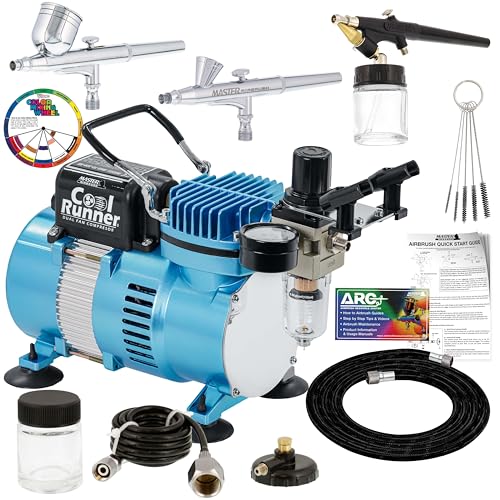
Master Airbrush Cool Runner II Professional Airbrushing Kit
Dual fan compressor ensures consistent airflow.
Includes three versatile airbrushes for flexibility.
Comprehensive kit with tools and guide included.
 Daniel Kenitz
Dual fan compressor ensures consistent airflow.
Includes three versatile airbrushes for flexibility.
Comprehensive kit with tools and guide included.

Dual fan compressor keeps it cool.
Includes three versatile airbrushes.
Comes with primary color paint set.

Includes essential accessories for beginners.
Versatile for various artistic applications.
Compact design with efficient performance.

Versatile airbrush with three different tip sizes.
Quiet compressor for a more pleasant experience.
Includes a helpful how-to guide for beginners.

Dual fans ensure consistent airflow.
Includes three versatile airbrushes.
Comes with a helpful user guide.

Easy to use with cordless convenience.
Offers precise control with 3-speed settings.
High 48 PSI pressure for professional results.
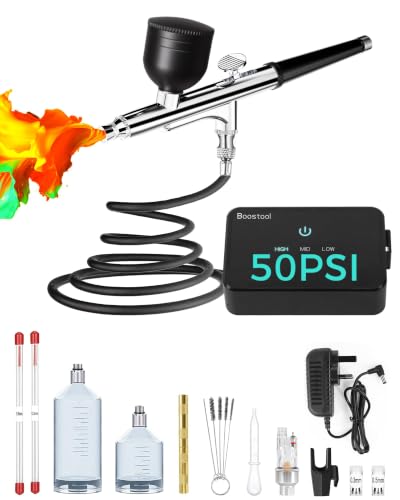
Versatile nozzle sizes for detailed work.
High pressure for smooth, consistent application.
Portable design perfect for on-the-go use.

Versatile nozzles for detailed precision work.
High pressure for smooth and even application.
Includes cleaning sets for easy maintenance.

Dual action trigger allows precision control.
Type-C rechargeable for convenient charging.
Four pressure settings suit various applications.

High-pressure performance ensures smooth, detailed finishes.
Multiple nozzle sizes offer versatile application options.
Includes comprehensive cleaning kit for easy maintenance.
Look for specifications tied to a precise model: nozzle and needle sizes, airflow, pressure range, hose connection, voltage, noise, tank capacity, and duty cycle. A stated maximum such as 32, 48, 50, 55, or 58 PSI does not show the pressure delivered during spraying. Working pressure, airflow, and whether a regulator and readable gauge are present matter more. Several supplied products have conflicting pressure figures, unclear units, or different numbers across listings. A pressure display is useful only if the underlying specification is consistent. Noise claims also need caution when catalog and seller figures disagree.
Compressor protection is another important distinction. Stronger documentation identifies a safe operating range, automatic cycling, moisture separation, overheating protection, and—where applicable—pressure relief. A product that merely claims high pressure or “continuous” operation does not establish a duty cycle, thermal cutoff, or protection against hose or pressure failure. The airbrush itself is a wear item: replaceable needles, nozzles, seals, valves, hoses, filters, and service parts can keep a kit in use longer than one with no parts information.
Electrical claims deserve independent confirmation. A CE, FCC, or similar marketing mark is not the same as a model-specific U.S. listing. Buyers seeking stronger evidence should be able to confirm the exact compressor configuration in an OSHA-recognized testing-laboratory directory, such as UL Product iQ, Intertek’s ETL directory, the CSA listing database, or TÜV Rheinland Certipedia. None of the supplied products had a publicly verified exact-model U.S. electrical listing. Voltage also needs checking on the rating plate and plug: one supplied product had conflicting 110–120 V and 220–240 V information.
Included materials change the risk profile. A kit without paint leaves the user responsible for choosing coatings, thinners, and cleaners, but avoids an undocumented chemistry bundled into the purchase. A kit with paints or cleaner should provide ingredient information and safety data sheets for the exact liquids. “Water-based,” “acrylic,” or ASTM D-4236 language can be useful, but does not make atomized paint harmless or establish cosmetic, food-contact, eye-area, or tattoo suitability. Broad claims for makeup, nails, temporary tattoos, or cake decorating need use-specific material and cleaning documentation, not just a general-purpose airbrush.
A spray booth can help capture overspray, but it is not automatically suitable for solvent or flammable materials. Effective exhaust, appropriate ventilation, and ignition control must follow the material’s safety data sheet and the applicable spray-operation requirements. A small booth with a filter and outdoor exhaust hose is not proof of vapor removal, fire safety, or safe use in a bedroom, apartment, or shared room.
Across the supplied reviews, the recurring contraindications are clear: do not treat ordinary artist paint as safe for skin, eyes, tattoos, cosmetics, or food; do not spray solvent-rich or flammable materials in an ordinary indoor setup; and do not assume a general ventilation statement replaces exposure and ignition controls. Paint, thinner, cleaner, and contaminated rinse water should not be poured into drains, soil, or storm sewers. Buyers who need verified electrical certification, published duty-cycle limits, or documented service support should require those records before purchase.
Airbrush safety depends on both the hardware and the liquid being atomized. The scores below reflect the supplied reviews: higher scores indicate more complete, consistent, or traceable documentation, not a guarantee that spraying is safe in every setup.
This measures whether the kit identifies the paints, cleaners, or cosmetics it supplies or promotes and explains protection for inhalation, eyes, and skin. It matters because airbrushing turns liquid into airborne mist. Among the supplied products, higher scores around 70–72 were associated with clearer protective warnings or narrower claims; lower scores reflected missing SDSs, ingredients, and material-specific limits.
This measures whether instructions distinguish water-based materials from solvent-containing or flammable products and address ventilation, ignition sources, and compatible equipment. A general request to use a “well-ventilated” room is limited guidance for spray work. The stronger supplied scores, around 70–72, came with more explicit ventilation or material boundaries; lower scores commonly omitted respirator, ignition-control, or solvent guidance.
This measures documented safeguards against excessive pressure, hose failure, overheating, and moisture problems, including a regulator, gauge, automatic cycling, thermal protection, and pressure relief where applicable. Higher-scoring products described several of these controls or automatic shutoff features. Lower-scoring products mainly stated a maximum PSI without documenting duty cycle, thermal cutoff, relief protection, or how delivered pressure is verified.
This measures whether the exact compressor and electrical configuration can be confirmed through an OSHA-recognized testing laboratory. A high score requires an independently searchable model-specific listing, not a CE, FCC, or self-issued conformity mark. The supplied scores clustered around 62–70 because no exact-model U.S. UL, ETL, CSA, or comparable listing was publicly verified for the reviewed products.
This measures whether body, cosmetic, nail, eye-area, tattoo, and cake claims are supported by the actual materials and cleaning instructions. A general airbrush does not make artist paint safe for skin or food. Higher scores belonged to products with narrower hobby claims or clearer limits; lower scores commonly reflected broad makeup or cake claims without cosmetic, food-contact, sanitation, or ingredient documentation.
This measures whether pressure, airflow, nozzle size, duty cycle, voltage, noise, tank capacity, and accessories are stated consistently for one model. It matters because conflicting figures can lead to an unsuitable coating, incorrect electrical connection, or unrealistic performance expectations. Higher scores around 75–79 came from more concrete, corroborated specifications; lower scores reflected missing data or contradictions.
This measures whether claims about precision, quietness, beginner use, professional work, and compatible applications are qualified by the kit’s documented limits. Higher scores were associated with narrower hobby claims or specific operating information. Lower scores commonly involved “non-clogging,” professional, beauty, tattoo, or food claims without material, ventilation, hygiene, or performance evidence.
This measures whether important safety, performance, material, and compatibility claims have accessible third-party testing or certification for the exact product. The supplied scores were mostly 68–70 because independent model-specific reports were generally absent, even when retailer pages repeated the same figures. A repeated marketplace specification is corroboration of a claim’s publication, not independent laboratory validation.
This measures whether the kit reduces chemical waste and tells users how to handle leftover paint, thinner, cleaner, and contaminated rinse water. The issue is especially relevant when cleaner or paint is included. Scores near 70 reflected some maintenance or material information, but no supplied product provided complete disposal guidance. Waste should follow the liquid’s label, SDS, and local household-hazardous-waste rules.
This measures whether needles, nozzles, seals, valves, hoses, filters, and compressor service items can be identified and replaced. Higher-scoring products had parts diagrams, stocked wear parts, or included spare components; scores in the high 50s or 60s reflected missing catalogs or uncertain availability. Cleaning tools can support service life, but they do not prove that replacement parts will remain obtainable.
This is a corded airbrush system for hobby painting and other fine spray work. It combines a tank-mounted single-piston compressor with two cooling fans, a regulator, moisture trap, 6-foot hose, holder, cleaning brushes, and three metal airbrushes. The G22 is a 0.3 mm gravity-feed brush, the G25 is a 0.2 mm gravity-feed detail brush, and the E91 is a 0.8 mm siphon-feed brush with two bottles. Manufacturer documentation for the compressor specifies a 3-liter tank, 1/5 hp motor, 23 to 25 L/min airflow, a 0 to 57 psi operating range, and automatic restart at 43 psi. Its manual documents thermal protection, a safety valve, grounded use, moisture draining, and a parts diagram. However, catalog noise and capacity figures conflict with the manufacturer materials, and an exact-model electrical listing could not be independently confirmed in public certification registers.
This system suits a hobbyist, model maker, craft painter, or artist who wants one compact 120-volt setup for learning several spray styles with separately selected, appropriate water-based art materials. The 0.2 mm and 0.3 mm gravity brushes fit detail work and small color changes, while the 0.8 mm siphon brush is intended for broader work. It is most appropriate for someone prepared to clean the equipment after every session, drain collected moisture, and work in a controlled, ventilated painting area.
It is not appropriate as a ready-to-use cosmetic, body-art, tattoo, or food-decoration system. The product supplies no cosmetic or edible media, ingredient declarations, food-contact documentation, or sanitation protocol, despite advertising those applications. It is also not the right setup for spraying solvent-rich automotive coatings, lacquers, enamels, or other flammable materials in an ordinary room. Those materials require their own safety data, ignition control, ventilation design, protective equipment, and waste handling. Buyers needing independently confirmed electrical certification should seek documentation for the exact unit before use.
The compressor manual gives useful basic equipment safeguards. It describes a pressure regulator and gauge, water trap, safety valve, thermal protection, automatic pressure cycling, grounding, and instructions to drain collected water. It also tells users to keep the unit in a well-ventilated area and away from flammable or explosive gases. These are meaningful equipment controls, but they do not replace material-specific controls for atomized paints, cleaners, or thinners. The product is sold with a California warning for brass exposure. The exact brass-containing part and exposure pathway are not explained. No paints or cleaners are included, so there are no supplied-material SDS documents to assess. The seller promotes food, nail-art, and temporary-tattoo uses without food-contact or cosmetic-use declarations. It also provides no practical instruction for collecting or disposing of contaminated rinse water, paint, or solvent. Hazardous leftovers should not be poured into drains, onto soil, or into storm sewers.
This product is a corded, tankless airbrush system for hobby and craft coating work. It includes a 1/5 horsepower, single-piston compressor with two cooling fans, a regulator, gauge, water trap, 6-foot hose, and three airbrushes. The manufacturer states that the two gravity-feed brushes use 0.2 mm and 0.3 mm tips for detail work, while the siphon-feed brush has a 0.8 mm tip for broader coverage. It also supplies six 1-ounce water-based opaque acrylic colors, reducer, cleaner, brushes, and guides. The published compressor range is 0 to 57 psi, with automatic shutoff at 57 psi and restart at 43 psi. Those are manufacturer specifications, not independently tested results. The supplied artist paints are marketed as ready to spray and ASTM D-4236 compliant by the seller, but the accessible product materials do not establish food, cosmetic, or tattoo suitability.
It suits an adult hobbyist who wants one compact, tankless setup for models, crafts, practice panels, or other small coated objects, and who plans to use the included water-based artist acrylics or similarly documented airbrush materials. The mix of two detail-oriented gravity brushes and a larger siphon-feed brush can reduce the need to assemble a first set of basic tools separately. The user should have a ventilated work area, protect eyes and skin from overspray, and be prepared to clean the brushes promptly after each session.
It is not appropriate for decorating food, applying makeup, or making temporary body art with the included paints. Those uses require dedicated materials with food or cosmetic labeling and composition support for the intended contact area. It is also a poor fit for spraying solvent-based, flammable, automotive, or two-component coatings indoors without purpose-designed ventilation, ignition control, and material-specific protective equipment. Households where children may access paint, cleaner, small nozzles, or sharp needles need secured storage and active supervision.
The supplied colors are represented as water-based acrylic artist paints, and the seller says they meet ASTM D-4236. That art-material statement does not make them edible, cosmetic, eye-area safe, sterile, or suitable for tattoo use. Food color additives and cosmetic color additives have use-specific FDA requirements. Keep this product dedicated to art and craft materials unless separately documented materials and equipment are used. The manufacturer does not provide practical rinse-water or leftover-material disposal directions in the accessible product information. Collect paint residue and cleaning waste rather than treating it as ordinary drain waste, then use local household hazardous-waste guidance when applicable. A California warning identifies potential exposure from brass. A Proposition 65 warning does not itself quantify risk, but it warrants handwashing after handling fittings and keeping the product away from food preparation areas. No product-specific CPSC recall was located in the checked databases.
This is a corded, oil-free piston airbrush kit for hobby spraying. It combines a dual-action gravity-feed airbrush with a 0.30 mm needle and nozzle, a 6-foot hose, cleaning brushes, five test paints, and a compact compressor. The product is promoted for models, crafts, nail work, temporary tattoos, cake decoration, makeup, and automotive graphics. A separately published product record corroborates the 20 to 23 L/min airflow, 43 psi automatic restart, 58 psi automatic stop, regulator and gauge, moisture trap, air filter, pressure-relief valve, and thermal protector. These are manufacturer-stated equipment features, not independently tested performance results. The supplied paint colors have no located ingredient list, safety data sheet, or defined intended-use boundary, which matters because the promotional uses include skin-contact and food-adjacent work.
This product suits an adult beginner doing small, controlled hobby jobs with documented water-based airbrush media, such as model color coats, craft pieces, or practice panels. The compact compressor, 0.30 mm airbrush, hose, regulator, and moisture control provide a defined starting setup for learning trigger control and pressure adjustment. It is most appropriate where the user can work with local exhaust or strong outdoor ventilation, clean the airbrush after use, and obtain safety information directly from the paint manufacturer.
It is not suited to anyone expecting verified North American electrical certification, independently published performance tests, or a documented spare-parts program. It is also not an appropriate all-purpose tool for tattooing, eye-area cosmetics, skin application, or food decoration using the included paints, because their ingredients, microbial controls, and approved use limits were not located. Avoid using it indoors with solvent-based automotive coatings, thinners, or flammable cleaners. Those materials require controls beyond the kit's generic ventilation advice.
The key health limitation is material traceability. The product includes test paints and promotes body tattoo, makeup, cake decoration, and automotive work, but no ingredient disclosure or safety data sheet for those paints was located. That leaves inhalation, eye, skin, food-contact, and flammability risks undefined. FDA notes that cosmetic color additives must be approved for their intended use, and tattoo inks carry contamination and adverse-reaction concerns. The product should therefore be treated as a general paint tool until a separately sourced medium is documented for the intended body or food-related use. The compressor documentation describes a water trap, adjustable regulator, thermal protection, and pressure relief, but no model-specific listing by an OSHA-recognized electrical test laboratory was located. A retailer also carries a California warning that package labels and packing slips may expose users to bisphenol S. No model-specific CPSC recall was identified in the reviewed recall results. For disposal, paints, solvents, cleaners, and contaminated rinse water should not go to drains, ground, or storm sewers. EPA directs users toward local household hazardous-waste programs for paints and solvents.
This is a corded airbrush set for hobby painting, supplied with a gravity-feed dual-action airbrush, compressor, hose, moisture separator, cleaning tools, practice material, and four paints in the premium version. The manufacturer identifies the compressor model as IK01205 and documents a 110-120 V, 1/6 HP single-cylinder piston compressor, 43 PSI auto-start, 57 PSI auto-stop, and 20-23 L/min stated airflow. The manufacturer also documents three nozzle sizes, 0.2 mm, 0.3 mm, and 0.5 mm, plus 15-50 PSI airbrush working pressure. Its manual has unusually concrete safety directions for this type of kit, including respiratory and eye protection, ventilation, keeping flammable liquids away from the compressor, and not spraying solvent paints near open flames. However, the official manual describes a tankless compressor while the marketplace record states a 3.8 L tank, so a buyer should confirm the delivered configuration and rating label.
This product fits a hobbyist learning model, miniature, figurine, mural, or other non-body art work who wants one corded setup rather than assembling separate components. It is most suitable for someone who can work in a ventilated area, use eye and respiratory protection appropriate to the paint selected, and is prepared to clean the nozzle and needle after sessions. The three supplied nozzle sizes are useful for moving between detail work and somewhat broader coverage, subject to paint thinning and practice.
It is not appropriate for food decoration, airbrush makeup, temporary tattooing, or nail work with the included paints unless separate materials specifically labeled for those uses are obtained. It also does not suit indoor users who cannot provide ventilation or who expect the included cleaner and paints to be harmless without safety data. Avoid using it for solvent-based spraying near ignition sources. Buyers who require independently confirmed U.S. electrical certification or a documented tank capacity should choose a product with those records available.
The manufacturer manual provides meaningful exposure controls. It says paint mist and solvent vapor can harm health, calls for breathing and eye protection, advises well-ventilated work areas, and says not to spray solvent-based flammable paints around open flames. It also directs users to keep flammable sprays and liquids away from the compressor, allow an overheated unit to cool, and keep the compressor dry. Those directions do not substitute for material-specific safety data. No accessible safety data sheets or ingredient declarations were found for the four included paints or the cleaner, so their pigments, solvents, sensitization risks, and disposal requirements remain unverified. Leftover paint, cleaner, and contaminated rinse liquid should not be assumed drain-safe. EPA guidance advises against pouring household hazardous waste down drains, onto ground, or into storm sewers. No product-specific CPSC recall or warning was located in the reviewed U.S. sources.
This is a corded 120 V airbrushing package centered on the TC-320 single-piston compressor. It includes three airbrush formats, a gravity-feed G22 with a 0.3 mm tip, a siphon-feed S68 with a 0.35 mm tip, and a single-action siphon-feed E91 with a 0.8 mm tip. A six-color acrylic paint set, hose, cleaning accessories, and instructional material are also included. The available product documentation states 1/5 hp output, 0.8 CFM airflow, dual cooling fans, an automatic shutoff, regulator, gauge, and moisture trap. Those are manufacturer-stated specifications, not independently tested performance results. Published kit details conflict on some figures, including listed motor power and whether the unit has tank capacity. The documentation supports ordinary artistic airbrushing, but does not establish safe use with solvent coatings, food, cosmetics, tattoo inks, or body-contact materials.
This package suits a hobby artist or craft user who wants one corded setup for learning ordinary water-based acrylic airbrushing on models, artwork, crafts, or similar non-food items. The three included airbrush configurations give a new user practical exposure to gravity feed, siphon feed, fine-detail work, and larger-area coverage. It is most appropriate where the user can work in a ventilated dedicated area, clean equipment after use, and obtain safety information for every additional paint or cleaner introduced.
It is not suited to users who need verified electrical certification, independently tested noise or airflow data, or fully traceable compressor specifications. Avoid treating the included tools as food-safe, cosmetic-safe, tattoo-safe, or suitable for spraying near eyes or skin, because the supplied materials and documentation do not establish those boundaries. It is also unsuitable for indoor solvent or flammable-coating work without purpose-designed ventilation, ignition control, compatible equipment, and material-specific safety documentation. Households unable to manage paint and rinse waste should not use it as an informal kitchen or living-room craft setup.
Airbrushing creates inhalable mist even when a coating is water-based. The available instructions advise ventilation, gloves, eye protection, and respiratory protection, which is useful but incomplete because no accessible safety data sheets or ingredient-level hazard information were located for every included liquid. OSHA guidance treats spray finishing as a ventilation and, when flammable materials are used, ignition-control issue. This package does not document an ordinary indoor setup as suitable for solvent spraying. The compressor documentation identifies a regulator, gauge, moisture trap, automatic shutoff, and dual cooling fans. However, no model-specific listing by UL, ETL, CSA, or another OSHA-recognized testing laboratory was independently confirmed. No product-specific CPSC recall was found in the public recall search reviewed. Replacement-parts support is available for two included airbrush models, which can extend their service life. Disposal guidance for paint, cleaner, and contaminated rinse water was not located, so users should retain waste and follow local household hazardous-waste instructions rather than sending uncertain residues to drains.
This is a portable, compressor-driven gravity-feed airbrush kit for small-scale spraying. The product page states a 50 PSI maximum pressure, 9 liters per minute airflow, and interchangeable 0.2 mm, 0.3 mm, and 0.5 mm nozzles. It also lists an aluminum bottle and cleaning brushes, needles, and a drip tube. The stated use range is unusually broad, covering painting, makeup, cake decoration, tattoo work, and nail art. Those are not interchangeable material categories. The reviewed listing identifies the hardware but does not supply paints, inks, cosmetic formulas, food-contact declarations, safety data sheets, or a model-specific operating manual. The pressure and accessory details are manufacturer-stated, not independently performance-tested in the materials reviewed.
This product suits a hobby user who already understands airbrush cleaning and will use a known compatible, low-hazard material for small artwork, models, crafts, or nail work. The stated three nozzle sizes make it relevant for users who want to experiment with line width and coverage without assembling a separate starter set. It is most appropriate where the user can obtain the coating maker's safety data and work in a controlled, well-ventilated area away from ignition sources.
It is not suited to users who need verified electrical certification, documented thermal and pressure safeguards, or a published repair path before operating a compressor indoors. It is also a poor fit for food decoration, eye-area cosmetics, temporary tattoo, or any skin-contact application unless separate purpose-made materials and sanitation practices are documented for that exact use. Do not treat a general paint airbrush as food-contact or skin-safe simply because the product page names those applications.
The central health issue is material selection, not the airbrush hardware alone. The product page promotes painting, makeup, tattoo, and cake work, but the reviewed materials do not identify supplied media or provide safety data sheets. FDA notes that tattoo and permanent-makeup inks have distinct safety concerns, and color additives approved for one use are not automatically approved for injection into skin. Separate, purpose-made materials are necessary for body or food-related work. For spray work, OSHA guidance distinguishes ordinary portable use from operations involving flammable vapors, mists, or repeated spraying, where ventilation and ignition control become critical. The reviewed listing does not explain those boundaries. No product-specific recall was identified in the reviewed CPSC results, but no model-specific independent electrical listing or test report was found either. Paint, solvent, cleaner, and contaminated rinse waste should follow the material safety data and local household hazardous-waste rules, not be poured into drains or stormwater.
This is a portable, compressor-powered airbrush set for hobby coating work. The product listing describes five selectable outputs, from 15 PSI at 5 L/min to 50 PSI at 15 L/min, plus 0.2 mm, 0.3 mm, and 0.5 mm nozzles. It also lists one airbrush gun, cleaning tools, manuals, and a book-sized carrying case. These are manufacturer-stated specifications, not independently tested results. The listing promotes model painting, craft work, nail art, makeup, cake decoration, clothing, and home renovation. Those applications span ordinary water-based hobby paints and potentially unsuitable or hazardous materials. The included-components list names no paints, cosmetics, food-safe materials, solvent, or material safety documentation. It also does not clearly document voltage, duty cycle, thermal protection, a pressure-relief device, or a verified electrical safety listing for the compressor.
This product suits an adult hobby user who plans to spray small model, illustration, or craft pieces with a known water-based material, has a dedicated ventilated work area, and is prepared to test spray settings and clean the airbrush after every session. The stated 15 to 50 PSI range and three nozzle sizes give that user several adjustment options without requiring a large shop compressor. It is best treated as a general-purpose paint tool, not as a ready-to-use cosmetic or culinary system.
It is not suited to buyers who need verified electrical certification, documented compressor protection, a published duty cycle, or replacement-parts support for regular production use. It is also unsuitable as presented for spraying solvent-containing coatings in an ordinary room, because the product page gives no ignition-control or ventilation instructions. Do not treat the general makeup, nail, or cake claims as evidence that the supplied equipment is clean, food-contact appropriate, or compatible with materials approved for skin, eye-area, or edible applications.
The key health concern is scope. The product is promoted for makeup, nails, and cake decoration, yet the documented box contents identify a gun, nozzles, cleaning tools, manuals, and case, not certified cosmetic or food materials. FDA requirements for color additives depend on the particular ingredient and intended use, including restrictions that can differ for food and eye-area cosmetics. A general airbrush claim does not establish those boundaries. For paint work, use only materials whose labels and safety data match the task. The listing contains no ventilation, flammability, or solvent guidance despite promoting home and small-space use. OSHA spray-operation guidance distinguishes hazards from dispersed coatings and flammable vapor or mist. The listing also gives no disposal instructions. Leftover paint, thinner, cleaner, and contaminated rinse water may require local household hazardous-waste handling, and should not be put down drains or onto the ground.
This is a battery-powered, handheld airbrush set for small detail spraying. The supplied record and independent retail reproductions describe a 5 V, 1000mAh rechargeable compressor, a 5 ml cup, a 0.38 mm nozzle, and four stated settings from 20 to 32 PSI. It includes 11 acrylic paints, a cleaning kit, a spare needle, and a replacement seal. The most defining limitation is the mix of claimed uses. The product is promoted for model painting and nail art, but also makeup and cake decoration, while the included paints are identified only as acrylic. No ingredient list, safety data sheet, or material declaration was located for those paints. The pressure settings, automatic shutoff, LED display, and 40 dB noise figure are manufacturer-stated, not independently tested figures. Public certification-directory searches did not identify a model-specific U.S. electrical safety listing or performance test report.
This product fits a hobby user doing occasional, small-scale model painting, craft coloring, or nail-tip practice with water-based materials, who values a cordless setup and is willing to clean the nozzle promptly after each session. It is most appropriate for someone who can work in a ventilated area, use eye and skin protection as appropriate for the coating, and treat the stated pressure, noise, and runtime figures as manufacturer claims rather than independently verified performance. The included maintenance items are useful for a beginner learning basic airbrush cleanup.
It is not suited to food decoration, face makeup, eye-area cosmetics, tattooing, or any skin-contact use unless separately documented, compatible food-grade or cosmetic-grade materials are used and the entire fluid path is dedicated to that purpose. It is also a poor fit for solvent-based, flammable, or two-part coatings, repeated indoor spraying in occupied rooms, or professional production work. Users needing a verified electrical listing, documented thermal safeguards, published replacement-parts support, or independently measured output should seek a product with those records.
The main health concern is material uncertainty. The set includes 11 paints identified as acrylic, yet no paint ingredient disclosure, safety data sheet, or cleaner documentation was located. That leaves inhalation, eye, skin, allergen, and flammability hazards uncharacterized. OSHA spray-finishing guidance distinguishes ventilation and ignition controls for sprayed materials, and FDA guidance does not make a general acrylic craft-paint claim evidence of cosmetic or food suitability. No product-specific CPSC recall or safety warning appeared in the CPSC sources searched as of August 16, 2026. That is not evidence of certification or safety testing. No model-specific U.S. electrical listing or independent laboratory performance report was located. The cleaning kit and spare needle and seal may extend useful life, but no ongoing parts catalog or disposal guidance was found. Leftover paint, cleaner, and contaminated rinse water should be handled according to their actual safety documentation and local household hazardous-waste rules, not assumed safe for drains.
This is a corded, compressor-powered dual-action airbrush package for model painting, artwork, and other craft spraying. The product record states a 55 PSI maximum pressure, 20 L/min airflow claim, a 6.5-foot hose, and three nozzle options. An independent reseller listing corroborates the 55 PSI, 20 L/min, 6.5-foot, and approximately 4.56-pound package specifications, but no model-specific technical manual or rating-plate image was located. It also includes 16.2 fl oz of airbrush cleaner and a cleaning kit. Public retailer listings describe the cleaner as intended for water-based and acrylic paint residue, alongside a glass cleaning pot, brushes, needles, and filters. The cleaner's ingredient list, safety data sheet, flash point, and full disposal instructions were not located. No independently verifiable electrical listing, laboratory test report, or model-specific compressor protection documentation was found.
This product suits a hobby user working on models, canvas, paper, wood, or similar craft surfaces with water-based or acrylic airbrush paints. It is most appropriate for someone who wants a compact corded setup with an included cleanup pot and small maintenance tools, and who can use it in a dedicated, well-ventilated craft area. The buyer should be comfortable treating the stated pressure and airflow figures as retailer-corroborated specifications rather than as figures documented in a full technical manual.
It is not appropriate for makeup, eye-area cosmetics, body painting, temporary tattoo work, food decoration, or any other skin-contact or food-contact application. The included cleaner lacks accessible ingredient and safety documentation, and the product materials do not establish those uses. It is also a poor fit for users spraying solvent-borne, flammable, two-component, or unknown coatings indoors, because no model-specific ventilation or ignition-control guidance was found. Buyers needing a documented electrical listing, formal duty-cycle data, or readily available compressor replacement parts need more traceable documentation.
The accessible product information limits the cleaner to water-based and acrylic paint cleanup and tells users to avoid direct skin contact. That is a useful boundary, but no accessible safety data sheet or ingredient disclosure was found for the cleaner. Users should avoid atomizing cleaner or paint toward their face, use eye and skin protection appropriate to the material, and work with ventilation suitable for the coating actually sprayed. No verified electrical certification, independent laboratory report, or product-specific recall was located for this product. A general-purpose craft compressor should not be assumed suitable for flammable or solvent-containing sprays. OSHA guidance calls for ventilation and ignition controls when flammable mists or vapors are involved. Leftover paint, cleaner, and contaminated rinse water should not be poured into drains or outdoors. EPA identifies paints, solvents, and some cleaners as household hazardous waste candidates and recommends checking local collection options.



