Best Overall

WOIZAO Cordless Car Buffer Polisher Kit
Dual batteries for extended polishing sessions.
Adjustable speed settings for versatile use.
Lightweight design ensures easy handling.
 Daniel Kenitz
Dual batteries for extended polishing sessions.
Adjustable speed settings for versatile use.
Lightweight design ensures easy handling.

Dual batteries for extended polishing sessions.
Lightweight design enhances user comfort.
Versatile attachments for various detailing needs.

User-friendly design for easy handling.
Comprehensive kit with essential polishing tools.
Powerful motor ensures efficient polishing results.

Includes two powerful 21V batteries.
Compact design for easy handling.
Versatile kit with multiple polishing pads.

Dual batteries offer extended run time.
LED display for easy speed adjustments.
Comprehensive 18-piece kit for versatile detailing.

Powerful motor ensures efficient polishing and waxing.
Adjustable speeds offer versatile use for different tasks.
Detachable handle enhances comfort and control.

Powerful 1600W motor for efficient polishing.
Seven variable speeds for customized control.
Detachable handle for comfortable, versatile use.
Effectively removes scratches and swirl marks.
Restores paint gloss and clarity effortlessly.
Includes both correction compound and polish.

Cordless design for easy maneuverability.
Three variable speeds for versatile use.
Compact size ideal for tight spaces.

Versatile speed range from 1000-3500 RPM.
Includes multiple backing plate sizes.
Powerful 1200W motor for effective detailing.
Start with the drive type. A dual-action or random-orbital tool moves the pad in an orbit as it rotates and is generally easier to control on automotive paint. A rotary tool drives the pad directly and can work quickly, but it can also concentrate heat and remove finish rapidly at edges, body lines, or areas with thin or previously repaired paint. Small 1-, 2-, and 3-inch pads are useful around trim, badges, headlights, and other tight areas; 5- to 10-inch pads cover larger panels more efficiently. A larger pad is not automatically safer or more effective.
Speed figures need context. Listings may report RPM, OPM, orbit size, unloaded speed, or a maximum that has not been measured under load. A stated range such as 1,000–3,500 RPM or 2,000–5,200 OPM does not establish actual speed stability, heat, correction ability, or compatibility with a particular pad. Wattage claims can conflict between a manual, manufacturer page, and marketplace listing. Buyers should match the exact model to its manual, confirm the backing-plate thread and diameter, and use accessories marked for the tool’s maximum speed. A manual that specifies fitment, centering, tightening, inspection, edge warnings, and cooling intervals is more useful than a headline “high power” claim.
For corded tools, look for a current listing for the complete product—not merely a component or a seller-issued mark—from an OSHA-recognized testing laboratory. Relevant verification may be found through UL Solutions Product IQ, Intertek’s ETL directory, CSA Group’s listing database, or TÜV Rheinland Certipedia, against the applicable UL 62841-1 and UL 62841-2-3 or UL 62841-2-4 scopes. For cordless tools, the battery pack and charger need their own clear ratings and safety documentation; a tool-only product does not establish the safety of a separately chosen battery.
Performance evidence should identify the exact model and state the test conditions. Useful independent results include loaded speed, runtime, temperature, vibration measured under ISO 28927-3, noise measured under ISO 15744, and paint-correction results that identify the paint system, pad, compound, speed, dwell time, gloss, or paint-thickness outcome. Customer ratings and nominal specifications cannot substitute for those measurements.
Across the supplied products, recurring cautions are substantial. No exact product had a verified current NRTL electrical listing. Independent data for vibration, noise, heat, runtime, and finish outcomes was usually absent; where noise or vibration was measured or reported, extended work called for hearing protection, breaks, or short sessions. Rotary tools, sanding discs, aggressive compounds, and small pads can burn through or abrade clear coat, especially on thin, damaged, fresh, sharp-edged, or unknown paint. Battery products also require careful charging, storage, inspection, and separate recycling. Several products lacked accessible manuals, accessory speed limits, parts support, or recycling paths. These are not confirmed defects, but they are important reasons to use a test spot, keep the pad moving, wear suitable protection, and avoid treating marketing claims as safety evidence.
These topics reflect the supplied reviews and scores. A high score means the available product-specific evidence addressed more of the stated issue; it does not mean a product is risk-free or independently certified in every area.
This measures whether the complete corded tool, or the cordless tool and charger, has a current listing from an OSHA-recognized laboratory to the applicable hand-held-polisher standard. It matters because many supplied products had no verified UL, ETL, CSA, or TÜV record. Scores ranged mostly from 68 to 70, while one non-tool compound scored 100 because it has no electrical equipment.
This covers battery and charger ratings, protective functions, safe-use instructions, and thermal-runaway precautions. It matters for cordless buffers because packs may be charged, stored, swapped, transported, or selected separately. Corded products scored as high as 100 or 95 because they avoid lithium battery and charger hazards; cordless kits with undocumented packs and chargers were near 69–75.
This measures whether the product identifies spindle or plate fit, compatible pad sizes, maximum accessory speeds, attachment checks, guards, and snag or kickback precautions. It matters because a loose, mismatched, or oversped pad can damage paint or throw the tool. Higher-scoring products supplied concrete plate, thread, centering, tightening, or speed guidance; lower-scoring products lacked an accessible manual or limits.
This considers measured vibration and noise alongside weight, grip, balance, and controls. It matters because polishing can last long enough to create hand-arm fatigue or hearing exposure. Most supplied tools scored around 68–74 because independent measurements were missing. Products with manual cautions or a hands-on noise result gave more useful warnings, but no supplied tool established a broadly low-exposure design.
This measures whether included compounds, pads, sanding media, and residues have accessible hazard information, PPE instructions, and ventilation guidance. It matters because paint dust and abrasives can be inhaled, while compounds can irritate eyes or skin. Scores were generally 68–80; higher scores reflected manuals or SDS access, while kits without identified chemicals or dust guidance left exposure controls uncertain.
This measures controllable speed or orbit behavior, pad guidance, edge and heat warnings, and evidence about safe paint correction. It matters because rotary action, sanding discs, aggressive compounds, pressure, and dwell time can remove clear coat or create holograms. Scores ranged from 52 to 81. The stronger products supplied staged instructions, test-spot guidance, or specific low-pressure and edge precautions; unsupported scratch-removal claims scored lower.
This measures whether the responsible maker, model, importer, support contact, manual, warranty, and serial or lot information can be matched to safety records. It matters when a tool, charger, battery, or accessory needs service or recall contact. Scores ranged from 70 to 83. Named models, manuals, support routes, warranties, and parts systems scored better than generic products with inconsistent listings.
This measures whether claims about wattage, RPM, orbit, battery capacity, low vibration, beginner safety, scratch removal, and professional results are specific and consistent with the available evidence. It matters because supplied listings sometimes conflicted with manuals or manufacturer pages. Scores ranged from 52 to 74; higher scores reflected qualified instructions and clearer limits, while conflicting power or mechanism claims reduced confidence.
This measures independent testing of the exact model for speed under load, runtime, heat, vibration, noise, and polishing results under stated conditions. It matters because nominal RPM and wattage do not show how a buffer behaves on paint. Most supplied tools scored about 68–70 because no exact-model laboratory report was found. The corded TORQX tool scored 83 after an independent hood trial, although its measured noise and substantial vibration remained cautions.
This measures documented service parts, repair instructions, replaceable wear items, warranty support, and authorized service. It matters because brushes, pads, backing plates, batteries, and switches can determine whether a buffer is maintained or discarded. Scores ranged from 68 to 84. Products with replacement pads, brushes, batteries, service portals, or repair directions scored higher than products with no parts or repair pathway.
This measures removable or replaceable batteries, clear labeling, and a credible U.S. collection or recycling route. It matters because lithium-ion packs must not go in household trash or curbside recycling. Corded tools avoid battery waste but remain electronic waste. Scores were highest where a recognized collection route or manufacturer replacement path was identified, and lower where batteries or end-of-life guidance were undocumented.
This measures reusable accessories, unnecessary single-use pads or packaging, and substantiated recycled-content claims. It matters because buffers consume foam, wool, microfiber, bonnets, sanding discs, compounds, and packaging. Scores clustered around 68–74 because reusable pads were often documented but recycled content and packaging specifications were not. A washable or reusable accessory supports a higher score, but does not prove a low-impact product.
This is a cordless, 6-inch automotive buffer and polisher supplied with two stated 21 V, 2.0 Ah battery packs, a charger, foam and wool pads, cloth covers, and a storage bag. It is intended for waxing, buffing, and light paint-correction work. An independent retail listing repeats a 5.58-pound packaged weight and plastic construction, but it does not provide laboratory measurements of tool weight in use, runtime, orbit, or output under load. The maker states that the tool is an eccentric polisher with six speed settings from 2,500 to 5,500 RPM, plus temperature-control protection, a D-handle, and side grips. Those are useful operating details, but no product-specific instruction manual, accessory speed limit, spindle specification, safety listing, or independent performance test was located. The included pad assortment makes it ready for basic detailing, but does not establish safe pad compatibility or paint-correction results.
It suits an occasional home detailer who wants a cordless kit for applying wax, removing it, or doing cautious, small-area buffing on a vehicle with paint in generally good condition. The included accessory types and stated speed range are practical for someone prepared to learn pad and polish selection separately. It is most appropriate for short sessions where the user can inspect the finish often, keep the pad flat, and stop if heat, vibration, or battery behavior seems abnormal.
It is not suited to professional or high-volume detailing, fleet work, or extended correction sessions, because runtime, heat behavior, vibration, and sustained output have not been independently verified. It is also a poor fit for inexperienced users attempting deep scratch removal, work near body lines and edges, or correction on thin, unknown, damaged, or freshly painted finishes. Buyers needing a verified electrical listing, documented charger safety instructions, available service parts, or a defined battery recycling program need more documentation than was found here.
No product-specific electrical-safety certification could be confirmed in the searched UL, Intertek, CSA, or TÜV registers. The product description states temperature-control protection, but this is not equivalent to an independent listing of the complete tool, batteries, and charger. No product-specific recall or regulator warning was located in the checked U.S. consumer-safety sources. There was also no verified vibration or noise measurement. That matters because prolonged exposure to vibrating hand tools can affect the hands and wrists, so shorter sessions and breaks are prudent. The kit uses battery power and includes two removable packs, but no verified replacement-battery, take-back, or manufacturer recycling program was found. Lithium-ion batteries should not go in household trash or curbside recycling because damage and end-of-life handling can create fire risks. Foam, wool, and cloth pads are included, yet there is no verified material-content, recycled-content, packaging, parts, or repair documentation. No chemical polish is identified as included, so any compound used should be selected with its own label, safety data sheet, ventilation, and personal-protection guidance.
This is a cordless random-orbital polishing kit for waxing, light paint correction, polishing, and surface cleanup. The package is represented as including two removable 21V, 2,000mAh battery packs, a charger, and assorted foam, wool, bonnet, and sanding accessories. Independent retail listings outside the catalog corroborate the PGJ-21V model name, cordless format, six speed settings, and a stated maximum of 5,800 RPM. The key limitation is evidence quality. I did not locate an official manufacturer manual, service-parts catalog, U.S. safety listing, or independent laboratory report for this exact product. External listings also conflict on important basics such as tool weight and whether the motor is brushed or brushless. Treat the speed, orbit, weight, thermal protection, scratch-removal, and beginner-safety descriptions as manufacturer-originated claims rather than verified performance data.
It fits a home user doing occasional waxing, light polishing, or cleanup on a vehicle where cordless mobility matters and where the user is prepared to work cautiously. The included pads and bonnets offer a starting set for learning basic product application and finishing. It is more appropriate for someone who can inspect the battery labels, charger, pad attachment, and paint condition before use, and who will obtain compatible replacement consumables from clearly labeled sources.
It is not suited to a professional detailer, body shop, fleet operator, or anyone who needs documented runtime, repeatable correction results, low measured vibration, and a repair path. It also is not a good fit for users tackling deep scratches, thin or unknown paint, sharp panel edges, or extensive sanding without paint-thickness knowledge and suitable PPE. Households needing independently listed electrical equipment, clear battery instructions, or formal recall registration should select a product with that documentation.
The product is a battery-powered tool with removable packs, which is preferable to a permanently sealed battery for eventual replacement or separate collection. However, no U.S. manufacturer recycling or take-back program was found. EPA guidance says lithium-ion batteries and battery-containing devices should not enter household trash or curbside recycling. Protect terminals with nonconductive tape or separate bags and use a dedicated battery recycler or household hazardous-waste collection route. No verified U.S. third-party electrical listing was found for the tool or charger, and no exact-model vibration, noise, thermal, or polishing test report was located. No official manual or safety data was found for dust and chemical control. Use eye protection, hearing protection, suitable respiratory protection for sanding dust or product labels, ventilation, and conservative settings. Keep pads clean and attached securely, and avoid prolonged work on paint edges or hot panels.
This is a corded random-orbital automotive paint-correction kit. Independent retailer and product documentation for this version identify an 8 mm dual-action orbit and roughly 680 to 700 W motor, rather than the catalog title's 9 mm and 800 W figures. It is intended to run foam cutting, polishing, and finishing pads with abrasive compounds to reduce swirls, oxidation, haze, and lighter paint defects. The kit documentation identifies a 5.5-inch hook-and-loop backing plate and three foam-pad steps, with instructions to begin with the least aggressive combination. Chemical Guys also publishes a replacement backing-plate line and fitting instructions. The tool is corded, so it does not bring lithium battery or charger hazards. No current listing for this exact product was located in the major U.S. NRTL certification registers, and no exact-model independent performance, noise, or vibration test report was located.
This product suits a home vehicle owner who wants a corded, small-orbit machine for occasional correction of light swirls, wash marring, oxidation, or haze on conventional glossy paint. It is most appropriate for someone prepared to wash and decontaminate first, mask trim and sharp edges, test a small area, keep the pad flat, and start with the mildest pad and compound combination. The included staged foam pads make sense for a buyer learning a methodical correction process rather than attempting fast defect removal.
It is not suited to a buyer who requires independently verified electrical certification, measured vibration or noise data, or laboratory-confirmed output and heat behavior for workplace procurement. It is also unsuitable for use in wet areas, near ignition sources, or by anyone unable to use eye protection, ventilation, and careful chemical handling. Avoid machine correction on matte or satin finishes, severely compromised clear coat, unknown repaint work, sharp body edges, and panels where preserving remaining paint thickness is the priority. Deep scratches and chips need inspection rather than aggressive polishing.
The strongest safety advantage is structural, not certified performance. This is a 120 V corded tool, eliminating battery-pack storage, charging, and replacement hazards. However, no U.S. NRTL listing for the complete product was verified, and no exact-model independent noise or hand-arm-vibration report was found. Users should inspect the cord, center pads carefully, keep loose clothing clear, and stop if a pad, plate, or tool behaves abnormally. Chemical Guys provides an online safety-data-sheet repository. The available sheet for VSS Scratch and Swirl Remover identifies eye irritation and recommends general ventilation, with gloves recommended for extended contact. A U.S. retailer also displays a California Proposition 65 warning for the polisher, although its specific basis was not identified here. The foam pads and backing plate are reusable, and replacement backing plates are sold, but no quantified recycled-content, packaging, take-back, or end-of-life electronics program was found.
This is a cordless 6-inch dual-action car polisher supplied with two claimed 21 V, 2.0 Ah battery packs, a charger, foam and wool pads, covers, sanding sheets, and carrying accessories. It is intended for waxing, polishing, light sanding, and paint correction on vehicles, with other finished surfaces also claimed as compatible. Manufacturer-stated specifications reproduced by an independent retailer include six settings from 2,500 to 6,000 RPM, an 8 mm random orbit, 300 W maximum power, and roughly 3 lb tool weight. The same product information advises keeping applied force below 3 kg, taking a break about every 15 minutes, and ensuring the pad continues to rotate. Those are useful operating limits, but no independent test report was found for this exact product's speed accuracy, runtime, vibration, noise, heat behavior, or paint results.
This product fits a home vehicle owner who wants a compact cordless tool for wax application, light oxidation work, or small-area polishing, and who is prepared to work conservatively. Its stated two-battery kit, hook-and-loop 6-inch pads, adjustable speed range, and included accessories suit intermittent garage use where outlet access is inconvenient. It is most appropriate for someone willing to use a compatible polish, begin at low speed, keep the pad moving, avoid edges, and stop regularly to check panel temperature and paint condition.
It is not well suited to a professional detailer, fleet operator, or buyer who needs documented output, repeatable runtime, verified vibration limits, or independently listed electrical equipment. It also is not the right safety choice for a first-time user attempting heavy defect removal on thin, unknown, damaged, or recently repainted finishes. Avoid using it for aggressive edge work, dry sanding without suitable dust control, or long continuous sessions, especially because no independent heat, noise, or battery safety testing was located for this exact product.
The product uses removable battery packs, which can be preferable to a sealed battery when replacements are genuinely available. However, no verified replacement-pack catalog, battery recycling program, or U.S. take-back route was located. Users should not place lithium-ion packs in household trash or curbside recycling. Store packs dry and away from heat, use the supplied charger only if its labels and condition are satisfactory, and stop use if a pack swells, leaks, overheats, or smells unusual. No exact-product electrical safety listing was verified through the searched major U.S.-recognized certification directories. No matching CPSC recall or public unsafe-product report was located in the searched resources, which is not proof of safety. The included pads are stated to be washable and reusable, but no quantified recycled-material, packaging, or environmental certification was found. Polishes, compounds, paint dust, and residues are not included in the verified safety documentation, so follow each chemical's label and safety data sheet, use ventilation, gloves, eye protection, and suitable respiratory protection for dust-producing work.
This is a cordless, hand-held orbital car polisher supplied with two stated 21V, 2000mAh battery packs, a charger, a 5-inch backing plate, and a mixed pad kit for waxing, polishing, light sanding, and buffing. An external reseller independently reproduces the stated 6,300 RPM maximum, 8-speed control, accessory list, ABS housing material, and 5.5-pound product weight. The product is presented as a dual-action or orbital polisher, but no accessible manual, orbit measurement, spindle specification, pad speed rating, or independent performance report was located for this exact model. The listed one-year manufacturer warranty is useful basic coverage, though no repair portal, replacement battery catalog, parts diagram, or service network was found. Its concrete appeal is the included accessory and battery package, while its safety and performance documentation remains limited to seller-originated specifications.
This product suits a casual vehicle owner who wants a cordless tool for occasional wax application, finishing polish, or light spot work and is prepared to work conservatively. The two stated battery packs and broad pad assortment make it practical for short sessions where convenience matters more than documented output. It is most appropriate for a user who already understands pad and compound selection, checks every accessory before use, and can stop to recharge or change pads rather than expecting verified professional-duty runtime or correction performance.
It is not suited to a first-time paint-correction user who needs step-by-step safeguards against clear-coat burn, edge strikes, holograms, or excessive abrasion. It is also a poor fit for production detailing, body-shop use, or extended daily work because independent data on loaded speed, vibration, noise, heat, runtime, and service life was not located. Buyers who require a listed charger and battery system, documented replacement batteries and parts, or explicit accessory compatibility should use a product with those records available before use.
The main safety limitation is documentation, not a confirmed defect. Searches did not locate a current third-party electrical-safety listing for this exact tool and charger, an exact-model test report, an accessible manual, or a product-specific recall record. The external listing identifies ABS as the housing material and describes a battery-powered tool with two removable packs, but it does not provide the electrical ratings, cell chemistry, charger protections, or storage instructions needed to assess fire safeguards in detail. The removable battery format is preferable to a sealed-in pack for eventual replacement and recycling, but the maker does not appear to provide a take-back route or replacement-battery catalog. U.S. battery collection programs can accept many rechargeable lithium-ion packs, subject to local acceptance rules and terminal-protection requirements. The supplied pads are consumables, and no recycled-content, packaging, or accessory-life claims were substantiated. Use dust control, eye protection, and appropriate ventilation when sanding, polishing paint, or using chemical compounds.
This is a corded rotary buffer polisher for sanding, paint correction, polishing, and waxing. A published manual identifies it as a 110V, 1,600W unit with seven manufacturer-stated speed settings from 1,000 to 3,500 RPM, 6-inch and 7-inch backing plates, foam and wool pads, sanding discs, a D-handle, a side handle, and spare carbon brushes. The published operating guidance is more useful than the broad marketing copy. It tells users to begin compound work at low speed, use light pressure, keep the tool moving, and stop after 15 minutes for a five-minute cool-down. It also acknowledges risks of swirl marks, burns, excess vibration, and noise. However, no verifiable third-party electrical listing or independent test report for this exact product was located.
This product suits a hands-on user doing occasional vehicle, boat, furniture, or floor polishing who is prepared to follow a rotary-polisher technique. The published instructions provide a usable starting framework for spreading wax or compound at low speed, selecting among included foam or wool pads, and taking cooling breaks. It also fits someone comfortable inspecting pads, replacing worn carbon brushes, and using eye, hearing, and dust protection. The corded format avoids battery charging and replacement concerns, but requires a suitable nearby outlet.
It is not well suited to a first-time paint-correction user who needs independently verified low vibration, low noise, predictable heat control, or evidence of beginner-safe paint results. A rotary pad can generate heat quickly, and the manual itself flags burns and swirl damage from excessive pressure, high speed, or unsuitable pad and compound choices. It is also a poor fit for buyers who require a verifiable North American electrical-safety listing, clear accessory speed limits, dependable service contact information, or documented long-term parts and warranty support.
The health picture is mixed. This is a corded tool, so it has no onboard lithium battery or charger to store, transport, replace, or recycle. Its published instructions tell users to wear eye, hearing, and dust protection, avoid flammable atmospheres, unplug before accessory changes, use light pressure, and let the motor cool after 15 minutes. Those are useful safeguards, but they are manufacturer-stated instructions rather than independently validated performance evidence. No verified third-party electrical certification, exact-model vibration or noise test, chemical safety data sheet for compounds, or independent paint-finish test was located. The included reusable foam and wool pads, replaceable carbon brushes, and cleaning guidance may extend useful life, but no quantified recycled-content, packaging, take-back, or e-waste program was found. The published support address has a city and ZIP code mismatch, which is a practical concern if safety support or recall contact is needed.
This is a corded rotary automotive buffer for waxing, polishing, sanding, and paint-correction work. The product page identifies a 6-inch or 7-inch format, a claimed 1,600-watt motor, seven speed settings from 1,000 to 3,500 RPM, included pads, and a claimed 4.5-pound tool weight. It includes a detachable D-handle and a side handle. The corded design means there is no lithium-ion battery pack or charger to store, transport, replace, or recycle. The manufacturer also states that the tool has constant-power control, a lock switch, and a two-year warranty. Those are seller claims, not independently verified test results. No exact-product listing was located in publicly searchable UL, ETL, CSA, or TÜV certification records, and no independent laboratory report was located for electrical safety, noise, vibration, speed under load, heat, or paint outcomes.
This product suits an occasional home user who specifically wants a corded rotary machine for waxing, light oxidation work, or limited paint correction on a vehicle, boat, or other hard surface. The claimed seven-speed range and two handle options can give an experienced user some control over aggression and grip. It is more appropriate for someone able to inspect pads and fasteners before use, work in short sessions, manage cord placement, and follow paint-correction technique rather than relying on the product to prevent finish damage.
It is not suited to beginners seeking a low-risk first paint-correction tool. A rotary polisher can generate heat and remove material quickly, while this product lacks publicly available evidence for finish-protection instructions, attachment speed limits, or independently measured speed control. It is also not suited to frequent professional use, extended continuous work, or workplace deployment where documented electrical certification, noise and vibration data, service parts, and a formal repair path are required. Do not use it around flammable solvents or dust without suitable ventilation and task-specific protection.
The clearest safety-positive fact is that this is a corded product, so it has no lithium-ion battery or separate charger. That avoids battery thermal-runaway and battery-disposal concerns, but it does not establish electrical safety of the complete tool. Public searches of major third-party certification registers did not produce a current exact-product safety listing. No product-specific recall or CPSC regulatory action was located in the searches performed. Rotary buffers can expose users to moving pads, flying debris, heat, paint dust, and polish residues. The listing gives no accessible safety data sheets, PPE and ventilation guidance, backing-plate speed limits, or independent vibration and noise results. Packaging is identified by Amazon as suitable for shipment in the product's own packaging, which can avoid an additional shipping box. However, there is no quantified recycled-content claim, consumables replacement program, repair manual, parts catalog, or documented electronics take-back route.
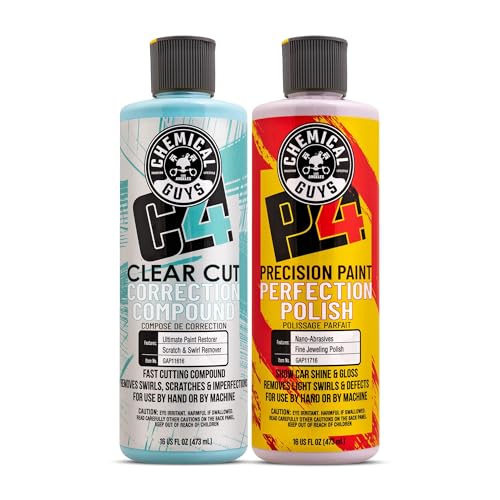
This product is a two-bottle paint-correction set, with a 16-fluid-ounce C4 cutting compound followed by a 16-fluid-ounce P4 finishing polish. It is a chemical kit, not an automotive buffer, so it includes no motor, backing plate, battery, charger, or pads. The intended workflow is to correct defects with C4, then refine the surface with P4 using a separately obtained hand, dual-action, or rotary polisher. Chemical Guys provides specific pad, pressure, and machine-use directions for the two stages. An independent Road & Track hands-on test found that the pair reduced scratches and oxidation on a weathered test panel, and that P4 refined residue from C4. The report also observed splatter when excess product was used. No controlled paint-thickness, heat, vibration, or long-term durability test for this exact set was located.
This set suits a vehicle owner or detailer who already has a compatible polisher, appropriate pads, microfiber towels, and a controlled workspace. It is most relevant for glossy paint with light-to-moderate swirls, towel marks, oxidation, or defects that can be addressed in a small test area before treating a full panel. The separate compound and polish stages are useful when a finishing pass is wanted after correction. Users should be prepared to use eye protection and gloves, and to follow the stated pad and pressure guidance.
It is not suited to someone expecting an all-in-one automotive buffer package, because it contains only liquid correction products. It is also a poor fit for users unable to work with eye protection, gloves, cleanup supplies, and ventilation, especially around children or food. Avoid treating unknown, thin, peeling, freshly repainted, matte, satin, or damaged finishes without paint-system guidance. People seeking measured evidence of clear-coat removal, dust exposure, or exact performance limits will find the available testing incomplete.
The key health issue is chemical exposure, not electrical safety. C4 is identified as an eye irritant in its SDS, which directs users to keep it away from children, wash after use, and wear gloves, protective clothing, and eye protection. The P4 SDS says it is not classified under GHS and is not flammable, but it advises ventilation and appropriate protection for spill cleanup. Its 2021 SDS also includes a California Proposition 65 warning for ethyl acrylate. The set does not create battery or e-waste because it contains no powered equipment. Its environmental profile is less fully documented. P4's SDS directs users not to release material to sewers or surface waters, and C4 calls for disposal according to local, state, and federal requirements. No quantified recycled-content, reusable-packaging, take-back, or third-party environmental certification was located for the bottles or consumables.
This is a compact cordless rotary detail polisher for small painted areas, trim-adjacent recesses, badges, handles, wheels, and other localized work. The supplied manual specifies 2 inch and 3 inch hook-and-loop backing plates, foam pads, shaped pads, sandpaper, and a nylon brush. It identifies a built-in 4000mAh, 3.6V lithium-ion battery, USB-C charging at 5V and 3A, three speed settings, and a stated unloaded maximum of 950 RPM. The maker states that the tool weighs 0.58 pounds, produces less than 65 dB, and can run for up to 50 minutes. Those figures were not independently verified. Its most distinctive evidence-backed feature is not a laboratory result, but a fairly specific operating manual: it assigns pad types and speed settings, requires secure accessory fitment, and gives heat-control instructions for paint and plastic surfaces. No current third-party electrical listing or independent performance test for this exact product was located.
This product suits an adult hobbyist doing occasional, localized cosmetic work on a vehicle that is otherwise in good finish condition. Its small pads, low stated maximum speed, shaped foam accessories, and instructions for badges, handle recesses, emblems, wheel areas, and minor paint defects make it most relevant where a full-size polisher is awkward. It also fits a user willing to follow the manual closely, choose compatible polishing liquids separately, inspect pads before use, and provide their own suitable USB power adapter.
It is not suited to users who need a listed electrical tool and charger for workplace, fleet, or other compliance-sensitive use. It is also a poor fit for large-panel correction, severe scratches, oxidation removal, or repeated professional detailing, because the maker provides no independent load, runtime, temperature, vibration, or correction testing for those jobs. Avoid it for children and for anyone unable to manage rotating accessories, chemical polish, wet sanding residue, or lithium-ion battery storage safely. Do not use it where paint thickness is unknown or finish damage would be costly.
The manual contains meaningful basic safety direction. It tells users to keep hair, clothing, and jewelry away from the rotating disc, fit the backing base fully, stop if abnormal heat occurs, avoid heat buildup on paint, reduce speed on plastics, and keep the tool dry. It also warns that its non-removable lithium-ion battery can pose fire, explosion, and leakage hazards if damaged, overheated, submerged, crushed, or improperly discarded. Important gaps remain. No recognized third-party electrical safety listing was located for this exact product or its required USB charging setup. The maker states a noise figure, but no independent vibration or noise test was found. The battery is not user-replaceable, and no documented U.S. take-back or spare-battery program was located. The kit includes reusable foam pads and backing plates, but also disposable sandpaper, with no material, packaging, or recycled-content disclosure found. No relevant CPSC recall was located in the searched records.
This is a corded rotary car polisher, not a dual-action orbital machine. It uses a 10 A, 1200 W motor, according to the Amazon product specifications, and the listing gives a 1,000 to 3,500 RPM six-setting speed range. At 5.2 pounds, it is intended for hand-held waxing, buffing, paint correction, sanding, and work on other hard surfaces. The manufacturer independently lists this product with 6-inch and 7-inch backing discs, four 6-inch foam pads, a 7-inch wool bonnet, sanding papers, a D-handle, side handle, and hex wrench. Its published spindle specification is 5/8 inch. Those are useful compatibility details, but no accessible independent test was found for its actual RPM under load, vibration, heat, noise, or finish results. No current third-party electrical-safety listing for this exact product was verified.
It suits an experienced home user or detailer who specifically wants a corded rotary machine for occasional paint correction, waxing, buffing, or sanding, and who can control a direct-drive rotating pad. The supplied 6-inch and 7-inch pad systems, selectable speed range, and alternate handles make it practical for users who already understand pad choice, compound behavior, edge pressure, and heat management. It also suits someone who prefers not to manage a battery pack or charger.
It is not a safety-oriented choice for a first-time user learning paint correction on valuable, thin, repainted, dark, or unknown-condition finishes. A rotary pad can generate concentrated heat and remove material quickly, while the available product information does not provide verified paint-thickness, heat, or finish-damage test results. It is also unsuitable for buyers who require a verifiable U.S. electrical-safety listing, measured noise or vibration data, documented replacement parts, or manufacturer-supported recycling details.
The main health advantage is that this is a corded tool, so it has no lithium battery or charger to store, replace, ship, or recycle. The product listing identifies 10 A and 1200 W electrical specifications, and the manufacturer identifies a six-setting speed range, 5/8-inch spindle, and supplied 6-inch and 7-inch backing systems. Those details help with basic setup, but they are not independent safety certification. No exact-product UL, ETL, CSA, or TÜV listing was verified, and no exact-model independent vibration, noise, heat, or polishing test was found. The supplied sanding papers and polishing pads can create dust or spread product residues, yet accessible product information did not provide an exact-model safety data package or detailed ventilation and PPE guidance. The reusable foam pads and wool bonnet may reduce repeat accessory purchases, but no recycled-content, packaging, spare-parts, or end-of-life recycling program was documented.



