Best Overall
24% off
Petra HD4000 Electric Backpack Sprayer
Long-lasting battery ensures extended spraying sessions.
Comfortable padded straps for easy carrying.
Versatile spray nozzles for various applications.
 Daniel Kenitz
Long-lasting battery ensures extended spraying sessions.
Comfortable padded straps for easy carrying.
Versatile spray nozzles for various applications.

Efficient dual battery system for extended use.
Versatile with 7 interchangeable nozzles.
Leak-proof design ensures mess-free operation.

Compatible with Makita 18V battery system
Includes five versatile spray nozzles
High 100 PSI pressure for effective spraying
Adjustable pressures offer versatile spraying options.
Telescopic wand enhances reach and convenience.
Rechargeable battery ensures cordless operation.

Comfortable backpack design for easy portability.
Adjustable pressure up to 90 psi for versatility.
Durable construction for long-lasting use.

Adjustable pressure for versatile spraying needs.
Compatible with Makita 18V battery system.
Includes five nozzles for varied applications.

Easy integration with Dewalt 20V batteries.
Automatic mixing feature saves preparation time.
Lightweight design enhances portability and comfort.

Compatible with DeWalt batteries for convenience.
Adjustable nozzles for versatile spraying options.
High pressure ensures effective pest control.

Efficient battery lasts through multiple uses.
Comfortable, adjustable straps for easy carrying.
Uniform spray pattern ensures thorough coverage.

Versatile with five adjustable spray nozzles.
Convenient battery-powered operation with 2Ah battery.
Adjustable pressure range from 0 to 65 PSI.
Start with the carried load. Water weighs about 8.3 pounds per gallon, before adding the tank, pump, battery, wand, and chemical. Across the supplied products, full loads range from roughly 22 pounds of water for a 2.6-gallon model to more than 44 pounds for larger tanks. Look for a documented empty weight, padded and adjustable straps, waist or lumbar support, balance, a reachable handle, an easy-to-control trigger, and a way to release pressure safely. A larger tank means fewer refills, but it also increases lifting and carrying strain.
Containment is central because the tank rides on your back. A credible product should document the cap, tank, hose, seals, pump, shutoff, filter, and battery-compartment protection, along with inspection and cleanout procedures. A phrase such as “leak-proof” is a manufacturer claim unless supported by model-specific testing or clear operating documentation. For powered products, inspect the complete sold system: sprayer, battery, and charger. A genuine US electrical certification should be traceable through an OSHA-recognized Nationally Recognized Testing Laboratory, such as UL, Intertek ETL, CSA, or TÜV records. CE, FCC, RoHS, or a seller-issued badge is not the same evidence.
Application control determines whether the product can deliver a repeatable dose. Useful documentation includes working-pressure ranges, measured flow rates, nozzle identities, tank graduations, calibration instructions, and, where relevant, droplet-size classification under ANSI/ASABE S572.3. Maximum PSI alone does not tell you the delivered rate or drift potential. Runtime claims can also mislead: published figures may conflict, may depend on pressure and nozzle choice, or may not identify the test conditions. Likewise, “six nozzles” says little if their flow rates and intended patterns are not identified.
Check chemical compatibility rather than assuming that a plastic tank is compatible with every liquid. The supplied reviews repeatedly found missing compatibility charts for tanks, hoses, seals, pumps, and nozzles. Product labels control the permitted pesticide, dilution, protective equipment, nozzle, pressure, weather conditions, application rate, cleanup, and disposal. A filter, removable nozzle, visible markings, and a documented flush-through procedure can reduce clogging and residue carryover, but they do not replace label directions.
For longevity, look for replacement seals, filters, hoses, pump parts, batteries, chargers, and harness components, plus repair instructions and a stable manufacturer or importer identity. Parts availability can reduce premature disposal, especially for equipment exposed to concentrated chemicals. Independent performance evidence is uncommon in this category; a meaningful report should identify the exact model, test method, laboratory, and results for leakage, pressure stability, flow, runtime, or spray distribution.
Recurring safety limits are substantial: a full backpack can be too heavy for people with back, shoulder, balance, lifting, or mobility limitations; powered units generally lack verified complete-system US electrical certification; and most products lack independently tested output, droplet, leakage, or compatibility evidence. Do not use an unverified product with flammable liquids, and do not assume compatibility with strong acids, caustics, solvents, oils, or disinfectants. Keep children, pets, bystanders, and sensitive plants away from active spraying, avoid windy conditions, inspect connections before filling, calibrate with water, depressurize before service, and clean according to the chemical label.
The scores below compare the supplied products on containment, carrying and control, chemical handling, environmental application, service life, and supporting evidence. A higher score indicates stronger documentation or design evidence for that topic; it does not prove that a product is safe for every chemical or application.
This measures containment of the tank, cap, pump, hose, seals, shutoff, and—on powered models—the battery compartment. Because the liquid rides against the wearer, loose connections, worn seals, or unintended discharge can create direct exposure. Among the supplied products, higher scores reached 76, while lower scores were 63; stronger entries documented inspections, filters, shutoffs, leak checks, or internal pump layouts.
For powered sprayers, this measures protection from liquid reaching electrical parts, battery overheating, charger faults, and unsafe battery interchangeability. It matters because the battery is close to a tank containing liquid. Manual products scored 100 because they have no battery or charger; powered products ranged from 54 to 73, reflecting gaps such as undocumented battery protection, liquid separation, or charging evidence.
This measures loaded weight, harness support, fit, balance, handle and trigger placement, pumping effort, and safe depressurization. A full tank can weigh roughly 22 to more than 50 pounds with water and equipment. The supplied scores ranged from 58 to 75. Higher-scoring products documented padded straps, waist or lumbar support, trigger locks, or powered pumping, but even a good score does not make a heavy full pack suitable for every wearer.
This measures identified wetted materials, chemical compatibility, draining, filter and nozzle access, flushing, and residue control. It matters because incompatible chemicals can damage seals or hoses, while residue can clog equipment or contaminate the next application. Scores ranged from 68 to 78. Higher-scoring products documented cleanout procedures, filters, replacement seals, or limited compatibility guidance; most still lacked a complete compatibility chart.
This measures documented flow, working pressure, nozzle identification, calibration guidance, tank markings, and output stability. It matters because pesticide labels specify rates, while pressure alone cannot establish the amount applied. Scores ranged from 64 to 75. Higher-scoring products offered markings, adjustable flow or pressure, named nozzles, or stated flow figures; the reviews still commonly found no nozzle-specific flow table or calibration procedure.
This measures whether capacity, pressure, flow, runtime, compatibility, leak resistance, and application claims are specific and supported, without implying that the sprayer itself controls pests or weeds. Scores ranged from 52 to 75. Higher-scoring products had fewer or better-qualified claims; lower-scoring products showed conflicting pressure, capacity, runtime, flow, or warranty figures, or relied heavily on unverified marketing language.
This measures model-specific independent results for leakage, pressure stability, flow, runtime, nozzle output, and spray distribution. It matters because seller claims and included accessories do not establish consistent application. Scores were tightly grouped from 68 to 70, but every supplied review reported that no accredited, model-specific performance report had been located. Buyers should therefore treat this category as an evidence gap across the set.
For powered sprayers, this measures whether the exact sprayer, battery, and charger can be matched to a verifiable US NRTL certification record. It matters because a generic UL, CE, FCC, RoHS, or seller badge may not cover the complete sold system. Powered products scored 68 to 71 and lacked a located match; manual products scored 100 because no electrical system exists.
This measures stable brand and manufacturer identity, model and serial marking, support access, warranty information, and a practical recall path. Traceability helps identify the exact unit if a defect emerges. Scores ranged from 70 to 84. Higher-scoring products had established model information, published parts or warranty support, UPCs, and reachable manufacturers; lower-scoring products had limited manuals, parts information, or importer detail.
This measures pressure control, nozzle information, shutoff control, droplet evidence, and instructions that limit drift, overspray, and runoff. A maximum PSI figure is not enough: nozzle, pressure, walking speed, spray width, and wind affect where the liquid goes. Scores ranged from 61 to 74. Higher-scoring products documented multiple nozzle patterns, lower-pressure options, or calm-weather and cleanout guidance, but none had complete independent drift evidence.
This measures serviceable seals, filters, hoses, pump parts, batteries, and the availability of parts and repair instructions. Chemical exposure and battery wear can otherwise turn a functioning tank into discarded plastic or electronics. Scores ranged from 68 to 87. The strongest products published substantial replacement-parts paths for pumps, seals, hoses, filters, valves, and harnesses; lower-scoring products had little or no parts, repair, or battery-replacement information.
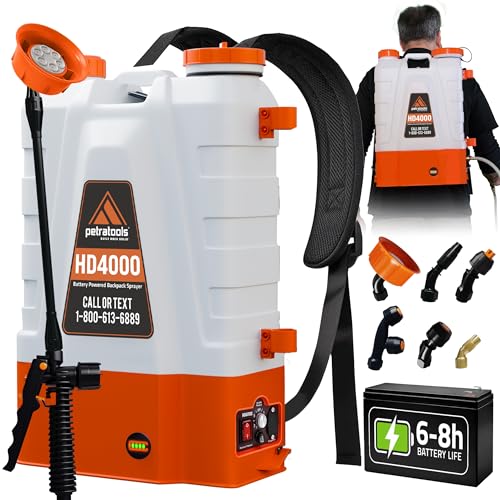
This is a battery-powered backpack sprayer for applying water-based lawn, garden, pest-control, and weed-control liquids. The documented configuration has a 4-gallon translucent tank with gallon markings, a 12V 8Ah sealed lead-acid battery, 4-foot hose, extendable 34.5-inch wand, six nozzles, and adjustable 40-90 PSI output. Empty weight is listed as 16.46 pounds. Manufacturer documentation describes padded shoulder straps, a back pad, locking handle, screen filter, spare O-rings, and a replaceable fuse. At a full 4-gallon water load, the carried weight is roughly 50 pounds before any denser chemical mixture. The manufacturer states 6-8 hours or 200-plus gallons per charge, but performance depends on nozzle and pressure. No model-specific independent lab report for leakage, flow consistency, runtime, nozzle droplet size, or distribution was located.
This suits a physically capable homeowner or grounds worker who needs repeated spot treatment or lawn and garden spraying without manual pumping. Its 4-gallon capacity, adjustable pressure, gallon markings, six nozzles, and locking handle are most useful when the user is prepared to calibrate output with water before applying a pesticide or fertilizer. It also fits users willing to flush the system after every use, inspect the filter and O-rings, and keep separate equipment or strict cleanout routines for incompatible products.
It is not well suited to people with back, shoulder, balance, or lifting limitations, because it can approach 50 pounds when filled with water and potentially more with some mixes. It is also a poor fit for households where children or pets can access charged equipment or chemical storage without controls. Applicators needing documented nozzle droplet classifications, independently verified application rates, certified full-system electrical safety, or validated compatibility with corrosive and strong caustic liquids should use equipment with that specific evidence.
The product carries liquid on the user’s back, so containment and cleanout matter more than convenience claims. The supplied instructions call for gloves, eye protection, protective clothing, keeping children and pets away, avoiding flammable liquids, securing connections, and staying within the stated 40-90 PSI range. They also direct users to empty the tank and flush water through the complete spray path after use. Those steps are useful, but they do not replace the pesticide label’s required protective equipment, dilution, wind, and disposal directions. The tank is described as plastic and the battery as 12V sealed lead-acid. Spare O-rings and a fuse may extend service life when maintained. PetraTools sells a replacement charger it calls UL Listed, but independent public verification of the exact complete electrical system was not located. No recall for this product was found in the CPSC recall search reviewed, although absence of a recall is not proof of safety.
This is a battery-powered backpack sprayer for applying water-based lawn, garden, fertilizer, weed-control, and pest-control liquids. It carries 5 gallons, includes a telescopic brass wand, 45.6-inch hose, lockable trigger handle, seven interchangeable nozzles, charger, two 2.0Ah rechargeable batteries, filter, and spare O-rings. The manufacturer states that pressure is adjustable from 0 to 100 psi, that each battery can provide up to 1 hour 48 minutes of continuous spraying, and that a diversion groove directs spilled liquid away from the battery compartment. Those are manufacturer claims, not independently published test results. A third-party retail listing corroborates the basic format and dual-battery configuration. No model-specific laboratory report for leakage, output stability, runtime, droplet spectrum, or spray distribution was located.
This product suits an experienced homeowner, groundskeeper, or small-property user who needs to cover larger outdoor areas without hand pumping and is prepared to calibrate the equipment with water before each pesticide use. The 5-gallon tank and two batteries make the format more practical for lawns, trees, orchards, fence lines, and repeated spot treatments than for a few patio plants. It is most appropriate where the user can wear protective equipment, keep the nozzle close to the target, and follow every pesticide label restriction.
It is not well suited to users who cannot safely carry a backpack containing up to 5 gallons of liquid, including people with back, shoulder, balance, or lifting limitations. It is also a poor fit for indoor spraying, very small gardens, or applications near children, pets, drains, water, pollinator habitat, or sensitive neighboring plants unless the label specifically permits that use and drift can be controlled. Commercial or workplace users needing verified electrical listing, documented nozzle output, or validated application records should use equipment with those records available.
The main health concern is containment of the liquid carried on the user's back. SEESII describes a leak-proof tank, factory water testing, a lockable handle, and a liquid-diversion groove intended to keep spills away from the battery compartment. These are useful design claims, but no independent leakage test or operating manual with detailed inspection, depressurizing, and chemical-cleanout instructions was located. No matching CPSC recall or safety warning was located in the searches performed. The product has adjustable pressure and multiple nozzle patterns, which can help match spray shape to the target. However, EPA guidance stresses that nozzle choice, pressure, weather, and calibration determine drift and application rate. The manufacturer does not publish model-specific flow data, droplet-size classifications, or calibration tables. No verifiable US NRTL certification was found for the electrical system, so keep the charger and batteries dry, use only the supplied charging system, and do not treat unsupported compatibility claims as proof for corrosive or abrasive formulations.
This product is a battery-powered backpack sprayer for applying water-based garden liquids such as fertilizer or products whose labels allow backpack-sprayer application. It has a stated 4-gallon, 16-liter tank, a telescopic wand, a 39.3-inch hose, five nozzle styles, and an included 21V, 2.6Ah lithium-ion battery and charger. The published empty weight is 8.93 pounds. An independently hosted manual, not an independent performance test, identifies HDPE, nylon, and polypropylene construction, a filter screen, adjustable pressure up to a manufacturer-stated 100 psi, and instructions to flush the liquid path after use. It also states compatibility with Makita 18V batteries, but does not document electrical certification, measured flow rates, droplet sizes, runtime conditions, or a chemical-compatibility chart for the seals, pump, hose, and battery enclosure.
This product fits a homeowner with a medium or large yard who needs an electric backpack format for occasional spot treatment, fertilizing, or watering, and is prepared to calibrate it with water before using a pesticide. It is most suitable where the liquid label permits this application method and the user can safely manage roughly 42 pounds before accounting for concentrate. The documented filter, flush instructions, wand, and multiple nozzle options are practical for users willing to inspect and clean equipment after every job.
It is not suited to users who need a verified pesticide application rate for regulated work, sensitive gardens, or areas near neighbors, drains, wells, ponds, or pollinator habitat. The supplied information lacks measured nozzle flow and droplet data. It is also unsuitable for anyone unable to lift, wear, and control a filled backpack, or for households that need verified electrical certification for the complete battery and charger system. Do not assume every herbicide, insecticide, disinfectant, or solvent is compatible without confirmation from its label and product support.
The product documentation identifies an HDPE, nylon, and polypropylene build, a filter screen, removable nozzle options, and post-use flushing of the tank, hose, wand, pump, and nozzles. Those steps can reduce clogging and residue carryover, but they do not establish compatibility with every pesticide or solvent. Follow the pesticide label for allowed equipment, mixing, protective clothing, gloves, eye protection, cleaning, and disposal. EPA guidance notes that backpack application can expose users through leaky hoses, loose connections, dripping nozzles, and high-pressure spraying. The same guidance calls for cleaning the entire spray system and preventing pesticide rinsate from entering drains or water bodies. No product-specific CPSC recall was located in the searched resources. However, no public US NRTL certification or independent model-specific safety and spray-performance report was located for the product, battery, or charger.
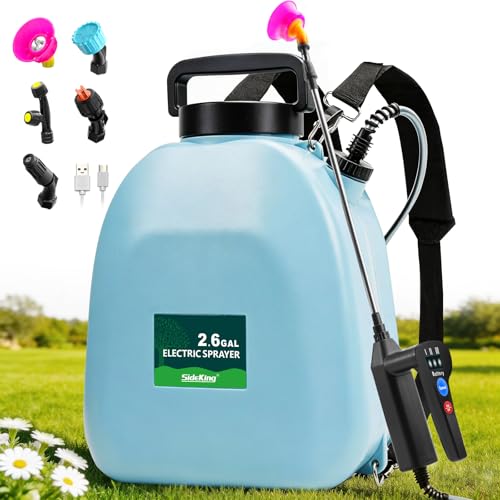
This rechargeable backpack sprayer is a roughly 10-liter, or 2.6-gallon, liquid applicator for watering, fertilizer, herbicide, pest-control products, and outdoor cleaning. It uses a battery-powered, self-priming pump rather than a manual pump. The product is carried on the back and operated with a hose, telescopic wand, trigger, and interchangeable nozzles. The product’s own retail listings state that it has a 7.4V motor, a 4,400mAh lithium battery, three output settings, five nozzle types, a translucent HDPE and ABS tank, a built-in filter, and padded adjustable shoulder straps. Those are manufacturer-stated specifications, not independently tested results. A full water fill alone weighs about 22 pounds, before the tank and hardware, so fit, careful filling, and controlled walking speed matter.
This product fits a homeowner with a small or medium lawn, garden beds, shrubs, or spot-treatment tasks who wants to avoid repetitive hand pumping. Its stated 2.6-gallon capacity is substantial enough for routine yard work while remaining less cumbersome than larger backpack tanks. It is most appropriate for users prepared to wear pesticide-label-required protective equipment, mix only compatible products, test the unit with water first, and measure real output over a marked area before applying any pesticide.
It is not well suited to users who need documented application rates for regulated, high-consequence, or repeatable pesticide work. Choose equipment with nozzle flow charts, a pressure gauge, calibration guidance, and verified droplet information for those uses. It is also unsuitable for anyone unable to safely carry at least 22 pounds of liquid plus the product, or for households that cannot store, charge, clean, and secure pesticide equipment away from children, pets, ignition sources, and food areas.
The tank is described by the seller as HDPE with ABS components, reinforced seals, a filter, and a spring-supported hose. Those construction details may help with ordinary handling and clog prevention, but the product information does not identify the seal elastomer, publish a chemical-compatibility chart, or document complete draining and flushing. Treat compatibility with herbicides, fertilizers, disinfectants, and solvents as unproven unless the chemical label and product support both allow it. The powered system uses a stated 7.4V lithium battery and USB charging cable. No exact-product listing was located in the major US electrical certification directories checked, and no independent electrical or spray-performance report was found. A search of CPSC recall resources on August 16, 2026 did not identify a product-specific recall. That is useful traceability context, not proof of electrical safety. Pressure selection and nozzle choice still require water-only calibration, label compliance, and low-drift technique to limit exposure and off-target runoff.
This is a hand-pumped, 4-gallon piston backpack sprayer for applying liquid pesticide, fertilizer, disinfectant, or plant-treatment mixes. SOLO specifies an HDPE tank, nylon-reinforced PVC hose, polypropylene shut-off valve and wand, a 90 psi maximum, and a stated full water weight of 43 pounds. It has no battery, charger, or motor. The manufacturer documents a filter basket, nozzle filter, lockable shut-off valve, four supplied nozzle patterns, and a left or right pump-handle arrangement. Its manual also directs users to water-test for leaks, wear chemical protective equipment, relieve pressure through the wand before service, and flush after use. The basic 425 has no standard pressure gauge, regulator, pressure-relief valve, or waist belt. No model-specific independent report verifying leakage, pressure stability, flow, or spray distribution was located.
It suits a trained home gardener, grounds worker, or landscaper treating modest areas with compatible liquid formulations and willing to calibrate with water before use. The four-gallon capacity can reduce refill interruptions, while the piston pump, multiple nozzle patterns, and replaceable service parts support regular manual spraying. It is most appropriate for users who can safely manage a stated 43-pound full load, maintain a consistent walking pace, inspect seals and filters, and follow the pesticide label and protective-equipment requirements.
It is not suitable for anyone unable to safely carry and control a 43-pound load, especially on slopes, ladders, uneven ground, or while repeatedly bending. It is also a poor fit for users who need a waist belt, a built-in pressure gauge, a pressure-relief valve, or a regulated output for tightly controlled application rates. Do not use it for flammable liquids, acids, caustic chemicals, or unverified disinfectants and solvents. Users handling wettable powders should select equipment specifically intended for abrasive formulations.
The product is hand-powered, so it does not introduce lithium battery, charger, or liquid-to-electrical hazards. SOLO identifies the tank as HDPE, with a nylon-reinforced PVC hose and polypropylene wand and shut-off components. Its manual calls for a pre-use water leak check, chemical-resistant gloves, goggles, protective clothing, ventilation, and pressure release through the wand before inspection or repair. It also warns that handling brass parts can expose users to lead, so hands should be washed after handling those parts. Chemical limits matter. The manual prohibits flammable materials, acids, and caustics, and advises against wettable powders in this piston-pump product because abrasive mixtures can accelerate wear and seepage. It directs complete draining, soapy-water flushing, and proper disposal of contaminated rinse water. Listed repair kits and individual parts can extend service life and reduce disposal of a contaminated sprayer. A search of CPSC recall records found no recall listing for this product as of August 16, 2026.
This is a battery-powered backpack liquid sprayer for lawn, garden, cleaning, and plant-care jobs. The product is sold with a 16 L tank described as four gallons, a telescoping stainless steel wand, hose, five nozzle types, a 2.6 Ah battery, charger, and padded shoulder straps. A copy of the model manual identifies the tank material as HDPE and lists an empty weight of 8.93 pounds. The manufacturer states that output is adjustable from 0 to 100 psi, that the tank has gallon markings and a fill filter, and that the battery system has low-voltage shutoff. Those are useful operating provisions, but they are manufacturer statements, not independently tested results. No model-specific flow chart, nozzle droplet classification, calibration guide, chemical-compatibility chart, third-party spray test, or verified U.S. electrical listing was located. A full tank can place roughly 42 pounds of water and equipment on the wearer.
This product suits a homeowner or groundskeeper treating a modest outdoor area who wants a battery-powered backpack format instead of pumping by hand. It is most appropriate for users prepared to measure output themselves with water before applying any pesticide, then follow the selected pesticide label for protective equipment, dilution, nozzle choice, wind limits, and cleaning. The marked tank, adjustable pressure control, fill filter, spare gaskets, and several nozzle options are practical for routine garden watering, fertilizer application, and limited spot treatment where the user can keep the wand close to the target.
It is not suited to anyone who needs documented electrical certification, independently verified spray performance, or a published nozzle flow and droplet chart for regulated or highly repeatable pesticide work. It is also a poor fit for users unable to safely carry about 42 pounds when the tank is full, or for jobs requiring waist support, verified chemical resistance, and readily available pump or hose replacement parts. Avoid relying on its 100 psi maximum claim to solve drift problems. High pressure can increase fine-droplet drift unless the pesticide label and nozzle documentation support that setting.
The available manual gives some meaningful containment and maintenance details. It calls for secure hose connections, provides spare gaskets, uses a fill filter, and instructs users to rinse the tank, hose, wand, and nozzle after use. The tank is identified as HDPE and the wand as stainless steel, but the product information does not identify seal, hose, pump, or nozzle materials well enough to confirm compatibility with particular pesticide or solvent formulations. No U.S. CPSC recall specific to this product was located in the review search. No model-specific independent leakage or spray-distribution report, and no verifiable U.S. NRTL listing for the sprayer, battery, or charger, was located. The manufacturer claims waterproof construction and low-voltage battery shutoff, but neither claim was independently substantiated. EPA guidance emphasizes calibration, correct nozzle and pressure selection, and keeping the nozzle close to the target to limit misapplication and drift. This product does not supply the flow and droplet data needed to replace those checks.
This is a battery-powered backpack sprayer with a 4.2-gallon plastic tank, a telescopic stainless-steel wand stated to extend to 42 inches, and six supplied nozzle types. It is sold as a tool only and is intended to accept a DeWalt 20V battery, without a supplied battery or charger. It is intended for garden liquids such as water, fertilizer, and products used according to their labels. The available product manual states that pressure can be adjusted from 0 to 100 PSI, the tank has a scale and wide-mouth cap, and the wand handle has a trigger lock. It also states that the unit has padded shoulder straps, waist support, a tank filter, and replaceable O-rings. These are manufacturer-stated features, not independently validated performance results. No model-specific laboratory report, flow-rate chart, droplet-size classification, or third-party electrical listing was located.
This product fits a homeowner or groundskeeper who already owns a compatible DeWalt 20V battery and needs a backpack format for occasional, medium-area watering or label-directed garden treatment. The 4.2-gallon tank reduces refilling, while the stated adjustable pressure, long wand, trigger lock, and padded harness may make spot treatment and routine garden work more manageable. The user should be comfortable calibrating output with water and following the chemical label, since product-specific output data is not published.
It is not suited to users who need a complete, independently certified electrical system, documented material compatibility for corrosive or solvent-containing liquids, or validated application-rate records. Commercial applicators and users working near water, pollinator habitat, neighbors, children, or pets need nozzle flow and droplet information that this product does not publish. It is also unsuitable for anyone unable to safely manage roughly 35 pounds of water in a full tank, before adding the unit and battery.
The available manual identifies a plastic tank and stainless-steel wand, calls for gloves, eye protection, and other appropriate protective equipment when handling chemicals, and instructs users to remove the battery before cleaning or maintenance. It also says to secure connections, avoid overfilling, clean the tank filter and nozzle, and replace damaged O-rings. Those instructions are useful, but the manufacturer does not publish a chemical-compatibility chart for the tank, hose, seals, mixer, or fittings. No exact-product recall was located in the CPSC search, and no model-specific US NRTL certification or independent spray-performance report was located. This matters because CPSC recalled another 20V, 4-gallon battery backpack sprayer in 2024 after reports that chemical leakage into its battery compartment could cause overheating and fire. That recall does not establish a defect in this product, but it underscores the importance of checking for leaks and keeping liquid away from the battery compartment. No replacement-parts catalog was found, which limits confidence in long-term repairability.
This is a battery-powered backpack sprayer that carries 3.2 gallons of liquid, or about 26.7 pounds of water before adding the tank, battery, and accessories. It is intended for hand-applied lawn, garden, weed, pest-control, fertilizing, and cleaning liquids. Independent marketplace records corroborate the stated 3.2-gallon capacity, 100 PSI maximum pressure, 1.6-meter hose, five nozzles, and two supplied wands. The product is sold as compatible with DeWalt 20V batteries and also includes a 2.0Ah battery and charger, according to seller materials. Those electrical claims were not matched to a model-specific safety certification or test report. A central limitation is traceability. The same product model and specification set appears in marketplace listings with no brand or under a different brand, so the responsible manufacturer, parts pipeline, and recall contact are less clear than the product presentation suggests.
This product suits a homeowner or property caretaker who needs to cover a medium to large yard, orchard, garden beds, or fence-line weeds without manual pumping. Its 3.2-gallon capacity is useful when repeated refills would interrupt work, while the wand and nozzle selection can support both broad wetting and directed spot application. It is most appropriate for users who already understand pesticide-label directions, wear the required protective equipment, can calibrate their own output, and will use only liquids confirmed compatible with the product materials.
It is not well suited to buyers who need documented electrical certification, a verified liquid-ingress rating, or independently tested performance for workplace use. It is also a poor fit for households where children or pets can access stored pesticides or charging equipment, unless chemicals and the battery are secured separately. Avoid it for flammable liquids, corrosive mixes, solvent-heavy products, or any pesticide whose label requires a specific droplet spectrum, pressure range, closed mixing system, or calibrated application method that this product does not document.
A full tank creates a substantial backpack load, and pesticide application can expose the wearer during filling, spraying, cleaning, or a hose or fitting failure. The product materials describe a cap, hose, trigger wand, filter, padded straps, and adjustable output, but no independent leakage test or materials compatibility chart was found. Follow the pesticide label, use its required gloves, eye protection, clothing, and respiratory protection, and depressurize before opening or servicing the tank. Pressure and nozzle choice affect drift. Federal applicator guidance emphasizes calibration, keeping the nozzle close to the target, using the correct nozzle and pressure, and avoiding wind and temperature inversions. No nozzle droplet-spectrum data or independent spray-distribution testing was found for this product. No specific CPSC recall was located in the searched records, but the unclear manufacturer identity and absent confirmed electrical certification make product marking, retained purchase records, dry battery storage, and careful inspection of seals and hose connections especially important.
This is a battery-powered backpack sprayer for applying water-based garden treatments, fertilizers, cleaners, or pesticide products that permit backpack application. The manufacturer describes a 4.2-gallon tank, six nozzle types, an adjustable telescopic wand, adjustable pressure control, and an empty weight of 8.5 pounds. A full tank of water alone adds about 35 pounds, so carried weight is a central practical safety issue. The manufacturer also states that it includes a stainless steel wand for water and neutral liquids, plus a plastic wand for diluted acids and alkalis from pH 4 to 9. Those compatibility statements are useful but are not accompanied by a full wetted-material list, chemical chart, cleanout procedure, or replacement-parts diagram. No model-specific independent spray, leakage, runtime, or electrical certification report was located. The brand's own specifications also conflict on battery voltage, with one page listing 12V while marketplace listings state 21V.
This product suits an adult homeowner or groundskeeper treating a medium to large outdoor area who wants to avoid continuous manual pumping and is prepared to calibrate output before applying a pesticide. It is most appropriate where the liquid label allows backpack-sprayer use, the user can keep the load manageable, and they will use the supplied wand only within the manufacturer's stated liquid limits. It also fits users who can rinse and empty equipment promptly after each compatible application.
It is not suited to anyone who needs independently verified electrical safety, certified charger performance, or documented spray-distribution testing for workplace purchasing. It is also a poor fit for users with back, shoulder, balance, or lifting limitations, since a filled tank can approach 44 pounds before accessories. Do not use it for unknown mixtures, strong acids or bases, solvents, or any pesticide use that conflicts with the product label. Households with children or pets need secure storage and strict separation from food areas.
The main health consideration is containment of the liquid carried on the user's back. The manufacturer describes a filter screen, trigger lock, adjustable straps, level markings, and dedicated stainless steel and plastic wands, but it does not publish a detailed seal, hose, cap, or pump service document. That means users should inspect fittings and straps before every fill, avoid overfilling, and rinse only where the pesticide label permits. The manufacturer supplies nozzle choices and adjustable pressure, but no documented droplet-size classification, pressure settings by nozzle, or calibration procedure was found. That matters because pressure and nozzle selection affect both application rate and drift. No relevant CPSC recall was identified in the search performed, but no verifiable US NRTL certification or model-specific third-party test report was found for the product, battery, or charger. Repairability is limited by the absence of a published parts catalog despite the brand offering support and a stated warranty.
This is a battery-powered backpack sprayer for applying compatible lawn, garden, and plant-care liquids. It carries 4.23 gallons, uses an 18V 2Ah rechargeable battery, and has claimed adjustable output from 0 to 65 PSI with five interchangeable nozzles and a spray wand. Garvee lists padded adjustable shoulder straps, a wide tank opening, and a 12-month warranty. A substantially matching published manual identifies a 16 L version with a membrane pump, removable 18V battery, battery-compartment cover, 0 to 65 PSI working-pressure range, and maximum stated output of 3.1 plus or minus 0.3 L/min. That manual also specifies rinsing the liquid path and spraying clean water for three minutes after use. No model-specific independent laboratory report for leakage, nozzle droplets, pressure stability, runtime, or distribution was located.
This product suits an adult homeowner maintaining a medium to large garden, lawn, greenhouse, fence line, or planted property with water-based liquids that are explicitly allowed by both the liquid label and product instructions. It is particularly relevant when avoiding repeated manual pumping matters and the user can measure and calibrate output with water before pesticide use. The user should be comfortable carrying roughly 44 pounds when filled, wearing the liquid label's required protective equipment, and rinsing the entire system promptly after each application.
It is not suited to anyone who cannot safely manage a roughly 44-pound backpack load, including users with back, shoulder, balance, or lifting limitations. It is also unsuitable for households needing independently certified electrical equipment, documented compatibility with corrosive or solvent-containing mixtures, or replacement parts for long-term field repair. Do not use it for fuels, flammable liquids, unapproved corrosives, or spraying people or animals. Users applying pesticides near neighbors, water, pollinator habitat, or sensitive plants need nozzle and calibration evidence that this product does not provide.
The key health issue is that this is a chemical container carried on the back. The available manual shows a covered battery compartment, removable battery, trigger shutoff, and cleaning instructions, but it does not identify the wetted plastics and seals or publish leakage testing. A 2024 CPSC recall of another brand's battery backpack sprayer involved chemicals entering a battery compartment and overheating the battery. That recall does not identify this product, but it makes careful inspection for leaks and keeping the battery area dry especially important. Garvee instructs users to avoid fuels, flammable liquids, solvents, and unapproved corrosive mixtures, to wear the liquid label's protective equipment, and to empty, rinse, and dry the liquid path after use. Complete cleanout helps limit residue carryover and contaminated disposal. The product has adjustable pressure and multiple nozzles, but no verified droplet-size or nozzle-flow data. Use the pesticide label, calibrate with water, keep the nozzle close to the target, and avoid high pressure and windy conditions to limit drift and runoff.


