Best Overall

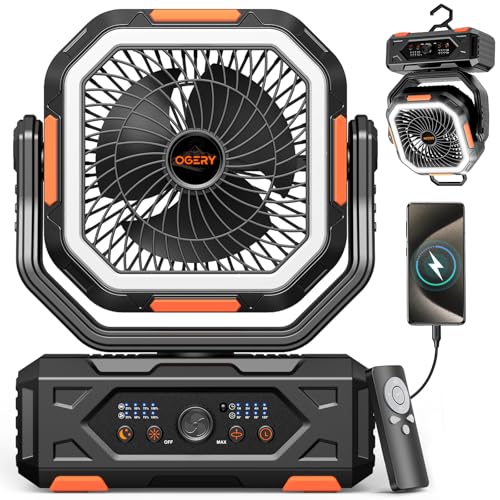
Ogergy Portable Camping Fan with LED Light
Long-lasting battery offers extended usage time.
Adjustable height stand enhances versatility.
Includes LED light for convenient illumination.
 Lauren Wilson
Long-lasting battery offers extended usage time.
Adjustable height stand enhances versatility.
Includes LED light for convenient illumination.
Long-lasting battery for extended outdoor use.
Convenient remote control for easy operation.
Versatile design with built-in LED lantern.

Long-lasting 30000mAh battery for extended use.
Convenient remote control and timer features.
Versatile fan and lantern combo for camping.

Compact design fits easily in bags.
Rechargeable battery for extended use.
Quiet operation enhances user comfort.

Long-lasting 20400mAh rechargeable battery.
Convenient remote control operation.
Versatile hanging design for various settings.

Long-lasting 40000mAh battery for extended use.
Dual functionality: fan and lantern combined.
Portable and convenient for outdoor adventures.

Comfortable, bladeless design ensures safe use.
Long-lasting 4000 mAh battery for extended cooling.
Adjustable speeds offer personalized cooling options.
Long-lasting 10,000mAh battery for extended use.
Strong airflow with four adjustable speed settings.
Versatile clamp design for various mounting options.

Long-lasting 48-hour battery life.
Convenient built-in LED lantern.
Compact and ultra-slim design.

Long-lasting 24-hour battery life.
Quiet operation for peaceful environments.
Compact and portable for easy travel.
The useful questions are: how much air reaches the intended sleeping or seating area, how long the fan runs at that setting, how loud it is at the user’s position, and whether it can be placed securely. A credible performance test should identify the speed, oscillation, light use, USB-output load, ambient conditions, charge method, and the point at which runtime ends. Airflow testing should use a recognized method such as ANSI/AMCA 210, ASHRAE 51, or IEC 60879 where applicable. Noise results should state the measurement distance, operating setting, and method, such as ANSI/AMCA 300 or ISO 3744. A headline such as “quiet,” “300 CFM,” “5.4 m/s,” “60 hours,” or “30,000mAh” is difficult to compare without those conditions.
Battery capacity is another common source of confusion. Milliamp-hours alone do not show usable energy unless voltage, charging losses, fan speed, lighting, oscillation, and USB output are considered. “Up to” runtime usually refers to a low setting and may exclude lights, oscillation, or device charging. Product materials in this category also commonly disagree about capacity, speed count, charging time, noise, weight, or maximum runtime. Treat an unresolved contradiction as a reason to verify the label and manual, not as evidence of the higher figure.
For electrical and battery safety, look for a traceable listing for the exact finished product—not merely a component, CE mark, RoHS statement, FCC claim, or generic safety badge—in the UL Product iQ, Intertek ETL, or CSA directories. Relevant documentation may also include testing to standards such as UL 507 for fans, applicable battery and power-supply standards, and a PHMSA/DOT UN 38.3 lithium-battery test summary. A responsible company, model marking, reachable support, warranty terms, and recall checks through CPSC and SaferProducts.gov make corrective action more practical.
For outdoor use, a hook, clip, tripod, or stand should have clear placement instructions and load limits. An IP rating is meaningful only when supported by an IEC 60529 test report; outdoor marketing alone does not establish rain or dust resistance. Remotes need attention too: if they use a coin cell, check the battery type and whether the compartment is secure against child access.
Across the supplied products, the recurring caveats are substantial: none had a confirmed exact-product U.S. NRTL listing, and independent testing of airflow, runtime, charging, and noise was usually absent. Multiple products were explicitly non-waterproof or lacked an ingress rating, so rain, wet tents, splashing, and damp storage are unsuitable. Integrated batteries commonly lacked replacement, repair, or take-back routes. Fans should not be relied on during dangerous heat; the supplied reviews repeatedly note that above 90°F indoors a fan can increase body temperature. Shade, fluids, rest, air conditioning, and medical attention remain essential.
The scores below reflect the supplied reviews only. A higher score means the available product evidence and documentation better addressed that topic; it does not prove that a product is certified, waterproof, medically protective, or independently tested when the review says that evidence was missing.
A camping fan should be presented as comfort airflow, not heat-illness prevention or a replacement for shade, water, rest, or air conditioning. Higher-scoring products in this set generally used more careful comfort framing; lower-scoring ones paired cooling or hot-weather language with unsupported recovery or sleep implications. The supplied reviews repeatedly warn that fans can increase body temperature indoors above 90°F.
This measures evidence for protection against overcharging, overheating, short circuits, burns, smoke, and fire in the battery, charging electronics, and supplied cable or adapter. Scores clustered around the high 60s and 70s because most products had instructions but no exact-pack certification, UN 38.3 summary, or independent charging and thermal report. A high score reflects stronger documented precautions, not confirmed certification.
A safe fan needs a guarded blade area, stable electrical operation, sensible controls, and a remote whose coin-cell risks are addressed where relevant. Higher scores were supported by practical warnings, enclosed or guarded designs, or documented controls; lower scores reflected unclear remote batteries, model inconsistencies, or missing independent compliance evidence. A remote’s convenience does not establish child-resistant battery protection.
This measures whether hooks, clips, stands, oscillation, ports, and water claims suit the advertised setting. Higher scores reflected observed or documented stable placement options such as feet, hooks, stands, or stakes. Across the set, however, no product supplied enough evidence to treat ordinary outdoor marketing as weather resistance. A claimed IP rating should be backed by an IEC 60529 test report, and a hanging point needs a known secure support.
This rewards repeatable measurements of airflow, runtime, charging, and noise under stated conditions. Higher-scoring products had at least some independent airflow or hands-on performance evidence, while many lower-scoring products relied only on “up to” runtime, CFM, dB, or mAh claims. No supplied product established a complete independently measured overnight profile covering speed, lighting, USB load, charging, sound, and cutoff conditions.
A high score requires specifications that identify meaningful conditions and agree across the listing, manual, packaging, and product. The strongest examples avoided or disclosed uncertainty more clearly; lower scores reflected conflicting battery capacities, runtimes, speed counts, charging times, weights, wattages, or noise claims. Buyers should give less weight to an attractive headline when the product’s own documents do not reconcile.
This measures whether the exact finished fan—not just its battery or charger—is listed by an OSHA-recognized U.S. testing laboratory. Scores were generally in the high 60s or 70 because no supplied product had a confirmed exact-model UL, ETL, or CSA listing in the reviewed records. CE, RoHS, and FCC statements are not substitutes for a traceable U.S. NRTL certificate and scope.
A higher score reflects a named manufacturer, model and batch identification, reachable support, warranty information, and no unresolved safety action in the checked CPSC or SaferProducts.gov records. Most products scored in the low-to-high 70s because some had identifiable companies and support, but a recall search is not a safety certification. Clear traceability matters if a defect or corrective action emerges.
Long service life reduces replacement waste, while cleaning access, repair instructions, replacement batteries, parts, and a meaningful warranty make continued use more realistic. Higher scores were associated with documented cleaning or battery-removal steps and longer warranties; lower scores reflected sealed batteries, no parts catalog, no replacement path, or short warranties. A warranty alone does not prove that a product is repairable.
This measures whether the lithium battery and electronics can be removed or directed to appropriate recycling rather than discarded. The strongest score in the set belonged to a product whose manual gave battery-removal and recycling guidance; other products offered only general disposal advice or none at all. Lithium-ion devices and batteries should not go in household trash or curbside recycling; use a suitable battery, electronics, or household-hazardous-waste route.
This is a rechargeable camping fan with a telescopic tripod, hanging hook, LED lantern, remote, timer, adjustable tilt, and selectable oscillation. The manufacturer specifies a 20,000 mAh version, USB-C charging, USB-A and USB-C power output, an adjustable stand reaching 3.7 feet, and included ground stakes. It is intended for personal airflow in tents, RVs, travel, and indoor spaces. The most useful independent evidence is a hands-on review that found airflow more noticeable in an enclosed tent, garage, or office than outdoors in open space. Airflow, noise, charging time, runtime, and splash resistance have not been independently lab measured. The manufacturer’s own pages also conflict on maximum fan runtime, citing 60 and 138 hours, while using 200 hours for light runtime. Treat all headline endurance and performance figures as conditional manufacturer claims.
It suits car campers, RV users, tent campers, and people preparing for a short power outage who want adjustable personal airflow rather than room cooling. Its format is most practical where a tripod can be set on level ground or secured with the included stakes, or where a strong tent support can safely carry it. The remote, timer, lantern, and variable speed control are useful for bedside use in a compact enclosed space. Buyers should regard the battery-life figures as estimates rather than plan-critical operating times.
It is not for anyone relying on a fan as protection during dangerous heat, especially children, older adults, people with chronic health conditions, or pets. CDC guidance says fans may increase body temperature indoors above 90°F, so shade, hydration, rest, air conditioning, and heat-safety planning remain necessary. It also does not suit buyers who require independently certified electrical and battery safety, verified rain resistance, tested overnight noise data, or a published battery replacement path. Avoid hanging it from weak tent loops or unsecured branches.
This product can improve comfort by moving air, but it is not a heat-illness prevention device. In high heat, especially indoors above 90°F, public-health guidance calls for safer cooling measures and hydration rather than dependence on a personal fan. The product page makes no medical or heat-illness-prevention promise, which is appropriate. No product-specific CPSC recall was located in the verification check, and OGERY publishes support contact details plus a limited warranty that refers to product serial numbers and repair or replacement. However, no exact-product U.S. safety certification, battery test summary, or accessible battery service guide was found. The rechargeable battery and electronics need specialized end-of-life handling. Do not put the product in household trash or curbside recycling. Use an electronics or battery collection program, and seek manufacturer guidance if the battery is damaged.
This is a freestanding or hanging rechargeable camping fan with a lantern, remote, USB power-bank outputs, adjustable airflow, automatic oscillation, and a stated 30,000 mAh battery option. OGERY lists a 15 by 9.5 by 4.3 inch ABS-body format, 120-degree selectable oscillation, 270-degree tilt, USB-C charging, and USB-A plus USB-C outputs. These are manufacturer specifications, not laboratory-confirmed measurements. An independent hands-on review of the 20,000 mAh F11 version confirmed the fan, light, two USB ports, remote, folding handle, hanging hook, and rubber feet. It did not provide standardized airflow, sound, battery, or charging tests. Runtime information is especially unsettled. The supplied marketplace page claims up to 322 hours, while OGERY's current technical specification says up to 60 hours of fan runtime and its own product-page feature panel says up to 138 hours for a 20,000 mAh version.
This product suits campers, RV users, patio users, or people preparing for short power interruptions who want a roughly 15-inch fan that can sit on a stable surface or hang from a secure point. Its practical appeal is feature consolidation, since one unit can provide airflow, low-level tent lighting, and USB charging. It is most appropriate for users willing to treat the stated battery capacity, runtime, airflow, noise, and splash rating as manufacturer claims rather than independently verified performance figures.
It is not suited to anyone relying on a fan as protection from dangerous heat. A portable fan can improve comfort, but it does not replace shade, water, rest, cooling space, or medical attention during heat illness risk. It is also unsuitable for buyers who require an exact-model U.S. NRTL safety listing, a documented battery safety test report, or independently measured all-night runtime and noise. Avoid hanging it where the hook cannot be securely supported, or using it in heavy rain or immersion conditions.
The current OGERY page identifies the housing as high-strength ABS and describes an IPX4 splash-resistance rating, but no exact-model ingress test report was located. It also advertises USB-C PD charging and USB power output. No exact finished-product certification from UL, ETL, CSA, or another OSHA-recognized laboratory was found in the directories checked, and no exact-model battery, charger, or protective-electronics test report was provided. Public CPSC recall and unsafe-product resources searched did not identify an OGERY F11 recall or report. A rechargeable battery can avoid disposable battery use, but service life is constrained by the lack of identified replacement-battery instructions or parts support. At end of life, do not put the product or any lithium battery in household trash or curbside recycling. EPA guidance directs consumers to specialized battery or electronics collection, household hazardous-waste programs, or participating retailers. The remote's battery type and secure-compartment details should be checked on the delivered product before use around young children.
This is a 3.66-pound rechargeable tent fan that combines a four-speed fan, three-level LED lantern, USB power-bank output, remote, timer, hanging hook, stand, oscillation, and manually adjustable head. Independent retailer records corroborate the 11.2 by 8.7 by 4.3 inch format and identify ABS and polypropylene exterior materials. The maker-stated battery capacity is 30,000 mAh, with Type-C charging and a 15-watt rating. The published manual states up to 58 hours at the lowest fan speed, 12 hours at the highest, and 35 dB noise. Those are manufacturer claims, not independently measured results, and the conditions do not disclose oscillation, light use, power-bank load, ambient temperature, or measurement distance. The manual gives basic handling warnings, including keeping fingers out of the grille, avoiding water, using a stable surface, and avoiding prolonged extreme heat exposure.
It suits campers, RV users, and households preparing for short power interruptions who want one battery-powered device for personal airflow, local tent lighting, and occasional phone charging. Its size and 3.66-pound weight make it more appropriate for car camping, bedside use, a campsite table, or a securely supported tent hook than for ultralight backpacking. It also suits a technically capable owner who values the availability of a third-party battery replacement guide and accepts that repair involves soldering.
It is not for anyone relying on a fan as protection from dangerous heat. CDC guidance says fans can raise body temperature above 90°F, so people at elevated heat risk need shade, hydration, rest, and air-conditioned cooling where available. It is also unsuitable for wet-weather exposure, unattended charging, or households where a coin-cell remote could be accessible to young children. Buyers requiring independently verified runtime, quiet operation, weather resistance, or a traceable U.S. electrical-safety listing need documented evidence that was not located here.
The manual gives sensible baseline precautions, including keeping fingers and objects out of the grille, keeping the product dry, placing it on a stable surface, and avoiding prolonged exposure to extreme heat. These are instructions, not proof of independent electrical, battery, or remote-control safety testing. No exact finished-product listing was found in the checked UL, Intertek ETL, or CSA certification resources. A rechargeable fan can improve personal comfort, but it does not replace heat-safety measures. CDC advises that indoor fans can increase body temperature when temperatures exceed 90°F. The listed ABS and polypropylene housing is paired with an internal rechargeable battery and a replaceable CR2025 remote battery. A third-party guide shows the main battery can be replaced, although it requires opening the product and soldering, while the manual advises against self-repair. No manufacturer take-back program or product-specific disposal instructions were located. At end of life, EPA says lithium-ion devices and batteries should not enter household trash or curbside recycling. They belong at a dedicated battery, electronics, or household hazardous-waste collection point.
This is a 250 g foldable personal fan for hand-held, desktop, or lanyard-supported neck use. The manufacturer lists five speeds, a USB-C input, LED battery and speed display, ABS housing, and a 5000mAh lithium-ion battery. Its listed dimensions are 84 x 42 x 193 mm. The manufacturer states up to 19.5 hours of runtime, a four-hour charge time, 5.1 m/s maximum wind speed, and 48 to 67 dB noise. Those figures are not backed here by an independent airflow, runtime, charging, or acoustic test with defined conditions. The available manual includes useful charging, moisture, heat, child-use, and obstruction warnings, but I could not verify an exact finished-product U.S. electrical-safety listing from UL, ETL, or CSA.
This product suits an adult who wants directed personal airflow for commuting, seated outdoor events, travel, dry-weather camping, or a desk. Its 250 g size, folding head, lanyard, five settings, and on-device battery display are practical when the goal is short-range comfort rather than cooling a tent or room. It also suits users willing to treat the stated runtime and noise figures as manufacturer claims, use a compatible USB power supply, and keep the unit dry and clear of hair, fabric, and loose objects.
It is not suited to people relying on a fan as protection during dangerous heat, especially children, older adults, or anyone with heat illness risk. A personal fan can improve comfort but does not replace shade, water, rest, or air conditioning. It is also unsuitable for wet-weather camping, bathrooms, or use near rain because the manual says it is not waterproof. Choose another product for unattended overnight charging, repairable battery service, documented NRTL certification, or independently measured low-noise overnight operation.
The safety documentation is more useful than a bare feature list. It warns against wet use, blocked intakes or outlets, high-temperature storage, battery disassembly, and continued use after smoke or malfunction. It also says children under 14 should use it under guardian supervision. The unit has a guarded fan head and a safety switch, but those features do not substitute for independent electrical and battery certification. The manufacturer identifies ABS plastic and a lithium-ion battery. No exact-product U.S. NRTL listing, battery test summary, repair parts program, removable-battery instructions, or brand take-back program was verified. The manual does not provide product-specific battery recycling directions. At end of life, lithium-ion electronics should go to an appropriate battery or e-waste collection route, not household trash. No matching CPSC recall was found in the CPSC recall search reviewed for this product.
This is a portable, hanging 21-inch fan for tents, gazebos, patios, canopies, and similar sheltered outdoor settings. It combines five detachable plastic blades, an integrated light, a remote, hanging hardware, a storage bag, and a rechargeable battery that is stated as 20,400mAh. It is not a permanently installed ceiling fan. An independent reseller reproduces the manufacturer’s claims of up to 36 hours of runtime, adjustable lighting, a brushless motor, and a 40-foot remote range. Those figures were not supported by an independent airflow, runtime, charging, or noise report. The published product information also conflicts on speed count, with one specification record stating two speeds while reseller copy states four. No exact-product U.S. safety listing, weather ingress rating, battery test summary, or load rating for the hook and strap was located.
This product suits campers, gazebo users, and patio occupants who need temporary, localized airflow and light in dry, sheltered settings where wall power is inconvenient. Its stated rechargeable battery, included hanging accessories, remote, and storage bag fit people who can inspect the hanging point, keep the unit protected from rain, and treat the claimed runtime as an estimate rather than a verified overnight guarantee. It is most appropriate as a comfort accessory, not a heat-safety device.
It is not suited to people relying on it during dangerous heat, especially older adults, young children, people with health conditions affected by heat, or anyone without access to water, shade, rest, and an air-conditioned location. CDC guidance says fans can increase body temperature above 90°F. It is also unsuitable for exposed rain, uncertain overhead supports, or households with children if the remote uses an accessible coin battery, because no remote battery documentation or compliance evidence was located.
The central health limitation is heat safety. The marketing language presents the fan as a response to being driven indoors by heat, but CDC guidance says a fan is for comfort only and can increase body temperature when indoor temperatures exceed 90°F. Use it with shade, fluids, breaks, and a plan to reach air conditioning when conditions are severe. No exact-product U.S. safety certification, battery test summary, weather rating, or independent performance report was located. Searches did not identify a product-specific CPSC recall or safety warning, but accessible seller identity, warranty terms, replacement parts, and battery-removal instructions were also not established. Because a rechargeable battery is integrated, end-of-life handling matters. EPA says lithium-ion batteries and devices containing them should not enter household trash or curbside recycling, and should go to specialized battery or electronics collection.
This is a roughly 3.6 pound portable plastic fan for a table or a tent hook. The available product manual identifies a claimed 40,000 mAh, 3.7 V rechargeable battery, LED lantern with warm and cool modes, 45 or 90 degree oscillation, a 270 degree adjustable head, timer, remote, USB-C charging, and USB or USB-C device charging. These are manufacturer-stated specifications reproduced in the available manual, not independent performance findings. The manual says a full charge takes about 16 hours and limits input to chargers of 3 A or less. It also warns users to keep the unit dry, use a stable flat surface, and keep fingers and objects away from the blades. No independent exact-product airflow, runtime, sound, battery-protection, or finished-product electrical-safety test was located. A listed 148 watt figure conflicts with the stated 3.7 V, 40,000 mAh battery and long runtime claims, so the power specification is not reliable as presented.
It suits campers, RV users, and households wanting a single cordless fan and lantern for a sheltered tent, tabletop, or dry indoor outage setup. Its claimed large battery, adjustable head, oscillation, remote, timer, and device-output ports are useful where outlet access is limited. It is most appropriate for comfort cooling at moderate temperatures, with a stable placement or a securely supported hook. Buyers should be comfortable treating stated runtime, airflow, noise, and charging performance as unverified manufacturer claims.
It is not suitable as a primary heat-safety measure during dangerous heat, especially for infants, older adults, people with chronic illness, or anyone without access to hydration, shade, rest, and air-conditioned cooling. CDC guidance says fans can increase body temperature above 90 F. It also does not suit exposed rain, wet tents, or dusty worksites because no ingress rating was found and the manual says to avoid water and excessive moisture. Households needing documented electrical certification, serviceable batteries, or replacement parts should choose a product with that evidence.
The available manual contains useful basic precautions, including using no more than a 3 A charger, keeping the product dry, placing it on a stable surface, and keeping fingers away from the blades. Those instructions are sensible, but no exact-product UL, ETL, CSA, or other traceable U.S. safety listing was located. No recall, regulatory action, or federal exposure warning specifically identifying this product was found in the CPSC sources checked through August 23, 2026. The rechargeable battery can reduce reliance on disposable fan batteries, but the manual does not identify battery chemistry, provide a battery-removal procedure, or offer a take-back program. It directs users not to disassemble the unit. At end of life, treat it as battery-containing electronics. EPA guidance says lithium-ion batteries and devices should not go in household trash or curbside recycling, because damage can create a fire risk. Use an electronics or battery collection program that accepts the device.
This is a rechargeable, U-shaped neck fan intended to blow air toward the face while leaving the hands free. The supplied product documentation describes a 4,000 mAh, 14.8 Wh lithium-ion battery, USB-C input rated at 5 V and up to 2 A, a 5 W maximum fan load, 258 g weight, and 3 to 16 hours of stated use depending on gear and conditions. It includes a USB-C cable, not a wall adapter. Its enclosed air outlets reduce exposure to conventional fan blades, though the manual still warns users to keep hair out of the air cavity. The documentation also gives screw-and-connector steps for battery removal. Published specifications need caution, because the catalog says five speeds while the available user guide describes three speeds. No independent airflow, runtime, charging, or noise test for this product was located.
This product fits an adult who wants lightweight, hands-free personal airflow for short commutes, seated work, travel, queues, festivals, or shaded outdoor breaks. It is suited to someone who can recharge by USB-C, accepts that the published run time depends on speed and conditions, and values an enclosed-outlet design over a conventional bladed fan. It also suits a user willing to follow the manual's cautions about hair, moisture, bending the flexible section too hard, and charging a lithium-ion device responsibly.
It is not for anyone treating a portable fan as protection from dangerous heat, especially older adults, children, pregnant people, workers, athletes, or people with health conditions during high HeatRisk conditions. Seek shade, water, rest, and air-conditioned space instead. It is also unsuitable for rain, wet tents, or dusty conditions because no ingress-protection rating was verified. Choose a product with documented independent safety listing if exact U.S. electrical and battery certification is a requirement.
The fan uses a lithium-ion battery, so charging and disposal matter. Its guide warns against crushing, disassembling, burning, or using a swollen battery, and it provides a tool-based removal procedure. No exact-product UL, ETL, CSA, or other OSHA-recognized U.S. finished-product certification could be verified from the public certification sources checked. No applicable U.S. CPSC recall or regulatory warning was found in the searches performed. The battery-removal instructions are a useful service-life feature, but the disposal wording is not sufficient for U.S. practice. EPA advises keeping lithium-ion batteries out of household trash and curbside recycling because they can start fires. Use a battery or electronics collection program instead. For heat safety, this fan should be understood as a comfort device, not a substitute for hydration, shade, rest, or air conditioning in dangerous heat.
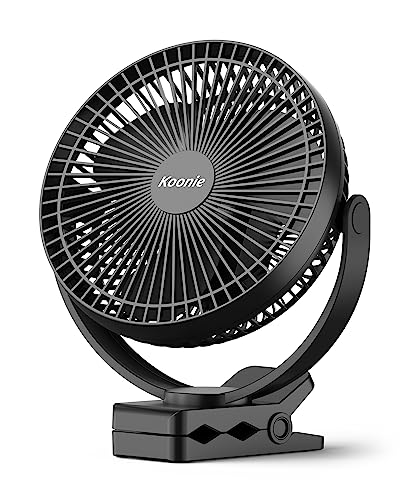
This is an approximately 8-inch, battery-powered personal fan that can stand on a desk or clamp to a firm edge. A retailer listing and the product manual identify the same model and describe four speed modes, USB-C charging, a 10,000 mAh rechargeable battery, a three-blade plastic rotor, and a roughly 1.76-pound body. The manual is manufacturer-stated rather than independently tested. ([newegg.com](https://www.newegg.com/p/0SS-023C-00001?utm_source=openai)) Its defining practical feature is flexible placement, with a clip base and manually adjustable head. The manual says to use the supplied cable, keep the unit dry, avoid direct sun or high temperatures, and secure the clip or stand before operation. The stated 24-hour low-speed runtime, 35 dB noise figure, and six-hour charge time have not been independently verified. A catalog specification also conflicts with the manual by showing 126 watts, while the manual specifies 10 watts. ([manuals.plus](https://manuals.plus/pt/asin/B08866RDYK?utm_source=openai))
This product suits a camper, desk worker, or traveler who wants close-range, cordless airflow and can mount it only to a stable, dry surface. The clip and stand format is useful when a standard tabletop fan would take up too much space, and the stated low-speed runtime may fit overnight personal comfort if the claim proves adequate in the buyer's conditions. It is most appropriate as a supplemental breeze for one person, not as cooling for an entire tent, vehicle, or room. ([manuals.plus](https://manuals.plus/pt/asin/B08866RDYK?utm_source=openai))
It is not suited to anyone who needs independently verified battery protection, electrical certification, or measured acoustic and runtime data before bringing a rechargeable device into a sleeping area. It is also unsuitable for wet-weather camping, rain-exposed tent entrances, or dusty settings because no ingress rating was found and the manual says to keep it dry. Infants, children, and pets should not be left with it unsupervised because it has moving blades behind a grille and a rechargeable battery. ([manuals.plus](https://manuals.plus/pt/asin/B08866RDYK?utm_source=openai))
This fan can improve perceived comfort through direct airflow, but it should not be treated as heat-illness protection. CDC guidance says fans may increase body temperature when indoor temperatures exceed 90°F. In dangerous heat, use shade or air-conditioned spaces, water, rest, and local heat guidance rather than relying on a personal fan. ([cdc.gov](https://www.cdc.gov/extreme-heat/about/?os=fuzzscan2O&utm_source=openai)) The available instructions provide sensible basics, including keeping the unit dry, avoiding high heat and direct sun, using the supplied cable, and securing it before operation. However, no exact-product U.S. safety certification or battery test documentation was located. No matching CPSC recall was found in the searches performed, but the product's internal battery chemistry, replaceability, and recycling route are not disclosed. At end of life, do not place a rechargeable fan in household trash or curbside recycling. EPA directs consumers to separate battery or e-waste collection. ([manuals.plus](https://manuals.plus/pt/asin/B08866RDYK?utm_source=openai))
This is a slim, rechargeable 8-inch personal fan for a desk, tent, bedside, or travel use. It has four fan speeds, an LED light, a folding stand, a hanging hook, a battery and speed display, USB-C charging, and a device-charging output. Warmco lists a 20,000mAh lithium-ion battery, ABS body, 665g net weight, and 4.5cm thickness. These are manufacturer-stated specifications, although a separately published instruction text independently reproduces the model, dimensions, battery capacity, controls, and charging limits. The defining limitation is evidence quality. Runtime of 15 to 48 hours and noise below 45dB are manufacturer claims with no identified independent airflow, runtime, or acoustic test. The instruction text provides practical charging and moisture warnings, but no traceable U.S. NRTL certification for the finished product was located in the searched UL, ETL, or CSA registers.
This product suits an adult camper, traveler, or bedroom user who wants a relatively thin, self-contained fan with light and a visible battery indicator, and who can position it on a stable dry surface or hang it from a genuinely secure support. It also fits users comfortable following charging limits, monitoring a rechargeable lithium-ion product, and treating the stated 15 to 48 hour runtime as a conditional manufacturer claim rather than a proven overnight result. The removable cover is useful for people who will clean accumulated dust from the guard and blades.
It is not for emergency heat protection during dangerous heat, especially for infants, older adults, people with medical vulnerabilities, or anyone relying on it instead of cooling shelter, hydration, rest, and medical attention when needed. CDC guidance notes that fans can raise body temperature above 90°F. It is also unsuitable for wet camping conditions, bathrooms, rain exposure, or users requiring a verified U.S. safety-listed electrical product. Households needing a user-replaceable battery, documented recycling route, or independently measured quiet overnight performance should not assume those qualities here.
The product uses a built-in lithium-ion battery and is intended only for dry use. Its published instructions say not to use it near bathrooms, sinks, pools, or other humid settings, not to immerse it, not to charge unattended, and not to use chargers above 5V. They also direct users to stop use if the battery becomes abnormally hot, smells, swells, is cut, or is otherwise damaged. These are useful operating warnings, but they are manufacturer documentation rather than independent battery-system test evidence. No exact finished-product UL, ETL, or CSA listing was verified in the searched U.S. certification registers. A named manufacturer, physical address, model designation, support email, and limited warranty appear in the published instruction text, helping traceability. The front cover is removable for cleaning, but the battery is not presented as replaceable. At end of life, do not put this lithium-ion product in household trash or curbside recycling. EPA guidance directs consumers to separate battery or household hazardous-waste collection.
This is a compact, battery-powered personal table fan with a foldable stand, 7-inch width, digital display, USB-C charging, and a stated 10,000 mAh lithium-ion battery. It is intended to move air around one person at a desk, bedside, campsite, or similar small space. It is not an air conditioner and should be treated as a comfort device, not protection from dangerous heat. Warmco states that it has four speeds, a brushless motor, a 18650-cell battery, USB-C input, and a fold-flat ABS body. Those are manufacturer specifications, not independently validated test results. Its published performance claims are notably inconsistent. The current brand page says 15 to 48 hours and under 50 dB, while other product documentation associated with this product gives 10 to 28 hours and different charging specifications. No independent airflow, runtime, charging, or sound test for this product was located.
This product suits an adult who wants a compact, cordless fan for short-range personal comfort at a desk, bedside, in a hotel room, or in dry camping conditions. The foldable profile and battery display are useful where outlet access is intermittent and the user can recharge with a suitable 5 V USB source. It is most appropriate for someone who can treat the published runtime and noise numbers as estimates, rather than requirements for an overnight trip or an exact sleep-noise limit.
It is not suited to anyone relying on a fan as a heat-safety measure during extreme heat, especially children, older adults, people with heart or chronic health conditions, or people without access to water, shade, rest, or air conditioning. CDC guidance says fans can increase body temperature above 90 F. It is also a poor fit for wet weather, rain-exposed tents, unattended charging, or buyers who require an independently listed U.S. electrical product, verified low noise, a replaceable battery, or documented repair parts.
The D3 uses a stated 10,000 mAh 18650 lithium-ion battery in an ABS-plastic body. The manufacturer identifies USB-C charging and a recessed power button intended to reduce accidental activation during transport. Those details do not establish protection against overcharge, short circuit, overheating, or fire. No exact-product U.S. NRTL certification record, battery test summary, or independent charging-safety report was located. Searches of CPSC recall and public incident resources did not identify a product-specific action, but that is not equivalent to a safety clearance. For heat, the fan may improve subjective comfort by moving air, but it does not replace heat precautions. Use shade, hydration, rest, and air conditioning or a cooling center when conditions are hazardous. At end of life, do not place the product in household trash or curbside recycling. EPA guidance directs consumers to specialized battery or electronics collection, because lithium-ion batteries can start fires if damaged. The lack of published battery-removal guidance makes responsible recycling less convenient.


