Best Overall

oneisall WiFi Automatic Cat Feeder
App control for convenient feeding schedules.
Portion control helps maintain pet health.
Supports WiFi connectivity for easy setup.
 Brianna York
App control for convenient feeding schedules.
Portion control helps maintain pet health.
Supports WiFi connectivity for easy setup.

Dispenses food for two cats simultaneously.
Large 5L capacity reduces refill frequency.
Programmable timer for consistent feeding schedules.

Large capacity for fewer refills needed.
Durable stainless steel ensures longevity.
Two-in-one design saves space efficiently.

Programmable for up to 6 meals daily.
Preserves food freshness efficiently.
Customizable portion sizes for precise feeding.
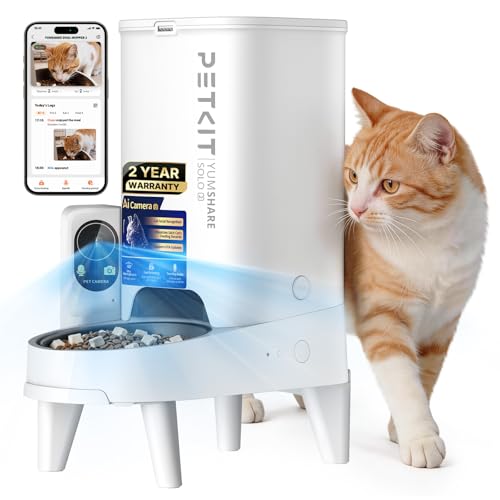
Real-time video lets you monitor pets remotely.
Two-way audio enables easy interaction with pets.
Scheduled feeding ensures consistent meal times.

Accommodates large kibble sizes easily.
Programmable for convenient feeding schedules.
Generous 3L capacity reduces refill frequency.

Tracks pet's eating habits accurately.
Convenient app-based meal scheduling.
Durable stainless steel feeding bowl.
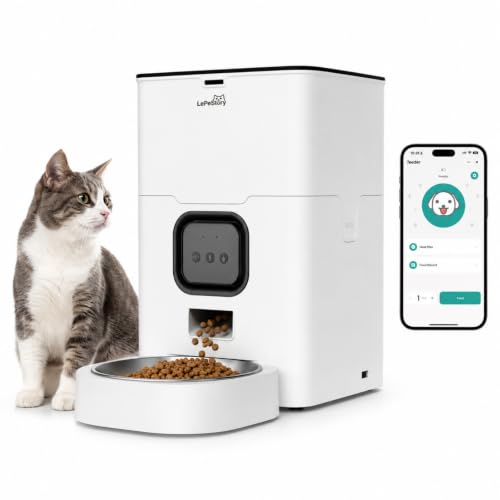
Remote feeding with intuitive app control.
Large 4L capacity reduces refill frequency.
Customizable feeding schedules for pet needs.

Convenient remote feeding via smartphone app.
Customizable meal schedules for consistent feeding.
Sleek design fits well in any space.

High-quality 1080P night vision camera.
Convenient 5G WiFi connectivity.
Personalized 10-second voice recording feature.
The first distinction is between **continuous access and scheduled meals**. Gravity feeders avoid electricity, batteries, Wi-Fi, and app dependence, but they cannot measure portions or prevent overeating. Hopper-style timed feeders usually dispense by volume, so a displayed portion is not necessarily a fixed weight. Kibble size, shape, density, freshness, and the amount remaining in the hopper can change the delivered mass. A product that claims “precise” portions should therefore be checked with the actual food you intend to use. A rotating tray can be more predictable because the owner fills each compartment directly, but its capacity and timing still depend on the mechanism, battery condition, and whether a jam can stop later meals.
Food compatibility matters just as much. Buyers should look for a stated kibble-size range and limits on wet, semi-moist, freeze-dried, oily, sticky, or irregular food. Large capacity is not a feeding-performance measure: a 3-, 5-, or 6-liter hopper says how often refilling may be needed, not whether meals will be accurate or clog-free. “Anti-jam,” “clog-free,” low-food alerts, feeding logs, and AI or intake tracking are claims that need model-specific instructions or testing; they should not be treated as proof that every fault is detected or recovered safely.
For outage protection, check whether schedules, clocks, and settings survive loss of mains power and Wi-Fi, what backup batteries are required, and whether the product alerts the owner to low battery, low food, blockage, or offline operation. A Wi-Fi feeder may continue a saved schedule without internet, but remote controls, notifications, camera functions, and feeding records may not work offline. A power backup is useful only if the batteries are installed, maintained, and appropriate for the product.
Cleaning is part of feeding safety. Look for clearly identified removable bowls, hoppers, lids, chutes, seals, and dispensing parts; instructions for washing, drying, and keeping electronics dry; and documentation of food-contact materials. A stainless-steel bowl does not establish that the hopper, chute, seals, or complete food path has been assessed. Dishwasher-safe claims should be checked against the exact part and model.
Multi-cat buyers should distinguish separate bowls from separate access. Two or three outlets may divide a shared meal, but they do not stop one cat from eating another’s food. RFID or collar-tag control can be relevant, but the supplied data shows that such claims remain manufacturer-stated unless independently tested. Also check whether the system uses a collar tag rather than an implanted microchip, and whether it supports the number of pets and diets involved.
The strongest evidence is an independent, model-specific repeat-cycle test that weighs portions, checks timing, uses the stated kibble range, and tests jams and power-loss recovery. For electrical safety, searchable listings in UL Product iQ, Intertek’s ETL directory, or the CSA database are more meaningful than CE, RoHS, UKCA, or an “FCC compliant” statement. FCC authorization addresses radio operation, not complete household electrical safety. Buyers should also look for a model number, warranty contact, support records, replacement parts, and recall information in CPSC databases.
Across the supplied products, recurring cautions include unverified portion accuracy, clogging or jams that can stop meals, no reliable controlled access in most multi-cat designs, and the need to protect cords and keep electronics dry. Several products lack alerts or require manual intervention after a fault. None should be treated as the sole safeguard for a medically urgent feeding plan without supervised testing and a human backup. Products using cameras or apps also require consideration of account, audio, video, location, feeding, and device data collection. Wet or perishable food should not be left unrefrigerated unless the product and feeding plan specifically make that safe; the supplied data provides no refrigerated feeder here.
These topics are grouped by the kind of risk or evidence they address. The supplied scores are comparative signals within this set, not proof that any product is safe, accurate, or suitable for a particular cat.
This measures whether scheduled food arrives on time and close to the programmed weight across stated kibble sizes, without skipped meals, runaway dispensing, or misleading records. It matters because a missed or oversized meal can affect weight and medical routines. The supplied scores range from 40 to 82: higher-scoring products include tested or better-documented designs, while lower scores lack independent weighing or show known variation and clogging concerns.
This measures schedule and clock retention, backup operation, and detection of low food, jams, batteries, Wi-Fi loss, and offline faults. For a feeder, continuity matters only if the owner can learn that intervention is needed. Higher scores in the set reflect documented battery or offline operation and clearer fault indicators; lower scores reflect missing alerts, settings that reset, or feeders that stop until a person clears a blockage.
This measures whether bowls, hoppers, chutes, seals, and removable parts are identified and can be washed, dried, and maintained without trapping food or moisture. It matters because stale dry food, residue, and damp parts can contaminate later meals. Higher-scoring products document removable washable parts and cleaning limits; lower-scoring ones leave the food path or materials unclear, require frequent desiccant replacement, or provide no food-contact declaration.
This measures resistance to tipping, prying, shaking, and food stealing, plus whether RFID or other access control works for the intended pets. Separate bowls alone do not establish separate feeding. Scores run from 45 to 76: the higher end includes a collar-tag-controlled feeder, while most products score lower because open bowls remain accessible to other cats and tamper claims were not independently tested.
This covers shock, overheating, cord chewing, battery leakage, unstable parts, pinch points, and tip-over risks for the complete feeder and power system. It matters because feeders operate near animals, food, water, and sometimes chewable cables. Higher scores in this set reflect simpler non-electric designs or clearer precautions; lower scores reflect unverified electrical safety, cord risks, battery dependence, or limited mechanical testing.
This measures whether the exact model, warranty contact, seller or importer, serial or lot information, manuals, replacement parts, and safety notices are available. Traceability matters when a feeder fails or a remedy is needed. Higher-scoring products have model-specific manuals, support, warranty, serial information, or replacement parts; lower scores lack manuals, service documentation, parts catalogs, or clear identification.
For Wi-Fi or camera feeders, this measures whether scheduled feeding works locally without internet and whether app permissions, accounts, cloud storage, audio, video, retention, security, and support life are disclosed. Higher scores in the set belong mainly to non-connected products or products with clearer offline behavior. Lower scores reflect broad data collection, subscription or cloud dependence, unclear retention, or unreliable app records and alerts.
This measures whether claims about precision, freshness, pet-proofing, equal splitting, monitoring, alerts, and capacity are specific and qualified for the exact model. It matters because a large hopper or three bowls can be mistaken for accurate or individualized feeding. Scores range from 54 to 77: higher-scoring listings define limits more clearly, while lower scores contain conflicting specifications or unsupported headline claims.
This measures qualified testing of the exact model for portion weight, timing, jams, outage recovery, and access control. It is the most useful way to separate repeatable results from manufacturer claims or reviews. Scores range from 52 to 84. The strongest evidence in the set comes from independent testing of timing and food measurement; low-scoring products have no qualifying repeat-cycle report, even when they advertise anti-jam or precision features.
This measures whether the complete feeder and supplied adapter appear in a recognized U.S. safety register, with wireless authorization matched separately where needed. A searchable UL Product iQ, ETL, or CSA listing is stronger evidence than CE, RoHS, UKCA, or an unverified FCC statement. Scores range from 68 to 78, but the reviews repeatedly found no complete-product UL, ETL, or CSA listing, so higher comparative scores do not mean certification was confirmed.
This measures electricity use, expected service life, repairability, replaceable parts, battery dependence, packaging, and recurring waste such as desiccant. It matters because a feeder can create waste through batteries, moisture-control packets, or early replacement. Scores range from 69 to 76: higher-scoring products generally avoid electronics or document replaceable parts, while lower-scoring products have recurring batteries and desiccant with little repair or energy information.
The oneisall PFD-001 Pro is a compact, indoor dry-food feeder for cats and small pets. It uses a 3.5 L hopper, a removable stainless steel bowl, 2.4 GHz Wi-Fi, and the Smart Life app to set meals, trigger a manual feed, review feed records, enable slow feed, and share controls with household members. The manufacturer says it supports up to 10 scheduled meals and up to 36 portions per meal. Its most consequential documented feature is local schedule continuation. The model-specific manual says saved schedules continue through a Wi-Fi interruption and, with batteries installed, during a power outage. Portion precision is less firmly established. The manual's own food test used approximately 0.3-inch kibble and tells owners to weigh their own food and adjust portions. No independent repeat-cycle weighing, jam testing, or third-party safety certification for this exact product was located.
This product suits a household feeding one cat or compatible small pet dry kibble on a regular schedule, especially where the owner wants remote schedule setup but needs saved meals to continue if home Wi-Fi drops. It is most appropriate for an owner willing to set it up with the app, install backup batteries, test several feeding cycles with a kitchen scale, and keep the feeder positioned where a pet is unlikely to knock it over. The documented support and warranty details also help buyers who want a clear service contact.
It is not well suited to households where cats need separate diets, prescription food protection, or reliable individual intake tracking, because this product has no microchip, RFID, or other controlled-access system. It is also a poor fit for pets that can push, tip, or pry at feeders, since the manual specifically recommends using it against a wall to reduce tipping. Owners who need independently proven gram-level portions, documented anti-jam performance, or a verified third-party electrical safety listing should not treat the stated claims as confirmation.
The supplied bowl is identified as stainless steel, but the available product documentation does not clearly identify the material of the hopper, chute, seals, or other food-contact plastic parts. Cleaning guidance is limited, and the manual says not to soak the main unit. It also warns owners to stop using the included desiccant bag if it is damaged. These limits make routine inspection, dry cleaning of the food path, and prompt replacement of damaged moisture-control components important. No exact-product listing was verified in the searched UL, ETL, or CSA certification registers. The manual instructs indoor use and use of the supplied adapter, while battery backup adds eventual battery waste. It provides a two-year manufacturer warranty and direct support contacts, which can extend use if service is available, but no verified spare-parts program, energy-use figure, packaging disclosure, or independent lifecycle assessment was located. The Smart Life app also has a broad developer-reported privacy label, so app permissions deserve review before setup.
This is a non-Wi-Fi, dual-bowl timed feeder for dry food, with a dial and display for setting up to six meals daily. The manufacturer manual identifies a 20-cup, 4.7-pound dry-food hopper, 304 stainless steel bowls, ABS housing, a 5V, 1A supplied adapter, and four AA batteries for backup. It is intended for indoor use and for kibble below 0.5 inch in diameter. Its most defining limitation is that every programmed portion is delivered to both bowls equally. It cannot tailor one bowl to a different cat. The manual's portion table is based on approximately 0.3-inch kibble and tells owners to measure their own food before relying on the setting. It also documents an E-01 food-stuck error and directs cleaning of the outlet. No qualified independent repeat-cycle weighing, jam, or power-recovery testing for this exact product was located.
This product fits an indoor household with one or two healthy cats, or small pets, that eat the same dry kibble and require equal portions on a stable routine. It is particularly relevant for a caregiver who wants local controls rather than an app, and who is willing to test actual delivered weights before using it for calorie management. The battery compartment provides an additional layer of continuity for households that occasionally lose power, provided owners install and maintain the four AA backup batteries.
It is not suited to pets that need different foods, different serving sizes, prescription diets, or dependable separation at meals. The two bowls are not controlled-access stations, so a fast or food-motivated pet may take food intended for the other. It is also unsuitable for wet food, kibble above the stated size limit, outdoor placement, or an unattended medical feeding plan without prior portion checks and a human backup. Buyers requiring independently listed electrical equipment or independently measured dispensing results need stronger documentation.
The documented food-contact setup is more specific than a generic stainless-steel claim. The manual identifies 304 stainless steel bowls and ABS construction, and says the lid, food tank, bowls, and bowl holder can be washed and dried. The electronic base and tank base are not waterproof and must only be wiped with a soft dry cloth. Keeping the outlet dry matters because the manual associates moisture and unsuitable kibble with a food-stuck error. No product-specific recall, CPSC action, or California Proposition 65 warning was located in the reviewed searches. That is not equivalent to a safety certification. No searchable UL, ETL, or CSA listing for this exact complete product was found. The two-year warranty, removable bowls, and replaceable desiccant support may extend use, but the feeder uses disposable desiccant and optional AA batteries. No power-consumption, packaging, repair-parts, or recycled-content disclosure was located.
This is a non-electric gravity feeder and water dispenser set for dry pet food and water. The stated large version has separate 3 L reservoirs, listed as 0.8 gallon each, with a food hopper stated to hold about 46 ounces of dry food. It is intended for small and medium cats or dogs that can have ongoing access to food rather than scheduled meals. The product description says its food and water reservoirs refill bowls by gravity, with no timer, app, Wi-Fi, batteries, or mains power. It also states that the contact bowls are 304 stainless steel and the body is BPA-free PP plastic. Those are manufacturer statements, not independently tested material or performance findings. No model-specific independent portion, jam, tampering, or fault-recovery testing was located.
This suits a household with one or two small or medium pets that are healthy with free-access dry food, and where a caregiver can inspect food and water levels daily. Its practical use is simple, continuous availability of dry kibble and water without a plug, batteries, app setup, or a feeding schedule. It is also relevant where power reliability is a concern because its gravity mechanism does not depend on electricity. The caregiver should be prepared to hand wash it and clean it at least weekly, as stated in the product instructions.
It is not suitable for pets needing measured calories, timed meals, medication mixed with meals, wet food, or veterinary-directed feeding control. It also does not prevent one pet from eating another pet's ration, so it is a poor fit for multi-cat households with food theft, weight-management needs, or separate diets. Do not treat it as a substitute for daily checks during travel or long work absences. The lack of independent testing also makes it less appropriate where verified jam resistance, tamper resistance, or documented safety certification is required.
The product is a passive gravity device, not an electronic feeder. That removes cord, charging, battery-leakage, Wi-Fi, camera, and account-privacy concerns. It also means scheduled feeding, low-food alerts, jam alerts, and power-fault detection are not available. The manufacturer states that it uses BPA-free PP plastic with 304 stainless steel bowls, but no independent food-contact certification or material test record for this exact product was located. For hygiene, the stated dry-food-only limitation matters. The food bowl is described as removable, while the water bowl is not directly removable from its rotating base, so careful hand cleaning and drying are important. The product description recommends weekly cleaning and regular food checks. Its no-electricity design avoids ongoing electricity use and disposable batteries, but no documented replacement-parts program, repair policy, packaging disclosure, or product-life assessment was located. No matching U.S. recall or regulatory warning was located in the searches performed.
This is a non-Wi-Fi, single-bowl dry-food feeder with a 3 L hopper, a stainless steel bowl, local buttons, a recorded meal call, and scheduling for up to six meals daily. The manufacturer specifies dry kibble measuring 2 to 15 mm in diameter, with one programmed portion representing about 20 mL, or roughly 1/12 cup by volume. Its core feeding mechanism is documented with an anti-clog detector and an E1 blockage indication. However, the manufacturer also states that portion mass varies with kibble shape, size, freshness, and thickness, and its manual says early portions can be uneven before settling after roughly six feedings. No repeat-cycle independent weighing or fault-testing report for this exact product was located. It runs from a 5 V adapter with three D-cell batteries for backup, and has no camera, Wi-Fi, or app account requirement.
This product suits a household with one cat, or a small dog, that eats compatible dry kibble and needs a basic local schedule rather than remote monitoring. It is most appropriate when an owner can measure the output using the pet's actual food during setup, keep the hopper and chute clean, and install backup batteries before relying on it during an outage. It also fits buyers who prefer a feeder with no app, camera, account, or ongoing cloud service.
It is not appropriate as the sole feeding safeguard for pets needing tightly weight-controlled meals, including pets on calorie-restricted or medical diets, because portions are measured by volume and can vary with kibble. It is also a poor fit for food-guarding households, determined food thieves, or multiple cats that require separately controlled access. Choose another feeding arrangement for wet food, kibble outside the stated 2 to 15 mm range, outdoor use, or pets that cannot reliably reach the bowl.
The food-facing setup has some practical hygiene strengths. The manufacturer identifies the bowl as stainless steel and says the lid, hopper, hopper base, bowl, and bowl holder can be washed, then thoroughly air dried. The electronic base must not be immersed. Owners should clean the outlet and anti-clog detector as part of routine care, use dry food only, and replace the desiccant bag every two weeks as directed. No product-specific U.S. electrical-safety listing from UL, ETL, or CSA was found in the certification registers searched. The manual carries FCC Part 15 and Canadian interference statements, which address electromagnetic interference rather than third-party electrical-safety certification. No relevant U.S. recall or CPSC safety action was located in the searches performed. Waste considerations include three disposable D-cell backup batteries and recurring desiccant packets. A 24-month warranty is stated in current brand materials, but repair parts, power consumption, packaging content, and recycling guidance were not clearly documented for this product.
This is a 3-liter automatic dry-food feeder for cats and small-breed dogs. It uses a single hopper, a removable stainless steel bowl, a 6V adapter, and optional five AAA alkaline backup batteries. PETKIT states that it accepts dry kibble up to 12 mm and freeze-dried pieces up to 9 mm, with meals set in one to five portions of about 10 g each. The manufacturer documents that schedules continue when the feeder is offline and, with separately purchased batteries installed, during a power outage. It also documents removable hopper, impeller, vanes, lid, and bowl parts for cleaning. The radio has an FCC equipment authorization. However, no reproducible independent repeat-cycle testing was located for portion weight, jams, or fault recovery, and no searchable UL, ETL, or CSA listing was identified for the complete feeder or supplied adapter.
This product suits a single-cat household, or a household with one small dog, that uses dry kibble or appropriately sized freeze-dried food and wants scheduled meals plus a camera view of the bowl area. It is most suitable where the owner can place it against a wall, secure the cord, clean the food path routinely, and fit five AAA batteries for outage resilience. It also fits users comfortable managing schedules, camera settings, and alerts through a 2.4 GHz Wi-Fi app.
It is not suited to pets needing wet food, large or irregular kibble, or medically precise gram-level feeding without home scale checks. It is also unsuitable as the only food-control measure in a multi-cat household, because it has one shared bowl and no microchip or RFID access control. Households with determined food thieves, cord-chewing pets, frequent missed maintenance, or no safe location to stabilize the unit should treat the documented lock and anti-jam claims cautiously.
The food route can be partly disassembled for cleaning. PETKIT instructs owners to wash the hopper, vanes, impeller, lid, and bowl, then dry every part completely before reassembly. The bowl is stated to be 304 stainless steel, while the hopper and housing are ABS. The powered base cannot be immersed, so food residues near fixed sensors and electronics require wipe-clean care instead. The feeder uses a 6V, 4W rated supply and can use five disposable AAA alkaline batteries for backup. Its removable components and two-year U.S. limited warranty can support continued use, but the batteries and desiccant create recurring waste. The manual provides WEEE disposal guidance, though U.S. owners should use local electronics and battery recycling options. Verification found FCC authorization for the wireless radio, but not a searchable U.S. third-party electrical-safety listing. No published CPSC recall for this product was identified in the review.
This is a compact, non-Wi-Fi automatic dry-food feeder for one cat. Its documented capacity is 3 L, or 12 cups, and the manual specifies dry kibble or snacks 2 to 18 mm in diameter. Feeding is programmed on the unit with a single dial, for up to six daily feeding plans and one to 12 portions per meal. It is not for wet food. The supplied manual identifies an ABS body and SUS 304 stainless-steel bowl, a 5 V, 1 A input, and optional backup from three D batteries that are not included. Its own portion table is explicitly only a reference based on 0.4-inch kibble, and directs owners to weigh output with their particular food. No repeat-cycle independent weighing or jam testing for this exact product was located.
It suits a single-cat household that feeds dry kibble or freeze-dried treats within the stated 2 to 18 mm size range and wants a simple local timer rather than app control. It is particularly relevant where internet or account dependence is unwanted, provided the owner can test the actual food output before relying on the schedule. The 3 L hopper and six daily schedules fit routine indoor feeding, with fresh D batteries installed if outage coverage matters.
It is not suitable for wet food, cats needing tightly measured gram-level meals, or households where a missed or oversized meal could create a medical risk. Those cases need documented repeat-cycle accuracy and fault monitoring, neither of which was found here. It is also not a controlled-access feeder, so it does not separate meals between food-motivated cats. Owners unable to periodically check food level, output weight, desiccant condition, and battery status should not treat it as unattended care.
The food-contact bowl is identified in the product manual as SUS 304 stainless steel. The manual tells owners to wash that bowl with mild soap and water, dry all parts before refilling, and keep the electronic base out of water. The hopper and food path are not documented as fully washable or as food-equipment certified, so dry-food hygiene still depends on regular emptying, wiping, and complete drying. The product uses a 5 V, 1 A supply and can use three D-cell backup batteries. This is useful during an outage, but creates recurring battery waste when backup is used. A desiccant pack is also required for the freshness system and the manual advises periodic replacement. A two-year manufacturer warranty is documented, but no repair-parts program, power-consumption figure, U.S. third-party electrical-safety listing, exact-product recall, or independent safety test was located in the sources checked.
This is a Wi-Fi dry-food feeder for cats and small dogs with a 3.6 L, or 3.8 quart, hopper, a removable stainless-steel bowl placed on a separate feeder scale, and app scheduling. The manufacturer limits it to dry kibble measuring 4 to 15 mm and supplies a 5 V, 1.5 A adapter. Three D-cell batteries can be fitted as backup, but are not included. Its defining feature is weight-aware dispensing and bowl monitoring. An independent two-week home test reported meals arrived at the programmed times, matched the app-selected amount when kitchen-weighed, and did not jam. Separately, the manufacturer states that the mechanism reverses and rotates to try to clear a jam, and that its scale tracks bowl changes. Those claims still depend on calibration, a level surface, compatible kibble, and a correctly seated scale.
This product suits a single-cat or single-small-dog household that feeds dry kibble within the stated 4 to 15 mm range and wants scheduled meals plus a record of bowl changes. It is especially relevant where an owner can place it on a hard, level indoor surface, calibrate the scale, clean the removable food-path parts, and fit backup D-cell batteries. The independently observed on-time meals and weighed portions are useful for a routine that needs closer portion oversight without using wet food.
It is not suited to multi-cat homes where one animal must be reliably prevented from taking another animal's meal. The open bowl has no microchip, RFID, or other controlled-access system. It is also unsuitable for wet, canned, moist, or oversized kibble, and for homes that cannot keep electronics dry or position the feeder level. Owners who need remote alerts throughout an outage should note that battery mode disables Wi-Fi, app control, and notifications. Those unable to maintain calibration should avoid relying on its intake records for precise clinical monitoring.
Food-contact upkeep is comparatively well documented. The submitted manual identifies a 304 stainless-steel bowl and says the tank, lid, agitator, distributor, distributor cover, and bowl can be washed with soap and water and fully dried. The electronic base and scale must only be wiped dry, so thorough cleaning requires disassembly and care around the scale. The feeder is for dry food only, which avoids the spoilage risks of leaving moist food in this design. The radio is authorized by the FCC for the specific smart feeder, but this is not a UL, ETL, or CSA electrical-safety listing. The privacy policy discloses collection of account, device, Wi-Fi, usage, feeding-record, and meal-call information. Recurring waste includes a manufacturer-recommended monthly silica-gel desiccant replacement and, when backup is used, three disposable D-cell batteries. The manual advises removing batteries during long storage to reduce leakage risk.
This is a compact Wi-Fi dry-food dispenser for cats, kittens, and small dogs. Independent retailer records identify the PF440A as a 4 L feeder measuring about 7 by 7 by 11 inches, with an ABS body and stainless steel bowl. It uses mains power and is sold with a power adapter and cord. Retailer copies of the product description consistently state that it can schedule up to 10 meals daily, dispense selectable portions, record a 10-second meal call, and use 2.4 GHz Wi-Fi app control. They also state that backup batteries can preserve feeding during an outage, although battery type, schedule retention behavior, fault alerts, compatible kibble dimensions, and feed-weight accuracy are not documented in a model-specific manual or test report. No independent repeat-cycle performance test for this exact product was located.
This feeder suits a single-cat household, or a small dog that eats dry kibble, where the owner wants a compact hopper and the convenience of scheduled servings. It is most appropriate when an owner remains available to verify actual portions during setup, check that the chosen kibble flows properly, clean the bowl and food path regularly, and keep a manual feeding backup. The stated battery backup may be useful for short interruptions, but it should be tested at home before relying on it while away.
It is not well suited to pets that require tightly measured gram-level meals, prescription feeding, wet food, or dependable unattended feeding during long trips. Multi-cat homes with food theft, dominance, or diet separation needs should not rely on its lid lock as access control, because it has no microchip or RFID identification and no independent tampering test was found. It is also unsuitable for buyers who require a documented electrical safety listing, published privacy terms, verified alerts, or readily available replacement parts.
The product is described by independent retailer records as an ABS and stainless steel dry-food feeder. Stainless steel can be useful for a removable feeding bowl because it is smooth and generally straightforward to wash, but no model-specific cleaning manual, food-contact declaration, food-path diagram, or evidence about the hopper seal and desiccant replacement was located. The advertised freshness and food-grade claims therefore remain manufacturer statements, not independently substantiated material-safety findings. No model-specific U.S. electrical safety certification listing was found in searches of UL, ETL, or CSA records, and no matching FCC authorization was identified. No product-specific recall or public safety action was found in the checked U.S. recall resources. Environmental information is limited. The brand does not provide model-specific power consumption, service-life, spare-parts, packaging, or repair documentation, and the optional battery backup adds a recurring battery-recycling responsibility.
This is a compact, app-connected dry-food feeder for cats and small-breed dogs. It holds 3 L, or 12 cups, uses a removable 304 stainless steel bowl and ABS body, and accepts kibble up to 0.47 inches and freeze-dried food up to 0.35 inches. The manufacturer specifies one to five portions per meal, with a nominal portion of about 10 g. Its most consequential documented limit is that portions are volumetric, not weight-based. The manual says actual weight changes with food size and density, and may shrink as the hopper gets low. PETKIT states that stored schedules continue through loss of internet, and that optional five AAA alkaline batteries can keep it operating during a power outage. No qualified independent repeat-cycle weighing or jam-resistance test for this exact feeder was located.
This feeder fits a household with one cat or a small dog that eats compatible dry or freeze-dried pieces, has a stable feeding routine, and is supervised often enough to refill the hopper and check dispensed amounts. It is especially suited to an owner who wants app scheduling but can accept that portions must be calibrated using their own food. Backup batteries are relevant for homes with occasional outages, provided fresh batteries are installed and checked before time away.
It is not a good fit where exact gram-level calorie control is medically important, including pets on a strict weight-management or prescription feeding plan, unless the owner independently weighs repeated portions and continues to monitor them. It is also unsuitable for wet food, large kibble, pets under three months according to the manual, or determined food thieves requiring verified access control. Do not rely on it unattended during long trips without checking food level, battery condition, and actual dispensing first.
Food contacts are comparatively well described for this type of appliance. PETKIT identifies ABS plastic and a 304 stainless steel bowl, and its manual instructs owners to remove the hopper, internal dispensing paddles, lid, and bowl for washing, rinsing, and complete drying. The powered base must not get wet. The feeder is intended for dry food only, and the manual warns that low hopper levels can reduce the delivered portion size. Its wireless radio has model-specific FCC authorization documentation, but no searchable U.S. third-party electrical safety listing for the complete feeder and power system was identified. No matching public U.S. recall was identified in the CPSC recall materials searched. From a waste perspective, the removable food-contact components and stated component-replacement warranty option are helpful, but the backup system needs five disposable AAA alkaline batteries and the hopper uses a replaceable desiccant packet. PETKIT does not provide verified energy-use, packaging, or end-of-life recycling information for this product.
This is a tall, indoor dry-food dispenser for cats and dogs, with a claimed 7-liter hopper, raised removable bowl, camera, two-way audio, app controls, and a mains-power plus battery-backup design. The published dimensions are about 12.8 by 7.5 by 17 inches. It is intended to dispense scheduled meals rather than provide controlled access to individual pets. Independent marketplace records corroborate that this product is sold as the MUBBI PF15 and identify ABS plastic and a stainless-steel bowl. The seller's stated operating range is up to 15 meals per day, with 1 to 99 portions per meal. Claims of jam-free dispensing, precise portioning, feeding records, low-food or fault alerts, 1080p monitoring, and reliable outage recovery are manufacturer statements. I found no repeat-cycle weighing test, fault-recovery test, or independent laboratory report for this exact product.
It suits a household feeding dry kibble to one cat, or to pets that safely share a common feeding bowl, where the owner wants a large stated food reserve and several scheduled meals each day. It may also fit an owner who values a manufacturer-stated camera and two-way audio feature for casual observation of the feeding area. It is most appropriate when a person can check delivered food, refill levels, cleanliness, and app behavior in person, especially during the first weeks of use.
It is not suitable as the sole feeding safeguard for a pet with diabetes, a medically strict diet, a history of missed meals, or a need for reliably measured gram-level portions. It is also a poor fit for multi-cat households that need one pet prevented from eating another pet's ration, because no individual access control is documented. Privacy-sensitive households should avoid relying on the camera features until the exact app, account, storage, retention, and security practices are clear. Pets that chew cords or pry lids need direct supervision and protective setup.
The product is described as using an ABS body and a stainless-steel bowl. A removable, dishwasher-safe bowl is useful for routine sanitation, but I could not verify food-contact certifications, detailed cleaning limits for the hopper and food path, or replacement-part availability. The product includes a desiccant bag, which may help limit moisture in stored dry food, but it also creates recurring disposable waste. The listing describes mains operation with battery backup, yet the battery type, runtime, schedule retention, and behavior during power, Wi-Fi, or app failures were not independently established. I found no product-specific CPSC recall or safety warning in the searched records. I also could not verify a searchable U.S. third-party electrical-safety listing, independent feeding-performance testing, or documented app privacy and camera-data practices for this exact product.