Best Overall

Bravo XL Pro Air Fryer Toaster Oven
Ultra-fast convection system for quicker cooking times.
142 presets simplify a variety of recipes.
Smarter probe ensures precise cooking temperatures.
 Lauren Wilson
Ultra-fast convection system for quicker cooking times.
142 presets simplify a variety of recipes.
Smarter probe ensures precise cooking temperatures.

Versatile 12-in-1 cooking functions.
Even and quick cooking technology.
Large 21-quart capacity.

Space-saving design with flip-up storage capability.
Versatile 8-in-1 cooking functions for variety.
Large capacity fits family-sized meals easily.

Versatile 11-in-1 cooking functions.
User-friendly touchscreen controls.
Compact size with 25 qt capacity.

Versatile 12-in-1 cooking functions.
Smart wireless thermometer for perfect results.
Large capacity with 360° turbo convection.
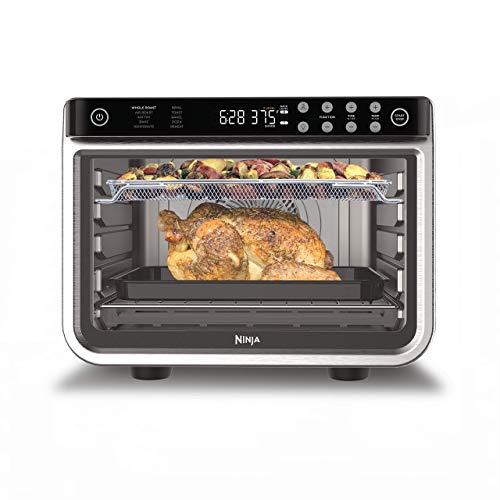
Versatile 10-in-1 functionality for diverse cooking needs.
Powerful 1800 watts for quick and even cooking.
Spacious interior fits large meals easily.
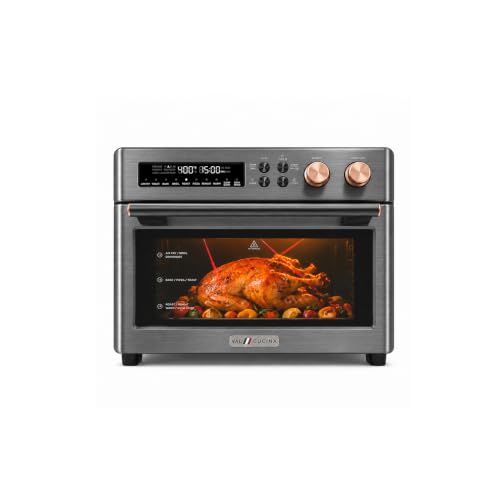
Infrared heating ensures faster, even cooking.
10-in-1 versatility replaces multiple kitchen gadgets.
Easy-to-clean enamel baking pan included.
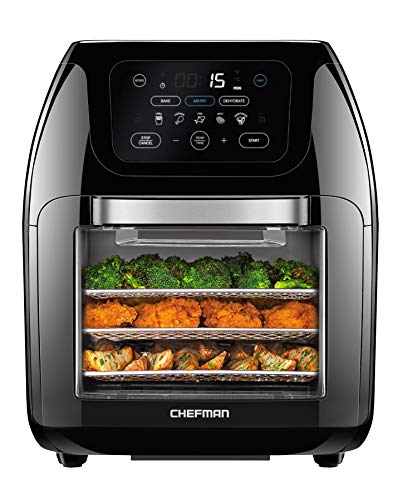
Multiple cooking functions in one appliance.
Large 10L capacity for family meals.
Easy-to-use touch screen presets.

Versatile with 12 cooking presets.
Compact design fits a 9" pizza.
Durable stainless steel construction.

Versatile 17 cooking presets for easy meals.
Spacious 24L capacity fits larger dishes.
Convenient French door design for easy access.
Start with the cooking space you can actually use. Manufacturer capacity claims range from compact cavities to roughly 37 quarts, but headline capacity does not tell you whether the oven fits a 12- or 13-inch pizza, a 9-by-13-inch pan, six slices of toast, multiple racks, or tall food. Interior height and rack positions matter just as much as volume. A wide, shallow design may suit toast and pizza but not a tall loaf or whole chicken. Check the exterior footprint and the manual’s clearance requirements before buying; supplied products commonly require about four to six inches of open space around or above the oven.
Temperature range is only a setting, not proof of accuracy. The supplied products list ranges from about 50 to 500°F, but independent testing found both stable, uniform ovens and models with substantial overshoot, underheating, or inaccurate preheat alerts. For a meaningful comparison, look for exact-model laboratory results identifying the test method, temperature variation, recovery, and heat uniformity. Even a well-tested oven does not make presets a food-safety endpoint: meat, poultry, seafood, eggs, and leftovers should be checked with a food thermometer and the applicable safe internal temperature.
Air-fry claims also need context. “Less oil,” “crispier,” “faster,” and “healthier” may describe a cooking method or a brand’s internal comparison, not a demonstrated health outcome. Lower added oil depends on the recipe and the amount used. A wattage figure describes electrical input, not the energy required to cook a representative meal. A credible energy comparison would report watt-hours for a defined cooking task and usable cavity, rather than relying on headline wattage or an unverified claim of savings.
Materials deserve similar scrutiny. “Non-toxic,” “PFAS-free,” or “PTFE/PFOA-free” wording may cover only one tray or accessory. Prefer product-specific disclosure naming the rack, basket, tray, probe, interior, and every coating, along with temperature limits and food-contact compliance documentation. A certification claim should be traceable to the exact model in an OSHA-recognized laboratory directory, such as UL Product iQ, Intertek’s ETL directory, or the CSA listing database. A component mark, retailer statement, or certification for a related model is not equivalent.
Finally, assess the service path. Removable crumb trays and grease-catching pans reduce smoke and baked-on residue only when cleaned as directed. A meaningful warranty, manual, replacement racks, trays, baskets, probes, and other wear parts can keep an oven in service and reduce waste. Check recall and incident records for the exact model through CPSC sources, while remembering that no recall found is not proof that a product is risk-free.
Across the supplied products, users should expect hot doors, handles, racks, trays, interiors, and exterior surfaces; oven mitts, ventilation, clearance, and supervision matter. Several manuals require prompt crumb-tray and grease cleanup because residue can create smoke. French-door models may close unexpectedly when partly open, and dome-style or multi-rack designs require careful handling of hot parts. Some products need food to be rotated or flipped, and several lack independent proof of temperature accuracy or evenness. Children, pets, and anyone unable to safely handle hot cookware should not operate these ovens without appropriate supervision. No category-wide contraindication beyond these recurring handling, clearance, cleaning, and thermometer requirements was found in the supplied data.
A convection oven can change how food is cooked, but it does not automatically change the nutritional quality of a meal. The most useful evaluation separates recipe-dependent benefits from unsupported health claims, checks food-contact disclosure and cooking reliability, and considers whether the appliance can be maintained rather than discarded.
This measures whether lower-oil or lower-fat messaging stays within what the oven can actually change. A high score reflects careful claims: air frying may use less added oil than deep frying, while health outcomes still depend on food and recipe. The supplied scores range from 48 to 92; the strongest products avoid disease, cholesterol, weight-loss, or automatic-health promises.
This measures disclosure for every rack, basket, tray, probe, interior, and coating, including composition, temperature limits, and food-contact support. It matters because several products use nonstick, enamel, ceramic, chrome, or other coated parts without fully identifying them. Supplied scores range from 48 to 82; higher-scoring products provide more specific material context, though no product has complete disclosure.
This measures whether selected temperatures are reached and held and whether hot and cold spots are limited. That matters for baking quality and for cooking foods that require reliable internal temperatures. Supplied scores range from 58 to 91. The higher-scoring products have exact-model independent evidence of stable or uniform heating; lower-scoring products show overshoot, undercooking, uneven browning, or no independent thermal test.
This measures safeguards against hot surfaces, grease ignition, overheating, unstable or spring-loaded doors, and unsafe handling. It matters because these are high-wattage heating appliances with hot glass, racks, trays, and sometimes domes or rotisserie parts. Scores range from 54 to 85; higher scores combine clearer warnings and practical controls, while lower scores include serious exposed-surface or handling concerns.
This measures whether drips and crumbs are captured, parts can be removed and cleaned, and residue can be managed without defeating guards or using unsafe methods. It matters because supplied manuals repeatedly link grease buildup or misplaced pans with smoke. Scores range from 61 to 84; higher-scoring products have accessible crumb trays and cleaning paths, while lower-scoring designs make residue control more difficult.
This measures whether the exact oven is currently listed by an OSHA-recognized laboratory to the applicable appliance standard, rather than merely carrying a retailer claim or component mark. It is especially important for countertop heating appliances. Scores range from 68 to 94. The Typhur model is the clear supplied example with an exact ETL mark tied to UL 1026; most others lacked a traceable public listing.
This measures reproducible third-party testing of temperature, evenness, capacity, speed, air-frying, and cleaning. It matters because brand demonstrations and customer reviews cannot establish controlled performance. Scores range from 68 to 94. Higher-scoring products have exact-model laboratory or hands-on testing, while lower-scoring products rely mainly on manufacturer claims or have no located independent test.
This measures whether the listing matches the manual and whether capacities, temperatures, functions, coating claims, and health or energy statements are qualified. It matters because supplied records include conflicting temperature ranges, function counts, dimensions, wattage, and pizza capacities. Scores range from 50 to 82; higher scores reflect better alignment, while lower scores show material discrepancies or unsupported headline claims.
This measures the exact model’s recall and incident history and whether the maker offers a usable remedy. A clean search is limited evidence, not proof of safety. Scores range from 70 to 78, and no exact-product CPSC recall was reported for the supplied products. Buyers should still distinguish an exact-model record from an incident involving an unspecified product family or unrelated model.
This measures electricity used for representative cooking tasks, not wattage alone. A smaller usable cavity may avoid heating a full-size oven, but that does not prove lower energy use. Scores range from 68 to 72, reflecting that no supplied product had a documented watt-hour-per-meal test or exact-category ENERGY STAR qualification. Treat energy-saving and faster-cooking claims as unverified unless task-based measurements are supplied.
This measures warranty support, manuals, service access, and availability of replacement trays, racks, baskets, probes, doors, or other wear parts. It matters because a replaceable accessory can prevent disposal of the whole oven. Scores range from 70 to 85. Higher-scoring products have longer warranties or clearly available model-specific parts; lower-scoring products offer limited warranty or unclear repair and replacement support.
This is a 30-quart countertop convection oven that also air fries, bakes, roasts, broils, grills, toasts, dehydrates, proofs, and reheats. It uses 120-volt, 1,800-watt power and includes a pull-out crumb tray, racks, air-fry basket, baking pan, probe, and, in the grill configuration, a grill and griddle accessory. The maker lists a 50 to 500 F control range, four rack levels, and a one-year warranty. Its defining practical feature is the integrated food probe, which the manufacturer says can stop cooking at a chosen internal temperature. The manual also provides specific rack positions and asks users to rotate or flip food during several functions, including baking, roasting, grilling, and pizza. Consumer Reports has lab-tested a related Bravo XL model, but a published independent laboratory result for this exact grill configuration was not located.
This product suits a household that wants a large countertop oven for routine cooking, rather than only small snack batches. Its 30-quart cavity, four rack positions, 50 to 500 F stated range, and adjustable top and bottom heat are useful for people who bake, roast, toast, air fry, and occasionally grill in one appliance. It also suits cooks willing to use the included probe, rotate food when the manual directs, maintain the crumb tray, and keep the required counter clearance around a high-wattage appliance.
It is not a strong fit for a buyer who needs independently demonstrated temperature accuracy, uniformity, energy use, or electrical safety certification for this exact version. It also needs substantial counter clearance, a dedicated outlet according to its manual, active supervision, and heat-safe handling. Households that cannot reliably clean grease after use, leave cooking appliances unattended, or need every food-contact material and coating documented in detail should choose a product with clearer third-party documentation and simpler maintenance requirements.
Air frying can reduce the need to add oil compared with deep frying, but it does not automatically make a meal healthful. This product can support lower-oil cooking when recipes use less added oil. The manufacturer’s percentage claims for oil reduction and crispness were not backed by an identified independent study of this product. For meat, poultry, seafood, and leftovers, safe internal temperature still matters more than a preset or appearance. USDA advises checking food with a thermometer, and the included probe may help when used correctly. The grill configuration is marketed by Nuwave as PFAS-free, but the public materials do not fully identify every food-contact substrate, coating chemistry, compliance record, and temperature limit. Its maintainability is a positive point. The manufacturer documents a one-year warranty and replacement accessories, which can reduce avoidable disposal. No model-specific CPSC recall was located in the public recall database checked on August 9, 2026. No independently measured watt-hour-per-cooking-task result was located, so energy-saving claims remain unverified.
This is a compact, 21-quart countertop convection oven and air fryer with a drop-down glass door, touch controls, 1,800-watt electrical rating, and 50 to 450 F setting range. Nuwave lists 10 preset cooking modes and includes a rack, baking pan, air-fry basket, and pull-out crumb tray. Those size, power, temperature, and included-accessory details are manufacturer-stated. The manual provides unusually concrete everyday safety and cleanup directions, including five inches of clearance, use of the baking pan to catch drippings, an automatic overheat shutoff, and cleaning of the crumb tray after each use. It also identifies replacement accessory part numbers. However, no independent laboratory test for this exact product's temperature accuracy, heat uniformity, air-frying results, cleaning performance, or energy use was located.
It suits a household that wants a small countertop oven for toast, reheating, baking, roasting, dehydrating, and air-frying tasks, and has enough open counter space to maintain the required five-inch clearance on the sides, rear, and top. It is also a reasonable fit for users willing to clean the crumb tray after each use, use the baking pan to capture drippings, and check meat, poultry, fish, and leftovers with a separate food thermometer rather than relying on a preset.
It is not suited to households with insufficient ventilated counter space, anyone likely to leave a hot appliance unattended, or users unable to safely handle hot racks and pans with oven mitts. It is also a poor fit for buyers who need independently demonstrated temperature precision for baking, dehydration, or food-safety-critical cooking. People who need documented food-contact material composition, or a traceable third-party electrical-safety listing for the exact unit, will find the available documentation incomplete.
Air frying can reduce fat absorption compared with deep frying for some foods, but that is a cooking-method effect, not evidence that this product automatically improves diet quality, weight, or health. Nuwave's manual appropriately lists safe internal temperatures for poultry, pork, seafood, and meat. Still, USDA guidance is clear that internal temperature should be checked with a food thermometer, especially because cooking time and browning are not reliable safety measures. The product listing calls this version PFAS-free, but the available product manual does not identify the metals, coatings, or temperature limits for the rack, pan, basket, and crumb tray. Nuwave's California chemical-disclosure page also does not specifically identify this Bravo Pro version. On waste, the manual identifies replaceable cooking accessories and Nuwave provides a one-year limited warranty. No exact-product recall was located in the CPSC recall search, but that is not independent proof of long-term reliability.
This is a 1,800-watt countertop convection oven, toaster, and air fryer with eight modes, including air fry, bake, broil, pizza, toast, bagel, roast, and dehydrate. It includes a mesh air fry basket, sheet pan, wire rack, and removable crumb tray. The maker states that it can flip upright after cooling to reduce occupied counter space, and offers a one-year limited warranty. Independent testing supports its strongest practical claim, controlled baking performance. RTINGS measured 4.7°F chamber temperature uniformity and 17.3°F average variation from the selected temperature. Its preheat reminder, however, was reported to signal readiness before the oven had actually reached the selected temperature. Independent testing also found only 3.3 inches of usable cavity height and an 11-inch maximum pizza size, versus the maker's 12-inch pizza claim.
This product suits a household that wants one compact countertop appliance for toast, reheating, small sheet-pan meals, frozen foods, and baking, but has limited permanent counter space. It is particularly suited to users who can wait for the cooling display before lifting it upright, will use oven mitts, and will verify meat and poultry with a food thermometer. Its wide, low cavity is most practical for flat foods, six slices of toast, small casseroles, and pizzas rather than tall dishes.
It is not suited to households that need to cook tall loaves, whole chickens, large roasts, or deep casserole dishes, because the independently measured usable height is only 3.3 inches. It is also unsuitable for anyone who needs complete disclosure of every food-contact coating and substrate before purchase. Users who rely on an appliance preheat chime as a food-safety signal should choose a different workflow or use an external oven thermometer, since independent testing found the alert premature.
Air frying can reduce oil added to food when it replaces deep frying, but it does not itself create weight-loss or disease-prevention benefits. The maker's reduced-fat message is therefore best read as a cooking-method comparison, not as a health outcome. Its instructions appropriately tell users to verify food temperatures with an external thermometer, and give a 165°F internal-temperature endpoint for chicken in a recipe. Material disclosure is the main health information gap. The maker identifies the product generally as stainless steel but does not publicly specify the composition or coating of each food-contact accessory. SharkNinja reports that it transitioned heated-product food-contact coatings and accessories to PFAS-free production by August 2024, but that corporate statement does not identify this product's exact production lot or each component. No exact-product CPSC recall was identified in the reviewed public recall sources. The one-year warranty is modest, although replacement cooking accessories are sold, which can reduce discard of an otherwise working oven.
This is a 25-quart, 1,750-watt countertop convection oven with a touchscreen, Wi-Fi app connection, three rack positions, six heating elements, and a manufacturer-stated 70 to 500 F range. It is intended to bake, roast, air fry, toast, broil, dehydrate, proof, slow cook, reheat, and keep food warm. The stated accessory set includes a crumb tray, wire rack, glide rack, basket, and ceramic-coated trays. Independent hands-on testing found strong results for roasting, baking, and air frying, including a spatchcocked 5-pound chicken, but weak dark-toast performance. The same testing measured a cool handle but exterior side temperatures around 180 F during a 400 F roast. The product documentation has inconsistent function counts, with the sales page saying 11 and the user guide saying 12.
This product suits a household that regularly prepares small oven meals and wants one compact countertop appliance for roasting, air frying, baking, and reheating. It is especially practical for cooks who value touchscreen presets, remote monitoring, and the option to add a compatible wireless food thermometer. The independently tested capacity is enough for a spatchcocked 5-pound chicken, which makes it more relevant to couples or small families than to single-slice snack use. It also suits users able to reserve clear counter space and keep children away during operation.
It is not suited to homes where children, pets, or vulnerable adults can easily touch appliance sides during cooking, because independent testing found the side near the door reached about 180 F. It is also a poor fit for buyers needing documented third-party electrical certification, complete food-contact material disclosure, or independently measured energy consumption. Choose another format if dark, highly consistent toast is a priority. Users who cannot maintain the required counter clearances, clean grease from the interior and fan, or safely handle hot racks should avoid this type of oven.
Air frying can reduce the oil added during cooking, but this product does not itself establish a health outcome. Safe cooking still depends on food handling and checking internal temperatures with a food thermometer, especially for poultry, ground meat, eggs, and leftovers. The compatible smart thermometer is sold separately. CHEF iQ states that five accessories are PFAS-free, but the available documentation does not identify the coating chemistry, base materials, temperature limits, or food-contact compliance evidence for all trays, racks, baskets, and the crumb tray. The official safety guide also carries a California cancer and reproductive-harm warning without identifying the relevant substance or exposure route. The removable crumb tray and washable accessories may help keep grease from burning, but no measured energy-use data or exact-model electrical safety listing was found. Warranty information is inconsistent across company documents, with one current page saying one year plus three months after app connection and a product safety guide saying two years.
This is a countertop convection oven with air-fry, bake, roast, toast, dehydrate, proof, reheat, broil, bagel, pizza, cookie, and keep-warm modes. It has a 1,750 W, 120 V rating, a drop-down tempered-glass door, three rack positions, and an included wireless food probe. The maker says the probe can stop cooking at a selected internal temperature, and the oven can also be used without the app. Independent testing measured a 13-inch pizza capacity, 85 to 450 F operation, and a 1,725 W maximum draw. That testing found notably stable and uniform oven temperatures, with a 11.7 F average variation from setpoint and 5.7 F chamber variation. Air-frying was fast and mostly even, although 21 percent of the tested fries were undercooked. The product label shows ETL listing to UL 1026 and applicable Canadian appliance standards.
It suits a household that regularly prepares chicken, fish, pork, roasts, vegetables, frozen foods, or small baking projects and has enough clear counter space for a roughly 17 by 16.5 inch footprint. It is particularly relevant for cooks who value a built-in probe for checking protein temperatures and want an oven that independent testing found stable for baking and reheating. It also fits people who need room for a 13-inch pizza, a whole chicken, or up to six slices of toast, but do not need full-size oven capacity.
It is not well suited to buyers who need complete disclosure of every food-contact material and coating before using an appliance. The coated tray has not been accompanied by a public chemistry or compliance declaration. It is also a weaker fit for households that primarily want rapid toast, routinely cook large holiday meals or multiple full sheet pans, or cannot accommodate a 26-pound countertop appliance. Anyone cooking poultry, ground meat, casseroles, or irregularly shaped foods should not treat presets as a substitute for verifying safe internal temperatures.
Air frying can use far less oil than deep frying, and food research supports lower fat absorption for air-fried fries under tested conditions. That is a cooking-method benefit, not evidence that this product causes weight loss or makes every meal healthy. The useful health feature here is the included probe, because USDA guidance identifies thermometer use as the reliable way to verify safe internal temperatures. Correct placement and checking more than one area still matter for large or irregular foods. The exact product label displays an ETL Listed mark and identifies certification to UL 1026, a meaningful independently administered electrical-safety listing for this appliance class. Public materials remain weaker on food-contact transparency. Independent testing identified a coated baking tray and no interior coating, but no accessible declaration established the tray's coating composition, substrate, or PFAS status. The manufacturer provides a support guide, manual access, and replacement-probe pairing support, but a public parts catalog for trays, racks, doors, and the probe was not located. No exact-model CPSC recall or California exposure warning was located in the public sources searched as of August 9, 2026.
This is a large 120 V countertop convection oven with 10 modes, including air fry, bake, roast, broil, toast, dehydrate, pizza, and reheat. The manufacturer lists 1,800 W, a 21 L cavity, and accessories including racks, baking pans, a mesh basket, roast tray, and crumb tray. It is intended for meals that would otherwise use a toaster, air fryer, or conventional oven. Independent testing confirms a roomy chamber that fits nine bread slices or a 9 by 13 inch pan. It also found notably uniform chamber heat and no measured temperature overshoot. The same testing found its preheat alert can sound well before the oven reaches the selected temperature. The product is therefore better treated as an oven that needs actual preheating time and normal food-temperature checks, not as a precision automatic cooking system.
It suits households that regularly cook toast, pizza, sheet-pan meals, roasted chicken, or two foods at once and have a stable, heat-safe counter with adequate clearance. Its independently measured chamber size is useful for families and batch cooking, rather than one or two small portions. It also fits people who will preheat conservatively, use a food thermometer for meat and leftovers, and clean the crumb tray and interior after greasy cooking. The controls and rack-position prompts can help cooks who want several oven functions in one appliance.
It is not well suited to cramped counters, homes where children can reach the hot glass door, or users who cannot maintain clear space around a high-heat appliance. It is also a poor fit for anyone who needs a confirmed public electrical-listing record or complete food-contact material documentation before purchase. Those making small, quick air-fry portions may find its measured preheat and air-fry speed inconvenient. Do not use the preheat alert as proof that food can safely start cooking, especially for poultry or other foods needing verified internal temperatures.
Air frying can reduce absorbed oil compared with deep frying when the recipe uses little oil. That is a cooking-method benefit, not evidence that this product automatically makes an overall diet healthier. High-temperature browning can still form acrylamide in potato and grain foods, so avoid excessive darkening. For poultry, meat, and reheated leftovers, use a food thermometer rather than visual browning or the early preheat reminder. The baking pans are reported by independent testing to have enamel coating, while the cavity itself is uncoated. However, a full maker-issued disclosure of every food-contact metal, coating, and temperature limit was not found. The manual provides smoke, crumb-tray, clearance, and cleaning warnings, and no exact-product recall was located in the CPSC recall search. There is no applicable household toaster-oven ENERGY STAR certification category or task-specific energy-use test for this product. Its one-year limited warranty and available accessory references offer some support for continued use, but public repair documentation is limited.
This is a countertop air fryer toaster oven with a drop-down door, digital display, two control knobs, convection fan, and 10 cooking modes. The manufacturer’s current TA25G-series manual lists 1750W power, a 150 to 450 F range, a 26 quart or 25 liter cavity, and stated space for a 12-inch pizza or six slices of toast. It includes an oven rack, air fryer basket, baking tray, and crumb tray. Its most defining verified documentation is practical rather than independently tested. The manual gives clearance, foil, hot-surface, crumb-tray, and cleaning instructions, and says heating stops when the set timer ends. The brand also sells replacement crumb trays, baking pans, and wire racks. However, no traceable independent performance test or exact-model electrical safety listing was found. The product record’s exterior dimensions and weight also conflict with the official series manual, so buyers should confirm fit from the unit label or seller before allocating counter space.
This product suits a household that wants one countertop appliance for toast, reheating, baking, roasting, pizza, and small-batch air frying, and has enough ventilated counter space for a roughly 17-inch-wide oven. It is especially practical for users who will follow the manual’s rack placement, crumb-tray cleaning, clearance, and foil instructions. It also suits people who value access to replacement trays, racks, and crumb trays, rather than treating those wear items as disposable.
It is not well suited to buyers who require an independently verifiable electrical safety listing for the exact product, or who need laboratory-confirmed temperature accuracy for frequent baking, dehydration, or food-sensitive cooking. It also needs a stable heat-resistant counter, open clearance around and above the appliance, and attentive handling of hot trays and the drop-down door. Households with young children or people unable to safely manage hot cookware should consider appliances with more independently documented safety controls.
Air frying can reduce fat uptake relative to deep frying when it replaces immersion frying, but that is a cooking-method benefit, not a guarantee that every meal becomes healthy. The product’s claimed enamel nonstick pan is described by the brand as PFOA-free, while the full chemistry of the coating and the materials of every food-contact part are not disclosed. That limits confidence in broad material-safety marketing. The manual gives useful measures for smoke and fire control, including keeping the crumb tray clean, not covering it with foil, allowing clearance, and unplugging the oven if dark smoke appears. No product-specific US recall or exposure warning was identified in the searched public sources. On waste, the strongest evidence is practical repair support, since the brand lists replacement crumb trays, baking pans, and wire racks. A one-year warranty is stated in the product record, but longer-term service coverage and electrical certification could not be independently confirmed.
This is a 10-quart countertop hot-air oven with three wire racks, a rotating basket, rotisserie spit, removable drip tray, touch controls, and a front viewing window. It is intended to air fry, bake, dehydrate, and roast. Chefman states a 95 to 400 F temperature range, 1,700 W power draw, 17 presets, and a 12 by 12 by 15 inch footprint. The operating guide supports several practical safeguards, including timer-end automatic shutoff, pausing when the door opens, a cool-touch handle, and instructions to use mitts and the supplied retrieval tool for hot rotisserie parts. The guide also tells users not to rely on preset timing alone, to check doneness against food-safety guidance, and to change rack positions for more even results. No independent temperature-accuracy, heat-uniformity, or cleaning test for this exact product was located.
This product suits a household that wants one compact countertop appliance for modest oven tasks, especially fries, vegetables, wings, dehydrated snacks, and small rotisserie cooking. It is most appropriate for users comfortable following a manual, checking food doneness with a separate thermometer, using oven mitts, and cleaning the drip tray and accessories after greasy foods. The rotating basket and multiple racks are useful where cooking flexibility matters more than independently verified precision or repair access.
It is not well suited to buyers who need independently validated temperature precision for baking, dehydrating, or reliable multi-rack cooking. It is also a poor fit for households with young children or users unable to safely manage hot racks, sharp spit forks, and a hot rotating basket, unless another adult handles operation. People seeking complete disclosure of food-contact materials, coatings, and the basis for the California warning should choose a product with that documentation before use.
Air frying can reduce added oil compared with deep frying when the recipe actually uses less oil, but this product does not itself make a meal healthy. Chefman promotes up to 98 percent less oil use, while its own guide notes that a light oil coating may improve crispness. The guide appropriately directs users to verify doneness using current food-safety guidance rather than relying only on presets or recipe times. Chefman states that this product is cETL approved, and the exact model is also described by a major retailer as cETLus safety listed. A current issuing-body registry record for this exact product was not located during verification. The product page displays a California cancer and reproductive-harm warning, without identifying the chemical or component. Food-contact accessories are washable and dishwasher safe according to the guide, but their materials and coatings are not fully disclosed. The limited warranty lasts one year, and model-specific repair and replacement-part support was not found.
This is a compact countertop convection oven with a four-slice format, three rack positions, a removable air fry basket, oven rack, baking pan, and crumb tray. Gourmia states that it provides 12 presets, a 90 F to 450 F cooking range, and convection airflow for air frying, baking, roasting, broiling, toasting, dehydrating, and popcorn. The manufacturer manual gives practical safety and cleaning directions, including four inches of clearance, a crumb tray during cooking, and use of the baking pan for greasy or drippy foods. It also tells users to verify raw proteins reach a food-safe internal temperature. However, no independent temperature-accuracy, cooking-uniformity, energy-use, or exact-model safety-listing result was located in public registers reviewed.
This product suits a household that wants a small countertop oven for toast, snacks, small pizzas, reheating, or modest air-fried batches, and is prepared to follow the manual's rack-position, clearance, and greasy-food guidance. It also fits users who value a removable crumb tray and dishwasher-safe basket and rack. It is most appropriate for people who already use an instant-read food thermometer for raw meat and poultry, since its presets do not verify internal food temperature.
It is not well suited to buyers who need independently verified temperature precision or evenness for frequent baking, reliable batch cooking, or food-safety-sensitive use. It is also a poor fit for households that need fully disclosed food-contact coatings and materials before purchase, or want confirmed access to replacement parts and repair documentation. Keep it out of cramped cabinetry, directly under cabinets, or any setup that cannot maintain the manual's four-inch ventilation clearance and safe handling space.
Air circulation can help users prepare foods with less added oil than deep frying, but it does not automatically make a recipe healthier. The product's instructions appropriately say to ensure raw proteins reach a food-safe temperature. Users should still check food with a thermometer, because appliance settings and appearance do not establish safe internal temperature. Material disclosure is limited. The available product information identifies aluminum and stainless steel generally, but does not clearly identify the composition or coatings of each food-contact part. The manual supports longer service through cleaning directions and a one-year limited warranty, but public replacement-part and repair information was not located. No recall for this exact oven was located. A February 24, 2026 CPSC warning involved a different Gourmia pressure cooker model, not this countertop oven.
This is a 1,700-watt countertop convection and air-fry oven with French doors, digital touch controls, a 24-liter cavity, and 17 preset functions. It includes an air-fry basket, oven rack, baking pan, and crumb tray. Gourmia states that it fits a 12-inch pizza or six slices of toast, and lists a 90 to 450 F temperature range. Its most consequential practical strength is a documented grease-management routine. The manual requires the crumb tray during cooking and directs users to place the baking pan beneath greasy foods. It also calls for a four-inch clearance around and above the oven, warns that steam, doors, accessories, and interior surfaces become hot, and instructs users to use oven mitts. No independent laboratory report was located for this exact product’s temperature accuracy, heat uniformity, air-frying performance, or energy use.
This product suits a household that wants a compact countertop oven for toast, a 12-inch pizza, reheating, baking, dehydrating, and small air-fry batches. It is most appropriate for users willing to follow manual directions, including leaving four inches of clearance, using the crumb tray, positioning the baking pan under greasy foods, rotating food when needed, and checking meat and poultry with a separate thermometer. The documented dishwasher-safe basket and rack also suit users who prioritize routine cleanup of removable cooking pieces.
This product is not suited to buyers who need independently verified temperature calibration, documented heat-uniformity results, or publicly traceable electrical-safety certification for the exact product. It is also a poor fit where countertop clearance cannot be maintained, where children or other vulnerable users could contact hot doors or escaping steam without close supervision, or where raw proteins will be prepared without a separate food thermometer. People avoiding unknown food-contact coatings or requiring a complete material declaration should select a product with specific, documented material and compliance disclosures.
Air frying can reduce fat absorbed by foods when it replaces deep frying and little oil is used. Food studies on potatoes support that general mechanism, but results vary with the food, recipe, and starting product. Gourmia’s product-specific 80 percent less-fat statement was not accompanied by accessible substantiation for this oven, so it should not be read as an automatic health outcome. The product does not establish that every air-fried meal is healthier. The maker identifies removable accessories and gives cleaning directions, but does not adequately disclose the composition or coating of each food-contact piece. The manual advises avoiding abrasive cleaners and aerosol cooking spray because accessories can be damaged. It has a one-year limited warranty and asks users to take the appliance to an official recycling collection point at end of life. No exact-product recall was located. A February 2026 CPSC safety warning involved a different Gourmia pressure-cooker product, not this oven.


