Best Overall

PetSafe Extreme Weather Dog Door
Triple flaps enhance insulation and energy efficiency.
Durable aluminum frame withstands extreme weather conditions.
Suitable for large dogs and exterior doors.
 Brianna York
Triple flaps enhance insulation and energy efficiency.
Durable aluminum frame withstands extreme weather conditions.
Suitable for large dogs and exterior doors.

Durable aluminum frame ensures long-lasting use.
Thermal insulation flap keeps energy costs down.
Locking mechanism enhances home security.

Easy installation with no cutting required.
Adjustable height fits most sliding doors.
Durable aluminum construction ideal for large dogs.

Easy installation with telescoping frame design.
Energy-efficient insulation for all weather conditions.
Durable, rust-proof construction for long-lasting use.

Adjustable height fits various sliding doors.
Durable aluminum frame ensures long-lasting use.
Secure locking mechanism for added pet safety.

Durable all-aluminum construction enhances longevity.
Dual magnetic flaps improve energy efficiency.
Easy installation with wide telescoping tunnel feature.
Durable plastic frame ensures long-lasting use.
Strong magnetic flaps provide secure closure.
Aluminum lock enhances safety and security.

Durable steel frame withstands heavy use.
Telescoping tunnel fits various wall depths.
Aluminum lock ensures added security.

Extra tall design enhances safety for toddlers.
Auto-close feature offers hands-free convenience.
Pressure-mounted installation avoids wall damage.

Adjustable height fits various sliding doors.
Durable aluminum alloy frame ensures longevity.
Convenient for renters; no permanent installation needed.
Start with the dog, not the product label. Measure body width, chest depth, shoulder height, gait, and mobility. A stated limit such as 40, 100, 110, or 220 pounds is not a complete fit or safety assessment. Opening dimensions and step-over height matter, especially for broad-chested, elderly, injured, anxious, or mobility-limited dogs. Flexible flaps may also require training, and several products note that seasonal temperature changes can shrink or stretch vinyl and affect the seal.
Next, match the installation format to the building. Sliding-door inserts depend on a specific track height; wall models depend on a stated wall-thickness range and require careful checking for studs, plumbing, wiring, structural members, and nearby hazards. Door-mounted models need the correct door thickness, cutout, fasteners, and perimeter sealing. A product described as “tool-free” may still require drilling and screws in its manual. Exterior installations need clear caulking, flashing, weather-stripping, and water-management instructions rather than a general “weatherproof” claim.
A closing panel or lock can stop ordinary pet passage, but it is not automatically a wildlife barrier or a home-security device. When the flap is usable, wildlife, stray animals, and other pets may enter. A determined person or animal may also defeat a removable panel unless model-specific forced-entry, pull-out, impact, or static-load testing supports the security claim. Buyers concerned about rabies exposure should treat supervision and closing the opening when appropriate as essential; the supplied reviews repeatedly note that ordinary flaps do not authenticate one authorized pet.
Weather and energy claims deserve particular caution. Three flaps, magnets, insulation layers, dust strips, or phrases such as “extreme weather” do not establish measured performance. Stronger evidence would be an exact-model, independently conducted report for the installed configuration using ASTM E283/E283M for air leakage, ASTM E331 for water penetration, and, where relevant, ASTM E330/E330M for structural pressure. An NFRC rating applies only when an applicable whole fenestration assembly is actually listed in the NFRC Certified Products Directory; it should not be inferred from a pet-door marketing phrase.
For materials, look for a model-specific material declaration, safety data, chemical migration testing, and applicable California Proposition 65 information. For powered or connected doors, check recognized electrical listings such as UL or ETL, FCC authorization for intentional radio transmitters, failure behavior on power loss, and published privacy and security-update policies. For every product, retain the model and manufacturer information and check CPSC Recalls and SaferProducts.gov. A named manufacturer, exact manual, warranty, replacement-flap support, and accountable customer-service route make later correction more practical.
Across the supplied products, the recurring safety caveats are clear: none should be treated as a substitute for a child, pool, fire, or burglary barrier; ordinary flaps do not reliably exclude wildlife; weight limits do not replace measuring the dog; and no reviewed dog door had located independent evidence that fully substantiated its weather, energy, or forced-entry claims. Exterior-wall or door cutting also creates water, structural, wiring, plumbing, and installation risks when done incorrectly. One plastic model carries a manufacturer Proposition 65 warning for DEHP, so material concerns are not identical across products.
The supplied scores are comparative signals, not certifications. Higher scores indicate stronger evidence or design support within this reviewed set; they do not prove that a product meets an external standard. The most consequential gaps across the category were the repeated absence of exact-model independent weather, chemical, flap-force, and forced-entry testing.
This measures opening size, flap force, edges, pinch points, impact risk, and stated size limits. It matters because a dog may use the door repeatedly and weight alone can hide poor clearance or difficult flap movement. Supplied scores range from 70 to 78: higher-scoring products provide clearer dimensions or fitting guidance, while lower-scoring reviews more often leave flap force, opening limits, or comfortable passage uncertain.
This measures whether a flap, lock, or closing panel can positively restrict access when needed. It matters because an ordinary flap does not identify the household’s pet and may admit wildlife, strays, or another animal. Scores range from 48 to 76. Higher-scoring products generally document a usable closing panel; lower scores reflect unrestricted passage, weak control instructions, or a screen design with no positive lock.
This measures disclosure and control of materials pets and people touch, mouth, or breathe near, including flaps, plastics, coatings, magnets, adhesives, and seals. The supplied scores range from 52 to 72. Higher scores reflect more concrete material identification or warnings, but most reviews still lacked chemical composition and migration testing. One product carries a manufacturer Proposition 65 warning for DEHP.
This measures fit range, fasteners, sealing, flashing, and instructions intended to prevent loosening, drafts, water entry, and moisture damage. Scores range from 52 to 78. Higher-scoring products have more specific manuals, templates, thickness ranges, caulking, or fastening guidance. Lower scores reflect conflicting dimensions, missing manuals, or installation claims that do not explain how the exterior opening stays secure and dry.
This measures resistance to unwanted opening, panel removal, tampering, and passage through the installed opening. It matters because a removable closing panel is not necessarily a security barrier. Scores range from 45 to 72. Higher-scoring products offer more concrete lock or panel information, but no supplied product had located independent forced-entry or impact evidence. Several manufacturers explicitly limit panels to ordinary access control or energy use.
This applies to powered, RFID, microchip, app-connected, or radio-controlled doors and covers electrical, battery, radio, authorization, privacy, and power-loss behavior. Most supplied products are non-powered and score 95 to 100 because they avoid those failure and data pathways. The lower scores belong to mechanical products whose evidence record is less complete; no supplied product offered a fully documented smart-door system.
This measures whether size, security, insulation, weather, durability, and extreme-weather statements match exact-model evidence and meaningful conditions. Scores range from 51 to 74. Higher-scoring products have clearer dimensions, manuals, and more restrained descriptions. Lower-scoring reviews identify undefined thermal percentages, unsupported security language, conflicting fit ranges, or claims presented without matching test reports.
This measures whether claims are supported by current, exact-model third-party reports or recognized listings and whether the responsible seller or manufacturer is identifiable. Scores range from 61 to 76. Higher-scoring products usually have a named manufacturer, model-specific manual, retailer corroboration, or support route. Across the set, no product supplied a complete package of independent performance reports or recognized certification evidence.
This measures model identification, warnings, support, warranty or registration information, and the ability to reach the responsible party if a defect emerges. Scores range from 69 to 78. Higher-scoring products have clearer manufacturer identity, manuals, warranties, or support pages. Lower scores reflect limited warranty, label, or recall-contact information. A clean recall search is context, not proof that a product is defect-free.
This measures tested air leakage, wind-driven rain, and heat loss after installation, not the number of flaps or an insulation phrase. Scores range from 49 to 71. Higher-scoring products have somewhat clearer sealing designs or claims, but the reviews repeatedly found no exact-model ASTM E283, E331, E330, NFRC, or ISO/IEC 17025 report. A marketing percentage is not a measured energy rating.
This measures resistance to flap cracking, warping, corrosion, magnet or hinge failure, and fastener loosening, along with access to replacement flaps and parts. Scores range from 64 to 79. Higher-scoring products document replacement flaps, spare flaps, or maintenance instructions. Lower scores reflect reported attachment concerns, missing parts catalogs, or durability claims without flap, corrosion, or tear testing.
This measures whether durable components, repair support, material disclosure, and packaging choices reduce premature disposal. Scores range from 69 to 78. Higher-scoring products combine aluminum or metal construction with replaceable flaps, a spare flap, or a stated repair route. No supplied product had verified recycled content, packaging sustainability, lifecycle assessment, or a recognized environmental certification.
This is a manually operated, large aluminum-framed pet door for installation in an exterior wood, paneled, PVC, or metal door. PetSafe specifies a 1.5 to 2 inch door-thickness range, three flexible flaps, magnetic flap bottoms, and a slide-in closing panel. The installation guide also says it can be fitted in most walls, but not glass, with additional framing or materials potentially needed outside its stated thickness range. The most concrete evidence is the manufacturer’s detailed installation and maintenance guidance. It requires caulk around the exterior frame and threshold joint, directs owners to align the flap magnets without side gaps, and makes vinyl and insulated flaps replaceable. PetSafe claims the three-flap design blocks three times more thermal energy than standard pet doors, but no exact-product independent air-leakage, water-penetration, structural-pressure, or thermal test report was located.
This product suits a household with a trained dog that needs routine access through a wood, PVC, paneled, or metal exterior door within the stated 1.5 to 2 inch thickness range. It is most appropriate where the owner can measure the dog while standing comfortably, install the frame level, caulk the exterior joint, and periodically check flap alignment. It also fits buyers willing to maintain a manual door by adjusting or replacing flexible flaps rather than replacing the whole assembly when seal wear develops.
It is not appropriate where the opening must function as a real home-security barrier, where a determined pet may charge the panel, or where children could reach hazards through the opening. It is also a poor fit for homes needing selective entry that keeps out wildlife or stray animals, especially where local wildlife exposure is a concern. Do not use it in glass, and do not treat the listed fit range as sufficient for unusually thin or thick doors, fire doors, or installations that need a contractor’s structural review.
The key health limitation is access control. The flexible flaps allow unsupervised passage, and PetSafe’s own instructions state that the closing panel is not a security device. That matters in homes where pets could encounter wildlife, stray animals, pools, roads, or other hazards. CDC guidance advises keeping pets away from wildlife and supervising them outdoors. The manual also calls for childproofing consideration and warns that a pet door can create access to hazards on the other side. From a waste perspective, the aluminum frame and serviceable flaps are favorable design features because worn vinyl and insulated flaps can be replaced and adjusted. However, the manufacturer identifies the flexible material only as vinyl and does not publish product-specific chemical composition or migration testing. No independent product-specific performance certification or laboratory report was located for its energy, water, or structural claims. A search found no product-specific CPSC recall result, while the maker and United States customer-support address are clearly identified.
This is a non-powered, door-mounted dog door with an aluminum frame, three magnetic flaps, and closing panels. Independent reseller information identifies the large door version as fitting doors up to about 2.36 inches thick and lists aluminum as the frame material. The product is marketed for dogs up to 100 pounds, but that limit is manufacturer-stated rather than supported by a published opening-size drawing or passage test. The most defining design features are the triple-flap arrangement and lockable interior and exterior panels, both manufacturer-stated. The seller also states that it includes installation instructions, accessories, a three-year after-sales commitment, and a flap-replacement service. No exact-product air-leakage, wind-driven-rain, forced-entry, corrosion, flap-tensile, or chemical-migration laboratory report was located in the reviewed public materials.
This product suits a household with a dog that is already comfortable using a flap door, where the intended installation is a conventional exterior door no thicker than about 2.36 inches. It is most relevant where the owner wants a non-electronic opening and can physically close the panels during travel, overnight periods, severe weather, or times when the dog should remain indoors. Careful measurement of the dog, the door, and the finished opening is important because the published weight limit is not a clearance measurement.
It is not suited to homes that need selective entry for one pet, automated curfews, microchip authorization, or alerts when an animal passes through. It also is not a strong fit for areas with routine wildlife activity, stray-animal access, or rabies concerns unless the panels are kept closed and outdoor time is supervised. Buyers needing documented resistance to wind-driven rain, measurable air sealing, tested intrusion resistance, or confirmed flap chemical composition should use a product supported by exact-model reports.
The aluminum frame is the clearest disclosed material feature, and the product is mechanical rather than electronic. That avoids battery, charging, radio-frequency, app-account, and power-failure issues. However, the material disclosure stops short of identifying the flap polymer, coatings, seals, adhesives, and magnetic components. No exact-product chemical declaration, migration test, or public exposure warning was located in the reviewed sources. The seller states that the unit has a three-year after-sales commitment and flap-replacement service, which could reduce disposal if replacement parts remain available. That remains a manufacturer-stated support claim, not independently verified repair infrastructure. The product also claims weather protection and rust resistance, but no independent test report was located. Public CPSC recall and unsafe-product search resources were reviewed, with no product-specific recall or warning identified in the materials reviewed.
This is a one-piece, aluminum-framed insert for a sliding glass door track. The large version is intended for pets up to 100 pounds and has a 10 1/4 by 16 3/8 inch flap opening with a 4 1/4 inch rise. PetSafe identifies the flap as vinyl and the glass as shatter-resistant tempered glass. The panel is sized for the 81-inch class of sliding-door frames. Its defining practical feature is removable installation, intended for compatible exposed sliding-door tracks without cutting the door or wall. The supplied manual also covers a more permanent attachment, a latch for the human sliding door, weather stripping, and a glass sweep. PetSafe makes a compatible large replacement flap available, which supports maintenance rather than whole-panel replacement. No product-specific independent air-leakage, water-penetration, forced-entry, chemical-migration, or flap-force test report was located.
This product suits a renter or homeowner with a compatible, exposed sliding-glass-door track around 76 to 81 inches high, who needs a removable route for a large dog or cat. It is most appropriate where the animal has been measured against the 10 1/4 by 16 3/8 inch opening and can clear the 4 1/4 inch rise comfortably. It also fits households willing to follow the drilling, latch, weather-strip, and glass-sweep instructions carefully, and to use the closing panel when pet access should stop.
It is not appropriate as a primary home-security measure, because the manufacturer says its closing panel and lock are not security devices. Homes in areas with wildlife, roaming animals, or escape-prone pets should not assume the magnetic flap limits entry or exit when it is left open for use. It is also unsuitable where a child could reach an unfenced pool or other hazard through the opening. Buyers with recessed door tracks need the separate bracket kit, and households seeking measured cold-climate or storm performance need evidence this product does not provide.
The product uses an aluminum frame, tempered glass, and a vinyl flap. PetSafe supplies installation warnings that matter for household safety, including child-proofing the opening, maintaining pool barriers, avoiding glass drilling, and not overtightening screws. The stated large flap opening and rise give useful fitting information, but there is no located measurement of flap resistance or a third-party pet-passage assessment. A dealer listing for this exact product carries a California chemical warning naming carbon black, vinyl chloride monomer, ethylbenzene, xylene, methanol, and toluene. That warning is important disclosure, but it does not establish the exposure level, component source, or real-world risk during normal use. PetSafe does support lower waste through a replaceable large vinyl flap and replaceable latch parts. No verified recycled-content, packaging, corrosion-test, or independent energy-performance evidence was located.
This is a non-electronic, through-wall pet door for dogs and cats. The large version has a 10 3/8 by 15 3/8 inch flap opening, a 12 by 18 7/8 inch wall cutout, and a manufacturer-stated limit of pets up to 100 pounds. Its telescoping plastic tunnel is specified for walls 4 3/4 to 7 1/4 inches thick, with an extension sold for thicker walls. The product uses two vinyl flaps and a slide-in plastic closing panel. Its installation guide supplies toggle bolts, drywall screws, a template, and instructions to measure shoulder height, locate studs, check for plumbing and electrical fixtures, and seal gaps with closed-cell foam or silicone caulk. No model-specific independent air-leakage, rain-penetration, forced-entry, or chemical migration test report was located.
This product fits a household with a dog that physically clears a 10 3/8 by 15 3/8 inch opening and needs ordinary access through a 4 3/4 to 7 1/4 inch exterior wall. It is most suitable where a conventional door installation is impractical, the owner can cut and finish a wall opening correctly, and the yard is already enclosed and supervised. It also suits owners willing to inspect flap alignment and replace a worn vinyl flap rather than replace the entire unit.
It is not suitable as a burglary barrier, a child-safety barrier, a fire-rated wall component, or a wildlife-exclusion device. PetSafe says the closing panel is not a security device, and an open nonselective flap cannot identify which animal passes through it. Households near raccoons, skunks, bats, feral animals, pools, busy roads, or other outdoor hazards need stricter access control and supervision. It also does not suit walls outside the stated thickness range without the separate extension tunnel or installations that could disturb wiring, plumbing, structure, or required weather barriers.
The product avoids powered-door hazards because it is fully mechanical. PetSafe provides a dedicated safety warning that calls out child access, pool hazards, building-code review, and the fact that the product is not a fire door. CDC guidance also supports keeping pets away from wildlife and supervising them outdoors, which matters because this flap does not recognize an authorized animal. The frame is described as plastic and the flaps as vinyl. Those material labels are useful, but no detailed chemical declaration, migration testing, or third-party material-safety report was located. On waste, the strongest point is repair support. PetSafe sells compatible replacement flaps and closing panels, and the guide shows adjustment and replacement steps. The same guide notes that vinyl can shrink in cold conditions and stretch in warm conditions, so periodic inspection is part of maintaining weather closure.
This is a full-height insert for a sliding glass patio door, intended to give large dogs their own passage while the main door closes against the insert. The manufacturer documents a 75 7/8 to 80 11/16 inch track-height range, a 17 inch-wide panel, and a 13 5/8 by 23 5/8 inch flap opening. Its stated construction includes an aluminum frame, tempered-glass panel, metal closing panel, latch hardware, weather stripping, and a vinyl flap. The supplied CWM03-series manual gives unusually concrete installation steps, including shimming gaps, fastening top and bottom T-brackets, and applying both a glass sweep and weather stripping. It also documents flap training and seasonal flap adjustment. However, no exact-product independent air, rain, structural, forced-entry, chemical, or flap-durability test report was located.
This product suits a household with a large dog that already uses a flap, has a compatible 75 7/8 to 80 11/16 inch sliding-door opening, and can supervise the dog’s outdoor access. It is particularly relevant where a full-height insert is preferred over cutting the existing glass. The buyer should be comfortable measuring carefully, drilling tracks or frames where appropriate, fitting seals, and using the supplied latch only to control the sliding door and the pet’s routine access.
It is not suited to homes that need the pet opening to provide burglary resistance, prevent determined wildlife entry, or serve as a child-safety barrier. The manufacturer specifically says its closing panel and lock are not security devices. Avoid it where exterior access must be reliably restricted without supervision, around unfenced pools or other hazards, or where the sliding-door warranty prohibits drilling. It also is not appropriate for pets that cannot comfortably clear the flap rise or safely tolerate flap contact during training.
The useful health information is practical rather than certification-based. The manual warns that a pet opening can give children access to hazards, requires pool barriers and monitoring, and calls for training the pet gradually by first lifting the flap and then letting it touch the animal’s back. CDC guidance also recommends supervising pets outdoors and keeping them away from wildlife, important limits on any unsupervised pet-door routine. The aluminum frame, tempered glass, metal closing panel, and replaceable vinyl flap suggest that selected wear components can be maintained rather than discarding the whole insert. Still, no material declaration, chemical migration report, recycled-content claim, packaging specification, corrosion report, or independent weather-performance test was located. CPSC recalls found for the VEVOR name involved other product categories, not this pet door. The manual’s erroneous reference to another company in its liability text weakens document-quality confidence.
This is a large, wall-mount pet door with an aluminum-alloy frame, telescoping tunnel, two magnetic flaps, and a removable closing panel. Public product pages state a 18.7 by 9.92-inch flap opening, a 10.6 by 18.9-inch wall cutout, compatibility with walls 3.95 to 7.5 inches thick, and a stated pet limit of 110 pounds. Those dimensions and limits are manufacturer-stated specifications, not independently tested passage limits. The door is passive, with no app, battery, RFID, or radio system. The seller states that the aluminum construction resists rust and that damaged flaps receive free replacement. A lockable closing panel is shown and described in retail listings, but no forced-entry, pull-out, impact, air-leakage, water-penetration, or pressure-test report for this product was located.
This product suits a household with a large dog that already fits comfortably through an approximately 10-inch-wide opening and has an exterior or interior wall within the stated 3.95 to 7.5-inch thickness range. It is most appropriate where the owner can accurately measure the dog and wall, inspect the flap regularly, and close and lock the panel when outdoor access should stop. It also suits buyers who value a metal frame and a stated damaged-flap replacement policy, while accepting that performance claims remain manufacturer-stated.
It is not suited to homes needing verified protection against wildlife entry, unsupervised escape, burglary, heavy rain, severe drafts, or high wind. A magnetic flap and manually inserted panel are not an animal-selective access system, and no forced-entry or weather laboratory results were found. It is also unsuitable for walls outside the stated thickness range, for pets that must crouch or squeeze through the listed opening, or for installations where the buyer cannot properly locate wiring, plumbing, framing, flashing, and weather seals before cutting an exterior wall.
Available product pages identify an aluminum-alloy frame and two flexible magnetic flaps, but they do not identify the flap polymer, coating, plasticizer, adhesive, or chemical-test documentation. That leaves mouth-contact and indoor-exposure chemistry unverified, even though the structural metal is clearly described. The passive design avoids electrical, battery, radio, and account-security issues. Because it permits independent outdoor access, owners should lock the panel when access needs to stop and keep pets separated from wildlife. CDC advises keeping pets away from wild animals and supervising them outdoors. Double flaps may reduce drafts in principle, but no exact-product ASTM air-leakage, water-penetration, structural-pressure, or equivalent independent laboratory results were located. The seller states that damaged flaps can be replaced free, which may reduce whole-unit disposal. No public parts catalog, service-life data, recycling guidance, packaging specification, or product-specific third-party certification was found. Public searches did not locate a product-specific CPSC recall or safety report.
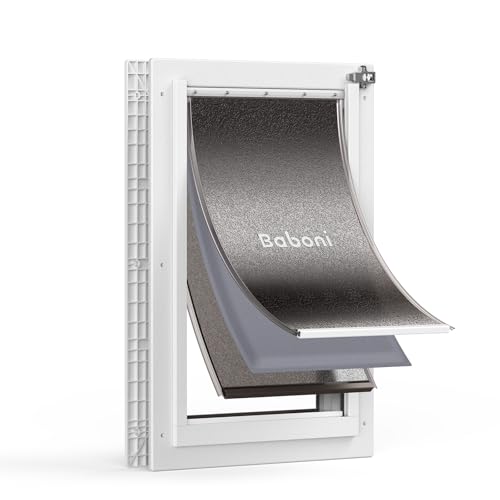
This is a manually operated, door-mounted pet door with a plastic frame, telescoping tunnel, three flexible flaps, magnetic closures, and a lockable metal closing panel. Baboni states that the large opening measures 10 1/4 inches wide by 16 1/4 inches high and is intended for cats and dogs up to 100 pounds. The manufacturer describes two magnetic vinyl flaps plus an insulated center flap, and says the panel can fully block the opening. It also lists large replacement flaps and replacement insulated flaps, which is meaningful repair support. However, no exact-product independent air-leakage, rain-penetration, forced-entry, flap-force, chemical-migration, or durability test report was located. There is also an important fit discrepancy. Baboni's own page specifies doors 1 3/8 to 1 31/32 inches thick, while the marketplace record says one inch.
It suits an owner fitting a compatible solid or insulated door within Baboni's stated 1 3/8 to 1 31/32 inch thickness range, whose pet can comfortably clear a 10 1/4 by 16 1/4 inch opening. It is most relevant where the owner wants day-to-day pet independence but can insert the closing panel at night, during travel, or when outdoor access needs to stop. It also fits households prepared to measure the pet's chest and shoulder clearance, cut the stated opening carefully, and seal the frame perimeter for exterior use.
It is not suited to a one-inch-thick door unless the manufacturer confirms compatibility for that exact installation, because the product record and Baboni's own fit guidance conflict. It is also not appropriate as a primary home-security barrier or as a wildlife-exclusion system. Households in areas with frequent raccoons, skunks, bats, foxes, stray animals, or unsupervised outdoor-pet risks should use the locking panel whenever access is not actively intended. Pets with mobility limits, fear of flaps, or borderline body clearance need a lower-force, carefully sized solution.
The health-relevant strengths are practical rather than independently certified. Baboni provides a stated large opening, magnetic flap closure, and a metal closing panel that can stop passage when fitted. The company also identifies an email contact and lists separate large replacement flaps, insulated flaps, and metal panels. No electrical or wireless functions are involved. Material transparency is limited. Baboni calls the frame outdoor plastic and identifies vinyl flaps, but does not publish a resin specification, chemical declaration, migration testing, or third-party safety report for this product. No exact-product recall or Proposition 65 warning was located in the searches performed. The repairable flap and panel availability may reduce premature replacement, but no recycled-content, packaging, take-back, or independently verified environmental performance information was found. CDC guidance also supports keeping pets away from wildlife and supervising outdoor access where wildlife exposure is possible.
This is a non-powered, wall-installed pet door for large cats and dogs. Baboni states that its usable flap opening is 10.25 inches wide by 16.25 inches high, for pets up to 100 pounds. Its telescoping tunnel is stated to fit walls 4.75 to 7.25 inches thick, with a 12 by 17.75 inch wall cutout. The stated construction is a steel frame with aluminum components, three flaps, magnetic closure, and a slide-in metal closing panel. The installation guide independently available online gives detailed cutting, fastening, fit-check, caulking, and pet-training instructions. It also says not to force a pet through the opening. No exact-product laboratory reports were located for flap force, air leakage, wind-driven rain, forced entry, corrosion, or chemical content.
This product suits a household that wants a manually operated wall pass-through for a large, able-bodied dog or cat and can match the wall depth to the stated 4.75 to 7.25 inch range. It is most appropriate where the owner can cut and finish a 12 by 17.75 inch opening, inspect the wall for studs and utilities, use caulk or closed-cell foam where needed, and use the included closing panel when access needs to stop. It also suits owners willing to replace worn flaps rather than discard the whole assembly.
It is not suited to homes that need electronic identity-based access, automatic locking, app alerts, or documented resistance to determined intruders and wildlife. Avoid using it as the only barrier near pools, roads, unfenced outdoor areas, or places where children could use the opening to reach hazards. It is also a poor fit for walls outside the stated depth range, fire-rated walls, locations with unaddressed wiring or plumbing, or pets with arthritis, limited mobility, broad chests, or reluctance to push through multiple flaps.
The health-relevant strengths are practical rather than independently certified. The available installation guide tells users to check for electrical and plumbing fixtures, warns that the opening needs child-proofing when children are present, and says the unit is not a fire door. It also advises owners not to force pets through during training. The closing panel can stop use of the opening when supervision or containment is needed. That matters because public-health guidance recommends keeping pets away from wildlife and supervising them outdoors. Material disclosure remains limited. Baboni identifies metal framing, aluminum components, vinyl replacement flaps, and an insulated flap, but no exact-product chemical declaration or third-party material testing was located. On waste, replaceable standard and insulated flaps plus a replacement metal panel are positive repair options. The available manual states a one-year non-transferable limited warranty. No exact-product CPSC recall or Proposition 65 warning was located in the searches performed, but no independent performance certification was located either.
This is an indoor steel barrier gate, not a pet door. The black, 36-inch-tall unit is intended to block a doorway, hallway, or stair opening so a child or pet does not pass through. Manufacturer product information reproduced by independent retailers states a 29.5 to 48.8 inch fit range, a 23.6-inch walk-through panel, a double-action latch, two-way opening, and gravity-assisted automatic closing. An available COMOMY 36-inch gate guide describes pressure mounting and optional wall-cup hardware mounting, regular tension checks, and a warning not to use pressure mounting at the top of stairs. The available guide is for a closely related 36-inch configuration, rather than a model-specific independent test report. No model-specific laboratory report, Children’s Product Certificate, coating disclosure, forced-load report, or weatherproofing test was located. The claimed 100-pound impact resistance and Moms’ Choice recognition were not independently substantiated for this product during this review.
This product suits a household that needs an indoor barrier for a measured opening between 29.5 and 48.8 inches, such as a doorway or hall, and wants an adult walk-through panel instead of stepping over a gate. It is most appropriate for supervised containment of pets or for child-use situations where the installation instructions are followed exactly. For a stair location, the buyer should be prepared to use the supplied hardware-mounting approach and wall cups rather than rely on pressure alone.
It does not suit anyone seeking a pet door that allows an animal to move independently between indoors and outdoors. It is also unsuitable for exterior doors, walls, garages, pools, or any location requiring a weatherproof seal, energy performance, wildlife exclusion, or real home-security resistance. Households with a powerful pet that repeatedly charges barriers should not treat the unverified 100-pound impact statement as engineering evidence. It should not be pressure-mounted at the top of stairs, based on the available COMOMY installation guidance.
The principal health consideration is installation. CPSC rules treat gates and enclosures as regulated durable infant and toddler products, and the current U.S. rule incorporates ASTM F1004 requirements. The available COMOMY guide gives useful warnings about securely engaging the latch, checking tension and hardware regularly, stopping use if damaged, and avoiding pressure mounting at the top of stairs. Searches of CPSC recall and SaferProducts resources did not identify a recall for this specific product, but that does not establish compliance or absence of future hazards. Material disclosure is limited to steel or metal. No model-specific information was located for finish chemistry, Proposition 65 exposure warnings, corrosion testing, replaceable components, warranty terms, or end-of-life packaging practices. It has no powered, wireless, app-connected, or battery components, so electrical, radio, and data-privacy exposure is not part of its design.
This is a brown, full-height insert panel for a sliding glass patio door. It adjusts for track openings from 75 7/8 to 80 11/16 inches high and provides a 10 1/4 by 16 1/4 inch flap opening. The manufacturer identifies an aluminum-alloy frame, tempered-glass upper panel, metal cover, self-adhesive seals, latch hardware, closing panel, and installation hardware. The exact-model manual provides important limits. It calls for measuring and checking the frame for a flush fit, and it describes tools and screws for installation. It also warns that screws can crack vinyl frames or jambs. Most importantly, it says the closing panel or lock is for aesthetic and energy-efficiency purposes and is not a security device. No independent air-leakage, water-penetration, forced-entry, flap-impact, chemical-migration, or durability test report was located for this product.
This product suits a renter or homeowner with a sliding glass door whose measured track opening falls within the stated 75 7/8 to 80 11/16 inch range, and whose dog can comfortably clear a 10 1/4 by 16 1/4 inch opening without squeezing. It is most appropriate where the pet door will be supervised, the patio door can tolerate the required fitting and possible fastening, and the buyer wants a removable full-height insert rather than cutting a hole in glass.
It is not for homes that need a pet door to function as an intrusion barrier or a dependable wildlife exclusion device. The manual specifically rejects use of its closing panel or lock as security. It also does not suit households with young children who could reach outdoor, pool, traffic, or other hazards through the opening without active controls. Avoid it where the door track is outside the stated range, the fit cannot be made flush and stable, or fastening into a vinyl frame could damage the door.
The main health positive is straightforward construction, with a stated tempered-glass panel and aluminum-alloy frame, plus no electricity, wireless connection, battery, or app. The manufacturer gives a specific flap opening, but it does not publish a pet weight limit, flap-force measurement, edge-safety test, or independent test evidence showing that repeated use is comfortable for a particular dog. Measure the dog rather than relying only on a size label. Material transparency is incomplete. The main frame and glass are named, but the flap polymer, seals, coatings, and adhesives are not chemically characterized in the materials reviewed. No product-specific Proposition 65 warning, chemical test report, or independent performance certification was located. VEVOR has a public recall channel and support route, although its published recall notices reviewed did not identify this dog door. The manufacturer offers a 12-month warranty, but a replacement flap or parts catalog for this product was not located.