Best Overall
32% off

Stay & Play Wireless Pet Fence
Easy setup with no digging required.
Portable design for use anywhere.
Covers up to 3/4 acre effectively.
 Brianna York
Easy setup with no digging required.
Portable design for use anywhere.
Covers up to 3/4 acre effectively.

No subscription needed for operation.
Customizable fence boundaries for flexibility.
Advanced safety features for peace of mind.

Extended battery life for uninterrupted usage.
Waterproof design for all weather conditions.
Accurate GPS, ensuring reliable boundary tracking.
Easy setup with no digging required.
Adjustable boundary covers up to 1/2 acre.
Safe, gentle correction for all dog sizes.

Customizable boundary for tailored safety zones.
No subscription fees for ongoing use.
Durable, waterproof design for outdoor conditions.

Covers up to 100 acres of land.
Includes tone, vibration, and static options.
Rechargeable collar for convenience and sustainability.

Easy setup with app-controlled features.
Adjustable range for customizable boundaries.
Reliable GPS tracking for pet safety.

No monthly fees, saving you money.
Customizable boundaries for precise pet control.
Track multiple pets with one app.

No subscription fees required for use.
Customizable wireless boundaries via app.
Waterproof, durable, and rechargeable collar.

Easy setup without digging or wires.
Adjustable boundaries for customized safe zones.
Portable design for travel-friendly pet containment.
Whether one works depends on more than the advertised range. Radio systems can be affected by metal, electrical noise, transmitter placement, collar orientation, wire damage, sharp turns, power loss, and signal interference. GPS systems depend on clear satellite reception and can behave differently around trees, buildings, eaves, terrain, weather, and weak signals. A headline radius or acreage figure is therefore not proof of a safe boundary at the property edge. Look for a documented buffer, minimum property size, operating limits, warning-to-correction sequence, loss-of-signal behavior, and instructions to test and flag the boundary before use.
The strongest performance evidence would be an independent report from an ISO/IEC 17025-accredited laboratory that identifies the exact model and explains its test method. For GPS, radio, and wired systems, that report should cover boundary error, latency, false activations, missed activations, obstructions, terrain, weather, and loss-of-signal conditions. The laboratory's status should be checkable through an A2LA or ANAB directory. A manufacturer's precision claim, customer reviews, or an unexplained badge is not equivalent evidence. Among the supplied products, boundary scores varied from 45 to 72, reflecting the difference between disclosed limitations and independently checkable performance—not simply advertised range.
Electrical and radio claims also need model-level records. An FCC equipment-authorization record can support radio-emissions traceability, but it does not prove GPS accuracy, charger safety, waterproofing, battery safety, or animal-welfare performance. For chargers and electrical equipment, look for a matching OSHA NRTL listing, UL Product iQ or Intertek ETL record where applicable, and check CPSC recalls and SaferProducts.gov reports. An IP67 or IPX7 claim should be matched to an independent IEC 60529 ingress test report; without one, treat it as self-declared.
For the dog, favor a clearly documented tone-only or sound-and-vibration mode, gradual reward-based training, visible flags, supervision warnings, suitability limits, correction duration and lockout details, and explicit advice that the system is not a physical barrier. Fit matters: contact points, receiver weight, neck-size limits, a two-finger or one-finger fit check, maximum wear time, repositioning, cleaning, and daily skin inspection can reduce pressure injury. Static correction remains an aversive exposure even when it is optional, and the supplied reviews repeatedly caution against relying on it, especially for fearful, reactive, aggressive, young, medically vulnerable, or skin-sensitive dogs.
Across the supplied products, recurring serious cautions include unreliable or unverified boundaries, unexpected activation or missed containment during interference or signal loss, power or wire failures, and unsuitable use near roads, wildlife, water, people, or other escape hazards. Buyers should also avoid unattended use during training and should maintain a physical, leash-based, or otherwise supervised backup where an escape could cause harm.
These topics address the parts of a wireless dog-fence decision that affect the dog's welfare, the collar and electronics, waste, and the reliability of the evidence. Scores are relative to the supplied products; a higher score means the reviewed materials provided stronger safeguards or more checkable support, not that the product is risk-free.
This measures whether the system limits fear, pain, and repeated aversive stimulation through tone-only or non-static options, correction limits, and suitability warnings. It matters because most supplied products retain static correction. Higher scores went to products documenting static disablement or automatic non-static fence cues; lower scores reflected static-centered sequences, unclear pulse limits, or unsupported claims that stimulation is harmless.
This measures contact-point design, strap and receiver fit, weight, sizing, wear limits, cleaning, repositioning, and skin checks. Direct neck contact can cause redness, pressure sores, or other injury when a collar is too tight or worn too long. Higher-scoring products supplied two-finger or similar fit guidance and daily checks; lower-scoring products lacked wear-time or contact-point instructions.
This measures gradual, reward-based training, visible boundary cues, dog screening, supervision, and warnings that the collar is not a physical barrier. It matters because a dog must learn the boundary before containment can be trusted. Higher scores reflected flags, leash practice, treats, praise, staged sessions, and clear exclusions; lower scores lacked a detailed training plan or relied more heavily on correction.
This measures whether the collar, battery, charger, and transmitting hardware have model-matched, checkable safety records. A product can have a radio authorization without proof of charger or battery safety. Higher scores in the supplied set generally reflected FCC records tied to the exact model; lower scores relied on generic or unverified compliance and waterproofing claims.
This measures independently measured boundary error, warning timing, false and missed activations, and containment results under the conditions claimed. It matters because advertised acreage and range do not reveal how a boundary behaves near metal, trees, buildings, terrain, weather, or signal loss. The supplied scores ranged from 45 to 72; higher scores reflected clearer limitations or stronger evidence, while no product had independent field validation for every important condition.
This measures what happens during low battery, charging faults, GPS or radio loss, app failure, restart, power outage, wire damage, and water exposure. A warning, pause, or clearly documented non-correction response can prevent silent reliance on a failing system, but may also mean containment is unavailable. Higher-scoring products documented distinct fault indicators or protection behavior; lower scores left failure responses unclear.
This measures collection, sharing, retention, security, updates, and owner control over dog and household location data. It matters only to connected products, while collar-only systems may collect less routine location data. Higher scores reflected clearer privacy information or no-app operation; lower scores reflected precise-location collection for analytics, development, or marketing, or missing privacy and security documentation.
This measures whether claims about range, accuracy, waterproofing, effectiveness, safety, subscriptions, and suitability match the disclosed evidence and operating limits. Higher scores went to products that qualified their claims or disclosed conflicts; lower scores reflected unsupported precision, waterproofing, runtime, or welfare language. Conflicting range units, fit ranges, charging times, or correction descriptions weaken this score.
This measures whether important radio, electrical, ingress, battery, and performance claims have exact-model third-party records or complete test reports. FCC filings improved traceability for several products, but did not verify containment or waterproofing. Higher scores reflected model-matched FCC or other traceable records; lower scores relied on self-issued badges or had no independently checkable certification or test report.
This measures an identifiable maker, U.S. responsible party, recall and incident transparency, firmware remedies, warranty, and customer support. It matters when a collar, charger, battery, or firmware problem affects containment or safety. Higher scores reflected established manufacturers, published support, warranties, or traceable filings; lower scores reflected limited public accountability. A lack of a located recall is not proof that no risk exists.
This measures replaceable batteries, repairability, replacement parts, durable construction, packaging, and take-back or recycling options. Rechargeable operation alone does not establish a lower-waste design, because a sealed battery can make the whole collar disposable. Higher scores reflected replaceable batteries, manufacturer-supported battery changes, parts, or disposal guidance; lower scores had no documented repair, replacement, or recycling pathway.
This product is a plug-in, radio-based circular containment system for dogs at least 5 pounds and 6 months old. It includes an indoor transmitter, rechargeable receiver collar, contact points, test light, and 50 visual training flags. The manufacturer states a radius of 22 to 105 feet, or up to 3/4 acre, with a tone-only setting plus five selectable static-correction strengths. It requires a wall outlet and is portable only where the boundary can be reset and marked again. Its most consequential documented feature is the collar’s static correction. The manual specifies a warning tone, up to 15 seconds of correction, then a 10-second correction lockout. It also states that electronic noise, metal, collar orientation, and lost transmitter signal can affect activation. The maker provides detailed setup, fit, and 14-day training instructions, but no independent accredited boundary-accuracy, water-ingress, or collar-output test report was located.
This product fits a household with a non-aggressive, physically healthy dog that is at least 5 pounds and 6 months old, an open and roughly circular yard, and an owner prepared to test the perimeter repeatedly and complete the maker’s 14-day training process. It is most suited to lower-risk properties where an adult can supervise outdoor time, use flags and rewards consistently, remove the collar indoors, and treat the system as a training deterrent rather than dependable physical security.
It is not appropriate for aggressive, fearful, anxious, highly reactive, or medically vulnerable dogs, which the manufacturer itself flags for veterinary or qualified trainer input. It also does not fit homes beside busy roads, wildlife hazards, unfenced pools, or places where an escape could harm people or the dog. Avoid it where metal buildings, metal crates, frequent outages, neighboring containment systems, or unavoidable radio interference could destabilize the boundary. It is also unsuitable for households that do not want static correction exposure.
The key health issue is not chemical composition but the training mechanism. The collar uses neck contact points and can apply static correction after a warning tone. The manufacturer supplies a tone-only mode, a 15-second correction timeout, stress-monitoring advice, and detailed skin-care instructions. Those safeguards matter, but they do not remove the welfare concern associated with aversive stimulation. AVSAB’s current position is that dog training should use reward-based methods and not electronic collars. The receiver contains a rechargeable sealed lithium-ion battery. The manual warns against heat, puncture, short circuit, incineration, and incorrect chargers. It says the battery should provide hundreds of recharge cycles and directs end-of-life electrical equipment to recycling, but it does not document user battery replacement or a U.S. take-back route. PetSafe provides a U.S. responsible-party address, customer support, replacement accessories, and a one-year limited warranty. The manual claims FCC Part 15 compliance, but no model-matched NRTL, water-ingress, or independent laboratory report was located.
This is an app-configured GPS containment system for dogs over 25 pounds with 13 to 28 inch necks and properties of at least three quarters of an acre. It includes a rechargeable collar, indoor base unit, short and long contact points, charging equipment and a two-week training guide. The owner draws a custom boundary in the My PetSafe app, which saves up to 32 digital fence posts to the collar. The manufacturer states that the collar gives vibration and tone before a selectable static correction, with a tone-and-vibration-only option or 10 static levels. Its manual also documents a maximum 15-second static pulse and a 10-second over-correction lockout. An FCC test report independently identifies this product's collar and documents compliant MURS radio-transmitter testing, but it does not test GPS boundary accuracy, weather durability, containment success, or charger safety.
This product fits households with a dog over 25 pounds that already knows basic cues, has a large open property, and can receive structured outdoor training and routine collar checks. It is most relevant where a buried-wire installation is impractical and the owner accepts an app-based setup with a fixed home boundary. The manufacturer says it continues containment during a home Wi-Fi or power outage, which is useful for owners who understand that this does not provide escape tracking.
It is not appropriate for dogs with aggression histories, dogs too small for the stated fit range, puppies that do not yet understand basic obedience, or dogs with skin sensitivity that cannot tolerate contact points. It is also a poor fit for homes near busy roads without a large 25-foot safety buffer, densely obstructed yards, or situations where a physical barrier is needed. It cannot locate a dog after escape, so it should not be treated as a tracking or recovery system.
The main health concern is the available static correction. The collar offers a tone-and-vibration-only setting, but its documented boundary sequence can progress to static stimulation through neck contact points, with settings from 1 to 10. AVSAB recommends reward-based training and advises against electronic collars. The manual does provide meaningful skin and snag-risk safeguards, including specific fit instructions, short and long contact points, a 12-hour daily wear limit, and a warning not to attach a leash or identification tag. For electrical and accountability checks, the radio collar has a model-matched FCC transmitter test record. That record does not establish charger, battery, waterproofing, or GPS-containment performance. The manufacturer provides a one-year limited warranty and U.S. support contact, while app-store disclosures say the app may collect location and other data, encrypts data in transit, and allows deletion requests. No product-matched recycling or battery-removal instructions were located, so end-of-life handling should follow local lithium-ion battery collection guidance.
This is an app-configured GPS containment collar for dogs. The catalog listing is the medium 12 to 18 inch neck version. SpotOn’s own current product page describes the Omni platform as using a rechargeable lithium-ion battery, multi-constellation satellite positioning, two contact-point sets for different coat lengths, and optional cellular features such as live tracking and escape alerts. Its defining evidence is unusually concrete for this category. A commissioned but publicly available Spirent field report tested the Omni in open, wooded, building-adjacent, and partially obscured settings, reporting alerts and corrections in every SpotOn test run. The collar also offers tones and vibration, with static correction optional and adjustable through 30 levels. That option matters because electronic stimulation is an aversive method, and veterinary behavior guidance favors reward-based training. SpotOn itself warns that no containment system prevents every escape and that owners should monitor dogs.
This product suits an owner of an adult, medium-sized dog with a neck within the listed 12 to 18 inch range, a property large enough to leave a conservative GPS buffer, and the time to conduct gradual training and routine collar checks. It is especially relevant where a portable virtual boundary is needed across more than one location and where the owner can actively supervise outdoor use. It also fits owners who want containment to function without paying for tracking, while understanding that live location and escape alerts require the optional cellular plan.
It is not appropriate as the sole safeguard for a dog that is aggressive, likely to harm itself or others after an escape, highly fearful, reactive, or prone to panic around sound, vibration, or static cues. It also does not suit households needing a true barrier against roads, visitors, wildlife, or other animals entering the property. Avoid relying on it for unsupervised containment in locations with poor sky view, dense structures, inconsistent cellular service for tracking, or when daily charging and fit checks are unlikely to happen.
The main health issue is the collar’s optional static correction. The product can operate with tones and vibration, but it also uses skin-contact probes and permits 30 static levels. AVSAB recommends reward-based training and advises against aversive tools. SpotOn’s setup guide does at least require gradual training, boundary testing, a two-finger fit check, coat-appropriate contact points, and removal indoors. The guide also says to inspect the unit for damage before water exposure and to use only the supplied charger. The collar has a rechargeable lithium-ion battery, which avoids routine disposable batteries. SpotOn offers one year of defect coverage and documents out-of-warranty repair for straps, exterior and interior components, and electronics, which can extend service life. However, no public battery-replacement instructions, take-back program, or model-specific third-party water-ingress certification record was found. The manufacturer identifies a New Hampshire responsible party and publishes support, warranty, privacy, and software-update information. No SpotOn-specific CPSC recall was located in the public recall search checked.
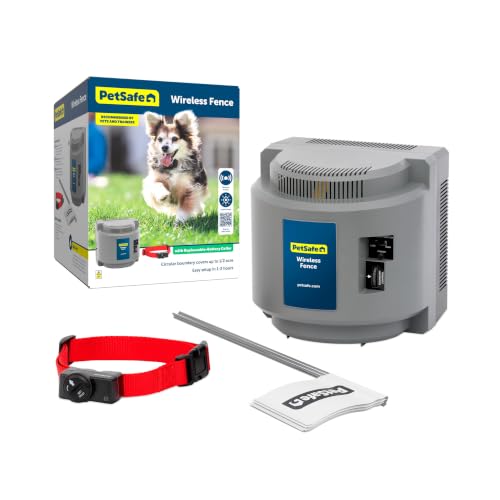
This product is a plug-in transmitter and one battery-powered receiver collar that creates an adjustable circular radio boundary. PetSafe states coverage is up to one-half acre, with a 10 to 180 foot diameter range, for dogs at least 8 pounds and 6 months old. The collar has tone-only operation plus five static-correction settings, visible training flags, and short and long contact points. The manufacturer manual provides unusually concrete operating limits. Its listed boundary distances are approximate, the field can fluctuate by up to 5 percent with electronic noise, and metal objects, vehicles, terrain, collar orientation, and signal loss can change where activation occurs. The transmitter radio has a model-matched FCC authorization, but no independent product-specific containment accuracy or collar ingress report was located. This is therefore a training aid with meaningful setup and supervision demands, not a physical barrier.
This product suits an owner of a healthy adult dog over 8 pounds who has a mostly open yard, can accept a circular rather than property-line-shaped area, and is prepared to test the boundary repeatedly. It is most workable where the transmitter can remain indoors, away from large metal objects, and where the owner can complete the multi-day flag, leash, treat, and supervision plan. It also fits households that value a portable setup and can monitor the replaceable collar battery and skin-contact area closely.
It is not suitable for puppies younger than 6 months, aggressive or fearful dogs, dogs with current neck irritation, or dogs likely to react badly to aversive stimuli. It is also a poor fit for yards with substantial metal structures, parked vehicles within the area, heavy electronic interference, steep terrain, or a layout requiring a noncircular boundary. Households needing a barrier that prevents outside animals entering, reliably restrains a dog during outages, or safely permits unsupervised use should not treat this product as a substitute for physical containment.
The collar uses stainless-steel contact points and comes with short and long versions for coat length. The manual gives meaningful skin safeguards, including a maximum 12-hour daily wear period, repositioning when possible, daily inspection, weekly cleaning, and stopping use if redness or sores appear. Those instructions matter because direct contact and tight fit can cause pressure injury. Static correction remains available through five correction levels, while tone-only operation is available for training or dogs that no longer need static correction. The transmitter is traceable to an FCC authorization for the relevant PetSafe wireless-containment transmitter. The receiver is described by PetSafe as waterproof, but no model-matched independent ingress report was located. The receiver battery is replaceable, and replacement collars, transmitters, adapters, and flags are listed, which can reduce premature disposal. The manual also warns against opening, shorting, burning, or wetting the battery, and directs users to dispose of used batteries properly. No product-specific CPSC recall was located in the searches performed.
This is a rechargeable GPS containment collar for medium and large dogs. The product is set from the collar itself, with either a circular radius or a walk-set multipoint perimeter. A separately published listing identifies a soft TPU strap, a stated fit for dogs above 15 pounds with 9 to 26 inch necks, and a claimed maximum radius of 6,561 feet. It is intended for open outdoor areas, not small yards or sites with dense tree cover. Its correction sequence is manufacturer-stated, not independently tested. The collar can issue a tone, vibration, or optional static correction at adjustable levels, with a claimed 10-foot warning zone and cutoff after two cycles. No model-specific independent boundary, waterproofing, electrical, or radio authorization record was located. The product is not a physical barrier.
This product fits a household with one healthy medium or large adult dog, an expansive open outdoor area, and an owner who can set a conservative boundary well inside property lines and supervise training. It is most relevant where avoiding buried wire and avoiding an app or subscription are practical priorities. The stated 15-pound minimum and 9 to 26 inch neck range should be checked against the individual dog. A reward-based trainer should guide boundary teaching, with tone or vibration used before considering any static setting.
It is not suited to puppies, dogs under the stated 15-pound minimum, dogs with neck skin problems, or dogs that show fear, reactivity, aggression, or strong chase behavior. It is also poorly suited to small yards, properties near roads or public access, heavily wooded sites, and locations where satellite reception may be obstructed. It should not be treated as protection against people or animals entering the property, or as a substitute for direct supervision and a physical barrier when escape could create serious risk.
The strap is identified as thermoplastic polyurethane, and the collar has a rechargeable battery. Those features may avoid disposable battery use, but no battery-removal instructions, replacement battery, spare-part program, repair pathway, or take-back option was located. Rechargeable electronics and their lithium battery should be routed through an appropriate battery or e-waste collection program rather than household trash. The main health issue is the available static-correction mode. The seller describes it as optional and says the collar gives a tone warning before correction and stops after two cycles. Those are manufacturer statements, not independent welfare testing. AVSAB advises against aversive tools, including electronic shock collars, and a controlled study found no consistent efficacy advantage over reward-based training with greater welfare concerns. No product-specific CPSC recall or warning was located in the searched public resources, but no model-matched FCC, NRTL, or independent IPX7 test record was located either.
This is a wired, in-ground containment system for one dog, using 1,000 feet of boundary wire and 100 visual flags. SportDOG states that the included layout can cover up to 1 1/3 acres, with added wire and flags extending the layout to 100 acres. The collar uses a rechargeable lithium-ion battery, and the manufacturer states a two-hour charge and one to two months of battery life. The collar gives a tone in the warning zone, then vibration or static stimulation depending on its setting. Setting 1 is tone and vibration only. Settings 2 through 8 add escalating static stimulation. The manufacturer documents a two-week flag-based training plan, a wire-break alarm, and a waterproof-to-25-feet claim. No model-matched independent boundary-accuracy, ingress, or electrical-safety test report was located.
This product fits an owner of a healthy, non-aggressive dog over 8 pounds who has a stable property layout, can bury and routinely inspect a wire loop, and can commit to the supplied multi-day training process. It is most suited to a setting where the owner can supervise initial use, maintain a generous buffer from roads and hazards, and choose the tone-and-vibration-only setting if that is adequate. It also suits households that need a wired boundary rather than app-based location tracking.
It is not appropriate for aggressive, fearful, highly reactive, medically vulnerable, or skin-sensitive dogs, or for households unable to monitor fit and skin condition. It is also a poor fit for yards adjoining traffic, public paths, roaming dogs, or wildlife, because the wire does not block outside access and a dog may escape before any correction deters it. People seeking independently verified containment accuracy, a physical barrier, or entirely reward-based containment should use a different approach.
The main health issue is the static-correction mechanism. The product has a vibration-and-tone-only setting, but static stimulation remains available across seven higher settings and is applied through metal contact points. The manufacturer gives useful fit, skin-check, aggressive-dog, and supervision warnings. Those safeguards matter, but they do not remove the welfare concern associated with aversive stimulation. AVSAB's current humane-training position supports reward-based methods and advises avoiding aversive techniques. The collar uses a rechargeable lithium-ion battery rather than disposable cells. SportDOG documents replacement accessories and provides instructions for battery removal at end of life, while directing owners to contact customer care for a replacement battery. The manual also carries an FCC Part 15 compliance statement. No model-matched publicly available third-party report was located to independently substantiate the waterproof rating or broader electrical, ingress, and boundary-performance claims. No U.S. CPSC recall specific to this product was located in the checked records.
This product is a rechargeable GPS dog collar that uses an app to create circular or polygonal virtual boundaries and no-go zones. The publicly available seller description says it combines dual-frequency GPS with cellular, Wi-Fi, and Bluetooth positioning, fits dogs at least 6 months old with 8 to 25 inch necks, and is intended for outdoor use. It also offers location history, activity reporting, alerts, and optional remote training functions. Important limits are not independently confirmed. The seller states that it can disable the virtual fence when GPS fails, that tracking and some premium features depend on subscription status, and that static stimulation is optional and adjustable. No model-matched independent boundary-accuracy test, ingress test report, electrical safety listing, or radio authorization record was located in the checked public records.
This product is most suited to an owner of a healthy, mature dog that fits the stated 8 to 25 inch neck range and has reliable recall training already in place. The owner should have an open outdoor area with stable positioning conditions, be prepared to supervise setup and boundary training, and prefer beep or vibration feedback. It may fit users who need portable, changeable zones for a yard or travel property and understand that GPS fencing is a supplementary containment tool, not a physical barrier.
It is not suited to puppies younger than the stated 6 month minimum, dogs with skin irritation, neck injuries, high anxiety, reactivity, fearfulness, or a history of distress around training equipment. It is also a poor fit for households near busy roads, wildlife hazards, unfenced public access, dense canopy, tall buildings, steep terrain, or inconsistent GPS conditions. Do not rely on it as the only control for a dog that may chase, roam, or encounter people and other animals outside the property.
The key health concern is the optional static-stimulation function. Although the seller describes beep and vibration alternatives, the collar is also promoted for static correction. AVSAB's current humane-training position supports reward-based methods and advises against aversive tools. The seller describes silicone conductive covers, an adjustable collar, a minimum age of 6 months, and a daily wear limit, but no independently verified receiver weight, contact pressure, or skin-inspection guidance was located. The collar is rechargeable, which can reduce use of disposable batteries. However, no battery chemistry, replaceable-battery procedure, repair parts listing, take-back program, or recycling pathway specific to this product was located. The seller claims an IP67 rating, but no model-matched third-party ingress report was found. No product-specific CPSC recall or public safety warning was located in the checked sources, and no independently checkable FCC, UL, ETL, or comparable product-level certification record was found.
This product is a GPS-enabled outdoor dog-containment collar system with a handheld remote and a phone app. The manufacturer says the app can draw a custom polygon boundary, manage up to five collars, provide activity monitoring, and operate without a monthly fee. It also says one remote can train up to two dogs when an additional collar is used. The advertised boundary response is selectable sound, vibration, or electrical stimulation. The product is specifically described as for open outdoor areas with a strong, clear GPS signal, not indoor use or heavily wooded areas. Independent reseller listings confirm those stated functions and list an approximately 11-ounce packaged product weight, but no publicly located product manual provided stimulation duration, lockout behavior, static-disable default, fit range, weather rating, GPS error margin, or signal-loss response.
It is most relevant to an owner of one or more physically healthy dogs who has a large, open outdoor area with reliably clear satellite reception and understands that the stated boundary is virtual, not a physical barrier. The owner should be willing to supervise outdoor use, build in a generous buffer from roads and property edges, and use reward-based teaching of recall and boundary cues before considering any collar warning. It may also fit a household that specifically values the manufacturer-stated no-monthly-fee app model and multi-collar management.
It is not suitable as the only containment measure near roads, wildlife, neighboring dogs, public access, pools, livestock, or any consequence-sensitive boundary. It is also a poor fit for wooded, obstructed, indoor, or unreliable-GPS locations, which the product itself says are unsuitable. Avoid using it for fearful, anxious, reactive, aggressive, very young, medically vulnerable, or skin-sensitive dogs without veterinary and qualified behavior guidance. Households seeking a reward-only training approach should not rely on a system that includes electrical stimulation.
The central health issue is the advertised electrical-stimulation mode. The maker presents sound, vibration, and shock as adjustable warning choices, but did not provide publicly located details on pulse length, correction limits, automatic lockouts, or whether static can be disabled while the fence remains active. AVSAB recommends reward-based training only, and published controlled research found greater behavioral welfare concerns from electronic-collar training without a consistent efficacy advantage over reward-based approaches. No product-specific recall or CPSC safety warning was located in the checked U.S. sources. That is not equivalent to a safety certification. No model-matched FCC authorization, NRTL listing, independent ingress test, battery-removal instruction, replacement-parts program, repair policy, or take-back program was located. The battery is described in reseller data as lithium polymer, but replacement and recycling arrangements remain undocumented.
This product is a rechargeable GPS virtual-boundary collar for outdoor dogs weighing at least 15 pounds, with a 10-inch minimum neck size and a manufacturer-stated 6.9-ounce receiver. A phone app is used to draw circular or custom boundaries, then the collar operates independently. Dogtra says it needs at least three quarters of an acre, has a warning zone, one main fence, and two backup fences. It is containment only, not live tracking, and app alerts work only within roughly 33 feet by Bluetooth. The collar can use tone, vibration, or static stimulation. Its return sequence is designed to stop correction when a dog returns toward the safe area. The Bluetooth radio is traceable to a matching FCC authorization and a Part 15.247 test report. Boundary accuracy, waterproofing, and containment performance remain manufacturer-stated because no model-specific independent field test or public IPX9K test report was located.
This product suits an owner of a healthy dog over 15 pounds who has a large, open outdoor property of at least three quarters of an acre and can supervise a deliberate training period. The best fit is someone willing to place visible flags, begin with tone or vibration, use a flat collar for leash work, reward returns, and inspect the neck at every use. It also suits a household that values a boundary system that continues operating after initial app setup and does not require a monthly subscription.
It is not suited to small dogs, dogs with a neck under 10 inches, dogs with skin irritation, or dogs whose fear, reactivity, aggression, or high chase drive makes aversive correction a foreseeable welfare concern. It is also unsuitable for small yards, dense indoor-outdoor access, or homes expecting live escape alerts and location tracking while away. Do not treat it as a physical barrier for roads, wildlife, neighbors, visitors, or other hazards. Owners unable to provide supervised flag training should choose a containment approach without automatic correction.
The collar has meaningful documented skin safeguards. Dogtra specifies medical-grade stainless-steel contact points and antimicrobial plastic, while its manual directs owners to use a two-finger fit, move the receiver every few hours, remove it after eight hours, and check for irritation. Those instructions matter because prolonged pressure and contact-point exposure can irritate skin. Static stimulation is optional, and the training guide begins with tone or vibration plus visible flags and praise, but the product still enables automatic electrical correction. For electronics, the matching Bluetooth radio has an FCC authorization and a Part 15.247 test report. That verifies radio compliance, not GPS containment accuracy, charger certification, or waterproof performance. Dogtra sells a compatible lithium-polymer replacement battery and offers authorized repair, which can extend service life. Self-installing the battery voids the warranty, and no take-back or battery recycling program for this product was located. Public recall and unsafe-product databases were checked, with no model-specific recall or regulatory warning located in the reviewed records.
This product is a rechargeable GPS dog-fence collar intended for outdoor use. A retailer syndicating the manufacturer description identifies a Bluetooth-paired app that can draw circular or polygonal boundaries, with a claimed adjustable boundary range of 64 to 3,280 feet. It also describes a 1,000 mAh lithium battery and a claimed 36 to 48 hours of use per charge. These are manufacturer-stated specifications, not independently confirmed performance results. The collar provides sound, vibration, and static correction options. It includes training flags, short and long contact tips, silicone caps, a magnetic USB charging cable, and a test light. No model-matched independent boundary-accuracy, weather, ingress, electrical-safety, or fault-condition report was located during verification.
This is suited only to an owner with a large, open outdoor area who can supervise closely, conduct gradual reward-based boundary training, and use the collar with sound or vibration rather than static. The owner should be comfortable testing the boundary repeatedly before every use and treating the GPS boundary as a training aid, not as a physical barrier. It may fit households that need temporary, portable boundary mapping and accept that the stated range and battery runtime have not been independently verified.
It is not suited to fearful, noise-sensitive, reactive, very young, medically fragile, or behaviorally complex dogs, especially where static correction could increase distress. It is also unsuitable for homes next to roads, water, cliffs, livestock, unfenced public areas, or other hazards, because no independent evidence establishes a reliable safety buffer or fault response. Buyers who need verified electrical certification, documented weather resistance, live location tracking, clear privacy terms, or a physical escape barrier should choose a product with those records.
The primary health issue is the availability of static correction. Although the product also states that it offers sound and vibration, electronic stimulation remains an aversive method. AVSAB recommends reward-based training rather than aversive tools, and controlled research on remote electronic collars found no consistent training benefit over reward-based alternatives while identifying greater welfare concerns. The package does include boundary flags, which can support visible, gradual training if the owner uses them consistently. The collar is stated to contain a rechargeable lithium battery, but no battery-removal instructions, replacement-battery program, repair parts policy, take-back program, or model-matched electrical certification was located. Lithium-ion devices should be directed to an appropriate battery or electronics recycler at end of life, not placed in household trash. No product-specific CPSC recall or public safety warning was found in the checks performed, but the maker's public recall, firmware-update, and accountable U.S. support documentation was not located.