Best Overall

Work Sharp Ken Onion Knife Sharpener
Adjustable sharpening angles for versatile use.
Sharpens knives, scissors, and serrated blades.
User-friendly design with reliable performance.
 Lauren Wilson
Adjustable sharpening angles for versatile use.
Sharpens knives, scissors, and serrated blades.
User-friendly design with reliable performance.

Compact design fits in kitchen drawers.
Sharpens knives quickly and effortlessly.
Consistent sharpening with every use.

Easy-to-use design simplifies knife sharpening.
Offers dual-angle sharpening for versatile use.
Compact size ideal for kitchen storage.
Adjustable sharpening angles for versatile use.
Quick and easy blade sharpening process.
Durable build quality for long-lasting performance.

Efficient three-stage sharpening process.
Precision angle guide for accurate sharpening.
Durable stainless steel grinding head.

Quick 40-second sharpening and polishing.
Suitable for various knife types.
User-friendly for beginners.

Sharpens both stainless steel and ceramic knives.
Includes a convenient scissors sharpening feature.
Equipped with a metal dust collection box.

Sharpens both straight and serrated knives effectively.
Compact design is easy to store and use.
Durable construction ensures long-lasting performance.

Uses 100% diamond abrasives for superior sharpening.
Three-stage process ensures precision and sharpness.
Efficiently restores knives to factory-level sharpness.

Quick sharpening with three-stage process.
Durable 100% diamond abrasives.
Consistently sharpens a variety of knives.
Start with compatibility. A product should clearly identify which blade materials, edge types, thicknesses, angles, and exclusions it supports. Serrated, single-bevel, ceramic, thin, heavily bolstered, and specialty knives cannot be treated as interchangeable with ordinary double-bevel kitchen knives. A fixed 15°, 20°, or 25° guide may improve repeatability, but it can also change a knife's factory geometry. Coarse stages can remove substantial metal, round a tip, overheat an edge, or damage a valuable blade when used with too much pressure or the wrong technique.
Look for a controlled blade path: stable feet or a stable base, enclosed or well-defined slots, guides that keep hands away from the edge, a clear power switch, instructions for starting and stopping, and warnings about accidental starting, cords, entanglement, and newly sharpened blades. A short automatic cycle or several speed settings may help operational control, but a headline such as “40 seconds” does not establish edge quality, safe temperature, even bevels, or reasonable material removal.
Abrasive and debris management matter in a kitchen. Metal filings and abrasive dust should have a defined collection or cleaning path, such as a removable tray or cover, and the instructions should explain how to empty and clean it with the product unplugged. No product in this set had an NSF sanitation listing, so “kitchen” does not mean food-equipment certification. Sharpen away from exposed food and clean the blade, appliance, and surrounding surface before food preparation.
For electrical safety, look for a model-specific certification from an OSHA-recognized Nationally Recognized Testing Laboratory, verifiable through OSHA's current laboratory list and the UL Product iQ, Intertek ETL, or CSA directories. A general UL-style statement, FCC language, double-insulation symbol, retailer wording, or certification for a different country's voltage does not establish US certification for the exact product. Similarly, “100% diamond,” a listed grit, a fixed angle, or a broad compatibility claim is not independent proof of performance.
The strongest sharpening evidence in this set came from independent hands-on or BESS testing that identified the exact product and reported results. Ideally, buyers should look for reproducible testing or an ISO/IEC 17025-accredited report covering sharpness, bevel consistency, material removal, edge retention, temperature, and tip condition. Seller demonstrations and customer ratings do not answer those questions. Also check whether the manufacturer is identifiable, reachable, and prepared to provide recalls, manuals, parts, warranty service, and disposal information.
Recurring caveats are important: no supplied electric model had independently verified model-specific US electrical certification; most lacked standardized sharpening or edge-retention testing; and several generated metal or abrasive dust without documented containment. Multiple products had incomplete or conflicting compatibility information, especially for serrated, ceramic, single-bevel, thin, or valuable knives. Powered abrasives can cause cuts, electrical injury, entanglement, respiratory exposure, sparks, noise, overheating, and unwanted metal removal. Keep children and bystanders away, use protective equipment when the instructions call for it, unplug before cleaning, and do not use these products beside active food preparation.
The topics below distinguish a convenient sharpening claim from a product whose risks, performance, accountability, and useful life are better documented. Scores are relative to the supplied products; a higher score means the review found stronger evidence or better controls for that topic, not that the product is risk-free.
This measures warnings and design controls for cuts, entanglement, electrical injury, burns, dust, and metal debris. For sharpeners, high scores reflect detailed manuals, controlled blade paths, stable placement, cord precautions, and clear protective-equipment guidance. Supplied scores ranged from 70 to 80: the higher-scoring products had more specific warnings and operating controls, while lower-scoring products often lacked manuals or relied mainly on listing claims.
This asks whether the exact US model has independently verifiable certification from an OSHA-recognized laboratory under an applicable appliance or tool standard. It matters because FCC language, double-insulation symbols, retailer wording, or foreign certification does not prove US electrical safety listing. Most electric products scored about 68–75, reflecting unverified records; manual products scored 100 because they have no electrical system to certify.
This measures guides, slot geometry, grip, stability, controls, and instructions that reduce unsafe blade movement. High-scoring examples combined fixed or adjustable guides with pull direction, pressure, tip, and start-stop instructions; lower-scoring designs offered broad claims without detailed operating documentation. Supplied scores ran from 72 to 82. Even a good guide cannot prevent injury from a newly sharpened exposed edge or careless handling.
This measures whether filings and abrasive particles are captured and safely removable rather than entering the user's breathing zone, food area, or moving parts. Higher scores generally reflected a removable crumb bin, magnetic tray, cover, or collection plate; lower scores reflected open belt systems or no defined collection path. Scores ranged from 68 to 78, and no product supplied independent exposure or containment testing.
This measures how specifically a product states supported blade types, angles, and exclusions, and whether it limits excessive grinding, heat, tip rounding, or edge damage. Higher scores reflected bounded instructions and staged abrasives; lower scores accompanied sweeping compatibility claims, conflicting guidance, or fixed angles unsuitable for some knives. Scores ranged from 52 to 79, making compatibility one of the clearest differences among the supplied products.
This measures whether sharpening debris can be removed without leaving filings in food-preparation areas, and whether sanitation claims are independently supported. Higher scores generally came from documented bins, covers, and cleaning steps, while lower scores reflected dust-producing designs or limited care guidance. Scores ranged from 68 to 75. No supplied product had an NSF sanitation certification, so all require cleaning away from food.
This measures reproducible, model-specific evidence for sharpness, bevel consistency, material removal, edge retention, and reasonable operating temperature. High scores of 80–88 came from independent hands-on or BESS-based results, although the supplied testing was not always accredited or comprehensive. Most products scored 68–70 because no independent test was located beyond seller demonstrations, manuals, or reviews.
This measures whether angle, speed, abrasive, compatibility, safety, and durability claims are specific and supported rather than absolute or vague. Higher scores, up to 78, accompanied clearer manuals and narrower claims. Low scores, down to 48, reflected contradictions such as broad “all blade” language, unsupported restoration promises, or claims that exceeded the available evidence. A listed speed or grit does not prove a better edge.
This measures whether the exact product has an identifiable manufacturer or importer, model number, support contact, warranty, and a practical way to check safety notices. Scores ranged from 69 to 86. Higher-scoring products had named companies, manuals, US support, and service or warranty information; lower-scoring products had sparse seller-only details. A lack of located recall does not prove that a product is risk-free.
This measures whether motors, abrasives, guides, belts, trays, and power components can last or be replaced instead of making the whole appliance disposable. The strongest supplied scores, 82–84, were associated with named warranties, service contacts, replacement abrasives, guides, belts, or factory service. Products scoring 68–72 generally lacked parts catalogs, repair instructions, or a documented service path.
This measures recurring abrasive and packaging waste, material disclosure, and practical US recycling or take-back information. Higher scores reflected replaceable consumables or clearer disposal language, but scores still clustered at 68–74 because no supplied product had a product-specific US take-back program. Electric sharpeners should be routed to an appropriate electronics recycler when retired, not assumed suitable for household recycling.
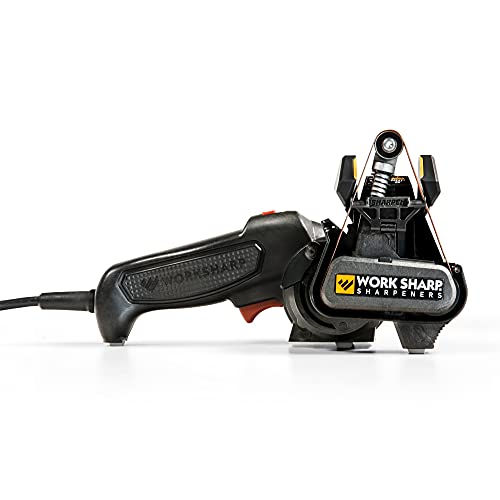
This product is a corded benchtop abrasive-belt sharpener for kitchen knives, pocket and outdoor knives, serrated blades, scissors, and some edged tools. The user draws a blade through guided slots beside a moving belt, selecting a belt grit, speed, and edge angle. It is intended for maintenance, reshaping, and repair rather than simple pull-through touch-ups. Work Sharp states that this version adjusts from 15° to 30° in half-degree increments, has seven speed settings, and includes P120, P220-equivalent, 1000, 3000, and 6000 grit belts. Its own listing gives a 3.3 pound weight and a three-year consumer warranty. The manual provides unusually detailed stroke, speed, and angle guidance, but the manufacturer also acknowledges that inexperienced use can damage a blade. No model-specific US NRTL electrical certification or reproducible laboratory performance report was located.
This suits an adult home user or hobbyist who maintains several types of blades and is prepared to learn a powered sharpening process. It is most appropriate where there is a stable workbench, good lighting, room to manage dust, and a willingness to follow the supplied angle, grit, and stroke chart. The adjustable geometry is useful for owners who want to maintain different kitchen, outdoor, serrated, and scissor edges rather than use one fixed sharpening setting.
It is not a good fit for households where children can access the work area, for users with limited grip control or difficulty following a moving blade path, or for anyone seeking a sealed, low-mess kitchen appliance. Avoid using it near food preparation or in a confined indoor area without cleanup controls. It also demands caution with expensive, thin, highly polished, or sentimental knives, because incorrect pressure, angle, belt choice, or tip timing can remove excess steel or alter the profile.
The safety documentation is substantive. It warns that the product creates very sharp edges, directs users to keep hands clear, use eye protection and condition-appropriate dust protection, avoid water exposure, unplug before belt changes, and use light pressure. The guide slots and trigger control improve blade handling, but grinding mode can expose more of the moving belt. No CPSC recall or public safety report specific to this product was located in the searches performed through August 16, 2026. No model-specific US NRTL electrical certification could be verified, so electrical safety should not be inferred from brand reputation or retail availability. The product uses replaceable abrasive belts and Work Sharp sells replacement guides and a cassette, reducing pressure to discard the full unit after normal wear or damage. Work Sharp reports solar-powered Oregon operations and efforts to reduce single-use plastic packaging, but it does not publish a product-specific US take-back or electronics recycling program for this sharpener.
This compact electric pull-through sharpener is made for kitchen knives, serrated knives, scissors, and shears. It uses two P120 ceramic abrasive discs for sharpening and a fine ceramic honing wheel for maintenance. Work Sharp states that its fixed guides set a 20-degree edge, and the product includes a cord stored in the base, a scissor guide, and replaceable abrasive discs. Independent tests confirm a guided, timed sharpening process rather than freehand grinding. One tester measured a dulled blade improving from 991 g to 321 g cutting force, while another found the sharpener stable and cool during extended operation. The tradeoff is the fixed edge geometry. Independent testing found that it can produce uneven bevels and remove a meaningful amount of steel, so its convenience does not make it a precision edge-profiling tool.
This product suits a home cook who uses ordinary Western-style kitchen knives and wants a guided electric process rather than learning whetstone technique. It is particularly suited to someone maintaining several dull but non-specialty knives, because its timed cycle, fixed guide, compact footprint, and center honing slot reduce setup and angle-control demands. It also fits households that want one tool for kitchen knives, serrations, and occasional scissors, provided the user can clean residual grinding dust after sharpening.
It is not well suited to owners of expensive knives with deliberately shallow, asymmetric, or highly specific edge geometry. The fixed 20-degree guide can change those edges, and independent testing found uneven bevels and material removal. It is also a poor fit for users who need independently verified electrical certification before bringing an appliance into the home, or for noise-sensitive households. Children should not operate it, and anyone sharpening near food should first clear the preparation area and clean the product afterward.
The product has practical physical safety controls. Independent inspection found that the angle guides cover the abrasives, the base remained stable, the motor stayed cool in extended testing, and automatic shutoff limits unattended run time. Metal particles are directed toward internal magnetic collection points, but users still need to open or wipe the unit to remove accumulated grinding dust. Independent testing also measured 103.7 dB, so hearing protection is sensible during repeated use. A California retailer flags a Proposition 65 warning, although the reviewed materials did not identify the chemical or exposure route. No product-specific CPSC recall was located in the public recall search reviewed. Work Sharp offers a three-year consumer warranty and replacement abrasive discs, which can postpone whole-product disposal. The company states that its facility uses solar power and that it is reducing single-use plastics, but product-specific recycling or take-back instructions were not found. Model-specific electrical safety certification could not be independently verified.
This is a fully manual rolling knife sharpener. A knife attaches to a magnetic angle holder, then the user rolls the abrasive cylinder along each side of the exposed edge. The manufacturer specifies two fixed positions, 15° and 20°, a diamond sharpening disc, and a stainless steel honing disc. It says the system is for most smooth-edged kitchen and outdoor knives, not serrated knives or scissors. Its manual format removes cord, electrical-shock, and motor hazards. The manufacturer instructs users to work on a stable surface with light pressure, then wipe abrasive dust from the knife. Independent hands-on reviews found that it can improve edges, particularly through regular maintenance, but results on very dull knives were slow or inconsistent. Testing also identified fit and contact difficulties with some narrow knives and broad cleavers.
This suits an adult home cook who mainly maintains ordinary, smooth-edged magnetic kitchen knives and prefers a fully manual tool. It is most appropriate for periodic touch-ups of blades that are already in fair condition, where the user can work slowly on a stable counter, keep fingers clear of the edge, and clean the knife afterward. The fixed 15° and 20° positions may be helpful to someone who does not want to learn freehand whetstone angle control.
It is not a good fit for households where children or people unable to safely manage an exposed sharp blade may access it. It is also unsuitable for serrated knives, scissors, ceramic knives, or other nonmagnetic blades. Users with very dull, damaged, unusually narrow, or very broad knives should be cautious because independent tests found slower results and positioning limitations. It is not designed for buyers who need documented, laboratory-measured sharpness, metal removal, edge retention, or sanitary debris containment.
The key safety advantage is that this is a manual product, so it has no mains power, battery, cord, motor, or corresponding electrical certification requirement. The sharpening process still presents meaningful cut and debris risks. The knife edge is exposed, the magnetic holder must remain stable, and the manufacturer instructs users to wipe visible abrasive dust from the knife after use. Independent guidance also warns users to keep hands and fingers away from the cutting edge and notes that the magnet should be kept away from children and sensitive electronic devices. Tumbler identifies itself as Tumbler Holdings Inc, provides a support email, a limited warranty, and a 30-day return policy. No product-specific CPSC recall or public incident record was located in the searches performed. The manufacturer does not provide a recycling or take-back program for this product, nor a replacement-parts catalog for the original fixed-disc sharpener. Its manual design avoids electronic waste, but the absence of end-of-life guidance leaves disposal and material recovery unaddressed.
This is a corded, consumer-use belt sharpener for knives, scissors, axes, mower blades, and other light-duty sharpening or grinding tasks. It uses 1/2-inch by 12-inch replaceable abrasive belts, a two-speed motor, a removable sharpening cassette, and a guide that sets either 20° or 25° per side. The supplied belt set includes coarse P80, medium P220, and fine 6000-grit belts. Work Sharp states that leather-lined guides and the front edge guide help keep a blade at the selected angle. Its manual gives detailed pull-through instructions, limits use to 30 minutes in an hour, and warns that the product creates an extremely sharp edge. Independent hands-on reviews found it can restore a working sharp edge quickly, but also documented that rushed or incorrect technique can round a knife tip.
This product suits a home user with ordinary kitchen knives, pocket knives, hunting knives, scissors, and occasional yard tools who wants powered sharpening with a defined guide rather than freehand stones. It is most appropriate for someone willing to read the manual, use eye protection, keep the work area clear, and practice first on an inexpensive blade. The replaceable belts, replaceable edge guide, and three-year consumer warranty also suit a user expecting periodic maintenance rather than a sealed disposable appliance.
It is not for households that need a low-mess sharpener directly beside food preparation, because the product can disperse abrasive and metal dust and has no stated collection tray. It is also unsuitable for unsupervised use, children, or anyone unable to follow power-tool precautions around a moving belt and newly sharpened edges. Owners of thin, costly, unusual-angle, or highly specialized knives should be cautious, because the guide only offers 20° and 25° settings and incorrect pulls can round a tip or change the blade profile.
The main health fact is that this is a small powered belt sander, not a closed-slot kitchen appliance. The manual gives unusually direct warnings about cuts, entanglement, electrical shock, dust, eye protection, and respiratory protection. It also says not to run the product unless the sharpening cassette is firmly engaged. The guide and edge rest provide some control, but they do not remove the need for careful blade handling and cleanup. The manufacturer is identifiable as Darex, LLC, with a US address, phone number, support contact, model-specific manual, and three-year consumer warranty. No matching recall was located in the CPSC recall resources checked. Public UL, ETL, and CSA searches did not establish a model-specific electrical listing. Ecologically, replaceable belts and guides can extend service life, though the belts are consumables and the manual offers only general local recycling advice for the electrical product.
This is a compact plug-in countertop sharpener for straight-edged kitchen knives. The available product manual describes three pull-through stages, coarse 120-grit diamond, fine 600-grit diamond, and 1000-grit resin polishing, plus a fixed 15-degree guide. It instructs users to pull from heel to tip with light pressure, make equal passes on both sides, and unplug before cleaning. These are manufacturer-stated specifications, not independently tested results. ([manuals.plus](https://manuals.plus/asin/B0FMXSDFN7?utm_source=openai)) The same manual describes a non-slip base, enclosed grinding components, and a removable magnetic collector for metal filings. It limits intended use to kitchen knives and separately says not to use it on serrated knives. No model-specific independent sharpening test, electrical safety listing, sanitation certification, replacement-parts catalog, or stated warranty term was located in the reviewed materials and official listing searches. ([manuals.plus](https://manuals.plus/asin/B0FMXSDFN7?utm_source=openai))
This product suits an adult home cook with ordinary straight-edged kitchen knives who wants a compact, plug-in guided sharpener and is willing to follow the supplied pull-through method carefully. Its stated 15-degree guide, three stages, non-slip base, and filings collector are most relevant to routine touch-ups and occasional repair of compatible blades. It is a better fit for someone comfortable treating the documentation as manufacturer guidance, rather than someone who needs independently measured sharpening results or verified electrical certification. ([manuals.plus](https://manuals.plus/asin/B0FMXSDFN7?utm_source=openai))
It is not suited to households that need independently verified electrical safety or performance evidence, especially where children may access countertop appliances or where a damaged cord or tool would be a serious concern. Avoid using it for serrated knives, as the instructions explicitly exclude them. Buyers with ceramic, single-bevel, specialty, or costly knives should seek written compatibility evidence first, because the fixed 15-degree system and broad material claims do not establish how much material is removed or how the original edge geometry is preserved. ([manuals.plus](https://manuals.plus/asin/B0FMXSDFN7?utm_source=openai))
The available instructions include useful basic controls, such as keeping fingers away from the slots, using a dry stable surface, pulling the blade toward the user through the guide, unplugging before cleaning, and not immersing the appliance. The manufacturer also states that a magnetic collector retains metal filings. These are sensible design and use measures, but they remain manufacturer-stated because no hands-on inspection or independent safety assessment was located. ([manuals.plus](https://manuals.plus/asin/B0FMXSDFN7?utm_source=openai)) No product-specific CPSC recall or safety warning was located in the reviewed recall materials. No verified model-specific NRTL electrical listing or NSF food-equipment listing was found, and the materials do not identify a recycling or take-back route. When the product reaches end of life, EPA guidance favors using an appropriate electronics recycler rather than household trash or curbside recycling. ([cpsc.gov](https://www.cpsc.gov/km/Recalls?utm_source=openai))
This is a countertop electric pull-through knife sharpener with three stages, a plastic housing, and a stated 10.43 by 4.13 by 3.74 inch footprint. The product is intended for household kitchen knives. The manufacturer states that it uses diamond abrasives, has fixed 20-degree guidance for standard straight-edge kitchen knives, and directs serrated knives to the finishing stage only. Its most distinctive practical feature is a manufacturer-stated magnetic collector for metal shavings, alongside a non-slip base. Those details suggest a more controlled cleanup path than an open abrasive system, but no instruction manual or hands-on inspection was located to confirm the collector design, cleaning procedure, guards, or blade-slot geometry. No model-specific independent sharpening test, electrical safety listing, or food-equipment sanitation certification was located during verification.
This product fits a household user with ordinary Western-style kitchen knives who wants a compact powered pull-through format and accepts manufacturer-stated fixed 20-degree sharpening guidance. It is most relevant for routine touch-ups of compatible straight blades, where convenient storage and a stated magnetic shaving collector matter. The buyer should be prepared to follow the supplied instructions carefully, clean the unit away from food preparation, and treat the speed and performance claims as unverified rather than laboratory-established.
It is not suited to buyers who require independently verified electrical certification before bringing a powered appliance into the kitchen, especially households prioritizing documented safety controls. It is also a poor fit for owners of expensive, thin, asymmetrically ground, or non-20-degree knives, because no verified compatibility chart, temperature data, or material-removal testing was found. Commercial kitchens and users needing NSF-listed sanitation support, repairable components, or documented recycling and replacement abrasives should use a product with those records.
The available product description identifies a plastic-bodied electric sharpener with manufacturer-stated diamond abrasives, a non-slip base, guided stages, and a magnetic metal-shaving collector. These features could reduce ordinary handling and cleanup risks if implemented as described. However, their design and warnings could not be checked against a product manual or physical inspection. Searches of CPSC recall and public incident resources did not locate a product-specific recall or public report, which is not proof that no incident has occurred. Electrical safety remains unverified. No exact-model listing was located in publicly searchable certification resources from recognized testing organizations. No NSF food-equipment sanitation listing, replaceable-abrasive plan, repair documentation, take-back program, or product-specific recycling instructions was located. When the product reaches end of life, it should be handled through local electronics recycling options rather than placed in household recycling.
This is a compact, corded electric kitchen sharpener with coarse and fine sharpening slots, a separate scissors slot, diamond abrasive wheels, and a bottom crumb bin for collected debris. The supplied manual identifies a 30 W unit designed for 100 to 240 V, 50 or 60 Hz power, with an external adapter. It is intended to restore common kitchen knives through repeated pull-back passes, then remove burrs in the fine slots. The product-specific manual documents directional slot guidance, blade-angle instructions, warnings to keep children away, and cleaning directions. It also states that its coarse and fine wheels use diamond abrasives and that it can be used on listed common and serrated kitchen knives. Claims of 30-second sharpening, a 20-degree angle, 6,000 rpm operation, hour-long running, and diamond performance are manufacturer statements, not independently verified test results.
This product suits an adult home cook who wants a small countertop tool for maintaining ordinary kitchen knives and has the patience to follow a specific pull-back technique. It is most appropriate for users comfortable keeping the sharpener dry, clearing the crumb bin, and limiting use to the blade types covered by the manual. The guided slots, separate finishing stage, and scissors function may be useful where basic kitchen tools need occasional maintenance and there is space to use a corded appliance safely away from food preparation.
It is not well suited to households where children may access plugged-in countertop appliances, or to anyone unable to maintain firm, controlled blade handling. Avoid relying on it for expensive specialty knives, single-bevel knives, unusually thick or curved blades, or knives whose edge geometry must be preserved precisely, because independent edge-damage and angle-consistency testing was not found. It is also a poor fit for buyers who require independently verified electrical certification, documented repair parts, or a clear recycling route before bringing another electrical appliance into the kitchen.
The product-specific manual includes practical cut-reduction guidance. It tells users to position the slots on the right, pull blades backward only, use the sloping guide surface, avoid excessive force, keep children away, and test sharpness with paper or food rather than the body. It also instructs users to unplug before cleaning, keep water and oil out, and avoid immersion. These are manufacturer instructions, not an independent safety assessment. The manual shows a bottom debris bin and directs users to empty it and wipe the slots, which can help keep filings off the counter when followed. It also states that a pungent smell and sparks may occur during sharpening. That deserves caution, particularly if either becomes excessive or persistent. No model-specific NRTL electrical-safety listing, independent performance report, recall record, recycling guidance, take-back program, or replacement-parts catalog was identified. The manufacturer and support contact are named, and the manual states a 24-month replacement-service policy.
This is a compact, manual countertop pull-through sharpener, not an electric appliance. A dial selects five stated functions, including repair, sharpening, polishing, serrated knives, and household scissors. The seller states that its sharpening components are tungsten carbide and ceramic, and that non-slip pads help hold it on the work surface. ([bulbhead.com](https://www.bulbhead.com/products/croco-dial?utm_source=openai)) The product has no cord, battery, motor, or electrical certification requirement because it is hand-operated. Its public materials provide a customer-service phone contact and a 30-day return policy. ([trademarks.justia.com](https://trademarks.justia.com/992/70/croco-99270032.html?utm_source=openai)) Important limitations are evidentiary. No model-specific independent sharpening report, edge-angle specification, material-removal result, debris-cleaning instruction, or published compatibility exclusions were located. The promotional language also ranges from specific kitchen knives and scissors to broader claims about sharpening any blade and tools. ([getcrocodial.com](https://www.getcrocodial.com/?utm_source=openai))
This product suits a household user who wants a manual, compact tool for occasional touch-ups of ordinary straight-edge kitchen knives, serrated knives, and household scissors. It is also relevant where avoiding an electric appliance is useful, such as small kitchens, RVs, or storage-limited homes. The stated dial-based functions and non-slip pads may make the basic process easier to organize, but the user should be comfortable making light, controlled passes and cleaning the surrounding counter after sharpening. ([bulbhead.com](https://www.bulbhead.com/products/croco-dial?utm_source=openai))
It is not suited to people needing documented sharpening accuracy, repeatable bevel angles, measured edge retention, or controlled metal removal. Owners of expensive Japanese knives, single-bevel blades, heavily coated blades, unusual serrations, very thin knives, or specialized tools should not assume compatibility because published limits and angles were not located. It is also unsuitable for households that need explicit debris-cleaning instructions, guarded operation details, or independently verified safety and performance evidence before using a sharpener near food preparation areas.
The main health positive is that this is a hand-operated sharpener. It has no electrical power system, so electrical shock, cord damage, battery, and motor risks do not apply. The manufacturer states that non-slip pads help stabilize the unit, but no public instruction manual with detailed cut-prevention warnings, cleaning steps, or debris handling was located. Tungsten carbide and ceramic components can abrade both the sharpener and blade, so wiping down the work surface and keeping filings away from food is prudent. ([bulbhead.com](https://www.bulbhead.com/products/croco-dial?utm_source=openai)) The product materials are only partly identified. The manufacturer names tungsten carbide and ceramic sharpening elements, but does not publish a parts catalog, replacement abrasive program, take-back route, or recycling instructions. Its manual format avoids electronic waste and disposable batteries, yet the lack of replaceable-part information makes long-term repairability unclear. Public seller materials provide contact information and a return policy, which offers a basic accountability route, but they do not replace product-specific safety or durability testing. ([getcrocodial.com](https://www.getcrocodial.com/Contact-Us?utm_source=openai))
This is a countertop electric knife sharpener sold as a black-and-orange, three-stage unit for kitchen knives. The product record gives dimensions of 12.2 by 4.9 by 4.6 inches. A publicly available manual for the same TG2101 model, branded Taidea rather than Hrevzon, describes 360-grit diamond coarse sharpening, 600-grit diamond refining, and a 1000-grit resin polishing stage. That public manual directs users to keep hands clear of the slots, use a stable non-slip surface, unplug before cleaning, and avoid water. It also says not to sharpen serrated knives, scissors, or ceramic knives. The product's advertised 100 percent diamond-abrasives wording is not supported by that model manual, which identifies the finishing stage as resin.
This product fits an adult home cook who wants a compact plug-in sharpener for routine maintenance of ordinary straight-edge kitchen knives and is willing to follow conservative operating steps. The relevant public TG2101 instructions call for a dry, stable counter, light controlled pulls through the slots, unplugging before cleaning, and periodic removal of accumulated filings. It is most suitable where convenience matters more than independently documented sharpening precision or preserving a custom edge geometry.
It is not suited to households where children could access an energized sharpener, or where the user cannot keep the unit dry, stable, and attended during use. Do not rely on it for serrated knives, scissors, or ceramic knives because the public same-model instructions specifically exclude them. It is also a poor fit for owners of expensive, thin, custom-ground, or angle-specific knives who need independently verified control of bevel angle, material removal, heat exposure, and tip condition.
The available same-model instructions contain useful basic safeguards. They tell users to keep fingers away from the slots, place the unit on a stable non-slip surface, avoid immersion, unplug before cleaning, and inspect a damaged cord. The cleaning procedure calls for opening the lower compartment and brushing out filings and abrasive dust. These are manufacturer-stated controls, not an independent product inspection. No model-specific North American electrical-safety listing could be verified in the UL, Intertek, or CSA resources checked. No Hrevzon or TG2101 recall was located in the CPSC public resources checked. The finishing stage is described in the public TG2101 manual as resin, despite the product's all-diamond wording. No take-back or parts program was found. At retirement, treat it as an electrical product and use a local electronics collection option, rather than putting it in curbside recycling.
This is a countertop electric knife sharpener measuring 12.2 by 4.9 by 4.6 inches. It uses three guided sharpening stages and is intended for pulling a kitchen knife from heel to tip through successive slots. Marketplace material describes coarse, fine, and polishing functions, four non-slip pads, and a magnetic collection box for metal filings. Those are manufacturer-stated features, not independently tested findings. A public manual for the same TG2101 model, issued under the Taidea name rather than Hrevzon, describes a removable debris tray, a side power switch, and safety steps including dry, stable placement, unplugging before cleaning, and keeping fingers clear of the slots. It is useful supporting documentation, but it does not establish that every Hrevzon unit has identical construction. No model-specific US electrical listing or independent sharpening test report was located.
This product suits an adult home cook who wants a plug-in countertop tool for occasional maintenance of ordinary straight-edge kitchen knives and is prepared to follow conservative handling steps. The user should have a dry, stable counter, room for a roughly 12-inch appliance, and a way to wipe the blade and clear collected filings before returning the knife to food use. It is most suitable where convenience matters more than documented precision testing or service support.
It is not well suited to households where children may access plugged-in appliances or where users cannot reliably keep hands, loose clothing, and water away from the operating slots. It is also a poor fit for owners of serrated, ceramic, specialty, or expensive knives because public product claims conflict on compatibility and no independent edge-damage testing was found. Buyers who require verified US electrical certification, repair parts, or a stated long-term warranty should choose a product with that documentation.
The clearest safety-positive evidence is procedural rather than independently certified. The public same-model TG2101 manual instructs users to keep fingers away from the slots, place the appliance on a dry stable surface, avoid water, inspect the cord, and unplug before cleaning. It also describes a removable tray for filings. The Hrevzon marketplace material separately claims non-slip pads and a magnetic filings collector. No model-specific UL, ETL, CSA, or other recognized US electrical listing was independently verified. No Hrevzon or TG2101 recall record was located in the CPSC sources checked, but that is not evidence of certification or long-term safety. The product has no located replacement-parts catalog, repair guidance, or US recycling or take-back instructions. As an electrical appliance, it should be routed through an appropriate electronics recycling option when retired, rather than discarded with ordinary household waste.


