Best Overall

WORX Nitro 40V 21" Cordless Lawn Mower
Efficient mowing with Intellicut technology.
Adjustable cutting height for versatile use.
Eco-friendly, cordless operation with included batteries.
 Daniel Kenitz
Efficient mowing with Intellicut technology.
Adjustable cutting height for versatile use.
Eco-friendly, cordless operation with included batteries.

Efficient battery power with two 5.0Ah batteries.
Self-propelled for easy maneuverability.
Aerodeck design enhances cutting performance.

Powerful 60V motor handles tough grass efficiently.
Lightweight design makes maneuvering easy and smooth.
Eco-friendly operation with zero emissions.
Reliable gas engine for consistent power.
Adjustable cutting height for customized mowing.
Durable steel deck ensures long-lasting use.

Efficient brushless motor for quieter operation.
Lightweight design makes it easy to maneuver.
Adjustable cutting heights for versatile lawn care.
Efficient, eco-friendly battery-powered operation.
Compatible with over 75 tools.
Lightweight and easy to maneuver.

Long-lasting batteries for extended trimming sessions.
Telescopic pole adjusts for comfortable use.
Lightweight design enhances maneuverability and ease.

Quiet operation enhances neighborhood friendliness.
Adjustable height suits varied grass lengths.
Lightweight design eases maneuverability.

Easy to maneuver with self-propelled feature.
Wide 21-inch cutting deck for efficiency.
Reliable gas engine for powerful performance.

Long-lasting 60V batteries for extended runtime.
Self-propelled feature makes mowing effortless.
Dual port charger for quick battery recharge.
Start with lawn conditions. Cutting width affects how many passes are needed; smaller decks are easier to carry and maneuver through narrow spaces, while wider decks cover more ground. Push models require the operator to provide all propulsion. Self-propelled models can reduce pushing effort, but they may be substantially heavier and still require careful control on slopes, wet grass, uneven ground, and near drop-offs. Runtime is not a fixed yard-size guarantee: grass height, density, moisture, terrain, cutting height, blade choice, and self-propel use all change battery demand. “Up to” minutes and acreage claims should be treated as estimates, especially when the manufacturer’s own figures conflict with marketplace claims.
Check what the kit actually includes. Battery count, amp-hours, nominal voltage, watt-hours, charger model, bag, mulch plug, discharge chute, and replacement parts should be identified for the exact product. A removable battery is more useful when the manufacturer supports replacements and a broader compatible tool platform. A corded model avoids battery charging and disposal but introduces extension-cord routing, trip, and electrical hazards; it also needs a suitable outdoor-rated cord and dry operating conditions.
Safety evidence should be more specific than a logo or seller statement. For walk-behind mowers covered by the federal standard, look for documented protective shielding, discharge protection, safety labels, and blade-control performance, including the required blade stop within three seconds after control release. A manufacturer General Certificate of Conformity should match the exact model. For the mower, battery, and supplied charger, an independently verifiable current listing should be traceable through an OSHA-recognized testing laboratory such as UL, Intertek, or CSA, using the model number and certification file information. A retailer’s claim that a product is ETL or UL listed is useful only when it can be matched to the exact equipment.
Independent testing is especially valuable for cutting evenness, bagging, mulching, handling, noise, runtime, and recharge claims. Sound claims without a stated method are not directly comparable with the CDC/NIOSH 85 dBA exposure reference. Broad “eco-friendly,” “zero pollution,” or lower-noise language does not account by itself for electricity, battery materials, durability, or disposal. Look for qualified, product-specific evidence rather than treating electric operation as impact-free.
Across the supplied reviews, recurring cautions include avoiding wet grass and slopes above 15 degrees where specified, mowing across slopes, keeping children, pets, and bystanders away, and removing batteries before servicing. Several products lacked exact-model safety listings, independent performance tests, sound or vibration measurements, or clear recycling and parts support. Gasoline products also create on-site exhaust and carbon-monoxide hazards and are outside this electric-mower category. Corded products add cord-management risks. Overgrown, dense, uneven, or leaf-covered grass repeatedly exposed performance limits, so buyers with those conditions should not rely on small-mower runtime or coverage claims without suitable testing.
An electric mower can avoid gasoline exhaust at the point of use, but it still has blade, electrical, noise, vibration, battery, and disposal risks. The distinctions below reflect the supplied topic scores and the evidence behind them, not price or customer popularity.
This measures documented blade-stop controls, deck and rear shielding, discharge protection, and safety labels. It matters because a mower’s rotating blade can cause severe laceration or amputation injuries. Higher-scoring products combined manual controls with blade-stop evidence or testing; lower-scoring products relied mainly on seller claims or lacked a measured stopping time and exact compliance documentation.
This covers protection against overheating, short circuits, charging faults, shock, and water-related electrical failure for the complete mower kit. Higher scores came with detailed battery and charger instructions or stronger safety evidence, while lower scores reflected missing exact-kit certification records. Buyers should match the mower, battery, and supplied charger to a current UL, ETL, or CSA listing where available.
This measures operator exposure to noise, vibration, and combustion exhaust. Battery and corded mowers avoid on-site gasoline exhaust, but they are not automatically quiet or vibration-free. Higher scores reflected independent noise or handling evidence and the absence of combustion; lower scores followed missing measurements. The supplied reviews repeatedly caution that an unsupported noise claim cannot be compared directly with the 85 dBA NIOSH reference.
This considers weight, propulsion, handle adjustment, wheel design, controls, slope limits, and maneuverability. Higher-scoring products had independent evidence of manageable pushing or clearly documented controls and limits. Lower scores reflected heavy push operation, uncertain specifications, or weak performance on wet, uneven, steep, dense, or overgrown ground. Self-propulsion can reduce pushing effort but does not remove lifting, turning, or slope-control demands.
This measures whether the exact mower, battery, and included charger have a current public listing from an OSHA-recognized testing laboratory, rather than an unverified logo. It is weighted more heavily because certification is central to electrical and blade safety. Higher scores reflected stronger traceability or retailer-documented listing evidence; many lower scores resulted because no public file matched the complete kit.
This measures cutting quality, bagging or mulching, handling, runtime, noise, and recharge performance under disclosed conditions. Higher-scoring products had exact-model Consumer Reports or hands-on testing, including products with measured runtime or blade rundown. Lower-scoring products depended on manufacturer estimates, especially “up to” minutes or acreage claims, without independent testing of the exact configuration.
This measures whether voltage, amp-hours, watt-hours, cutting width and height, runtime, recharge time, included equipment, compatibility, and self-propelled status are consistent and qualified. Higher scores came from clearer manuals and matching product records. Lower scores reflected conflicting weights, dimensions, bag capacities, battery descriptions, runtime figures, or model identities—problems that can change whether the mower actually fits a buyer’s lawn.
This measures model and serial traceability, registration, warranty contact, recall communication, and the absence of unresolved relevant safety actions. Higher scores reflected identifiable support systems and clearer accountability. Lower scores reflected limited registration or recall documentation. A recall involving another model or product is not evidence that the reviewed mower is recalled, but buyers still benefit from a manufacturer contact and traceable model number.
This measures whether batteries, chargers, blades, wheels, bags, and other service parts can be replaced and supported. It matters because a worn battery or ordinary breakage should not automatically make the mower waste. Higher scores were associated with documented platform compatibility, parts channels, and replacement blades or batteries. Lower scores reflected unclear parts catalogs, limited battery support, or customer-service-only replacement routes.
This measures whether the buyer receives a realistic U.S. route for lithium-ion battery recycling, including removal, storage, terminal protection, and take-back instructions. Higher-scoring products named Call2Recycle or gave practical recycling directions. Lower-scoring products offered only generic symbols or no route. Lithium-ion batteries should not go in household trash or curbside recycling; terminals need protection before an appropriate collection drop-off.
This measures whether environmental claims account for electricity, battery materials, durability, and disposal. Higher scores reflected more qualified claims, repairability, and concrete end-of-life guidance; lower scores followed broad “green,” “zero pollution,” or lower-noise language without lifecycle, energy-use, or material evidence. Electric mowing avoids local gasoline exhaust, but the supplied reviews do not support treating any product as zero-impact.
This is a battery-powered, push walk-behind mower with a 21-inch polymer deck and a 20-inch cutting width. It uses two removable 20V 5.0 Ah lithium-ion batteries together, marketed as a 40V maximum system. The included equipment is a dual 4A charger, grass bag, mulching insert, rear discharge deflector, and replacement-compatible blade. Cutting height adjusts through seven positions from 1.5 to 4 inches. Worx states that one charge can mow up to one quarter acre in 50 minutes, a condition-dependent claim that is more conservative than the half-acre marketplace claim. Consumer Reports independently includes this exact mower in its battery mower laboratory program, covering cutting, mulching, bagging, and side-discharge criteria, although its numerical results are not publicly available. The mower is push-only, not self-propelled, and weighs 56 pounds with batteries according to Worx.
This product suits a homeowner with a small, generally level lawn who wants a cordless push mower with a broad cutting path, removable batteries, and options to bag, mulch, or rear-discharge clippings. It is most appropriate where the user can comfortably control a 56-pound mower and has a dry, maintained lawn rather than dense, overgrown grass. The documented replacement blade, batteries, and charger also matter for someone intending to keep the mower in service rather than treat it as disposable.
It is not a good fit for people who need powered traction on hills, have limited ability to push and turn a 56-pound mower, or regularly mow wet, rough, or excessively steep ground. The manual specifically warns against wet grass and steep slopes because of slip and control risks. It is also unsuitable for buyers who require a publicly verifiable third-party safety listing for the mower, batteries, and charger, or who need published sound and vibration figures for exposure planning.
The manual gives meaningful operating safeguards, including a lockout control, operating bail, safety flap, discharge guard requirements, battery removal before servicing, and instructions to wait for the blade to stop. It also directs users not to mow wet grass, to mow across slopes, and to keep children and bystanders away. Those safeguards do not replace careful use, and the published material does not document a tested blade-stop time or a public independent safety listing. The battery system avoids on-site gasoline exhaust, but it is not impact-free. Worx identifies the batteries as removable lithium-ion packs and its manual directs users to Call2Recycle rather than household waste. For safer drop-off, EPA advises taping terminals or bagging each battery separately. Worx also posts a California Proposition 65 warning for lead and DEHP. No lifecycle assessment, recycled-content disclosure, or quantified environmental comparison was found for this product.
The WG760 is a self-propelled, battery-powered walk-behind mower for domestic lawns. It uses two removable 20V 5.0Ah lithium-ion packs together as a 40V system, has a 21-inch deck with a 20-inch cutting path, and includes a bag, mulch insert, rear side-discharge chute, and dual-port charger. Worx lists a 1.5 to 4-inch, seven-position cutting-height range and a 55.7-pound assembled weight. The manufacturer’s 50-minute, no-load runtime and up-to-half-acre fit claim are qualified claims, not field-runtime guarantees. Consumer Reports does independently include this exact mower in its lab test program, covering cutting modes, handling, runtime, charge time, and noise, though its detailed ratings are member-only. The manual documents a safety button, operating bail, safety flap, discharge protection, battery-removal procedures, and slope instructions, but a public exact-model NRTL listing was not verified.
This mower fits an owner of a maintained small to medium domestic lawn who wants a cordless, self-propelled machine with bagging, mulching, and rear side-discharge options. It is most appropriate where grass is cut regularly, terrain is generally dry and not excessively steep, and the user can store batteries indoors within the manual’s temperature limits. It also suits someone already using the PowerShare battery platform, since the included packs are removable and replacements remain available from Worx.
It is not suited to unmanaged, very tall, wet, or consistently dense grass where the stated no-load runtime will not represent actual work. It is also a poor fit for large properties that depend on completing more than a half-acre without recharging, or for users needing a publicly verifiable independent safety listing for every supplied electrical component. Avoid it for steep, wet, ditch-adjacent, or drop-off terrain, since the manual directs users not to mow those conditions and to mow across slopes, never up or down.
This battery mower eliminates on-site gasoline combustion exhaust during mowing, but that does not establish a zero-impact profile. Worx provides no product-level lifecycle assessment, electricity-use estimate, recycled-content disclosure, or substantiated broad environmental claim. The product also carries a California Proposition 65 warning for lead and DEHP. No measured sound or vibration figure was located, so its actual operator exposure cannot be quantified against occupational noise guidance. The batteries are removable lithium-ion packs, and the manual identifies the compatible battery and charger models, specifies temperature limits, and directs users to remove batteries before service or storage. It also documents an RBRC-Call2Recycle disposal route rather than disposal in household trash. Worx continues to sell the battery separately and describes broad PowerShare compatibility, which can support longer use. A public independent safety listing for this exact mower package was not verified.
This is a cordless, self-propelled walk-behind mower with a 21-inch cutting deck, a 60V 5.0Ah battery option, brushless motor, steel blade, and bagging, mulching, or side-discharge modes. The manufacturer states that one battery can provide up to 65 minutes of runtime and mow up to one-half acre. Those are seller claims, not independently tested results. The manufacturer also states that the mower has adjustable-speed propulsion, seven height settings, a three-year tool warranty, and a two-year battery warranty. However, the product information reviewed does not provide a public operator manual, a General Certificate of Conformity, a matched NRTL listing for the mower, battery, and charger, or a disclosed independent cutting, runtime, noise, or handling test. Its advertised cutting-height information is inconsistent across available product materials.
This mower suits an adult homeowner with a mostly level, maintained lawn who wants a cordless 21-inch machine and values powered forward drive more than independently documented performance. It is most appropriate where the user can inspect the unit on arrival, follow conservative battery-charging practices, and obtain warranty support through the manufacturer. The stated 5.0Ah battery configuration may fit routine mowing of a modest to medium lawn, but the claimed half-acre coverage and 65-minute runtime should be treated as conditions-dependent manufacturer estimates.
It is not well suited to buyers who need documented third-party certification for the mower, battery, and charger, or who require published proof of blade-stop compliance. It is also a weaker fit for steep, wet, rough, or obstacle-heavy lawns because no public manual was found to establish slope limits, traction guidance, or handling procedures. Households needing measured low-noise performance, dependable one-charge coverage of a large property, readily documented repair parts, or a brand-operated battery recycling route should seek clearer documentation.
Battery operation avoids gasoline combustion at the mowing site, so it does not create tailpipe exhaust where the user is standing. That is a real exposure advantage over a gasoline mower. The manufacturer also claims quieter operation and battery-management protection, but it does not provide a measured sound level, vibration data, or a matched independent electrical safety listing. Hearing protection and normal blade and debris precautions remain sensible because the product is still a rotary mower. A replaceable battery can reduce waste when a tool platform remains supported, and the manufacturer presents its 60V battery as part of a cross-tool system. Still, no product-specific parts catalog, battery take-back program, or disposal instructions were located. EPA guidance says lithium-ion batteries should not go in household trash or curbside recycling, and should instead go to an appropriate battery recycler. The manufacturer's broad zero-emissions and sustainability statements should be read as on-site use claims, not full lifecycle evidence.
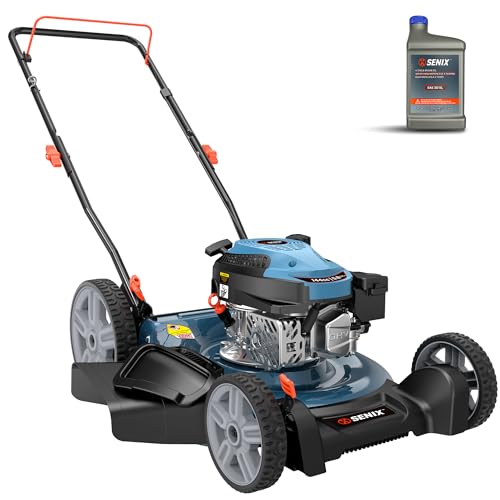
This is a gasoline-powered, manual push mower for domestic grass cutting. It uses a 144cc four-cycle RATO engine, a 21-inch steel cutting deck, recoil start, and a 27.05-ounce fuel tank. It is not an electric mower and includes no lithium-ion battery or charger. The manufacturer documents two cutting modes, mulching and side discharge, plus six dual-lever height settings from 1.25 to 3.75 inches. The supplied manual identifies a blade-control bail that stops the engine and blade when released, along with a side-discharge cover and mulching cover. The manufacturer states 8-inch front and 11-inch rear wheels, a 46-pound product weight, and a 14-gauge steel deck. No independently published test of this exact mower's cut quality, maneuverability, vibration, sound level, or blade-stop time was located.
This mower suits an adult homeowner maintaining a small to medium, mostly level lawn who specifically wants a basic gasoline push format rather than a battery mower. It is appropriate for someone able to push a roughly 46-pound machine, pull a recoil starter, refuel and maintain a four-cycle engine, and follow routine blade, oil, spark plug, and air-filter care. The documented 21-inch deck reduces passes on open turf, while the mulching and side-discharge options give the user a choice for ordinary dry-grass conditions.
It is not suitable for anyone seeking an electric mower, low local exhaust, or a battery system, because this is a gasoline machine with no battery or charger. It is also a poor fit for people who cannot safely manage recoil starting, fuel storage, regular engine maintenance, or the physical effort of a push mower. Do not use it indoors, in enclosed storage areas, on wet grass, or on slopes over 15 degrees. Homes with children, pets, or frequent bystanders need a reliably clear mowing area and strict separation during operation.
The manual gives meaningful operational safety instructions. It requires the operator to hold the blade-control bail for operation, directs users to keep shields and covers installed, warns against wet grass and slopes over 15 degrees, and says to keep people and pets at least 75 feet away. It also warns that the blade may continue rotating for a few seconds after release. These safeguards are documented, but no public certificate or independent test was found to verify the exact product's blade-stop time or safety listing. This mower has no battery, charger, or lithium-ion battery disposal issue. Its environmental and health tradeoff is gasoline use. The manual warns of flammable fuel, hot surfaces, fuel-vapor ignition, and carbon monoxide in engine exhaust. It provides storage and spill precautions, but no measured noise, vibration, emissions, lifecycle, recycled-content, or take-back information was found. Hearing protection is prudent because the manufacturer calls for it and no product-specific sound test was located.
This is a compact, hand-pushed cordless mower for routine trimming of small lawn areas, edges, flower beds, and pathways. The product page lists a 9-inch cutting width, 12-pound weight, three stated cutting heights of 1, 1.6, and 2.2 inches, two 21V 4.0Ah lithium-ion batteries, a charger, two replacement blades, and a small clipping shovel. Assembly is required. The seller states that a safety lock and continuously held trigger are required for operation, and that releasing the trigger stops the mower. That is a relevant blade-control claim, but no operator manual, compliance label, test record, or certificate documenting the required blade stopping time was publicly available. The listed runtime is internally inconsistent, with 40 minutes claimed in the description and 60 minutes in the specifications. No independent cutting, runtime, noise, or handling test for this exact product was located.
This product is most relevant to a person maintaining a very small, regularly cut patch of ordinary lawn grass, narrow borders, or garden paths where a 9-inch cutting width and low stated weight can make storage and turning easier. It also suits someone who values a cordless, non-gas format and can work slowly within the seller's stated limits. The user should be comfortable treating the stated 40 to 60 minute runtime as uncertain until confirmed in actual use, and should inspect the product's physical safety labels and instructions before first operation.
It is not suited to large lawns, thick weeds, woody growth, heavily overgrown areas, or wet and sloped terrain. The seller itself says it is not intended for thick brush or woody stems. It is also not a sound choice for a buyer who needs independently verified runtime, measured noise and vibration information, a public electrical safety listing, or documented blade-stop compliance before operating a powered cutting tool. Households with children or bystanders should not rely on the marketplace claim alone, and should require clear labels, instructions, and controlled storage.
This battery-powered product avoids on-site gasoline exhaust during use, but no measured sound or vibration result was provided. The seller describes a continuous-contact trigger system that stops the mower when released. Federal requirements for walk-behind rotary mowers call for continuous contact to keep the blade driven, blade stopping within three seconds after release, protective shielding, and a visible compliance label. Public evidence did not establish that this particular product meets those requirements. No public UL, ETL, CSA, or other OSHA-recognized laboratory listing was located for the mower, batteries, or charger. No product-specific recall was located in the CPSC material searched, but public registration, serial-traceability, recall, and recycling information was also not found. The broad eco-friendly claim is not backed by lifecycle, electricity-use, durability, or take-back evidence. At end of life, lithium-ion batteries should not enter household trash or curbside recycling. EPA advises separate collection, terminal protection with non-conductive tape or separate bagging, and following product markings.
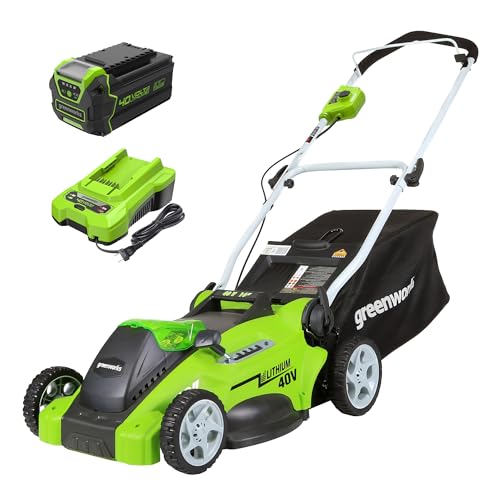
This is a 16-inch, battery-powered push mower supplied with one removable 40V, 4.0Ah lithium-ion battery, charger, grass bag, and mulching plug. It is a compact walk-behind mower with five cutting-height positions, rear bagging or mulching, and folding handles. It is not self-propelled, so the user provides all forward force. The manufacturer states up to 40 minutes of runtime, a two-hour recharge, and suitability up to one-third acre, although its own specification section also lists one-quarter acre. Independent testing of this exact mower found it quiet at 71.9 dBA at head height, easy to maneuver in compact spaces, and effective at packing clippings into its bag. The same test found uneven cutting, weak mulching, and reduced performance in tall or uneven grass.
This product suits someone maintaining a small, mostly level lawn that is cut regularly before grass becomes tall or dense. It is particularly suited to users who need a compact mower for narrow gates, tight turns, small storage areas, or a fenced section of lawn. Its push format and narrow deck require walking effort and extra passes, but independent testing found it maneuverable and relatively quiet. Bagging is the practical choice for users who want to collect clippings rather than rely on its mulching performance.
It is not suited to large lawns, infrequent mowing, dense overgrown turf, or bumpy ground where its narrow deck and light weight can leave an uneven cut. It is also unsuitable for slopes over 15 degrees, wet grass, or areas near drop-offs, as the manual specifically warns against those conditions. Buyers who need powered drive assistance, side discharge, consistently fine mulch, or an independently verifiable safety listing for the complete mower, battery, and charger package should select a product with those documented attributes.
The most useful health feature is the documented operator control. The manual says the blade stops within three seconds after the control handle is released, requires the rear shield, discharge cover, bag, and other safety devices to be in place, and instructs users to remove the battery before service. It also prohibits wet mowing and slopes above 15 degrees. Independent testing measured 71.9 dBA at head height, while the battery-electric design avoids on-site gasoline exhaust. Vibration data was not located. The battery is removable and the manual identifies replacement parts, which can extend useful life. Greenworks also lists a replacement grass bag for this mower. The manual says lithium-ion batteries must be removed and sent to an appropriate recycling facility, not household waste. EPA guidance adds an important missing step, protect terminals with nonconductive tape or isolate the battery before taking it to a specialized collection point. No exact-product recall was located, though other Greenworks products have had separate recalls.
This is a cordless, dual-line string trimmer and edger, not a walk-behind lawn mower. It is intended for trimming grass and weeds at edges and around obstacles. The product description states a 13-inch cutting swath, 2 mm dual line, automatic feed, brushless motor, and a telescoping pole that adjusts from 42 to 56 inches. A reseller independently reproduces those basic product claims, but no operator manual or technical sheet for this exact unit was located. The most consequential finding is an unresolved battery-specification conflict. The product title says two 40,000 mAh batteries, while the supplied specification record calls them 4.0 Ah batteries and also inconsistently describes them as 12 V despite the 21 V tool claim. That makes runtime, stored energy, charging, and replacement-battery expectations unclear.
This product fits a homeowner with a small area of lawn edging, fence-line grass, or light weed growth who specifically wants a cordless hand-held tool rather than a mower. The stated 13-inch swath and adjustable 42 to 56 inch pole suit detail work around beds, sidewalks, and obstacles. It is most appropriate for a buyer prepared to inspect the battery and charger labels on arrival, follow their instructions closely, and confirm replacement-battery availability before relying on it long term.
It is not suited to anyone seeking a lawn mower for broad, level turf, because this is a string trimmer with an exposed rotating line system rather than a decked mower. Avoid it for heavy brush, woody stems, large properties, prolonged commercial work, or situations where measured runtime and noise data are essential. Households needing independently verified electrical safety certification, a documented parts system, or a clear battery recycling and support program should not treat these points as established for this product.
Because it is battery powered, this product produces no on-site gasoline exhaust while trimming. That does not establish low noise or low vibration. No measured sound or vibration result for this exact model was found, and NIOSH recommends limiting exposure at 85 dBA averaged over eight hours, with allowed duration decreasing as sound rises. Hearing protection remains prudent until actual sound data are available. The walk-behind mower blade standard does not directly describe this hand-held string trimmer. Its rotating line and debris hazards still make eye protection, footwear, guard use, and keeping bystanders clear important. No exact-product listing from an OSHA-recognized testing laboratory was located. For end of life, lithium-ion batteries should not enter household trash or curbside recycling. EPA advises protecting terminals with non-metallic tape or isolating batteries in separate bags before taking them to an appropriate collection site. No product-specific take-back plan was found.
This is a cord-free, push walk-behind mower with a plastic 17-inch deck, a 16-inch cutting path, collection bag, mulch plug, and two removable 20V 4.0Ah batteries that operate the mower as a 40V system. It is intended for domestic lawns and is not self-propelled. WORX states that it needs both batteries installed, includes a dual-port charger, and has a single-lever height adjustment. Independent testing of this exact product found it light and easy to push, particularly for small, maintained yards. The same test found that it bags and mulches but has no side-discharge option, and that heavy 6-inch grass mixed with leaves stalled it before repeated high-height turbo passes cleared the area. Product documents provide safety-key, bail-handle, rear-flap, battery-removal, wet-grass, and slope-use instructions, but no publicly matchable NRTL listing was found for the complete mower, supplied batteries, and charger.
This product suits someone maintaining a small, regularly cut residential lawn who wants a cord-free push mower rather than a self-propelled machine. Its independently tested light handling is useful where the mower must be carried, turned tightly, pushed uphill, or stored in limited space. It also fits users who want either bagging or mulching and already use, or expect to use, the compatible 20V Power Share battery platform. It requires a user comfortable pushing a roughly 35 to 38 pound mower and following battery and blade safety procedures.
It is not a good fit for large properties, frequently overgrown grass, heavy leaf loads, or anyone who needs a side-discharge option. Independent testing documented a stall in 6-inch grass with oak leaves, even though the mower could finish the area in several higher-cut turbo passes. Buyers who need a fully documented third-party electrical safety listing for the complete mower and supplied charging system should choose a product with a publicly matchable listing. It also may not suit people who need online ordering of routine replacement blades immediately.
The product eliminates on-site gasoline-engine exhaust during mowing, but electric operation does not eliminate hearing or physical injury concerns. NIOSH identifies repeated exposures of 85 dBA or more as hazardous, and no verified sound-pressure measurement for this exact product was located. The manual instructs users to keep guards in place, stop and remove batteries before service, avoid wet grass, use the specified charger, and wait for moving parts to stop. It also uses a safety key, bail handle, and rear safety flap. WORX identifies a California Proposition 65 warning for lead and DEHP exposure. The supplied lithium-ion batteries are removable, and the product documentation directs users not to trash them and points to the Positec and Call2Recycle recycling route. The battery platform can potentially reduce duplicate battery purchases across compatible tools. However, battery materials still require responsible collection, and current official support says a replacement blade is not available online, which weakens straightforward long-term repair access.
This is a gasoline, walk-behind rotary mower, not an electric mower. The matching SENIX manufacturer listing describes a 21-inch steel-deck, self-propelled mower with a 170 cc four-cycle engine, six cutting heights from 1.25 to 3.75 inches, and bagging, mulching, or side-discharge operation. Those are manufacturer-stated specifications, not independently tested performance results. The catalog’s stainless-steel material claim could not be confirmed. SENIX instead identifies the corresponding mower’s deck as steel. The manufacturer also describes large 8-inch front and 11-inch rear wheels and a grass bag, but the public product materials located did not provide an exact-model operator manual, a General Certificate of Conformity, measured noise or vibration data, or a public independent test of this product.
This mower fits an adult homeowner who specifically wants a gasoline machine for a residential lawn and accepts fuel, oil, spark-plug, filter, and blade maintenance. The manufacturer-stated 21-inch deck, self-propelled drive, six height settings, and three clipping modes suit routine grass cutting where a bagging option is useful and the user can safely control a 61.7-pound walk-behind machine. It is most appropriate where outdoor storage, fresh fuel management, and hearing protection are practical.
It is not suited to buyers seeking an electric mower, quiet operation, zero on-site combustion exhaust, or a lithium battery platform. It is also a poor fit for people unable to manage a gasoline engine, lift or stabilize a roughly 62-pound mower, or maintain firm control around slopes, wet grass, curbs, and obstacles. Households with children or pets in the mowing area need particularly strict separation, because this remains a rotary-blade machine with thrown-object and foot-injury hazards. Those needing independently verified noise, cutting, or certification data will find the public evidence incomplete.
The main health issue is inherent to the power source. This is a gasoline engine mower, so it produces on-site exhaust and has the noise exposure associated with lawn mowers. NIOSH identifies 85 dBA as its recommended eight-hour noise limit and notes that lawn mowers commonly fall around 85 to 90 dBA. No product-specific sound or vibration figure was found, so hearing protection and limited exposure are prudent rather than optional assumptions. Federal rules require covered consumer walk-behind mowers to meet blade-control, shielding, labeling, and three-second blade-stop requirements. However, no public General Certificate of Conformity for this exact product was located. SENIX does offer registration and a route for safety notifications. There is no included lithium battery to recycle, but that does not make the mower low impact. EPA regulates exhaust and evaporative emissions from small spark-ignition engines, and no lifecycle, recycled-content, or take-back documentation was located for this mower.
This is a 21-inch, battery-powered walk-behind mower for domestic lawns. It has self-propulsion, a brushless motor, a 3-in-1 deck for mulching, rear bagging, or side discharge, and seven cutting-height positions. The supplied kit is manufacturer-stated to include two 60V 4.0Ah lithium-ion batteries and a dual-port 3-amp charger. The mower weighs 65 pounds without batteries, so its powered drive is important for routine use. Its manual specifies a removable safety key, a hold-to-run start handle, discharge guarding, battery removal before service, dry cleaning only, and a 15-degree slope limit. Independent hands-on testing of this exact mower found more than one hour of runtime in a defined lawn test and measured 75.7 dB from a position a couple of feet away. A public OSHA-recognized laboratory listing for the exact mower, batteries, and supplied charger was not located.
This product suits a homeowner with a small or medium, regularly maintained lawn who wants a cordless mower with a broad 21-inch cut and help moving a relatively heavy machine. It is most appropriate on dry, reasonably even ground with slopes below 15 degrees. The two included 4.0Ah batteries are useful for a user who needs a complete kit rather than an existing battery platform. It also fits someone with limited storage space, since the handle folds and the mower can be stored vertically.
It is not appropriate for users who cannot safely control a 65-pound mower, including when loading it, turning it, or moving it without self-propulsion. Avoid it for wet grass, slopes over 15 degrees, drop-offs, ditches, or rough ground that compromises footing. It is also a weaker fit for buyers who require a publicly verifiable independent safety listing for every supplied electrical component. Households that cannot store, charge, and transport lithium-ion batteries in a dry, protected area should consider a non-battery option.
The main operator-health advantage is the absence of on-site gasoline exhaust during mowing. Independent testing measured 75.7 dB near the operating mower, but that is not a standardized at-ear noise result, so hearing protection remains prudent for extended use. The manual calls for keeping guards installed, using the hold-to-run control, removing the battery and safety key before maintenance, and avoiding wet grass and slopes over 15 degrees. The replaceable battery packs and documented replacement parts can help extend the mower's life beyond ordinary blade, wheel, or bag wear. Lithium-ion batteries still require careful end-of-life handling. EPA guidance says not to put them in household trash or curbside recycling, and to protect terminals with nonconductive tape or individual bags before taking them to a specialized recycler. Greenworks maintains a safety-notice and recall system, but no recall or safety notice was located for this specific product. The manual also includes a California Proposition 65 warning without naming the chemical involved.


