Best Overall

EUHOMY Bottom Loading Water Cooler Dispenser
Convenient bottom loading design for easy access.
Child safety lock ensures safe usage.
LED light enhances visibility in low light.
 Daniel Kenitz
Convenient bottom loading design for easy access.
Child safety lock ensures safe usage.
LED light enhances visibility in low light.

Built-in 4-stage filtration ensures clean water.
Offers hot, cold, and room temperature options.
Self-cleaning feature for easy maintenance.

Convenient bottom loading design for easy bottle changes.
Self-cleaning feature ensures hassle-free maintenance.
Child safety lock provides added security.

Child safety lock ensures secure usage.
Compatible with 3 or 5-gallon bottles.
Provides both hot and cold water options.

Seven temperature options for personalized beverage needs.
No installation required for easy setup.
Efficient 3:1 pure to drain water ratio.

Easy installation process saves time and effort.
Compact design fits seamlessly in small spaces.
Advanced filtration improves taste and purity of water.
Easy installation with plug and play setup.
Offers nine temperature settings for versatility.
Monitors TDS and filter lifespan efficiently.

Instant hot and cold water dispensing.
Quiet, efficient multi-stage filtration system.
Modern touchscreen design for easy use.

Instant hot and cold water dispensing.
Efficient 2:1 pure to drain ratio.
Smart LED faucet for easy monitoring.

Convenient bottom loading design for easy bottle replacement.
Offers three temperature options: hot, room, and cold.
Features child safety lock for added security.
For a treatment model, begin with the actual concern in the local water report, well-water test, or drinking-water advisory. Then check the complete named product and its specified replacement filter in public certification records. NSF/ANSI 53, 58, 401, P231, P473, P477, and related claim sheets can identify contaminant-specific performance; NSF/ANSI/CAN 61 and 372 address relevant water-contact and lead-content questions. IAPMO R&T, the Water Quality Association Gold Seal directory, and CSA listings are also useful verification points. A claim that a carbon block, reverse-osmosis membrane, UV lamp, or “seven-stage” design reduces a contaminant is not the same as certification of the finished system.
The headline numbers commonly mislead. A reverse-osmosis ratio such as 2:1 or 3:1 describes claimed pure water versus drain water, not contaminant performance; it also does not disclose standby electricity. A TDS meter measures dissolved solids broadly and cannot prove reduction of lead, PFAS, arsenic, microbes, or another particular hazard. A micron rating does not establish removal of every smaller contaminant. “NSF components,” “NSF approved,” or a standard number displayed near a product name may refer only to low-lead materials or another product family. Confirm the exact model, filter, standard, and reduction claim in the issuer’s current listing.
For bottled dispensers, examine the water path rather than relying on exterior antimicrobial language. Reservoirs, tubing, probes, spouts, ice bins, drip areas, and heated tanks can all require cleaning. Useful documentation identifies how to drain the unit, access wet parts, sanitize them, flush a new filter, replace cartridges, and handle extended periods without use. A self-cleaning, UV, ozone, or BioGuard statement is not proof that every wet surface is sanitized. Removable trays, drains, filter alerts, leak sensors, and clear replacement parts improve maintainability, but they do not eliminate it.
Hot-water safety deserves separate attention. Near-boiling outputs in the supplied products range roughly from 185°F to 212°F. Look for a deliberate child-resistant action, clear warnings, stable controls, and an exact-model electrical listing in UL Product iQ, Intertek ETL, or CSA records. A spring-return handle, warning label, or manufacturer claim can reduce risk without being independent certification. Also check installation requirements: grounded outlets, ventilation, compatible plumbing, drain connections, leak checks, and traceable fittings matter for powered appliances that can damage cabinets or floors.
Ecology is a lifetime calculation. Bottled units create delivery, washing, transport, and bottle-reuse or recycling demands. Filtration systems create spent cartridges; reverse osmosis creates reject water; hot tanks, compressors, ice makers, and instant heaters use electricity. ENERGY STAR or Department of Energy records are more useful than an unsupported low-energy claim, while measured annual use, filter capacity, repairability, and end-of-life instructions help compare the whole system. Across the supplied products, no category-wide contraindication was found beyond the recurring need to use suitable source water, maintain wet parts, and supervise very hot dispensing; products with incomplete safety or certification records should not be treated as protective treatment systems.
A dispenser can improve access to convenient temperatures, but its health value depends on source-water suitability, verified treatment, cleanable wet parts, and safe operation. The reviewed products vary widely: some have no treatment function, while others have narrow material or contaminant certifications that do not support their broader advertising.
This measures whether treatment addresses a documented risk in the intended source water without unsupported alkaline, mineral, wellness, or formula benefits. For dispensers, a high score reflects a specific match between the water problem and the treatment; lower-scoring products mainly heat, cool, or make broad claims without verified relevance. The reviewed scores span 70 to 78.
This asks whether the complete product and named replacement filter are independently certified for each claimed health contaminant. A high score requires an exact model and exact reduction claim, not merely reverse osmosis, carbon, a micron rating, or a generic test. The strongest reviewed evidence was tied to specific NSF or equivalent listings; unsupported broad PFAS, lead, or arsenic claims scored lower. Scores range from 52 to 88.
This measures protection against growth in reservoirs, lines, spouts, ice areas, and drip trays, plus whether users can drain, access, clean, sanitize, and maintain them. Higher-scoring products provide concrete cleaning, flushing, draining, or filter-change instructions. Lower-scoring products rely on self-cleaning, UV, ozone, or antimicrobial language without validating the whole wet path. Scores range from 69 to 77.
This measures child-resistant controls, warnings, stable operation, and safe temperature limits for water that can approach boiling. Higher-scoring products document a two-action lock or another deliberate control, but no safeguard replaces supervision. Lower-scoring products lack a documented lock or allow very hot output with limited evidence. Reviewed scores range from 68 to 78, with several products reaching 203°F to 212°F.
This measures independent certification of the complete powered appliance and the absence of relevant unresolved recalls or incident patterns. It matters because dispensers combine heating, cooling, water, and electricity, sometimes under a sink or near cabinetry. Higher scores reflect traceable exact-model safety evidence; lower scores reflect manufacturer or retailer statements without a public UL, ETL, or CSA record. Scores range from 69 to 76.
This measures resistance to bottle, tubing, fitting, backflow, and installation failures that can cause property damage or contaminate water. Higher-scoring products document compatible connections, leak checks, drains, replacement parts, or automatic water shutoff. Lower-scoring products leave fittings, installation conditions, or parts traceability unclear. Plumbed and under-sink models need particular attention; reviewed scores range from 69 to 78.
This measures independent assessment of tanks, tubing, faucets, reservoirs, and filters for drinking-water contact and lead content. A high score covers relevant finished components, not just BPA-free, food-grade, stainless-steel, or low-lead language. The strongest supplied evidence was an exact IAPMO or NSF material listing; scores range from 68 to 88. Material compliance does not prove contaminant removal.
This measures whether advertising separates filtration, heating, cooling, UV, self-cleaning, mineral, and alkaline functions and avoids implying that boiling removes chemicals or that generic testing proves the finished product. Higher-scoring products state narrow, supported claims; lower-scoring products combine broad reduction lists with unrelated standards or wellness language. The reviewed scores range from 52 to 86.
This measures current third-party records for the exact finished model, plus a verifiable model number, manual, warranty, and recall contact. Higher-scoring products have public NSF, IAPMO, WQA, UL, ETL, or CSA records that match the claim; lower-scoring products rely on seller assertions, self-issued reports, or certification for another model. Scores range from 54 to 88.
This measures whether the brand and exact product are traceable, support is reachable, corrective action is clear, and no unresolved recall or serious incident pattern is evident. Higher scores reflect usable warranty and support information alongside a clean reviewed record. Lower scores reflect incomplete support trails or less accountability. Scores in the supplied set range from 60 to 75; absence of a located recall is not proof that a product is risk-free.
This measures lifetime electricity, reverse-osmosis reject water, bottles, cartridges, and repair or recycling prospects. Higher-scoring products have a traceable ENERGY STAR record, a favorable stated recovery ratio, replaceable parts, or reduced bottle use, though manufacturer figures remain estimates unless measured independently. Lower scores reflect unknown energy use, disposable consumables, or unclear end-of-life handling. Reviewed scores range from 63 to 85.
This is a freestanding, bottom-loading dispenser for standard 3- or 5-gallon bottled drinking water. It provides cold, room-temperature, and hot water through push-button controls, and its listed footprint is 14.1 by 12 by 41.1 inches. The product is intended for a home office, break room, or household that wants bottle-fed water at multiple temperatures without lifting a full bottle onto the top of the unit. The seller states that the hot and cold tanks are stainless steel, that the bottle compartment has a loading ramp, and that hot dispensing requires a two-step child lock. A model-specific manual found independently gives a hot dispensing range of about 185 to 194 F, despite the product page also displaying 203 F as an upper temperature rating. I found no filtration, UV, or contaminant-reduction function, and no current exact-model certification record in the public NSF, UL, ETL, IAPMO, WQA, or CSA registers searched.
This product suits a small household or office already using sealed 3- or 5-gallon drinking-water bottles and wanting cold, room-temperature, and hot dispensing from one floor-standing unit. Bottom loading is particularly relevant for people who want to avoid lifting a full bottle above waist height. It also fits users prepared to clean the drip tray regularly, drain and descale the tanks periodically, keep clearance around the unit, and rely on the quality of the bottled water they choose rather than on treatment by the dispenser.
It is not suited to buyers who need a product to address a known drinking-water problem, such as lead, PFAS, arsenic, microbial contamination, or a local boil-water advisory. There is no filter or independently verified treatment claim for this unit. Households with young children should also account for the very hot water function and should not treat the stated child lock as a substitute for supervision. Buyers requiring an independently documented electrical listing, drinking-water-contact certification, or measured low-energy performance need more product-specific evidence.
The important health limitation is that this product stores, cools, and heats bottled drinking water. It does not claim to filter or disinfect it. CDC guidance recommends selecting treatment based on the specific contaminant in the source water, so the safety of what is dispensed depends substantially on the bottle supplier and on keeping the wet parts clean. The seller states that the tanks are stainless steel, while the listed exterior material includes ABS plastic. No public certification was located for the finished water-contact path under common drinking-water material standards. The manual instructs users to clean the removable drip tray, drain tanks for descaling, and check connections if leaking occurs. No exact-product recall or public safety warning was found in the U.S. sources searched. Ecologically, the product uses replaceable large bottles and electrically maintains hot and cold water, but no measured daily energy use, repair program, or end-of-life guidance was located.
This is a freestanding, bottleless water dispenser that connects to a cold-water line and filters water before dispensing it at room temperature, chilled, or hot. The model-specific manual lists a 11.8 by 14.1 by 41.7 inch cabinet, approximately 194 F hot water, 41 to 48 F chilled water, and four replaceable filters. The sediment filter is listed for 3 to 6 months, while the other three filters are listed for 6 to 12 months depending on source water. Its most consequential practical features are documented in the manual, including a slide-and-press hot-water lock, a cabinet leak sensor, a removable drip tray, and drain instructions for the reservoirs. The manufacturer describes four-stage filtration for sediment, chlorine, odors, and lead. However, independent certification records for the complete dispenser and its stated contaminant reductions were not confirmed.
This suits a homeowner or small office with a stable indoor location near a cold-water connection and grounded outlet, who wants chilled water, hot drinks, and room-temperature water without managing five-gallon bottles. It is most appropriate where a local water report or a separate water test identifies concerns aligned with the manufacturer-stated carbon and sediment filtration claims, such as chlorine taste or particulate matter. The buyer should be willing to change several cartridges on schedule, flush the system after changes, and drain reservoirs during extended absences.
It is not suited to households relying on a dispenser to address a confirmed PFAS, mercury, microbial, or other health-risk finding without independently certified reduction data for that exact contaminant. It is also unsuitable where a water line, level floor, dedicated grounded outlet, and regular maintenance cannot be provided. Homes with young children still need direct adult supervision around the hot outlet because the manual warns water can reach scalding temperatures. Renters or users unable to manage plumbing connections should avoid this installation format.
The dispenser uses sediment, KDF and activated-carbon filtration rather than reverse osmosis, so it does not create reverse-osmosis reject water. It can also reduce the ongoing plastic and transport burden of bottled five-gallon water. Those benefits are offset by four disposable cartridges, with replacement intervals ranging from 3 to 12 months, plus powered heating and compressor cooling. The manual lists 500 W heating power and 85 W cooling power, but no measured annual energy use or current ENERGY STAR listing was confirmed. The manufacturer identifies food-grade polypropylene in the sediment filter, but independent certification for the finished water-contact system was not confirmed. The manual gives useful draining and filter-flush instructions, yet no independent validation was found for microbial sanitation or self-cleaning performance. No specific product recall was identified in the reviewed safety sources. Separately, the FTC reached a 2019 settlement with iSpring over false made-in-USA marketing claims for imported filtration systems, a past advertising compliance issue rather than a recall or documented hazard for this product.
This is a freestanding, bottom-loading bottled-water dispenser for 3 or 5 gallon bottles. It is intended to pump supplied drinking water from the concealed bottle and deliver hot, cold, or room-temperature water. The published product dimensions are about 14 by 12 by 41 inches, and the listed power rating is 550 watts. The bottle is not included. The product documentation and retailer material describe a two-step child lock for hot-water dispensing, LED status and empty-bottle alerts, and a removable drip tray. A self-cleaning function is claimed, with third-party retail descriptions identifying UV as the mechanism, but no independent validation of sanitation performance for this finished product was located. Likewise, no current public certification record was located for this exact product in the NSF, UL, ETL, CSA, IAPMO, or WQA registers reviewed.
This product suits a household, small office, or apartment that already uses delivered or refilled 3 or 5 gallon drinking-water bottles and wants easier bottle changes than a top-loading cooler. It is especially relevant where hot drinks, chilled water, and room-temperature water are used regularly, and where the operator is willing to clean the drip tray, inspect the bottle and probe, and follow periodic descaling instructions. The documented two-step hot-water action is useful for homes that want an additional control barrier around hot dispensing.
It is not suited to people who need a dispenser to make questionable tap water safer, since no certified contaminant-reduction performance was identified. Households with young children should not treat the claimed child lock as a substitute for supervision around near-boiling water. It also does not fit buyers who require independently verified electrical safety, certified drinking-water-contact materials, or independently validated UV sanitation before bringing an appliance into the home. Users unable to maintain bottles, probes, drip areas, and periodic descaling should choose a setup with service support.
The key health limitation is that the product distributes the water supplied in its bottle. It does not present independently certified reduction claims for lead, microbes, chemicals, or other contaminants. Use bottled drinking water from a source appropriate to local conditions, and follow local drinking-water advisories rather than assuming heating, cooling, or a self-cleaning cycle changes source-water quality. The claimed self-cleaning function and removable drip tray may support routine hygiene, but neither replaces cleaning the wet surfaces that the user can access. The available product material identifies an ABS exterior material, not a certification of all tanks, tubing, faucets, or other water-contact parts. No product-specific public certification record for those components was located. No exact-product recall or CPSC safety warning was located in the reviewed sources. Energy consumption is also unverified, and the bottled format creates ongoing bottle transport and sanitation demands.
This is a freestanding, top-loading hot and cold bottled-water dispenser for 3 or 5-gallon bottles. The product measures 11 by 11.4 by 36.5 inches. Its published manual specifies 110-120V power, 520W heating, 90W cooling, hot water at 184-200°F, and cold water at 44-49°F. Those figures are manufacturer-stated, rather than independently confirmed. The product dispenses supplied bottled water and does not present itself as a filter, purifier, UV sanitizer, or water-treatment system. A manual available for this exact product describes a sliding hot-water child lock, removable drip tray, removable top lid, and removable bottle seat. Searches of major certification registers did not identify an exact-product NSF, UL, ETL, CSA, IAPMO, or WQA listing. A search of current CPSC recall records did not identify a recall for this product.
This product suits a household break room, small office, or shared living space that already uses potable 3 or 5-gallon bottled water and wants separate hot and cold taps without plumbing work. It is most appropriate where adults can safely lift, seat, and replace a full bottle, and where someone can regularly wash the removable drip tray and bottle-seat parts. The rear switches may also suit users who want to disable heating or cooling during periods when that function is unnecessary.
It is not suited to buyers seeking a certified response to lead, PFAS, microbes, arsenic, or another source-water concern. This product does not replace testing local water or choosing a treatment system certified for a specific contaminant. Homes with young children, people with impaired dexterity, or settings where hot-water access cannot be supervised should consider the manufacturer-stated hot-water range carefully. It also is not ideal for anyone unable to safely lift and install a 3 or 5-gallon bottle.
The central health limitation is scope. This product heats and cools potable bottled water, but no exact-product NSF, IAPMO, WQA, UL, ETL, or CSA certification record was located for contaminant reduction, water-contact materials, sanitation, or electrical safety. CDC guidance advises matching treatment to the actual germ or chemical of concern. Heating water in this dispenser is not a substitute for a certified treatment claim. The manual does specify a child lock and instructs users to prime the tanks before heating, use a grounded outlet, avoid extension cords, and clean removable parts. From an ecology perspective, the product has active heating and cooling, with manufacturer-stated 520W heating and 90W cooling ratings, but no model-specific energy-consumption figure or ENERGY STAR certification was found. Its top-loading design avoids filter cartridges and plumbing reject water, but relies on recurring large water bottles. Environmental impact depends heavily on bottle reuse, return, local recycling, delivery distance, and whether heating and cooling are switched off when not needed. No current CPSC recall was identified for this product.
This product is a plug-in countertop reverse-osmosis dispenser for municipal tap water. It uses a refillable 4.7 L feed tank, produces water into a removable 1.5 L glass pitcher, and heats dispensed water through preset temperature settings up to 212°F. The manual limits intended feed water to municipal water below 500 ppm TDS and says not to use microbiologically unsafe or unknown water without adequate disinfection. Its practical strengths are the no-plumbing format, filter-life alerts, and written tank, screen, drip-tray, and descaling care instructions. The main evidence concern is certification clarity. The manufacturer markets IAPMO R&T certification to NSF/ANSI 42, 58, and 372, but its own comparison table lists only NSF/ANSI 372 for this model. An exact current public issuer record for this finished product was not located in the verification review.
This product suits a renter, apartment resident, office user, or small household with compliant municipal tap water who wants reverse-osmosis treatment and on-demand hot water without altering plumbing. It is most appropriate for someone willing to refill a feed tank, follow weekly cleaning and monthly descaling instructions, flush after filter changes, and replace the proprietary filter when prompted. The 50 oz pitcher format fits intermittent drinking, tea, coffee, or meal preparation rather than continuous high-volume dispensing.
It is not appropriate as a primary safeguard for private-well water, a boil-water advisory, or water of unknown microbiological quality. The manual itself requires adequate disinfection for unsafe water and advises prefiltration for well water. Households with young children who need a documented child-resistant hot-water control should note that such a control was not established in the reviewed manual. It also does not suit users unable to maintain wet parts, discard standing water, descale monthly, or accept a proprietary replacement-filter schedule.
Reverse osmosis can be relevant when a household has a documented dissolved-contaminant concern in its municipal water, but the source water should first be checked against a local water report or a targeted test. This product is not a microbial-water solution. Its manual and performance sheet warn against use with microbiologically unsafe or unknown water without adequate disinfection. The manufacturer advertises reductions for a wide range of contaminants, but the finished product’s public certification record was not confirmed, and its own certification descriptions conflict. The glass pitcher is a useful material feature, though it does not establish independent approval of every water-contact part. The manual calls for weekly cleaning of the tank and drip tray, discarding water after two days of nonuse, and monthly citric-acid descaling. The maker states a 3:1 pure-to-drain ratio and up to 1,100 gallons or 12 months per cartridge. It uses disposable filters and a 1050 W heating appliance, while no measured standby-energy figure or recycling program for the cartridge was located. No CPSC recall for this exact product was located during this review.
The Waterdrop CT01 is a manual-fill countertop dispenser that filters tap water, then dispenses it hot, warm, or cold. It has a 1.32-gallon feed tank, measures about 14.4 by 10.6 by 13.4 inches, and uses a replacement cartridge specified for six months or roughly 300 to 317 gallons. Its manufacturer states that the carbon-based multi-stage filter reduces chlorine, rust, sediment, and unspecified common impurities while retaining minerals. The manual specifies 110 to 120 V operation, 1,600 W heating, 60 W refrigeration, a UV-C emitter, a child lock, and hot settings up to 203°F. IAPMO documentation lists the CT01 product family as conforming to U.S. lead-free plumbing content requirements. However, current independent listings reviewed did not confirm finished-product contaminant reduction claims or electrical safety certification for this specific powered dispenser.
This product fits a household or small office with municipally supplied potable water that primarily wants convenient hot drinks, chilled water, and improved chlorine taste without plumbing changes or reverse-osmosis reject water. It is particularly suited to users who can refill a 1.32-gallon tank, use a grounded GFCI-protected outlet, replace the cartridge about every six months, and follow flushing and descaling instructions. The lead-free plumbing listing adds useful material assurance, but it does not establish broad contaminant removal.
It is not appropriate as the main safeguard for a home with a documented lead, PFAS, nitrate, arsenic, microbial, or other health-based water problem. The reviewed independent records did not verify contaminant-specific reduction for this finished product. Households with young children should also consider the practical risk of 203°F water despite the stated child lock. Avoid it where maintenance will be inconsistent, where the unit cannot sit level with ventilation and a protected outlet, or where an unexplained California exposure warning is unacceptable.
The clearest independently confirmed materials point is an IAPMO listing for the CT01 family that states compliance with U.S. lead-free plumbing content requirements. That is narrower than certification of finished water quality or contaminant reduction. The manufacturer states that the product uses carbon-based multi-stage filtration and retains minerals, but no current independent certification was located for its chlorine, sediment, rust, or broader impurity claims. Its use of a UV-C emitter is also not accompanied by a verified microbial-treatment claim. The manual calls for regular cartridge replacement, flushing after replacement or long inactivity, and descaling when indicated. These steps matter because a tank, internal water path, and nozzle need active maintenance. The product produces no reverse-osmosis wastewater, which is a real water-use advantage. It still uses disposable cartridges and powered heating and cooling, and no measured standby-energy figure or cartridge recycling program was found. The manual also includes a California cancer and reproductive-harm warning without naming the relevant substance.
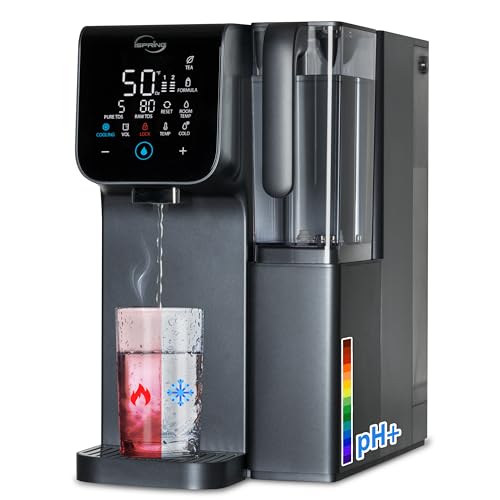
This is a 22-pound countertop reverse-osmosis dispenser for manually filled water, with separate source and filtered-water pitchers. It measures 16.7 by 9.2 by 16.3 inches, plugs into a standard outlet, and is intended to provide room-temperature, cooled, or heated water without a plumbing connection. The manufacturer lists nine temperature settings, six preset dispense volumes, a TDS display, filter-life alerts, and a hot-water child lock. Its defining limitation is evidence, not format. iSpring claims removal of more than 99% of over 1,000 contaminants, including PFAS, lead, fluoride, and arsenic, but current public third-party certification records for this exact finished product were not identified. The maker previously stated that this model had not yet been certified. Its alkaline function may alter taste or pH, but broad wellness benefits from alkaline water are not established by robust human evidence.
This product suits a renter, office user, or household that wants a large countertop appliance for manually filled water and values on-demand cold and near-boiling water without altering plumbing. It is most appropriate where the local water concern has first been identified through a Consumer Confidence Report, well-water test, or local advisory, and the buyer is prepared to maintain the listed filters, rinse the pitchers, clean the mesh filter every three weeks, and monitor the unit. Its size and 22-pound weight require a stable, dedicated counter location.
It is not the right fit for households needing independently certified reduction of a specific contaminant such as lead, arsenic, PFAS, cysts, or microbes. It also is not suitable as a substitute for instructions during a boil-water or do-not-drink advisory. Homes with young children or people unable to reliably operate a hot-water lock should be cautious because the unit can dispense water up to 210°F. It is also poorly suited to users who cannot keep up with cleaning, filter changes, manual filling, and countertop space requirements.
Reverse osmosis is a credible treatment mechanism, but its real protection depends on the specific membrane, operating conditions, replacement schedule, and verified contaminant claims. For this product, iSpring advertises broad reductions for PFAS, lead, fluoride, arsenic, and many other substances, yet no current public certification listing was located for the complete product and its specified filters. The manufacturer’s earlier response said the product had not yet been certified. Alkaline water should not be treated as a documented wellness or disease-prevention benefit. The manual gives useful handling basics, including indoor use, a level surface, rinsing the removable water containers, regular fitting checks, and use of authorized filters. It also warns users to disconnect power after more than 24 hours of nonuse. The unit avoids disposable bottled-water use, but it still uses disposable filters and produces RO reject water. Its stated 2.5:1 purified-to-drain ratio, thermoelectric cooling, and filter intervals have not been independently confirmed for this product. No product-specific CPSC recall or warning was identified in the checked public sources.
This is a slim, plumbed countertop dispenser for municipal tap water. It connects to a cold-water line under the sink, then provides cold, warm, and hot water through a touchscreen. The maker lists a 16.73 by 7.09 by 14.96 inch footprint, 125 W cooling, 1,400 W heating, a 0.396-gallon cold tank, and temperature selection from 41°F to 212°F. The supplied documentation describes sediment and carbon filtration plus a UF configuration, while also presenting an alternative RO membrane configuration. It documents a child-lock control, filter-life indicator, front-access cartridges, and rear drainage or flush ports. A key evidence limitation is that the maker's broad lead, PFAS, virus, and 99.9% contaminant-removal claims could not be matched to a public, model-specific certification claim sheet. Its marketed WQA, NSF, UL, and Energy Star references likewise were not confirmed in the relevant public product registers.
This product fits a household or small office with an accessible, compatible cold-water line under the sink and enough counter depth for its roughly 16.7-inch body. It is most practical for users who regularly want measured hot water for tea or cooking and chilled water without managing bottles. The buyer should be comfortable with basic installation, planned cartridge replacement, and checking local water-quality reports. Its filtration claims should be treated as manufacturer-stated unless the buyer obtains model-specific certification documentation.
It is not well matched to renters or kitchens where connecting tubing to the cold-water supply is prohibited, impractical, or likely to create a leak concern. Households that need independently certified reduction of lead, PFAS, cysts, or other particular contaminants should not rely on the broad marketing claims alone. It also needs caution in homes with young children or people unable to safely operate a hot-water lock. Buyers wanting a fully documented sanitation procedure, independently listed electrical safety record, or verified annual energy use need more documentation.
The treatment approach is relevant to drinking-water quality because it combines sediment and carbon media with either UF or an optional RO membrane, plus a UV-C feature. The maker says the standard replacement set includes a 0.01-micron UF and carbon stage, with cartridges rated up to six months or 550 gallons. Those are manufacturer statements, not independently confirmed reduction claims for the finished product. Public searches did not confirm the marketed WQA, NSF, UL, or Energy Star references for this exact product. The maker also states that water-contact components are BPA-free and silicone-free, but no finished-product drinking-water-contact certification was located. A direct-plumbed design can reduce dependence on single-use bottled water. However, it still uses disposable cartridges, and the manufacturer provides no cartridge recycling instructions. Instant heating may avoid holding a large hot tank at temperature, but the product has 1,400 W heating and 125 W cooling ratings without measured annual energy data. RO use may also create drain water, while the UF option may not. No CPSC recall or public regulatory safety action for this product was located as of August 9, 2026.
This under-sink product combines a tankless reverse-osmosis water filter, a dedicated smart faucet, and a small heated-water reservoir. Waterdrop identifies the matching K6 product as the same family as the WD-KJ600, with a 600-gallons-per-day rating, five-stage filtration, 104 to 203 F hot-water settings, and a 2:1 pure-to-drain ratio. Its manufacturer page describes the non-heated output as ambient water, not refrigerated water. The most important independently confirmed fact is narrower than the filtration advertising. IAPMO R&T currently lists the exact product names to NSF/ANSI/CAN 372 for low-lead water-contact compliance. That certification does not verify reduction of PFAS, fluoride, lead, arsenic, or other contaminants. Those reduction claims are presented by Waterdrop as third-party laboratory tested, rather than as certified finished-system reduction claims.
This product fits a homeowner using municipally treated tap water who wants filtered ambient water plus adjustable hot water from one dedicated faucet. It is most suitable where under-sink space is limited, a grounded outlet is available, and the buyer can install a drain saddle and maintain the cartridge on schedule. The low-lead certification is useful for buyers focused on water-contact material compliance. It also suits households that value the manufacturer's stated 2:1 RO recovery ratio and can accept ambient rather than chilled water.
It is not suited to households that need independently certified reduction of a specific local contaminant, especially PFAS, arsenic, lead, nitrate, or fluoride. Check the local Consumer Confidence Report and any local advisory first, then choose treatment certified for the relevant contaminant. It is also a poor fit for homes with young children or vulnerable users if the hot-water lock may be disabled, for anyone requiring truly chilled water, or for installations without proper drainage, a grounded outlet, and routine access to fittings for leak inspection.
The independently verified health-related strength is the current IAPMO R&T listing to NSF/ANSI/CAN 372, which covers low lead content in the listed product's water-contact components. This is meaningful material-safety evidence, but it is not proof that the product removes lead or other contaminants from incoming water. Waterdrop's PFAS, fluoride, heavy-metal, and TDS reduction statements rest on manufacturer-described third-party testing, without a current public finished-system performance certification located for this product. The manual includes automatic flushing, filter-life alerts, a hot-water safety lock, leak checks, and instructions to flush both cold and heated water after long periods out of use. It also warns that hot water and steam can scald. The stated 2:1 recovery ratio limits reject water relative to less efficient RO systems, but the heated reservoir uses standby energy and the annual cartridge is disposable. No product-specific energy-use figure, filter recycling program, or U.S. recall for this product was located.
This is a freestanding, bottom-loading bottled-water dispenser for 3- or 5-gallon bottles. It provides cold, room-temperature, and hot water through separate taps, with a 3.6 L cold tank and 1 L hot tank. The manufacturer specifies a 41.4 by 12.2 by 15.6 inch footprint, cold water at 37 to 50 F, and hot water at 176 to 198 F. The manufacturer states that its reservoirs are 304 stainless steel and that the hot-water control uses a two-action child lock. Its official manual also gives concrete setup, draining, and sanitizing directions, including cleaning the bottle probe and spout at bottle changes and descaling reservoirs every 3 to 4 months. This product does not filter or disinfect the source water, so water quality depends on the bottled water supplied.
This product suits a household, small office, or shared kitchenette that already uses professionally supplied 3- or 5-gallon drinking-water bottles and wants cold, room-temperature, and hot water without plumbing work. Its bottom-loading cabinet is particularly relevant for people who find overhead bottle lifting awkward. It also fits users willing to follow a recurring sanitation routine, keep clearance around the condenser, clean spills promptly, and switch off heating or cooling during longer idle periods.
It is not for households that need their dispenser to remove lead, PFAS, microbes, or other contaminants from tap water, because this product has no documented filtration or treatment function. It is also a poor fit where children can access appliances without close adult supervision, since the product can dispense near-boiling water even with its two-action lock. People unable to clean the probe, spouts, drip tray, and internal reservoirs on schedule should avoid relying on this format for daily drinking water.
The main health safeguard is procedural rather than treatment-based. The manual says to use known safe water, flush the product before first drinking, clean the probe and spout at every bottle change, and descale the reservoirs every 3 to 4 months. Those are practical hygiene instructions, but no exact-product certification was located for filtration, microbial reduction, or finished water-contact safety. The maker's stainless-reservoir statement is not a substitute for an independent water-contact certification. The product uses refillable 3- or 5-gallon bottles, which can reduce the number of single-use beverage bottles when bottles are returned through an exchange program. It creates no reverse-osmosis wastewater, but it still uses electricity to heat and cool stored water. No model-specific ENERGY STAR listing or daily standby-energy measurement was located. The manufacturer page also contains an unresolved documentation conflict, describing UV Care while the product manual documents manual sanitation instead.



