Best Overall
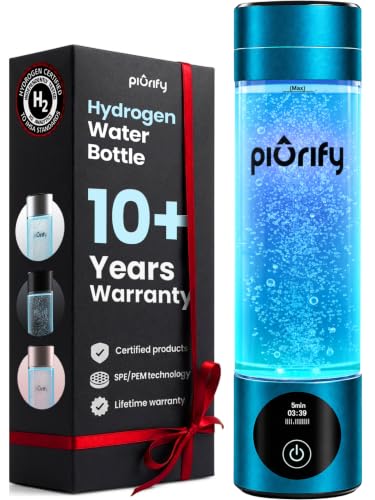
PIURIFY Hydrogen Water Bottle - Turquoise
High concentration of 3000ppb pure hydrogen.
Durable, food-grade body ensures safety.
OLED display for easy monitoring.
 Lauren Wilson
High concentration of 3000ppb pure hydrogen.
Durable, food-grade body ensures safety.
OLED display for easy monitoring.
Generates rich hydrogen water for better hydration.
BPA-free materials ensure safe and pure water.
Balanced pH levels and advanced filtering technology.

Generates hydrogen-rich water quickly and efficiently.
Portable design for on-the-go hydration.
Easy to use with intuitive operation.

Generates high hydrogen concentration up to 6000 PPB.
Features advanced SPE/PEM certified H₂ technology.
Compact design ideal for on-the-go hydration.

Generates 3000ppb pure hydrogen concentration quickly.
Features durable Dupont membrane for purification.
Easy-to-read OLED display for convenience.

High hydrogen concentration of 6000 PPB.
Efficient SPE/PEM ionizer technology.
Portable 16.2 oz capacity design.

Integrated LCD screen for easy water tracking.
Compact design, perfect for on-the-go use.
Transparent flask allows monitoring hydrogen levels.

High hydrogen concentration for better health benefits.
Durable Dupont membrane ensures long-lasting performance.
Clear OLED display for easy monitoring.
Generates hydrogen-rich water quickly and efficiently.
Features convenient self-cleaning functionality.
Portable design ideal for on-the-go use.

High hydrogen concentration enhances antioxidant benefits.
Certified technology ensures reliable and safe use.
Portable design ideal for travel and sports.
The most important performance figure is the delivered dose, not the largest number in a listing. A result in milligrams per liter (mg/L) or milligrams per bottle is more useful than a headline “PPB” figure unless the test explains the fill volume and timing. A credible report should cover the exact model and revision, water type, fill volume, temperature, cycle length, pressure condition, measurement delay, and hydrogen remaining after opening. Headline figures can mislead when they describe a peak after several cycles, measure immediately before ordinary carrying or drinking, apply to a different model, or omit whether the test used distilled water rather than tap or filtered water. Claims of four- or 12-hour retention need timed testing, not simply a concentration measured at the end of a cycle. Concentrations above ordinary ambient-pressure solubility require a clear, validated pressure and measurement method.
The strongest measurement approach in the supplied reviews is headspace gas chromatography, with documented calibration, detection limits, sample handling, temperature, pressure, and time-to-measurement. A report from an ISO/IEC 17025-accredited laboratory is stronger still when the accreditation scope covers the method. A seller-issued badge, a vague “certified” label, or a report for an unbranded or materially different bottle does not establish performance for the product being sold.
Safety evidence also needs to match the exact product. Buyers should be able to trace electrical or product claims through UL Product iQ, the Intertek ETL directory, CSA’s product listings, or—where relevant—an FCC equipment authorization. Food-contact claims should identify wetted materials, seals, membranes, coatings, and electrodes, with independent migration or extractables testing rather than only a general “food grade” or BPA-free statement. Finished-water testing should cover the actual cycle and permitted source waters, including relevant metals, chlorine- or ozone-related byproducts, pH, and other chemistry. A test of pre-use water or two bottle plastics is not a complete finished-water assessment.
A usable bottle must also be cleanable. Look for accessible wetted surfaces, disassembly guidance, drying instructions, water restrictions, cleaning intervals, and replacement schedules. Rechargeable products should specify charging limits and warnings, and ideally provide traceable battery-safety testing, replacement parts, repair support, and a clear battery or electronics recycling route. Reusability can reduce disposable-container use, but that benefit is weakened when batteries, seals, electronic bases, and membranes cannot realistically be serviced.
Across the supplied products, do not use these bottles for hydrogen inhalation merely because a nasal cannula or inhalation tube is included; the reviews specifically advise against bottle-based inhalation. Do not rely on them to treat fatigue, inflammation, pain, metabolic or immune conditions, cognitive or mood symptoms, sleep problems, aging concerns, or athletic recovery. The human evidence is described as preliminary and heterogeneous, and several products make claims beyond their verified dose. Use only water the instructions permit, avoid additives unless explicitly allowed, follow charging and pressure warnings, keep electronic bases dry, and do not substitute these devices for medical care or a proper water-treatment system.
These topics separate a convenient hydrogen-water ritual from a product with evidence that can be checked. Scores reflect the supplied reviews and documentation, not clinical approval or a guarantee of safety.
This measures whether human research supports advertised wellness, recovery, antioxidant, inflammation, metabolic, or performance effects at the amount the bottle actually delivers. Among the supplied products, scores were generally modest: a higher score reflects restrained claims and a more credible connection to measured dose, while a lower score reflects broad claims without a finished-product clinical trial or independently verified dose.
Electrolysis can change water chemistry, so this topic examines finished-water testing under the product’s actual cycle and permitted water conditions. Higher-scoring products had narrower but useful evidence, such as no detectable chlorine or ozone or screened metals below reporting limits. Lower scores reflected no post-cycle testing for byproducts, metals, pH, or other chemistry.
This assesses whether the complete wetted system—bottle, seals, coatings, membranes, and electrodes—is identified and tested for chemical migration. A glass or BPA-free claim alone is not enough. Higher-scoring products supplied some exact-model material or migration evidence; lower-scoring products left internal parts unidentified and provided no finished-product extractables report.
This measures whether users can clean, dry, and maintain the bottle well enough to limit residue, mold, and biofilm. Higher scores among the supplied products were associated with explicit daily or weekly cleaning, monthly generator care, removable parts, brushes, and replacement intervals. Lower scores reflected sealed or non-submersible bases, unclear drying access, or unvalidated self-cleaning claims.
Rechargeable electrolysis bottles combine water, lithium batteries, charging ports, pressure, and electrical components. Higher-scoring products had clearer charging limits, warnings, pressure-release instructions, and some traceable testing; lower scores reflected missing certification, unclear battery details, or incomplete leak and pressure documentation. Keeping the electronic base dry and following charging instructions matters regardless of score.
This is the central performance question: how much dissolved hydrogen reaches the user after the stated cycle and normal drinking delay. Higher-scoring products had model-specific concentration measurements, including gas-chromatography reports or clearly stated test conditions. Lower scores reflected seller claims, immediate sampling, different models, reagent-only testing, or no retention result after opening.
This measures whether electrical, material, wireless, and performance certifications are traceable to an accredited independent issuer and apply to the exact product. A higher score requires a public certificate, model match, issuing body, and scope; an “FDA compliant,” “H2 certified,” or “USA certified” label without a registry entry or certificate number is not equivalent.
This topic checks whether concentration, retention, technology, safety, certification, and health statements are specific and consistent with the evidence. Higher-scoring products acknowledge test limits and avoid inflated or contradictory figures. Lower-scoring products commonly claimed extreme PPB levels, long retention, disease-related benefits, or certification without supporting reports, while some listings also conflicted on capacity, cycle time, or model identity.
This measures whether a rechargeable bottle can remain in service through warranty support, replaceable seals, chargers, batteries, and electronics repair. Higher-scoring products offered longer warranty coverage or replacement accessories; lower-scoring products had sealed electronics, no battery-service path, and no parts catalog. A rechargeable design still creates battery and electronics waste when repair and end-of-life routes are unclear.
This assesses whether claims about glass, recycled content, packaging, carbon impact, recyclability, and lifecycle benefits are specific and independently supported. Higher scores generally reflected concrete material disclosures or reusable formats, while lower scores reflected no packaging specification, recycled-content evidence, environmental certification, lifecycle assessment, or recycling instructions. Reusability alone does not prove a lower overall impact.
This is a rechargeable 10 oz hydrogen-water bottle with SPE/PEM electrolysis, a 5-minute and 10-minute mode, USB charging, an OLED display, and a nasal cannula. It is intended to make hydrogen-rich drinking water shortly before use. The brand states that repeated 10-minute cycles can reach 6,300 ppb and retain hydrogen for up to four hours. A third-party H2HUBB evaluation of the Piurify bottle measured about 2.80 mg/L after five minutes and 3.85 mg/L after 10 minutes in 280 mL of distilled water at 18 to 21°C. It found no detectable chlorine or ozone in that test. That is useful product-specific evidence of hydrogen delivery, but it does not verify the three-cycle claim, four-hour retention claim, full water-chemistry safety, or the advertised wellness outcomes.
This product suits an adult who specifically wants a small rechargeable bottle for making hydrogen-rich water immediately before drinking, and who views it as a hydration accessory rather than treatment. The 10 oz volume is practical for short sessions at a desk, gym, or during travel, although it is not a primary daily water bottle. It also suits someone willing to follow cleaning and charging precautions, use drinking-quality water, and accept that the best product-specific result currently available is a third-party 10-minute measurement rather than a fully accredited retention study.
It is not suited to anyone seeking treatment for inflammation, pain, metabolic disease, fatigue, athletic recovery, cognitive symptoms, or aging. The available clinical literature does not establish those outcomes for this product's delivered serving. It is also unsuitable for people who need independently listed electrical safety, full migration testing of every wetted component, or robust finished-water contaminant testing. Avoid using the included nasal cannula as a therapeutic inhalation device. Households needing one large, dishwasher-safe, easily disassembled everyday bottle should also use another format.
The strongest safety-positive finding is narrow but relevant. An independent H2HUBB evaluation of this exact bottle found no detectable chlorine or ozone after five- and 10-minute electrolysis cycles in distilled water. It also measured 2.80 mg/L and 3.85 mg/L dissolved hydrogen after those respective cycles. The test did not cover hydrogen peroxide, metals, organic leachates, microbes, other source waters, or hydrogen retention after normal carrying time. Piurify identifies the bottle material as food-grade polycarbonate and describes SPE/PEM electrolysis with platinum-coated components, but it does not provide a public finished-product migration report or an NSF food-contact certification. Its lifetime limited warranty supports replacement or repair for manufacturing defects, which can extend use, but the brand does not publish battery, seal, or electrode replacement parts, battery recycling instructions, packaging specifications, recycled-content documentation, or lifecycle data. The product should be cleaned, thoroughly rinsed, dried, and stored open when practical to limit moisture and residue.
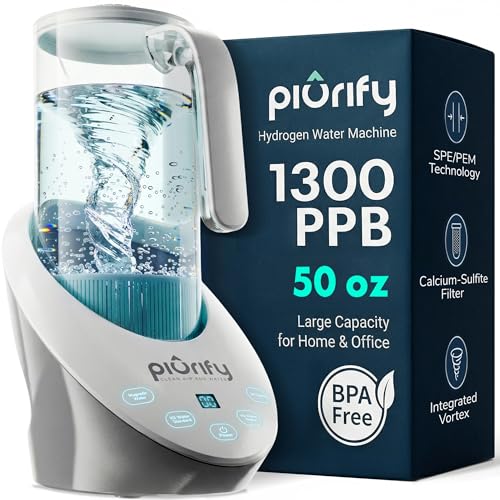
This is a corded countertop hydrogen-water pitcher with a 50-ounce Tritan reservoir, a dock, calcium sulfite cartridge, vortex setting, and two electrolysis cycles. The manufacturer specifies an 8-minute standard cycle at 700 to 900 ppb and a 13-minute higher cycle at 1,000 to 1,300 ppb. It also says to drink the water within 30 minutes. The material description is unusually specific. The manual identifies Tritan, polypropylene filter housing, titanium-platinum generator components, ABS enclosure, and silicone sealing material. A 2023 SGS report for this product model verified only two limited food-contact screens, one each on the submitted ABS and Tritan samples. No public independent report was found that measures this pitcher’s delivered hydrogen after normal handling, retention, finished-water contaminants, electrical safety, or all wetted-material migration.
This product suits an adult household that specifically wants a countertop, corded way to make hydrogen-infused drinking water in batches rather than carry a small rechargeable bottle. It is most practical for users willing to follow the documented routine, including using potable water only, drinking promptly after a cycle, flushing after every 10 electrolysis cycles, descaling when output appears reduced, and replacing the filter cartridge every three months. It also suits buyers who value the stated lifetime defect warranty and can register promptly.
It is not suited to buyers who need independently verified hydrogen concentration, chlorine reduction, contaminant removal, or electrical certification before using a water appliance. It is also a poor fit for people expecting treatment for fatigue, inflammation, cognition, athletic recovery, aging, digestive concerns, or immune conditions, since public evidence does not validate those outcomes for this exact pitcher and delivered dose. Households with high-risk water concerns should not treat its calcium sulfite cartridge as a substitute for a certified contaminant-reduction system.
The clearest independently supported safety finding is narrow rather than comprehensive. SGS tested submitted ABS and Tritan samples from this product model and reported non-detect results for two specified extractables screens under defined water-contact conditions. The report does not assess the titanium-platinum generator, polypropylene filter housing, silicone seal, complete assembly, long-term wear, or finished water after electrolysis. The instructions give useful contamination-control steps, including rinsing the pitcher and cartridge, running a self-cleaning program after every 10 electrolysis cycles, discarding self-cleaning water, and replacing the cartridge every three months. The product is corded, not rechargeable, so it avoids an onboard lithium battery, but it still contains electronics and no public parts catalog, repair instructions, recycling plan, recycled-content statement, or lifecycle disclosure was found. The manufacturer’s lifetime warranty may reduce premature replacement, but repair availability remains unclear.
This is a rechargeable, single-person hydrogen-water bottle with a 280 mL capacity, an OLED display, USB-C charging, and selectable 5 and 10 minute electrolysis cycles. Lifepro identifies the bottle body as food-grade polycarbonate, with an aviation-aluminum base and a 2,000 mAh lithium-polymer battery. Its manual directs users to fill it no more than 90 percent, use clean drinking water, and drink the treated water within 10 minutes. Lifepro states that the 5 minute cycle reaches about 4,000 ppb dissolved hydrogen and the 10 minute cycle about 8,000 ppb. Those are manufacturer claims, not independently verified results located for this exact product. The product documentation also lists CE, FCC, UL, and RoHS, but no traceable certificate number, test report, or public listing for this model was located. Human studies of hydrogen-rich water are limited and use differing concentrations and much larger daily volumes, so this product's advertised wellness benefits are not established at its claimed delivered dose.
This product fits an adult who specifically wants a small, rechargeable bottle for making a single 280 mL serving of hydrogen water at home, work, or the gym. It is most appropriate for someone willing to follow detailed handling instructions, including using clean low-mineral water, hand washing the bottle body daily, descaling monthly, keeping the product upright, and drinking shortly after a cycle. The buyer should treat the hydrogen concentration and wellness effects as manufacturer-stated, rather than clinically confirmed outcomes.
It is not suited to anyone seeking a verified therapeutic tool for fatigue, pain, anxiety, depression, inflammation, metabolic disease, athletic performance, or any other health condition. People who need independently documented food-contact, electrical, or finished-water safety testing should choose a product with traceable certification and full test reports. It is also unsuitable for households needing dishwasher-safe cleaning, for users likely to add electrolyte mixes or other liquids, and for anyone unable to maintain the specified daily and monthly cleaning routine.
The identified wetted bottle body is polycarbonate, with a silicone seal and an aluminum base. Lifepro calls the polycarbonate food-grade, but independent food-contact migration or extractables testing for the finished product was not located. Likewise, no independent report was found showing that the actual electrolysis cycle avoids unwanted byproducts or changes finished-water chemistry when used with the permitted water types. The manual has useful risk controls, including limits on water temperature, a warning not to operate while charging, restrictions on fast chargers, pressure and leak precautions, and instructions to dispose of the battery and parts under local and federal rules. Its listed CE, FCC, UL, and RoHS claims could not be independently traced to a public certification record for this model. On October 23, 2025, CPSC announced a separate Lifepro recall for Bioremedy infrared sauna blankets due to overheating and burn hazards. That recall does not identify this water bottle.
This is a rechargeable, personal hydrogen-water generator with a 460 ml borosilicate-glass bottle body, a USB-C charging cable, and a stated 5-minute electrolysis cycle. It is intended to add molecular hydrogen to drinking water for ordinary hydration, with the listing also promoting energy and recovery-oriented wellness uses. The product listing states up to 6000 PPB hydrogen, more than 20 cycles per charge, six-hour hydrogen retention, and SPE/PEM technology. Those are manufacturer-stated specifications, not independently confirmed results for this exact product. No full third-party dissolved-hydrogen report was located that identifies the water source, fill volume, temperature, cycle, measurement delay, analytical method, or retained concentration. The listing also refers to CE, RoHS, FCC, and FDA-grade materials, but it does not provide traceable certificate numbers, issuer records, or complete reports for this product.
This product suits an adult who specifically wants a small, rechargeable personal bottle for making hydrogen water at home, at a desk, or while traveling, and who treats the wellness claims as unconfirmed. The 460 ml capacity and stated five-minute cycle fit someone who is comfortable preparing a single serving at a time and following any water restrictions in the supplied manual. It is most appropriate for users who already have safe drinking water and can keep a glass electronic bottle protected from drops and charging moisture.
It is not suited to anyone seeking a clinically established treatment for fatigue, inflammation, kidney conditions, metabolic disease, or athletic recovery. The product-specific delivered hydrogen dose and retention have not been independently demonstrated. It is also a poor fit for households needing dishwasher-safe, fully disassemblable drinkware, or for people unable to maintain and dry a bottle with an electronic base. Children should not manage charging or a glass vessel without close adult supervision. Users needing documented food-contact migration testing or traceable electrical certification should choose a product with public records and full reports.
The listed bottle body is borosilicate glass, but the product documentation located does not identify every wetted component, including seals, membrane, electrode materials, and any coatings. No independent migration or extractables report was located for the finished bottle after repeated electrolysis use. Likewise, no finished-water report was found showing whether normal cycles with permitted source water avoid unwanted byproducts or material release. The listing's CE, RoHS, FCC, FDA-grade, and SPE/PEM language could not be independently tied to a public certificate, issuing laboratory, or product-specific report. FDA has previously warned another hydrogen-water seller that disease-related hydrogen-water marketing can create unapproved-drug and misbranding concerns. This is not a finding against Fruaros, but it makes precise, non-disease marketing important. No warranty, replacement battery or seal policy, repair instructions, recycled-content evidence, packaging specification, or end-of-life recycling plan was located.
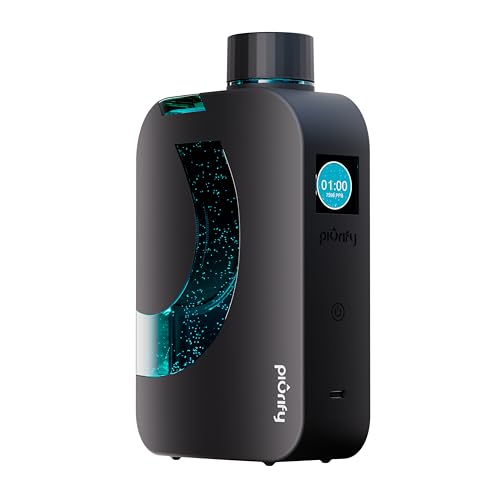
This is a rechargeable 10 oz hydrogen-water bottle with a 1,800 mAh lithium battery, USB-C charging, a display, and 5-minute and 10-minute electrolysis cycles. The instructions say to use potable still water, hand-wash the bottle and cap, keep the electronic base out of water, and drink promptly after a cycle. An externally published H2HUBB report tested a 280 mL Piurify Hydrogenator with distilled water and found averages of 2.80 mg/L after 5 minutes and 3.85 mg/L after 10 minutes, or about 1.08 mg dissolved hydrogen in the tested 10-minute fill. That report used reagent titration, not headspace gas chromatography, and did not establish retention during the product's claimed six-hour storage period. PIURIFY's current product materials are inconsistent, with 4,100+ PPB stated for this compact 10 oz model while other marketing claims exceed 6,200 PPB.
This suits an adult who specifically wants a small, rechargeable hydrogen-water device for fresh, single-serving use and is willing to follow restricted water, charging, and hand-cleaning instructions. The documented 10-minute test result is relevant to someone who values a measured dissolved-hydrogen result more than an unqualified display estimate. It is also more suitable for a user who treats molecular hydrogen as an experimental wellness practice, not as treatment for a medical condition, and who will drink the water soon after generation rather than rely on the claimed storage period.
It is not suited to anyone seeking treatment for fatigue, inflammation, metabolic disease, detoxification, recovery from illness, or another health condition. Human research on hydrogen-rich water remains preliminary and does not validate this product's broad wellness language at its documented single-bottle dose. It is also unsuitable for people intending to use the included nasal cannula, because the available external report advises against bottle-based inhalation. Households needing dishwasher-safe equipment, fully washable wetted parts, verified electrical certification, or replacement batteries and seals should use a product with those records.
The clearest product-specific health evidence is limited but useful. An external H2HUBB report found 2.80 to 3.85 mg/L dissolved hydrogen in a distilled-water test and no detectable chlorine or ozone under that condition. It does not replace a full finished-water contaminant and leachate assessment across the permitted source waters. The available materials descriptions are also incomplete and inconsistent, using broad food-grade PC language while cleaning instructions refer to a glass bottle. No independent migration report for the seals, membrane, electrodes, coatings, or other wetted components was located. PIURIFY states a lifetime warranty, which can support longer use, but no battery-replacement process, spare-parts catalog, recycling instructions, or lifecycle and packaging disclosures were verified. The built-in rechargeable battery and electronic base should not enter ordinary household waste. There was no product-specific public recall located in the reviewed U.S. safety sources, but no traceable public electrical or drinking-water-material certification for this exact product was verified.
This is a rechargeable, 480 ml borosilicate-glass bottle with a silicone sleeve, USB charging cable, and an inhalation tube. It electrolyzes filled water using manufacturer-described SPE/PEM technology and is intended to make hydrogen-rich water for drinking. The maker advertises up to 6,000 ppb hydrogen and broad wellness effects, including skin, inflammation, energy, cognitive, metabolism, and gut-health claims. The key performance figure is not independently established for this exact product. No public, exact-model third-party report was located that identifies the water, fill volume, cycle, measurement method, delay before testing, or hydrogen retention. Documentation also conflicts on use conditions. The product marketing specifies 6,000 ppb in 10 minutes, while the brand FAQ describes an approximately three-minute drinking cycle and says water quality is unrestricted. Its website also displays “FDA approved,” a claim not supported by a traceable FDA authorization.
This product suits an adult who specifically wants a portable hydrogen-water format, understands that the 6,000 ppb figure is manufacturer-stated rather than independently verified, and will treat it as a personal hydration container rather than a health treatment. The 480 ml capacity, glass body, protective sleeve, and stated weekly cleaning cycle fit desk, gym, or travel use where the bottle can be kept upright, promptly cleaned, and fully dried. It is more appropriate for someone using already potable, low-mineral water and willing to follow evolving manufacturer instructions carefully.
It is not suited to anyone seeking evidence-based treatment for inflammation, cognitive symptoms, weight management, metabolic disease, skin changes, or recovery. The product-specific delivered dose has not been independently verified, so its relevance to human hydrogen-water studies cannot be established. It is also unsuitable for households that need clearly validated electrical, food-contact, or finished-water safety documentation, or for users relying on hard, mineral-heavy, or otherwise variable water. Children should not use the included inhalation tube without qualified medical guidance.
Human research on hydrogen-rich water remains preliminary and condition-specific. Systematic reviews identify some small or modest findings, but also call for larger and more rigorous trials. Those studies do not verify this product's dose, retention, or broad consumer-facing claims. The manufacturer says this bottle uses SPE/PEM electrolysis, borosilicate glass, and platinum-coated titanium plates, but no exact-product finished-water chemistry or leachate report was publicly located. The manufacturer documents a weekly cleaning mode and a one-year defect warranty. Those are useful maintenance and service commitments, but there is no published replacement-battery, seal, or parts program, and no end-of-life battery recycling instructions were found. The brand's “FDA approved” website statement did not come with a traceable FDA authorization and should not be read as independent safety or effectiveness verification.
This is a rechargeable, app-connected 12 oz hydrogen-water bottle. It uses a proton-exchange membrane between platinum-coated titanium plates to electrolyze water, then requires the user to release pressure before opening. Echo recommends purified, filtered, or distilled drinking water, a 10 or 20 minute cycle, weekly bottle washing, and monthly generator descaling. A published H2 Analytics report on the Echo Flask recorded mean dissolved hydrogen of 6.07 mg/L after 10 minutes and 8.25 mg/L after 20 minutes in about 350 mL of distilled water, equal to calculated doses of 2.17 mg and 2.89 mg. The measurements were immediate after opening, so they do not establish retention during carrying or delayed drinking. A separate SGS report on a sample labeled Echo Flask found the reported metals, cyanide, surfactants, and common inorganic contaminants at or below its stated reporting limits. The bottle also has an FCC authorization for its Bluetooth transmitter, not a general US electrical-safety certification.
This product suits an adult who specifically wants a portable hydrogen-water generator, will use purified or distilled drinking water, and is willing to run a 10 or 20 minute cycle before drinking. It is most relevant to someone who values a documented concentration test and can follow the pressure-release, hand-washing, and monthly descaling routine. The 12 oz capacity is better suited to single prepared servings than to all-day hydration. Its price also fits a buyer who accepts a specialized rechargeable bottle rather than a conventional reusable bottle.
It is not suited to anyone seeking proven treatment for fatigue, inflammation, athletic recovery, metabolic disease, or another health condition. People who need a dishwasher-safe bottle, a bottle that can be refrigerated, or a fully submersible design should avoid this format. It is also a poor fit for users unwilling to use plain water only, release pressure before opening, keep charging areas dry, and clean on schedule. Households wanting independently certified food-contact and electrical safety documentation should seek a product with those public certifications.
The most useful health evidence is product-specific performance and water testing, not a demonstrated medical outcome. Published testing measured up to 8.25 mg/L dissolved hydrogen after a 20 minute cycle in distilled water. Human research includes small randomized studies at comparable high concentrations, but systematic reviews describe a developing and heterogeneous evidence base. That is not enough to treat the bottle as a therapy. The manufacturer identifies platinum-coated titanium plates and a proton-exchange membrane, while the catalog materials include polycarbonate, polyphenylsulfone, and ABS. SGS testing found the reported metals and several water-quality analytes below stated limits in a sample labeled Echo Flask. However, complete wetted-material and migration documentation was not supplied. The rechargeable design avoids disposable hydrogen cartridges. A five-year prorated warranty and replaceable cap, gasket, cord, and charging block can reduce premature disposal, although the sealed battery and electronic base are not user-repairable.
This is a rechargeable 10 oz polycarbonate bottle that electrolyzes drinking water in a 5 or 10 minute cycle. It has a USB-C charged 1800 mAh battery, an OLED status display, a screw lid and gasket, and a vented base. The product guide says to keep it upright during generation, hand wash it, and drink prepared water promptly. BUZIO states that its SPE and PEM system uses a DuPont membrane and can produce up to 1,600 ppb in five minutes and 3,000 ppb in 10 minutes. A separate guide also states a 4,000 ppb maximum. No full independent laboratory report was located for this exact product showing delivered dissolved hydrogen, retention after normal drinking delays, or finished-water contaminant results. The guide also lists FCC, RoHS, and FDA certification, but no traceable public certificate was located for the product.
This product suits an adult who specifically wants a small, rechargeable hydrogen-water generator for occasional home, desk, or gym use and is prepared to follow a careful maintenance routine. The 10 oz capacity, USB-C charging, display, and 5 or 10 minute cycles fit someone making and drinking one small serving promptly. It is more appropriate for a user treating hydrogen generation as an optional wellness practice, not as a proven treatment or dependable athletic-performance intervention.
It is not suited to anyone seeking clinically established recovery, antioxidant, inflammation, metabolic, or disease-related benefits. It is also a poor fit for people who need high fluid volume during sport, want dishwasher-safe equipment, or cannot reliably hand wash, dry, inspect, and keep an electronic bottle upright. Households with young children should avoid leaving it charging or operating unsupervised. Buyers requiring independently certified electrical, food-contact, or water-quality verification should choose a product with traceable records.
BUZIO identifies the bottle body as BPA-free food-grade polycarbonate and describes a membrane-based electrolysis design with a vent intended to separate or release byproducts. Those are manufacturer statements, not substitutes for independent finished-water testing. No product-specific report was located for chlorine, ozone, metals, organic leachates, pH, or other post-electrolysis water-quality measures. The available guide calls the product FDA certified, but FDA states that it does not certify medical devices or issue registration certificates that imply product approval. No relevant U.S. recall or FDA warning letter for this product was located in the searches performed. The bottle is reusable and BUZIO states a 12-month warranty. Its rechargeable battery and electronics may reduce disposable-bottle use, but they also create an end-of-life electronics and battery stream. No public spare-battery, replacement-membrane, gasket-parts catalog, repair procedure, recycled-content record, packaging specification, or lifecycle assessment was located. The non-removable electronic components and inaccessible membrane limit repair and thorough cleaning.
This is a rechargeable, single-serving hydrogen-water flask with a claimed 12 oz capacity, 5,000 mAh battery, USB-C charging, 10- and 20-minute electrolysis cycles, and a self-cleaning program. Piurify describes the wetted bottle body as BPA-free copolyester and directs users to use filtered or still mineral water, avoiding sparkling or high-mineral water. It also says to drink promptly after a cycle. Piurify claims up to 8,630 PPB dissolved hydrogen and displays an H2 Analytics report. However, the linked report identifies a different 500 mL unbranded Piurify bottle and reports 2,540, 4,240, and 6,290 PPB after 5, 10, and 20 minutes. It does not verify this flask or its 8,630 PPB claim. Human research on hydrogen-rich water remains limited and mixed, so the advertised recovery, energy, antioxidant, and hydration claims go beyond product-specific evidence.
This product fits an adult who specifically wants a small rechargeable hydrogen-water device for occasional, prompt single servings and is prepared to follow the stated water restrictions. The written limited lifetime warranty may matter to a buyer seeking manufacturer support for defects. Its intended role is a supplemental wellness routine, not primary daily hydration, because the capacity is small and the manufacturer itself advises drinking each prepared serving fresh. The buyer should treat the advertised concentration and wellness effects as unconfirmed for this exact flask.
It is not suited to anyone seeking medically established help for fatigue, inflammation, athletic recovery, metabolic conditions, or hydration problems. The product-specific dose supporting those outcomes has not been independently verified. It is also unsuitable for households needing a fully documented food-contact vessel, validated microbial cleaning process, or independently listed battery and charger safety certification. People who routinely use sparkling water, very mineral-heavy water, dishwasher cleaning, or need an all-day water bottle should select equipment designed and documented for those conditions.
The product is described by Piurify as BPA-free copolyester, and the company has a written lifetime limited warranty for manufacturing defects. These are useful durability signals, but there is no public migration or extractables report identifying every wetted seal, membrane, electrode, and coating or measuring realistic-use leachates. No recycled-content, packaging, lifecycle, repair-parts, battery-replacement, or end-of-life recycling documentation was found. Piurify's linked H2 Analytics report uses static-headspace gas chromatography and describes a pressure-relief design, but it applies to a different 500 mL bottle. It therefore cannot establish this flask's advertised 8,630 PPB output, material safety, or byproduct safety. No Piurify-specific recall or FDA warning letter was found in the checked sources. The FDA has, however, warned another hydrogen-water seller that disease-related hydrogen-water claims can cause a product to be regulated as an unapproved drug, which makes restrained wellness marketing important.
This is a rechargeable, personal hydrogen-water bottle with a stated 460 ml capacity, a borosilicate-glass bottle body, and a listed size of 2.7 by 2.7 by 9.1 inches. It is intended to electrolyze suitable drinking water using manufacturer-stated SPE and PEM technology, rather than to make unsafe water potable. The product claims up to 5000 PPB dissolved hydrogen and retention above 1.6 ppm for eight hours, but no full independent laboratory report for this exact product, cycle, water type, temperature, or time-to-measurement was located. Its advertised certification language is not traceable to a public certificate number or product listing. Related marketplace copies also vary between 4500 and 5000 PPB and refer variously to SGS or TÜV, which makes the concentration and certification claims difficult to verify.
This product fits an adult who wants a compact personal bottle for occasional hydrogen-water experimentation and already has potable purified or mineral water available. That user should be comfortable treating the stated 5000 PPB figure, retention statement, and certification language as unverified manufacturer claims. The 460 ml size is most suited to a single serving at a desk, during travel, or after exercise, not to supplying a household or replacing a conventional water-treatment system.
It is not suited to anyone seeking medically supported help with fatigue, sleep, immunity, metabolism, inflammation, athletic recovery, or a diagnosed condition. The finished product has no located human clinical evidence at a verified delivered dose. It is also unsuitable as a water purifier for questionable tap, well, camping, or emergency water, because the available instructions point users toward purified or mineral water and do not document contaminant removal. Households needing traceable electrical certification, independently tested materials, or repairable rechargeable equipment should select a product with those records.
The key health issue is evidence matching. Human research on molecular hydrogen remains limited and mixed, and the product itself has no located clinical study or independent test confirming the amount retained when it is actually consumed. Broad claims about metabolism, immune defense, sleep, muscle recovery, and post-workout fatigue therefore go beyond what can be established for this specific bottle. FTC guidance calls for competent and reliable scientific evidence for health claims, commonly including well-designed human trials. Borosilicate glass is the stated main bottle material, but the product does not publicly identify every wetted seal, membrane, electrode, coating, and internal metal component. No exact-product migration, finished-water chemistry, or electrolysis-byproduct report was located. There was also no publicly traceable certificate supporting the advertised safety language, nor clear documentation for battery replacement, spare seals, warranty duration, recycling, recycled content, or packaging impacts. No United States recall or regulator warning specifically naming this product was located in the reviewed searches.


