Best Overall
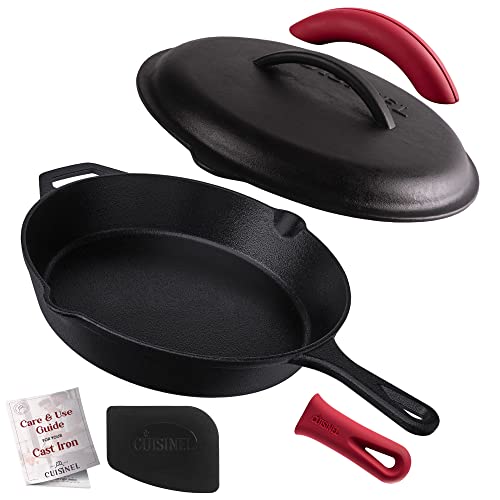
Cuisinel Cast Iron Skillet with Lid Set
Pre-seasoned for easy, non-stick cooking.
Includes silicone handle for safe grip.
Versatile for oven, stovetop, and camping.
 Lauren Wilson
Pre-seasoned for easy, non-stick cooking.
Includes silicone handle for safe grip.
Versatile for oven, stovetop, and camping.

Versatile for all cooking surfaces.
Includes comfortable silicone handle grips.
Durable and pre-seasoned for easy use.

Excellent heat retention and even cooking.
Durable and versatile for various recipes.
Comfortable silicone handle for safe handling.

Excellent heat retention and distribution.
Pre-seasoned, ready for immediate use.
Durable construction for long-lasting performance.

Durable cast iron construction ensures even heat distribution.
Glass lid allows easy monitoring while cooking.
Silicone handle holder offers safe, comfortable grip.

Smooth surface enhances cooking performance.
Lightweight design makes handling easier.
Versatile use on multiple heat sources.

Smooth surface ensures even cooking.
Pre-seasoned for immediate use.
Versatile for campfires, stoves, and ovens.

Durable and long-lasting cast iron construction.
Pre-seasoned for easy, non-stick cooking.
Versatile set suitable for various cooking needs.

Excellent heat distribution and retention.
Durable construction for long-lasting use.
Versatile for a variety of cooking methods.

Durable and long-lasting cast iron construction.
Even heat distribution for better cooking results.
Pre-seasoned for convenient, non-stick use.
The first question is what actually touches food. Look for a plain disclosure of the food-contact material and every seasoning or coating ingredient. “Pre-seasoned,” “naturally nonstick,” “non-toxic,” “chemical-free,” and “PFAS-free” are not interchangeable. A high-confidence product would identify the seasoning, distinguish baked oil from a synthetic coating, and support chemical claims with a current product- or batch-specific report. The most important missing evidence across this category is accredited testing for lead, cadmium, arsenic, and other toxic-metal migration, particularly under acidic cooking conditions. A complete report should identify the sample and method and come from a laboratory whose applicable scope is accredited to ISO/IEC 17025. FDA cookware guidance and its Elemental Analysis Manual method are relevant reference points; a seller statement alone is not equivalent to a test result.
Performance claims also need boundaries. “Oven safe,” “induction compatible,” “campfire safe,” and “500°F” do not necessarily establish flatness, resistance to cracking or warping, handle strength, or safe use of a grip accessory at that temperature. Check the manual for separate limits on the pan, handle, silicone holder, lid, broiler, grill, and rapid temperature changes. A glass lid should have credible thermal-shock limits and clear restrictions. A cast-iron lid avoids glass breakage concerns but still becomes hot. A handle cover can reduce contact heat without making a hot skillet safe to lift bare-handed.
Headline figures can mislead. A listed capacity may conflict with the physical format, and a set’s catalog weight may exclude packaging or accessories. A “12-inch” pan can still differ substantially in working surface, helper-handle design, and total weight. A one-year marketplace warranty may conflict with a manufacturer’s current limited-lifetime terms, so retain purchase records and check the official conditions. High review counts and ratings describe popularity, not food-contact testing, thermal testing, or defect rates. Likewise, a company-level recycled-content or packaging claim is not a product-specific life-cycle assessment or environmental declaration.
Buyers should also consider the iron-health context. Iron transfer to food varies with the food and cooking conditions, and the supplied reviews do not support treating an iron skillet as a predictable nutrition dose or as treatment for iron deficiency. People with iron-overload disorders or clinician-directed iron restrictions should seek individualized medical advice. Across the supplied products, no category-wide contamination finding or universal contraindication was established. However, repeated warnings make several precautions important: hot cast iron is heavy, handles become hot, and some pans lack a helper handle or supplied grip; users with limited grip strength, reduced heat sensation, or unstable handling should choose carefully. None of the reviewed products supplied the complete product-specific toxic-metal migration evidence that a cautious buyer might want for frequent acidic cooking. Rust, flaking seasoning, rough casting, pitting, and sticky surfaces remain care and quality-control concerns, and dishwasher use is generally incompatible with the stated care instructions.
## Health and Ecology Iron skillets can be durable cookware, but a responsible choice depends on the food-contact surface, handling limits, care demands, and the quality of evidence behind safety and environmental claims. The supplied scores distinguish documented disclosures and practical protections from unsupported assurances; they do not establish that any product is risk-free.
This measures evidence that the actual cooking surface and seasoning avoid harmful lead, cadmium, arsenic, and other toxic-metal migration. It matters because bare iron and its seasoning contact food directly, including acidic food. Among the supplied products, the stronger scores were 76 for one large Lodge skillet and 75 for two others, but no product had the batch-specific acidic-food leach evidence required for the highest confidence.
This measures whether a seller explains that iron transfer depends on the food and cooking conditions rather than presenting a skillet as treatment for iron deficiency. Scores ranged from 58 to 78. Higher-scoring reviews gave bounded guidance and cautions for iron overload; lower-scoring products used less complete health framing. Buyers should not treat cookware as a controlled iron supplement.
This measures whether weight, handle geometry, helper handles, grip accessories, and warnings reduce burns and drops during normal use. It is especially relevant because cast iron remains heavy and its handles heat up. Scores ranged from 52 to 75: higher-scoring products offered clearer handling support or warnings, while the lowest-scoring set was about 32 pounds and had hot cast-iron handles.
This measures credible temperature limits and thermal-shock or breakage guidance for lids, silicone holders, and other accessories. It matters when a glass lid or grip is used with hot iron. Scores ranged from 70 to 82. The stronger products either avoided a glass lid, used a cast-iron lid, or supplied a stated limit; broad heat-resistant wording without limits scored lower.
This measures resistance to rust, pitting, flaking seasoning, rough casting, and persistent sticking under the stated care routine. It matters because seasoning is the working release surface and must be maintained. Scores ranged from 62 to 80. Higher-scoring products had more practical restoration guidance and stronger longevity support; lower-scoring ones had reports of inferior seasoning or casting defects.
This measures whether the skillet remains stable and intact at its stated temperatures and on its claimed cooktops, grills, or fires. It matters because generic compatibility does not prove flatness, crack resistance, or handle strength. Scores ranged from 68 to 77. Higher-scoring products supplied clearer operating boundaries, while several still lacked product-specific thermal or flatness testing.
This measures whether material, safety, temperature, and performance claims are supported by a current third-party certificate or complete report from an appropriately accredited laboratory. Scores ranged from 68 to 72, showing a narrow spread but a common evidence gap. No supplied product had a publicly auditable report sufficient to verify all major food-contact and performance claims; ISO/IEC 17025 scope, NSF listings, and certificate databases are useful checks.
This measures whether the seller identifies every food-contact material and seasoning ingredient and separates oil seasoning from synthetic nonstick chemistry. Scores ranged from 58 to 83. Higher-scoring products named soybean, vegetable, or grapeseed oil and described baked seasoning; the lowest-scoring product used an ambiguous “nonstick” description alongside vegetable-oil seasoning without resolving whether another coating was present.
This measures whether the product has an identifiable manufacturer or U.S. seller, model or lot information, reachable support, and no unresolved safety action. Scores ranged from 69 to 79. Higher-scoring products had clearer manufacturer identity, model information, support, and warranty paths. Lower scores reflected less complete traceability or weaker public support information, even where no matching recall was found.
This measures whether claims about non-toxicity, nonstick performance, PFAS, weight, capacity, origin, and temperature are qualified and internally consistent. Scores ranged from 50 to 76. Higher-scoring products had clearer disclosures and fewer conflicts; lower-scoring products relied on broad safety language, conflicting weights or capacities, or unsupported performance claims. A specific limitation is more useful than an absolute promise.
This measures whether a skillet can stay in service through durable construction, re-seasoning, repair or replacement support, minimal disposables, and eventual metal recycling. Scores ranged from 71 to 86. The strongest result came from a product with a limited lifetime warranty and documented recycled-material and foundry practices; lower-scoring products lacked warranty, replacement-part, or end-of-life details.
This measures product-specific transparency about manufacturing, emissions, packaging, transport, and life-cycle impacts. Scores ranged from 52 to 82. The higher-scoring Lodge products had company reporting on foundry operations, recycled material, or packaging, but still lacked a product-specific life-cycle assessment or verified environmental declaration. The lowest score reflected largely undocumented manufacturing and packaging claims.
This is a 12-inch bare cast-iron frying pan sold as a covered set with a cast-iron lid, silicone holders, and a pan scraper. An independent wholesale listing identifies this exact covered set as made in China and gives a packaged weight of 16.31 pounds. It is intended for stovetop, oven, grill, campfire, and induction use. Cuisinel states that its cast-iron cookware is pre-seasoned with organic vegetable oil, and describes seasoning as oil baked into the iron rather than a synthetic nonstick layer. The company also provides a limited lifetime warranty for defects in materials and workmanship for the original U.S. owner. No product-specific accredited laboratory report for lead, cadmium, other toxic-metal migration, PFAS, temperature performance, or flatness was located in this review.
This product suits an experienced home cook who wants a large covered cast-iron pan for searing, shallow frying, braising, baking, or outdoor cooking, and who is prepared to hand wash, dry promptly, and restore oil seasoning when needed. The cast-iron lid is useful for covered stovetop work without relying on a glass cover. It also fits a buyer who values a stated lifetime defect warranty and accepts that the set is heavy and that independent food-contact test documentation was not found.
It is not well suited to anyone who needs documented, product-specific proof of low toxic-metal migration before cooking for children, pregnancy, or other exposure-sensitive households. People with hereditary hemochromatosis or other iron-overload concerns should seek individualized clinical guidance rather than treating cast iron as neutral or therapeutic. It is also a poor fit for users unable to safely manage a heavy hot pan and lid, or for cooks who want dishwasher use, maintenance-free release, clearly tested silicone temperature limits, or tightly reconciled capacity and weight specifications.
Cuisinel identifies the cooking surface as cast iron and its pre-seasoning as organic vegetable oil. That is a clearer disclosure than an unexplained nonstick label, and the company explains how to renew the oil seasoning. However, no product-specific independent report was located to establish migration levels for lead, cadmium, arsenic, or other metals. FDA cookware alerts reviewed for this assessment concern certain aluminum, brass, and related alloy cookware, not this cast-iron product. No Cuisinel recall or FDA safety action for this product was located in the searched public sources. Cast iron can remain usable for many years when rust is removed and seasoning is renewed. Cuisinel's stated limited lifetime warranty supports repair-or-replace longevity, though it excludes overheating, misuse, commercial use, and normal cosmetic casting variation. Cast iron is widely recyclable as ferrous scrap, but Cuisinel did not provide product-specific recycled-content, packaging-material, foundry-emissions, transport, life-cycle, or environmental-product-declaration evidence in the materials reviewed.
This product is a three-piece bare cast-iron frying-pan set, with 8-inch, 10-inch, and 12-inch pans and three silicone handle covers. It is intended for stovetop, oven, grill, and outdoor-fire cooking, with hand washing, prompt drying, and repeat oil seasoning required to keep the cooking surface usable. Cuisinel’s own product page identifies the pans as factory-seasoned cast iron and lists the three diameters. Its care instructions give practical rust-restoration and re-seasoning directions, state that silicone covers are oven safe to 350°F, and warn that the covers can still become hot and are not substitutes for oven mitts. No product-specific accredited laboratory report for lead, cadmium, other metal migration, seasoning composition, or thermal performance was located in the verification work.
This set suits a household that wants several traditional cast-iron pan sizes and is prepared to maintain them. The 8-inch pan fits smaller portions, while the 10-inch and 12-inch pans allow larger frying, baking, and searing tasks. It also suits users who cook across induction, gas, electric, grill, or campfire settings and already use oven mitts. The owner should be comfortable hand washing, thoroughly drying, lightly oiling, and occasionally re-seasoning cookware.
It is not suited to anyone seeking documented heavy-metal migration results, a fully disclosed factory seasoning formula, or a verified PFAS-free certification. It also does not fit users who need dishwasher-safe cookware, low-maintenance nonstick performance, or a clearly independently tested oven-temperature rating. Children, people with limited grip strength, and anyone likely to move a hot heavy pan using only the silicone cover need extra caution. The covers are not substitutes for oven mitts, according to Cuisinel’s instructions.
The food-contact surface is described by Cuisinel as pre-seasoned cast iron rather than a synthetic nonstick coating. That distinction matters, but the exact factory seasoning oil and any product-specific testing for lead, cadmium, arsenic, or other metal migration were not found. FDA has warned about lead-leaching imported cookware in certain aluminum, brass, and related alloys, not this cast-iron product. Still, the absence of a warning is not equivalent to an independent safety test. Cuisinel says seasoning may flake during early use and directs owners to restore the surface with oil seasoning. Its site also offers a limited lifetime household warranty, which can support long use if the pans are maintained. Cast iron is a durable, recyclable material in principle, but no product-specific recycled-content evidence, foundry location, packaging specification, life-cycle assessment, or environmental product declaration was located. Cuisinel’s references to cast iron’s health benefits should not be read as treatment guidance for iron deficiency. Human evidence indicates iron transfer and health effects vary by food and use conditions.
This product is a 12-inch, pre-seasoned cast-iron skillet with an assist handle and a red silicone holder for its long handle. At 7.5 pounds in the catalog specification, it is a substantial everyday pan for searing, frying, baking, braising, and use on induction or other heat sources. The product does not include a lid. The product manual identifies it as made in the United States and says its seasoning is soy vegetable oil baked into the iron, not a synthetic nonstick layer. Lodge's current California cookware disclosure lists iron, several alloy-related constituents, and soybean oil for its seasoned cast iron. Lodge also says third-party laboratories verify PFAS and dangerous lead and cadmium levels, but it does not publish a product-specific laboratory report, methods, detection limits, or laboratory accreditation for this skillet. The included holder has a 500 F manufacturer-stated heat-protection limit, but hot cast iron and the assist handle still require a dry mitt or holder.
This product suits a household cook who wants a large, bare cast-iron skillet for stovetop and oven cooking, and who is comfortable with routine seasoning care. Its 12-inch format is practical for family-size sautéing, browning, cornbread, skillet baking, and searing where heat retention matters more than quick responsiveness. It also fits users who value a disclosed iron-and-soybean-oil cooking surface and want a product with a documented limited lifetime warranty. The user should have secure storage, a strong grip, and oven mitts available for both handles.
It is not well suited to anyone who needs a lightweight pan, has reduced hand strength, or may struggle to control a hot 7.5-pound skillet. It is also a poor fit for cooks wanting dishwasher convenience, a maintenance-free release surface, or a permanently cool handle. People with a soy allergy should note the manufacturer-stated soybean-oil seasoning, even though it is baked onto the surface. Those seeking documented toxic-metal migration testing for acidic cooking should choose a product accompanied by a current, product-specific accredited lab report.
For food contact, Lodge gives unusually clear manufacturer disclosure for seasoned cast iron. It identifies the cooking surface as iron with soybean-oil seasoning and says the cookware is made without PFOA and PTFE. Its disclosure also names phosphorus, manganese compounds and strontium in the cast iron. Lodge reports third-party testing for PFAS, lead and cadmium, but the underlying report for this product is not public, so that assurance cannot be independently checked. Cast iron can add iron to food, but published human evidence finds the health effect variable, so this skillet should not be treated as iron-deficiency therapy. People with iron-overload disorders should seek clinical guidance. The environmental record is comparatively detailed at the company level. Lodge reports that its melt averages over 60% recycled material, remelts returns and production scrap, and uses recyclable paper-based packaging for skillets. The pan is repairable through rust removal and reseasoning, and the warranty covers manufacturing defects such as cracks and warping. Lodge has not supplied a product-specific life-cycle assessment or independently verified environmental product declaration.
This is a 12-inch, 3-quart bare cast-iron skillet with a cast-iron long handle and a helper handle. The listed weight is 7.9 pounds. It is intended for pan-frying, sautéing, roasting, baking, grilling, and campfire cooking. The Spacious Skies design is a commemorative casting on this particular unit, not a separate food-contact coating. Independent retail specifications identify it as a U.S.-made, 12-inch Lodge skillet seasoned with vegetable oil and sold without a lid or silicone grip. Lodge states that its traditional cast iron is sprayed with soy-based vegetable oil and baked to create the initial easy-release seasoning. That clarifies the cooking surface, but no product-specific accredited-laboratory report for lead, cadmium, arsenic, or other metal migration was located.
This product suits a household cook who wants a large, uncoated cast-iron skillet for searing, cornbread, shallow frying, roasting, or outdoor cooking and is comfortable maintaining seasoning. Its 12-inch diameter makes sense for family portions, one-pan meals, and recipes that benefit from retained heat. The helper handle is useful for two-handed transfers, especially from oven to counter. It also fits users who value a U.S.-made pan with a documented limited lifetime warranty and do not need a lid or a lightweight everyday skillet.
It is not suited to anyone who cannot safely manage a 7.9-pound hot pan, including users with limited grip strength, reduced hand sensation, or an unstable cooking setup. It is also a poor fit for households that want dishwasher-safe cookware, a permanently low-stick factory coating, or minimal maintenance. People who require documented product-specific testing for lead and other toxic-metal migration, particularly for frequent acidic cooking, will find that evidence missing. Those with iron-overload disorders should seek individualized medical guidance rather than treating cast iron as neutral cookware.
The cooking surface is disclosed as cast iron with oil seasoning. Lodge says its traditional seasoning is soy-based vegetable oil baked onto the iron, and this product is marketed without PFAS or a synthetic nonstick coating. That is useful material information, but it is manufacturer disclosure rather than independent chemical analysis. No product-specific accredited test report for toxic-metal migration was found. The broader evidence on iron cookware indicates that iron transferred to food can vary, and it should not be treated as a proven treatment for iron deficiency. Iron-overload conditions warrant medical advice. Lodge identifies South Pittsburg, Tennessee as the location where its cast iron is melted, molded, finished, and packaged. Its 2025 sustainability reporting states that average cast-iron cookware contains 61% recycled material, and that packaging is 99% plastic-free. These are company-reported line-level figures, not a product-specific life-cycle assessment or third-party environmental declaration. The pan's durability and recyclable iron body support long use, although seasoning care is needed to prevent rust.
This product is a 12-inch pre-seasoned cast-iron skillet supplied with a tempered-glass lid and a removable silicone handle cover. Cuisinel states that it is intended for frying, baking, grilling, broiling, braising, and sautéing, including use on stovetops, induction cooktops, grills, and outdoors. The cooking surface is disclosed by the manufacturer as cast iron pre-seasoned with organic vegetable oil, rather than a stated synthetic nonstick coating. The glass-lid specification is more concrete than most of the pan claims, Cuisinel states that its tempered 12-inch lid is oven-safe to 350°F. No product-specific accredited laboratory report was located for lead, cadmium, other metal migration, PFAS, glass thermal shock, flatness, or maximum pan temperature.
This product suits a home cook who specifically wants a large, traditional cast-iron skillet for searing, shallow frying, baking, and covered stovetop cooking. It is most appropriate for someone comfortable with hand washing, thorough drying, periodic oil seasoning, and using a towel, mitt, or other heat protection around hot iron cookware. The included transparent lid can be useful for simmering or reducing splatter, provided its 350°F manufacturer-stated oven limit is observed. Registration is important for access to the stated lifetime warranty.
It is not well suited to a buyer who needs independently documented toxic-metal migration testing, accredited PFAS verification, or a fully specified food-contact chemical disclosure. Households managing iron overload disorders should not treat cast-iron cooking as medically neutral or as a substitute for clinician-directed dietary advice, since iron transfer can vary with food and cooking conditions. It is also a poor fit for anyone unable to safely manage a heavy hot pan, or for frequent high-heat oven and broiler use where the glass-lid and silicone-cover limits are not clearly documented.
The manufacturer discloses a cast-iron cooking surface pre-seasoned with organic vegetable oil. That makes the claimed cooking surface more transparent than an unspecified nonstick finish, but it does not replace independent testing for lead, cadmium, arsenic, PFAS, or migration during acidic cooking. No product-specific accredited laboratory report or third-party certification was located. FDA warnings found in this review concern certain imported aluminum, brass, and Hindalium cookware, not this identified cast-iron product. Iron cookware can increase iron in food under some conditions, but the amount depends on the food and cooking conditions. It should not be represented as a treatment for iron deficiency. Cast iron is inherently durable and recyclable as metal, and Cuisinel lists replacement lids plus a limited lifetime registered warranty. However, no product-specific recycled-content, foundry-location, packaging-material, emissions, or life-cycle documentation was located.
This is a 12-inch, 3.1-quart bare cast-iron skillet for frying, searing, sautéing, oven cooking, grilling, and open-flame cooking. Cooklife lists a 6.1-pound weight, a one-piece cast-iron body and handle, induction compatibility, hand washing, and a 500 F maximum temperature. The current product package is stated to include a silicone handle holder, wooden spatula, and printed cooking materials. The food-contact surface is described by Cooklife as machined cast iron with three coats of grapeseed-oil seasoning, rather than a synthetic nonstick coating. Cooklife also claims SGS testing to U.S. FDA standards and gives a stated leachable-lead result in brand material, but it does not publish the underlying report, laboratory scope, sample identification, or certificate number needed to independently confirm that claim for this product.
This product suits a home cook who specifically wants a smooth, bare cast-iron skillet for routine eggs, vegetables, searing, shallow frying, and oven finishing, while accepting hand washing and periodic oiling. Its stated 12-inch diameter and 3.1-quart capacity fit family-sized portions, and the stated 6.1-pound weight may be easier to manage than many larger cast-iron skillets. It also fits users with induction, gas, electric-coil, or glass cooktops who will preheat gradually and use a dry mitt or holder every time.
It is not well suited to anyone who needs documented, product-specific toxic-metal migration testing before using cookware, especially for frequent long acidic cooks. Choose another format if lifting roughly six pounds one-handed is difficult, if a helper handle is needed for safe transfers, or if children may reach a hot exposed handle. It is also a poor fit for dishwasher users, people unwilling to maintain seasoning, or cooks who regularly simmer tomato, citrus, wine, or other acidic foods for extended periods.
The main health-relevant disclosure is relatively specific for this type of skillet. Cooklife says the cooking surface is cast iron, polished smooth, and seasoned with three coats of grapeseed oil. That is more useful than a generic nonstick claim. However, its public SGS and FDA-compliance language is not accompanied by a report number, complete laboratory report, or sample traceability, so the claimed lead result and broader toxic-metal assurances cannot be independently confirmed for this product. Cooking in iron cookware can alter food iron content, but human evidence is mixed and depends on food and cooking conditions. This product should not be treated as an iron-deficiency intervention. Cooklife also gives useful restoration instructions and advertises a lifetime warranty, though public warranty terms and replacement-part details were not located. Cast iron can be handled as scrap metal where locally accepted, but Cooklife provides no verified recycled-content figure, foundry disclosure, product life-cycle assessment, or substantiated packaging-footprint documentation.
This is a 10-inch, about 2-inch-deep cast-iron frying pan intended for searing, sauteing, baking, grilling, and open-flame cooking. A retailer listing identifies both its cooking surface and exterior as cast iron, with no lid included. The same listing presents a roughly 4.75-inch bare metal hanging handle, so it should be treated as a hot surface during stovetop, oven, grill, and campfire use. The seller states that the polished cooking surface is pre-seasoned with vegetable oil rather than describing a separate synthetic nonstick chemistry. It also gives hand-wash, dry, and oil-after-use care directions to manage rust. No product-specific toxic-metal migration report, accredited laboratory certificate, temperature limit, or independent performance test was located. Syndicated listings also give conflicting weight and capacity figures, making those specifications less reliable than the stated 10-inch diameter.
This product suits a home cook who specifically wants a 10-inch bare cast-iron pan for small skillet meals, browning, oven finishing, or outdoor fire cooking. It is most appropriate for someone already comfortable with cast-iron routines, including hand washing, immediate drying, light oiling, and using a mitt on a hot handle. The disclosed vegetable-oil seasoning and smooth polished surface may also appeal to cooks who want the initial cooking finish identified rather than left wholly unexplained.
It is not well suited to anyone who needs documented food-contact testing for toxic-metal migration, such as households seeking evidence beyond a material claim before regularly cooking acidic foods. People with limited grip strength, reduced heat sensation, or difficulty lifting hot cookware should consider the bare metal handle and approximately five-to-six-pound reported weight carefully. It also does not fit buyers who need dishwasher use, a supplied lid, a stated maximum oven temperature, or precise verified capacity and weight specifications.
The available retail documentation describes bare cast iron with a vegetable-oil pre-seasoning process. That is useful surface disclosure, but the exact oil is not named and no independent report was found showing migration results for lead, cadmium, arsenic, or other toxic elements. FDA notes that foodware can release toxic elements and that testing methods depend on the material and intended use. The FDA's recent imported-cookware warnings concern particular aluminum, brass, and related alloy products, not this cast-iron product. No product-specific recall, FDA enforcement action, or public safety warning was identified in the reviewed sources. Cast iron is inherently a long-service material if its seasoning is maintained, and it is generally recyclable as ferrous scrap. However, no product-specific warranty, replacement-parts program, recycled-content claim, manufacturing location detail beyond imported origin, packaging specification, or life-cycle assessment was located.
This is a 28-pound, five-piece seasoned cast-iron cooking set. It includes 8-inch and 10.25-inch skillets, a 10.5-inch round griddle, a 5-quart Dutch oven, and a cast-iron cover. The manufacturer states that the cover fits the larger skillet, griddle, and Dutch oven. The set is intended for stovetop, oven, grill, campfire, and induction cooking. The food-contact surface is bare cast iron with factory seasoning, rather than a synthetic nonstick coating. Lodge identifies the seasoning as soy-based vegetable oil and says no synthetic chemicals are added. Lodge also says it uses third-party laboratories to verify PFAS and dangerous levels of lead and cadmium, but it does not publish a product-specific laboratory report, test method, batch result, or accredited laboratory identity. The supplied cover is cast iron, not glass, so there is no glass-lid thermal-shock issue.
This set suits a household that wants a basic cast-iron collection for searing, baking, griddling, braising, and outdoor cooking, and is prepared to maintain seasoning after use. It is especially practical for buyers who want a smaller skillet for eggs or side dishes, a larger skillet for everyday stovetop cooking, and a 5-quart Dutch oven without collecting each piece separately. It also fits cooks using induction or those who regularly move cookware among stove, oven, grill, and campfire.
It is not a low-maintenance choice for households that need dishwasher-safe cookware, acid-food convenience, or a consistently slick surface without periodic oiling and re-seasoning. People with limited hand strength, impaired grip, burn-risk concerns, or difficulty lifting heavy cookware should account for the mass of cast iron and its exposed hot handles and lid. Buyers who require published batch-level toxic-metal migration testing, an accredited laboratory report, or a named third-party food-equipment certification should choose a product with those documents publicly available.
The relevant health feature is the disclosed cooking surface. Lodge describes traditional cast iron seasoned with soy-based vegetable oil, and its seasoning guidance says the oil is refined so soy proteins are removed. The company also states that it uses third-party laboratories to check PFAS and dangerous levels of lead and cadmium. However, no public report establishes results for this particular set, including under acidic cooking conditions. Cast-iron cooking should not be treated as treatment for iron deficiency. Human evidence suggests iron transfer and hemoglobin effects can vary, and clinical care remains appropriate for diagnosed deficiency or iron overload concerns. For longevity, the manufacturer offers a limited lifetime warranty that includes qualifying cracks, warps, and casting defects in normal household use. Bare cast iron can remain usable through re-seasoning, and metal is generally recyclable at end of life. Lodge publishes sustainability reporting and identifies its Tennessee foundries, but a product-specific life-cycle assessment, verified environmental product declaration, recycled-content percentage, and detailed packaging specification were not located. No recall or FDA exposure warning specific to this product was located in the checks performed.
This is a nested set of three bare cast-iron frying skillets, in 6, 8, and 10 inch sizes. It is intended for frying, sautéing, roasting, and outdoor cooking. The manufacturer lists oven, stove, grill, and campfire use, and the catalog record identifies the pans as hand-wash-only cast iron made in China. The cooking surface is described as pre-seasoned. Available product guidance identifies vegetable oil for seasoning and provides instructions for washing, drying, oiling, and re-seasoning. That is manufacturer guidance, not an ingredient specification or an independent chemical test. No product-specific accredited laboratory report for lead, cadmium, arsenic, PFAS, or acidic-food migration was located. Independent product testing did report deep pinhole casting defects in one skillet received for testing, so finish consistency should be checked on arrival.
This set suits a household that wants three compact bare cast-iron pans for tasks that vary by portion size, such as a single egg, a side dish, or a modest stovetop meal. It also fits cooks who will regularly dry and oil cookware after washing, are comfortable building seasoning over time, and already use heat-safe mitts. The stated oven, grill, and campfire compatibility makes it relevant for people who need the same pan format indoors and outdoors. Inspect each pan for rough areas or pits before first use.
It is not suited to people who need documented migration testing for lead, cadmium, arsenic, or PFAS, including households making precautionary choices for young children or frequent acidic-food cooking. It also does not fit users who cannot safely manage a hot, all-cast-iron handle or who want a supplied cool-touch grip. Choose a different format if dishwasher cleaning, a glass lid, an explicitly stated seasoning ingredient list, a published long-term warranty, or verified environmental documentation is important. Buyers sensitive to casting finish should inspect promptly for pits and roughness.
The food-contact surface is described as bare cast iron with vegetable-oil seasoning, rather than a stated synthetic nonstick coating. That distinction matters, but the exact oil blend and any processing aids are not fully disclosed. No product-specific accredited test report was found for toxic-metal migration or other food-contact contaminants. FDA warnings about lead-leaching imported cookware have focused on particular aluminum, brass, and aluminum-alloy products, not this cast-iron set, but that does not substitute for testing of this product. Cooking in iron cookware can increase food iron in some circumstances, yet human evidence is variable and does not establish this skillet as treatment for iron deficiency. People with diagnosed iron-overload disorders should seek clinical guidance rather than use cookware for iron management. Cast iron is durable and recyclable as scrap metal when retired, and its oil-seasoned surface can be renewed. However, no product-specific recycled-content claim, foundry emissions data, life-cycle assessment, packaging specification, or published warranty was located. No matching U.S. recall or FDA safety action was found in the searched public records.
This product is a 12-inch, pre-seasoned cast-iron chef's pan for frying, searing, baking, and outdoor cooking. The current manufacturer marketplace listing identifies cast iron as the pan material and vegetable oil as the pre-seasoning. It also describes stovetop, grill, and camping use. Those are manufacturer statements, not independently validated performance limits. ([business.walmart.com](https://business.walmart.com/ip/Utopia-Kitchen-Cast-Iron-Skillet-12-Inch-Pre-Seasoned-PFAS-Free-Black-Chef-Pan-Even-Heat-Distribution-Stovetop-Oven-Campfire-Grill-Safe-Large-Skillet/20864967684)) The product is sold by Utopia Brands Inc., a traceable U.S. business, and the marketplace page shows no lid included. Its food-contact surface is not presented with a product-specific heavy-metal migration report, accredited laboratory report, or food-equipment certification. Independent testing coverage found the factory seasoning comparatively sticky out of the box, so immediate nonstick performance should not be assumed. ([business.walmart.com](https://business.walmart.com/ip/Utopia-Kitchen-Cast-Iron-Skillet-12-Inch-Pre-Seasoned-PFAS-Free-Black-Chef-Pan-Even-Heat-Distribution-Stovetop-Oven-Campfire-Grill-Safe-Large-Skillet/20864967684))
This product suits a home cook who wants a large, traditional cast-iron pan for searing, frying, baking, or occasional grill and campfire cooking, and who is prepared to hand wash, dry promptly, and maintain the seasoning. It is most appropriate for someone comfortable with the weight and with using an oven mitt or dry towel for the hot handle. It also fits buyers who value a cooking surface that can be re-seasoned after normal wear, rather than a pan with a replaceable synthetic nonstick coating.
It is not suited to anyone who needs documented low-metal migration testing, a certified food-contact standard, or independently verified PFAS and temperature claims. Choose another product if heavy lifting is difficult, if a hot helper handle cannot be managed safely, or if low-maintenance dishwasher cleaning is essential. It is also not appropriate as an iron-deficiency treatment. Iron transfer from iron cookware varies with food and cooking conditions, and medical iron deficiency or iron-overload concerns need clinician-guided care. ([pubmed.ncbi.nlm.nih.gov](https://pubmed.ncbi.nlm.nih.gov/34290890/))
The key health fact is that the product is described by its seller as bare cast iron pre-seasoned with vegetable oil. That is more informative than a generic nonstick claim, but it does not establish the exact oil formulation, the absence of all other processing materials, or safety under acidic cooking. No product-specific heavy-metal leachate report or independent certification was found. The FDA's recent cookware actions concern particular imported aluminum and brass products, not this cast-iron product, so they do not establish a problem here. ([amazon.com](https://www.amazon.com/Utopia-Kitchen-Pre-Seasoned-Cast-Skillet/dp/B00X4WQMAS)) Cast iron can have a long usable life because surface seasoning is maintainable and the metal is widely recyclable. The available evidence does not document recycled content, foundry location, packaging composition, lifecycle impacts, replacement parts, or a product-specific warranty. Cooking in iron cookware can increase food iron in some circumstances, but systematic-review evidence finds variable effects and calls for more research. It should not be treated as a predictable nutrition dose or therapy. ([pubmed.ncbi.nlm.nih.gov](https://pubmed.ncbi.nlm.nih.gov/34290890/))


