Best Overall

PetCove Self Cleaning Automatic Cat Litter Box
Effortless self-cleaning reduces daily maintenance.
Odor removal keeps your home fresh.
App control offers convenient remote management.
 Brianna York
Effortless self-cleaning reduces daily maintenance.
Odor removal keeps your home fresh.
App control offers convenient remote management.

Features advanced safety sensors for protection.
Easy access step designed for senior cats.
Self-cleaning function reduces maintenance effort.

Effortless cleaning with automatic self-cleaning feature.
Comprehensive bundle with accessories and odor control.
Stylish design complements home decor.

Automatically cleans, reducing daily maintenance.
Supports multiple cats effortlessly.
App control for convenient operation.

Self-cleaning feature reduces maintenance time.
Open top design suits multiple cats.
Includes liners and mat for convenience.

Effortlessly maintains cleanliness with self-cleaning feature.
Open-top design offers easy access for cats.
Reduces odor effectively for a fresher environment.

Effortless cleaning with automatic self-cleaning feature.
Safety sensors protect multiple cats while in use.
Includes practical liner bags and litter mat.

Automatic cleaning reduces maintenance effort.
Advanced odor control keeps spaces smelling fresh.
Compact design fits in small areas easily.
Effortless cleaning with automatic waste removal.
Waterproof design prevents messy litter leaks.
Convenient app control via 2.4G WiFi.

Effortless self-cleaning with automatic functionality.
Convenient app control for easy monitoring.
Odor-free waste disposal with trash bags included.
The most important distinction is between an inherently non-entrapment design and a sensor-dependent design. A rotating drum, globe, or rake should not be able to trap, pinch, crush, or close on a cat merely because a sensor, app, or power function fails. A strong safety case would also include model-specific, independently documented occupied-entry, obstruction, sensor-fault, stop, and reversal testing. Manufacturer descriptions of infrared, weight, motion, gravity, overload, or anti-pinch sensors are useful, but they are not the same as independent testing.
Electrical and connected-device claims need similar checking. A wireless product should have a model-matched FCC authorization, while electrical-safety claims should be traceable in UL Product iQ, Intertek’s ETL directory, or TÜV SÜD Certipedia. A laboratory report should identify the exact model and come from an ISO/IEC 17025-accredited laboratory. An FCC record confirms radio authorization; it does not establish mechanical pet safety or complete-appliance electrical safety. No supplied product had publicly located independent testing that fully verified its mechanical fail-safe claims, and most lacked a public UL, ETL, or TÜV listing.
Fit and welfare are practical safety issues. Check the published minimum age and weight, maximum weight, entry height and width, interior space, footing, cleaning delay, litter type, and whether automatic mode must be disabled for kittens, pregnant or nursing cats, or cats with mobility limitations. A large capacity figure does not prove a large usable interior. A stated cat-weight range does not prove that a particular body shape can enter comfortably. Covered or moving designs may also be unsuitable for fearful cats or cats that avoid enclosed boxes.
Waste handling should be judged by the parts you can actually reach and wash. Removable drums, globes, baskets, drawers, and liners can make deep cleaning more feasible, but powered bases generally must stay dry. Sealed or bagged drawers may reduce direct contact during emptying; they do not make feces harmless or eliminate hand hygiene. Odor, dust, leak, and tracking claims are meaningful only when the litter type, fill level, number of cats, test conditions, method, and results are disclosed. “Odor-free,” “100%,” “zero odor,” and similar wording should not be treated as measured performance without that evidence.
App weight, visit, behavior, waste-analysis, and health-alert features are convenience tools unless model-specific accuracy and alert validation are available. They should not replace veterinary assessment. App resilience also matters: local buttons or automatic cleaning that continues on preset settings without internet reduce dependence on cloud services. Review the app’s privacy notice for data collection, retention, deletion, security updates, and account requirements.
Finally, compare recurring waste, not just the purchase price: disposable trays, liners, bags, filters, and fragranced deodorizers can outweigh a reusable washable component’s benefit. Look for material and ingredient disclosures, safety data sheets, repair parts, warranty terms, energy information, and recycling or disposal guidance.
Across the supplied reviews, independent occupied-entry, obstruction, sensor-fault, stop, and reversal testing was absent or incomplete. Several products also lacked model-matched electrical certification, and app-based health data was not validated for veterinary use. Repeated practical exclusions included young or underweight cats, cats with mobility limitations, fearful cats, and cats unable to use a raised or enclosed entry. Sensor cleaning, level placement, supervision during introduction and special empty cycles, and a conventional backup box were recurring safeguards. Fragranced deodorizers often lacked ingredient or safety-data disclosure. One product also carried unresolved allegations of a fatal trapping incident; that was not an adjudicated product-wide finding, but it is a serious reason not to treat seller safety language as proof.
Automatic litter boxes combine a powered mechanism, contaminated waste, plastics, consumables, and sometimes a connected app. The scores below reflect the supplied reviews: higher scores indicate stronger documented performance or transparency relative to the other products reviewed, not a guarantee of safety or clinical usefulness.
This measures whether the mechanism remains unable to trap, pinch, crush, or close on a cat if sensing, software, or power fails. For this category, a high score requires non-entrapment geometry plus independent occupied-entry, obstruction, sensor-fault, stop, and reversal testing. Supplied scores ranged from 48 to 76; the lower results reflected sensor-dependent designs, missing independent tests, or serious unresolved safety concerns.
This measures spill control and access to feces-, urine-, dust-, and litter-contaminated parts during cycling, bag changes, and deep cleaning. High-scoring products had removable washable drums, globes, baskets, drawers, or liners and clearer cleaning instructions; lower scores reflected difficult disassembly, sharp-edge warnings, sealed areas, or bases that must remain dry. Supplied scores ranged from 63 to 80.
This measures whether the stated cats can enter, stand, turn, and use the box without undue stress or injury. Entry dimensions, age and weight limits, delay settings, footing, noise, litter requirements, and exclusions for kittens or mobility-limited cats matter more than a generic “large” label. Supplied scores ranged from 54 to 78; clear limits and accessible designs scored better.
This measures model-matched electrical evidence, adapter ratings, wireless authorization, and unresolved safety notices. An FCC authorization supports radio compliance but does not prove complete-appliance electrical safety. Higher-scoring products had traceable FCC records and clearer electrical documentation; lower-scoring products had no public model-matched certification or adapter evidence. Supplied scores ranged from 68 to 80.
This measures what happens during jams, full bins, sensor errors, power loss, app outages, and worn parts. Stronger products documented local controls, error states, troubleshooting, replacement parts, firmware or support arrangements, and meaningful warranties. Lower scores reflected unclear recovery behavior, inconsistent manuals, or dependence on sensors and apps. Supplied scores ranged from 65 to 79.
This measures demonstrated containment of urine, tracked litter, airborne dust, and odor under stated conditions. Sealed drawers, filters, delay periods, and washable surfaces can help, but “odor-free” or “100%” claims are not measured results without a disclosed method and report. Supplied scores ranged from 62 to 78; unsupported absolute claims and missing leak or odor tests reduced scores.
This measures disclosure and safe-use information for plastics, liners, bags, filters, cleaners, and deodorizers. Accessible materials and ingredient lists help buyers avoid unexplained fragrance or chemical exposure. Lower scores reflected scented consumables without ingredients or safety data sheets and incomplete material records. Supplied scores ranged from 62 to 72; washable parts helped, but did not resolve consumable gaps.
This measures whether safety, electrical, performance, and material claims identify the exact model and connect to publicly checkable third-party evidence. A high score means current model-specific certification or an ISO/IEC 17025-accredited report, not seller wording. Supplied scores ranged from 68 to 80; FCC records improved traceability for wireless products, but did not verify mechanical safety.
This measures whether “self-cleaning,” “safe,” “odor-free,” “quiet,” “hands-free,” and “multi-cat” claims disclose operating conditions, exclusions, and remaining care. Higher scores came from concrete age, weight, litter, cleaning, and capacity limits. Lower scores reflected absolute claims, conflicting specifications, or missing test methods. Supplied scores ranged from 52 to 76.
This measures whether basic operation remains safe during internet, account, cloud, or vendor-service failures and whether pet and household data practices are clear. Local controls and preset operation without internet improved scores; unclear retention, deletion, security support, or app dependence reduced them. Supplied scores ranged from 68 to 86. Offline operation does not by itself establish good privacy practices.
This measures whether basic operation remains safe during internet, account, cloud, or vendor-service failures and whether pet and household data practices are clear. Local controls and preset operation without internet improved scores; unclear retention, deletion, security support, or app dependence reduced them. Supplied scores ranged from 68 to 86. Offline operation does not by itself establish good privacy practices.
This measures electricity, litter loss, disposable bags or trays, filters, proprietary consumables, packaging, repairability, and end-of-life guidance. Higher scores went to products that reduced litter use, accepted ordinary bags, offered washable parts, or provided parts and disposal information. Lower scores reflected disposable trays, recurring filters or deodorizers, and missing recycling or repair routes. Supplied scores ranged from 63 to 78.
This product is a covered, rotating-drum automatic litter box for clumping litter. It separates clumps into a lined waste drawer after use and can be run from onboard buttons or a phone app. The published manual lists a 12 V, 18 W maximum electrical rating, a 2.5-gallon waste bin, a 9.65-inch entrance, 45 dB operation, and a 17-pound maximum cat weight. Its defining safety approach is manufacturer-stated sensor control. The manual describes four weight sensors and an infrared sensor that pause cycling when a cat approaches or enters, and it excludes kittens under 3 pounds plus pregnant or nursing cats from automatic mode. No model-specific independent occupied-entry, obstruction, sensor-fault, stop, or reversal test report was publicly verifiable. Public product materials also contain inconsistent capacity, noise, and cat-weight figures, which limits confidence in the advertised specifications.
This product fits an indoor household with one to three healthy adult cats that already use clumping litter, weigh comfortably below the published 17-pound limit, and can tolerate a covered box with a roughly 9.65-inch entry. It is most practical for a caregiver who wants to reduce routine scooping but will still check litter level daily, empty the bag when indicated, clean the drum during litter changes, and introduce the machine gradually. It also suits buyers who want physical controls available if the app or home internet is unavailable.
It is not appropriate for kittens under 3 pounds, pregnant or nursing cats, because the manual directs users to use manual cleaning for those animals. It is also a poor fit for cats near or above 17 pounds, cats with mobility limits, strong aversion to enclosed boxes or motor noise, or households unable to provide the required firm, level placement with clearance around the unit. Safety-focused buyers who require independently documented sensor-fault and obstruction testing, or verified electrical certification, will find those evidence gaps material.
The manual provides useful operational limits, including a 3-pound minimum for automatic use, a 17-pound maximum cat weight, daily litter-level checks, a three-minute clumping delay, and instructions to disconnect power before cleaning. It also documents a bagged waste drawer and removable litter components. However, the litter pan carries a sharp-edge warning, so deep cleaning involves a real hand-injury precaution. The rotating mechanism relies on weight and infrared sensors, but independently verifiable failure-mode testing was not located. The listed accessible materials are polypropylene, TPE rubber, and polystyrene. The unit uses disposable 2.5-gallon waste bags and a filter, creating ongoing consumable waste. Its stated power draw is up to 18 W at 12 V, but no energy-use test, recycling program, replacement-parts catalog, or end-of-life guidance beyond general disposal instructions was found. No relevant United States recall or public product-safety warning was located in the searched databases.
The PetPivot AS12 is an open-top, corded automatic litter box with a rotating litter chamber, removable 8 L waste container, optional entry step, and included disposable liners. Its published dimensions are 21.06 by 15.75 by 21.85 inches. PetPivot states that it uses 24 W at DC 12 V, accepts small-particle clumping mineral or bentonite litter, and is not compatible with crystal or long-strip tofu litter. Its most defining design choice is local, button-based operation without an app. The manufacturer describes manual mode, sensor-trigger alerts, a 10-minute delayed cleaning sequence, and removable washable chamber parts. It also specifies a minimum 3 lb weight and 6-month age, with manual mode recommended for smaller, younger, pregnant, or nursing cats. I found manufacturer documentation for these features, but no public model-specific independent safety test, electrical certification record, or laboratory performance report.
This product fits a household with one or more healthy adult cats that weigh at least 3 lb, already use small-particle clumping litter, and can be observed during the transition to automatic cleaning. It is particularly relevant for owners who prefer a visibly open litter area, local buttons instead of an app, and a removable chamber that can be rinsed. The optional step may help a cat that benefits from a more gradual approach to the 12.4-inch entry height. Owners should still be prepared to inspect waste and clean the bin regularly.
It is not suitable for kittens younger than 6 months or under 3 lb when automatic mode is active. PetPivot also recommends manual mode for pregnant or nursing cats. It is a poor fit for households that use crystal or long-strip tofu litter, need independently verified anti-entrapment or electrical-safety evidence, or cannot perform routine bin emptying and monthly deep cleaning. Cats with severe mobility limits, marked litter-box anxiety, or a history of avoiding moving litter equipment need an individual transition plan and close observation.
PetPivot provides useful operating limits that are often missing from automatic litter box listings. The guide specifies a 3 lb minimum weight and 6-month minimum age for automatic use, directs owners of smaller, younger, pregnant, or nursing cats to manual mode, and tells users to unplug before cleaning. It also describes an alert for a full waste bin or a triggered safety sensor. These are manufacturer instructions, not independently validated safety testing. The removable chamber and litter bed can be rinsed, which can reduce residue if the parts are dried fully before reassembly. The product uses disposable liners, so normal operation creates recurring plastic waste. PetPivot publishes 24 W power consumption and a 12-month repair or replacement warranty, but I found no public model-specific certification listing, material chemistry disclosure for liners or accessible plastics, repair-parts catalog, recycling program, or independent odor, dust, leak, or safety test report.
This is a black, powered self-cleaning litter box bundle built around the Litter-Robot 4. The cataloged bundle includes the main unit, a mat, three OdorTrap packs, 10 liners, 30 wipes, and two carbon filters. Whisker documents a 24-pound unit with a 22 by 27 inch footprint, 29.5 inch height, 15.75 inch square entry, and an enclosed waste drawer lined with a bag. The cleaning system rotates the litter globe after use and sends clumps to the drawer. Whisker states that laser and weight sensing stop rotation when a cat is detected, while the manual specifies that cats below 3 pounds must not use unattended automatic mode. This is a manufacturer-described safety system, not independently published fault testing. The unit can operate without internet access, though app functions require 2.4 GHz Wi-Fi. Publicly verifiable model-specific electrical safety certification and independent performance testing were not located.
This product suits an adult-cat household that can dedicate roughly a 22 by 27 inch level floor area near an outlet and can still perform routine litter checks, bag changes, and periodic deep cleaning. It is especially relevant where reducing direct contact with daily clumps matters, since waste moves into a lined drawer and standard 10 to 13 gallon bags are compatible. It also fits households comfortable following app and sensor setup instructions, while retaining basic automatic operation when Wi-Fi is unavailable.
It is not appropriate for any household where a cat under 3 pounds could access it in unattended automatic mode. It also needs caution with frail, mobility-limited, highly noise-sensitive, or reluctant cats because the entry is 12 inches above the floor without an optional step or ramp. Choose another setup if the unit must sit on an unstable surface, if caregivers cannot keep pets away during manual Empty cycles, or if scented cedarwood-based odor-control packs are unsuitable for the home.
Whisker gives concrete safety instructions rather than treating this as a maintenance-free appliance. Cats under 3 pounds are excluded from unattended automatic operation, the machine must sit level, only the supplied power supply should be used, and the base must not be submerged. Its documented sensing, overload detection, and anti-pinch features are meaningful design controls, but public independent fault-test evidence for this specific product was not located. No active U.S. Consumer Product Safety Commission recall was identified in the product search. Waste is contained in a drawer bag, and ordinary 10 to 13 gallon bags can replace branded liners, which can reduce consumable lock-in. The ecology tradeoff is continuing plastic-bag waste, monthly carbon-filter replacement under normal use, and OdorTrap packs intended for replacement every two weeks. OdorTrap ingredients are disclosed, including cedarwood oils, proprietary plant-oil ingredients, EVA, and dye. The manufacturer says not to let people or pets ingest the beads and to discontinue use if irritation or adverse reactions occur.
The Cumrige M2 is a covered, rotating-drum automatic litter box with a drawer-style waste bin, onboard controls, and optional 2.4 GHz Wi-Fi connection through the Tuya Smart App. Product documentation describes a 95 L litter drum, a 15 L waste bin, compatibility with clumping clay or mixed mineral litter, and automatic or manual cleaning modes. The published operating limits exclude kittens under 3 months and state a 2.2 to 33 lb cat range. The safety case rests primarily on manufacturer documentation. The manual describes entrance and waste-chamber infrared sensing, drum-gravity sensing in some modes, and anti-pinch protection. However, no model-specific independent occupied-entry, obstruction, sensor-fault, or reversal test report was located. The same applies to the odor, leak-proof, quiet, and health-monitoring claims. Published M2 specifications also conflict across product documents, including dimensions, power draw, and stated noise level.
This product suits an adult-cat household that wants automatic sifting with a physical control option, uses clumping mineral litter, and can supervise the transition to a new covered box. It is more appropriate where the stated 2.2 to 33 lb range and minimum age of 3 months clearly fit every intended cat. A buyer should also be prepared to power the unit off for periodic drum and drawer cleaning, inspect the sensors and liner area, and maintain a separate accessible litter option while cats adjust.
It is not a suitable primary choice for kittens under 3 months, cats below the stated weight threshold, or cats that are fearful of enclosed or moving litter equipment. Senior cats, cats with arthritis, mobility limits, litter-box avoidance, or medical urinary and bowel concerns may need a lower-entry, easy-access box and closer direct observation. It is also poorly suited to buyers who require independently verified electrical certification, independently tested anti-entrapment performance, validated health data, or disclosed fragrance ingredients before use.
The M2 manual identifies a powered rotating drum, infrared sensors, anti-pinch protection, a removable waste drawer, and a supplied fragrance tablet. The listed material information is not fully consistent across product records. One manual identifies ABS, PP, and POM, while other product information emphasizes PP. No ingredient disclosure or safety data sheet was located for the fragrance tablet, so fragrance-sensitive households should treat that consumable as insufficiently characterized. No U.S. recall or regulator warning specific to this product was located in the searched public sources. That is not the same as independent safety certification. No public model-matched electrical certification, wireless authorization record, accredited safety test, odor test, leak test, or health-monitoring validation was found. The unit uses disposable waste bags and a fragrance consumable. Its stated low power draw is manufacturer-stated, while no repair, recycling, or end-of-life program was located.
This product is a 22-pound, open-top automatic litter box with a rotating chamber that sifts clumping waste into a pull-out, bag-lined container. Its manual lists 6.5 L litter capacity, 7 L waste capacity, a 13.18-inch entry height, 24 W power use, and 32 dB operating noise. It uses a 12 V, 2 A adapter, physical controls, and no Wi-Fi or app. PetPivot states that infrared and other sensors pause cycling when a cat approaches or enters. However, no publicly verifiable independent safety test report or model-matched electrical certification was located. A pending federal product-liability case involving this design alleges fatal entrapment after sensor failure. The court's February 24, 2026 order did not decide whether those allegations are true, but the case makes the claimed sensor protection a material safety concern.
This product is designed for a household with one or more healthy, mobile adult cats that are older than six months and weigh more than 3 pounds. It suits someone seeking locally operated automatic sifting rather than app features, and who can keep the unit on a firm level floor, use compatible clumping litter, inspect sensor areas, empty the drawer on schedule, and retain a conventional box during the transition period. Its stated 7 L waste container can reduce, not remove, routine waste handling.
It is not appropriate for kittens under six months, cats under 3 pounds, pregnant or nursing cats, because the manual directs those cats to manual mode. Cats with arthritis, impaired balance, weakness, or reluctance to climb may struggle with the 13.18-inch entry. It also does not suit households that need independently validated fail-safe protection, especially where cats may approach a cycling machine unsupervised. The pending fatal-entrapment allegation and absence of public third-party safety testing are important constraints.
The manual identifies the body only as plastic and gives no public resin, liner, filter, fragrance, or chemical-additive disclosure. It instructs owners not to immerse the base, to wipe it with a damp cloth, and to use only specified accessories. The waste drawer is removable and bag-lined, but changing bags and washing contaminated parts still create exposure opportunities. No model-matched UL, ETL, or TÜV listing was publicly verifiable, and no CPSC recall was located in the reviewed U.S. sources through September 6, 2026. Routine resource use includes a 24 W appliance, clumping litter, and disposable waste bags. The manual lists no repair-parts catalog, recycling program, packaging information, or end-of-life guidance. It does provide a one-year warranty and troubleshooting instructions for jams, blocked sensors, and motor faults, although recovery may require unplugging, cleaning sensor areas, or contacting support.
This is a plug-in, open-top automatic litter box made from polypropylene. It measures 21.25 by 20.21 by 24.1 inches and weighs 21.3 pounds. The stated setup is to attach its legs, connect power, add litter, and use buttons on the unit. The seller states that it needs no app or Wi-Fi, holds up to 6 kg of litter, uses a 10 L waste container, and operates at about 32 dB. Those capacity, noise, and ease-of-use figures are manufacturer-stated, not independently tested. The open format provides a visible exit rather than a fully enclosed rotating globe, but no exact-product manual, occupied-entry test, sensor-fault test, stop-and-reversal test, or accredited safety report was located. That gap is particularly important for a powered product that moves around a cat.
This product suits an adult-cat household that specifically wants simple local controls instead of an app, and that can supervise introduction and retain a conventional backup litter box. Its stated 6 kg litter capacity and 10 L bin may suit owners seeking fewer routine refills than a standard pan requires. It is most appropriate where the caregiver can inspect the unit, clean sensors and waste areas promptly, and stop automatic operation if the cat appears hesitant or if the machine behaves unexpectedly.
It is not suited to kittens, cats under an independently confirmed minimum size, pregnant or nursing cats, mobility-limited cats, or any cat that enters during movement, since the seller did not provide exact-product fail-safe testing or clear eligibility limits. Households unable to observe early use, troubleshoot faults, or keep a second litter box available should avoid relying on it as the sole toileting option. It is also a poor fit for buyers who require verified electrical certification, documented replacement parts, or independently measured odor and leak performance.
No active CPSC recall or product safety warning specific to this product was located in the checked U.S. databases. That is not proof of safety. The key unresolved health issue is the absence of publicly verifiable testing for cat presence detection, obstruction response, sensor failures, and recovery after a power or mechanical fault. A separately branded open-top automatic box with similar naming has been the subject of litigation involving an alleged cat death, but the available court material does not identify this product as the same unit. Polypropylene is disclosed, but accessible additives, bag composition, filter materials, adapter ratings, and end-of-life instructions were not disclosed in sources located. The product's no-app design reduces household data collection and removes cloud-dependency risk. Automated waste handling still does not remove hygiene duties. CDC guidance recommends changing litter daily and washing hands after contact, with added precautions for pregnancy and immunocompromise.
This is a plug-in, open-top automatic litter box with a rotating and sifting litter chamber, a lined waste container, physical controls, and a supplied litter mat. The available manual specifies a 6.5-liter litter bed, 10-liter waste container, 24 W power use, a 13.18-inch entry height, and clumping mineral or bentonite litter. It also directs monthly emptying and cleaning. Its most important limitation is safety evidence. The seller states that infrared and Hall sensors pause cleaning around a cat, but no model-matched independent occupied-entry, obstruction, sensor-fault, stop, or reversal test was found. A federal court order recounts unresolved allegations involving a PetPivot-branded unit with the same AS11 design that fatally trapped a cat. That case does not establish that this Mimfam-labeled product caused the event, but it makes unsupported fail-safe claims a material concern.
This product is most suited to a household with healthy, mobile adult cats that weigh more than 3 pounds, are older than 6 months, already accept clumping mineral or bentonite litter, and can be observed during introduction. It suits an owner who wants a basic physical-control machine rather than health tracking, and who is prepared to use manual mode during transition, check the waste container regularly, clean sensors, and perform monthly deep cleaning. It is not a hands-off sanitation system.
It is not suited to kittens under 6 months, cats under 3 pounds, pregnant or nursing cats, or cats with limited mobility that may struggle with the 13.18-inch entry. Households that cannot monitor a new automatic box closely, cannot keep a conventional backup litter box available, or need independently verified entrapment protection should avoid relying on automatic cycling. It is also unsuitable for users of crystal or long-strip tofu litter, which the manual says can interfere with operation.
The available documentation identifies a powered 24 W litter box with a removable washable litter chamber and a 10-liter lined waste container. It restricts automatic operation by cat age and weight, and directs manual mode for smaller, younger, pregnant, or nursing cats. The powered base must not be rinsed. Waste still requires bag handling, regular drawer checks, sensor cleaning, and monthly cleaning, so it does not eliminate exposure to feces, urine, or litter dust. No model-matched UL, ETL, TÜV, or accredited safety report could be verified, and no product-specific recall or CPSC warning was located. The listed plastic is polypropylene, but no detailed material declaration, safety data sheet, fragrance disclosure, recycling instruction, repair-parts program, or end-of-life plan was found. Disposable liners add routine plastic waste. The unresolved litigation involving a matching AS11 design is the central safety issue, especially because no independent fail-safe testing was provided.
This is a powered, rotating self-cleaning litter box for one or two cats. It has a 20.6 by 24.3 inch footprint, stands 27.6 inches tall, weighs 21.5 pounds empty, and has a 14.85 inch square entry. The manufacturer specifies use with cats weighing 3 to 19 pounds and with clumping or scoopable litter. The globe sifts clumps into a lined waste drawer after a delay. The manufacturer documents several active safeguards, including weight sensing, drawer motion detection, chute obstruction sensors, and overload detection. Its instructions say the globe pauses and briefly retracts when an obstruction or overload is detected. Those are meaningful designed protections, but no public model-specific independent occupied-entry, sensor-fault, stop, or reversal test report was located. The product has a full-color local display and app connection, although app onboarding requires 2.4 GHz WiFi.
This product fits a household with one or two healthy, mobile cats that each weigh at least 3 pounds, use clumping litter, and can comfortably enter a 14.85 inch opening. It is particularly suited to an owner who wants automated sifting but will still inspect the box daily, empty waste on schedule, clean sensors, and deep-clean the unit. The compact footprint can matter in a smaller home. It also suits a buyer who values local controls and a one-year manufacturer coverage plan.
It is not suitable for any household where a kitten under 3 pounds could access automatic cycling, unless the owner can reliably keep the unit powered off and perform only supervised manual cycles. It is also a poor fit for cats above the stated 19 pound limit, cats with limited mobility unless the optional ramp is assessed carefully, or cats distressed by enclosed rotating equipment. Avoid relying on app weight or visit trends for medical decisions, because model-specific accuracy validation was not located. It also requires clumping litter and recurring plastic bag disposal.
The important health feature is the documented safety response system. The manufacturer says entry sensing pauses the globe, obstruction sensing stops and briefly retracts it, and repeated overload attempts end in an error state. These are useful controls, but they remain manufacturer documentation rather than independently published fail-safe testing. No relevant active U.S. recall or public product-safety warning for this exact product was located in the searched CPSC sources. Waste is enclosed in a lined drawer, and the globe, drawer, and step mat can be cleaned with soap and water. The electronics-containing base must not be submerged, sprayed, or soaked. The unit uses a replaceable carbon filter, and bags are disposable, though ordinary 8 to 13 gallon white bags are allowed. Whisker says the app collects device events, pet profile information, weight, and visit data. Its policy provides access, deletion, and advertising-sharing opt-out options, but it does not provide a model-specific validation study for health insights.
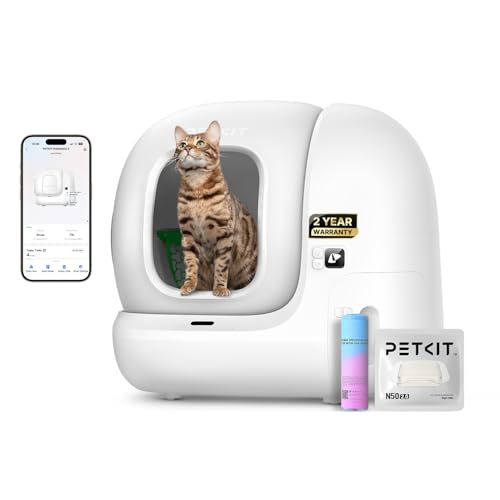
This is a 22-pound, app-connected rotating litter box for cats older than 6 months and at least 1.5 kg. It uses a removable waste drawer with a bag, a detachable cylinder and litter sifter, and a 12V, 2A power input. The front panel can run core cleaning and maintenance functions without the app. Its wireless radio authorization is independently traceable through a matching FCC filing for the product, but no model-matched UL, ETL, TÜV, or independent occupied-entry and sensor-fault safety test was located. The manual says the unit pauses and alerts if a cat enters during normal operation. It also documents an optional Continuous Rotation setting that does not stop when a cat approaches, which materially limits confidence in the claimed fail-safe safety design.
This product fits an adult-cat household that wants scheduled scooping and app status alerts, but can also operate core functions from the unit itself. It is more suitable where the cats are comfortably above the stated 1.5 kg minimum, can adapt to a rotating enclosed cylinder, and the caregiver can inspect the waste drawer, refill litter, and perform periodic disassembly cleaning. It also suits buyers who value a documented two-year U.S. warranty and are willing to use approved litter sizes and replace consumables.
It is not appropriate for kittens under 6 months or cats below 1.5 kg, according to the manual. Households with highly anxious cats, cats that enter during cycling, chewers that may damage power cords, or caregivers unable to supervise transition and maintenance should treat the rotation mechanism carefully. The Continuous Rotation setting deserves particular caution because the manual says it continues operating when a cat approaches. It is also a poor fit for buyers seeking independently validated anti-entrapment, odor, dust, or health-monitoring performance.
The wireless version has a matching FCC equipment authorization, and the manual specifies a low-voltage 12V, 2A input. However, no publicly verifiable model-specific electrical safety listing from UL, ETL, or TÜV was found. No U.S. CPSC recall or public safety warning specific to this product was located in the checked sources. The manual warns to use the original adapter, keep the unit indoors and dry, and avoid cord damage from pets. The body materials are disclosed broadly as ABS and PP-class plastics in product documentation. The included N50 deodorizer has a disclosed ingredient list, including water, gelling agents, salts, persimmon extract, solubilizer, amino acids, and fragrance. Its plastic case reduces direct contact, but it is a disposable monthly consumable. The manual provides separate electronic-waste disposal guidance, yet U.S.-specific recycling and end-of-life support were not established.
This is an app-connected, open-top automatic litter box that separates clumped litter by rotating its chamber and drops waste into a lined lower bin. Manufacturer documentation for the Plus version states a 7.17 L litter capacity, an 11.2 L waste bin, a 13.86-inch entry height, and suitability for cats weighing 2.2 to 33 pounds. The related PS0120 manual specifies 24 W at 12 V and about 50 dB operation. The defining safety feature is manufacturer-stated, six sweeping infrared sensor sets that pause rotation when a cat is detected. The open-top geometry avoids the enclosed rotating-drum layout associated with some litter-box hazards, but no independent occupied-entry, obstruction, sensor-fault, stop, or reversal test report was located. Documentation is also not fully model-specific, because the publicly available PS0120 manual is titled M1 rather than M1 Plus.
This product fits an adult-cat household that wants automated clump separation but prefers an open, visible chamber rather than an enclosed globe. It is most appropriate where cats fall within the published 2.2 to 33 pound range, can clear a 13.86-inch entry, and already use compatible clumping litter. The household should be comfortable checking the waste bin, inspecting the chamber and seals, monitoring error lights, and retaining a conventional litter box during setup, faults, firmware changes, or cat acclimation.
It is not suited to kittens below the manufacturer’s published 2.2 pound threshold, cats unable to manage the 13.86-inch entrance, or highly fearful cats that may avoid a cycling appliance. It is also a poor fit for households needing independently proven fail-safe entrapment performance, because no public third-party occupied-entry or sensor-fault testing was found. Avoid relying on its app data to identify illness, or using it as the only litter option for a cat with urinary, mobility, or elimination problems without veterinary guidance.
The main health strength is access and serviceability. The chamber can be removed for rinsing, while the electrical base must not be washed directly. The manual recommends clumping bentonite litter and warns against oversized pellet litter, so litter choice and fill level matter for reliable separation. The product page states that the Plus uses six infrared sensor sets, but this safety claim remains manufacturer-stated rather than independently tested. No CPSC recall or product safety warning for this product was located in the U.S. review. However, Neakasa publicly issued a 2025 firmware update for earlier M1 and M1 Lite units after identifying a rare over-rotation possibility if a silicone-pad magnet detached or was absent. Routine operation uses disposable waste bags and electricity, rated at 24 W in the PS0120 manual. Published materials include PP, ABS, POM, silicone, and plastic, but no public chemical disclosure or material-safety testing was located.