Best Overall

Mueller Austria Mandoline Slicer, Adjustable Vegetable Chopper
Adjustable settings for precise slicing thickness.
Easy to clean with removable parts.
Sturdy, durable design for long-term use.
 Lauren Wilson
Adjustable settings for precise slicing thickness.
Easy to clean with removable parts.
Sturdy, durable design for long-term use.

Versatile 6-in-1 slicing and grating functions.
Includes safety glove for added protection.
Compact design with built-in organizer.

Versatile with six different slicing and dicing options.
Easy to clean with dishwasher-safe components.
Compact design saves kitchen space efficiently.

Adjustable thickness for precise slicing.
Includes cut-resistant gloves for safety.
Durable stainless steel construction.

Adjustable thickness for versatile slicing options.
Dishwasher safe for easy cleaning.
All-in-one design saves kitchen space.

Easy to adjust for different slice thicknesses.
Comfortable non-slip handle for safer use.
Compact design for convenient storage.

Adjustable blades for precise slicing options.
Larger size accommodates more food variety.
Detachable blade design for easy cleaning.

Adjustable blade for precise slicing options.
Larger size accommodates more food types.
Safe design minimizes risk during use.
Includes cut-resistant gloves for added safety.
Adjustable thickness settings for versatile slicing.
Durable stainless steel ensures long-lasting use.

Adjustable thickness for precise slicing needs.
Safe design minimizes risk of kitchen accidents.
Versatile use for various vegetables and foods.
Whether one works well depends on more than the number of attachments or the thinnest advertised setting. First consider how the cutting edge is isolated from the hand. An exposed-blade model needs a food holder used from the first pass through the final small piece, while an enclosed-feed model should provide a covered chute, pusher, stable base, and clear instructions for short or irregular pieces. A guard or included glove is not automatically verified cut protection: supplied gloves should have an ASTM F2992-23 test basis and ANSI/ISEA 105 marking if cut resistance is claimed.
Stability is equally important. Look for instructions identifying the intended surface, food size, guard use, and thickness controls. A non-slip base or suction feet can help, but the supplied reviews include products that may slide on wet or unsuitable counters. A buyer should also check whether blades, inserts, locks, housings, and containers remain securely retained during use, switching, and cleaning. Fixed or integrated blades reduce loose-insert handling, but they can also make replacement more difficult.
Headline specifications often overstate certainty. A listed range such as 0.1–8 mm may conflict with the manual or an adjustment diagram, and a “precise” setting is not the same as independently measured slice thickness or uniformity. “Dishwasher-safe” can conflict with hand-wash instructions, while a capacity may appear as both four and five cups. “BPA-free,” “food-grade,” “non-toxic,” or “PFAS-free” describes a claim, not finished-product evidence covering every plastic, coating, colorant, elastomer, and blade-contact surface.
For substantiated material claims, look for model-specific food-contact declarations tied to applicable FDA Food Contact Substances records or 21 CFR provisions, an NSF Official Listing where NSF certification is claimed, or an ISO/IEC 17025-accredited laboratory report identifying the finished product, food simulants, test conditions, and results. Environmental claims also need traceability: recycled-content claims should be supported by certification records such as GRS or RCS documentation, or databases such as UL SPOT or SCS where those certifications are asserted. A credible product record should identify the responsible company, model, warranty, recall status, and replacement parts.
Across the supplied products, the recurring caveat is that even guarded or enclosed designs still require careful setup, pusher use, and cleaning near sharp blades. Exposed-blade models are a poor match for children, reduced hand control, impaired vision or sensation, or anyone likely to rush the final pass. Several products also lack verified replacement parts and independent food-contact or glove testing. Removable grids and recessed mechanisms can retain food, making brush cleaning and allergen-sensitive use important. No supplied product had independently verified protection that makes careless handling risk-free.
The scores below compare the supplied products against the same health, ecology, and evidence criteria. Higher scores indicate stronger documented performance relative to the other products in this set; they do not turn an unsupported marketing claim into independent proof.
This measures whether hands stay separated from the cutting edge through the final pass. Enclosed chutes and pushers scored better among the supplied products, reaching 82, while exposed-blade designs generally depended on a holder and disciplined technique. A high score reflects clearer safeguards and instructions; a low score reflects accessible blades, uncertain final-pass protection, or unverified glove claims.
This measures whether blades, inserts, locks, and housings stay retained during slicing and cleaning. The strongest supplied score was 78, supported by secure or fixed arrangements and better handling documentation. Lower scores reflected tricky insert changes, concerns about lifting lids, or no independent retention testing. For mandolines, a loose sharp insert can create both injury and contamination hazards.
This measures resistance to slipping, tipping, food-holder loss, and uncontrolled force on different produce. Supplied scores ranged from 54 to 84. Higher-scoring products had tested or documented planted bases and controlled feeding; lower-scoring products acknowledged sliding or lacked stability evidence. Stability matters because extra force or movement brings hands closer to the blade and can worsen uneven cuts.
This measures documentation for every blade, plastic, coating, colorant, and elastomer that contacts food—not merely a “food-grade” or “BPA-free” statement. Scores ranged from 68 to 74, so no product stood far above the group. A higher score reflected more specific material information; low scores reflected absent migration reports, finished-product declarations, or publicly authenticated food-contact certification.
This measures whether blade slots, grids, containers, and removable parts can be inspected and cleaned without unsafe hand contact. Scores ranged from 58 to 84. Higher-scoring designs could be disassembled or fully accessed and included clear brush or dishwasher guidance. Lower scores involved residue-trapping blade geometry, recessed mechanisms, or cleaning that required close work around exposed sharp edges.
This measures whether claims about safety, glove protection, dishwasher use, thickness, capacity, and performance are qualified and model-specific. Scores ranged from 52 to 80. Higher-scoring products had fewer contradictions and stronger independent testing; lower scores included absolute safety language, conflicting dimensions or capacities, and thickness ranges that differed between listing and manual.
This measures current, model-specific certification or competent laboratory evidence for important safety, material, durability, and environmental claims. Scores ranged from 68 to 74, a narrow range because independent proof was limited across the set. A higher score indicates more corroboration, but the reviews repeatedly found no public NSF listing, accredited migration report, or standardized glove test.
This measures traceable manufacturer or importer information, model identification, support, warranty access, and matching recall history. Scores ranged from 68 to 78. Higher-scoring products had identifiable companies, direct support, or clearer model records and no matching recall found. A clean search is not proof of safety, and one different Mueller product recall remains relevant accountability context.
This measures repeatable dimensions, clean cuts, usable yield, and whether advertised settings match actual results. Scores ranged from 63 to 90. Benriner scored highest after independent testing found even slices and effective julienne cuts; OXO also had independently tested clean slicing. Lower scores reflected soft or fibrous produce limits, technique-sensitive dicing, or inconsistent thickness documentation.
This measures durability, warranty support, repair instructions, and availability of replacement blades, guards, feet, containers, or other parts. Scores ranged from 65 to 80. Benriner stood out because replacement blades and a food holder were reported as available; several other products had warranties but no public parts catalog. A warranty alone does not prove repairability.
This measures substantiated recycled content, reduced material use, simpler construction, and lower-waste packaging. Scores ranged from 68 to 78. Geedel had the highest score because its listing presented a Global Recycled Standard claim and at least 50% recycled material, although direct certificate authentication was not available. Most others had no verified recycled-content or packaging evidence.
This is a manual, counter-supported mandoline for household slicing, julienning, grating, shredding, and wavy cuts. It uses a fold-out stand or can rest across a bowl, with a food holder that rides on the slideway. The manufacturer manual specifies five removable cutting blades, a 1 to 9 mm slicing adjustment, and 6 or 9 mm julienne settings. Its safety approach is conventional rather than enclosed. The manual requires the food holder, a dry flat surface, and holding the stand handle, while warning that both blades and food pins are extremely sharp. Independent kitchen testing found strong cutting performance on tough-skinned tomatoes and confirmed the listed stainless-steel-and-plastic construction, but another independent test found food could catch in the V-shaped blade tip and that the blades were less sharp than some tested alternatives.
This product suits an experienced home cook who wants several cut styles in one manual tool and is comfortable following blade-safety procedures every time. It is practical for regular batches of potatoes, cucumbers, onions, carrots, tomatoes, cheese, and similar produce, especially when 1 to 9 mm slicing and two julienne sizes are useful. It also fits a household that can store the separate blades in the supplied box, keep a cleaning brush available, and has enough counter or bowl space for the fold-out stand.
It is not well suited to people seeking hands-fully-separated slicing, including households with young children, users with reduced hand control, or anyone likely to rush the end-of-produce pass. The manual itself says children need close supervision and that the product should not be used by people with reduced capabilities without supervision or instruction. It is also a weaker fit for allergy-sensitive kitchens that need especially simple inspection and cleaning, because independent testing found food can lodge near the V-shaped blade tip.
The product has stainless-steel cutting blades and plastic structural parts, according to independent kitchen testing. Its manual identifies a food holder, fold-out stand, blade box, specific safe-use directions, and a top-rack dishwasher limit of 158°F or 70°C. Those are useful operating details, but the cutting edge remains exposed and the manual repeatedly warns that the blades and food pins are extremely sharp. A brush is recommended instead of fingers for clearing residue. No public, product-specific NSF certification, food-contact migration report, recycled-content certification, packaging specification, or replacement-parts catalog was located. The one-year limited warranty is documented, but blade replacement availability was not confirmed. A different Mueller onion chopper was recalled by the CPSC in October 2020 following locking-tab failures and laceration injuries. That recall did not identify this slicer, and no matching recall for this product was located.
This product is a manual, V-blade vegetable slicer with a stated 5-cup catch container. It is intended to slice, grate, and spiralize produce, with six interchangeable cutting attachments. The current marketplace listing describes stainless-steel blades, a BPA-free ABS plastic body, a finger guard, a protective glove, a cleaning tool, and dishwasher-safe components. Fullstar’s support material independently confirms the general mandoline format, removable blade approach, top-rack dishwasher guidance, brush and scraper cleaning tools, and instruction to use a finger guard. Those are useful design provisions, but they are maker statements rather than independent safety or performance tests. No model-specific material migration report, glove cut-resistance rating, public third-party certification, or measured cutting comparison was located.
This format suits an adult home cook who wants a compact manual tool for routine cucumber, potato, carrot, zucchini, onion, cheese, and garnish preparation. It is most appropriate for someone willing to use the finger guard on every pass, wear the included glove as an added precaution, keep the unit on a dry stable surface, and clean blade areas with the supplied brush rather than fingers. The catch container can be useful in a small kitchen where containing prep scraps and cut food matters.
It is not suited to households where children may access loose sharp inserts, or where the user cannot reliably follow guarded manual-slicing practices. People with reduced hand strength, impaired grip, limited vision, reduced sensation, or a history of hand injuries should avoid relying on an open-blade mandoline and its unverified glove. It also does not fit buyers who require certified food-contact documentation, independently tested cut protection, or documented replacement compatibility for each individual blade and guard.
The product uses stainless-steel cutting inserts and a plastic body that Fullstar describes as BPA-free ABS. That is a composition claim, not a finished-product food-contact compliance file. No model-specific migration report, NSF listing, or other publicly authenticated certification was located for the plastic, blade metals, colorants, glove, or finished product. The marketplace also calls the ABS non-toxic, but does not provide supporting test conditions or results. The maker gives cleaning instructions that include disassembly, top-rack dishwasher cleaning, and a brush or scraper for blade areas. It also states a lifetime defect warranty and currently lists a replacement blade kit, though compatibility with this exact product is not documented. No matching CPSC recall was located in the search conducted. Fullstar identifies a U.S. company and provides support contacts, but its sustainability language is limited to reusable, BPA-free materials. No recycled-content, packaging, or end-of-life evidence was found.
This is a manual countertop vegetable-prep set that combines a press-down dicer, a mandoline-style slicer, grater, julienne insert, catch container, blade storage, cleaning tools, finger guard, protective glove, and a separate handheld spiralizer. It is intended for home preparation of produce such as onions, potatoes, cucumbers, carrots, and tomatoes. A product manual identifies stainless-steel blades, an ABS-plastic container, a 3.7-pound unit, and top-rack dishwasher cleaning. Those are manufacturer-provided specifications, not independently certified material declarations. In an independent hands-on test of this all-in-one format, the large dicer made uniform pieces from tomatoes, onions, cucumber, and peppers, while the slicer produced useful thin and thick potato and onion slices. The same tester found the small dicer technique-sensitive, and reported a finger nick while handling the sharp mandoline blade during washing.
It suits a home cook who wants one manual set for occasional to regular vegetable prep, particularly diced onions, peppers, cucumbers, potatoes, and thin onion or potato slices. The catch container can help contain cut food and reduce transfers between tools. It is most appropriate for someone willing to cut produce to fit, learn the blade setup, use the finger guard for every mandoline pass, and wear the supplied glove when handling or cleaning blades. The dishwasher-safe claim may also suit households that want removable parts rather than hand-washing every component.
It is not suited to anyone who needs the cutting edge physically enclosed from their hands, has limited hand control, reduced sensation, impaired vision, or cannot consistently use a food guard. It is also a poor fit for unsupervised children. High-volume users and people expecting years of heavy commercial-style use should note independent reports of blade dulling and hinge or spring durability concerns. Avoid relying on it for very soft produce without practice, or for unusually hard, oversized produce that requires excessive force. Hand-washing the sharp removable inserts also requires close attention.
The product's health-relevant strengths are practical controls rather than independently certified safety systems. The maker's instructions call for a finger guard during mandoline use, a protective glove while handling blades, a brush or scraper instead of fingers for stuck food, and blade-organizer storage. These instructions matter because independent testing documented a minor finger nick during washing. The same testing found that the blade lock exists, but raised concern that the lid could lift under enthusiastic use. The stated food-contact construction is stainless-steel blades and ABS plastic, with BPA-free and PFAS-free claims in the catalog record. No public model-specific migration testing, accredited laboratory report, or public certification was located to confirm those claims across the finished product's plastics, colorants, and other contact parts. The brand advertises a lifetime defect warranty and sells a blade replacement kit, which could reduce discard risk, but model-specific replacement compatibility was not established. No matching U.S. consumer-product recall was located in the CPSC search performed for this product.
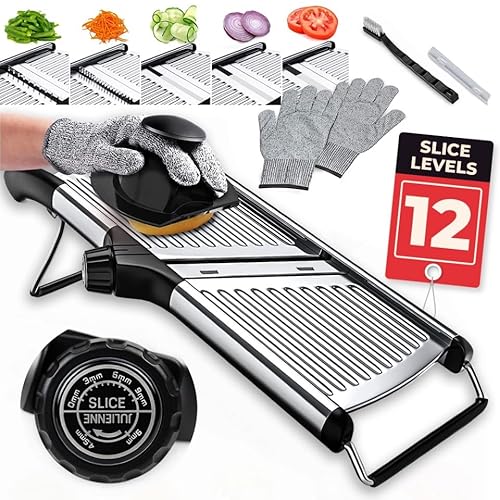
This is a manual, foldable stainless-steel mandoline for slicing and julienning vegetables. It is used over a bowl, with food secured to a hand-held safety holder and moved over an exposed adjustable cutting area. The product includes a blade cover, food holder, and a pair of gloves. The available product instruction manual states a 1 to 9 mm slicing range, plus 4.5 mm and 9 mm julienne settings. It also instructs users to wear the supplied gloves, use the holder rather than bare hands, set the unit on a dry stable surface, and remove the cutting controller for cleaning access. Those are manufacturer instructions, not independent performance or safety validation. The documentation identifies stainless steel for the body and blades, but does not provide a steel grade, plastic or glove composition, food-contact compliance record, or model-specific laboratory test report.
This product suits a home cook who wants a compact manual tool for repeated vegetable slices or julienne cuts, is comfortable following detailed sharp-blade procedures, and has a dry, stable work surface. It is particularly relevant for users preparing potatoes, cucumbers, onions, carrots, or cabbage in quantities where uniform cuts matter. The user should be willing to attach food to the holder, wear the supplied gloves as an added precaution, stop before the final small piece becomes difficult to control, and clean the blade area carefully.
It is not well suited to households where users may bypass guards, rush food preparation, or leave sharp utensils accessible to children. People with limited grip strength, reduced hand coordination, impaired vision, or difficulty following multi-step safety instructions should avoid relying on an exposed-blade mandoline with a separate holder. It also does not fit buyers who require independently verified glove protection, documented food-contact testing, a formal warranty, replacement blades, or a tool that keeps hands separated from the blade in an enclosed chute.
The safety documentation is more useful than a bare marketing claim. It tells users to use the food holder, wear gloves, keep hands away from the blade, use a stable non-slip surface, and wear gloves during cleaning. The instructions also say the cutting controller can be removed to reach the blade area. This helps cleaning access, but it does not eliminate sharp-edge exposure. The stated stainless-steel body and blades may support repeated use, but the maker does not publicly identify steel grade, the composition of the holder or other nonmetal food-contact parts, or finished-product migration testing. No public NSF listing, ISO/IEC 17025 test report, ASTM or ANSI glove rating, recycled-content documentation, packaging specification, replacement-parts catalog, or defined warranty was located. Searches of CPSC recall resources and the public unsafe-product reporting database did not identify a matching recall or published report, but that does not independently establish long-term safety or durability.
This is a manual, upright vegetable mandoline with a covered food chute, handle-driven feed path, folding legs, collection container, and cleaning brush. It is intended to slice, make strips and julienne, and dice vegetables. The product listing states a 0.1 to 8 mm thickness range and four cutting modes. The supplied instructions instead describe adjustment from 0 to 8 mm, so the exact lower limit is not consistently documented. The most important safety feature is the enclosed chute and food pusher. The instructions specifically say to use the pusher, keep fingers away during operation and cleaning, use a flat stable surface, and store the unit folded. The material specification in the supplied product document identifies an ABS body, AS container, and stainless-steel blades. These are manufacturer documents, not independent safety or food-contact test reports.
This product suits a home cook who wants an upright, compact vegetable slicer for occasional to moderate prep of potatoes, cucumbers, carrots, onions, and similar produce. It is most appropriate for someone prepared to follow the setup directions closely, keep the legs fully opened on a flat counter, use the food pusher for every small end piece, and clean the blade area carefully with the supplied brush. The folding format and collection container are useful where drawer or cabinet space is limited.
It is not well suited to households that need independently certified food-contact materials, public third-party safety testing, or replacement parts that can be ordered by part number. It also is not appropriate for unsupervised children or for anyone unlikely to follow blade-cleaning and food-pusher instructions. People with reduced hand control, impaired vision, or limited ability to stabilize a countertop tool should not assume the enclosed design eliminates risk. The manufacturer’s broad safety and accessibility claims are not independently substantiated for this product.
The supplied documentation identifies an ABS body, AS collection container, and stainless-steel blades. The listing also calls the product BPA-free and dishwasher-safe. However, no finished-product food-contact compliance declaration, migration test report, NSF listing, or other independently authenticated certification was located for this product. Those claims should therefore be treated as manufacturer statements rather than confirmed material-safety evidence. The product has an enclosed chute, food pusher, storage cover, and written directions intended to reduce hand contact with the blades. The manual still warns users to keep fingers away during use and cleaning. Searches did not identify a matching CPSC recall or FDA safety alert, but that is not independent proof of safety. A stated 24-month warranty supports continued use, although no public replacement-parts catalog or recycled-content and packaging documentation was found.
This is a compact handheld mandoline for making plain vegetable and fruit slices, rather than julienne, waffle, or dice cuts. It has a fixed stainless steel cutting blade, a broad plastic runway, a hand-held food holder, and a dial for seven slice-thickness settings. It can rest on a work surface or hook over a bowl using its non-slip notches. OXO states that the product is BPA-free, dishwasher safe, and fitted with a stainless steel blade. Independent kitchen testing confirmed the large hand guard, a secure blade-locking position, clear thickness labels, and clean slicing through a range of produce. That testing also found the blade somewhat less sharp than the strongest cutting-focused alternatives, so tough, fibrous vegetables may need more force. The cutting edge remains exposed during use, which makes consistent use of the supplied food holder essential, especially at the final pass.
This suits an adult home cook who wants repeatable plain slices for cucumbers, potatoes, onions, zucchini, apples, cabbage, ginger, or shallots without storing a full countertop mandoline. The clear runway and labeled dial are useful for cooks who value seeing sliced food accumulate and selecting a known setting. It is best suited to small and medium preparation jobs where the user can keep the product stable on a board or bowl, use the supplied holder throughout, and wash it promptly after use.
It is not for households where children may access sharp kitchen tools, or for anyone unwilling or unable to use a food holder on every pass. A person with reduced hand control, impaired vision, or a history of cut injuries should prefer a slicer with a more enclosed feed system or use a properly selected cut-resistant glove. It is also not ideal for cooks who need julienne, crinkle, waffle, or diced cuts, replacement cutting parts, or independently documented food-contact testing.
The primary health consideration is laceration risk. OXO supplies a food holder, non-slip contact points, and a blade-locking position, and independent testing found those controls useful during setup and slicing. They reduce risk, but they do not eliminate it because a sharp fixed blade remains exposed on the runway. The product has no loose blade inserts, and the checked US recall sources did not identify a matching recall or safety warning. OXO describes the product as BPA-free and dishwasher safe, with stainless steel blades. Those are manufacturer statements, not a public, model-specific material declaration or migration-test report. No public NSF certification, accredited laboratory report, recycled-content certification, packaging specification, or replacement-blade listing was found for this product. Its fixed-blade construction limits detachable-part waste, while the lack of documented replaceable cutting parts may shorten useful life once the blade dulls or a small component is lost.
This is a manual, upright press-down mandoline for household vegetable and fruit preparation. It uses a food chute, pusher, spring-loaded handle, adjustable thickness dial, integrated toothed cutting settings, and a catch container. The maker states that it slices from 0.1 mm to 8 mm and can make slices, strips, julienne, diced pieces, and chopped pieces without changing blade inserts. Its most consequential design feature is the enclosed feed path. The available instruction manual tells users to load food into the chute and use the pusher against the blade, rather than guiding produce by hand. That is a meaningful safety-oriented format, although it remains manufacturer documentation rather than independent safety testing. The manual also gives assembly, cleaning, blade-retraction, disassembly, and storage instructions, including a warning that the spring-loaded handle can release quickly.
This format fits a household cook who wants to process batches of firm produce such as potatoes, cucumbers, carrots, onions, cabbage, and apples while keeping fingers behind a chute and pusher. It is particularly suited to users who have enough counter height for an upright press-down tool, will read the setup instructions, and want multiple cut styles without handling separate blade inserts. It also suits someone with limited storage space who values a folding body and catch container, provided they can clean the cutter promptly and carefully after use.
It is not appropriate for unsupervised children, people unable to reliably control a spring-loaded handle, or anyone who cannot follow the pusher and cleaning instructions. The manual also excludes very hard, very soft, very juicy, hot, or bone-containing foods, so it is not a universal food processor. Households managing serious food allergies should consider that the internal cutting path has blade slots and mechanisms that require brushing and disassembly. Buyers who require independently certified food-contact materials, independently measured cut accuracy, or readily orderable spare parts need more documentation than is available here.
The product uses an enclosed chute and pusher rather than an open hand-held blade path. Its manual repeatedly warns users not to put fingers near the blade, directs them to use the pusher for short foods, and instructs users to retract blades before cleaning and storage. Those are useful safeguards, but they are maker instructions, not independent injury-prevention testing. The manual also cautions that the handle is spring-loaded and can release quickly. The maker identifies ABS plastic and stainless steel construction, and its own product page specifies 420 stainless steel blades. It also makes BPA-free and dishwasher-safe claims. No publicly verifiable, model-specific food-contact migration testing, NSF listing, or other third-party certification was located for this product. A search of US consumer-product recall records did not identify a matching recall for this product. The maker states a two-year warranty, but no public replacement-parts catalog was found, and no recycled-content, lower-impact material, or packaging certification was substantiated.
This is a manual, upright vegetable mandoline with an enclosed food chute, a handle-driven cutting mechanism, integrated stainless-steel blades, a catch container, and a cleaning brush. The listed product measures 6 by 5.5 by 13.6 inches and is intended for slicing, strips, julienne cuts, and dicing. Its body is listed as ABS plastic, with stainless-steel cutting parts. The defining design feature is the covered chute and pusher arrangement. The manufacturer says this keeps the operating hand above the blade path, while the instructions still warn that blades are sharp during cleaning and that small food requires the pusher. The maker also states that the unit has four cut modes, thickness adjustment to 8 mm, detachable parts, and dishwasher-safe components. A published hands-on review reports stable use and successful cuts, but it is affiliate-supported rather than an accredited comparative test.
This product suits an adult home cook who regularly prepares batches of cucumbers, carrots, potatoes, onions, or zucchini and wants an upright, contained alternative to an open flat mandoline. It is most appropriate for someone with a stable, uncluttered counter, enough cabinet space for a tall folded tool, and willingness to follow the pusher, setup, disassembly, and brush-cleaning instructions. The four integrated cut modes may also suit meal preparation where slices, strips, julienne, and diced vegetables are used routinely.
It is not suitable for children or for anyone who cannot reliably operate the pusher, apply controlled force, inspect the parts, and clean around sharp internal blades. People with severe hand weakness, impaired coordination, reduced vision, or difficulty following multi-step setup should not treat the covered chute as complete injury protection. It is also a poor fit for households that need independently certified food-contact materials, sanitation-design certification, documented replacement parts, or laboratory-confirmed cut accuracy and long-term mechanical durability.
The product is listed as ABS plastic with stainless-steel blades, and the maker describes the plastic as BPA-free. Those statements identify broad materials, but they do not establish the formulation of all food-contact plastics, colorants, or other components. No public model-specific migration testing, NSF certification, or independently authenticated food-contact certificate was located. FDA food-service guidance calls for food-contact surfaces that are safe, durable, smooth, accessible, and cleanable. The supplied instructions acknowledge the key safety limitation, sharp blades still require care during use, disassembly, and cleaning. I found no matching publicly indexed CPSC recall or regulatory warning in the United States during this review. The stated 24-month replacement warranty may extend usable life, but no public replacement-blade or spare-parts catalog was found. No substantiated recycled-content, packaging-reduction, or other product-specific environmental claim was located.
This is a manual, fold-out mandoline for slicing and julienning produce. The listed unit is about 16.5 inches long, uses a dial-operated internal blade system, and is sold with a food holder, blade guard, cleaning brush, and cut-resistant gloves. Its stated blade material is 4CR15 stainless steel, with polycarbonate and rubber also identified in product instructions. The available product instructions describe straight slicing from 0 to 9 mm, plus 4.5 mm and 9 mm julienne settings and waffle cuts. They instruct users to wear the gloves, use the food holder, work on a stable nonslip surface, and discard or manually cut the last small piece. Those are manufacturer-stated operating directions, not independent safety testing. No model-specific third-party performance, glove test report, or food-contact compliance report was located.
This product suits an experienced home cook who wants a compact manual tool for repeated vegetable slices, julienne strips, and waffle-style cuts, and who is willing to use the food holder and gloves every time. It is most practical for medium to large potatoes, cucumbers, onions, carrots, and similar produce that can be securely impaled on the holder. It also suits someone with space to store a roughly 16.5-inch folding tool and who accepts manufacturer-stated, rather than independently validated, slice settings and safety claims.
It is not suited to households where users may skip guards, rush final passes, or where children can access an exposed sharp blade. People with reduced grip strength, reduced hand sensation, limited dexterity, or difficulty maintaining stable two-handed control should favor a design with an enclosed feed path. It is also a poor fit for buyers who require independently documented cut-resistant gloves, certified food-contact materials, or readily purchasable replacement blades and guards. Very small, irregular, or slippery produce needs extra caution or another cutting method.
The main health consideration is laceration risk. The product instructions specify a food holder, gloves, a blade guard, a cleaning brush, a stable work surface, and careful handling during cleaning. They also acknowledge that very small or irregular pieces may not hold securely, so the final portion should be discarded or cut manually. That is useful safety guidance, but the included gloves have no located model-specific ANSI/ISEA marking or ASTM F2992 test documentation. Materials are identified only at a general level as stainless steel, polycarbonate, and rubber. No finished-product food-contact compliance declaration, migration testing, NSF certification, recycled-content claim, or packaging specification was located. No matching CPSC recall for this product was located in the searched recall records. A one-year warranty is stated, but no documented replacement-parts catalog was found, so dull blades or lost safety parts may increase replacement waste.
This is a compact, manual vertical mandoline for fruits and vegetables. Food is loaded into a chute and driven through built-in stainless-steel blades with a pusher and handle. The supplied product sheet identifies an ABS body, an AS collection container, stainless-steel blades, a food chute, pusher, container, cleaning brush, and manual. It is listed at roughly 13 inches tall and about 1.5 pounds. The maker says the covered chute keeps hands above the blade during slicing, that the legs lock and suction cups should attach to a clean, dry, flat surface, and that the unit is dishwasher safe. An independent review reports trying carrots, potatoes, and cucumbers and finding the hidden-blade arrangement and cuts satisfactory, though it is not a laboratory performance test. The published thickness range is inconsistent, with 0.1 to 8 mm stated in text but a 1 to 8 mm diagram.
This product suits a home cook who wants repeatable vegetable slices for potatoes, cucumbers, onions, carrots, zucchini, or apples, and who prefers a guarded vertical format over sliding food directly across an exposed mandoline blade. It is most appropriate for routine home meal prep on a clean, dry, flat countertop, with enough attention to extend and lock the legs, secure the suction cups, and use the pusher for every pass. The folding format also fits kitchens with limited storage space.
It is not suited to households where users may bypass the pusher, children could access the tool, or safe cleaning procedures cannot be followed. People needing independently certified food-contact materials, documented migration testing, or a public third-party safety certification should use a product with those records. It is also a poor fit for repair-focused buyers who expect separately purchasable blades, guards, feet, or containers. Those needing a guaranteed, measured slice thickness should avoid relying on the published 0.1 to 8 mm claim because the documentation is inconsistent.
The main safety benefit is structural, not a cut-resistant glove or a no-injury guarantee. The maker documents a covered chute, food pusher, built-in blades, locking legs, suction cups, a blade cover, and a cleaning brush. These features can reduce hand contact with the blade when the operating instructions are followed. The instruction material still warns users to use the brush and exercise caution while cleaning, so the product should not be treated as risk-free. The product sheet identifies ABS for the body, AS for the container, and stainless steel for the blades. That is useful composition disclosure, but no finished-product food-contact compliance report, migration testing, or public certification was located. No matching United States recall was found in the reviewed CPSC sources. The 24-month stated warranty may extend service life, but there is no located replacement-parts catalog, recycled-content claim, packaging specification, or verified environmental certification.


