Best Overall
19% off

AAOBOSI Electric Meat Grinder 3000W Max
Intuitive touch screen for easy operation.
Auto-reverse function prevents clogging.
Built-in storage for accessories and parts.
 Lauren Wilson
Intuitive touch screen for easy operation.
Auto-reverse function prevents clogging.
Built-in storage for accessories and parts.

High power for efficient meat grinding.
Durable build ensures long-lasting use.
Easy to clean with removable parts.

Enhanced motor ensures smoother and faster grinding.
Stainless steel blades offer superior durability.
User-friendly design simplifies operation and cleaning.

Compatible with all KitchenAid stand mixers.
Includes multiple plates for versatile grinding.
Comes with sausage stuffer tubes for variety.

Powerful 2800W motor for efficient grinding.
Includes versatile sausage stuffer and kubbe kit.
Durable stainless steel ensures long-lasting use.

High capacity: Processes 552 lbs of meat hourly.
Powerful motor: 750W ensures efficient grinding.
Durable construction: Built to withstand heavy use.

Dual bowls for convenient food separation.
Powerful motor handles tough ingredients effortlessly.
Versatile blades for diverse chopping needs.

Dual bowls offer versatile food processing options.
Smart overheat protection enhances safety and durability.
Includes cleaning brush for easy maintenance.
High power ensures quick and efficient grinding.
Durable stainless steel for long-lasting use.
Two-speed settings for versatile meat processing.
Durable, rust-resistant 304 stainless steel construction.
Includes versatile sausage stuffer attachment.
Easy manual operation for precise meat grinding.
For hygiene, look for a removable tray, head, auger, knife, plates, locking ring, pusher, tubes, and attachments, with instructions for washing, rinsing, drying, and reassembly. A fixed throat or inaccessible internal channel is a meaningful limitation because residue can remain in a raw-meat contact area. Dishwasher claims also need care: supplied reviews include conflicts between product pages and manuals, and aluminum parts commonly require prompt hand washing and drying to avoid oxidation. A pusher, clear hand-clearance warnings, unplug-before-cleaning instructions, stable feet or a secure clamp, and a defined reverse function are more useful than a generic “safe” label.
Material claims should identify the actual food-contact parts. “Stainless steel,” “food-grade,” “BPA-free,” or “LFGB approved” is not the same as a product-specific food-contact declaration covering the head, auger, knife, plates, tray, tubes, pusher, plastics, coatings, and locking ring. The strongest documentation would identify alloy or resin details and support them against FDA food-contact information or NSF/ANSI 51 requirements. A high score in this area reflects complete, component-level evidence; a low score reflects broad material language or unsupported certification claims.
Electric models should be checked against an OSHA-recognized testing laboratory’s record, such as UL Product iQ, Intertek’s ETL directory, or CSA’s product listings. The record should match the sold model and applicable appliance standard; a logo, marketplace statement, or “ETL approved” title alone is not enough. Commercial or restaurant claims likewise need a traceable sanitation listing, such as an NSF Certified Products entry or equivalent sanitation certification, plus a stated duty category appropriate to regulated food service.
Power and speed figures are frequent sources of confusion. Several supplied products distinguish normal rated power, such as 300, 350, 500, 600, 700, or 1,100 watts, from much larger locked-motor or maximum-output figures between 2,000 and 3,500 watts. Claimed rates such as 1.5 kg, 2.2 lb, 4 lb, 7 lb, 180 lb, or 550 lb per minute or hour are not independently meaningful without a reproducible test protocol that states meat temperature, trim, plate, feeding rate, and duty limit. A 10- or 15-minute run limit followed by cooling is household batch guidance, not continuous commercial capacity.
Across the supplied products, no product-specific sanitation certification was found for the household grinders, and most electric models lacked a traceable electrical listing. Buyers should not treat home grinding as a food-safety treatment: raw meat still requires separation, cold handling, prompt cleaning and drying, and thorough cooking. Ground beef guidance in the reviews specifies 160°F. The recurring serious limitations are inaccessible or conflicting cleaning instructions, incomplete material documentation, unsupported peak-power and throughput claims, limited replacement-part evidence, and products marketed with “heavy-duty” or commercial language despite household-use limits. Manual models avoid electrical and motor-fire exposure but still have sharp blades, pinch points, open feed paths, and clamp-stability risks. No supplied review identified a category-wide contraindication beyond these recurring requirements and limitations.
A meat grinder’s health and sustainability profile depends less on its headline power than on whether its food-contact path can be cleaned, its materials and safety claims are documented, and its parts can remain in service. The supplied scores reward evidence-backed design rather than broad marketing language.
This measures whether every raw-meat contact area can be reached, washed, dried, and reassembled. That matters because grinding can spread contamination through the batch. Higher-scoring products document removable heads, augers, knives, plates, trays, and attachments; lower-scoring designs include fixed or poorly documented throats, conflicting dishwasher guidance, or incomplete cleaning instructions.
This measures whether the head, auger, knife, plates, tray, tubes, pusher, and plastics are specifically identified and supported for food contact. High-scoring products name more components or materials, such as documented stainless grades; low-scoring products rely on “food-grade,” “stainless,” BPA-free, or LFGB wording without a complete declaration.
This measures protection from cuts, pinch points, entanglement, unsafe clearing, and tipping. A high score reflects a supplied pusher, warnings to keep hands out, unplug-before-cleaning instructions, stable feet or a secure clamp, and useful reverse or shutoff features. Lower scores reflect exposed feed paths, unclear guarding, or greater dependence on careful manual handling.
For electric grinders, this measures whether the sold model is traceably certified by an OSHA-recognized testing laboratory to the applicable appliance standard. The manual VEVOR products scored highest because manual operation removes electrical certification needs; most electric products scored around 68–70 because no exact-model UL, ETL, or CSA record was located. A logo or seller assertion is not equivalent.
This measures whether commercial or heavy-duty claims are supported by a traceable sanitation listing and suitable duty cycle. Higher scores reflect clearer residential positioning or stronger sanitation evidence; lower scores reflect commercial wording without NSF or equivalent certification. None of the supplied household products should be assumed suitable for regulated food service without local acceptance.
This measures whether rated power, maximum power, motor type, grind rate, plate sizes, reverse function, and duty limits are consistent and testable. Higher scores distinguish rated watts from locked-motor or maximum figures and provide concrete plate or run-time details. Lower scores rely on unsupported claims such as 2,800–3,500 watts or very high pounds-per-minute rates.
This measures whether claims such as “safe,” “food-grade,” “non-toxic,” antibacterial, or health-related benefits are precise and supported. Higher scores avoid implying that home grinding makes meat safer and describe ordinary safeguards accurately. Lower scores include unsupported nutrition or health language, or material and safety claims that cannot be matched to documentation.
This measures whether relevant recalls, warnings, import actions, and corrective actions are checkable and resolved. The supplied products generally scored about 70–76 because no matching recall or public warning was located, but that absence is not a certification or proof of complete safety. A high score requires a clear, checkable model and brand record.
This measures whether durable parts, replacement knives, plates, gears, accessories, warranty coverage, and repair support can keep the product working. Higher scores in the set are associated with documented warranties, listed replacement bowls or service support, or robust metal components. Lower scores reflect unavailable parts catalogs, unclear warranties, or consumable blades without replacement access.
This measures durable or recyclable metal use, packaging information, take-back options, and practical recycling guidance for powered components. Higher-scoring products generally disclose more durable metal construction or avoid electronics entirely, as manual grinders do. Lower scores reflect missing packaging, recycling, take-back, and electronics end-of-life information.
This countertop electric meat grinder is a 9.44-pound household unit with a detachable grinding head, auger, blade, three plates, food pusher, sausage attachment and kibbe attachment. Its documented dimensions are 17 by 10.1 by 7.6 inches. It is intended for grinding boneless meat, stuffing sausages and forming kibbe, not for bones or continuous commercial processing. A publicly available manual identifies 350 watts as rated power and 3,000 watts as maximum output power, so the prominent 3,000-watt figure should not be read as continuous running power. The same manual states up to 4 pounds per minute, a manufacturer performance claim that was not supported by an independent test report located during verification. It also specifies a 10-minute maximum continuous run time, followed by a 5 to 10 minute cool-down.
It suits a home cook who wants a compact countertop grinder for occasional batches of boneless meat, sausage filling or kibbe, and who will fully disassemble, wash and dry the raw-meat-contact parts immediately after use. It is also suited to someone willing to follow a short operating cycle, use the supplied pusher rather than hands, and pause for cooling after up to 10 minutes. The stated one-year household warranty is relevant for buyers comfortable with ordinary consumer-appliance support rather than repair-network service.
It is not for restaurants, caterers, hunters processing repeated large batches, or any setting where sanitation certification, documented duty cycle and traceable electrical certification are required by a health department, employer or insurer. It is also not for buyers who need verified food-contact resin and metal specifications, readily documented spare parts, or dishwasher-safe cleaning for the whole food path. Households that may use it for raw pet food should apply the same strict separation, cleaning and sanitizing controls used for raw meat.
The useful health feature is access. The manual calls for removing the hopper, grinding head, auger, blade, plates, ring, pusher and attachments before cleaning, then washing, rinsing and fully drying them. That design supports raw-meat hygiene when the instructions are followed. USDA notes that raw-meat bacteria can spread through equipment and that home grinding is not inherently safer than store-bought ground beef. Clean promptly, keep raw meat separate from ready-to-eat foods, and cook ground meats safely. Material and certification evidence is limited. Stainless steel is stated generally, but exact food-contact metal grades and plastic resins are not disclosed. The LFGB claim could not be tied to a model-specific certificate. No traceable electrical or sanitation certification record was located during verification. The manual states a one-year warranty, but published replacement-part and electronics-recycling guidance for this product was not located. Keeping the removable parts dry and replacing only worn components when available can help extend service life.
This is a countertop electric meat grinder for home preparation of ground meat, sausage filling and kibbe. The supplied manual describes a removable tray, grinding head, auger, knife, plates, pusher and stuffing accessories. It lists four plates, with 2 mm, 5 mm and 7 mm holes plus a sector-shaped plate, and three stuffing tubes. The product measures 21 by 11 by 9 inches and weighs about 15.9 pounds, according to the manufacturer documentation. The most important qualification is power. The sales headline presents 3000 W, while the manual identifies a 600 W rated copper motor and 3000 W as maximum power. The same manual sets a 10-minute continuous-use limit followed by a 10-minute rest. It also provides disassembly and washing instructions, but it does not identify the composition or food-contact compliance of every part.
This product suits a home cook who wants to grind small batches of chilled, boneless meat, make occasional sausage, or use multiple plate sizes without buying separate attachments. It is most appropriate for a user with enough counter space for a 21-inch-long appliance, who is prepared to take the grinder apart promptly after every raw-meat use, hand-wash several components, dry them completely and respect the stated 10-minute run limit. The documented pusher and reverse function are useful for careful, hands-off feeding and clearing minor jams.
It is not suited to a restaurant, butcher operation, shared commercial kitchen or anyone who needs NSF-listed sanitation equipment or a traceable electrical certification. It is also a poor fit for continuous large-batch processing because the manual limits operation to 10 minutes, followed by a 10-minute rest. Households unable to consistently disassemble, wash, sanitize as appropriate and air-dry all raw-meat-contact parts should avoid this format. Young children should not operate it, and users should not feed meat by hand or grind bones or other hard items.
Raw meat can spread surface bacteria throughout a grind, so cleaning the full food path matters. The manual's removable head, auger, knife and plate support access for washing. It directs immediate removal of meat residue, washing with warm soapy water, rinsing and prompt drying. USDA guidance also emphasizes controlling cross-contamination, keeping ground meat cold and cooking ground beef to 160 F with a food thermometer. Material documentation is incomplete. The manufacturer calls the blades and plates stainless steel, but does not provide a food-contact compliance declaration or identify every alloy and plastic that contacts food. No traceable NSF sanitation listing or electrical listing was found. The manufacturer states a one-year warranty and lifetime support, but no verified repair-parts catalog, recycling instructions, packaging specification or take-back program was found. Metal parts may be durable, yet practical repair and end-of-life handling remain insufficiently documented.
This is a compact, 110 V countertop electric meat grinder intended for home batches of boneless meat. Available instructions describe a removable grinder head, feed screw, cutting blade, three perforated plates, food tray, pusher, reverse setting, sausage adapters, Kubbe attachment and cleaning brush. The stated body size is 9.92 by 5.78 by 12.59 inches. The published instructions identify 3 mm, 5 mm and 7 mm grinding plates and direct users to wash, rinse and fully dry non-electrical parts before use. They also limit continuous operation to 10 minutes, followed by at least 10 minutes of cooling. The advertised 3500 W, 5,000 RPM and three-second grinding claims are manufacturer claims, not independently tested results. Retail copies also vary between 3,000 W and 3,500 W descriptions, so ordinary load performance is not established.
This product suits a home cook who wants an occasional countertop grinder for small batches of boneless, trimmed meat, burgers, sausages or Kubbe, and who is prepared to disassemble, wash, rinse and thoroughly dry every removable food-contact part after each use. It is better aligned with someone who can follow the stated 10-minute operating limit, use the supplied pusher rather than fingers, and pause to clear jams safely using the reverse setting or full disassembly.
It is not suited to a restaurant, butcher operation, shared commercial kitchen or anyone whose local rules require certified food-service equipment, because no traceable sanitation certification was found. It is also a poor fit for buyers who require a confirmed electrical safety listing, documented food-contact compliance for every component, independently measured throughput, or readily searchable replacement parts. Households with children should not allow unsupervised use, cleaning or blade handling. Avoid feeding bones, hard materials or highly sinewy meat as the instructions warn against them.
Raw-meat grinding increases the importance of cleaning because organisms on meat surfaces can be mixed throughout the ground product. USDA guidance says ground beef should be held at 40 F or below and cooked to 160 F. The instructions are useful in requiring disassembly, washing, rinsing and drying of non-electrical parts, but they do not replace careful sanitation of the screw, blade, plate, head and tray after every use. The product claims stainless steel blades and plates, with other published retail copy referring to aluminum parts and a plastic pusher. A complete food-contact material declaration and a traceable SGS report were not located, so food-contact claims remain incomplete. No relevant CPSC recall, public warning or regulatory action was located in the checked sources. The manufacturer states one-year coverage and eligible replacement parts, but no public parts catalog, take-back program or recycling guidance was found. Recycle the electrical appliance through an appropriate electronics program when it can no longer be repaired.
This product is a mechanical meat-grinder and sausage-stuffer attachment that runs from the front power hub of a compatible KitchenAid-style stand mixer. It includes a die-cast aluminum grinder body, metal cutting and grinding components, four grinding plates, two blades, sausage-stuffer tubes, a tray, and a pusher. The published dimensions are about 9.1 by 5.78 by 8.48 inches, with a listed weight near 2.3 pounds. Its most defining practical feature is its fully disassemblable raw-meat path. Published instructions direct users to take it apart, hand wash promptly in warm soapy water, and dry every part immediately. The maker also states a rate of up to 2 pounds per minute, but no independent, reproducible throughput test was located. Material descriptions consistently identify aluminum alloy for the body and stainless steel for some components, but do not provide alloy grades or a food-contact compliance declaration for every food-contact part.
This product suits a home cook who already owns a compatible stand mixer and wants occasional batches of freshly ground meat, burgers, meatballs, or sausage without storing a separate countertop grinder. It is most appropriate for someone willing to fully disassemble the attachment after each raw-meat session, hand wash it, dry it immediately, and oil steel cutting parts when needed. The included plate and stuffing accessories make it practical for varied small home projects, provided the mixer is secured and the pusher is used consistently.
It is not suited to restaurant, catering, or other regulated food-service work that requires traceable NSF or equivalent sanitation certification. It is also a poor fit for households that depend on dishwasher cleaning, cannot reliably dry and maintain metal parts, or need documented material specifications for every food-contact component. Anyone grinding large volumes, hard bones, or unusually tough material should use equipment designed and rated for that workload. Children should not assemble, feed, clear, or clean it without close adult control because of the sharp blade and moving feed mechanism.
The key health issue is cleaning discipline, not a safety benefit from home grinding. The product's published instructions require full disassembly, prompt hand washing, and immediate drying. That is useful because raw-meat residue can remain in the auger path, plate holes, blade, and threaded ring if those parts are not separated and scrubbed. USDA guidance also says ground beef should be kept at 40 F or below and cooked to 160 F. Home grinding does not make raw meat inherently safer. The body is described as die-cast aluminum, with stainless steel identified for some cutting and tray components. These are durable material categories, but the available documentation does not identify every alloy or provide a full food-contact compliance declaration. No relevant CPSC recall or public incident record was located in searched databases. No sanitation certification, recycling guidance, take-back program, or replacement-parts catalog was located. Keeping the attachment dry, maintaining the cutting parts, and replacing worn pieces where available are the clearest ways to extend its usable life.
This is a compact household electric meat grinder for grinding meat, stuffing sausage, and making kibbe. Its manual describes a 300 W rated motor with a 2800 W maximum figure, three grinding plates in 3 mm, 5 mm, and 7 mm sizes, a reverse function, a pusher, and a 10-minute running limit followed by 10 minutes of cooling. The main defining evidence is mixed. The manual provides detailed disassembly, hand-washing, drying, and safe-feeding directions. It also expressly warns that black metal powder or small metal filings can appear in finished meat, especially during early uses or idle running, and says to remove and discard them. No traceable UL, ETL, CSA, NSF, or equivalent listing for this sold model was located. The manual identifies household use only, rather than commercial food-service use.
This product is suited to a home cook who wants occasional small-batch grinding, sausage preparation, or kibbe making and is prepared to follow detailed handling steps. It fits a user who can cut meat into small pieces, use the supplied pusher rather than hands, promptly disassemble the food path, hand-wash and dry metal parts, and keep runs within the stated 10-minute limit. It is also best for someone willing to inspect output carefully during early use because of the manual's metal-particle warning.
It is not suited to households that need a grinder for frequent bulk processing, game processing, or sustained sausage production. The stated 10-minutes-on, 10-minutes-off duty cycle is restrictive for those uses. It is also not appropriate for users unwilling or unable to inspect ground meat for metallic debris, thoroughly disassemble and dry parts, or keep children away during operation and cleaning. Commercial kitchens and regulated food-service settings should not treat this household-only product as sanitation-certified equipment.
The most important health finding is in the product manual itself. It says black metal powder or small metal filings may appear in ground meat, particularly in early operation or if the grinder is run empty, and tells users not to eat those particles. That warning makes careful output inspection and immediate cleaning important. The manual also provides meaningful injury controls, including a food pusher, unplugging before assembly or cleaning, and a pause before reverse operation. The food path can be taken apart for washing, and metal parts are intended to be dried after cleaning, which can support reuse. However, the product lacks a disclosed food-contact material specification for each part, and no traceable electrical or sanitation certification was located for this model. The manufacturer provides warranty and support information, but its published coverage terms are inconsistent across documents, and no detailed replacement-parts catalog or US electronics recycling guidance was found.
This is a countertop, size-12 electric meat grinder for raw meat, sausage stuffing and kibbe preparation. VEVOR lists a 750 W, 1 HP motor, 9.2-pound-per-minute claimed capacity, two grinding plates in 6 mm and 8 mm sizes, three stuffing tubes, a pusher and a kibbe attachment. The stated dimensions are 15.75 by 7.68 by 15 inches and the stated weight is 36.6 pounds. The product is listed by VEVOR and an independent industrial retailer as model HC-12D with those core power and capacity specifications. The claimed ETL status is repeated in sales materials, but no matching public Intertek directory record was located for this exact model. VEVOR says food-contact parts are stainless steel, yet it does not provide alloy grades, a food-contact declaration, or a sanitation certification. An accessible grinder manual also contains ratings that do not cleanly match this 750 W model, which weakens confidence in the product documentation.
This product suits a home cook, hunter or small-scale sausage maker who needs to process sizeable chilled, boneless batches and is prepared to hand-wash, dry and reassemble every meat-contact part after use. Its claimed output, size-12 format, included pusher and stuffing accessories fit occasional high-volume meal prep better than small countertop grinders. It also suits a buyer who can accommodate a 36.6-pound appliance on a stable counter and who treats the stated capacity as a manufacturer claim rather than independently tested output.
It is not well suited to a regulated food-service operation that requires a traceable NSF or equivalent sanitation listing, model-specific electrical certification paperwork and documented duty limits. It is also unsuitable for anyone intending to grind bones or frozen meat, which the manufacturer says not to process. Households that cannot fully disassemble, promptly wash, dry and protect metal parts after raw-meat use should avoid this format. Buyers who expect readily purchasable spare plates, knives or gears should seek documented parts support first.
Raw-meat safety depends heavily on cleaning practice. The product can be disassembled into its grinding head, auger, knife, plate and tubes, and the available instructions direct users to wash meat-contact parts in hot soapy water, rinse and dry immediately. That is important because grinding can distribute contamination through the equipment and ground meat still requires safe handling and thorough cooking. The available documentation says to use the pusher rather than fingers and to unplug before assembly, disassembly or cleaning. VEVOR calls the meat-contact parts stainless steel, but no alloy specification, food-contact compliance declaration or NSF sanitation listing was found. The body is metal and potentially long-lived, but no product-specific electronics recycling, packaging or take-back guidance was located. No recall or CPSC warning was found for this grinder model. CPSC records do show separate VEVOR recalls for unrelated handrail and baby-gate products, so those actions do not establish a fault with this grinder.
This is a compact, corded electric food chopper, not a conventional auger-and-plate meat grinder. Ganiza’s official product page identifies a 450 W unit with two 8-cup bowls and two bi-level blade sets for chopping or mincing meat, nuts, fruit, vegetables, and baby food. Published instructions identify one glass bowl, one stainless-steel bowl, two speeds, and a 120 V supply. The stated 8-cup capacity applies to each bowl. The published instructions say the bowls, lid, and blade assemblies can be removed, washed, dried, and reassembled. They also describe non-slip bowl mats, blade covers, thermal shutoff, and a lift-off blade-stop design. These are manufacturer-originated operating and safety claims, not independent certification results. No traceable model-specific UL, ETL, CSA, NSF, or equivalent sanitation listing was located in the relevant public certification sources.
This product suits a home cook who wants a small countertop chopper for short batches of vegetables, nuts, herbs, sauces, or meat to be cooked promptly. It is particularly practical for a household that can dedicate one removable bowl and blade set to raw meat and another to ready-to-eat ingredients, then wash and dry them carefully. The stated two-speed, 8-cup format fits intermittent home preparation rather than continuous processing. Users should be comfortable handling exposed sharp blade assemblies during loading, washing, and storage.
It is not suited to a buyer who needs a true meat grinder for consistent coarse or fine grinds, sausage work, plate selection, reverse clearing, or documented output. It is also not suited to restaurant, catering, or regulated food-service use where a traceable sanitation listing and commercial duty rating may be required. Households with users unable to safely remove and wash sharp blades should choose a design with a different blade-handling system. It is not appropriate for unattended use, continuous heavy batches, or claims of safer home-ground beef.
The most useful hygiene feature is the removable processing set. Published instructions direct users to unplug the unit, remove the blade, wash the bowls, lid, and blades, and dry everything before storage. That access is helpful, but raw-meat safety still depends on full cleaning and sanitation. USDA notes that grinding distributes potential surface contamination through meat, and home grinding is not inherently safer than buying retail ground beef. Cook ground beef to 160 F. Ganiza identifies glass and stainless-steel bowls, plus stainless-steel blades, which are more durable food-contact materials than an all-plastic processing bowl. However, the documentation does not fully identify all food-contact plastics or provide a material-compliance declaration. No model-specific electrical or sanitation certification was found in public registries. No relevant CPSC recall or warning was identified in the searched public records, but the product materials also provide no detailed end-of-life or electronics-recycling guidance.
This compact countertop product is a 120 V, 450 W, two-speed chopper for small batches of vegetables, nuts, cooked foods, and raw meat. It uses a direct-drive, bi-level S-blade in either an 8-cup glass bowl or an 8-cup stainless-steel bowl. It is a chopping and mincing design, not a conventional grinder with an auger, feed tube, knife, and perforated plates. Manufacturer materials describe two bowl-and-blade sets, a safety lock, anti-slip rings, an automatic stop when the motor is lifted, and an overheat indicator. A separately published instruction document confirms that the bowl, lid, blade, and motor unit can be disassembled for cleaning, with drying required before storage. No reproducible independent throughput, motor-life, or raw-meat performance test for this product was located.
It suits a home cook who wants a compact pulse chopper for modest batches and can follow a disciplined raw-meat workflow. The two bowls are useful when one is reserved for meat and the other for produce or cooked foods. It also fits buyers who value removable components, hand washing of sharp blades, complete drying, and the option to replace a bowl or blade assembly rather than discard the whole product. It is intended for intermittent countertop meal preparation, not continuous processing.
It is not suited to restaurants, caterers, or other regulated food-service settings that require traceable electrical and sanitation certification. It is also a poor fit for anyone seeking a conventional meat grinder with a feed tube, pusher, auger, plates, and published grind-rate capability. Households unable to keep sharp loose blades away from children, or unable to clean and fully dry the lid, blade hub, bowl center, gasket, and brush after raw meat, should choose a format with safer handling controls or avoid raw-meat use.
The meaningful hygiene advantage is the removable food-contact assembly and the option to dedicate one bowl and blade set to raw meat. That is only a workflow aid, not a safety guarantee. FDA food-equipment guidance emphasizes smooth, accessible, easily cleanable food-contact surfaces. The published instructions call for disassembly, cleaning, and complete drying, but do not provide an independently verified cleanability assessment of the lid seal, blade hub, or other crevices. The stainless-steel bowl is identified as SUS 304 in product documentation, and separate bowls and blades are available, which can extend use after damage. However, no food-contact compliance declaration for all plastics, no model-specific electrical or sanitation certification, no packaging specification, and no electronics recycling or take-back guidance were located. No product-specific CPSC recall or safety warning was located in the public records checked.
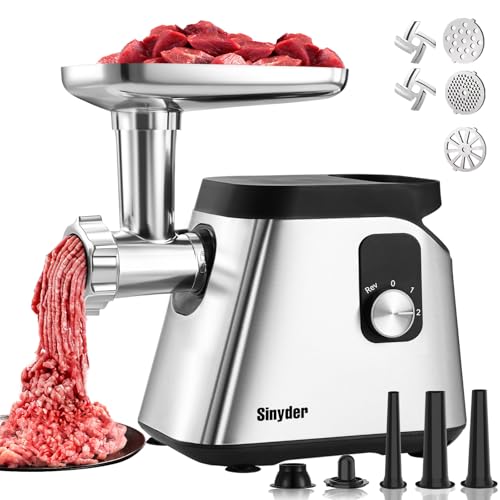
This is a compact electric countertop meat grinder for household grinding, sausage stuffing and kubbe preparation. The marketplace listing gives dimensions of 12.2 by 7.29 by 13 inches and includes two blades, three grinding plates, sausage tubes and a kubbe attachment. It is presented for home and kitchen use, not commercial food service. The seller states that it has two forward speeds, reverse for jams and a 2,800 W maximum-output copper motor, with a claimed rate of up to 3.5 pounds per minute. A seller video shows a pusher and suction-cup feet. The listing also says detachable blades, plates and hopper can be hand washed. However, that same product page contains conflicting dishwasher guidance, so the safe cleaning routine should be hand washing, thorough drying and reassembly only after every raw-meat contact part is clean.
This product suits a home cook who wants a small countertop grinder for occasional batches of burgers, meatballs, sausages or kubbe, and who is prepared to hand wash and fully dry each removable raw-meat contact part after use. It is most appropriate where a pusher, reverse setting and small footprint matter more than documented commercial sanitation status. The user should treat the 2,800 W and throughput figures as manufacturer-stated maximum claims, not independently verified continuous-use performance.
It is not suited to restaurants, caterers, shared commercial kitchens or anyone whose local food-service rules require certified sanitation equipment. It also is a poor fit for users who need a clearly documented electrical safety listing, detailed food-contact material declarations, dishwasher-safe cleaning instructions or easy access to replacement parts. Households with children should not treat the pusher or feed opening as a substitute for supervision, unplugging before disassembly, and keeping hands and loose items away from the auger and blade.
Raw meat requires particularly careful cleaning because grinding can distribute bacteria through the meat, and raw-meat juices can cross-contaminate equipment and nearby food. The product's detachable parts and stated hand-wash suitability are useful, but the dishwasher contradiction on its own product page weakens confidence in the cleaning instructions. Hand wash the removable meat-contact parts, dry them completely and follow raw-meat hygiene practices. The product is described as stainless steel, but it does not disclose alloy grades or identify all food-contact plastics. Its “food-grade” language is therefore not a material compliance declaration. No traceable electrical safety listing or sanitation certification was located, and no specific recycling, take-back or replacement-parts program was found. No product-specific CPSC recall or regulatory safety action was located in the reviewed sources, but that is not equivalent to certification or independently tested safety performance.
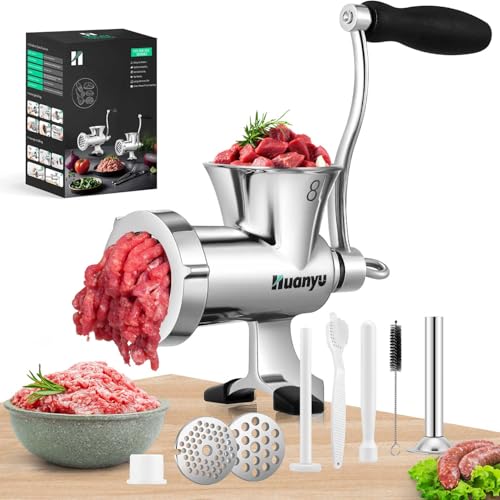
This is a compact, hand-cranked number 8 style meat grinder for home grinding and sausage stuffing. The product is listed at about 3.5 pounds, with a table clamp, two grinding plates, a cross blade, food pusher, sausage tube, brush, and manual crank. It has no motor, cord, battery, or electrical heating system. An independent reseller page for this exact model repeats the maker's claims of a one-piece 304 stainless steel body, tool-free disassembly, dishwasher-safe components, and a clamp for counters about 0.39 to 1.9 inches thick. Those material, cleaning, and stability details are manufacturer-stated rather than backed by a material declaration, sanitation certificate, laboratory test, or model-specific manual found in this review. The same reseller repeats a 5-pound-in-10-minutes throughput claim, but no reproducible independent test was located.
This product suits a home cook who wants a non-electric grinder for occasional small batches of chilled boneless meat or sausage mixture, has a sturdy counter edge that accepts the clamp, and is prepared to fully disassemble, wash, dry, and reassemble it after every raw-meat session. It also fits someone who prefers a hand crank because it avoids cord storage and electrical appliance risks. The user should be comfortable handling a sharp removable knife and working slowly with the supplied pusher.
It does not suit buyers who need documented food-contact compliance, NSF-listed sanitation equipment, or equipment intended for regulated commercial food service. It is also a poor fit for households where children or people unable to safely manage exposed sharp parts may operate or clean it without close supervision. Choose another format if the counter cannot be securely clamped, if frequent high-volume grinding is expected, or if readily documented replacement parts and warranty support are required.
The product's manual format removes electrical shock and appliance-fire concerns, but it does not remove raw-meat safety duties. USDA explains that grinding can distribute surface bacteria throughout meat. After each use, all food-contact parts should be washed with hot, soapy water, dried thoroughly, and kept separate from ready-to-eat foods. Ground beef, pork, lamb, and veal should reach 160 F when cooked. The maker's 304 stainless steel claim is plausible for durable food equipment, and metal parts can have a longer useful life and better recycling prospects than disposable plastic equipment. However, no independent alloy test, food-contact declaration, NSF listing, sanitation certificate, packaging specification, recycling instruction, warranty, or replacement-parts catalog was found for this product. Searches of the CPSC recall resources did not identify a recall or warning specifically naming this brand and model, but that is not a certification of safety.


