Best Overall

ThermoMaven Wireless Bluetooth Smart Meat Thermometer
NIST certified accuracy ensures precise temperature readings.
WiFi unlimited range allows remote monitoring.
Six sensors cover multiple meats simultaneously.
 Lauren Wilson
NIST certified accuracy ensures precise temperature readings.
WiFi unlimited range allows remote monitoring.
Six sensors cover multiple meats simultaneously.

Extended WiFi range for effortless monitoring.
Accurate readings with ±0.5°F precision.
Convenient standalone base with display control.

Quick 0.5-second temperature reading.
Sunlight-readable display for outdoor cooking.
Durable, IP67 waterproof design.
Ultra-thin probes for precise temperature readings.
Unlimited range with WiFi connectivity.
Safe for high heat up to 1000°F.

Accurate temperature readings
Wireless design for convenient
User-friendly interface

Ultra-fast 0.5-second instant temperature reading.
NIST certified for precise ±0.5°F accuracy.
Convenient auto-rotating backlit display.
Quick 0.5-second temperature read.
Rechargeable with convenient USB-C port.
Accurate readings with ±0.5℉ precision.

Dual probes for precise temperature monitoring.
5G Wi-Fi ensures fast, reliable connections.
IP67 rating for water and dust resistance.

Dual probes for precise temperature monitoring.
Large LCD backlight for easy reading.
Timer mode enhances cooking accuracy.
Fast 0.5-second temperature reading.
180° rotating display for easy viewing.
IP67 waterproof for safe cleaning.
Start with the measurement claim, but do not treat a number such as ±0.5°F, ±1.8°F, or a 0.5-second response as proof. Those figures are often manufacturer-stated. The strongest evidence is a current, model-specific ISO/IEC 17025 laboratory report that identifies the exact thermometer or probe assembly, test points, claimed range, measured error, uncertainty, instrument identity, and test date. A product’s stated accuracy should cover food-safety-critical temperatures, not only a convenient part of its range. Response time can also mislead: a fast display update is not the same as a stable, accurate reading.
Look for a practical calibration route. A useful product explains an ice-point or boiling-point check, gives acceptable limits, and provides adjustment, replacement, or service instructions when readings drift. An included “calibration certificate,” “NIST certified” wording, or “NIST-traceable” claim is not, by itself, independent proof that the product will remain accurate. NIST does not certify commercial instruments or endorse their suitability for a particular use.
Heat claims need component-level detail. Check separate limits for the food sensor, ambient sensor, probe handle, cable, connector, transmitter, and display body. A headline such as 752°F, 932°F, or 1,000°F may apply only to brief ambient exposure at the probe tip. Several supplied products had conflicting heat or waterproofing information. A base that is not waterproof, a cable that cannot touch an element, or a body limited to about 122°F changes how the thermometer can safely be used.
For connected products, a local display or hub is valuable, but it does not establish fail-safe monitoring. Look for documented behavior when Bluetooth, Wi-Fi, the app, range, or batteries fail, including visible loss-of-connection warnings and low-battery alerts. Wireless hardware claims should be traceable through the FCC Equipment Authorization System. UL Product iQ or Intertek ETL records can support electrical-safety claims; NSF listings can support a certification claim only when the exact product and scope match. FDA and NIST language in a listing should not be treated as consumer-product certification without an issuer record.
Finally, consider cleaning and service life. The maker should identify food-contact parts, explain washing and waterproofing limits, and address raw-meat cross-contamination. Replaceable batteries, probes, repair support, warranties, and responsible electronics or battery disposal can keep a thermometer in use longer. Across the supplied reviews, no product had a current model-specific independent accuracy report. Repeated cautions included unclear recalibration or drift limits, unsupported certification language, app or connection behavior that was not independently tested, and the need to keep bases and electronics away from heat and water. Multiple products also should not be used in microwaves or pressure cookers; instant-read models should not be left in cooking food or hot appliances. Treat app alerts as a supplement, not the sole food-safety control, when failure behavior is undocumented.
These topics distinguish a thermometer that merely displays a number from one that supports a responsible cooking and ownership routine. Scores reflect the supplied reviews; a higher score indicates stronger evidence or more useful safeguards within this set, not a guarantee of performance.
This measures whether readings have been shown accurate at temperatures used to decide whether meat is safe to eat or hold. High-scoring products have stronger evidence around food-safety temperatures; lower-scoring products rely more heavily on manufacturer claims. Correct probe placement still matters: the supplied reviews repeatedly stress checking the thickest part and avoiding bone, fat, or cavities.
This measures whether a buyer can detect and address drift through an ice-point or boiling-point check, stated limits, and adjustment, replacement, or service instructions. The strongest supplied scores belong to products with a documented user calibration procedure. Lower scores reflect no check, no tolerance, no adjustment method, or no clear replacement path—important because an initially accurate thermometer can become unreliable.
This measures whether the probe, cable, handle, transmitter, and body are suitable for the advertised oven, grill, smoker, fryer, or air-fryer use. High-scoring products provide component-level limits and insertion instructions. Lower-scoring products leave limits unclear or conflict across listings and manuals. A probe-tip rating does not make the display or cable safe for direct flame, prolonged heat, microwaves, or pressure cookers.
This measures whether a leave-in or smart thermometer still warns the cook, or clearly shows lost monitoring, when power, range, Bluetooth, Wi-Fi, or the app fails. High scores reflect documented local displays, alarms, low-battery notices, or disconnect behavior. Lower scores reflect alerts that depend on an app without a clear failure warning. A temperature notification is not proof that delivery will continue during an outage.
This measures evidence for rechargeable batteries, charging equipment, and radio hardware, including traceable compliance and unresolved fire, burn, or interference concerns. Higher-scoring supplied products have identifiable FCC radio records or clearer safety documentation. Lower scores reflect broad marks without exact-product records or unclear charging information. FCC authorization supports radio compliance; it does not prove temperature accuracy or every safety certification.
This measures whether food-contact parts are identified, washable, and designed to avoid trapping raw-meat residue. Higher scores combine material information with clear cleaning and waterproofing instructions. Lower scores reflect missing material declarations, conflicting dishwasher or immersion directions, or bases that must stay dry. Even a product described as waterproof needs cleaning according to the exact manual, especially around connectors and charging contacts.
This measures whether the exact product or probe assembly has a current report from a competent independent laboratory, with traceability, uncertainty, test points, and claimed-range coverage. This was a limiting factor across the supplied set: no product had a located current model-specific report. A factory certificate or hands-on ice-water test can be useful, but neither replaces an accredited report with identified uncertainty.
This measures whether claims about speed, accuracy, range, sensor count, waterproofing, heat resistance, app behavior, and certifications match the tested scope and stated limitations. Higher scores reflect specific, bounded claims and fewer contradictions. Lower scores reflect headline figures unsupported by reports, conflicting manuals and listings, or claims that apply only to one component. Treat “NIST certified” and broad “FDA certified” language cautiously.
This measures whether a claimed mark or compliance statement matches the exact product and a real issuer record. Higher-scoring examples in the supplied set include checkable FCC records or an exact NSF listing. Lower scores reflect broad lists of UL, NSF, FDA, NIST, or other marks that could not be matched to the product. Certification scope matters: radio authorization is not food-contact or accuracy certification.
This measures account dependence, permissions, data collection, offline operation, and continuing app support. Higher scores belong to standalone products or systems with useful local operation and little app dependence. Lower scores reflect required registration, location or device permissions, linked identifiers, third-party sharing, or unclear support. For a thermometer, offline temperature monitoring can remain useful when app privacy or network reliability is a concern.
This measures service life through warranties, replaceable batteries or probes, repair support, packaging information, and responsible disposal. Higher scores in the supplied set generally accompany replaceable batteries, replacement probes, longer warranty coverage, or clear electronics-disposal instructions. Lower scores reflect sealed batteries, no parts or repair route, and no recycling program. Rechargeable does not automatically mean more sustainable if the battery cannot be serviced.
This rechargeable wireless leave-in meat thermometer includes a charging display base and two stainless-steel, ceramic-handled probes. Each probe has five internal sensors and one ambient sensor. The base can show temperatures and set cooking targets without the phone app, while Bluetooth and 2.4 GHz Wi-Fi add remote monitoring. The probes are intended to remain in food during cooking, with the internal sensors placed beyond the marked safety line. The manufacturer states internal accuracy of ±0.5°F from 32°F to 221°F, an ambient limit of 752°F, and IPX8 probe water resistance. Its manual also documents low-battery, overheat, malfunction, and probe-disconnection indicators. The probe radio authorization and the Wi-Fi and Bluetooth module authorization can be checked in FCC records. No current model-specific independent calibration report was located. The product's "NIST certified" wording is not substantiated by a public NIST report and does not match NIST's policy on product endorsement.
This product suits a cook who regularly manages two large cuts or separate dishes in an oven, covered grill, smoker, or rotisserie and wants a local display base as well as optional remote status. It is especially relevant where the stated 752°F ambient limit and 221°F internal limit fit the cooking setup. Buyers should be comfortable following the marked probe insertion line, keeping the base away from water, charging rechargeable components, and treating the manufacturer’s accuracy figure as a claim rather than a published independent calibration result.
It is not suited to buyers who need a documented, current third-party calibration certificate for each product, such as a food operation with formal verification procedures. It is also a poor fit for households that do not want connected-device data collection, do not want to manage rechargeable probes and a base, or expect the entire set to be waterproof. Avoid using it beyond the stated component limits, for microwave use, or as a substitute for checking proper placement and the USDA safe cooking temperatures for every portion.
For food safety, the useful documented safeguards are a minimum insertion safety line, separate internal and ambient sensor limits, a 752°F ambient maximum, a 221°F internal maximum, and base indications for low battery, disconnection, overheating, and faults. The probe is identified as stainless steel and IPX8 washable, including dishwasher use after cooling. The base must not be submerged or put in a dishwasher. Its radio hardware is more traceable than its temperature-accuracy claim. The manual identifies FCC-authorized wireless components, including a wireless thermometer probe with an FCC grant. However, no public model-specific independent calibration report was located. NIST does not endorse commercial products, so the product's "NIST certified" phrasing should not be read as a NIST product certification. Replacement probes can reduce disposal of a complete set, but the rechargeable battery is not user-replaceable in the available documentation. The manufacturer directs disposal through local electronic-waste channels and offers repair or replacement coverage during its warranty period.
This is a rechargeable leave-in wireless meat thermometer with one stainless-steel and ceramic probe, a countertop base with an LED display, and phone app support. The probe has five internal sensors and one ambient sensor. The base can show temperatures and provide cooking modes without requiring the phone during the cook. The manual states an internal range of 32 to 221°F and internal accuracy of ±0.5°F. It also states an IPX8 probe rating and permits hand washing or dishwasher cleaning, while the base must stay dry. Radio compliance is traceable to matching FCC equipment filings for the base and probe. However, no current model-specific independent temperature calibration report was located, so the accuracy figure remains a manufacturer claim rather than independently confirmed performance.
This product fits a home griller, smoker user, or oven cook who wants to leave a single probe in a roast or other thick cut and read progress from a nearby base as well as a phone. It is particularly suited to cooks who value displayed low-battery and overheat prompts, a dishwasher-permitted probe, and the ability to set a target temperature from the base. It is best used within the documented internal-food range, with the probe inserted past its safety line and centered in the food.
It is not suited to buyers who need independently documented accuracy for commercial food controls, HACCP records, scientific work, or other compliance-sensitive measurements. Those users need a thermometer with a current model-specific calibration report, stated uncertainty, and a recalibration process. It is also not for microwave or pressure-cooker use, or for leaving the base on or near hot grill surfaces. Cooks using very high direct heat should not assume the advertised maximum applies indefinitely, because the manual limits 932°F exposure to two minutes and gives conflicting ambient-limit information.
For food handling, the strongest documentation is practical rather than laboratory-grade. The manual identifies stainless steel and ceramic at the probe, says to insert it past the safety line with internal sensors centered in the meat, and allows washing the IPX8 probe by hand or in a dishwasher. It warns that the base is not waterproof, the probe is sharp and hot after cooking, and the probe should cool before washing. The base and probe are rechargeable, which can reduce disposable-battery waste. The manual also directs users not to discard the electronic product with household waste. Its published support materials do not show a replaceable battery, spare-probe policy, repair program, or product-specific recycling program. A search of the U.S. Consumer Product Safety Commission recall resources did not identify a published recall for this product, but absence of a recall is not proof of long-term reliability.
This is a battery-powered, fold-out instant-read food thermometer with a 4.5-inch probe, rotating LCD, IP67 water-resistance claim, and two replaceable AAA batteries. It is intended to be inserted briefly into food, then removed, for grilling, frying, baking, candy making, and final temperature checks. It is not a leave-in oven or smoker probe. An NSF official listing independently identifies the exact HT06 model as a handheld thermometer rated from -58°F to 572°F. Typhur states ±0.5°F accuracy from -4°F to 248°F, with ±1.8°F outside that band, plus a 0.5-second full reading. Those performance figures are manufacturer-stated, not backed by a public model-specific accredited laboratory report. The product's “NIST certified” language is not supported as phrased, because NIST does not certify commercial products or extend a calibration result to untested units.
This product suits home cooks and grill users who want a handheld check of a steak, poultry piece, roast, frying oil, candy syrup, or baked food near the end of cooking. It is especially relevant for people willing to verify readings periodically in an ice-water slurry and who value a documented calibration adjustment path. The NSF listing is useful reassurance for a food-preparation tool, while the replaceable AAA batteries avoid charging downtime and app setup.
It does not suit cooks who need continuous monitoring during an oven roast, long smoker session, sous-vide cook, or unattended fry. The manufacturer expressly says not to leave it in food or in the oven, and the body is limited to 122°F ambient exposure even though the probe measurement range reaches 572°F. It is also not ideal for buyers who require a unit-specific accredited calibration certificate, a fully documented food-contact material declaration, or readily documented replacement probe parts.
The strongest independently checkable health point is the current NSF/ANSI 2 listing, which names the exact HT06 handheld thermometer and its -58°F to 572°F range. Typhur also gives specific cleaning guidance, recommending a food-safe antibacterial wipe after use and a quick rinse. That is useful for reducing raw-meat residue, but the public materials reviewed do not give a detailed food-contact material declaration. The probe tip is sharp and should cool before cleaning. The thermometer is designed for short, handheld checks rather than in-oven monitoring. Its safety instructions warn against ovens, microwaves, dishwashers, and sustained body exposure above 122°F. Replaceable AAA batteries and the registration-based 10-year warranty can support a longer service life. However, no public evidence was located for spare probe availability, repair parts, packaging reduction, or a United States product-specific recycling program. The “NIST certified” claim should not be treated as independent product certification.
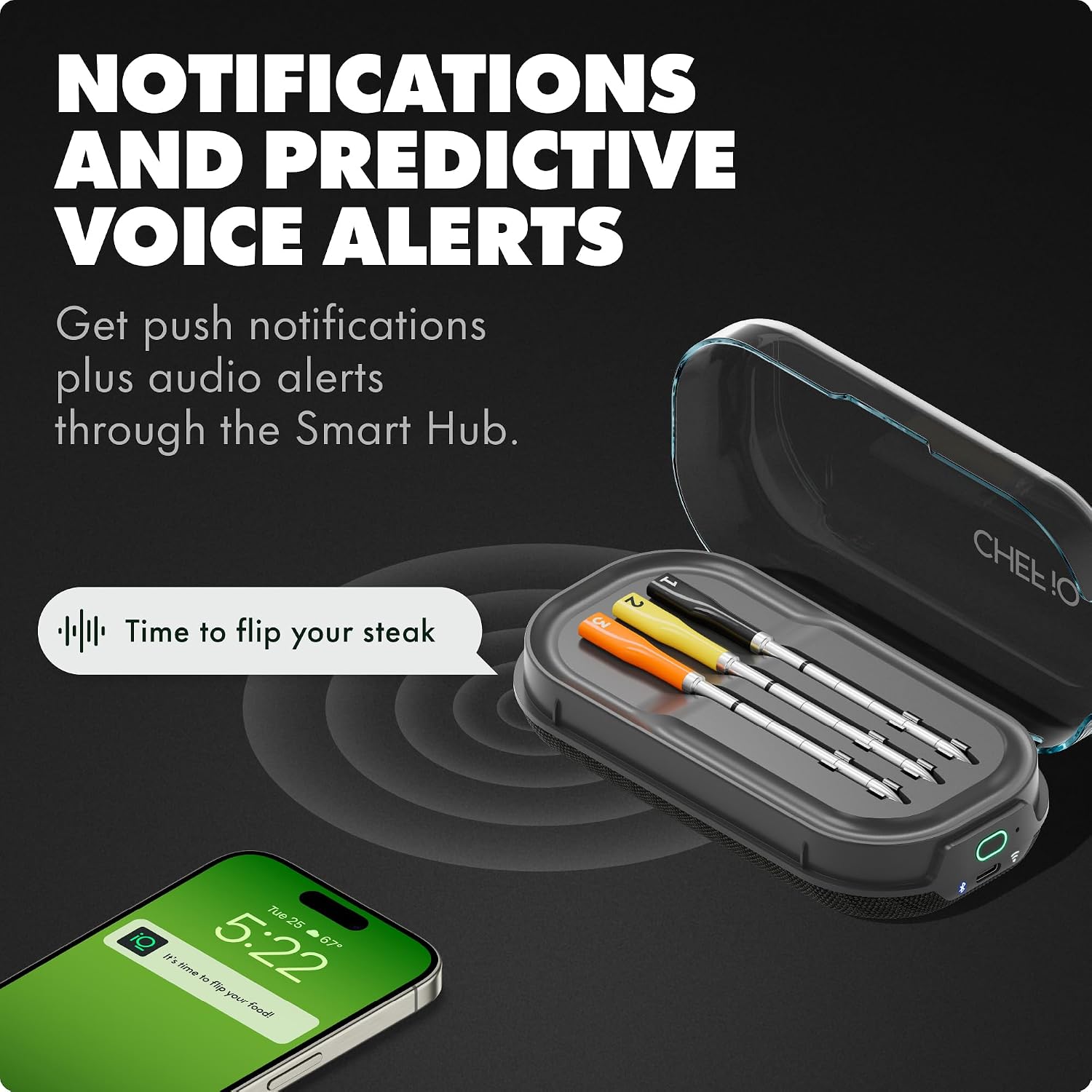
This is a three-probe wireless cooking thermometer system for monitoring food temperature through a phone app and a rechargeable Smart Hub. Each 4.75-inch probe has four internal sensors and one ambient sensor. CHEF iQ states that the food-temperature range is 32 to 212°F and the ambient sensor can withstand up to 1,000°F. The hub relays data over Bluetooth or Wi-Fi and provides audible alerts. The current manufacturer guide gives useful use limits. Probes must be inserted to the marked minimum depth, cannot be used in a microwave or pressure cooker, and are not candy or deep-fry thermometers because components in the metal section cannot exceed 212°F. The manual directs users to USDA temperatures, but the app presets are primarily framed around cooking method and preferred doneness. The product has a confirmed FCC authorization for its probe radio, while published accuracy, waterproofing, thermal testing, and food-contact compliance reports were not found.
This product suits a home cook who regularly grills, smokes, roasts, or uses an oven and wants to follow several foods at once. It is especially relevant for cooks who will keep the hub near the appliance, use the local audible alert as well as the app, insert the probes to the marked line, and independently confirm poultry, ground meat, fish, and other foods against USDA safe minimum temperatures. It also fits users comfortable charging and pairing an app-connected device before cooking.
It is not suited to people who need a documented, independently calibrated instrument for safety-critical temperature verification, commercial food work, or highly precise process control. It is also unsuitable for pressure cooking, microwaving, candy making, or measuring frying oil. Households that need monitoring to remain dependable without a paired app, charged hub, nearby radio connection, or phone should use a thermometer with a clearly documented local display and failure alerts. Keep the sharp, hot probes away from children and people unable to handle them safely.
The health-positive design element is direct food-temperature monitoring. USDA identifies a food thermometer as the reliable way to verify safe minimum internal temperatures, and the guide explicitly instructs users to follow USDA temperatures. It also gives practical placement, cleaning, heat, and handling instructions. The probes are stainless steel and zirconia according to CHEF iQ, but the company does not publish a complete food-contact material declaration or a compliance letter. The guide also carries a California cancer and reproductive-harm warning without identifying a substance in the reviewed materials. The probes contain permanent rechargeable lithium batteries, which reduces routine disposable-battery use but limits repair at end of life. Additional probes are sold separately, and the guide provides a one-year limited warranty activated through the app. It directs users to follow local recycling rules, but no brand takeback route was found. EPA advises taking lithium battery devices to certified electronics recyclers or designated collection programs, not household trash or curbside recycling.
This product is a two-probe, leave-in wireless meat thermometer for cooking separate cuts at the same time in an oven, grill, smoker, or air fryer. Each slim probe is inserted past its safety line, then sends food and local ambient-temperature data to a rechargeable display base. The base can show readings and alarms without requiring the phone app. Typhur states that each probe has five internal sensors plus one ambient sensor, with internal accuracy of ±0.5°F from 32°F to 221°F. Its manual specifies an IPX8 probe made of stainless steel and ceramic, an IPX2 base, and a 932°F ambient probe limit. Those are manufacturer specifications, not independently published performance results. The wireless electronics do have matching U.S. FCC authorization records, but no current model-specific ISO/IEC 17025 accuracy report was located.
This product suits a frequent griller, smoker user, or holiday cook who needs to watch two large cuts at once and wants a physical display base rather than phone-only monitoring. It is particularly relevant when the cooker blocks ordinary Bluetooth signals, because Typhur states that the system uses Bluetooth, Wi-Fi, and Sub-1G communication. The buyer should be comfortable treating the stated accuracy as a manufacturer claim and checking readings against a trusted reference thermometer when food safety is critical.
It is not suited to buyers who require a public independent calibration certificate before relying on a thermometer for poultry, ground meat, or professional food-service controls. It is also a poor fit for households wanting a fully washable receiver, user-replaceable probe batteries, or long-term repairability at the battery-cell level. Do not use it in a microwave or pressure cooker, and do not expose the probe above its stated ambient limit. Children should not handle the sharp probes without close supervision.
The food-contact portion is described as stainless steel and ceramic, and the manufacturer specifies IPX8 water resistance for probes plus dishwasher-safe cleaning. The manual also gives useful safeguards: insert the safety line fully into food, let a hot probe cool before washing, avoid abrasive or solvent-based cleaners, and keep the IPX2 base dry. The claimed internal operating limit is 221°F, while the ambient sensor is stated to tolerate 932°F for limited high-heat cooking. The radio claims are more traceable than the temperature-performance claim. U.S. FCC authorization records correspond to the wireless probe and base hardware. However, no public UL or ETL electrical-safety listing, food-contact material declaration, or model-specific independent accuracy report was located. No U.S. CPSC or FDA recall specific to this product was located in the checked databases. Ecologically, non-replaceable batteries remain a limitation, although Typhur provides replacement-probe support and publishes app updates.
This is a folding, instant-read kitchen thermometer for checking the internal temperature of food, rather than a leave-in probe for monitoring a roast or smoker remotely. The documented guide identifies a 304 stainless-steel probe, a 1.5 V AAA battery, a rotating backlit display, a stated measurement range of minus 58 to 572 F, and a maximum operating temperature of 122 F for the probe body. ThermoMaven states a 0.5-second response and plus or minus 0.5 F accuracy. Those performance figures were not supported by a publicly available, model-specific independent laboratory report with test points and uncertainty. The product does provide a practical ice-water recalibration procedure and explicit instructions not to leave it in cooking food or put it in an oven.
This product suits a home cook who wants a compact handheld thermometer for quick checks of chicken, burgers, roasts, candy, frying oil, or baked foods, then removes it immediately. It is especially practical for someone willing to periodically verify it in a properly prepared ice-water bath and replace a standard AAA battery when needed. Its documented folding probe, display rotation, and cleaning instructions fit ordinary kitchen use where the cook remains present and reads the temperature directly.
It is not for unattended oven, grill, smoker, or air-fryer monitoring. The guide expressly says not to leave it in food while cooking and gives a 122 F maximum operating temperature for the probe body. Buyers who need an independently documented accuracy report for regulated food service, HACCP records, laboratory work, or highly safety-critical cooking should use a thermometer whose exact model has a current accredited-laboratory report. It also does not suit users who need remote alarms, app monitoring, or disconnection alerts.
For food handling, the useful safeguards are concrete. The guide identifies a 304 stainless-steel probe, directs users to clean the instrument after every use with an alcohol or food-safe antibacterial wipe, and gives an ice-water calibration process. USDA guidance likewise recognizes ice water as an appropriate calibration check for many food thermometers. The thermometer is intended for quick handheld checks, not leave-in cooking, which matters because putting the body into an oven can damage it and produce unreliable readings. The product uses a replaceable AAA battery, includes a low-battery indicator, and the guide directs owners to electronic-waste collection rather than household disposal. ThermoMaven also states a lifetime warranty with replacements after registration. No ThermoMaven HT04 recall or CPSC safety warning was located in the reviewed U.S. recall resources. The advertised NIST and NSF claims remain a concern because public issuer records for this exact product were not located, and NIST distinguishes traceability from a blanket certification of later user measurements.
This is a compact folding instant-read food thermometer with a rechargeable battery, a plastic body, a fold-out probe, backlit display, and USB-C charging cable. It is intended for brief temperature checks in foods during grilling, frying, baking, candy making, and brewing, rather than continuous remote monitoring. The independently hosted product manual identifies a stated range of minus 58 F to 572 F, a stated 0.5-second response, and a stated accuracy of plus or minus 0.5 F. The same manual describes an IP65 housing, a 4.6-inch stated immersion depth, and an on-device calibration function. These are manufacturer-stated specifications, not results from a model-specific independent laboratory report. Its cooking-use instructions matter, because the manual limits oven use to the probe only. The product has no wireless connection or app, so it cannot provide remote alarms or temperature logging.
This product suits a home cook who wants quick, in-person temperature checks of roasts, poultry, burgers, frying oil, candy, or brewed liquids. It is most appropriate for someone willing to verify it periodically with an ice-water check and follow the manual's instruction that only the probe, not the plastic body, goes into oven heat. The folding form, rechargeable design, backlit display, and rinseable housing are practical for occasional grilling and everyday kitchen use where the cook remains nearby.
It is not suited to cooks who need continuous monitoring of food while it remains in an oven, smoker, grill, or fryer. There is no remote probe, cable, alarm, wireless link, or documented disconnect warning. It is also a poor fit for commercial food operations, highly safety-sensitive cooking, or buyers who require a current accredited laboratory calibration report for the exact product. Do not treat the stated 572 F measurement range as permission to expose the plastic body to that heat.
For food safety, the important positive is that the product is an instant-read format with a stated calibration control and a claimed accuracy tighter than the FDA Food Code benchmark for Fahrenheit food thermometers. However, those performance figures remain manufacturer-stated. A user should check readings in properly prepared ice water, and use boiling water only with altitude taken into account, following USDA guidance. The manual also says to keep the body out of oven heat and to rinse rather than immerse the unit. The rechargeable battery can reduce disposable-battery waste, but the battery chemistry, replaceability, charging safety certification, and end-of-life takeback route are not documented publicly for this product. Public searches did not identify a product-specific CPSC or FDA recall or warning. The listed FCC, CE, RoHS, and FDA language was not matched to a model-specific public certification record, so it should not be treated as independently verified safety or food-contact certification. At end of life, recycle the electronic product and its battery through an appropriate collection program, not household trash.
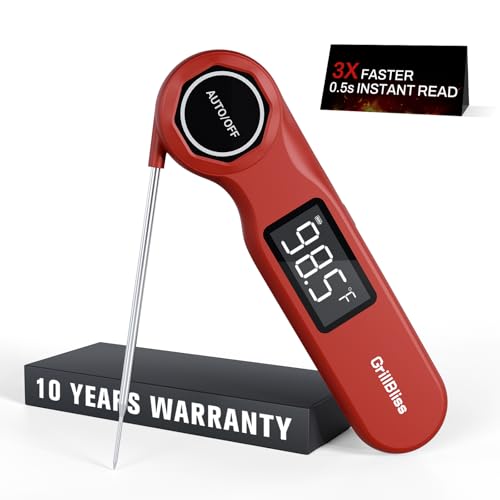
This is a rechargeable wireless leave-in meat thermometer with a charging and display base, two probes, Bluetooth and Wi-Fi connectivity, and a companion-app workflow. One probe is presented for food temperatures and one for ambient grill or oven temperatures, allowing a cook to follow both during a smoking, grilling, or roasting session. Independent retailer listings identify the same GrillBliss product and state a food range of 14 to 212 F, an ambient range of 32 to 572 F, a one-second refresh rate, and claimed accuracy of plus or minus 1.8 F. That stated food accuracy is within the FDA Food Code's plus or minus 2 F benchmark, but no model-specific independent calibration report was located. The listed base display is a meaningful fallback for checking live readings locally, while the stated app range, offline storage, alarm behavior, waterproofing, and battery runtime remain manufacturer claims rather than independently tested results.
This product suits a home griller or smoker user who wants to watch both the center of a roast and the cooking environment from a countertop display or phone. It is most appropriate for cooks who can treat its stated accuracy as a useful starting point, then check it in ice water and boiling water before relying on it for poultry, ground meat, or other food-safety-critical cooks. The two-probe setup also fits longer grill sessions where a standard instant-read thermometer would require repeated manual checks.
It is not suited to commercial food operations, caterers, or anyone who needs documented calibration traceability, a verified uncertainty value, or certification records tied to the exact product. It is also a poor fit for households that need proven disconnection alerts, clear low-battery behavior, or a named, maintained app with a transparent privacy policy. Do not rely on the app alone for safety-critical alerts, especially during unattended or overnight cooking, because exact-model alarm and connection-loss testing was not found.
The manufacturer-stated food accuracy of plus or minus 1.8 F falls within the FDA Food Code benchmark of plus or minus 2 F for Fahrenheit food temperature devices. USDA guidance also supports using a food thermometer for safe cooking and recommends checking calibration in ice water or boiling water. That check is particularly important here because no independent calibration report for this exact product was located. The listing states that the probes are food-grade stainless steel, IP67 water resistant, and dishwasher safe, but no material declaration or food-contact compliance file was found. It also claims FCC, NSF, RoHS, WEEE, and EMC compliance, without exact-product records in the public certification registers searched. No product-specific CPSC recall or safety warning was located. The rechargeable battery may reduce disposable-battery waste, but no spare-probe, repair, battery-replacement, recycling, or packaging-reduction policy was found.
This is a corded, battery-powered leave-in cooking thermometer with two stainless-steel probes, a backlit display, timer, preset and adjustable temperature targets, and audible alerts. The display unit stays outside the oven, grill, or smoker while the probes remain in food or can be used to monitor cooking-chamber temperature. The maker states a 14 to 572 F measurement range, ±1.8 F accuracy from 14 to 212 F, and a one-second refresh rate. That stated tolerance falls within the FDA Food Code benchmark of ±2 F for a Fahrenheit food thermometer, but no current model-specific independent calibration report was located. The manual gives more useful heat-use detail than the product page, including a 716 F maximum for the stainless probe wire, no direct flame contact, and instructions to keep the body off hot surfaces.
This product suits a home cook who wants to watch two temperatures at the cooker, such as two roasts, a roast plus smoker temperature, or different servings with separate targets. Its corded format is practical for oven roasting, covered grilling, and smoking because the display remains outside the heat. It also suits people who prefer simple controls and do not want a phone app, wireless pairing, charging cable, or account. Users should be comfortable positioning probes correctly and hand-washing them carefully.
It is not for cooks who need independently certified accuracy for commercial food-service controls, scientific work, or other high-consequence temperature records. It is also unsuitable for anyone who needs phone alerts, remote room-to-room monitoring, waterproof equipment, dishwasher-safe probes, or use near direct flame. Households that may overlook battery maintenance should be cautious because the manual says a weak AAA battery can reduce accuracy. Do not use its older preset labels as the sole source of current safe-minimum cooking temperatures.
For food safety, the documented strengths are the leave-in design, two probes, external display, and target alarms. The manual instructs users to place the tip at least two inches into the thickest part of meat, avoid bone and gristle, keep the display outside the oven, and avoid direct flame or contact with heating elements. These details help prevent false readings and burns. The maker's stated ±1.8 F tolerance is within the FDA Food Code's ±2 F benchmark for Fahrenheit food thermometers, but it remains unverified by a model-specific independent report. The probes are described by the maker as food-grade stainless steel, but no material grade or third-party food-contact certificate was located. Clean with hot soapy water, rinse, and dry thoroughly. Do not submerge the probe-cable connection or display, and do not put the probes in a dishwasher. Ecologically, the replaceable AAA battery and warranty replacement of a failed probe during the warranty period can reduce disposal, although no broader recycling, packaging, or spare-parts support policy was located.
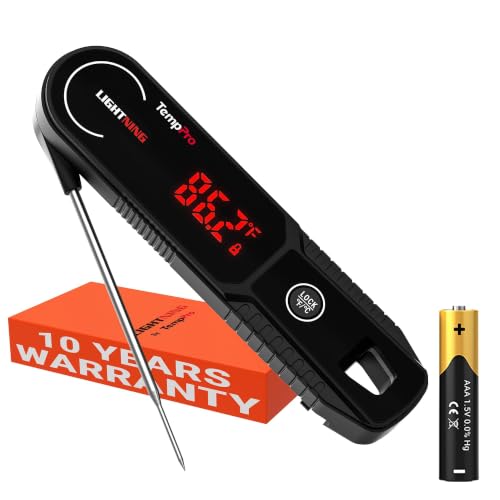
The TempPro TP622 is a folding, battery-powered instant-read food thermometer with a 4-inch 304 stainless-steel probe, LED display, magnet, and one replaceable AAA battery. It is meant for brief spot checks of internal food temperature, not for leaving in an oven, grill, or food while cooking. Its current manufacturer manual specifies a thermocouple sensor, a -58°F to 572°F range, and ±0.5°F tolerance from -4°F to 248°F. NSF's current food-equipment listing independently identifies TP622 as a digital meat thermometer over the same overall range. The manual also gives a practical ice-water calibration process. However, no model-specific ISO/IEC 17025 laboratory calibration report was located, and published response and waterproof claims conflict across the catalog record and manufacturer materials.
This suits a home cook who wants a handheld probe for quick checks of roasts, poultry, burgers, baked dishes, frying oil, or grill food, then removes it immediately. It is particularly suitable for someone willing to perform an occasional ice-water check and use safe-minimum-temperature guidance rather than relying on preset labels. The replaceable AAA battery and stated 10-year limited warranty are practical for a household that wants to avoid a rechargeable device and app setup.
It is not for cooks who need continuous monitoring of food in an oven, smoker, grill, or fryer. The manufacturer describes it as temporary handheld equipment and says not to leave it in an oven or in food during cooking. It is also not ideal for commercial users who require a current, model-specific accredited calibration certificate, documented uncertainty, and scheduled calibration records. People with implanted pacemakers should follow the manual's one-foot separation warning for the built-in magnet.
The strongest health-related evidence is the current NSF directory entry for the exact TP622 thermometer and its stated full range. The manufacturer manual identifies the food probe as 304 stainless steel, tells users to clean the probe between readings, and provides an ice-water calibration method. It also gives useful handling limits, including temporary handheld use only, no oven use, and no more than one minute in foods or liquids above 572°F. The unit uses a replaceable AAA battery rather than an internal rechargeable pack, and its manual directs users not to put batteries or electronic equipment in household waste. A 10-year limited warranty is stated. No matching recall or product-safety warning was identified in the CPSC sources searched. Important evidence gaps remain, including no located material declaration for all food-contact components and no located independent calibration report for this exact model.


