Best Overall

Pamapic Patio Heater with Table Design
Stylish round table design with heater function.
Durable 304 stainless steel burner for longevity.
Triple protection system enhances safety features.
 Daniel Kenitz
Stylish round table design with heater function.
Durable 304 stainless steel burner for longevity.
Triple protection system enhances safety features.

High heat output for cooler outdoor nights.
Easy mobility with built-in wheels.
Durable construction for long-lasting use.

High heat output warms large outdoor spaces.
Durable construction withstands various weather conditions.
Easy ignition system for quick start-up.

Easy mobility with built-in sandbox wheels.
Powerful heating capacity of 48,000 BTU.
Durable construction for long-lasting outdoor use.

Efficient heating with 48,000 BTU output.
Durable construction for long-lasting use.
Easy ignition system for quick start-up.

Easy mobility with built-in wheels.
High heat output for large areas.
Sturdy construction ensures durability.

Versatile for indoor and outdoor use.
Convenient remote control operation.
Built-in thermostat for precise temperature control.

Heats large areas efficiently with 50,000 BTU.
Durable stainless steel construction withstands elements.
Easy mobility with built-in wheels feature.

Adjustable heat direction with swivel arm.
Integrated drink table for added convenience.
Hidden propane tank for a sleek look.
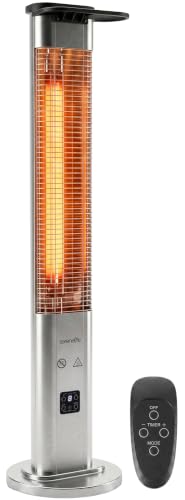
Energy-efficient heating with 900W power output.
Compact design suitable for small patios.
Quick and easy to install and use.
A large BTU or wattage figure is only an input rating. It does not prove how much warmth reaches people, how evenly it is distributed, how long fuel lasts, or how the heater performs in wind. Look for a model-specific report from an ISO/IEC 17025-accredited laboratory identifying the exact product, with heat output, coverage, runtime, and outdoor test conditions. Manufacturer claims such as “18-foot coverage,” “360-degree warmth,” or a square-foot comfort area should be treated as estimates when no such report is available. For propane, the rating plate and manual should state BTU per hour, fuel requirements, cylinder compatibility, and operating instructions. For electric heaters, compare watts with the claimed area and confirm that the circuit, plug, cord, outlet, and mounting arrangement are suitable.
Safety certification should apply to the complete heater, not merely a burner, hose, plug, or other component. A credible listing should be traceable by the exact model in a public record from an OSHA-recognized Nationally Recognized Testing Laboratory, such as UL Product iQ, Intertek’s ETL directory, CSA Group, or IAPMO R&T. Relevant standards include CSA/ANSI Z83.26:20 (R2025) / CSA 2.37:20 for gas-fired outdoor infrared patio heaters and UL 499 or UL 1278 for applicable electric heaters. A certification logo or a claim in an online listing is not equivalent to a matching public record.
For propane units, prioritize clear outdoor-only warnings, ventilation instructions, combustible clearances, leak-testing guidance, flame-failure protection, emergency gas shutoff, and tilt protection. For electric units, look for a stated and independently supported weather rating, grounded-plug instructions, direct connection requirements, and clear GFCI-compatible outdoor use guidance. IP65 or “waterproof” language should not be accepted without model-specific test evidence, especially when the manual limits use near water or in wet areas. Freestanding heaters also need level placement, appropriate ballast or anchoring, honest wind limitations, and protection from hot surfaces, glass, mesh, reflectors, and moving arms.
Durability matters because an outdoor heater becomes a safety risk if corrosion, damaged hoses, worn controls, or unavailable parts force premature disposal. Favor accessible manuals, named replacement parts, service information, realistic warranty terms, and a stated recycling or disposal path. Also check the exact model in CPSC recall and product-safety records.
Across the supplied products, the recurring non-negotiable caveat is that propane heaters must never be used indoors or in enclosed or poorly ventilated spaces, including garages, tents, vehicles, campers, screened rooms with inadequate airflow, and enclosed porches. Carbon monoxide can accumulate rapidly. Electric heaters avoid on-site combustion but still have hot surfaces, mounting and clearance requirements, and electrical shock risks; conflicting weather claims and missing GFCI guidance require particular caution. No supplied product had independently verified outdoor comfort coverage, so advertised area and wind performance should not be treated as guarantees.
Outdoor heaters involve three different questions: whether the heat source can harm people during use, whether the design avoids unnecessary fuel and material impacts, and whether safety and performance claims are independently supported. The scores below reflect the supplied reviews; higher-scoring products generally had clearer controls or documentation, while lower scores often reflected unverified certification, unclear weather protection, or unsupported coverage claims.
This measures whether a combustion heater is clearly outdoor-only, has safe-combustion controls, and gives prominent ventilation and carbon-monoxide warnings. It is central for propane heaters because combustion gases can become deadly in enclosed spaces. Electric products scored highest here because they have no on-site combustion; among gas models, stronger scores went to products with explicit outdoor limits and detailed warnings, while lower scores reflected less complete documentation.
This measures whether an electric heater, cord, plug, controls, and weather rating are suitable for the claimed outdoor exposure, including grounded and GFCI-compatible use. It matters because “waterproof” or an IP rating does not by itself prove safe wet-location operation. Electric scores ranged from very low where marketing conflicted with the manual or GFCI guidance was absent to very high where the product avoided electrical exposure or had clearer instructions.
This measures guarding, overheating protection, shutdown behavior, hot-surface control, and credible clearance instructions. Propane burners, reflectors, glass tubes, and electric heating heads can ignite nearby materials or burn people even when the heater is functioning normally. Higher-scoring products supplied clearer clearances or documented protection; lower-scoring products relied more heavily on manufacturer claims or lacked accessible exact-model instructions.
This measures whether a freestanding heater remains stable or a hanging or wall-mounted heater has a verified mounting system, suitable ballast, and honest wind limits. Tall patio heaters need level placement, anchoring or ballast, and supervision during wind. The supplied products generally scored better when they provided ballast, anchors, solid-surface mounting rules, or tilt shutdown; scores were lower when mounting loads, clearances, or wind performance were unavailable.
This measures the cylinder connection, regulator, hose, ignition, flame-failure protection, tilt shutoff, leak testing, and emergency shutdown instructions. It matters because a propane heater can create both fire and carbon-monoxide hazards after a connection failure or extinguished flame. Higher scores reflected detailed manuals and multiple stated shutdown controls; lower scores reflected unverified claims, missing hose details, or no accessible model-specific leak procedure.
This measures whether the complete heater has a current, traceable certification from an OSHA-recognized testing laboratory to the applicable U.S. standard. It is stronger when the exact model appears in a public UL, ETL, CSA, or IAPMO record. Most supplied products scored only moderately because certification claims could not be matched publicly; the better scores reflected stronger supporting documentation, not proof of certification where no listing was found.
This measures whether the exact model’s BTU or wattage, runtime, coverage, and wind limits were independently reproduced under stated outdoor conditions. Nearly all supplied products had only manufacturer or retailer coverage claims, so their scores stayed moderate or low despite large input numbers. A high score requires a model-specific accredited laboratory report; a 48,000 or 50,000 BTU label alone does not establish usable warmth across a claimed area.
This measures whether claims such as waterproof, all-weather, safe, commercial-grade, or area-heating are specific, qualified, and supported. Higher-scoring products acknowledged limitations and avoided unsupported conclusions; lower scores reflected conflicting coverage figures, unverified IP or certification language, or comfort claims without wind conditions. Buyers should compare the listing, manual, rating plate, and independent records rather than relying on a headline phrase.
This measures accessible manuals, durable warnings, setup instructions, support contacts, and transparent handling of recalls or safety actions. It matters because correct clearances, leak checks, mounting, storage, and emergency shutdown are essential to heater safety. The stronger supplied products had detailed manuals and model-specific parts or operating information; lower scores reflected missing manuals, mismatched manuals, unclear warnings, or unresolved uncertainty about the exact product.
This measures heat delivered relative to fuel or electricity input, directional control, and whether efficiency claims are supported. Propane heaters create direct carbon-dioxide emissions; electric heaters shift emissions to the local grid. The supplied scores were generally higher for electric models and for products with controllable lower settings, while gas models scored lower because high BTU inputs imply substantial fuel use and no independent efficiency or comfort test established the warmth delivered.
This measures corrosion resistance, replaceable wear parts, manuals, service support, warranty coverage, and end-of-life options. Outdoor exposure makes corrosion and damaged gas or electrical components important safety issues. Higher scores went to products with named replacement parts, such as burner, hose, regulator, or switch assemblies, and clearer support. Lower scores reflected unavailable parts catalogs, limited warranties, no service documentation, or no recycling path.
This is a tall, freestanding propane radiant patio heater with a round storage table around its center. It is intended for outdoor use with a standard 20-pound propane cylinder, which is not included. The maker lists overall dimensions of 87.8 inches high by 27.6 inches wide and deep, a 54-pound product weight, and a 50,000 BTU per hour input rating. A separate major retailer lists the same product family under model PH-ZMSX-WH3. Pamapic states that it has a 304 stainless steel burner, an aluminum reflector, flame-out protection, an oxygen-depletion feature, and tilt shutoff. It also claims CSA certification. CSA Group is an OSHA-recognized testing laboratory, but I could not trace this exact model to a public CSA product-listing record. The stated 20-foot heat range and rapid warm-up claim were not supported by a model-specific independent test report.
This product suits an adult who needs a freestanding heat source for an open, level patio, deck, or garden gathering area and can safely manage a standard 20-pound propane cylinder. The round table is useful where guests need a nearby surface for drinks or small items. It is most appropriate for users willing to follow cylinder leak checks, keep children and pets away from hot surfaces, and stop use in strong wind. The stated stainless burner may also appeal to buyers expecting seasonal outdoor exposure.
It is not appropriate for enclosed or partially enclosed rooms, garages, tents, RVs, boats, screened spaces with inadequate ventilation, or any place where combustion gases could accumulate. Households that cannot maintain clear space around a hot radiant appliance, supervise children and pets, or securely place the heater on level ground should choose another heating arrangement. It is also a poor fit for buyers who require publicly traceable certification records, independently tested comfort-area data, a documented weather rating, or readily published model-specific replacement parts before purchase.
The central health issue is propane combustion. Carbon monoxide has no odor, and CPSC warns that operating outdoor heaters indoors can create deadly carbon monoxide buildup within minutes. Pamapic's comparable patio-heater manuals prominently require outdoor-only operation, leak testing, clearance from combustibles, and keeping the appliance stationary while lit. Those precautions are essential for this product type, regardless of the claimed protection systems. Pamapic states that this product has flame-out, oxygen-depletion, and tilt shutoff protection and is CSA certified. CSA itself is an OSHA-recognized testing laboratory, but a public certificate record matching this exact product was not located. The stated 304 stainless steel burner can support service life, and the maker states a one-year limited warranty, but no exact-model spare-parts catalog was found. Climate impact is substantial in use because propane is a fossil fuel. EPA emission factors list about 5.72 kilograms of carbon dioxide per gallon of propane burned.
This is an 87-inch freestanding propane radiant patio heater with a round tabletop, wheeled base, and space for a standard propane cylinder in its lower housing. It is intended for open-air patios, decks, porches, gardens, and similar outdoor settings. An instruction manual matching this product model is publicly available from an independent retailer, which supports that the product is a real, documented heater format rather than only a marketplace listing. The 48,000 BTU rating, 18-foot claimed heat diameter, double-layer 304 stainless-steel burner, and 4 to 8 person comfort claim are manufacturer-stated, not independently heat-tested. The manufacturer also states that gas stops if the flame goes out and that a tilt beyond 45 degrees extinguishes the flame. Public searches did not locate a matching complete-product listing in major U.S. NRTL certification directories or an independent test report for output, coverage, or those shutdown functions.
This product suits an adult user heating an open, level patio or deck for short social gatherings, where a freestanding propane appliance is acceptable and the unit can be kept clear of structures, furnishings, and foot traffic. It is most appropriate for someone willing to follow a manual, inspect the hose and regulator, perform leak checks, secure the base with the supplied anchoring or ballast provisions, and manage a propane cylinder. Expectations should be limited to localized radiant warmth rather than uniform heating across the claimed full diameter.
It is not suitable for indoor rooms, garages, enclosed porches, tents, camper awnings, or partially enclosed spaces where combustion gases can accumulate. It also does not suit households seeking independently verified certification, independently tested coverage, or documented long-term replacement parts. Avoid it where children, pets, or unmonitored guests could contact the hot reflector or move the tall freestanding unit. Exposed, windy locations without a secure, level anchoring arrangement are also a poor setting for this heater.
The central health issue is propane combustion, not electricity. Outdoor-only use is essential because carbon monoxide is colorless, odorless, and potentially fatal in enclosed or poorly ventilated areas. The manufacturer states that this heater stops gas flow after flame loss and extinguishes the burner after a 45-degree tilt, but those protections were not independently verified for this exact product. A public exact-model manual improves access to instructions, although a complete-product NRTL certification record was not found. Climate impact is material. A 48,000 BTU per hour propane input is a high fossil-fuel heat load, and EPA factors equate propane combustion with roughly 139 pounds of carbon dioxide per million BTU. Stainless steel is stated for the burner, which may help corrosion resistance, but no verified spare-parts program, repair guide, extended warranty, or end-of-life plan was located. Sweetcrispy's April 2026 pressure-washer recall was for a different electrical product, not this heater.
This is an 87-inch, floor-standing propane radiant patio heater for outdoor patios, gardens, lawns, and gatherings. The listing states a 48,000 BTU heat input, adjustable flame, wheels, a standard 20-pound propane-cylinder compartment, and an 18-foot heating diameter. The cylinder is not included. It is a gas appliance, not an electric space heater, so plug, cord, rain, and GFCI issues do not apply to its normal operation. The defining safety claims are manufacturer-stated 45-degree tip shutoff and flame-out gas cutoff, plus ground anchors intended for soft ground. A linked user manual and one-year manufacturer warranty are available through the marketplace listing. No model-specific NRTL certification listing, accredited laboratory heat test, or public evidence validating the advertised 18-foot, one-minute warming claim was located during verification.
This product suits a buyer with an open-air patio, garden, or lawn who wants movable radiant heat from a standard 20-pound propane cylinder and can anchor the unit in soft ground if needed. It is most appropriate for users prepared to assemble a tall freestanding heater, inspect the hose and connections before use, follow the supplied manual, and keep people, furniture, fabric, and combustibles well away from hot surfaces. The stated tilt and flame-loss shutoffs add practical safeguards, but remain manufacturer claims rather than independently verified evidence.
It is not for indoor rooms, garages, tents, enclosed porches, sleeping spaces, or any partially enclosed area where combustion gases can accumulate. It is also unsuitable for households needing independently verified safety certification, tested wind performance, or documented clearances and leak-test procedures before use. Avoid it for hard-surface locations if anchoring is needed, because the supplied ground anchors are stated to be for soft ground rather than concrete. Households with young children, pets, or close seating around the heater need especially careful hot-surface control.
The key health issue is combustion. Propane can produce carbon monoxide, an odorless and potentially fatal gas, and the CPSC warns that outdoor heaters must never be used indoors. The marketplace listing does label this unit for outdoor use and states that gas shuts off after flame loss or a 45-degree tip. Those are useful claimed controls, but no public model-specific certification record or independent combustion test was located to confirm their performance. The stated 304 stainless-steel burner may help resist corrosion, and the listing offers a one-year manufacturer warranty and a linked manual. However, no parts catalog, repair instructions, take-back program, recycled-material disclosure, or independent durability testing was found. Climate impact is also material because this heater burns fossil propane. Its heat-output and coverage claims have not been independently substantiated, so fuel use and real-world warmth per unit of emissions remain uncertain.
This is a freestanding, radiant propane patio heater for outdoor use. It stands about 87 inches high and is sold as a 48,000 BTU unit with wheels, a round utility table, and a fillable sandbox base. A standard propane cylinder is required but is not included. The product page states that the base can take sand or water for up to 26.45 pounds of added ballast. It also states that gas flow shuts off after flame loss and that a sensor responds when the unit leans beyond 45 degrees. These are useful claimed safeguards, but this review did not locate a model-specific independent test report or a public NRTL listing that confirms the complete heater. The 18-foot warmth range is also manufacturer-stated rather than independently verified under stated wind and temperature conditions.
This product suits an adult who needs movable radiant heat for an open, spacious patio, deck, or backyard gathering area and can keep people and combustible furnishings well away from the hot upper assembly. It is most appropriate for someone prepared to fill the sandbox base, obtain and correctly connect a compatible propane cylinder, inspect the hose and regulator before use, and follow the linked manual. The claimed 48,000 BTU input is intended for short-range outdoor comfort, not whole-area heating in windy weather.
It does not suit apartments, enclosed porches, tents, garages, campers, or any other partly enclosed setting. Propane combustion can create dangerous carbon monoxide buildup where ventilation is inadequate. It is also a poor fit for households that cannot keep children, pets, or passersby away from hot surfaces, or for exposed locations where the unit cannot be ballasted and monitored in wind. Buyers needing documented third-party certification, independently proven coverage, readily available repair parts, or a clearly published warranty should require that evidence before relying on this product.
The key health issue is combustion, not electricity. CPSC warns that outdoor heaters used indoors can create deadly carbon monoxide buildup quickly. This product is described as outdoor-only, so it should be operated only in genuinely open air, with the cylinder connection checked for leaks and the heater shut down if a gas odor is present. The listing claims flame-failure shutoff and a 45-degree anti-tilt response, but neither safeguard was independently verified for this exact unit. At its stated 48,000 BTU per hour input, full-power operation would use roughly 0.52 gallon of propane per hour and produce about 3.0 kilograms of carbon dioxide per hour using EPA propane emission factors. The stated 304 stainless steel burner mesh may help corrosion resistance, but there is no verified whole-product material specification, parts catalog, repair program, or recycling pathway. No applicable OLIXIS recall was located in the CPSC recall search during this review.
This is a freestanding, propane-fired radiant patio heater for outdoor use. The listed Havana Bronze version is about 85.8 inches tall, has a roughly 18.1-inch-square base, weighs 32.1 pounds before the propane cylinder and added ballast, and rolls on wheels. A round table surrounds the column, while the base is intended to hold a propane cylinder. The product page states a 48,000 BTU per hour input and an 18-foot heating diameter, but no model-specific independent heat-output, comfort-range, wind, or runtime test was located. It also states that the 304 stainless steel double-layer burner has flame-out gas shutoff and a shutoff when the unit tilts beyond 45 degrees. Those are useful claimed protections, not independently confirmed performance. The public listing identifies the heater as outdoor-only and links a user manual.
This product suits an adult managing an open-air patio, deck, or garden gathering who wants a movable, tall radiant heater and is prepared to follow propane handling procedures. It is most relevant where an 18-inch base footprint and an approximately 86-inch overall height fit comfortably, where the heater can be kept away from traffic and combustible materials, and where the owner can add base ballast. The stated round table and wheels may be useful for repositioning it between outdoor seating areas.
It is not suited to any enclosed, screened, tented, garage, camper, or indoor setting. CPSC warns that using outdoor heaters indoors can cause deadly carbon monoxide buildup in minutes. It also does not fit households unable to keep children, pets, and guests away from hot surfaces, or sites exposed to strong or unpredictable winds. Buyers who need independently verified output, certified model-specific safety documentation, explicit clearance instructions, readily available repair parts, or a low-carbon heat source should select a product with that evidence.
Propane combustion is the principal health issue. The product is explicitly designated for outdoor use, and that limitation matters. CPSC states that outdoor heaters used indoors can produce deadly carbon monoxide buildup in minutes. Propane is also a fuel that can produce carbon monoxide when combustion is incomplete. The listing claims flame-out and tilt shutoffs, but those features were not independently verified for this exact heater. No exact-model public certification record from CSA, UL, Intertek ETL, or another NRTL was located, and no independent laboratory report was found for its heat output or coverage. The listing offers a manual download, but its detailed clearances and leak-test procedure were not independently reviewable. At the stated 48,000 BTU per hour input, propane use would emit roughly 3 kilograms of carbon dioxide per hour at full input, calculated from EPA stationary-combustion factors. The claimed 304 stainless steel burner may aid corrosion resistance, but parts, warranty, and recycling support remain unverified.
This is a freestanding pyramid-style propane patio heater with an enclosed cylinder base, a visible quartz-glass flame tube, protective mesh, top reflector and wheels. A retailer listing for the same FOOWIN pyramid heater describes an 81.5-inch-tall, 58-pound unit rated at 48,000 BTU, with a cover, weighted base and adjustable flame control. The product is intended for open-air patio, backyard and gathering use, not indoor space heating. The 48,000 BTU output and roughly 130-square-foot comfort claim are seller and manufacturer statements, not independently reproduced performance results. Retailer and manual materials state that the heater has automatic tip-over shutdown and flame-out protection. The retailer also calls it ETL Listed, but a matching current product record could not be located in Intertek's public directory. The available retailer-linked manual also uses non-U.S. cylinder and pressure specifications, so it should not substitute for a clearly matched U.S. manual.
This product suits an adult user with an open, level patio or backyard who wants a movable focal-point heater for short outdoor gatherings and can safely manage a standard propane cylinder. It is most appropriate where the user can keep a generous clear area around the heater, complete a soap-solution leak check before use, supervise it around guests, and store it covered after cooling. The stated 48,000 BTU input may fit a small outdoor seating zone, but buyers should treat the advertised coverage figure as an estimate rather than a tested comfort guarantee.
It is not for use indoors, in garages, tents, screened rooms with inadequate open area, RVs, boats, or beneath low and combustible overhead structures. Carbon monoxide from propane combustion can build up quickly in enclosed spaces. It is also unsuitable for households that cannot keep children, pets and loose fabrics away from hot mesh, glass and reflector surfaces. Avoid it in strong or gusty wind unless the product's exact U.S. instructions specify a secure anchoring method. Buyers needing traceable U.S. certification and an exact matched manual should choose a product with those records readily available.
The key health issue is combustion. CPSC warns that outdoor heaters must never be used indoors because carbon monoxide can become deadly within minutes. Product materials consistently say outdoor use only and describe leak checks, hot-surface precautions, flame-out protection and tip-over shutdown. Those are useful claimed protections, but the complete product's certification could not be independently matched in Intertek's public listing system. The available retailer-linked manual also appears configured for non-U.S. gas cylinders and pressures, which limits confidence in its suitability as U.S. setup guidance. Propane combustion produces direct climate emissions. EPA emission factors list propane at about 5.59 kg of carbon dioxide per gallon, and a 48,000 BTU-per-hour input can consume roughly half a gallon per hour at maximum output. The product has metal construction, a glass tube and a storage cover, but no verified corrosion specification, parts catalog, repair program or end-of-life recycling plan was found. No applicable CPSC recall or regulatory warning was found in the searched public databases.
This is a fixed-installation electric carbon-infrared heater for a greenhouse, garage, workshop, or sheltered patio. The product is 34.6 inches long, runs on 110 to 120 volt power, and has 1,000 watt and 1,500 watt heat settings. It can be secured to a wall or ceiling or suspended from the supplied chain hardware. Its external temperature probe supports automatic control from 30°F to 120°F, and its timer can switch the heater off after up to 24 hours. The accessible owner manual independently confirms the electrical rating, mounting format, clearances, and operating controls. The manufacturer states that the housing is dual-layer aluminum and water resistant, while also claiming both IPX5 and IP55 on the same product page. Those ratings are not documented in the manual. The manufacturer and a retailer state that it is ETL certified, but a matching public Intertek listing was not located during this review.
This product suits a greenhouse, potting area, detached garage, or workshop owner who needs directional electric heat without occupying floor space. It is most appropriate where the heater can be permanently mounted high on a solid nonflammable structure, its sensor can be placed near the protected plants or work area, and a qualified installer can provide a grounded, code-appropriate sheltered outlet. Its two power levels and automatic temperature setting are useful for maintaining a selected local temperature rather than trying to heat a large, open outdoor area.
It is not suited to an exposed deck or patio where rain, hose spray, wind-blown water, or uncertain outlet protection are likely. The manual does not document its IP rating and does not explicitly call for GFCI protection. It is also unsuitable where children, pets, or seated occupants can approach the heater, or where it cannot be mounted at least 94.5 inches above the floor with the stated clearances. Buyers needing independently demonstrated outdoor coverage or a publicly traceable certification record should require that documentation first.
Because it is electric, this product creates no combustion exhaust, carbon monoxide, propane leak risk, or fuel-cylinder handling risk at the point of use. That is a meaningful indoor and greenhouse safety advantage over combustion patio heaters. It still needs careful installation. The manual requires a grounded outlet, prohibits extension cords and power strips, calls for a weatherproof outlet outdoors, and warns that heater components can exceed 200°C. At full output it uses 1.5 kilowatt-hours for each hour it runs, or 1.0 kilowatt-hour on low. Electric resistance heating can target nearby plants and work surfaces, but its climate impact depends on the local electricity grid. EPA grid data show that electricity emissions vary substantially by region. The manufacturer states that the housing is aluminum, and the manual directs owners to recycle the product rather than discard it with unsorted municipal waste. Repairability is limited because the manual identifies no user-serviceable parts and provides a one-year limited component warranty.
This is a freestanding, tower-style propane patio heater for open-air patios, decks, and gathering areas. It uses a 20-pound propane cylinder, measures about 31.9 inches wide by 86.6 inches high, and weighs 45 pounds, according to Gas One. The manufacturer identifies it as for outdoor use only, an important limitation for any combustion heater. Gas One states a 50,000 BTU per hour input rating, 360-degree warmth, push-button ignition, a heat-control dial, wheels, and tilt-triggered shutoff. The burner and protective mesh are described as stainless steel. These are manufacturer statements, not independently located model-specific performance or safety test results. A public operating manual, clearance schedule, fuel-consumption figure, replacement-parts catalog, and traceable third-party certification record for this exact product were not located during verification.
This product fits an adult household that needs movable radiant heat for an open, level patio, deck, or backyard seating area and can store, connect, and exchange a standard 20-pound propane cylinder safely. It is best suited to users who accept a fuel-burning outdoor appliance, can keep it attended around children and pets, and will stop using it during unsuitable wind. The claimed tilt shutoff and broad freestanding footprint are relevant practical safeguards, although both should be confirmed on the delivered unit and in its instructions.
It is not for indoor rooms, garages, tents, screened enclosures, enclosed porches, or locations near doors, windows, and vents where combustion gases can enter a building. It is also unsuitable for households that cannot manage propane-cylinder handling, routine hose and connection checks, or hot-surface separation from children and pets. Buyers who require verified all-weather use, documented clearance distances, independently confirmed output, published replacement parts, or a publicly traceable safety certification should select a product with those records available before installation.
The key health fact is that this is a propane combustion appliance, not an electric heater. Gas One clearly says outdoor use only, and U.S. consumer-safety guidance warns that outdoor heaters must never be used indoors because carbon monoxide can accumulate rapidly. No electrical supply is involved, so cord shock and outdoor receptacle issues do not apply. However, public verification did not locate a model-specific manual or a public certification record confirming the complete heater's tested gas controls, clearances, flame-failure function, or leak-test instructions. Its stainless steel burner and mesh may help resist corrosion, but no parts catalog, repair program, recycling guidance, or warranty terms specific to this product were located. At the stated 50,000 BTU per hour input, EPA's propane carbon factor implies roughly 6.9 pounds of carbon dioxide per hour at full input. Gas One recalled separate adapter hoses in September 2021 for swelling and gas-leak risk. That recall did not identify this product, but it is a relevant connection-safety history.
This product is a freestanding liquid-propane radiant patio heater with a folding swivel arm that positions the burner overhead and to one side of the base. It uses a separately purchased 20 lb propane cylinder, stores that cylinder in an enclosed compartment, and has a small stainless steel drink table. The official product page states 38,200 BTU per hour, a 33 inch heat shield, a 50 lb sand-filled wheeled base, and 88 inch height. Its operating manual gives a matching 38,200 BTU per hour input and 1.77 lb per hour fuel-use rating, plus a flame-failure and tilt shutoff. The manual also gives unusually detailed outdoor-only, ventilation, clearance, leak-test, storage, hot-surface, pinch-point, and wind instructions. It names the CSA/ANSI outdoor infrared patio-heater standard, but a model-specific public NRTL certification listing was not located. The manual and product page also disagree on overall weight, listing about 110 lb and 100 lb respectively.
It suits an adult household that wants a movable, full-size propane heater for an open patio or deck, particularly where directional overhead radiant heat is more useful than heat cast equally in every direction. The user should be comfortable assembling a roughly 100 lb unit, obtaining and securing a 20 lb cylinder, performing soapy-water leak checks, and storing the heater and cylinder correctly. It is most appropriate where a level, noncombustible surface and a 40 inch combustible-material clearance can be maintained.
It is not for indoor rooms, garages, tents, enclosed porches, enclosed gazebos, or any sleeping area. It also does not fit homes with children or pets who cannot reliably be kept clear of hot surfaces and the moving overhead arm. Choose another format if the installation area is uneven, wind-exposed, damp, under an overhang, near low branches, or unable to preserve the stated clearances. It is also unsuitable for buyers seeking a publicly traceable independent safety listing or independently tested coverage performance.
The key health issue is combustion. The manual prominently says outdoor use only and warns that carbon monoxide from enclosed-space use can be fatal. It also requires a well-ventilated setting, specifies clearance from combustibles, directs users to inspect the hose, perform leak tests, and keep the cylinder enclosure ventilated. Its stated flame-failure and tilt devices are meaningful safeguards, but they do not make covered or enclosed operation safe. The manual also carries a California warning about benzene exposure from propane fuel and combustion products. This heater has no mains-powered heating element, so rain-related electric-shock risk is limited to its battery ignition system. Climate impact remains material because it burns propane. At the manual's 1.77 lb per hour maximum fuel-use rating, it emits roughly 2.4 kg of carbon dioxide per hour based on federal propane emissions factors. Repair prospects are better than for a sealed unit because major gas-system parts are named, but the one-year warranty excludes corrosion and weather damage. No model-specific CPSC recall was located in the reviewed public records.
This is a slim, freestanding electric infrared patio heater with a 37.4-inch tower format, a 9-inch base, remote control, and three manufacturer-stated power levels of 300, 450, and 900 watts. The manufacturer identifies an aluminum-alloy frame, stainless-steel base cover, carbon-fiber heating elements, mesh front grille, 78.7-inch power cord, 9-hour timer, tip-over switch, and overheat protection. It does not burn propane or other fuel, so it produces no combustion gases at the point of use. Its manual provides unusually concrete fire and use instructions, including a 3-foot clearance from combustibles and use on a stable, level surface. However, its published comfort range is inconsistent. The manufacturer manual says 15 square feet but also says 5 to 10 square meters, while another seller page lists 150 square feet. The IP65 and ETL claims were not traceable to a public certifier record for this exact product.
This product fits an adult who wants close-range radiant warmth at a single chair, bistro table, or small covered seating nook, and who has a stable, dry, grounded wall outlet nearby. Its 900-watt maximum input and the manufacturer's 15-square-foot figure point to personal comfort rather than heating an open deck or a group. It is also relevant for households that specifically want to avoid propane cylinders, open flames, and combustion exhaust, while accepting corded electric operation and active supervision around the hot front grille.
It is not suited to an exposed patio where rain, standing water, wet flooring, or wind-driven spray are realistic because the waterproof marketing conflicts with the manual's no-wet-area and no-near-water warnings. It is also not suitable for heating a whole porch, large gathering, or open backyard, since its coverage claims are inconsistent and no independent output test was found. Choose another arrangement for unsupervised use around children, pets, people needing assistance, combustible furnishings, extension cords, or an outlet that is not properly grounded and readily accessible.
The key health advantage is the absence of fuel combustion at the heater. It does not use propane or gas, so there is no onsite carbon-monoxide or combustion-particle source while operating. The manual also calls for a grounded outlet, direct wall connection, a stable level surface, 3 feet of clearance from combustibles, and cooling before cleaning. It warns that the heating head and surfaces become hot, so the mesh grille is not a substitute for child and pet separation. The product's 900-watt maximum is a known operating input, but its claimed 88 percent efficiency and comfort coverage were not independently substantiated. Electricity use still carries upstream climate and air-emission impacts that depend on the local grid. The aluminum-alloy housing and stainless base cover may support service life, and the maker offers a registered 3-year warranty, but no parts catalog, element replacement path, or product-specific recycling program was located. The manual also includes a California Proposition 65 warning without naming the relevant chemical.



