Best Overall

SHALL Mini Pen Sander with Adjustable Speeds
Offers four adjustable speed settings.
Compact design for easy handling.
Efficient for detailed and precise sanding.
 Daniel Kenitz
Offers four adjustable speed settings.
Compact design for easy handling.
Efficient for detailed and precise sanding.

Versatile with 64 color-coded sanding heads.
Convenient charging dock for easy recharging.
Ideal for 3D printing and model making.

Lightweight design for easy handling.
Long-lasting battery for extended use.
Versatile accessories for multiple applications.
Efficient dust collection with micro-filter dust box.
Versatile with three additional attachments included.
Comes with 12 sanding sheets for various tasks.

Compact design for easy handling.
Versatile for 3D prints and models.
Efficient in reaching tight spaces.

Efficient dust collection keeps workspace clean.
Compact design ideal for tight spaces.
Includes multiple sandpapers for versatility.

Compact design makes it easy to handle.
Efficient dust collection keeps work area clean.
Powerful motor provides smooth sanding performance.
Compact design for easy maneuverability.
High RPM for efficient sanding.
Comfortable grip reduces hand fatigue.

Versatile 3-position grip enhances user comfort.
Efficient dust collector keeps work area clean.
Compact design ideal for tight spaces.

Compact design for easy maneuverability.
Cordless convenience with powerful 20V battery.
Hook and loop system for quick sandpaper changes.
Whether one works well depends on matching the tool to the job and checking what its specifications actually establish. A pointed or triangular pad can improve access to corners, but it does not prove sanding speed, finish quality, or performance under load. Adjustable speed is useful only when the stated range is clear and supported; figures described inconsistently as RPM, OPM, or strokes per minute should not be compared as though they were the same measurement. Runtime claims need a disclosed load, abrasive, material, and battery condition. Accessory counts also deserve checking when product pages and manuals disagree.
Dust control is a central buying criterion. A dust bag, canister, micro-filter, or “collection system” is not the same as measured containment. Strong evidence would identify the substrate, abrasive, collection setup, test duration, and measured capture or airborne-dust result. A compatible vacuum connection should have documented dimensions and a suitable extraction arrangement; a HEPA claim should be specific rather than assumed from the word “filter.” For hazardous dust, the instructions should address wood dust, silica-containing materials, and legacy lead-coated surfaces, with point-of-generation extraction guidance where appropriate.
Electrical and battery claims also need exact-model verification. A safety logo in an image or manual is weaker than a current listing in UL Product iQ, Intertek’s ETL directory, or CSA’s product database matching the complete tool system. For cordless products, that means checking the tool, charger, and included battery where applicable. Battery-platform compatibility should be supported by the original equipment manufacturer, not inferred from a similar-looking connector. A clean CPSC recall search is useful accountability evidence, but it does not establish certification or prove that a product is risk-free.
For vibration and noise, look for independently measured values or manufacturer data that names the test method, measurement location, and operating conditions. A phone-app reading, an unexplained decibel number, or a general “low vibration” statement is not comparable evidence. For performance, the most useful independent report states the substrate, abrasive, battery, load, and test conditions. Repairability is stronger when the manufacturer documents replacement pads, bases, dust boxes, cords, batteries, service support, and recycling routes.
Across the supplied products, recurring limits matter. None had a verified independent dust-capture result, and several lacked a dust shroud, vacuum port, or HEPA-compatible extraction option. The included collectors or bags therefore should not be treated as lead- or silica-dust controls. Do not rely on these products for sanding lead-painted surfaces, pre-1978 renovation, silica-containing masonry or stone, or other hazardous coatings without an appropriate containment and HEPA-based exposure-control plan. Several products also lacked exact third-party certification records, measured noise or vibration data, or documented repair support. Follow each manual’s instructions on eye, hearing, and respiratory protection, workpiece securing, attachment inspection, unplugging or battery removal, and dust or coating residues that may ignite.
The scores below reflect the supplied reviews and the topic definitions. A higher score indicates stronger evidence or clearer safeguards within this set; it does not turn an untested collector into a certified hazardous-dust control system.
This measures whether the tool and instructions address wood dust, silica-containing materials, and legacy lead coatings, including suitable extraction options. Detail sanders often work close to the user, so open or poorly controlled dust is consequential. Scores ranged from 42 to 79: the higher-scoring corded products had more specific hazard warnings, while low-scoring products lacked substrate-specific guidance or extraction capability.
This measures demonstrated containment during sanding, not merely the presence of a bag or canister. Among these products, no independent capture result was found. Scores still ranged from 35 to 73, reflecting differences in documented collectors, ports, and review observations. A higher score means better-supported collection arrangements in this group, not verified HEPA performance or safe control of lead or silica dust.
This measures protection against shock, overheating, charging faults, short circuits, and battery events, with the strongest evidence requiring exact-model third-party certification for the complete system. Scores ranged from 68 to 78. Manuals with charging, unplugging, ventilation, or fire-related instructions helped, but several products had no publicly traceable exact certification record.
This measures controls, pad and accessory attachment, guards, inspection, and shutdown guidance that reduce unintended operation or ejected-part injuries. Scores ranged from 62 to 80. Higher-scoring products had clearer instructions for removing power before changes, matching accessories, inspecting parts, or avoiding unsafe spindle-lock use; lower scores reflected weaker or less complete documentation.
This measures comparable hand-transmitted vibration and ergonomic control during realistic use. Scores ranged from 68 to 78, but no supplied product had a disclosed independent vibration test. Higher scores were supported by practical grip or comfort evidence and stated controls, while lower confidence followed from marketing claims without a test method or from reviewer reports of noticeable vibration.
This measures whether sound output is measured and clearly disclosed, alongside hearing-protection guidance. Scores ranged from 55 to 76. The stronger entries included stated sound-pressure or sound-power figures, although these were not always independently confirmed. Products with phone-app readings, unexplained low-noise claims, or no acoustic measurement scored lower.
This measures whether speed, runtime, power, reach, accessories, and battery compatibility are confirmed under disclosed conditions. Scores ranged from 52 to 77. Higher scores came from manuals or hands-on reports confirming specific features, while lower scores reflected conflicting speed figures, untested runtime, inconsistent accessory counts, or claims without load and substrate details.
This measures whether dust, safety, precision, power, and material claims are qualified and supported. Scores ranged from 52 to 72. Higher-scoring products more clearly stated limits such as light-duty use or noncommercial operation. Lower scores were associated with broad paint-removal or dust-efficiency claims that were not supported by hazardous-material guidance or measured results.
This measures whether the exact tool, charger, and battery can be matched to a current UL, ETL, CSA, or comparable certification record. Scores ranged from 68 to 76, but the reviews repeatedly noted that an exact public match was not located. A reproduced mark or retailer statement is weaker evidence than a searchable issuing-body record for the complete system.
This measures the ability to check recalls, incidents, serial information, and remedies, with stronger scores for a clean and accountable record. Scores ranged from 70 to 78. No relevant product-specific recall was identified in the supplied checks, but a clean search is not proof of certification or absence of risk, especially for newer or sparsely documented products.
This measures whether pads, bases, dust boxes, cords, chargers, and batteries can be replaced, supported, repaired, or recycled. Scores ranged from 68 to 84. Higher-scoring products had documented replaceable wear parts, repair channels, or battery stewardship; lower-scoring products had only replaceable abrasives or no parts catalog, service manual, replacement-battery support, or recycling pathway.
This is a corded, pen-shaped reciprocating detail sander intended for small surfaces, corners, hollows, polishing, craft work, and finishing. Independent retail listings reproduce a 12 V, 0.5 A specification, a 6-foot cord, four stated speed settings from 5,000 to 10,000 strokes per minute, and tool-free interchangeable heads. They also list eight head shapes and 18 abrasive sheets across 180 through 1,000 grit. The useful distinction is scale. Its narrow reciprocating format and supplied shapes are designed for localized work, not rapid preparation of broad panels. The published speed range, sanding reach, ergonomic comfort, accessory durability, vibration, and noise have not been independently laboratory tested. Public listings also use both strokes-per-minute and rotational-speed terminology for the 10,000 figure, so buyers should treat that figure as a manufacturer-stated operating range rather than a verified output measurement.
This product suits a hobby user doing brief, localized sanding on small craft pieces, model parts, 3D-printed items, furniture details, or accessible interior corners. The best fit is someone who values a narrow corded tool and wants several head profiles and fine abrasive grades in the initial kit. It is most appropriate where dust can be controlled externally, the substrate is known to be free of hazardous coatings, and the task does not require verified production-level output or extended continuous operation.
It is not suited to preparing large flat surfaces, stripping coatings, or work where speed, finish consistency, and sustained-duty durability need documented verification. Do not use it for suspected lead-painted surfaces, silica-containing materials, or dusty indoor woodworking without an appropriate local-exhaust and cleanup plan. EPA guidance calls for HEPA-equipped sanding controls when lead paint is present or presumed. It is also a poor fit for workplaces that require traceable electrical certification, measured sound and vibration data, or established repair support.
The central health limitation is dust control. Available product descriptions identify sanding heads and abrasives, but do not document a dust bag, shroud, vacuum connection, HEPA attachment, capture result, or instructions for wood dust, silica-containing material, or legacy coatings. OSHA identifies local exhaust ventilation as the principal engineering control for woodworking dust. EPA advises minimizing dust and using HEPA vacuum attachments for sanding where lead dust is a concern. No exact-product match was located in the checked UL, ETL, CSA, or TÜV public certification sources, and no product-specific recall or regulatory action was located in the CPSC recall search. That is not confirmation of certification or absence of risk. The tool is corded, so it avoids a removable lithium-ion battery waste stream, but no spare-parts catalog, repair manual, recycling instruction, or verified durability program was found. Worn sanding sheets and heads remain consumable waste.
The HOZO NeoSander Premium Combo is a compact cordless reciprocating detail sander for finishing 3D prints, models, small wood pieces, resin parts, and similar close work. The manufacturer states that its 89 g tool uses a 3.7 V, 1,100 mAh internal lithium battery, runs at up to 13,000 strokes per minute, and has a continuously adjustable 0.6 to 1.8 mm stroke. The package includes 64 color-coded sanding heads, a dock, and starter sheets in eight grits from 180 to 1500. HOZO identifies the body materials as magnesium, aluminum, steel, and ABS plus PC, and lists IP54 protection only for the main unit front section. Independent hands-on reviews support its usefulness for confined detail finishing and its comfortable, low-vibration feel, but they also describe it as a finishing tool rather than one for substantial stock removal. No published laboratory performance, vibration, dust-capture, or acoustic report was located.
This product suits a hobbyist who frequently finishes small 3D prints, scale models, miniatures, jewelry components, or detailed craft pieces at a dedicated workbench. Its value is in access and workflow, not broad-area sanding. The included range of head shapes and grit-coded organization can help someone move among tight grooves, curved features, and crisp corners without repeatedly cutting and attaching paper. It is most appropriate where the user can work slowly, hold small parts securely, and provide their own dust-control measures.
It is not suited to paint stripping, renovation of older homes, drywall work, masonry, or any task that can create lead or silica-containing dust. The product has no attached HEPA local-exhaust system, even though EPA and OSHA guidance emphasizes capture at the point of generation for hazardous sanding dust. It is also poorly matched to tabletops, doors, large flat panels, or jobs requiring fast material removal. People needing documented electrical certification, measured low noise, or quantified vibration data should use a product with those exact records.
The key health limitation is dust control. This is an open detail sander, not a dust-extraction system. OSHA identifies local exhaust ventilation as the preferred control for wood dust, and EPA recommends wet methods or HEPA-equipped sanding tools for lead-dust work. A hands-on reviewer reported substantial loose dust during resin sanding. The IP54 statement concerns protection of the tool's front section from dust and splashes, not containment of dust generated at the abrasive. The product has an internal lithium battery and USB-C charging, but no exact-model listing from UL, Intertek ETL, or CSA was located in the checked certification sources. The manufacturer provides a one-year limited warranty and sells official replacement heads and sandpaper, which can extend use of the main tool. However, no battery-recycling program, replaceable battery documentation, service manual, or independent environmental materials assessment was located. No relevant CPSC recall or regulatory action was found in the searched U.S. sources.
This is a compact, rechargeable rotary tool for fine sanding, engraving, polishing, light drilling, and small cutting jobs. The supplied documentation identifies a 3.7 V lithium-ion battery, USB-C charging, a 5,000 to 18,000 RPM five-step speed range, LED worklight, and a low tool weight of about 0.14 kg. Its manual explicitly limits it to light-duty projects, which is important for interpreting broad multi-material claims. HARDELL's current product pages state a 2,000 mAh battery, up to 200 minutes of runtime, and a 69-piece kit. These are manufacturer claims, not independently load-tested results. Documentation for this product is inconsistent on accessory count, with another product manual identifying 61 accessories. The verified manual gives useful fitting and shutdown warnings, but it does not provide a dust port, vacuum interface, measured dust capture, vibration data, or a reproducible noise test.
This product fits a hobbyist doing short, controlled detail work on small resin pieces, 3D-print cleanup, jewelry-scale polishing, softwood shaping, or model making. Its pen-like format, low weight, five manufacturer-stated speed settings, and included small accessories are most relevant when access and fine control matter more than material removal rate. It also suits users who understand that the tool is light-duty and will inspect each bit, tighten the collet correctly, wear eye protection, and work with a separate dust-control setup.
It is not appropriate for extended sanding, furniture refinishing, aggressive cutting, heavy grinding, or work that needs verified sustained torque and runtime. Do not use it for lead-painted surfaces in pre-1978 homes, silica-containing masonry or stone, or dusty hardwood work without an exposure-control plan. Those jobs can create hazardous airborne dust, while this product has no documented extraction connection or capture test. It is also a poor fit for users needing traceable U.S. electrical safety certification, published vibration data, or independently measured noise results.
The product manual provides several meaningful basic safeguards. It tells users not to operate in wet conditions or around flammable gases or liquids, to wear glasses, to keep hands away from rotating tips, and to avoid using the spindle lock during operation. It also warns that an incorrectly matched accessory shank can vibrate and lead to loss of control. These are useful operational protections, but they are not a substitute for third-party certification or measured safety performance. Sanding wood, old coatings, stone, and similar materials can create airborne hazards. OSHA identifies airborne wood dust from sanding as a health concern, and EPA warns that sanding in homes built before 1978 can create hazardous lead dust. No dust collector or vacuum interface is documented for this tool. The manual says electronic products should be recycled where facilities exist, but does not document replacement batteries, spare-part support, or a battery take-back program. No relevant CPSC recall was located in this review.
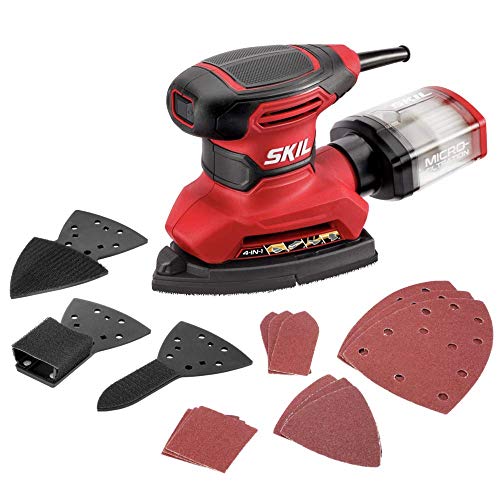
This is a compact, corded 120 V, 1.2 A detail sander for finish work on corners, edges, narrow gaps, louvers, and some curved surfaces. It uses hook-and-loop abrasive sheets and includes a triangular louver attachment, a finger attachment, a flexible attachment, a dust canister, and 12 sanding sheets. SKIL lists the tool at 2.6 pounds with one speed setting. The manufacturer documents a micro-filter canister and a 1-1/4 inch port for a vacuum connection, plus instructions to align sheet holes and empty the canister often. Its instructions also explicitly identify lead-paint, silica, treated-wood, and coating dust hazards. However, no comparable measured dust-capture, vibration, noise, or sanding-performance test was found. A notable specification conflict remains, the catalog record states 14,500 RPM while SKIL's current product page states 13,500 OPM.
This product fits a homeowner or occasional workshop user doing small finish-sanding jobs on bare wood, metal, plaster, or previously assessed coatings. Its compact 2.6 pound format, fixed corded power, standard triangular pad, and three specialized attachments are useful where hand sanding would otherwise be needed, such as furniture corners, trim details, louvers, and narrow edges. It also suits users who can connect a suitable vacuum and who will empty and clean the dust canister frequently. The one-year consumer warranty is relevant for intermittent personal use.
It is not suited to lead-paint disturbance in a pre-1978 home or child-occupied facility without the required lead-safe work plan, containment, and appropriate HEPA dust control. The supplied canister and generic vacuum port are not evidence of compliant lead-dust capture. It is also a poor fit for occupational silica work, long continuous sanding sessions where documented vibration and noise data are needed, or jobs requiring verified extraction performance. Users needing variable speed, independently confirmed acoustic data, or a clearly traceable exact-model safety certification should select equipment supported by that documentation.
The manual correctly treats sanding dust as a health and fire concern. It warns that dust can contain lead from older paint, crystalline silica from masonry materials, and arsenic or chromium from treated lumber. It advises ventilation, eye protection, particulate-filtering respiratory protection, frequent canister emptying, and careful disposal. It also warns that fine dust and coating residues can ignite or combust, and directs users to unplug the tool before accessory changes, canister removal, or maintenance. For households built before 1978, the relevant risk is not solved by a small onboard collector. EPA guidance identifies sanding as a source of hazardous lead dust and calls for lead-safe practices. The product has no battery, avoiding battery disposal and thermal-event issues. SKIL documents replaceable pad, base-plate, and dust-box assemblies, along with repair-service support. No product-specific recall was found on the brand recall page or in the reviewed CPSC search results, but an exact-model independent safety-certification listing was not publicly traceable in this review.
This is a compact, pen-grip reciprocating detail sander for finishing small 3D-printed parts, models, crafts, resin, plastic, and thin wood. Fanttik states that it has a brushless motor, three settings of 2,000, 4,000, and 6,000 strokes per minute, a ring light, USB-C charging, and a built-in 700 mAh lithium-ion battery. It can also run while plugged in. The supplied kit is unusually focused on shaped detail work. The manufacturer lists nine interchangeable sanding heads, six flexible film-backed sheets from 180 through 1200 grit, a cleaning brush, and a storage case. Fanttik also claims resistance to stalling at a 3,000 g applied load, but it provides no disclosed test protocol or independent confirmation. The product page depicts and lists a dusting brush, not a dust collector, shroud, or vacuum connection.
This product suits a hobbyist who sands a small number of 3D prints, miniatures, resin pieces, plastic parts, or thin-wood details at a dedicated bench. It is particularly relevant where hand sanding awkward grooves, internal corners, and curved surfaces is slow, and where the supplied shaped heads and fine abrasive range can be used. The user should have a separate approach for dust control, such as working wet only when the material and electrical-use instructions permit it, or using local extraction nearby.
It is not suited to sanding painted building materials, unknown legacy coatings, stone, concrete, ceramics, or other silica-containing substrates. Those tasks can require point-of-generation HEPA capture, containment, and exposure controls that this product does not document. It is also a poor fit for prolonged production work, users sensitive to vibration or noise, and households where children, pregnant people, or pets could enter an uncontained sanding area. Buyers needing documented electrical certification, measured noise, measured vibration, or replaceable battery support should look for those records before use.
The main health limitation is dust control. OSHA identifies sanding-generated wood dust as an airborne health concern and recommends local exhaust ventilation at the source. EPA warns that sanding painted surfaces can create hazardous lead dust, especially in homes built before 1978. This product has no documented dust shroud, vacuum port, HEPA attachment, or tested collection performance. Its included brush is for cleanup, not exposure control. Do not treat wet-and-dry abrasive capability as evidence that a given workpiece is safe to wet sand. The tool contains a built-in lithium-ion battery, but no exact-product third-party electrical safety certification was found in the checked public registers. Fanttik provides a one-year warranty and lifetime technical support, but its support materials state that replacement parts and accessories are not currently sold through its website or after-sales service. That creates a waste concern when sanding heads, charging parts, or the integrated battery eventually fail. No product-specific CPSC recall or public safety warning was located in the checks performed.
This is a compact, 120 V corded detail sander for dry sanding wood, plastic, and similar materials. Its pointed hook-and-loop pad is intended for corners, edges, and small surfaces. The supplied U.S. manual specifies 1.6 A input, 14,000 no-load motions per minute, a 5.51-inch triangular sanding surface, and twelve starter sheets in P80, P120, and P240. These are manufacturer-stated specifications, not independently load-tested results. The manual documents a rear dust collector, a rubberized grip, a single on-off switch, Class II construction, and a cETLus marking. It also states that the product is not designed for commercial use. Manufacturer noise data list 74 dB(A) sound pressure and 85 dB(A) sound power, while listed vibration is 6.7 m/s². No independent acoustic, vibration, dust-capture, or sanding-rate test was located.
This product suits a homeowner doing short, dry detail-sanding jobs on clean, known materials, such as smoothing a small wood repair, refinishing furniture edges, preparing a trim patch, or removing light rust from a small metal item. The pointed pad, low 2.2-pound listed weight, corded operation, and included three-grit starter set fit intermittent work where reaching corners matters more than covering large flat areas. The buyer should be prepared to use eye, hearing, and respiratory protection and to manage escaped dust.
It is not suited to commercial or extended continuous sanding, which the supplied manual expressly excludes. It is also inappropriate as the dust-control solution for lead-painted surfaces, silica-containing materials, or other hazardous coatings. Homes with children, pregnant occupants, or pets should not treat the included collector as lead-safe containment. Users needing documented vacuum compatibility, measured fine-dust capture, variable speed, low vibration for long sessions, or independently traceable certification records should use a product with that evidence before beginning work.
Sanding creates airborne wood dust, which OSHA identifies as a respiratory health concern. The manual includes symbols and instructions for eye, hearing, breathing, and hand protection, plus dry-use, unplugging, workpiece-securing, and damaged-part inspection guidance. It also says not to process hazardous materials. Those are useful baseline directions, but they do not replace a substrate-specific exposure plan. For paint in pre-1978 housing or other potentially lead-coated surfaces, EPA guidance calls for containment and power tools with HEPA vacuum control. This product's included collector has no HEPA claim or measured capture result. The manual reproduces a cETLus mark, though a public directory match for this exact product was not confirmed and retailer documentation conflicts. No relevant U.S. CPSC recall was located in the searched public records as of September 7, 2026. The manual asks users to recycle the electrical product rather than discard it with household trash, but no product-specific parts catalog or repair network was located.
This is a compact, corded detail sander with a triangular hook-and-loop pad for corners, edges, small repairs, and finish preparation. The available TX104 documentation describes a 140 W motor, 13,000 no-load rpm, a 1.8 m cord, a dust bag, a vacuum adapter, and 12 papers in P80, P120, and P240 grits. These are manufacturer-stated specifications, not independently performance-tested results. The instructions include practical safeguards, including eye and hearing protection, unplugging before accessory changes, checking the cord, and keeping vents clear. They also document external vacuum connection, but provide no measured dust-capture result or HEPA compatibility statement. A material documentation mismatch needs attention in the US context, the available manual specifies 230 V and CE certification, while the US product record states 120 V. Confirm the voltage and safety marking on the actual tool before use.
This product suits a DIY user doing light, short-duration work on unfinished wood, furniture edges, trim, small metal items, or plastic pieces. Its triangular pad, supplied P80, P120, and P240 papers, and compact format are appropriate where access to corners matters more than rapid stock removal. It also fits a user who can connect a compatible vacuum, inspect the product marking before first use, and use eye, hearing, and respiratory protection appropriate to the material being sanded.
It is not appropriate for lead-paint work in pre-1978 housing, silica-bearing materials, or other hazardous coatings unless the job uses an appropriate HEPA-controlled system and lead-safe containment practices. The supplied dust collector and adapter are not documented as HEPA equipment. It is also a poor fit for sustained professional use, users who need verified low vibration or low noise data, or anyone unable to confirm that the actual tool has a 120 V US-compatible rating and a recognized safety certification marking.
The instructions provide basic power-tool safety direction, including eye protection, hearing protection for extended operation, unplugging before changes, cord checks, and clearing blocked ventilation openings. They also recommend a dust mask for dusty work and offer a bag plus vacuum adapter. Those are useful controls, but there is no disclosed capture test, airborne-dust measurement, HEPA rating, or specific guidance for respirable silica and legacy lead coatings. That gap matters because EPA guidance calls for HEPA vacuum attachments and containment when mechanically sanding lead-painted surfaces. The available documentation also states CE certification and 230 V operation, neither of which verifies the safety status of a 120 V US product. No relevant US recall was located in the checked CPSC sources. Abrasives are replaceable, but documented repair support for the cord, pad, collector, and internal components was not found.
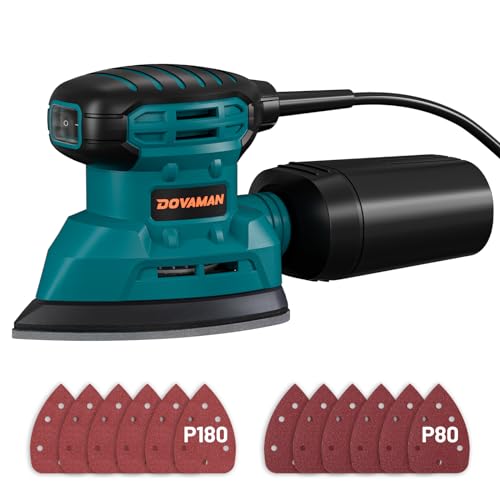
This is a compact, corded triangular detail sander for dry sanding wood, metal, paint, filler, plastics, stone, and similar materials. The manufacturer manual specifies a 130 W motor, 12,000 no-load rpm, 1 mm eccentricity, a 140 x 140 x 80 mm sanding surface, a 3 m cord, a dust box, and 12 supplied sanding sheets. The manual also says it is not for wet sanding, asbestos-containing materials, or damp environments. The product has a detachable collector and a connection for a vacuum, but no independent dust-capture test was located. Its manual discloses sound and vibration figures measured to EN 60745, rather than independent results. A significant listing-quality issue remains, the Amazon specification table says 220 V while the manufacturer manual says 120 V, 60 Hz. Buyers need to confirm the voltage on the tool label before connecting it to U.S. mains power.
It suits a homeowner doing small, dry finish-sanding jobs on accessible wood, filler, or metal, particularly corners and tight details that benefit from a triangular pad. The included P80 and P180 sheets provide a starting set for material removal and smoothing. It is most appropriate for short, intermittent jobs where the user can connect the collector or a suitable vacuum, wear eye and respiratory protection, inspect the pad and cord, and verify the voltage printed on the actual tool before first use.
It is not suited to work on suspected lead-painted surfaces in pre-1978 homes, silica-containing masonry or concrete, or asbestos-containing materials. EPA guidance calls for a shrouded power tool with a HEPA vacuum attachment for lead-paint sanding, and this product has no evidence of that system or its capture performance. It is also unsuitable for wet sanding, damp spaces, production sanding, or buyers who require an exact-model independent electrical-safety certification, independently measured dust control, or validated low-vibration performance.
The strongest health evidence is in the manufacturer manual. It tells users to use dust extraction and a dust mask, identifies dust as potentially hazardous, combustible, or explosive, warns that sanding lead-containing paint can create poisonous dust, and excludes asbestos-containing materials. Those instructions are useful, but the product's collector and household-vacuum connection are not shown to meet HEPA lead-dust control practices. EPA guidance specifically calls for HEPA vacuum attachments on power sanders used on lead-painted surfaces. The manual reports 76 dB(A) sound pressure, 87 dB(A) sound power, and 4.948 m/s² hand-arm vibration, with stated uncertainties, but these are manufacturer figures rather than independent measurements. No exact-product third-party electrical certification record was located. On waste reduction, the tool is corded, so it has no battery disposal burden. DOVAMAN states that defective parts can be repaired or replaced under its two-year limited warranty, although no public spare-parts catalog or repair manual was found.
This is a compact, corded detail sander for furniture refinishing, cabinet work, paint preparation, and other small-area sanding. It has a 1.2 amp motor, a pointed sanding pad, a removable finger attachment, hook-and-loop abrasives, and an onboard dust canister. A separate retailer specification lists the tool at 2.8 pounds, with an 8 foot cord and a 14,000 OPM speed. The manufacturer manual provides substantial use and hazard instructions, including disconnecting power before accessory changes, using the canister for wood sanding, and emptying it every 10 minutes. The manufacturer describes a three-position comfort grip and dust-sealed switch. However, the speed claim is inconsistent: the manufacturer page headline says 16,000 OPM while its detailed feature text says 14,000 OPM, matching retailer specifications. No independent dust-capture, vibration, acoustic, or sanding-rate test was located.
This product suits a homeowner doing intermittent, small-scale detail work, such as smoothing cabinet edges, refinishing furniture, preparing trim, or reaching into corners where a broad sheet sander is awkward. It is best matched to users who have access to household power, can work in short sessions, and will use correctly perforated abrasives so the canister can function. The documented replaceable pad components also help a user maintain a tool used occasionally over time.
It is not appropriate for commercial sanding or long, repetitive jobs, because the manufacturer limits the warranty to home use and provides no vibration or noise exposure data for sustained operation. It is also unsuitable for sanding known or suspected lead paint in pre-1978 homes without lead-safe planning and HEPA point-of-generation control. The manual specifically discourages lead-paint sanding, prohibits wet sanding and magnesium sanding, and says not to use the canister or a vacuum while sanding metal because sparks can ignite dust.
The manual recognizes sanding dust as a respiratory hazard and tells users to wear certified eye, hearing, and respiratory protection. It specifically identifies risks from lead paint, crystalline silica, and treated lumber. It says lead-paint sanding is not recommended because contaminated dust is difficult to control. This matters because EPA guidance requires HEPA exhaust control for power-tool work that disturbs lead paint in covered renovations. The supplied canister is useful for basic housekeeping, but it is not a substitute for verified HEPA extraction. The manual also warns that coating dust, including polyurethane or linseed-oil residues, can self-ignite in the canister. Empty it frequently and follow coating instructions. On repairability, replaceable sanding pads and bases are documented, and canister replacements are available through parts channels. No battery is involved. A CPSC recall located for Black and Decker concerned different random-orbit sander models from 2010, not this detail sander.
This product is a compact, battery-powered detail sander for consumer sanding of wood, metal, plastic, and painted surfaces. It is sold as a bare tool, so its battery and charger are separate purchases. BLACK+DECKER lists a brushed motor, 12,000 RPM, 2.3-pound tool weight, one required 20V MAX lithium-ion battery, a removable dust canister, and a two-year limited warranty. The stated 20V figure is maximum initial voltage, while nominal voltage is 18V. Its manual gives unusually specific dust and coating warnings. It requires the dust canister for wood sanding, advises emptying it every 10 minutes, discourages sanding lead paint, and warns against using the collector or vacuum on metal because sparks can ignite dust. No independent dust-capture, runtime, vibration, noise, or performance test was located. The official product page also conflicts internally about whether the detail finger attachment is included.
This product suits a homeowner doing short, dry, detail-sanding tasks on furniture, trim, painted surfaces, plastic, or small metal areas. It is most appropriate for someone who already owns compatible BLACK+DECKER 20V MAX batteries and chargers, understands that this listing is tool-only, and can follow the manual's dust-canister, respirator, eye-protection, and cleanup instructions. Its compact shape is intended for narrow spaces and edge work rather than broad-surface production sanding.
It is not suited to anyone needing documented low airborne-dust performance, a direct OEM vacuum connection, or independently measured noise and vibration data. Do not use it for extended drywall sanding, wet sanding, magnesium, or metal sanding with the dust canister or vacuum attached. Projects involving suspected lead paint, silica-containing material, or old coatings need exposure controls beyond a small onboard canister, including appropriate containment, cleanup, and respiratory protection. Commercial users should also note that the stated warranty is for home use.
The strongest safety evidence is in the product manual, not in independent testing. It warns that sanding can expose users to lead from old paint, crystalline silica from masonry products, and chemicals from treated lumber. It calls for certified eye, hearing, and NIOSH, OSHA, or MSHA appropriate respiratory protection. For wood sanding, the manual says the dust canister must be installed and emptied every 10 minutes. It also warns that coating dust can self-ignite, and that sparks make collector or vacuum use unsuitable on metal. The product uses a removable lithium-ion battery rather than an integral pack. The manual identifies compatible battery and charger families, advises returning damaged packs for recycling, and directs users to Call2Recycle or authorized service and retail locations for battery recycling. Replaceable sanding tips, a removable canister, service-center support, and a two-year limited warranty can extend use. No exact-product third-party electrical certification record or relevant product-specific CPSC recall was located in the checks performed.



