Best Overall
44% off

WYBOT C1 Cordless Pool Vacuum
Efficient cleaning with strong suction power.
Easy to use with cordless design.
Long-lasting battery for extended cleaning time.
 Daniel Kenitz
Efficient cleaning with strong suction power.
Easy to use with cordless design.
Long-lasting battery for extended cleaning time.
Operates without cords or hassle.
Eco-friendly, uses solar power.
Effective at removing debris efficiently.

Dual charging options for continuous cleaning power.
Shallow water safeguard prevents skimmer from getting stuck.
Twin motors tolerate salt chlorine pools effectively.

Continuous cleaning with solar power efficiency.
Smart obstacle avoidance for hassle-free operation.
Convenient app support for easy control.

Cordless design for hassle-free cleaning.
Self-parking feature enhances convenience.
Portable and ideal for above-ground pools.

Powerful 8000 GPH suction for thorough cleaning.
Smart navigation mapping ensures efficient coverage.
Long runtime of 180-300 minutes per charge.
Efficient 3D navigation for thorough cleaning.
Long 210-minute runtime for extended use.
Energy-saving technology reduces power consumption.

Long 180-minute cleaning time per charge.
Efficiently navigates and cleans pool surfaces.
Sleek deep gray design enhances pool aesthetics.

Efficient AI sonar ensures thorough pool cleaning.
Long-lasting 180-minute battery for extended use.
Designed specifically for inground pool compatibility.

Efficient cleaning with smart navigation technology.
Convenient cordless design for hassle-free use.
Self-parking feature for easy retrieval.
Whether a cleaner works depends less on a headline suction number than on fit, retention, and recovery. Check the exact pool dimensions, water depth, floor slope, liner or surface, drains, steps, ledges, corners, and wall geometry against the manual. Manufacturer area figures are not interchangeable: supplied reviews describe conflicting maximum-area claims, and some products are limited to flat floors or struggle with steps, perimeter ledges, sharp drains, reflective surfaces, or complex shapes. A stated runtime also needs context. Maximum figures may apply only to an Eco or floor-only mode; independent hands-on tests in the supplied set often found shorter practical runtimes, and debris load can affect both runtime and coverage.
Filtration should be described precisely. A reusable basket is useful for leaves and larger debris, but a stated micron figure is not the same as measured fine-particle recovery. Look for independent testing that identifies the exact product, debris type, filtration setting or size, recovered mass, visible re-release, pool geometry, cleaning mode, and repeat runs. A 180-micron or 300-micron claim, for example, does not prove that fine silt or algae-sized particles remain captured. Dual-filter claims are more meaningful when testing shows what each stage retains and whether material blows back into the pool.
Treat navigation, wall, waterline, suction, solar operation, and “full coverage” claims the same way. A credible performance report should disclose the pool, debris, settings, number of runs, limitations, and exact model. Testing from an independent laboratory accredited to ISO/IEC 17025, with scope confirmed through A2LA or ANAB, is stronger evidence than a seller demonstration or an unspecified review. Manufacturer manuals remain important for supported surfaces, depth, chemistry, charging, retrieval, storage, and warranty exclusions.
Electrical safety is a separate question from performance. For the complete cleaner, battery pack, and charger, look for a traceable U.S.-relevant third-party listing in UL Product iQ, Intertek’s ETL directory, CSA Group, or TÜV Rheinland Certipedia, with the applicable listing report, mark, and standard. CE, RoHS, FCC, or an unverified “UL tested” statement is not a substitute. Check CPSC Recalls and SaferProducts.gov for the exact product and model, not merely the brand. A missing listing does not prove that a product is unsafe, but it means the claimed protection was not verified in the supplied reviews.
Recurring cautions are substantial. Multiple products lacked a verified U.S. electrical listing; several had no independent exact-model testing; and several had conflicting specifications for runtime, charging time, pool area, battery details, branding, or controls. Many batteries are sealed or non-replaceable, and some products lack a clear parts or recycling route. Charging guidance repeatedly requires a dry port, the supplied charger, GFCI protection, and distance from the pool. Do not charge wet or damaged equipment, operate while people or animals are in the pool, or assume self-parking guarantees retrieval. Prior recalls involving different models from some brands also make careful model identification and charging precautions important.
The supplied products are best understood as physical debris cleaners. The scores below reflect the supplied topic assessments, not a guarantee that any product is safe or effective in every pool. Higher scores distinguish products with stronger documented boundaries, testing, traceability, or service evidence; lower scores generally reflect missing verification, conflicting claims, or unsupported performance.
This measures whether the complete submerged cleaner, battery, and charger have a traceable U.S.-relevant third-party safety listing and a clean incident history. It matters because a rechargeable appliance is repeatedly immersed and then charged near a pool. Among the supplied products, scores ranged from 50 to 73; higher-scoring products still generally lacked a verified complete-product NRTL listing, so buyers should check UL, ETL, CSA, or TÜV records rather than rely on logos.
This measures whether the product is clearly described as a debris aid rather than a sanitizer, algaecide, disinfectant, or replacement for circulation, testing, and chemical treatment. That boundary prevents a cleaner from being mistaken for water-quality protection. Scores ranged from 58 to 85. Higher scores went to products with explicit debris-only limits; lower scores reflected chemical-dispenser or purification language without supplied EPA registration evidence.
This measures evidence for immersion sealing, charging-interface protection, and tolerance of intended treated-pool conditions, including specific exclusions and chemistry limits. It matters because water ingress, leakage, swelling, or exposed electrical parts can create safety and durability problems. Scores ranged from 58 to 78. Higher scores generally had concrete manufacturer limits for pH, chlorine, salt, temperature, or charging; independent ingress confirmation was usually absent.
This measures retention of leaves, sand, and fine sediment in a basket or filter, including safe emptying and re-release performance. It matters because a robot that blows fine material back into the pool may appear to clean while merely moving debris. Scores ranged from 55 to 78. Higher scores had reusable baskets plus better hands-on evidence or defined filtration; lower scores lacked recovery testing or reported weak fine-debris pickup.
This measures reproducible third-party evidence for coverage, filtration, runtime, walls, waterlines, and realistic debris. It matters because seller videos and maximum specifications do not show performance across pool shapes or loads. Scores ranged from 68 to 78. Higher scores had hands-on tests showing useful debris pickup or runtime; no supplied product had the strongest form of accredited, exact-model laboratory testing across all advertised claims.
This measures whether the robot covers the advertised zones within stated limits for area, depth, slopes, drains, steps, ledges, liners, and pool shape. It matters because several supplied products missed corners, struggled at steps or ledges, or were limited to flat floors. Scores ranged from 52 to 76. Higher scores combined clearer limits with better field evidence; broad coverage claims without repeat runs scored lower.
This measures tested runtime, recharge time, low-battery behavior, self-parking, and retrieval under normal pool conditions and debris loads. It matters because a robot that sinks or stops in a difficult location adds handling and safety risk. Scores ranged from 55 to 80. Higher scores had observed edge parking or realistic runtime evidence; lower scores were affected by conflicting charge and runtime claims.
This measures consistency among the marketplace listing, manual, product page, advertising, and independent results for suction, filtration, area, runtime, navigation, and cleaning zones. It matters because buyers need to know which exact product they are receiving and what was actually measured. Scores ranged from 50 to 73. Higher scores had clearer claim boundaries and fewer contradictions; lower scores had mismatched specifications, exaggerated coverage language, or unsupported features.
This measures whether the maker, model, product information, support route, replacement parts, and recall remedy can be identified. It matters for a battery appliance that may require safety notices, warranty service, or corrective action. Scores ranged from 54 to 79. Higher scores had named manufacturers, model numbers, warranty policies, or accessible parts; lower scores involved mismatched branding, unclear manufacturers, or weak support documentation.
For ecology, this topic focuses on keeping the robot, battery, and wear parts in service instead of discarding the whole appliance. Replacement filters, brushes, tracks, chargers, and covers are useful only when the parts and support route are actually available. The supplied scores ranged from 60 to 78: products with documented replacement parts or warranty support scored higher, while sealed batteries and absent recycling programs limited otherwise good designs.
This measures likely electricity and battery use per useful cleaning job, disposable-filter burden, and whether energy-saving or solar claims are supported. It matters because a long-running battery robot can shift environmental burden from labor to charging and eventual battery disposal. Scores ranged from 65 to 76. Higher scores were associated with reusable baskets, solar operation, or lower documented battery burden; few products had independent energy-per-cycle measurements.
This cordless robotic pool cleaner is a rechargeable, app-configured unit intended to brush and collect debris from pool floors, walls, and the waterline. The manufacturer manual identifies an 8 kg cleaner with a 180-micron reusable filter basket, five cleaning modes, a stated 120 to 150 minute runtime, and a three-hour charge time. It is intended for pools up to 150 square meters and water up to 3 m deep. An independent hands-on test of the exact C1 model found effective wall cleaning in a 4.6 m diameter, 1.2 m deep pool, but reported small floor areas left uncleaned. The manual specifies IPX8 water resistance and limits use to balanced water, including chlorine up to 4 mg/L, pH 7.0 to 7.8, and salt up to 5,000 ppm. No verifiable U.S. NRTL listing for the complete cleaner and charger was located.
This product fits a pool owner with a small or medium pool that has textured walls, routine leaf and sediment loads, and a place to charge the cleaner well away from the pool. It is most suited to someone who can inspect the charging port, fully dry it before charging, rinse the basket after every run, and accept periodic manual touch-up of missed floor spots. The app presets and wall-side parking are useful where the owner already has a standard pool pole for hook retrieval.
It is not suited to buyers who require a verifiable U.S. safety listing for the complete battery appliance and charger, or who cannot provide dry, supervised charging away from sun, water, and flammable materials. Avoid relying on it as the only cleaning method for pools with demanding floor geometry, slick tile, mosaic, acrylic surfaces, or areas around steps and ledges, since coverage is not assured. It also does not replace circulation, sanitizer, water testing, or chemical balancing.
This product is a debris cleaner, not a sanitation or water-treatment device. Its manual sets chemical and temperature boundaries and warns against operating it while people are in the pool. It requires a dry charging port, a GFCI and earth-leakage protected outlet, original charger use, and charging at least 3 m from the pool. Those instructions are meaningful safeguards, but a U.S. third-party safety listing for the exact cleaner and charger could not be verified. The company’s April 9, 2026 recall covered other robotic pool vacuum models, not this product, after battery overheating and fire reports. The C1 uses a lithium-ion battery and a reusable 180-micron basket, which limits disposable-filter waste. However, the sealed electronics and battery are not described as owner-replaceable. At end of life, the cleaner and its lithium-ion battery should be handled through an appropriate battery or electronics recycling program, not household trash.
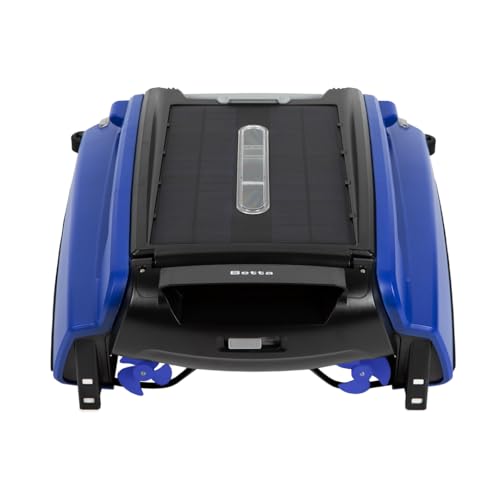
The Betta SE is a floating, cordless robotic surface skimmer. It is intended to travel across the water surface, pull in floating leaves, pollen, insects, dust, and pet hair, and hold that material in a removable basket. It does not vacuum the pool floor, climb walls, clean the waterline, or replace the pool's circulation and sanitation system. The manufacturer states that it uses a top solar panel to charge an internal lithium-ion battery, has no plug-in charging port, and uses a 200-micron basket. It also states that it is suitable for fresh water and saltwater pools up to 5,000 ppm salt, with a stated maximum pool coverage of 40 by 60 feet. A hands-on Bob Vila test supports the practical surface-skimming function, reporting fast movement, effective debris pickup, and easy basket emptying. That test did not publish repeat-run debris recovery, fine-sediment retention, energy-use, or ingress-protection measurements.
This product suits an owner of an above-ground or in-ground pool who mainly wants to reduce repeated hand-netting of floating leaves, pollen, insects, and pet hair. It is most practical for a pool with reliable sun exposure, ordinary perimeter walls, and enough open surface for a floating robot to move. It also fits owners willing to empty a reusable basket regularly and remove the unit before swimmers enter. The maker states compatibility with treated freshwater and saltwater pools up to 5,000 ppm, subject to its operating limits.
It is not suited to anyone expecting floor, wall, waterline, vacuum, filtration, or sanitation duties. Households that routinely swim while equipment is left running should note the explicit instruction to remove this product when the pool is in use. It is also a weaker fit for persistently shaded pools, winter use with limited sun, seawater pools, infinity-edge pools, or pools with shallow stairs and complex structures where it may strand. Buyers needing a verified U.S. electrical listing or independently measured water-ingress protection should seek documented evidence before relying on it.
This is a debris-management product, not a water-treatment device. The reviewed manufacturer materials describe collection of floating debris and do not make germ-control, algae-control, or chemical-treatment claims. Safe use still depends on normal pool circulation, testing, and chemical sanitation. The manual instructs users not to swim while it operates, not to operate it with other pool-cleaning devices in the water, and not to pressure-wash it. No product-specific U.S. third-party electrical listing or ingress-protection rating was identified in the materials reviewed. Its solar panel and reusable debris basket can reduce plug-in charging and disposable filter use during normal surface skimming. However, solar output is weather-dependent, and the product contains a lithium-ion battery. Betta offers several replacement mechanical parts and a service-request path, but no consumer battery-replacement procedure was identified. At end of life, lithium-ion batteries and devices containing them should go to a specialized battery recycler or household hazardous-waste collection point, not household trash or curbside recycling.
This is a cordless, floating robotic surface skimmer, not a floor, wall, or waterline cleaner. It uses a solar panel and internal lithium-ion battery to move across the water surface, directing leaves, insects, pollen, pet hair, and similar floating debris into a removable basket. The maker specifies a 200-micron mesh basket, remote control, shallow-water safeguard, and suitability for above-ground and in-ground pools up to 40 by 60 feet. Betta states that the Plus model can charge by direct sun or the included adapter, with 30+ hours of claimed operation per full charge. A published hands-on account in one shaded 20 by 40 foot pool reported consistent capture of leaves and insects, but also reduced movement and occasional overnight stalling in poor light. No publicly traceable U.S. NRTL listing for the complete product, battery, and charger was located.
This product fits a residential pool owner whose main recurring problem is floating organic debris, especially leaves, pollen, insects, and pet hair, and whose pool receives regular sun. It is most relevant for an above-ground or in-ground pool within Betta's stated 40 by 60 foot limit, where the owner can remove the unit before swimming and empty the basket every few days. The adapter backup may be useful for intermittently cloudy weather, provided the product is removed, switched off, and dried for charging as instructed.
It is not for someone seeking a single robot to vacuum settled debris or scrub pool floors, walls, or waterlines. It is also unsuitable for households that expect swimmers to share the pool while the unit runs, because the manual says to remove it during pool use. Pools that remain heavily shaded, have persistent stormy weather, complex obstacles, or use other in-pool cleaning devices at the same time need particular caution. Buyers requiring independently listed electrical safety and independently measured ingress protection should seek documented certification before relying on it.
The product is marketed as a debris skimmer and does not make sanitation, algae-control, germ-control, or water-treatment claims. That is an important boundary. Removing floating debris can reduce manual skimming, but it is not a substitute for maintaining circulation, testing pool water, and using appropriate registered sanitizing products. Betta's manual also says not to swim while it is operating and not to use it alongside other pool-cleaning devices. Its solar panel and reusable basket could reduce grid charging and disposable-filter use, but the environmental benefit is not independently quantified. The internal lithium-ion battery creates an end-of-life responsibility. Betta does not describe user battery replacement, and EPA guidance says lithium-ion batteries and devices containing them should not go into household trash or curbside recycling. No matching CPSC recall was identified in the reviewed search, but no publicly traceable U.S. NRTL listing was found for the full electrical system.
This is a cordless, solar-assisted robotic skimmer for debris floating on a pool surface. It is not a floor, wall, or waterline vacuum. The unit has a 4-liter removable basket, a manufacturer-stated 150-micron filter, a built-in compartment for 3-inch chlorine tablets, app control, and a 56.16 Wh lithium-ion battery. Aiper states up to 35 hours of runtime from adapter charging and continuous solar-assisted operation. Its manual is more conservative, listing 30 or more hours and a six-hour charge, while the product page lists four to six hours. Independent hands-on testing found good synthetic-leaf pickup, but slow and somewhat random navigation. The manual also limits use to surface cleaning, specifies pH 7.0 to 7.8, chlorine no higher than 4 ppm, salt no higher than 5,000 ppm, and advises against glass or infinity pools.
This suits an owner of an outdoor, conventionally shaped pool who wants help removing floating leaves, insects, pollen, and similar surface debris between manual maintenance sessions. It fits users willing to empty and rinse a basket every few days, maintain Wi-Fi only if they want app functions, and follow the stated chemistry limits. It is most appropriate where there is reliable sunlight and where the pool has few shallow ledges, tanning shelves, exposed corners, or strong skimmer suction that could strand the unit.
It is not suited to anyone seeking a robot to vacuum the floor, climb walls, or replace the pool's normal circulation, filtration, water testing, and sanitation routine. Avoid relying on it around swimmers or animals, since the manual says not to operate it with people or animals in the pool. Pools with glass or infinity edges are excluded by the manual. Owners with complex surface structures, protruding corners, steps, or strong built-in skimmers should expect a greater risk of sticking or scuffing and may need frequent intervention.
The manual gives meaningful electrical-use instructions, including use of the supplied charger only, a dry charging port, indoor charger use, a charging location at least 11.5 feet from the pool, and no operation with people or animals in the water. It also states an IPX8 water-protection rating for the skimmer and IP20 for the charger. However, no U.S. third-party electrical safety listing for this exact product, battery, and charger was located. A prior 2023 CPSC recall involved a different Aiper Elite Pro model, not this product. The basket is washable and reusable, reducing disposable filter use. Solar assistance can reduce grid charging in sunny conditions. The 56.16 Wh lithium-ion battery is not user-replaceable, although the manual says skilled service is required for replacement and directs disposal under local rules. The product can hold chlorine tablets, but it does not verify chlorine concentration or sanitize water by itself. Continue testing water and follow the tablet label, circulation, and filtration requirements.
This is a compact, battery-powered robotic cleaner for pool floors. It is designed for flat-floor pools, with no hoses or in-water power cord. Aiper states that the Seagull SE runs for up to 90 minutes, charges in about 2.5 hours, and parks near the wall when its cycle ends or its battery is low. The supplied hook is intended for retrieval from a standard telescopic pole. The product uses a rinseable flat filter screen rather than a removable basket. Aiper's own current material limits it to round above-ground pools up to 33 feet, or flat-floor in-ground pools up to 40 by 20 feet. Independent hands-on reviews confirm it can collect loose debris, but report inconsistent self-parking, difficulty with larger leaves, and a messy filter-emptying process. The product page also calls its optional chemical dispenser a way to balance and purify water, a claim that extends beyond ordinary debris removal.
This product fits an owner of a small, flat-bottom above-ground pool who wants a cordless helper for loose leaves and coarse floor debris between normal pool-maintenance tasks. It is most suitable where a 90-minute manufacturer-stated run time is enough for a single cleaning session, a telescopic pole is already available for the hook, and the owner is prepared to rinse the flat filter after each use. It also suits someone comfortable replacing brushes or wheels using the manual's instructions.
It is not appropriate for pools with walls, waterline grime, significant slopes, stairs, ledges, deep floor transitions, or a need for dependable fine-sediment removal. It also does not suit buyers who need independently verified electrical listing, waterproofing, filtration, or full-pool coverage data before using a lithium-battery appliance around water. Households must not treat its debris collection or optional chemical dispenser as a substitute for testing water chemistry, running circulation equipment, or using properly registered sanitation products.
The product is a debris cleaner, not a sanitation system. Aiper's statement that the optional chemical dispenser can balance and purify pool water is not accompanied by an EPA registration or a clear explanation of what chemical is supplied, at what dose, or what water-quality result is supported. EPA guidance distinguishes ordinary cleaning from claims to purify water or control microorganisms. Pool sanitation still requires appropriate testing, circulation, and registered treatment products. Aiper's manual instructs users to power the unit off, dry its charging port before charging, use an authorized adapter, and store the battery in a cool, ventilated place. It supports replacement of brushes and wheels and a washable filter, which can limit routine waste. However, no user-replaceable battery program or U.S. battery-recycling route specific to this product was identified. Aiper has conducted U.S. recalls for other cordless models, including the Elite Pro in August 2023 and Seagull Pro in March 2025, for overheating and fire hazards. Those recalls do not identify this Seagull SE product, but they make strict charging practices important.
This is a cordless robotic pool cleaner with a 21.6 V lithium-ion battery, magnetic charger, remote control, retrieval hook, tracked drive and front and rear TPU brushes. It is intended to collect pool debris from the floor, walls and waterline, then be removed, emptied and stored dry after use. The manual lists a 4.5 L filter basket and four cleaning modes. The manufacturer states up to 180 minutes of runtime, 8,000 GPH suction, waterline parking and cleaning coverage up to 2,160 square feet. An independent hands-on assessment of this product platform recorded an 80-minute clean of a disclosed pool test area, using 47% of battery capacity, and observed waterline retrieval behavior. However, no U.S. third-party NRTL listing for the complete cleaner, battery and charger was located.
This product suits a pool owner who wants a cordless cleaner for routine debris pickup in a residential in-ground or above-ground pool that stays within the stated limits. It is most appropriate for pools 0.5 to 2.5 m deep, with balanced water, chlorine at or below 4 ppm, and salt at or below 5,000 ppm. It also fits someone able to lift a roughly 26-pound robot, rinse the basket after each use, dry the charging port, and use a properly located protected outlet for charging.
It is not suitable for anyone who requires a demonstrably U.S.-listed battery appliance and charger before using electrical equipment near water, because that exact listing could not be verified. It is also a poor fit for pools with very dark, highly reflective or transparent-glass surfaces, or unusually complex shapes, since the manual identifies mapping limitations. Do not use it while people are in the pool, after adding liquid flocculant or clarifier, or where the robot would exceed its stated depth, temperature, salt or chlorine limits.
This product is a debris cleaner, not a pool sanitizer or water-treatment device. Its documentation gives useful operating boundaries, including a maximum 4 ppm chlorine level, pH 7.0 to 7.8, salt up to 5,000 ppm, water depth of 0.5 to 2.5 m, and a direction not to run the pump while people are in the water. It also instructs users to dry the magnetic charging port before charging and keep the charger away from the pool edge. The manual claims IP68 protection for the robot, but no independent U.S. verification of that rating or of the complete charging system was located. The battery is lithium-ion and non-replaceable. Dreame directs users not to place it in trash or municipal recycling, and parts such as baskets, filters, tracks and brushes are separately sold. Reusable basket cleaning can reduce disposable waste, but optional ultra-fine filters are consumables.
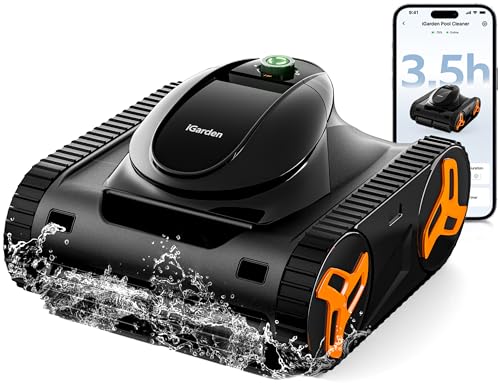
This is a cordless robotic pool cleaner for above-ground or in-ground pools. The KN35 version is listed by iGarden as an approximately 17.9-pound unit with a 3.2-liter reusable basket, three cleaning modes, and a 127 Wh lithium-ion battery. It is intended to collect pool debris from the floor, walls, and waterline, then park at the edge for retrieval. The most useful concrete specifications are manufacturer-stated rather than independently verified. iGarden specifies up to 210 minutes of floor-only runtime, 180-micron filtration, 4,491 GPH maximum suction, and recommended pool dimensions up to 19.7 by 32.8 feet. Its published use limits also specify pH 7.0 to 7.8, chlorine no higher than 4 ppm, salt no higher than 5,000 ppm, and water depth from 3.3 to 8.2 feet. No independent cleaning-performance report or exact-product U.S. third-party electrical listing was located.
This product suits an owner of a small or medium residential pool who wants a cordless debris cleaner with a defined basket size, adjustable cycle choices, and a relatively long manufacturer-stated floor-only cycle. It is most appropriate where pool chemistry is kept within the stated limits, including saltwater at or below 5,000 ppm and chlorine at or below 4 ppm. The buyer should be comfortable treating the claimed coverage, navigation, suction, and runtime as manufacturer specifications rather than independently confirmed results.
It is not suited to households that need independently verified electrical safety certification for a rechargeable appliance stored and charged near a pool. It is also a poor fit for pools with unusually steep slopes, complex ledges, significant algae, heavy suspended sediment, or chemistry outside the stated chlorine, pH, salt, temperature, and depth limits. Do not rely on it as a sanitation device. Families should not swim while it operates, and the charger should be kept indoors, dry, and away from heavy rain or immersion.
This product is a debris cleaner, not a substitute for circulation, testing, sanitation, or chemical treatment. iGarden itself says that excessive dirt, algae, and suspended particles can reduce cleaning efficiency, and advises running the pool circulation and filtration system first when water conditions are poor. That is an appropriately limited hygiene message, with no verified germ-control or algae-treatment claim found. The cleaner uses a 127 Wh lithium-ion battery and a reusable basket, which can reduce disposable-filter use. iGarden specifies treated-water limits for pH, chlorine, and salt, but no independent ingress-protection test, exact-product U.S. safety listing, or public battery-replacement route was located. The company advises charging indoors because the power supply is water-resistant, not waterproof. A search of U.S. recall sources did not locate a recall for this product, but absence of a recall is not third-party certification.
This product is a cordless, rechargeable robotic cleaner intended for in-ground swimming pools. It is placed in the water to vacuum and brush debris from the floor, walls and waterline, then retrieved for filter cleaning. The catalog record specifies an ABS housing, a 96 Wh lithium-ion battery, and a supplied charger. Letexpool states that its C1 cleaner uses three motors, dual rolling brushes, dual-layer filtration, seven cleaning modes, app-based mode selection, and coverage for pools up to 1,615 square feet. It also states a 2.5-hour full charge and long battery life. These are manufacturer claims, not independently reproduced results. No exact-product NRTL electrical listing, published independent cleaning test, or public third-party ingress test was located in the checked sources.
This product fits an owner of a residential in-ground pool who wants a cordless debris-cleaning helper and is comfortable treating the stated coverage, wall cleaning, filtration and runtime figures as manufacturer claims. It is most practical for routine pickup of leaves, grit and settled debris where the owner can inspect and rinse the filters after each cycle, retrieve the unit safely, and keep normal pool circulation, testing and chemical treatment in place. The app-controlled mode selection may suit owners who want to choose a cleaning zone before placing the cleaner in water.
It is not suited to buyers who require independently verified electrical certification before using a lithium-powered appliance around a pool, or those who need a documented ingress rating and detailed saltwater or chemical-use limits. It is also a poor fit for pools with narrow steps, difficult ledges, unusual surfaces, severe slopes, or coverage-critical layouts, because exact-product repeat-run testing was not found. Do not rely on it for water sanitation, algae control, chemical balancing, or as a substitute for circulation and routine water testing.
The main health consideration is the combination of immersion and a rechargeable lithium-ion battery. The catalog identifies a 96 Wh battery, but the verification work did not locate an exact-product U.S. NRTL safety listing for the cleaner, charger and battery system, or an independently published water-ingress evaluation. No CPSC recall or public regulatory warning for this product was located in the checked U.S. recall sources. Absence of a recall is not a safety certification. This is a debris cleaner, not a sanitation device. Letexpool's material describes vacuuming and filtration, but it does not establish germ control or replace chemical treatment, circulation, or water testing. The dual-layer filter is presented as reusable, though no parts catalog or battery-service instructions were found. At end of life, EPA advises keeping lithium-ion batteries and battery-containing electronics out of household trash and curbside recycling, and using an appropriate battery or electronics collection route instead.
This is a cordless, battery-powered robotic pool cleaner with tracked drive, a removable top-access basket, a charger, and a hook that fits a separately purchased standard pool pole. The supplied product listing presents it as MOREBOT, but the available product manual identifies the same SAT25 model as built by Seauto. That makes exact product identity less straightforward than the listing suggests. The Seauto manual and product page state a 7,800 mAh lithium battery, floor, wall, and waterline cleaning, a roughly 294 to 300 micron reusable basket, and suitability for pools up to 2,150 square feet. These are manufacturer statements, not independently reproduced tests. The manual also gives specific use limits, including water depth from 1.6 to 9.8 feet, chlorine at or below 4 ppm, pH 7.0 to 7.8, and salt at or below 5,000 ppm. Charging and runtime figures conflict across the manual, manufacturer page, and supplied listing.
This product fits an owner of a residential pool within the stated 2,150 square foot limit who wants a cordless debris cleaner with a washable basket and does not mind retrieving it with a hook on a standard pool pole. It is more appropriate where pool chemistry stays within the manual's stated chlorine, pH, temperature, and salt limits, and where the floor and wall layout lacks sharp steps or raised drains. The buyer should be comfortable treating runtime, navigation, and waterline claims as manufacturer-stated rather than independently validated.
It is not suited to pools with sharp steps, raised floor drains, or drain outlets likely to trap the cleaner. The manual specifically describes drain-related sticking, and the supplied listing names sharp steps and raised drains as exclusions. It is also unsuitable for anyone who requires a traceable U.S. third-party safety listing for the complete battery, charger, and robot, or independently tested wall, waterline, and filtration performance. Avoid relying on it for sanitation, algae control, or water treatment. It is a debris cleaner, not a substitute for circulation, testing, or chemicals.
The manual provides useful risk-control directions for a lithium-battery pool appliance. It calls for the original charger, a GFCI-protected supply in the United States and Canada, removal from the pool before cleaning the basket, and storage dry and protected from rain, frost, and direct sun. It also directs owners not to disassemble the battery and to use a certified battery-electronics recycler. No matching recall was located in the CPSC recall search during this review. The manufacturer states IPX8 protection for the motor and battery area and IP67 protection for the charger, but no independently traceable listing or ingress test certificate was found. The washable basket can reduce disposable filter use, and several wear items are sold separately. However, no SAT25 battery replacement was listed, so battery end-of-life could still limit the useful life of the whole product. The product makes debris-cleaning claims, not sanitizing or germ-control claims, which is an appropriate boundary for this type of equipment.
This is a cordless robotic pool cleaner for in-ground or above-ground pools. It is a 14.3-pound, battery-powered unit with a removable 2.5 L debris basket, supplied charger, and retrieval hook. The brand states that it cleans floors, walls, and the waterline, self-parks at low battery, and is intended for pools up to 2,150 square feet. The available product documentation appears to describe the same SAT25 platform sold under another name. That source specifies a 300 μm basket filter, approximately 180 minutes of cleaning, IPX8 protection for the robot, and stated limits for chlorine, pH, temperature, salt, and water depth. These are manufacturer specifications, not independent test results. No traceable U.S. NRTL listing for the complete cleaner and charger, or independent cleaning-performance report, was located.
This product suits a pool owner who wants a cordless cleaner for routine pickup of leaves, hair, sand, and other visible debris, and who can retrieve it with a pole and empty a reusable basket after use. It is most appropriate where the pool is within the stated depth and water-chemistry limits, has accessible walls and a conventional floor layout, and the owner is comfortable treating the stated 2,150-square-foot coverage and 180-minute cycle as manufacturer claims rather than independently verified results.
It is not suited to households that require independently verified electrical safety certification for a lithium-battery appliance used near water. It is also a poor fit for pools with unusual ledges, complex steps, extreme slopes, obstructions, or fine sediment problems, because no independent test establishes reliable coverage or fine-particle recovery in those conditions. Do not rely on it for water sanitation, algae control, or chemical balance. People who need replaceable batteries, documented repairs, or a defined parts supply should seek a product with those resources published.
The product is a debris cleaner, not a sanitizer. The available materials do not show a pesticide, germ-control, algae-control, or water-treatment registration, and vacuuming does not replace circulation, disinfectant, pH control, or water testing. The platform manual says to charge only when dry, use the supplied charger, remove the unit after use, and operate within stated limits for chlorine, pH, temperature, salinity, and depth. The robot uses a lithium battery and an ABS plus PC plastic shell. The reusable basket can reduce disposable-filter waste, but its stated 300 μm filtration does not demonstrate capture of very fine sediment. No U.S. NRTL safety listing could be verified for the complete appliance and charger. No exact-product recall or regulatory warning was located in the searched U.S. records. The brand provides a contact route and limited warranty language, but no parts catalog, battery service procedure, or recycling program was found. Lithium batteries should be taken to an appropriate battery recycler, not placed in household trash.


