Best Overall

Heavy-Duty Telescoping Ladder 12.5FT
Sturdy aluminum build supports up to 330 lbs.
Anti-slip steps enhance safety during use.
Compact design easily fits in small spaces.
 Daniel Kenitz
Sturdy aluminum build supports up to 330 lbs.
Anti-slip steps enhance safety during use.
Compact design easily fits in small spaces.

Versatile design adapts to various tasks.
Stabilizer bar enhances safety and stability.
Built-in wheels simplify transportation and storage.

Lightweight design makes it easy to transport.
Detachable hooks enhance stability on various surfaces.
Compact size allows for convenient storage.

Hooks provide extra safety and stability.
Wheels make transport and storage easy.
Extends to a versatile 20.3 feet length.

Compact design allows for easy storage.
High weight capacity supports heavy-duty tasks.
Versatile use for RV and outdoor projects.

Lightweight design for easy transportation.
Triangle stabilizers offer enhanced stability.
Collapsible feature saves storage space.

Easy one-button retraction for simple use.
High 375 lbs capacity ensures safety.
Compact design ideal for storage and transport.
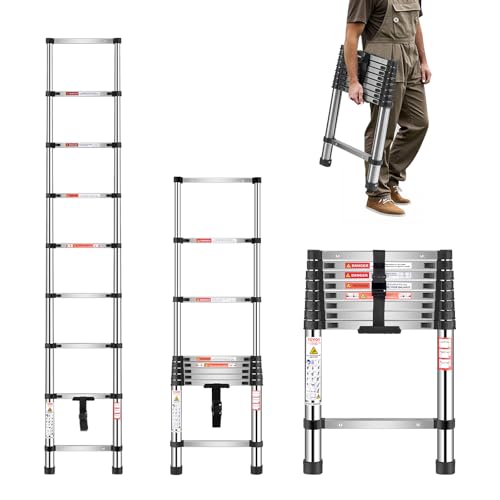
Lightweight design for easy portability.
Multi-button retraction ensures safe operation.
Non-slip feet provide stable footing.

Compact design for easy storage and transport.
Adjustable height for versatile use across tasks.
Sturdy build ensures safety and durability.

Sturdy design with a 330lb weight capacity.
Non-slip feet ensure safe, secure usage.
Conveniently portable for household and outdoor tasks.
The central buying question is whether the exact product—not merely a product family or similar-looking model—has credible evidence for its load and structure. A stated 330- or 375-pound capacity is only a manufacturer claim unless supported by a dated, model-specific laboratory report covering the rails, rungs, telescoping joints, locks, hooks, and stabilizers in the advertised configurations. Look for testing to the applicable portable-metal-ladder standard, such as ANSI/ASC A14.2 or CSA Z11, and a report from a laboratory that can be independently confirmed as ISO/IEC 17025 accredited. A general standards statement, reseller description, or report naming a different model does not establish the capacity of the product being sold.
Locking and hand safety deserve separate attention. Each telescoping section should have a clearly visible, independently checkable lock, with instructions explaining how to confirm engagement before climbing and how to retract without placing fingers beneath closing rungs. Stabilizer bars, hooks, wheels, textured steps, and anti-slip feet can help with placement, but they do not compensate for an unstable surface, incorrect angle, weak top contact, or missing securement. A buyer should also check whether accessories are supplied for the claimed setup and whether their strength has been tested for that exact model.
Height claims commonly mislead in three ways. First, extension length is not usable access height: an upper landing may require the side rails to extend at least three feet above it, with secure support and a grasping aid where applicable. Second, listings may combine incompatible specifications, such as different maximum heights, materials, step counts, or configurations. Third, roof, RV, attic, and outdoor-use language can imply a safe setup without stating the required angle, top support, landing access, or configuration limits.
A metal ladder is conductive. The product and manual should clearly warn against work near exposed energized electrical equipment; broad household or outdoor-use language is not a substitute for that limitation. Buyers should also expect durable labels and a model-specific manual covering setup, inspection, cleaning, storage, safe retraction, damaged-product withdrawal, and warnings. A real manufacturer identity, model number, batch or date traceability, U.S. safety contact, warranty, recall channel, and remedy process make it possible to act if a defect is found.
Across the supplied products, recurring contraindications are significant: none should be treated as suitable for exposed energized electrical work; roof or upper-landing claims do not by themselves prove safe roof transfer; unstable, wet, slippery, uneven, or unsecured surfaces remain inappropriate; and several products lack model-specific testing, complete manuals, or clear labels. Contradictory height or material information is a reason to verify the delivered product before use, not to assume the headline specification is correct. Telescoping mechanisms also create recurring pinch and crush hazards during collapse.
For this category, the important differences are not convenience features alone. The supplied reviews generally found manufacturer-stated capacities and heights, while independent evidence for the exact product was uncommon. The topics below explain what the scores represent and what stronger performance looked like in this set.
This measures whether the overall design and intended-use information credibly reduce fall injury risk. A higher score reflects clearer setup, inspection, support, and use guidance beyond convenience features. Among these products, the stronger reviews paired practical instructions with stable-footing and angle guidance; lower scores were associated with broad roof, attic, or outdoor claims without clear limits or complete model-specific documentation.
This asks whether the exact rails, rungs, joints, locks, hooks, and stabilizers have credible evidence for the stated duty rating and configurations. A high score requires model-specific independent testing, not a 330- or 375-pound listing claim. The supplied scores were strongest where a relevant test report existed, although some reports covered a family or different model; low-scoring products had no public structural report.
Telescoping ladders depend on every section locking fully and retracting without uncontrolled collapse or finger injury. Higher-scoring products had inspectable dual locks, lock checks, or controlled-retraction instructions; the strongest evidence included reported lock-cycle testing. Lower scores reflected unverified auto-lock or slow-retraction claims, missing manuals, or acknowledged pinch exposure during collapse.
This measures resistance to sliding, sideways movement, tipping, and insecure top contact. A high score requires supplied, appropriate stabilizers or tested slip-resistant feet, while still requiring correct placement and securement. Products scored better when they included stabilizer hardware and setup guidance; unsupported wobble-reduction percentages, missing setup limits, or reliance on feet alone weakened the evidence.
The issue is whether height, extension, A-frame, articulated, hook, RV, attic, and roof claims state their actual limits. Higher scores went to products with clearer configuration instructions and realistic setup guidance. Lower scores reflected conflicting heights, manuals tied to another model, or headline reach that did not explain usable access height, top support, angle, or upper-landing requirements.
Metal ladders conduct electricity, so buyers need a prominent warning not to work near exposed energized equipment. High scores reflected an explicit warning in product-specific instructions, while lower scores reflected missing or unclear warnings despite aluminum or other metal construction. A general home, outdoor, roof, or RV claim does not remove this limitation.
This measures whether the product includes durable labels and a usable exact-model manual covering setup, lock checks, inspection, cleaning, storage, retraction, and removal from service when damaged. Higher-scoring products supplied identifiable instructions with concrete checks; lower-scoring products had no located manual or label photographs, leaving safe configuration and defect decisions uncertain.
A buyer should be able to identify the manufacturer, model, batch or date information, safety contact, warranty, and remedy process. Higher scores in this set reflected named manufacturers, model numbers, public support, or recall channels. Lower scores reflected limited batch information, overseas-only or unclear support, and no clear process for replacement or action after a safety notice.
This compares the listing’s height, capacity, materials, certifications, stabilizer benefits, and use claims with exact-product documentation. Higher scores went to more consistent specifications and qualified wording. Lower scores reflected contradictory heights or materials, unsupported wobble percentages, broad roof claims, and misuse of terms such as “ANSI certified” or “ANSI listed,” which do not by themselves prove product certification.
A high score requires a named independent conformity-assessment body and a public or directly confirmable record for the exact manufacturer and model. An ANSI reference, self-issued badge, family report, or report for another item is not enough. The supplied set was generally weak here; one product had a dated relevant test report, but its model identification did not cleanly match the advertised configuration.
This measures whether durable materials, corrosion resistance, replaceable wear parts, repair support, and truthful disposal information can prevent premature disposal. Aluminum or stainless-steel construction may support durability and recycling, but mixed plastic, rubber, locks, wheels, and feet complicate end-of-life handling. Higher scores reflected clearer material or support information; most products still lacked parts programs, repair policies, or product-specific recycling guidance.
This is a single-section aluminum telescoping extension ladder, marketed at 12.5 feet with a 330-pound capacity. It is intended for occasional access tasks such as attic entry, painting, light maintenance, RV work, and roof-related work. The manufacturer states that it has 1.56-inch anti-slip rungs, non-slip foot pads, triangular stabilizers, and click-lock extension with gradual unlocking. Independent retailers reproduce the aluminum construction, 26.1-pound weight, model name, and stated capacity. The safety-critical claims remain manufacturer-stated. No model-specific laboratory report, public certificate from UL, Intertek, CSA, or TÜV Rheinland, or independently verified ANSI or CSA conformity record was located. A telescoping ladder also depends on correct angle, sound top support, firm level footing, and inspection of every lock before climbing. These setup controls matter because base slide-out and poor placement are major contributors to ladder injuries.
This product is most suited to a person who needs a compact, straight extension ladder for occasional, low-complexity home access tasks and can independently establish safe placement. The user should have a firm, level base, a sound upper support, enough ladder length to extend above a landing when access is required, and the ability to inspect each telescoping lock before every climb. Its stated 26.1-pound weight and telescoping storage format may suit owners with limited storage space who do not need an A-frame ladder or a dedicated roof-access system.
It is not suited to electrical work, or any task near exposed energized equipment, because its aluminum rails conduct electricity and no verified product-specific electrical warning documentation was found. It is also a poor fit for commercial or frequent high-consequence use, users needing documented ANSI or CSA conformity, or work where a ladder cannot be secured and placed on firm, level ground. Do not treat the stated 12.5-foot length as enough for roof or upper-landing access without the required rail extension or a secured top support and grab point.
The main health issue is fall risk. The product is described as using aluminum rails, click locks, anti-slip rungs, foot pads, and triangular stabilizers, but those are manufacturer-stated features rather than independently tested outcomes. Public NIOSH guidance identifies incorrect extension-ladder angle, inadequate inspection, unsuitable ladder selection, and improper use as major fall contributors. A roughly 75-degree setup angle, secure upper contact, level footing, and a lock-by-lock pre-use check remain essential. No product-specific CPSC recall, public safety warning, or regulatory action was located in the searches performed. That is not proof of safety or of a complete remedy process. The product has a model designation and UPC, but no public parts list, repair program, corrosion-service guidance, or end-of-life recycling instructions were located. Aluminum is commonly recyclable, but plastic feet, lock components, and mixed materials may require separation under local recycling rules.
This is a folding aluminum, multi-position ladder sold for indoor and outdoor access tasks. The product listing states a 17 foot maximum straight-ladder height, 330 pound capacity, stabilizer bars, wheels, and configurations including A-frame, straight, stair, right-angle, and scaffold-base use. An independent retailer record corroborates aluminum construction, a 34 pound listed weight, and the stabilizer-bar format, though these are still seller-provided product specifications rather than laboratory findings. Available instructions describe checking locks before climbing, using a level nonslip surface, keeping three points of contact, and keeping hands clear during retraction. Those are useful safeguards, but no model-specific independent test report or public certification listing was located. A related retailer page also presents a Type 1A, 300 pound rating alongside a 330 pound load-capacity claim, so the working-load claim needs clarification from the product label or seller before safety-critical use.
It suits an experienced home user who needs one folding aluminum ladder for occasional indoor maintenance, exterior access, or carefully planned stairwell work, and who can inspect every lock, foot, fastener, and stabilizer attachment before each use. The stated 17 foot straight configuration and wheeled, 34 pound format may be practical where storage space and transport matter. Use should remain within the confirmed label rating, with a firm level base and secure top contact for any leaning configuration.
It is not suited to work near energized wiring or overhead lines, because aluminum is conductive and the available instructions only provide a general avoidance warning. It is also a poor fit for users who cannot comfortably inspect and operate multiple locks, attach stabilizer bars, or judge stable footing on stairs. Do not treat the scaffold-base claim as permission to improvise a platform. Buyers needing documented occupational compliance, independently verified load testing, or a clearly resolved duty rating should select a product with that documentation.
The main health issue is fall prevention. Available product instructions address several important controls, including pre-use inspection, fully engaged locks, level nonslip placement, three points of contact, stable top support for straight-ladder use, and hand clearance during retraction. The product is aluminum, so it should not be used near exposed energized equipment or overhead wires. No product-specific recall or regulator warning was located in the searched U.S. recall sources. Aluminum can have a long service life and is commonly recyclable, but this product includes plastic locking and wheel components that complicate end-of-life handling. The available material claims describe anti-oxidation treatment, but no independent corrosion testing was found. No verified replacement-parts catalog, structural repair policy, or product-specific recycling guidance was located, so longevity depends heavily on careful storage, cleaning, inspection, and withdrawal from use when locks, feet, rails, rungs, or joints are damaged.
This product is a straight, non-self-supporting telescoping aluminum ladder intended for household, outdoor, RV, roof, and construction access. It extends to a manufacturer-stated 16.5 feet, carries a stated 330-pound capacity, and includes detachable top hooks. An independent retailer repeats the maker’s claims of 6063 aluminum, 29.5-pound weight, 38-inch packed length, rubber feet, and separate locks for each section. The crucial evidence is less reassuring. No public model-specific ANSI A14.2 report, accredited laboratory report, or third-party certification record was found for this exact product. A June 11, 2024 UK product-safety report covered other 5-meter black RIKADE hooked telescoping ladders, not this exact product, and found serious risks involving inadequate load support, collapse, hand-protection failure, and missing base stabilizers on ladders over 3 meters. That related enforcement finding makes the unverified safety claims especially important.
This product fits an experienced adult who needs a compact straight ladder for occasional light-access tasks and has limited storage space, such as reaching a high window, RV exterior, or low roof edge. That user should be able to inspect every rail, rung, lock, foot, and hook before each use, set a firm 75-degree angle, secure the top, and stay well within the stated load including tools. The compact form is its clearest practical advantage, not independently demonstrated safety performance.
It is not suited to buyers who need independently documented ladder compliance for professional work, repeated jobsite use, or high-consequence roof access. It is also unsuitable near exposed energized equipment because it is aluminum and no prominent product-specific electrical warning was verified. Do not treat the top hooks or rubber feet as substitutes for equal rail support, securement, a stable level base, and correct angle. Households where users cannot perform routine lock, foot, rail, and damage inspections should use a product with stronger model-specific documentation and support.
The relevant health issue is fall prevention. This aluminum ladder is conductive, so it should not be used where it or the user could contact exposed energized electrical equipment. OSHA requires nonconductive side rails for that situation. Safe use also requires a stable level base, secure top support, equal rail contact, a roughly 75-degree angle, and inspection before use. The strongest concern from verification is a June 11, 2024 UK safety report on other 5-meter black RIKADE hooked telescoping ladders. It found serious risks from insufficient load support, collapse, hand-protection failure, lack of a stabilizer on ladders over 3 meters, and inadequate labeling and documentation. It does not identify this exact product, but no exact model-specific independent test or certification was located. Aluminum can have good recycling value, yet no parts availability, repair pathway, or product-specific recycling guidance was found.
This is an aluminum, single-sided telescoping ladder sold in a 20.3-foot, 16-step configuration, with removable top hooks, a base stabilizer bar, wheels, and a storage strap. It is intended for elevated access such as roof, gutter, RV, and outdoor maintenance work, rather than as a self-supporting step ladder. A third-party-hosted manual attributed to this product describes rung-by-rung automatic locking, dual thumb-button retraction, anti-slip foot covers, and a 330-pound capacity. The product record instead states 300 pounds and says it was tested to ANSI A14.2-2017. The 6.2-meter JL-101 configuration is also shown in a factory catalog, but no dated model-specific laboratory report or public independent certification record was located. Capacity and test claims therefore need confirmation from the label and documentation supplied with the unit.
This product suits an informed adult who needs occasional, straight-ladder access to a high roof edge, gutter, RV exterior, or similar supported surface and has dry, level ground available. It is most appropriate for someone willing to inspect every lock, attach and tighten the stabilizer hardware, follow the 75-degree setup rule, secure the top when possible, and verify the duty rating on the delivered ladder before use. Its retractable form is useful where storage length matters.
It is not suited to work near exposed energized electrical equipment, because its aluminum rails conduct electricity. It is also unsuitable for stairs, soft or sloped ground, slick floors, doorways, traffic areas, or any task requiring a self-supporting ladder configuration. People who need documented commercial-grade testing, a public certification listing, ready replacement parts, or a clearly reconciled load rating should use a product with those records. It is not appropriate where safe top support and three-foot landing extension cannot be achieved.
The primary health issue is fall risk at substantial working height. The attributed manual includes useful precautions, including inspection before use, a roughly 75-degree angle, one-person use, three-point contact, locked-rung checks, and keeping hands clear during retraction. These align broadly with CDC and OSHA ladder guidance. OSHA also cautions that slip-resistant feet do not replace proper placement or securement, and requires nonconductive rails where energized equipment could be contacted. The available evidence does not establish independent certification or model-specific structural testing for this product. The stated 300-pound capacity conflicts with the 330-pound figure in the attributed manual, so the unit label should control until the seller resolves that discrepancy. Aluminum can have recycling value, but no Wolec replacement-parts, repair, warranty-detail, or recycling program was located. No Wolec-specific CPSC recall or regulatory warning was located in the searches performed.
This is a straight, single-section telescoping ladder intended to lean against a support for home, RV, and outdoor access tasks. The product page states a 12.5-foot maximum height and a 330-pound maximum load. It also presents collapsible storage and anti-slip bottom caps as its key convenience and stability features. Those are manufacturer-stated claims, not independently verified performance findings. The central documentation issue is inconsistency. The same product page describes the ladder as high-strength stainless steel in its feature bullets, while its comparison content identifies the selected unit as aluminum. A listed model number creates some product traceability, but no public model-specific test report, independent certification record, instruction manual, label photographs, repair-parts information, or U.S. safety contact was found. No matching CPSC recall or safety warning was located in the sources checked.
This product fits a user who needs a compact ladder for occasional, short-duration access such as reaching an RV roof edge, a loft opening, or a low exterior maintenance point, and who has a firm level surface plus a solid support to lean against. The user should be comfortable conducting a careful pre-use inspection, confirming that every telescoping section is fully locked, and staying within the manufacturer-stated 12.5-foot and 330-pound limits, including carried tools. Its compact-storage claim is most relevant where conventional ladders are difficult to transport or store.
It is not suited to work near overhead lines, exposed energized equipment, or any task where nonconductive fiberglass is required. It is also unsuitable for users who need documented independent load testing, a publicly verifiable certification, a clear U.S. recall contact, or a supplied manual with exact locking and retraction procedures. Do not treat the stated height as automatic roof or upper-landing access. Jobs involving repeated heavy materials, forceful side loading, unstable ground, wind, or uncertain top contact need a setup and product specifically documented for those conditions.
The main health issue is fall prevention. A telescoping ladder relies on section locks, base grip, correct lean angle, secure top contact, and careful hand placement during retraction. The listing claims anti-slip base caps, but no independent testing of base slip resistance, lock reliability, pinch protection, or full-extension load performance was located. The page also does not provide accessible exact-product instructions or visible electrical hazard warnings. This matters because a metal ladder can conduct electricity. No product-specific recall or CPSC safety warning was found in the records checked. That is not proof of safety. The supplied model reference helps trace the unit, but public remedy and support details remain limited. Environmental claims were not made or verified. Aluminum is listed in one part of the page and would generally have established recycling routes, but the conflicting stainless-steel statement means the actual construction and end-of-life guidance should be confirmed from the product label before recycling or disposal.
This is a non-self-supporting aluminum telescoping ladder intended to lean against a secure upper support for household, attic, RV, and exterior access tasks. An independent retailer lists the model at 12.5 feet extended, roughly 19 by 33 inches when collapsed, about 22 pounds, and with a 330 pound stated capacity. The available product documentation describes locking pins at each rung, two triangle stabilizers, non-slip end caps, and a button-operated retraction process that directs hands to the side rails. Those are manufacturer-stated safety features, not independently validated performance results. No model-specific laboratory report or public independent certification record was located. There is also a material listing inconsistency, with one record stating 13 steps and an independent retailer listing 12.
It suits an adult homeowner or RV owner who needs occasional straight-ladder access around a one-story property, attic opening, storage area, or vehicle, and has a firm level surface plus a solid upper contact point. Its compact stored size is useful where a conventional extension ladder will not fit in a closet or vehicle. The user should be comfortable inspecting every rung lock before climbing, setting the ladder at the instructed angle, and keeping the work away from electrical hazards.
It is not suited to work near exposed energized electrical equipment, because the ladder is aluminum and conductive. It is also a poor fit for frequent trade use, repeated roof access, unstable ground, slick surfaces, doorways, traffic areas, or tasks where the top cannot be equally and securely supported. Buyers who need independently documented load testing, a publicly confirmable certification, readily available replacement parts, or direct manufacturer safety support should use equipment with those records before undertaking high-consequence work.
The central health issue is fall prevention. The product documentation includes useful directions to inspect rails, rungs, locks, and feet, confirm both locks at every extended rung, maintain a stable angle, avoid the top three rungs, and keep hands clear during retraction. Those directions align broadly with OSHA ladder-use principles, but the product's capacity, lock performance, base grip, and claimed stabilizer benefit were not backed by a located model-specific independent test report. No matching public CPSC recall was located during this review, but the available support route directs buyers through the retailer rather than providing a clearly documented direct remedy and parts system. Aluminum is durable and generally recyclable, yet no parts catalog, replacement-wear-part policy, repair program, recycled-content declaration, or end-of-life guidance was located. The product should therefore be maintained carefully and withdrawn from use if rails, rungs, locks, or feet are damaged.
This is a straight, non-self-supporting aluminum telescoping ladder for leaning against a support. The manufacturer states that it extends to 10.5 feet, closes to 2.5 feet, weighs 18 pounds, and has a 375 pound capacity. It uses section locks with red and green visual status indicators, non-slip foot covers, and a one-button retraction system. Its concrete safety features are manufacturer-stated rather than independently confirmed. The available instructions call for level, firm ground, checks that every lock is green before climbing, short-duration light work, and avoiding the top three rungs. However, the publicly available manual is headed for different ladder models, while the product page makes broad home, RV, tree-pruning, and roof-related use claims. The page also uses ANSI-listed wording, but does not identify a certifier, certificate, or test report for this product.
This product is suited to an informed homeowner who needs a compact leaning ladder for brief, low-force tasks such as changing a bulb, reaching a high interior shelf, or light exterior touch-up work. The user should be able to carry and position an 18 pound ladder, inspect the rails, feet, and locks before every use, and place it against a firm, stable support on level ground. Its closed size is especially relevant where a full-size extension ladder cannot be stored easily.
It is not appropriate for work near exposed electrical equipment, because aluminum rails conduct electricity and the available instructions do not prominently state that limitation. It is also unsuitable for anyone needing verified commercial-duty documentation, repetitive professional use, high side-load tasks such as forceful drilling, or unassisted roof access. Avoid it where the base cannot sit on firm level ground, the top cannot contact a stable support, children may access it, or the locking indicators and moving sections cannot be closely inspected before use.
The main health issue is fall prevention. The manufacturer provides rung-lock indicators and non-slip foot covers, and the available instructions tell users to inspect the ladder, use firm level ground, keep both feet on a rung, and avoid the upper three rungs. These are useful safeguards, but they are not substitutes for secure placement, proper leaning angle, and a confirmed lock check on every section. The manufacturer states that the product is aluminum with nylon and plastic components. Aluminum can be recycled, but the mixed-material construction and absence of a published spare-parts program limit confidence in repairability and end-of-life recovery. The available manual directs users toward local recycling and identifies a US importer, but it is headed for different models. No recall specific to this product was located in the CPSC review, and no independent model-level certification record or test report was located.
This is a non-self-supporting, nine-step telescoping ladder for leaning use. The manufacturer lists an 8.33-foot extended height, 2.23-foot retracted height, 14.68-pound weight, and a 330-pound maximum load at a 75-degree setup angle. It is intended for household, RV, loft, gardening, and similar reach tasks. The manufacturer states that the rails are steel or stainless steel with nylon connectors, and that each rung uses two spring-loaded locking pins. Its manual gives useful core warnings, including checking locks before loading, using firm level dry ground, inspecting before use, and keeping the metal ladder away from live electrical wires. No public model-specific independent laboratory report or certification listing was located. The product information also conflicts on rung spacing, with official material listing 400 mm while a retailer image for this product lists 300 mm.
This product suits an informed adult who needs a short, portable leaning ladder for occasional low-height tasks, such as reaching a loft opening, cleaning, painting, or light RV maintenance. It is most appropriate when the user has a firm, level, dry surface, a rigid top support, room to set the ladder near 75 degrees, and can inspect every locking button before each climb. Its compact stored length is particularly relevant for apartment closets, vehicles, and small garages.
It is not suited to electrical work, work near exposed energized equipment, or jobs requiring a nonconductive ladder. It is also a poor fit for roof access or any upper landing where the ladder cannot extend at least three feet above the landing or be securely tied at the top with a grab point. Avoid it for uneven, wet, icy, slippery, high-traffic, or windy locations. People unable to perform pre-use lock and condition checks should choose equipment with more managed setup controls.
The main health issue is fall risk. The instructions support several basic controls, including a 75-degree leaning angle, level dry placement, pre-use inspection, lock checks, and withdrawal from use if parts are damaged. Those are meaningful instructions, but they do not substitute for independent evidence that this exact product meets ladder load, slip, and telescoping-lock tests. The product is metal and the manual gives a direct electrical-conductivity warning. The manufacturer describes steel or stainless-steel construction with nylon connectors. Stainless steel can support a longer service life when kept clean and protected from corrosive exposure, but no parts catalog, replacement-lock program, repair policy, or product-specific recycling guidance was located. A named manufacturer, U.S. importer, model designation, and support route improve traceability. No recall specific to this ladder was located, although other VEVOR products have had separate CPSC recalls.
This is a straight, non-self-supporting telescoping ladder for household access tasks such as attic entry, RV work, eaves, window frames, and exterior walls. The product page states a 14.5 foot maximum height, 14 rungs, 30 cm rung spacing, 330 pound stated capacity, and a 37 inch collapsed height. It is therefore designed to be leaned against a stable upper support, rather than opened as a step ladder. The manufacturer states that the ladder uses iron or steel tubing, has a lock at every telescoping section, non-slip rubber feet, and two triangular stabilizers. Those are useful design claims, but no model-specific independent load report, certification listing, user manual, label photographs, or controlled-retraction evidence was located. The listed material also deserves caution because other marketplace documentation for the same model inconsistently describes aluminum.
This product suits an adult homeowner or RV owner who needs occasional straight-ladder access, has a firm level base, and can provide a solid upper contact point. It is most relevant where a compact 37 inch stored length matters, such as limited garage, closet, or vehicle storage. The user should be able to inspect each lock before climbing, follow conservative extension-ladder setup practices, and keep the job away from energized electrical equipment. Its stated 330 pound capacity should be treated as manufacturer-stated, not independently verified.
It is not suited to buyers needing a documented occupational ladder for frequent trade work, roof access, or any task requiring an independently verified duty rating. It is also unsuitable for use as a freestanding step ladder, on slick or uneven ground, where the top cannot contact both rails securely, or near exposed energized electrical equipment. Households seeking detailed safety instructions, confirmed pinch-control retraction, readily available replacement parts, or a clearly defined recall contact process should select a product with that documentation.
The main health issue is fall prevention. The manufacturer states that this metal telescoping ladder has individual section locks, rubber feet, and two stabilizers. Those features may help when correctly used, but they are not independently documented for this exact product. OSHA guidance requires a non-self-supporting ladder to have secure, equal rail support, a stable level base, and placement at roughly a 4 to 1 angle. Metal side rails are not appropriate where they could contact exposed energized electrical equipment. No exact-product recall or CPSC safety warning was found in the searched public sources. That is not evidence of independent safety validation. No named third-party certification, model-level laboratory report, parts list, repair policy, corrosion specification, recycled-content declaration, or disposal guidance was located. The stated iron or steel construction could have scrap value, but the product provides no verified recycling or repair pathway, and its material description is inconsistent across marketplace records.
This is a non-self-supporting aluminum telescoping extension ladder, intended to lean against a stable upper support for household, RV, roof, and work-at-height tasks. The product is listed at 20.3 feet with a 330-pound maximum load and detachable top hooks. Independent resale documentation and a model-specific manual identify the GGT-062 as a 6063 aluminum-alloy ladder, though these figures are not backed by a publicly available laboratory report. The available manual gives useful setup detail, including a roughly 75-degree working angle, checks that each extended rung has locked, pre-use inspection, non-slip feet, and two-button retraction with fingers kept clear. It also says aluminum conducts electricity. No public model-level listing, certification record, or independent structural and locking test report was found for this product.
This product fits an experienced adult who needs a compact-storing straight ladder for occasional access tasks and can independently assess a firm, level base and a rigid upper support. It is most suited to tasks where the ladder can be set near 75 degrees, every used rung can be visually checked for lock engagement, and the top hooks can be attached to a genuinely secure point. The user should be comfortable inspecting the rails, feet, locks, fasteners, and hooks before every use.
It is not suited to electrical work, work near exposed energized equipment, or any task where a conductive aluminum ladder could approach wiring. It is also a poor fit for users who need independently verified structural certification, documented laboratory load testing, or established replacement-parts support. Do not treat the stated full height as automatic roof-access height. Choose another access method where the ladder cannot extend above the landing as needed, cannot be secured, rests on slippery ground, or faces traffic and doorway hazards.
The main health concern is fall and hand-injury risk. The available manual gives meaningful controls, including a 75-degree setup angle, locked-rung checks, non-slip footwear, inspection before use, and a warning to keep fingers clear during retraction. These align with basic ladder-safety practices, but the product has no publicly confirmed independent test or certification record for its rails, rungs, locks, hooks, or feet. No product-specific U.S. recall was identified in the checked CPSC sources. The ladder is described as 6063 aluminum alloy, a durable and commonly recyclable material. Its manual advises dry storage, cleaning, and inspection, which can support longer service life. However, no documented replacement-parts program, repair policy, material-recycling instructions, or substantiated environmental claim was found. Worn feet, damaged hooks, faulty locks, loose fasteners, or bent rails should remove the ladder from service rather than be treated as normal wear.



