Best Overall
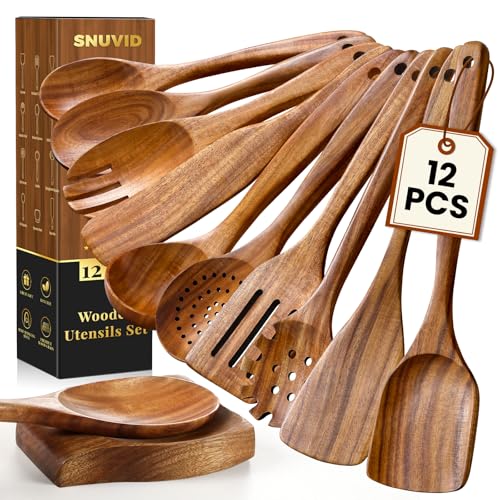
Snuvid Teak Wood Cooking Utensil Set
Durable teak wood ensures long-lasting use.
Nonstick design protects pots and pans.
Heat resistant for safe cooking.
 Lauren Wilson
Durable teak wood ensures long-lasting use.
Nonstick design protects pots and pans.
Heat resistant for safe cooking.

Durable acacia wood resists heat and scratches.
Elegant design enhances kitchen aesthetics.
Lightweight handles ensure comfortable cooking.

Heat-resistant design perfect for non-stick cookware.
Smooth teak material ensures comfort grip.
Lightweight and durable for everyday cooking.

Durable and resistant teak wood material.
Smooth, non-toxic finish for safe cooking.
Variety of utensils for versatile kitchen use.

Durable teak wood ensures long-lasting use.
Non-stick safe, ideal for delicate cookware.
Comfortable grip for easy handling.

Durable acacia wood ensures long-lasting use.
Smooth finish prevents scratching cookware.
Eco-friendly material adds natural charm.

Durable teak wood resists cracking and warping.
Includes convenient holder and hooks for organization.
Smooth finish prevents scratching cookware surfaces.

Durable and sturdy acacia wood construction.
Smooth finish prevents scratching cookware.
Includes a versatile range of utensil types.

Durable teak wood construction resists wear.
Safe for use with nonstick cookware.
Includes a convenient, matching utensil holder.

Durable natural wood ensures long-lasting use.
Versatile set covers all cooking needs.
Eco-friendly materials provide a sustainable choice.
Start with the food-contact surface. A product should identify the wood treatment, coating, dye, adhesive, and conditioning oil, rather than relying on broad phrases such as “natural,” “non-toxic,” or “food safe.” For repeated food contact, the relevant regulatory basis should be identifiable through FDA Food Contact Substances Inventory resources, including 21 CFR Parts 175–178, Food Contact Notifications, or applicable Threshold of Regulation exemptions. Stronger evidence is a product-specific migration, extractables, or composition report from an ISO/IEC 17025-accredited laboratory. A generic supplier certificate does not establish that the exact finished utensil was tested under relevant conditions.
Care instructions matter because wood can absorb moisture, roughen, check, split, or retain food in damaged areas. Look for smooth, close-grained surfaces; clear hand-wash, drying, soaking, oiling, and replacement guidance; and, where claimed, evidence from wet-dry cycling or other product-specific durability testing. A one-piece construction claim can reduce concern about glued utensil joints, but it does not prove resistance to cracking or splintering. A warranty or replacement-parts policy can support longer use, although it is not a substitute for durability evidence.
Heat claims should be read narrowly. “Heat resistant,” “nonstick safe,” and a number such as 446°F or 450°F may be manufacturer statements without a published test method, finish specification, or conditions of use. A credible claim should state the relevant material, temperature limit, cookware context, and supporting test evidence. Wood may provide a nonscoring surface for coated cookware, but users should still avoid overheating, charring, or using a degraded finish.
For environmental claims, a named species such as teak or acacia is only material identification. It is not proof of responsible forestry. Look for a product-linked FSC Forest Management or Chain of Custody record, a valid FSC trademark-license record, or corresponding PEFC or SFI certification and chain-of-custody evidence. Also check whether the product discloses coatings, adhesives, holders, hooks, silicone, plastics, metal parts, and packaging. Mixed materials can make disposal and recycling less clear. Service life, repair or replacement options, and care guidance are relevant because a longer-lasting utensil avoids repeated replacement.
Headline figures can mislead. Piece counts may include holders, hooks, rests, or accessories rather than additional cooking tools. Ratings and review volume describe customer experience, not chemical compliance, responsible sourcing, or independent testing. A stated wood species does not identify the finish, and “BPA-free,” “plastic-free,” “chemical-free,” “eco-friendly,” or “food-grade” wording may leave important components and test conditions unspecified. A lack of recalls is not proof of safety.
Across the supplied products, the recurring caveat is that none had product-specific independent laboratory evidence sufficient to confirm all food-contact chemistry, migration, heat, or durability claims. Most lacked verified FSC, PEFC, or SFI sourcing. The repeated practical limitation is hand washing, prompt drying, avoiding soaking or dishwashers, and replacing utensils that become rough, cracked, split, stained, odorous, or difficult to clean. Buyers needing documented finishes, certified forestry, commercial sanitation evidence, or independently verified heat limits should not treat seller assurances as equivalent evidence.
For wooden spoon sets, the strongest products are not necessarily those with the most pieces or the broadest claims. The scores below reflect how clearly each product addresses food contact, upkeep, construction, sourcing, and independent proof. Across the supplied set, scores were generally moderate because seller guidance was more common than product-specific testing or certification.
This measures whether every food-contact treatment, coating, dye, adhesive, and oil is identified and supported for repeated use. It matters because wood sets may be oiled, lacquered, coated, or assembled with adhesives that contact hot food. The supplied scores ranged from 68 to 74: higher-scoring products disclosed more about their treatment, while lower-scoring products left the finish or its chemistry unexplained.
This measures whether surfaces are smooth, close-grained, uncracked, and supported by realistic washing, drying, oiling, and replacement guidance. Wood can become rough or retain food when soaked, put through a dishwasher, or allowed to crack. Supplied scores ranged from 69 to 76. Higher scores reflected clearer hand-wash and drying instructions and more usable care guidance, not proof that every surface remains sanitary indefinitely.
This measures resistance to rough edges, splintering, checking, splitting, loose parts, and failed joints after kitchen use. A damaged spoon can become both a physical hazard and a harder-to-clean food-contact surface. Scores ranged from 70 to 74. Higher-scoring sets had features such as stated solid or one-piece construction, but none had comprehensive independent product-specific durability testing.
This measures whether heat resistance and nonstick-safe use limits are specific, plausible, and supported for the supplied materials. It matters because high heat can char wood or degrade an unidentified finish, while coated cookware needs nonscoring tools. Scores ranged from 68 to 74. Higher scores generally had clearer material or heat statements, but the reviews repeatedly noted missing test conditions or conservative maximum-temperature evidence.
This measures whether claims such as “food safe,” “natural,” “non-toxic,” “heat resistant,” “nonstick safe,” and “eco-friendly” are specific and properly qualified. Scores ranged from 62 to 72. Higher-scoring products kept claims closer to the available evidence, while lower-scoring reviews identified broad reassurance claims that lacked test conditions, finish details, or supporting documentation. A confident-sounding label is not the same as substantiation.
This measures whether current, product-specific evidence identifies the exact product, sample, method, date, conditions, and result. It matters because generic supplier documents cannot confirm the finished utensil. Scores ranged from 68 to 70, and no supplied product had a strong package of independent food-contact, composition, heat, and durability reports. The main difference between products was limited corroboration of basic format or material, not full laboratory verification.
This measures whether the exact product, brand, importer, or seller has unresolved recalls, warnings, enforcement actions, or credible incident records. Scores ranged from 70 to 76. Higher scores reflected searches that did not identify a matching recall or public action, but that absence is only a limited signal. It does not prove chemical safety, durability, responsible sourcing, or compliance with food-contact requirements.
This measures whether the stated wood species and supply chain can be checked through FSC, PEFC, or SFI certification and chain-of-custody records. Teak or acacia naming alone does not establish responsible forestry. Scores ranged from 68 to 70, reflecting that no supplied product had a verified product-linked certification record. A high score in this category would require traceable certification, not simply “sustainable” or “eco-friendly” language.
This measures whether construction, thickness, finish, care guidance, warranty, replacement policy, and durability evidence support extended use. Longer service can reduce discarded utensils. Scores ranged from 70 to 78. Higher-scoring products combined practical care instructions with a warranty or replacement-part availability; however, the supplied reviews generally lacked independent wet-dry cycling, crack, warp, or heat-durability results.
This measures whether the product identifies wood species, coatings, adhesives, metal, silicone, plastics, holders, and packaging so buyers can understand disposal and recycling limits. Scores ranged from 68 to 74. Higher-scoring products disclosed more of the utensil material or included components, while mixed-material sets and products with unspecified finishes or accessories scored lower. Clear material naming still does not guarantee recyclability.
This is a 12-piece wooden kitchen-tool set with a spoon rest. Published sales descriptions list turners and spatulas, a pasta server, serving and mixing spoons, a ladle, skimmer, oil spoon, and salad fork. It is intended for stirring, turning, serving, and use on nonstick cookware. Separate retail listings describe the utensils as teak wood, hand-wash only, with hanging holes. They also state a 450 F heat rating and rounded edges for nonstick cookware. Those are seller or manufacturer statements, not independently validated performance results. The exact surface treatment is not adequately documented. One outside product review reports a clear food-grade coating, while other sales copy presents the set simply as natural teak, without naming the coating chemistry, oil, adhesive, or food-contact authorization.
This set fits a home cook who wants a single, broad assortment of wood utensils for ordinary stovetop cooking and serving, and who is prepared to hand wash and air dry them promptly. It is most suitable for people using nonstick cookware who prefer not to use metal tools. The stated 12-piece format and included spoon rest are useful for kitchens starting from few utensils. Buyers should regard the teak identity, heat rating, and whole-piece construction as manufacturer claims rather than independently confirmed specifications.
It is not well suited to buyers who require documented food-contact chemistry, independently verified migration testing, or a named finish with defined repeated hot-food conditions. Choose another product if verified responsible forestry certification is essential, because no FSC, PEFC, or SFI evidence was found. It is also unsuitable for dishwasher users, or for households that cannot reliably inspect wood tools for roughness, cracking, staining, odor, or coating wear and replace affected utensils promptly.
The health issue is evidence transparency, not a confirmed hazardous finding. FDA explains that each component expected to migrate from a food-contact article needs an applicable regulatory basis for its intended use. The available product information does not identify a finish, oil, dye, adhesive, or test report well enough to evaluate that question for repeated hot cooking use. Hand washing, complete drying, and removal from service when surfaces become rough or cracked are prudent for wood utensils. Teak is consistently stated by sales listings, but its source is not traceable through a responsible-forestry certificate. No FSC, PEFC, or SFI record was found for the brand or product. Searches of the CPSC recall and safety-warning database and FDA recall database did not identify a matching product-specific action. That is not independent proof of material safety, durability, or sustainable sourcing.
This product is a 10-piece wood utensil set, listed at 10.5 to 13.5 inches, intended for stirring, mixing, flipping and serving. An independent Walmart listing identifies it as an acacia-wood set with spoons and spatulas. The seller describes it as suitable for everyday cooking tasks and gentle on nonstick cookware, but those intended-use claims are not backed by a product-specific performance test. The main evidence limitation is its food-contact finish. The reviewed listings identify acacia wood but do not identify whether the food-contact surfaces are unfinished, oiled, waxed, lacquered, glued, or otherwise treated. No product-specific laboratory migration, extractables, heat-exposure, wet-dry durability, or surface-inspection report was located. The product is therefore a plainly described wood set with limited substantiation for the details that matter most in repeated hot-food use.
This set suits a home cook who wants a broad group of wood tools for ordinary stovetop stirring, serving and turning, and who is comfortable maintaining wood kitchenware. It is most appropriate for someone prepared to hand wash promptly, dry thoroughly, inspect surfaces for roughness or cracks, and use a separately sourced food-contact conditioning oil if the wood becomes dry. The listed 10.5 to 13.5-inch range can also suit cooks who prefer some reach over shallow cookware without using metal tools against nonstick surfaces.
It is not suited to buyers who need documented food-contact chemistry, a named factory finish, traceable responsible forestry certification, or an independently issued test report before using utensils with hot food. It is also a poor match for dishwasher-dependent households, people who want explicit high-heat limits, or users unwilling to inspect and maintain wood after wet-and-dry cycles. Anyone replacing utensils because of prior splintering or cracking should seek a product with published durability testing and a clear replacement policy.
Acacia wood is consistently named in the independent retailer listing and the seller's product descriptions. That gives a basic material identity, but not a complete food-contact declaration. The finish, any oil, wax, lacquer, dye, adhesive and treatment chemistry remain unspecified. FDA guidance makes the regulatory status of each food-contact component relevant, especially when a component may migrate to food. No product-specific laboratory report was located to resolve those unknowns. Wood needs realistic care because moisture, heat and wear can leave surfaces rougher or harder to clean. The reviewed product information does not provide full care, temperature or replacement guidance. A search of public CPSC and FDA recall resources did not identify a matching Hefild utensil recall as checked on September 27, 2026, but this is not independent proof of safety. No FSC, PEFC or SFI sourcing certification, packaging-material declaration, or verified end-of-life plan was found for this product.
This is a six-piece wooden cooking-utensil set for stirring, scraping, sautéing, and serving. The manufacturer identifies the utensils as 100% natural teak conditioned with food-grade mineral oil, and says there is no lacquer, shellac, dye, or synthetic coating. It also states that the set is suitable for nonstick cookware and should be hand washed, dried promptly, and kept out of the dishwasher. The disclosed material is relatively simple for a food-contact utensil, but the safety case remains largely manufacturer-stated. FDA listings include white mineral oil in food-related regulatory entries, yet no product-specific oil specification, migration test, extractables report, or independent composition test was located. Zulay Kitchen offers a limited lifetime warranty for eligible household-use purchases and sells individual replacement utensil parts.
This set suits a home cook who wants solid wood utensils for routine stovetop stirring, serving, and use around nonstick or ceramic-coated cookware, and who is prepared to hand wash and dry them promptly. It is also relevant to someone who values a disclosed teak and mineral-oil construction over a mixed-material utensil. The stated warranty and availability of replacement parts may matter to households that expect to keep individual tools in service rather than replace a whole set after ordinary wear.
It is not suited to households that need dishwasher-safe utensils, leave tools soaking in the sink, or want a documented heat limit for high-temperature cooking. Buyers who require independently tested food-contact materials, a named oil grade, or a current third-party migration report should choose a product that publishes those records. It is also not a fit for buyers who need verified FSC, PEFC, or SFI sourcing, because no product-specific responsible-forestry certification record was identified.
The useful health detail is the manufacturer's disclosure that the utensils are teak, conditioned with food-grade mineral oil, without lacquer, shellac, dye, or synthetic coating. FDA food-ingredient and food-contact inventories list white mineral oil in multiple regulated food-related uses. That supports the general plausibility of an appropriate mineral-oil treatment, but it does not verify the exact oil grade, application amount, or repeated-use performance of this set. No product-specific independent laboratory certificate, migration report, or accredited test report was located. No relevant CPSC or FDA recall record was identified in the public searches reviewed, though absence of a public record is not proof of testing. The set has a stated limited lifetime warranty and replacement parts, both of which may extend use. Responsible wood sourcing remains unverified because no applicable FSC, PEFC, or SFI chain-of-custody certification was found.
This product is a 10-piece wooden cooking-utensil set for stirring, turning, skimming, serving, ladling, and handling pasta. The manufacturer lists a flat spatula, wok spatula, slotted spatula, pasta server, serving and mixing spoons, ladle, skimmer, oil spoon, and salad fork. The listed utensil size is 13.9 inches long by 4.13 inches wide, and the set is intended for hand washing rather than dishwasher use. The manufacturer consistently identifies the material as teak and says each utensil is made from one piece of wood. It also describes the pieces as carefully finished and free from harmful chemicals. Those material and finish assurances are seller statements, not product-specific wood-species identification, finish disclosure, migration testing, or an accredited laboratory report. The brand provides useful wash, dry, avoid-soaking, and occasional-oiling guidance, but offers a 30-day return policy rather than a stated long-term product warranty.
This set suits a home cook who wants multiple wooden tools for routine stirring, serving, turning, and draining, and who is prepared to maintain wood properly. It is most appropriate for households that can hand wash promptly, dry each piece thoroughly, avoid prolonged soaking, and occasionally oil dry-looking wood. The one-piece construction claim may also appeal to buyers who prefer a utensil without a stated glued joint. It is designed for ordinary kitchen tasks, not for verified high-heat or commercial-kitchen performance.
It is not well suited to buyers who need dishwasher-safe utensils, sanitation procedures suitable for frequent high-volume food preparation, or a clearly documented food-contact finish. People with heightened concern about coatings, chemical migration, wood species authenticity, or certified forestry sourcing should choose a product with a named treatment and current independent reports. It also does not fit users who routinely leave utensils soaking in sinks, need a long written warranty, or expect documented resistance to cracking and warping after repeated wet-and-dry cycles.
The main health positive is straightforward material disclosure at the seller level. Both the brand store and Amazon page identify teak wood, and the manufacturer says the utensils are one-piece wood. The brand also provides care advice that includes gentle washing, thorough drying, avoiding soaking, and occasional oiling. Those steps are relevant because persistent moisture can damage wooden food-contact surfaces. Important gaps remain. The brand calls the utensils carefully finished and free from harmful chemicals, but does not disclose the actual food-contact finish or provide a product-specific migration, extractables, or composition report. No product-specific independent test certificate was located. The brand uses sustainability language and displays a Climate-ID statement, but no FSC, PEFC, or SFI chain-of-custody record was located for the product. Searches did not locate a matching CPSC recall, FDA recall notice, or California Proposition 65 warning for this product or brand, though an absence of public listings is not independent safety testing.
This is a nine-piece wooden cooking and serving set. The stated assortment includes a turner, slotted turner, spatula, skimmer, ladle, pasta server, serving spoon, salad spoon, and salad fork. It is intended for hand use in cookware and at the table. Seller materials identify teak wood and specify hand washing, a soap-and-water rinse, and complete drying before reuse. The product is described by the seller as smooth, suitable for nonstick cookware, and covered by a limited lifetime warranty for eligible household-use defects. Exact-product retail listings also describe a clear lacquer finish. That finish is a defining food-contact detail, yet its chemical identity, food-contact authorization, migration performance, and any independent test report were not published in the materials found.
This set suits a household cook who wants a coordinated group of wood tools for everyday stirring, turning, serving, and pasta tasks, and is prepared to hand wash and fully dry them after use. It is especially relevant for someone using delicate coated cookware who prefers wood contact surfaces over metal tools. The published lifetime defect coverage may also matter to a buyer who will retain purchase documentation and contact the brand if a manufacturing issue appears during normal household use.
It is not well suited to buyers who need documented food-contact chemistry, such as households seeking the exact identity and compliance basis of every finish or coating. It also does not fit users who expect dishwasher cleaning, commercial sanitation documentation, or independently verified heat limits. People who require certified responsible wood sourcing should choose a product with a current, product-linked FSC, PEFC, or SFI chain-of-custody claim. Replace any utensil that becomes rough, split, cracked, or difficult to clean.
The key health issue is finish transparency. The exact-product listings describe teak wood with a clear lacquer surface, while the brand also uses broad reassurance claims such as non-toxic and statements that the set is made without BPA, PTFE, PFOA, and PFAS. No composition declaration identifies the lacquer chemistry, and no product-specific migration, extractables, or accredited laboratory report was located. That does not establish harm, but it prevents an independent confirmation of repeated hot-food contact safety. For hygiene, the stated hand-wash and dry-completely instructions are useful. Smooth surfaces should be inspected during use, because cracks, lifting finish, roughness, or splinters can make wood harder to clean. The product has a published limited lifetime warranty, which can support longer use. However, no responsible-forestry certification or supply-chain record was located for the teak, so the wood species claim is not the same as verified sustainable sourcing. Searches did not identify a product-specific CPSC or FDA recall notice.
This is a 12-piece acacia-wood cooking-utensil set sold with a countertop holder, spoon rest, and six hooks. The listed tools include serving utensils, a slotted spatula, a pasta spoon, a skimmer, and salad utensils. Independent marketplace listings corroborate the named material, model, 12-count format, 1.23 kg listed weight, and roughly 13.9 by 5.7 by 4.8 inch package size. An external resale listing identifies China as the country of origin. The maker markets the set as natural, non-toxic, heat-resistant, easy to clean, sturdy, and suitable for nonstick cookware. Those are seller claims, not product-specific laboratory findings. No publicly available food-contact migration report, finish or oil declaration, independent material analysis, responsible-forestry certificate, warranty, or durability test report was located for this exact product. The wood itself is identified, but the treatment, adhesive use, holder and hook materials, and packaging composition are not plainly disclosed.
This set fits a home cook who wants a single wood-utensil assortment for light to routine stovetop tasks, has limited drawer space, and values the included countertop organization. It is most suitable for someone prepared to hand wash promptly, dry thoroughly, inspect each utensil for roughness or checking, and retire damaged pieces. The product is also relevant where avoiding direct metal contact with nonstick cookware is a practical preference, while recognizing that the nonstick-safe claim remains manufacturer-stated rather than independently tested.
It does not suit buyers who need documented food-contact compliance for a household with heightened chemical-sensitivity concerns, or for professional food-service purchasing. Choose another product if you require a declared food-contact finish, named adhesive system, accredited laboratory testing, a conservative verified heat limit, or a traceable forestry certification. It is also a poor fit for dishwasher use, prolonged soaking, or anyone unwilling to monitor wood for raised grain, cracks, stains, or splinters after repeated wet-and-dry use.
Acacia wood is consistently named by external marketplace listings, and the product is sold as a wood utensil set rather than a set with a disclosed plastic food-contact head. That provides basic material identification, but it does not establish what oils, sealers, dyes, preservatives, or adhesives may be present. The FDA Food Code recognizes that wood food-contact surfaces need use limitations because wet foods can degrade wood and some treatments can migrate. Prompt washing, complete drying, and replacement of cracked or rough utensils are therefore practical hygiene precautions. No public ISO/IEC 17025 laboratory report, NSF listing, or other independent proof was found for the exact product. No responsible-wood certificate could be verified, so the acacia claim should not be read as proof of responsibly managed forestry. Searches of public U.S. recall and safety-warning resources found no identified recall, warning, or enforcement action for this product or brand at the time checked. That is not a substitute for verified composition or durability evidence.
This is a 12-piece kitchen set intended for stirring, scraping, serving, and storing everyday cooking tools. The manufacturer describes 10 teak-wood utensils, a draining holder, and a spoon rest. It also lists hooks for storage, although the number of hooks is not consistently described across available product information. The catalog record identifies it as hand-wash only. The manufacturer states that the utensils are teak, smooth-finished, and suitable for nonstick cookware. A separate product evaluation also identifies a matching Woodenhouse set as teak and gives hand-wash and occasional-oiling guidance, but it is not an accredited food-contact laboratory report. No product-specific migration report, finish composition, food-contact compliance statement, or documented heat-use limit was located.
This set suits a home cook who wants a coordinated group of wooden stirring, scraping, and serving tools, plus countertop storage. It is most suitable for someone prepared to hand wash promptly, air dry thoroughly, inspect each utensil for roughness or cracks, and oil wood when it dries out. The stated nonstick-friendly use may appeal to cooks who want to avoid metal utensils on coated pans. It also fits buyers who value teak as a stated material but do not require formal sourcing certification or laboratory documentation.
It is not suited to households that need dishwasher-safe tools, a long written warranty, or evidence that the finish and any processing materials have been independently assessed for repeated hot food contact. People with heightened sensitivity to undisclosed coatings, oils, dyes, or adhesives should choose a product with a complete material declaration and current laboratory documentation. It is also a weak fit for buyers who require FSC, PEFC, or SFI traceability for tropical hardwood, or for anyone unwilling to hand wash, dry, oil, and replace wood that checks or splinters.
The useful health feature is the simple stated base material, teak wood, and the manufacturer describes the tools as hand-wash only. Wood requires attentive care. Wash it promptly, avoid soaking and dishwashers, dry it fully, and retire pieces that develop cracks, raised grain, splinters, or damaged surfaces. The seller's broad safety language does not identify the finish or provide a food-contact migration report, so it cannot establish chemical exposure performance during repeated hot use. The manufacturer calls the teak sustainably sourced, biodegradable, plastic-free, and low carbon impact. Those claims were not matched to an accessible FSC, PEFC, or SFI certificate for this product or brand. The set's wood utensils may have a simpler end-of-life profile than mixed plastic tools, but the holder, hooks, finish, packaging, and any adhesives are not fully disclosed. Searches did not identify a matching public CPSC recall, FDA recall, or California Proposition 65 warning.
This is a 10-piece brown acacia-wood utensil set for stirring, turning, draining, mixing, and serving. The listed tools measure about 10.5 to 13.5 inches, and an independent retail listing identifies the set as acacia wood, made in China, with a 1.37-pound packaged weight. The product is intended for ordinary stovetop and serving tasks rather than measuring food or handling very high heat. The seller describes a sanded surface, thickened handles, warm-water-and-mild-soap cleaning, and suitability for nonstick cookware. Those are manufacturer-stated claims, not independently verified performance results. No product-specific finish composition, food-contact migration report, adhesive disclosure, heat-exposure test, or accredited laboratory certificate was located. The wood species is identified, but the food-contact treatment remains unspecified.
This set suits a home cook who wants a broad range of wooden utensils for everyday stirring, sautéing, turning, draining, and serving, and who is prepared to hand wash and inspect them over time. It is especially relevant for kitchens using nonstick cookware, because the product is expressly marketed as gentle on coated pans. It also fits buyers who value a disclosed wood species and prefer simple wooden working ends over plastic or metal utensils, while accepting that the finish chemistry is not independently documented.
It is not suited to buyers who need documented food-contact chemical compliance, such as households seeking an identified finish and product-specific migration testing. It is also a poor fit for dishwasher-dependent kitchens, people who want a stated high-heat limit, or anyone needing a warranty-backed durability commitment. Avoid relying on the sustainability claim if certified forestry traceability is a purchase requirement, because no valid certification record for this product or seller was located. Inspect and retire any piece that becomes rough, cracked, deeply stained, or persistently odorous.
The material is described as acacia wood, and the seller advises washing with warm water and mild soap. That offers a practical cleaning starting point, but wood needs routine inspection because roughening, checking, and retained food can make sanitation harder. FDA food-contact guidance treats each component of a food-contact article as relevant, so an unspecified oil, coating, dye, or adhesive cannot be assumed compliant for repeated hot-food use. No product-specific independent laboratory report was found. The seller also calls the wood sustainable, but no FSC, PEFC, or SFI certificate or chain-of-custody record was located for this product. The wood species is disclosed, while packaging, finish, adhesives, and end-of-life limitations are not. Searches conducted September 27, 2026 did not locate a product-specific CPSC recall, FDA recall, public incident report, or California Proposition 65 warning. That is useful but does not replace independent chemical or durability verification.
This is an 11-piece cooking set made up of 10 wooden utensils and a holder. The independently listed contents include several spatulas, a soup ladle, pasta server, tongs, strainer spoon, salad fork, mixing spoon, egg whisk, and holder. The listed utensil length is about 13 inches. It is intended for stirring, turning, serving, and other everyday stovetop preparation. AIUHI describes its wooden utensil range as natural teak and one-piece, handmade construction. An independent retailer for this exact set also identifies teak wood, hand washing with warm soapy water, and avoiding prolonged soaking. However, no product-specific material analysis, finish or oil disclosure, migration testing, heat-exposure test, or independent durability report was located. The available evidence supports its basic format and care instructions, not broad food-safety or lifetime-performance assurances.
This set suits a home cook who wants a coordinated group of long-handled wooden tools for routine stirring, turning, ladling, pasta serving, and salad preparation. It is most suitable for someone prepared to hand wash promptly, dry the utensils thoroughly, and avoid leaving them submerged. The included holder can suit a countertop setup where keeping frequently used tools together matters. It also fits cooks using nonstick pans who prefer wooden utensil heads rather than metal tools.
It is not suited to buyers who need documented food-contact testing, full disclosure of every finish or treatment, or independently verified material identity. Households that routinely use a dishwasher, soak utensils in a sink, or need a written replacement guarantee should choose a product with explicit durability and care support. It is also not the right fit for buyers who require certified responsible wood sourcing, because no verifiable forestry certification was located for this set.
The available product information consistently describes teak wood and a hand-wash-only care approach. Avoiding prolonged soaking is relevant because repeated water exposure can contribute to surface checking, roughness, and harder-to-clean wood over time. FDA food-contact guidance emphasizes that each substance reasonably expected to migrate to food must be identifiable and supported for its intended conditions of use. This product does not disclose a specific food-contact finish, oil, dye, adhesive, or supporting migration report. No product-specific ISO-accredited laboratory report, NSF listing, or other independent food-contact verification was located. No FSC, PEFC, SFI, or comparable chain-of-custody evidence was located, so the teak sourcing cannot be independently traced as responsibly managed. Searches of the CPSC recalls and product-safety-warning resources did not identify a relevant AIUHI recall or warning. That absence is not independent proof of product safety.
This is an eight-piece acacia-wood cooking-utensil set with a countertop holder. The listed tools include flat, fried, and slotted spatulas, a strainer spoon, salad fork, salad spoon, and mixing spoon. At about 13.8 inches long, it is intended for routine stirring, turning, draining, tossing, and serving in home kitchens. Independent retail listings reproduce the product’s solid-acacia composition and holder-with-drainage claim, but they do not establish the identity of any finish, oil, preservative, adhesive, or packaging materials. No product-specific food-contact migration report, accredited laboratory certificate, FSC or PEFC chain-of-custody record, or warranty terms were located. The product’s nonstick-friendly use is plausible because wood is nonscoring, but no specific heat limit or finish stability evidence was found.
This set suits a home cook who wants a single group of wooden tools for ordinary stovetop stirring, flipping, serving, and salad tossing, plus counter storage. It is most practical for someone prepared to hand-wash promptly, dry every piece and the holder thoroughly, and inspect the wood regularly for roughness, splits, staining, or raised grain. It also fits users of coated cookware who specifically want nonscoring utensils, provided they do not treat the wood as a high-heat or dishwasher-safe tool.
It is not well suited to buyers who need documented food-contact chemical testing, a disclosed finish formula, verified no-added-coating construction, or a traceable certified-forestry claim. Households that routinely use dishwashers, leave utensils soaking, or need a stated high-temperature limit should select a product with explicit care and heat instructions. It is also a poor fit for commercial food-service settings or for users unwilling to replace utensils once cracking, splintering, persistent odor, or rough surfaces develop.
The relevant health issue is not that wood is inherently unsuitable. FDA Food Code guidance permits hard, close-grained wood for certain utensils, while also noting that moisture can deteriorate wood and make it harder to clean. Wooden tools are also compatible with nonscoring use on coated cookware. For this product, however, the exact wood treatment remains undisclosed. The broad BPA-free, lead-free, PVC-free, and plastic-free language does not substitute for a product-specific food-contact test report covering any finish or other processing materials. Ecology evidence is limited. Acacia is named, but no FSC, PEFC, or SFI certificate record was located for the product, brand, or named manufacturer. No meaningful material declaration, packaging disclosure, warranty, or replacement policy was found. Searches of CPSC recall resources and FDA recall resources did not locate a matching product or brand recall, but that absence does not independently verify product safety or durability.


