Best Overall
34% off

Comu Action Pro AI Voice Recorder
Exceptional sound clarity for precise recordings.
Intuitive voice-activated recording feature.
Compact design for easy portability.
 Daniel Kenitz
Exceptional sound clarity for precise recordings.
Intuitive voice-activated recording feature.
Compact design for easy portability.

Supports 113 languages for diverse use.
Unlimited transcription and summarization capabilities.
Easy one-tap recording feature.
Efficient AI transcription for clear meeting notes.
Real-time voice recognition with high accuracy.
User-friendly interface for seamless operation.
Supports 112 languages for diverse usability.
Ultra-slim design with convenient InstantView display.
Transcribes and summarizes meetings with AI efficiency.

Transcribes and summarizes using ChatGPT for efficiency.
Supports 59 languages for global versatility.
64GB memory for extensive recording storage.

Auto transcription simplifies note-taking effortlessly.
Smart assistant enhances productivity in meetings.
Compact design ideal for on-the-go use.
Large 64GB storage for extensive recording needs.
Offline AI processing ensures privacy and speed.
Smart summarization simplifies meeting and lecture notes.

Transcribes and summarizes in 150+ languages.
Wearable design for hands-free recording.
Quick USB-C charging with 64GB storage.

Supports 112 languages for versatile use.
AI transcribe and summarize for easy note-taking.
64GB memory ensures ample recording space.

Long-lasting battery for 100 hours of recording.
AI noise reduction ensures clear audio quality.
Compact design for easy portability.
For recording quality, look for independent tests that disclose distance, room noise, microphone mode, codec, settings, number of speakers, and whether the files are unedited. A claimed pickup distance, noise-reduction result, or battery runtime is not a substitute for repeatable real-world recordings. Transcription claims deserve even more scrutiny: a meaningful evaluation should report word-error rate, speaker-separation results, languages, accents, noise conditions, test date, and model version. The strongest evidence would come from an ISO/IEC 17025-accredited laboratory using disclosed methods and a representative test corpus. A percentage such as “98% accuracy” is difficult to interpret without those details.
AI summaries and action items should remain linked to the source audio or transcript, allow editing, preserve changes, and identify uncertainty. Buyers should check whether the product supports ordinary exports for the original audio and written output, such as WAV, MP3, TXT, SRT, DOCX, PDF, or Markdown. Also confirm whether recording itself works without an account, whether files remain on the device, whether transferred files are deleted automatically, and whether transcription minutes, cloud storage, or advanced features require payment. “Unlimited,” “free,” and “no subscription” can describe different tiers, time limits, or features.
Wireless products should have a model-matched U.S. FCC equipment authorization, with the FCC label, radio hardware, exposure documentation, and sold configuration aligned. Bluetooth qualification can provide additional traceability. For rechargeable products, a high-confidence safety record would identify the exact battery and charging setup and provide relevant UL 62368-1, Intertek ETL, CSA, IEC 62133-2, or UN 38.3 evidence. A lack of a recall is not the same as a safety certification.
Privacy is part of product safety here. Check what happens to recordings, transcripts, summaries, account information, and identifiers; where processing occurs; how encryption, deletion, retention, access controls, third-party processors, and model-training opt-outs are described; and whether app-store disclosures agree with the privacy policy. Independent SOC 2 Type II or ISO/IEC 27001 evidence covering the relevant service is stronger than a general security statement.
Across the supplied products, no category-wide contraindication was found for ordinary, clearly consented note-taking, but several serious cautions recur. None had located model-specific battery-safety evidence for the sold configuration. Independent transcription and summary testing was generally absent, so AI output should not be treated as a final legal, clinical, employment, financial, or other high-consequence record. Multiple products place consent responsibility on the user without a jurisdiction-specific workflow; covert recording should be avoided, and laws can differ when participants are in different states. Cloud processing, unclear retention, conflicting privacy disclosures, and paid service dependence also recur. One wearable model warns people with pacemakers not to wear its magnetic accessories on the chest.
The scores below compare the supplied products on the specific health, ecological, and evidence questions defined for this category. A higher score indicates stronger supplied evidence and controls; it does not turn an untested marketing claim into a verified result.
This measures protection against overheating, fire, shock, and burns from the recorder, battery, cable, and charger. It matters because every supplied rechargeable model depends on a charging setup, yet reviews repeatedly found no model-specific UL, ETL, CSA, IEC 62133-2, or UN 38.3 evidence. Scores ranged from 63 to 73: the higher-scoring products had clearer charging precautions or battery documentation, while lower scores reflected missing evidence, conflicting battery claims, or an unverified sold configuration.
This asks whether Bluetooth or Wi-Fi hardware sold in the United States can be matched to the required FCC authorization, model label, radio, and exposure documentation. That matters when a recorder transmits audio or connects to a phone. Supplied scores ranged from 70 to 93. Higher-scoring products had exact-model FCC records with radio and exposure material; lower-scoring products had no matching authorization located or only seller claims.
This measures whether recording status is clear and whether the device or app supports notice, consent, pause, deletion, and sharing controls. It matters because recorders can capture meetings and both sides of calls, while recording law varies by state and circumstance. Scores ranged from 61 to 78. The stronger examples had visible lights, vibration, displays, pause controls, or documented consent guidance; lower scores reflected responsibility left entirely to the user and no jurisdiction-specific workflow.
This covers protection of audio, transcripts, summaries, and account data, including encryption, retention, deletion, access controls, third-party processing, and model-training choices. It matters because many AI features upload recordings or transcripts to cloud services. Scores ranged from 54 to 81. Higher scores had specific deletion, encryption, cloud-sync, or training statements; lower scores reflected conflicting app and policy disclosures or no clear retention, processor, or independent audit evidence.
This measures whether speech remains intelligible with distance, movement, several speakers, and background noise. For this category, a high score requires disclosed, repeatable recordings rather than an ideal demonstration. Scores ranged from 68 to 78. The stronger products had independent hands-on evidence of useful ordinary-room capture; lower scores had only manufacturer noise-reduction, range, or clarity claims and no disclosed test protocol.
This measures independently tested word accuracy, speaker separation, language recognition, accents, and noise performance. It is especially important because a transcript can look polished while omitting or misattributing speech. Scores ranged from 66 to 77, but no supplied product had the requested independent, representative error-rate study. Higher scores reflected limited hands-on results or clearer disclosures, not validated accuracy across advertised languages.
This measures whether summaries, action items, and translations faithfully reflect the source and remain easy to check. Source links, editable output, uncertainty handling, and preserved revisions matter for meeting records. Scores ranged from 68 to 78. Higher-scoring products had hands-on evidence of useful summaries or editing and regeneration controls; lower scores had no independent summary evaluation. All should be reviewed against the recording.
This measures whether claims about hours, storage, languages, accuracy, cloud features, and included minutes match the listing, app, checkout, and terms. Scores ranged from 45 to 77. Higher scores had clearer monthly allowances, export details, or plan disclosures. Lower scores included inconsistent runtime or capacity figures, unclear paid limits, or “unlimited” claims whose feature boundaries were not easy to establish.
This measures whether important safety, radio, audio, transcription, privacy, and environmental claims have current third-party evidence for the exact model. Scores ranged from 69 to 84. Higher scores generally had model-matched FCC records and some independent hands-on corroboration; lower scores had mostly seller statements. Even the highest scores do not imply that battery safety, AI accuracy, or privacy was independently verified in every area.
This measures whether buyers can keep, export, delete, and locally play original recordings and transcripts if an app, account, cloud service, or subscription changes. Scores ranged from 69 to 86. Higher-scoring products documented offline capture and standard-format exports such as WAV, MP3, TXT, DOCX, or PDF. Lower scores depended more heavily on app or cloud workflows, had unclear exports, or could remove local files after transfer.
This measures battery chemistry disclosure, material and packaging information, unnecessary accessories, recycling support, and substantiated environmental claims. It matters because these are small sealed rechargeable electronics often supplied with cables, cases, docks, clips, rings, or magnetic accessories. Scores were tightly grouped from 68 to 70. The limited spread reflects a common evidence gap: reviews generally found no verified take-back program, battery chemistry detail, packaging analysis, or battery-recycling pathway.
This measures warranty coverage, replacement parts and accessories, battery service, firmware support, and repair information. It matters because a sealed battery, proprietary cable, app dependence, or discontinued service can end a recorder's useful life even when its storage still works. Scores ranged from 62 to 76. Higher scores had longer stated warranties, updates, or clearer accessory support; lower scores lacked battery replacement, parts, or repair pathways.
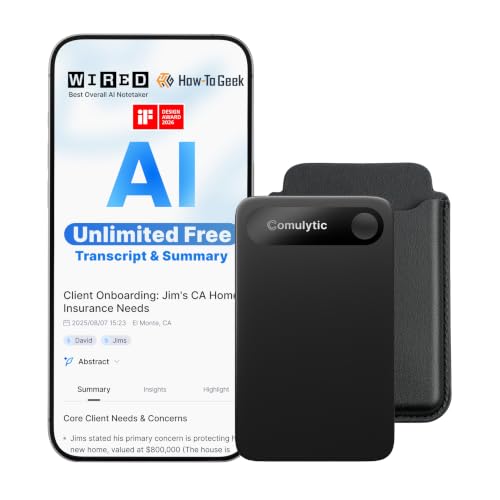
This is a pocket-sized, app-connected voice recorder that records through a multi-microphone array, transfers files by USB-C, and uses Bluetooth for pairing. The supplied quick-start guide documents a recording timer, indicator light, pause control, USB-C charging, local storage management, and app-based transcription and AI functions that require internet access. Comu states that the product has six microphones, up to 70 hours of recording per charge, a seven-meter pickup range, and unlimited basic transcription and summaries. Those performance figures are manufacturer claims, not independently tested results. An independent hands-on review found transcription generally usable, but reported thin audio, unwanted pickup of nearby conversations, and software that was buggy or poorly translated. Official materials also conflict on battery life, with one Comu page listing 45 hours while the product page lists 70 hours.
It suits a professional who records short in-person meetings, interviews, personal voice notes, or phone conversations with informed consent, and who wants an app to turn those recordings into searchable transcripts and draft follow-ups. It is especially relevant for someone who values USB-C file transfer, visible recording status, and a published five-year minimum security-update period. The buyer should be comfortable reviewing every transcript, summary, and generated document before use.
It is not suited to people recording confidential, legally sensitive, medical, financial, or high-stakes discussions unless every participant has given appropriate consent and the organization has separately approved the cloud workflow. It is also a poor fit for noisy cafés, open offices, or crowded rooms where an independent test found pickup of nearby voices. Buyers needing independently validated transcription accuracy, formal radio certification traceability, battery test records, or guaranteed offline AI processing need stronger documentation.
The product has useful consent-oriented controls. Its guide documents a visible timer, indicator light, vibration feedback, and pause control, while Comu's own guidance tells users to ask everyone for permission because recording laws vary by location. The service policy also makes the user responsible for obtaining required notices and consent. These controls help, but they do not replace checking the law where recording occurs. Comu states that voice data is encrypted during transmission and at rest, and that deleted voice data and associated text are generally removed within seven days. The company also says it will provide security updates through August 12, 2031. However, public materials reviewed did not identify battery chemistry, battery-replacement instructions, a recycling program, repair parts, or model-specific third-party battery and radio certifications. USB-C charging and transfer can reduce dependence on a proprietary cable, but the sealed-battery and end-of-life picture remains unclear.
This is a thin, credit card-sized digital recorder for in-person meetings, calls, and interviews. It stores audio locally, transfers recordings to a phone through Bluetooth or Wi-Fi, then uses the companion app for transcription, speaker labeling, summaries, action items, and AI questions. The manufacturer specifies 64GB storage, a 400mAh battery, two MEMS microphones plus one vibration pickup sensor, and up to 45 hours of recording, though those performance figures are manufacturer-stated. Independent reviews confirm the small format, app-based workflow, editable output, and transcript text synchronized to audio. They also found useful English transcription in practical use, but imperfect speaker recognition and weaker recognition for at least one less-common language. The maker advertises free basic transcription and summaries, while reserving some richer AI functions for paid plans, so buyers should check the current plan terms before relying on any feature described as unlimited.
This product fits a person who regularly captures permitted meetings, interviews, lectures, or personal notes and wants a very small dedicated recorder rather than leaving a phone recording throughout the session. It is most suitable when the buyer can review the original audio and transcript before relying on action items, especially for English-led conversations. Local storage, app exports, and a transcript linked to playback are useful for people who need to revisit what was said. The buyer should also be comfortable managing an account and checking the current service-plan terms.
It is not suited to anyone who needs independently validated transcription accuracy for legal records, clinical documentation, regulated financial communications, formal accessibility accommodations, or high-stakes multilingual work. Speaker identification and less-common-language recognition have shown weaknesses in independent reviews. It is also unsuitable for covert recording or for settings where every participant has not been clearly informed and consented as required by local law. People with pacemakers, implanted defibrillators, or similar implants should not carry the magnetic recorder close to the implant and should follow the manual's 10 cm separation warning.
The manual contains useful basic battery directions, including a 32°F to 95°F operating range, instructions not to disassemble or use damaged equipment, and warnings about fire, crushing, and incorrect battery replacement. It also warns that the product's permanent magnets can interfere with pacemakers, implanted defibrillators, and other medical implants within 10 cm. No recall or public consumer-product incident specific to this recorder was located in the reviewed U.S. sources. Its privacy policy says voice data can be processed for transcription, summaries, and speaker labeling, and places responsibility for obtaining other speakers' consent on the user. The company describes local recording by default, optional cloud backup, deletion controls, and encryption, but public independent security certification or audit evidence was not found. The manual directs users to recycle the product and rechargeable battery rather than discard them in household waste. Battery chemistry, take-back arrangements, packaging detail, and repairable battery service are not disclosed.
This is a 27.6 g, card-shaped voice recorder that pairs with a phone app to capture meetings, calls, lectures, and in-person conversations, then create transcripts and AI summaries. The manufacturer lists two MEMS microphones, one VPU, Bluetooth and Wi-Fi, a 3.7 V 400 mAh battery, 64 GB of local storage, and up to 45 hours of recording. Those capacity and battery figures are manufacturer-stated, not independently tested. The app is central to the product. Comu documents editable, time-synced transcripts and export or sharing options, while its current plan page says basic transcription and summaries are included and more advanced AI features sit in paid tiers. An independent hands-on test found English transcription useful but reported weak results with a rarer language. The catalog record's 16 GB storage claim also conflicts with the manufacturer's current 64 GB specification, so buyers should confirm the delivered configuration.
This product suits an adult who wants a very thin, dedicated recorder for routine English-language meetings, interviews, lectures, or personal notes and is prepared to review important transcripts against the source audio. It is most appropriate where the user can clearly obtain recording permission, manage a phone app, and export copies of recordings and notes for their own archive. The stated 45-hour recording capacity and compact format may fit people who need to carry a recorder through a workday rather than rely on a phone microphone.
It is not suited to covert recording, or to any setting where every participant has not been informed and consent requirements have not been checked. It is also a poor fit for medical, legal, financial, school, or other regulated records that require a verified compliance package, a documented business associate agreement, or independently audited security controls. Users who need proven multilingual transcription, reliable speaker labeling in noisy rooms, or a repairable device with published battery replacement instructions should not treat the manufacturer's claims as sufficient evidence.
The main health and privacy issue is recording consent. The manufacturer's terms put responsibility on the user to obtain required consent and follow call-recording and privacy laws. This matters because the compact format can make recording less visible to other people. Use an explicit verbal notice before recording, and confirm the rule that applies where every participant is located. Comu says audio is encrypted locally with AES-256, cloud data is encrypted at rest, transfers use TLS, and deleted voice data is generally removed within seven days after deletion. These are manufacturer statements, not public third-party certification evidence. The product has a rechargeable 3.7 V 400 mAh battery, but no public battery chemistry, recycling program, battery-service procedure, or model-specific safety test record was located. Its stated replacement-oriented warranty and extended-care plan do not substitute for repair instructions or replaceable battery support.
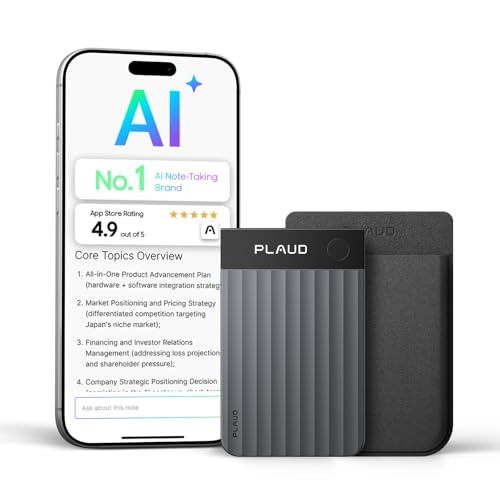
This is a 30 g, card-sized AI voice recorder for in-person conversations and phone calls. It records locally, then transfers recordings to the Plaud app for transcription, summaries, speaker labels, and export. Manufacturer documentation specifies 64 GB storage, a 500 mAh battery, four MEMS microphones plus a VPU, and 30-hour Enhance or 50-hour Endurance recording modes. The radio traceability is a particular strength. An FCC filing identifies the Note Pro model and its matching FCC ID. Independent hands-on testing found useful transcription, summaries, timestamps, and generally effective speaker separation in a five-person English conversation. That testing was qualitative, however, not a published accuracy study with a representative test corpus or error rates. Plaud also clearly publishes its free and paid transcription allowances, including 300 free minutes per month.
This product fits a professional, student, interviewer, or project lead who wants a very small dedicated recorder for ordinary meetings, calls, lectures, and follow-up notes. It is most suitable for someone willing to review the transcript against the audio before relying on action items or quotations. It also suits people who want to preserve files outside the service, since audio, transcripts, and summaries can be exported in common formats. The included free 300 monthly transcription minutes support occasional or moderate use without an immediate paid plan.
It is not suited to anyone who needs a validated transcription record for legal, medical, disciplinary, compliance, or safety-critical decisions without human checking. It also is not appropriate for covert recording, or for users unwilling to notify participants and verify consent requirements where every participant may need to agree. Heavy users who need more than 300 minutes a month should account for continuing service costs. Buyers who prioritize user-replaceable batteries, formal repair access, or detailed recycling documentation will find the available product information limited.
The wireless hardware is traceable to an FCC authorization for the Note Pro model, which is a meaningful U.S. compliance check. Plaud's support material says recordings are stored locally before transfer. It also says transferred recordings are removed from the recorder, which can reduce exposure if the device is later lost. Plaud states that cloud data is encrypted with AES-256 at rest and TLS 1.3 or higher in transit. Those security details are manufacturer statements, and the cited ISO and SOC 2 materials were not publicly available for independent review. Recording consent remains the user's responsibility. Plaud explicitly advises notifying participants and checking local law, but it does not collect consent on the user's behalf. The device contains a rechargeable 500 mAh battery and bundled magnetic charging accessories. No product-specific UL, ETL, battery test summary, battery-service path, chemistry disclosure, or dedicated end-of-life recycling program was identified. Material information is limited to manufacturer-stated aluminum alloy and glass, so the product's repair and disposal burden cannot be fully assessed.
Plaud Note is a credit-card-sized AI voice recorder for in-person conversations and phone calls. This black version stores audio on 64 GB of internal storage, uses two MEMS microphones and a vibration pickup sensor, and transfers recordings to the Plaud mobile app for transcription and AI summaries. Plaud states a 400 mAh battery can provide up to 30 hours of continuous recording, with a stated 2-hour charging time. The NB-100 model is independently traceable to a US FCC equipment authorization for 2.4 GHz wireless operation. Plaud documents a red front indicator that remains lit whenever recording is active and cannot be disabled. Its claims of 112 transcription languages, speaker labels, summaries, 300 monthly transcription minutes, cloud features, and security controls are primarily manufacturer-stated. Independent reviews support useful speech capture and transcription in ordinary use, but there is no disclosed accredited test reporting word-error rates, diarization errors, or results by language and noise condition.
This product suits a meeting-heavy professional, student, interviewer, or consultant who wants a very thin dedicated recorder for short to all-day note capture and is prepared to review the transcript before relying on it. It is especially practical for users who value local recording before transfer, need phone-call and in-person modes, and can work within the included monthly transcription allowance or clearly understand the paid plan terms. It also suits users willing to notify every participant before recording.
It is not suited to anyone who needs legally defensible, independently measured transcription accuracy, guaranteed speaker separation, or dependable capture in loud rooms and at long distances. It is also unsuitable for covert recording or for users unwilling to actively obtain consent where local law requires it. People handling highly sensitive medical, legal, financial, or confidential discussions should not treat the app's cloud AI processing as risk-free. Buyers needing a replaceable battery, formal battery safety documentation, repair parts, or long-term offline independence should choose a product with those records.
The strongest independently checkable safety-related point is radio traceability. The NB-100 model corresponds to a US FCC authorization for the Plaud Note wireless transmitter. Plaud also documents a red recording indicator that stays on while audio is being captured, plus consent guidance that tells users to notify participants and respect local rules. These are useful safeguards, but the user remains responsible for recording-law compliance. Plaud states that recordings remain on the device by default and that cloud AI providers do not retain inputs or use them for model training. Its app listing still reports collection of user content, identifiers, contact information, location, usage, and diagnostics in certain circumstances. No active US recall or regulatory warning was located in the checked sources. Environmental documentation is limited. The product has an internal battery and magnetic accessories, but no model-specific battery chemistry, recycling program, replaceable-battery pathway, or repair documentation was located. A 12-month manufacturer warranty is published.
Pocket is a rechargeable, app-connected voice recorder intended to capture in-person conversations, phone calls, and spoken ideas, then turn synced recordings into transcripts, summaries, action items, and mind maps. The product documentation identifies a 3.8 V, 840 mAh rechargeable lithium-ion battery, USB-C input rated at 5 V and 1 A, Bluetooth and Wi-Fi file transfer, and a one-year limited warranty. Those are manufacturer documents filed with the wireless authorization record. Its radio traceability is a concrete strength. The documented model carries an FCC authorization for Bluetooth and Wi-Fi operation in the United States. Pocket also states that recordings can be stored locally while offline and synced later. The catalog says 64 GB, while the available model manual says 128 GB, so the capacity of the exact retail configuration is not reliably resolved. No independent audio, transcription, or summary-accuracy testing was located.
This product fits an adult who wants a separate, screen-free recorder for personal ideas, meetings, lectures, or calls, and who is willing to review transcripts and summaries against the original conversation. It is most suited to users who can obtain permission before recording, can keep the device charged with an appropriate USB-C power source, and accept app-based syncing for AI processing. Offline capture may be useful when an internet connection is unavailable, provided the user plans to sync later for transcription and summaries.
It is not suited to anyone who needs independently verified transcription accuracy for legal, clinical, academic, accessibility, investigative, or high-consequence records. It is also a poor fit for people who cannot obtain consent from everyone recorded, especially for calls or in locations with stricter recording rules. Buyers who require fully local processing, documented third-party security certification, guaranteed permanent access to exports, clear included AI limits, or user-replaceable battery service should not assume those protections are provided here.
The documented product model has an FCC-authorized Bluetooth and Wi-Fi radio configuration, and its label documentation identifies a rechargeable 3.8 V, 840 mAh lithium-ion battery with USB-C charging at 5 V and 1 A. The manual warns against heat, puncture, crushing, liquids, and using damaged batteries. No active United States recall or regulator warning was located in the sources checked. Pocket's privacy policy says recording begins when the user activates it rather than through continuous background capture. It also says audio, transcripts, and AI outputs may be processed by cloud and AI vendors, while personal recordings are not used to train models without consent. No model-specific battery safety listing, recycling program, battery chemistry disposal guidance, environmental certification, repair manual, replacement battery program, or independent security audit was located. The fixed rechargeable battery and unclear repair path can add to e-waste if it degrades.
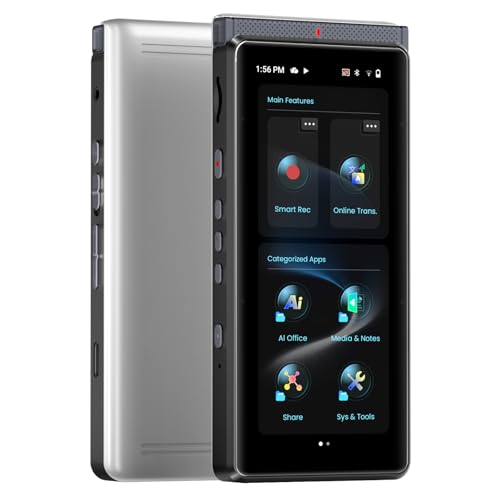
The Innioasis PR1 is a handheld AI voice recorder with Wi-Fi, Bluetooth, USB-C file transfer, a color screen, and internal storage sold in a 64 GB version. It is intended for recording meetings, interviews, lectures, and travel conversations, then creating transcripts, summaries, and translations. The FCC-filed manual identifies a 1,100 mAh battery, WAV and AAC compatibility, and a manufacturer-stated 20.5-hour recording time. The most concrete independently traceable feature is its radio authorization. FCC equipment records identify the PR1 as an AI voice recorder with authorized Bluetooth and Wi-Fi transmitters. The manual also documents copying recordings from the device's My Recordings folder to a computer through USB-C file-transfer mode. Innioasis states that transcription can run on-device and in real time, but no independent accuracy, diarization, summary-fidelity, noise-performance, or translation evaluation was located for this product.
This product suits a person who wants a dedicated, pocketable recorder for classes, interviews, or meetings and values copying original files directly to a computer. It is especially relevant when a phone is inconvenient or when recording needs to continue independently of a phone app. Buyers should treat the AI functions as productivity aids rather than a verified record, retain the original audio, and review every transcript, summary, action item, and translation before relying on it for work, school, legal, medical, or financial decisions.
It is not well suited to anyone handling confidential client, patient, employee, legal, or sensitive business conversations unless they first obtain written confirmation of how audio and AI outputs are processed, retained, secured, and deleted. It is also unsuitable where precise transcripts, reliable speaker labels, or faithful summaries are required, because no independent accuracy evidence was located. Avoid recording people without clear notice and consent, since recording rules vary by state. Users concerned about RF instructions should seek clarification before body-worn use.
The product has traceable FCC equipment authorization for its Bluetooth and Wi-Fi radios, and the FCC-filed manual gives basic care warnings about temperature extremes, water, prolonged sun exposure, and thunderstorms. However, the available radio materials conflict on exposure instructions. The FCC grants describe a 20 cm separation condition for the transmitters, while the manual describes unrestricted portable use. The product should not be treated as having independently confirmed battery or charging certification because no model-specific UL, ETL, CSA, IEC battery-test, or transport-test documentation was located. No U.S. recall, public CPSC warning, or public unsafe-product report was located in the searched databases for this model or brand. Environmental information is sparse. The available documents identify a rechargeable battery capacity, but not battery chemistry, recycled content, packaging details, battery replacement procedure, or a manufacturer recycling program. Local USB-C transfer and WAV or AAC support reduce dependence on a cloud account, but end-of-life and repair information remains limited.
This is a small wearable voice recorder with a charging case, two microphones, a USB-C charging connection, and 64 GB storage in the listed configuration. It can be clipped to clothing, worn on the included lanyard, or attached to a phone through its magnetic case. Recording starts with a physical button, while the app is used for transfer, playback, transcription, summaries, editing, and exports. FCC authorization independently traces the D3200 radio hardware to Anker Innovations for 2.4 GHz operation. The manual also confirms a visible orange recording light and vibration feedback. Soundcore states that transcription is processed in its app, that 300 monthly transcription minutes are included, and that paid plans add capacity and some advanced AI features. Its advertised transcription accuracy and cloud security claims were not supported by a published independent performance test or an accessible audit report during this review.
This product fits a person who needs a very small recorder for in-person meetings, classes, interviews, or personal voice notes and is prepared to manage recordings through a phone app. It is particularly suited to users who value editable transcripts and summaries, need to export materials into ordinary audio and document formats, and can work within the included monthly transcription allowance. It also suits users who will actively obtain permission before recording and who can keep the recorder positioned near the people speaking.
It is not suited to people who need independently verified transcription accuracy for legal, medical, research, disciplinary, or other high-consequence records. It is also a poor fit for anyone needing fully offline transcription, direct playback from the recorder, or a recorder that remains easy to use without an app account. Avoid using it for sensitive conversations unless your organization permits cloud transcription and sharing links. It is not appropriate for covert recording, for recording people without clear notice, or for settings governed by strict consent rules.
The D3200 has a traceable FCC authorization for its 2.4 GHz radio, and its manual documents the orange recording light, vibration feedback, app-controlled pause, and an explicit instruction to obtain participants' consent before recording. These are meaningful safeguards for a wearable recorder, although the product does not itself determine whether a recording is lawful in a particular state or workplace. Soundcore states that recordings and transcripts are local by default, and that cloud transcription uploads are temporary. Failed transcription files may remain in cloud storage for up to seven days, according to its service information. The company has had CPSC recalls for other battery-powered Soundcore and Anker products, but no recall specific to this recorder was located. No model-specific public battery test summary, battery chemistry disclosure, repair guide, replacement battery program, or environmental certification was found. Use appropriate electronics recycling at end of life rather than disposing of the product in household trash.
This is a small wearable audio recorder designed for in-person conversations, spoken notes, interviews, and lectures. It can be worn with the included magnetic pin or clip, then synced with a phone app for transcription, summaries, speaker labels, sharing, and exports. It is not a phone-call recorder. The radio hardware is independently traceable to a United States FCC authorization that matches this product's PN0200 model family. Plaud states that it weighs 0.59 ounces, has two MEMS microphones, 64 GB of local storage, and can record continuously for up to 20 hours. The included Starter Plan is stated to provide 300 transcription minutes each month. Plaud also describes cloud-based processing for transcription and summaries, so the recorder remains useful for capturing audio without a subscription, while most AI value depends on the app and available transcription minutes.
This product suits an adult who frequently needs a lightweight, hands-free way to capture their own in-person meetings, interviews, classes, field notes, or spoken reminders. It is especially practical when wearing it close to the speaker and when the buyer can review the transcript before relying on it. It fits lighter transcription use because the included plan provides 300 minutes monthly. The buyer should be comfortable using a phone or web app to transfer recordings, manage cloud content, and correct AI output.
It is not suited to anyone who needs covert-recording capability, or who cannot consistently obtain and document consent from everyone required by local law. It is also a poor fit for minors, for sensitive healthcare, legal, employment, or financial conversations where an unreviewed transcript or summary could create harm. People with pacemakers should not wear it on the chest with the magnetic accessories, according to Plaud. Choose another arrangement if you need independently measured transcription accuracy, a replaceable battery, or fully documented third-party safety certification.
The strongest independently checked safety point is radio traceability. The Bluetooth product family has a matching FCC authorization, including RF exposure and radio test filings. Plaud also gives practical charging instructions, including use of the supplied dock and a 5 V, 0.5 A power source. No relevant United States recall or CPSC safety warning was located during this review. However, no public model-specific battery safety certification or shipment battery test summary was located. Privacy controls are more detailed than usual for a recorder. Plaud states that cloud data are encrypted at rest with AES-256 and in transit with TLS 1.3 or higher, that content is not used for model training without explicit informed consent, and that account and cloud-file deletion are supported. These remain manufacturer statements. The product contains a rechargeable battery and magnetic accessories, but Plaud does not clearly disclose battery chemistry, repair procedures, battery replacement, material composition, packaging details, or a product-specific recycling program. A 12-month limited warranty is documented.
This product is a compact rechargeable voice recorder for locally capturing lectures, meetings, interviews, and personal notes. It uses a physical ON, OFF, and voice-activation switch, a USB-C connection for charging and file transfer, and included wired listening accessories. A supplier page for the NZ007 platform identifies an ABS and aluminum-alloy body, plus direct WAV and MP3 file copying to and from a computer. The stated 132GB capacity, up to 9,800 recording hours at 32 kbps, 100-hour battery runtime, and AI triple noise reduction are manufacturer claims. The available manual describes a light and vibration response when recording modes are selected, and automatic saving on critically low battery. It does not document Bluetooth, Wi-Fi, an app, cloud transcription, AI summaries, encryption, battery chemistry, or model-specific safety certification. Product materials also contain inconsistent capacity, runtime, and format references, so the headline specifications should be treated as unverified.
This product fits someone who wants a simple, local recorder for a desk, lecture hall, or meeting room and is prepared to transfer files manually by USB-C. It is most suitable where a physical switch is preferable to an app and where WAV or MP3 files need to remain available on a computer without a subscription. The buyer should be comfortable checking recordings after use, because voice activation and noise-reduction performance have not been independently tested and the stated capacity figures are not fully consistent across materials.
It is not well suited to users who need verified long-distance speech capture, dependable recording in noisy or moving environments, or evidence-backed voice activation for time-critical work. It is also unsuitable for people who need automatic transcripts, searchable notes, reliable AI summaries, cloud collaboration, or documented encryption and account controls. Do not use it for covert recording or in conversations where consent has not been addressed. Recording laws vary by state and can require notice or consent from more than one participant.
The available instructions indicate a rechargeable product charged through USB-C and describe automatic saving followed by shutdown when battery power is critically low. A search of U.S. consumer-product recall resources did not identify a recall or public safety warning specifically naming this product or brand. That is not the same as safety certification. No model-matched UL, ETL, CSA, battery test summary, battery chemistry, charging limits, or approved-charger specification was found. The NZ007 platform supplier identifies ABS and aluminum alloy construction, and the product uses a rechargeable battery rather than disposable cells. Its ability to transfer standard audio files directly can extend usefulness if software services change. However, no battery replacement procedure, spare-parts catalog, recycling program, packaging disclosure, repair instructions, or end-of-support policy was found. Recycle the product and its battery through an appropriate electronics or battery collection program rather than household trash.



