13% off

Photon Mono 4 Resin 3D Printer
High-resolution 10K mono LCD screen.
Fast printing speed at 70mm/h.
Stable LighTurbo light source enhances precision.
Members Only
Checked by ReviewTier
 Daniel Kenitz
High-resolution 10K mono LCD screen.
Fast printing speed at 70mm/h.
Stable LighTurbo light source enhances precision.

Fully auto leveling simplifies setup and use.
High-speed printing up to 600mm/s.
Easy-to-change 3S detachable nozzle.

High-speed printing at 150mm/h.
Large 16K resolution for detailed prints.
Smart tank heating ensures consistent results.

Large build volume for bigger projects.
Convenient auto-leveling feature simplifies setup.
High-resolution printing for detailed results.
High speed printing at 150mm/h
Smart automatic leveling feature
Convenient WiFi file transfer

Ultra-high 9K LCD for detailed prints.
Pre-leveled platform simplifies setup process.
AI 2D-to-3D model generation for easy design.

Delivers exceptional ±2μm high precision.
Features fast 4.5s/layer printing speed.
Includes reliable C5 industrial Z-axis.

High precision for detailed 3D prints.
Beginner friendly with auto leveling feature.
Compact size fits in small spaces.
Build volume determines the largest part or batch the product can handle, but stated dimensions are not proof of accuracy or full-volume reliability. Resolution figures such as 14K or 16K describe the display or pixel arrangement; they do not independently establish dimensional accuracy, light uniformity, surface quality, or print success. Speed claims can also depend on layer height, resin, exposure settings, temperature, model geometry, and whether the figure describes travel speed rather than completed parts. Look for testing that identifies the exact model, resin, settings, test method, and results. ISO/ASTM 52902 is the relevant geometric-capability framework named in the assessments, while an ISO/IEC 17025-accredited laboratory report offers stronger traceability than seller graphics or general reviews.
Safety evidence should cover the complete US-market product, not just its power adapter or wireless hardware. A model-specific UL listing searchable in UL Solutions Product iQ or an ETL listing searchable in Intertek’s directory is materially different from an unsupported compliance logo. The CPSC recalls database can identify known product actions. FCC authorization is useful for verifying Wi-Fi or Bluetooth radio compliance, but it does not establish electrical or fire safety for a heated, UV-equipped printer.
For resin handling, look for practical containment rather than claims that an enclosure is automatically safe. Useful features may include controlled resin filling, stable vats, drip trays, recovery paths, sealed wash vessels, replaceable parts, and clear instructions for ventilation, gloves, eye protection, spills, ignition control, and contaminated waste. A cover limits casual UV access, but it is not evidence of effective vapor capture or a reliable interlock unless those functions are documented or tested. Resin-specific profiles should identify exposure, wash, and cure conditions by compatible material; generic instructions are weaker evidence.
Across the supplied reviews, the recurring caveat is that no product should be treated as a plug-and-play appliance for an occupied room. The resin printers generally lacked an independently searchable complete-product UL or ETL listing, an IEC 62471 photobiological-safety report, and independent laboratory validation of headline accuracy, emissions, light uniformity, or repeatability. Covers, carbon filters, automatic feeding, and optional purifiers do not replace local ventilation, chemical-resistant gloves, eye protection, spill control, sealed solvent handling, or careful cleanup. Bedrooms, kitchens, shared living areas, child-accessible spaces, and poorly ventilated classrooms are repeatedly identified as unsuitable. Uncured resin, contaminated wipes, failed prints, and wash solvent must not be poured into drains or released to soil or storm sewers; local household hazardous-waste guidance is needed. One wash-and-cure product also had an independently reported inconsistent UV lid shutoff, making interlock claims worth checking rather than assuming.
Resin printing combines a UV curing source with liquid photopolymer resin and, usually, solvent washing. The scores below reflect how well the supplied products documented controls and evidence; they do not make uncured resin harmless or turn a lower-scoring feature into a safe substitute for ventilation and protective practices.
This measures controls for skin contact and breathing exposure during filling, printing, cleaning, and curing. Higher-scoring products in the set combined ventilation instructions with features such as automatic feeding, recovery paths, carbon filters, or exhaust connections; the strongest scores reached 96. Lower scores reflected generic warnings without a complete exposure plan. No enclosure or purifier was shown to replace local ventilation.
This measures cover quality, UV access, interlocks, and safe servicing instructions. The supplied products ranged from 70 to 99: higher scores reflected documented opaque or tinted covers and clearer warnings, while lower scores lacked interlock evidence or an IEC 62471 report. A cover can reduce casual exposure, but the wash-and-cure equipment review showed why automatic-shutoff claims should be independently checked.
This measures third-party certification of the complete US-market product, including its heater, UV source, motors, and power system. Scores were tightly grouped from 68 to 72, because no supplied resin printer had a model-specific UL or ETL listing independently identified. FCC authorization found in several reviews covers wireless operation only; it is not electrical or fire-safety certification.
This measures stable vats or wash vessels, secondary containment, compatible materials, and instructions for flammable-solvent storage, ignition control, spills, and emergency cleanup. Scores ranged from 68 to 96. Higher-scoring designs included drip trays, funnels, sealed tanks, or controlled pouring, but even those reviews noted that detailed solvent and hazardous-waste procedures were often incomplete.
This measures usable resin-specific settings and post-processing instructions, including exposure, washing, and cure conditions. Scores ranged from 68 to 88. Higher-scoring printers supplied resin libraries, profiles, manuals, or safety data sheets; lower-scoring products offered only brief generic wash-and-cure directions. A manufacturer profile is useful, but it is not the same as independent validation across materials.
This measures whether claims about accuracy, speed, light uniformity, heating, emissions, or print success were tested independently with a stated method. Scores ranged from 68 to 79. The stronger products had identifiable hands-on tests, such as successful prints, a timed Benchy, or cold-workshop heating results. Those tests still generally fell short of ISO or accredited-laboratory measurement.
This measures whether marketing avoids unsupported claims such as non-toxic, child-safe, odor-free, food-safe, skin-safe, or universally successful. Scores ranged from 54 to 87. Higher-scoring reviews found more qualified claims and clearer limits; the lowest score reflected a title that could imply included dual-material hardware when the kit was sold separately. Beginner or child-oriented wording deserves particular caution.
This measures repeatability, leaks, adhesion, alignment, failure patterns, calibration, warranty, and spare-part support. Scores ranged from 60 to 78. Higher scores were supported by independent successful prints, documented build areas, heating results, or replaceable parts. No supplied product had transparent long-run testing across multiple resins and full build volumes, so headline reliability remains conditional.
This measures whether the exact model, responsible company, electrical ratings, wireless authorization, warranty contact, and safety notices can be verified. Scores ranged from 68 to 86. Higher-scoring products had model-specific FCC records and clearer support or parts documentation. FCC records establish radio compliance, not complete-product electrical safety; inconsistent product naming or missing certification identifiers lowers confidence.
This measures resin efficiency, failed-print and solvent burdens, packaging, repairability, replacement parts, and disposal guidance. Scores ranged from 68 to 76. Higher-scoring products documented replaceable screens, vats, films, filters, or other parts and sometimes included resin recovery features. The reviews repeatedly found incomplete disposal instructions, so uncured resin, contaminated solvent, wipes, and failed parts still require local hazardous-waste handling.
This is a compact desktop masked-stereolithography resin printer for making small parts, miniatures, prototypes, and detailed models from liquid photopolymer resin. It uses a 7-inch 10K monochrome LCD and a resin vat, then requires users to remove, wash, dry, and post-cure each print. The manufacturer specifies a 153.4 x 87 x 165 mm build volume, a 24 V, 2.5 A power adapter, and USB-only file transfer. The product's manual provides a 0.05 mm starting profile and an included exposure-range test for tuning resin settings. It also documents resin filtering, vat cleaning, replaceable release film, and a one-year warranty. These are manufacturer-provided instructions, not independent validation of print accuracy, light uniformity, safety performance, or long-term reliability. The supplied cover encloses the working area, but no model-specific UV interlock or photobiological-safety test report was located.
This product suits a hobbyist or small workshop user making miniatures, figurines, jewelry masters, model components, or other small, detailed resin prints. The stated 2.2-liter build volume is sized for compact batches rather than large objects. It is most appropriate for someone willing to level the platform manually, tune exposure by resin, handle washing and post-curing, and maintain the vat and release film. The user should already have a dedicated, ventilated work area and a separate workflow for solvent and resin waste.
It is not suitable for bedrooms, shared living areas, classrooms without controlled ventilation, or households where children or pets can reach uncured resin, solvents, tools, or UV equipment. It also does not fit users who need a documented model-specific US electrical listing, verified UV interlock performance, or independently validated dimensional accuracy for regulated, medical, food-contact, skin-contact, or safety-critical work. People without a sealed wash setup, compatible gloves, ventilation, and local hazardous-waste access should choose a different process.
The key health issue is not the cured print, but handling liquid resin, wash solvent, and emissions during printing and post-curing. The manufacturer manual warns that vapors or fumes may irritate, calls for an open, well-ventilated area, warns against direct UV exposure, and tells users to wear anti-UV goggles and gloves. This is useful baseline guidance, but it does not specify glove material, ventilation rate, respirator selection, spill containment, or ignition controls for alcohol washing. The manual supports some waste reduction by directing users to filter and reuse remaining resin, clean cured residue through the vat-cleaning function, and replace the release film and screen protector when needed. It does not give clear US disposal instructions for uncured resin, contaminated wipes, or solvent. Those materials should not be poured into drains, ground, or storm sewers, and local household hazardous-waste rules should be followed. A model-specific UL or ETL listing for the complete product was not independently confirmed, and no US CPSC recall was located in the searches completed.
This product is an open-frame, fused-filament 3D printer, not a resin printer. It melts solid plastic filament through a direct-drive nozzle and builds parts within a stated 220 x 220 x 220 mm volume. Flashforge lists PLA and PETG as recommended materials, with TPU and carbon-fiber-filled PLA or PETG supported through a 0.6 mm nozzle. It has a removable PEI steel build plate, Wi-Fi, Ethernet, USB, power-loss recovery, and a 350 W mains power system. The 600 mm/s figure is manufacturer-stated and its specifications describe it as maximum travel speed. Independent testing confirmed fast small prints, a 26.8-minute Benchy, plus good clearances and support removal. The same testing found inconsistent surface quality on some geometry, a measured usable bed area of 217 x 217 mm, and occasional software connection issues. The product is open and has no listed air filtration, so its manual's well-ventilated-workspace instruction matters.
This product suits an adult hobbyist, maker, classroom technician, or small workshop that wants to make prototype parts, organizers, fixtures, and models from PLA or PETG. Its 220 mm cubic build space and removable PEI plate are practical for common desktop projects, while the independent setup test suggests a relatively low initial assembly burden. It is most appropriate where the printer can sit in a ventilated, supervised work area and the user is willing to tune slicer settings when surface quality matters.
It is not suited to buyers specifically seeking a resin printer for very fine vat-photopolymer detail, because it uses heated filament and has no resin vat, wash process, curing station, or UV source. It is also a poor fit for bedrooms, poorly ventilated classrooms, nurseries, or shared living spaces without a plan for ventilation or external containment. Users needing independently verified fire certification, a factory-installed filtered enclosure, food-contact parts, or consistently high-quality bridges and overhangs at default settings should not treat those needs as established by this product.
The most important safety clarification is that this product does not use liquid photopolymer resin or UV curing. That avoids the skin-contact, solvent, spill, and UV-light hazards addressed by resin-printer guidance. Its manual instead warns users to keep away from combustible gases, liquids, and dust, avoid touching the hot extruder and build plate, use the supplied grounded power cord, and operate in a well-ventilated environment. Ventilation remains important. NIOSH reports that fused-filament printers can emit ultrafine particles and volatile chemicals, and recommends ventilation or local exhaust controls. This product has an open shell and no listed air filter. It has user-replaceable service parts, which can help extend use, but the reviewed documentation did not provide clear disposal directions for filament scrap, failed parts, or end-of-life electronics. Its Wi-Fi radio has an identifiable FCC authorization, but that is not equivalent to a verified US electrical or fire-safety listing.
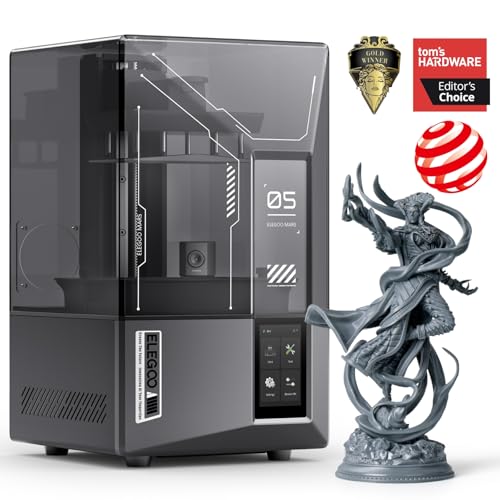
This is a desktop masked-stereolithography resin printer for detailed models, figures, prototypes, and other parts that fit its 211.68 x 118.37 x 220 mm build volume. It uses a 405 nm UV light source, a heated resin vat, a tilting vat release system, Wi-Fi, and a flip-up tinted lid. Printing still requires handling liquid photopolymer resin, removing wet parts, solvent washing, UV post-curing, and cleanup. Independent reviewers tested the exact product and reported smooth, detailed prints. One cold-workshop test reported successful printing after the heated vat reached about 25 C. ELEGOO states that the vat targets 30 C, its sensor system can flag low or excessive resin and residue, and the LED system pauses above 80 C. Those are manufacturer claims, rather than third-party safety validations.
This product suits an experienced hobbyist, maker, or small workshop that needs a fairly large resin-printing area for miniatures, terrain, statues, prototype housings, or batches of small detailed parts. It is most appropriate where there is a dedicated, ventilated work area, chemical-resistant cleanup setup, sealed solvent containers, and room to wash and cure parts separately. The heated vat is particularly relevant for users working in cool spaces, based on the independent cold-room test. It also suits users willing to calibrate resin settings and inspect the vat before every run.
It is not appropriate for bedrooms, occupied living areas, classrooms without engineered ventilation, or homes where children, pets, or chemically sensitive people can access the work area. A tinted lid is not a substitute for controlling resin vapors, solvent fumes, or UV curing emissions. It also does not suit buyers who need a verified US electrical-safety listing for procurement, insurance, or workplace compliance. Avoid it if you cannot safely manage uncured resin, flammable wash solvent, contaminated wipes, and local hazardous-waste disposal, or if you need fully validated print parameters without calibration.
Uncured photopolymer resin can cause allergic or irritant dermatitis, and NIOSH warns that vat printing, solvent washing, UV curing, and sanding can release particles or gases. The product includes gloves and a mask, but neither the manufacturer listing nor independent reviews establish that the supplied items provide adequate chemical or respiratory protection. Use local exhaust or other effective ventilation, change contaminated gloves promptly, and keep wash containers closed. The tinted cover and manufacturer-stated LED overtemperature pause provide some practical safeguards, but no model-specific IEC 62471 report or complete-product UL or ETL safety listing was identified. The product has an FCC authorization record for its Wi-Fi radio, which is not electrical or fire certification. ELEGOO sells replacement tanks, film, and screens, supporting repair. Uncured resin, solvent, and contaminated cleanup materials should not go to drains, ground, or storm sewers. EPA recommends using local household hazardous-waste programs for hazardous household materials.
This is a large-format masked stereolithography resin printer for making models, prototypes, props, and batches of small parts from liquid photopolymer resin. The manufacturer states a 285.5 x 214 x 300 mm build space, equal to 18.3 L, with a 14-inch 12K LCD and a 1.9 L heated resin vat. The manual independently filed with the wireless authorization record identifies the same model, 296 W input rating, dimensions, and 2.4 GHz Wi-Fi. Its defining practical feature is scale. The stated 300 mm print height accommodates parts that would otherwise need joining, but it also increases resin handling, wash-container size, spill consequences, and the burden of post-curing. An independent hands-on review confirmed the heated vat, locking vat and build plate, and supplied slicer, while also reporting a leveling workflow glitch on its review unit. Anycubic supplies material-specific starting profiles, but the company notes they are reference settings rather than universal validated outcomes.
This format suits an experienced resin-printing user who needs tall single-piece props, large display models, or dense batches and already has a dedicated ventilated work area. It is especially relevant where ambient temperatures can fall below typical resin-processing conditions, because the heated vat can maintain a controlled printing temperature. The user should have a sturdy bench, enough clearance for the cover, suitable chemical-resistant gloves and eye protection, sealed wash vessels, and a plan for cleaning and curing large parts.
It is not suited to bedrooms, shared living areas, classrooms without engineered exposure controls, or homes where children, pets, or sensitized people can access the work area. It also does not fit users seeking a self-contained clean workflow. The printer does not include a verified whole-machine vapor-control system, and the optional air-purifier port does not replace ventilation. Avoid this format if there is no capacity to wash, cure, transport, and dispose of resin-contaminated materials from very large prints safely.
Uncured photopolymer resin and common wash solvents are the central health issue, not the cured print alone. NIOSH warns that vat photopolymerization can release particles and organic vapors, while uncured acrylate-containing resin can contribute to dermatitis or asthma. The manual does direct users to work in an open, well-ventilated area and to wear gloves and a mask. It also warns that the heated vat can become hot. Those are useful baseline controls, but it does not provide a detailed solvent, spill, respirator, or disposal procedure. The dark cover encloses the print area, but no model-specific photobiological-safety report or cover-interlock documentation was found. A model-specific FCC filing supports traceability of the 2.4 GHz wireless function, not electrical or UV safety. No relevant CPSC recall was located in the review. The documentation also lacks clear instructions to keep uncured resin, contaminated IPA, wipes, supports, and filters out of drains and ordinary waste, so local household hazardous-waste rules remain important.
This is a desktop masked-stereolithography resin printer for small, detailed plastic parts such as miniatures, models, prototypes and fixtures. It uses 405 nm UV light to cure liquid photopolymer resin in a stated build volume of 153.36 x 77.76 x 165 mm. The manufacturer specifies a 7-inch 9K monochrome screen, 18-micron XY resolution, Wi-Fi and USB connectivity, and a 24 V, 3 A external power arrangement. The product includes a resin tank, build plate, resin tray, gloves, mask and funnel. Its manual documents a resin calibration function and calls for 95 percent or stronger ethyl alcohol or isopropyl alcohol for most non-water-washable resins. Independent hands-on testing has documented calibration and sample-print use, but no ISO/IEC 17025 laboratory report or ISO/ASTM capability study was located for this exact product.
This product suits an informed hobbyist or small workshop making compact, high-detail resin parts who already has a dedicated, ventilated work area and a separate washing and curing workflow. Its stated build area is appropriate for miniatures, jewelry-scale masters, small prototype components and batches of compact pieces. It is also a reasonable fit for a user willing to calibrate exposure for each resin, manage consumables, and maintain the tank and release film. The included basic handling items help with first setup, but do not replace proper PPE or ventilation.
It is not suited to bedrooms, living rooms, classrooms without controlled chemical handling, or any household where children, pets, or chemically sensitive people can access the work area. It is also unsuitable for buyers who expect a self-contained, low-maintenance appliance with no solvent, PPE, ventilation, curing station or hazardous-waste planning. Choose a different workflow if you cannot keep uncured resin and flammable wash alcohol in a dedicated area, or if you need independently documented electrical certification, UV safety testing, or validated production-grade dimensional capability.
Liquid photopolymer resin is the central health issue, not the printer's resolution. NIOSH warns that uncured resin can contain acrylates associated with dermatitis or asthma, and that printing, washing and UV curing can release particles and gases. The product's supplied gloves, mask, funnel, resin tray and anti-UV cover are useful handling aids, but they do not establish effective ventilation or substitute for compatible gloves, eye protection, spill supplies and a cleanable work surface. The manual supports alcohol washing for most conventional resins, which adds an ignitable solvent stream to the workspace. EPA advises against pouring household hazardous waste or alcohol-containing liquids down drains, onto the ground, or into storm sewers. Cure resin residue and contaminated disposable materials only where appropriate, and confirm local household hazardous-waste rules for liquid resin and spent wash solvent. No product-specific US NRTL electrical listing or independent UV safety report was located in the reviewed public records.
This is a compact desktop LCD resin printer for small detailed models such as miniatures, figures, and hobby parts. Creality lists a 153.36 x 77.76 x 160 mm build area, a 6.8-inch 9K screen, 18 micrometer XY pixel size, 0.01 to 0.2 mm layer settings, and a 65 W rated power. These are manufacturer specifications, not independent measurements. Its defining convenience feature is a factory pre-leveled build platform, according to Creality. The manufacturer also lists USB, 2.4 GHz Wi-Fi, and Creality Cloud connectivity, plus HALOT BOX and CHITUBOX slicer compatibility. The official support hub provides model-specific maintenance material for the vat, release film, screen, motor, mainboard, and touchscreen. Independent, model-specific accuracy, emissions, electrical-safety, and long-run reliability test reports were not located.
It suits a hobbyist who specifically wants small, detailed resin models and already has a separate, well-ventilated workspace for pouring, washing, curing, and storing photopolymer resin. Its compact manufacturer-stated build area is appropriate for tabletop miniatures, figures, and modest prototype parts rather than large objects. It also fits a user who values a factory pre-leveled platform and intends to work with HALOT BOX or CHITUBOX. The buyer should budget space and equipment for washing, UV curing, gloves, cleaning supplies, and waste containment.
It is not appropriate for bedrooms, dorms, kitchens, shared living spaces, or homes where children, pets, or bystanders could enter an inadequately controlled resin work area. It is also a poor fit for anyone unable to provide ventilation, chemical-resistant gloves, sealed wash containers, spill cleanup materials, and local hazardous-waste disposal. Buyers needing large parts, built-in air purification, independently verified performance, or verified model-specific US electrical-safety certification should look for equipment with those documented provisions.
Uncured photopolymer resin, contaminated wipes, and wash liquid are the central safety issues, not the printer's compact size or beginner marketing. NIOSH advises ventilation, gloves compatible with acrylates and isopropyl alcohol, immediate spill cleanup, sealed wash containers, and proper disposal of contaminated materials. Creality's own comparison chart shows that this model has no built-in air purification. A separate wash and cure machine is offered, rather than included. The official support material documents vat cleaning and replacement tasks, which is useful for maintainability, but I did not locate product-specific disposal instructions, an independent emissions test, a model-specific UL or ETL listing, or an IEC 62471 UV safety report. EPA guidance treats solvents and other hazardous household chemicals as materials requiring careful local handling, and warns against drain disposal. No US CPSC recall for this model was located in the verification work.
This is a desktop masked-stereolithography resin 3D printer for detailed miniatures, models, and small parts. It uses liquid photopolymer resin, then requires washing and UV post-curing of printed parts. The product is a substantial enclosed machine, listed at about 23 kg, with a lift-up hood, touchscreen operation, and a resin vat workflow. HeyGears states that this Turbo version uses a 566:1 amber screen, a C5-grade Z-axis module, automatic leveling, automatic resin heating and refill, plus an average 4.5-second layer time. Those are manufacturer claims, not independently validated product results. The company does provide printer-specific resin profiles and an open-material mode for experienced users. A detailed independent hands-on review found strong print quality from the earlier Reflex RS, but it did not test this Turbo model, so it cannot verify the Turbo's advertised precision or speed.
This product suits experienced hobbyists, makers, and small studios producing detailed miniatures, display models, prototypes, or small batches who can dedicate a stable, ventilated work area to resin printing. It is most appropriate for users willing to follow a defined printer, resin, wash, and cure workflow, use gloves and eye protection, and learn the supplied slicing software. The official material-profile system may reduce initial tuning compared with manually creating settings, while open-material mode offers more control to experienced resin users.
It is not suitable for bedrooms, shared living areas, poorly ventilated apartments, classrooms without formal chemical controls, or homes where children and pets can access resin, solvent, contaminated tools, or waste. It also does not fit buyers who need independently verified electrical certification, verified UV photobiological testing, or independently measured performance before operation. Users unwilling to wear appropriate protective equipment, manage wash solvent, cure residues, and use local household hazardous-waste services should choose a different production method.
The important safety issue is the resin, not simply the printer enclosure. HeyGears' compatible PAP10 resin safety sheet instructs users to avoid breathing vapors, work in a well-ventilated area, wear protective gloves, protective clothing, and eye or face protection, and avoid environmental release. It identifies a skin-sensitizing acrylate component. CDC guidance similarly notes that vat photopolymerization can release particles and gases during printing and curing, and that skin exposure to uncured resin can cause dermatitis or asthma. The product's hood offers a basic physical barrier around the light source and resin vat, but published material did not establish tested vapor filtration, a UV interlock test report, or a model-specific electrical safety listing. Dispose of uncured resin, contaminated wash liquid, wipes, and containers through local hazardous-waste guidance, not down drains or onto soil. HeyGears does document replaceable screens, resin-tank parts, support contacts, and a one-year warranty, which can support repair rather than immediate replacement.
This is a compact LCD resin 3D printer for small models and parts. The manufacturer states a 118 x 65 x 110 mm maximum build area, 405 nm UV curing, a 5.5-inch 2K LCD, automatic leveling, and a removable magnetic build plate. It runs from a 12 V DC, 5 A supply, with a separate 100 to 240 V AC adapter. The available manual confirms that it uses a covered resin vat, has a manual 10-second UV-vat-cleaning function, and includes basic instructions to wear gloves, clean resin from skin promptly, and clean liquid found inside the machine. It also gives exposure settings for its own resin and recognizes that other resins need different settings. No model-specific independent accuracy, light-uniformity, emissions, or repeatability test report was found.
It suits an adult hobbyist making small miniatures, figurines, jewelry-scale prototypes, or compact detail parts who has a dedicated, ventilated work area and is prepared to establish a full resin workflow. That means chemical-resistant gloves, eye protection, sealed wash containers, a curing setup, spill supplies, and local waste handling. Its small manufacturer-stated build area and automatic-leveling arrangement fit occasional small-batch work better than large objects or production use.
It is not suited to children, shared living spaces, bedrooms, poorly ventilated rooms, or schools without a managed chemical-safety program. Resin handling includes uncured material, contaminated tools, and often flammable wash solvents, while the product documentation does not supply complete exposure-control or disposal instructions. It is also unsuitable for users needing independently verified dimensional accuracy, certified electrical and fire safety, validated medical or food-contact workflows, or a large build volume for one-piece models.
Uncured photopolymer resin is the central health issue. CDC and NIOSH guidance identifies skin contact, airborne particles and gases, solvent cleaning, UV curing, and sanding as exposure points. The manual's instructions to wear gloves, keep children away, clean resin from skin promptly, and remove liquid from inside the machine are useful basics. Its acrylic cover provides a physical light barrier during ordinary operation, but no IEC 62471 assessment, interlock evidence, or tested chamber filtration was located. The manual does not provide a sufficiently complete wash-solvent, spill, or disposal protocol. This matters because used isopropyl alcohol and uncured resin should not go down drains or into the environment. EPA guidance directs households toward local hazardous-waste options for hazardous products. The manual advises curing unwanted resin before discarding it, but it does not address contaminated solvent or waste liquids. No product-specific recall or regulator safety action was located in the searches performed.