Best Overall
17% off
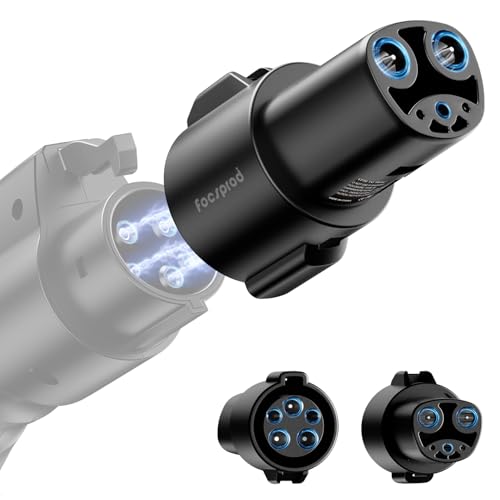
FOCSPROD J1772 to Tesla Charging Adapter
Supports fast charging up to 80 amps.
Compatible with all Tesla models.
UL 2252 certified for safety assurance.
 Daniel Kenitz
Supports fast charging up to 80 amps.
Compatible with all Tesla models.
UL 2252 certified for safety assurance.

Compatible with Tesla Gen 2 and 3 chargers.
Sturdy and reliable for frequent use.
Easy installation with clear instructions provided.

Compatible with all Tesla models seamlessly.
Supports up to 250kW for fast charging.
Works with all DC Level 3 stations.

COMPATIBILITY — Tesla vehicles must show CCS Adapter Support: Enabled under Controls > Software > Additional Vehicle Info. Not compatible with Cybertruck. For other NACS EVs, check your vehicle settings, manufacturer app, or owner’s manual.
EXPANDED FAST CHARGING ACCESS — Connect your Tesla or NACS EV to 12,000+ CCS1 fast-charging stations across North America. Requires CCS DC fast-charging support.
FOR TESLA & NEXT-GEN NACS EVs – Tesla Model S, 3, X & Y, plus NACS (J3400) electric vehicles, including Chevrolet Bolt (2027), Hyundai Ioniq 5 (2025), Kia EV6 (2025), Lexus RZ (2026), Lucid Gravity (2025), Rivian R2/R3 (2026), Toyota C-HR (2026). Please refer to the included User Manual for complete operating instructions and compatibility requirements.

Supports high-speed charging up to 250KW.
Compatible with multiple Tesla models.
Works with Level 1, 2, and 3 stations.

Compatible with a wide range of vehicles.
Supports high-speed charging up to 80 amps.
Durable design ensures long-lasting performance.

Easy installation with straightforward instructions.
Compatible with Tesla Gen 2 Mobile Connector.
Durable construction ensures long-lasting use.

Supports high-speed 250kW charging for efficiency.
Compatible with all Tesla models for versatility.
Enables access to numerous Level 3 charging stations.

Enables Tesla Supercharger use for CCS vehicles.
High power capacity up to 500A/1,000V.
Built-in interlock ensures safe charging sessions.

High compatibility with Tesla Superchargers.
Supports fast charging up to 500A, 1000V.
Easy to use and reliable adapter.
Start with the vehicle, charger, and connector direction. Confirm the vehicle year and hardware, whether CCS communication support is enabled or requires a retrofit, whether the charger is AC or DC, and whether the charging network permits third-party adapters. Tesla guidance supports J1772 AC charging with an SAE J1772 adapter, but CCS and Supercharger access depend on the individual vehicle, station, and network policy. Tesla's supplied or manufacturer-approved adapter requirement matters for Supercharger use; physical fit does not establish authorization.
Treat headline numbers as limits to verify, not promises of charging speed. Current, voltage, and power must describe the same mode and connector direction: for example, 24A on a NEMA 10-30 circuit is tied to a 30A circuit and Tesla's documented 5.7kW-at-240V guidance, while an 80A, 240V AC claim is different from a 400A DC claim. The vehicle, battery condition, station, circuit, temperature, and charger setting determine the actual rate. Marketplace listings can combine AC and DC figures, show inconsistent voltage or current values, or present a maximum power figure without model-specific testing.
For a substantiated product, look for the exact manufacturer and model in an OSHA-recognized Nationally Recognized Testing Laboratory record. Relevant checks include UL Product iQ, Intertek's ETL directory, and CSA's product listings; UL 2252 is the relevant adapter safety standard for many EV-coupler adapters. A certification claim should match the exact product, maker, and scope—not merely a component, factory, seller statement, FCC mark, CE mark, RoHS statement, or a different version. A model-specific report from an ISO/IEC 17025-accredited laboratory, with the applicable AC or DC connector direction and rating, is stronger evidence for voltage, current, power, temperature, endurance, and environmental claims than a headline specification.
Also check the locking and live-disconnect behavior, connection order, inspection steps, moisture limits, current limits, and instructions for stopping after heat, damage, corrosion, or a failed latch. Plug-style products must identify the correct receptacle, dedicated circuit, and continuous-current limit; they should not invite use with extension cords, improvised splitters, or an apparently similar outlet. Repeated use, heat, drops, vibration, corrosion, and weather exposure are relevant because contact heating or insulation failure can create shock, arcing, or fire risk.
Across the supplied products, recurring cautions include unverified exact-model certification, missing or incomplete manuals, unsupported high-current or high-power claims, conflicting AC/DC ratings, and compatibility claims broader than the available vehicle or charger evidence. Several products also lack independently verified weather, thermal, endurance, and latching performance. DC adapters require particular care: Tesla's current policy limits third-party Supercharger use, and CCS support must be confirmed for the individual vehicle. No product should be used when its connector will not latch, its contacts or housing are damaged, or its stated rating cannot be reconciled with the charger, vehicle, circuit, and instructions.
These topics distinguish a connector that merely fits from one with evidence for safe, compatible, and lower-waste use. Scores below reflect the supplied reviews; higher scores indicate stronger evidence or documentation among these products, not a guarantee of safe use in every installation.
This measures protection against shock, arcing, overheating, and fire at the product's stated AC or DC voltage and current. It matters because adapters carry continuous charging current, and DC versions handle especially high voltage and current. Supplied scores range from 54 to 78; higher-scoring products had clearer protective claims or supporting evidence, while lower-scoring ones had conflicting ratings or little model-specific testing.
This measures whether the connector pair latches securely and prevents hazardous live disconnection, particularly during DC fast charging. A high score reflects validated latching, pilot or status behavior, and release instructions for the exact connector pair. Scores range from 68 to 74. Products with a usable manual or stated interlock scored better than products with only generic locking claims or incomplete release guidance.
This covers contact heating, insulation, corrosion, drops, vibration, repeated mating, and outdoor exposure at the claimed rating. It matters because a loose, wet, worn, or overheated adapter can become unsafe during a long charging session. Scores run from 55 to 75; higher scores reflect more credible durability or thermal information, while lower scores reflect missing endurance reports or contradictory weather guidance.
This measures whether plug-style products identify the correct receptacle, dedicated circuit, and continuous-current limit without encouraging unsafe outlet substitutions or extension-adapter use. It is especially important for NEMA 10-30 products, where 24A is tied to the intended 30A circuit. Scores range from 55 to 80; the stronger products clearly matched the stated limit to Tesla's guidance and named exclusions.
This measures whether instructions cover inspection, connection order, dry use, current limits, storage, stopping after heat or damage, and emergency or recall response. Scores range from 48 to 76. The highest-scoring example provided concrete inspection and no-live-disconnect directions; lower-scoring products had placeholder FAQs, no accessible manual, or incomplete heat, moisture, and fault instructions.
This measures whether the exact product—not just its factory, components, or seller claim—is listed by an OSHA-recognized safety laboratory to the applicable EV-adapter standard. Scores range from 68 to 78. Even the stronger products had certification claims that could not be matched to a publicly retrievable exact-model record, while lower scores reflected vague claims or reliance on CE, FCC, or RoHS marks.
This measures whether the advertised limits are supported by model-specific third-party testing for the correct connector direction and AC or DC use. Scores range from 50 to 76. Higher-scoring products presented more consistent ratings or supporting documentation; lower-scoring products mixed AC and DC figures, used different tested model names, or offered maximum numbers without an accredited laboratory report.
This measures vehicle hardware, model-year limits, connector direction, charger network, and AC-versus-DC exclusions. Scores range from 47 to 78. Stronger products clearly stated a narrow use case and aligned with Tesla guidance; weaker products made broad vehicle or Supercharger claims despite requirements for CCS support, retrofits, approved adapters, or network authorization.
This measures whether the maker, exact model, ratings, certification, warranty, and limitations can be checked without vague terms such as “UL certified.” Scores range from 45 to 72. Higher-scoring listings had more consistent model and rating information; lower-scoring listings contained conflicting voltage, current, length, generation, material, or compatibility details.
This measures durability-related support, meaningful warranty coverage, repair or replacement parts, take-back or recycling options, and packaging or material disclosures. Those details matter because a damaged adapter can become electronic waste. Scores range from 68 to 72, so differences are modest: warranty information and a protective case helped, but no supplied product had a fully documented repair, take-back, or recycling program.
This is a compact, passive J1772-to-Tesla charging adapter. A J1772 plug from an AC charging station connects to the adapter, which then connects to a Tesla-style vehicle charge port. It is intended for Level 1 and Level 2 AC charging, not DC fast charging or Supercharging. Tesla confirms that Tesla vehicles can charge at J1772 stations when using a SAE J1772 adapter. FOCSPROD describes its version as an 80A, 280V adapter, while the marketplace product record states 80A, 250V and 20kW. That unresolved rating conflict matters because this product carries charging current continuously. The marketplace also claims UL 2252, and an independent retailer repeats that claim, but I could not confirm an exact-product listing in an issuing body's public certification register. FOCSPROD's own page provides only a generic safety-certification statement.
This product suits a Tesla driver who regularly encounters working J1772 Level 1 or Level 2 charging stations at home, work, hotels, or public parking, and needs the correct J1772-to-Tesla connection direction. The user should understand that the vehicle and charging station set the actual current, and should inspect the plug, contacts, latch, and housing before charging. It is most appropriate where AC charging flexibility matters more than fast-charge capability.
It is not suited to anyone seeking DC fast charging, Supercharger access, or an adapter that converts a Tesla or NACS charging plug for a J1772-port vehicle. It is also a poor fit for users who need a fully traceable exact-model NRTL certification record, independently published heat and endurance testing, or detailed manufacturer instructions for hot connectors, wet conditions, damaged contacts, and emergency response. Do not rely on its 80A headline rating to override a charger, vehicle, circuit, or connector limit.
The key safety positive is that UL 2252 is the relevant safety standard for EV coupler adapters. UL describes it as covering adapter construction, electrical hazards, temperature, endurance, vibration, markings, and instructions. However, the exact product's claimed UL 2252 status could not be independently matched to a public issuer record, so the claim should not be treated as fully verified. Searches of CPSC and NHTSA sources did not surface a recall or regulatory action for this product as of October 12, 2026. FOCSPROD identifies the housing as polycarbonate in marketplace specifications, and the retail information states a three-year warranty. Neither a repair program, replacement protective parts, take-back service, material-recycling program, nor packaging disclosure was located for this specific product. The conflicting 250V and 280V claims, together with unusable heat-related questions on the maker's page, reduce confidence in documentation quality and can contribute to avoidable replacement waste.
This product is a short NEMA 10-30 outlet adapter intended to connect a Tesla Mobile Connector to a 30A, 208V to 250V three-wire receptacle. The catalog describes a 24A, 6,000W, 10-inch product for Gen 2 and Gen 3 mobile chargers. The maker's own product page instead describes a 15-inch adapter specifically for the Gen 2 Mobile Connector. The stated 24A limit is consistent with Tesla's official NEMA 10-30 guidance for Tesla's own Gen 2 adapter, which permits up to 24A and 5.7 kW at 240V. That confirms the appropriate circuit limit for this outlet type, not this product's construction, thermal performance, or electrical safety. No model-specific UL, ETL, CSA, or accredited-laboratory test record was located.
This is for a Tesla owner who has already confirmed that their portable charger uses the Gen 2 adapter interface and that the available receptacle is a correctly wired, dedicated NEMA 10-30 outlet on a 30A circuit. The user should understand that 24A is the continuous charging limit for that circuit and be prepared to inspect the receptacle and plug for heat, looseness, discoloration, or damage during initial charging sessions. It is most applicable where a permanently available 10-30 outlet is in good condition.
It is not for owners who need independently listed charging hardware, who charge unattended in high-consequence locations, or who cannot verify their Mobile Connector generation. It is also unsuitable for a different 240V outlet type, extension-cord setups, damaged or loose dryer receptacles, shared appliance circuits, or installations with uncertain wiring. Buyers expecting documented outdoor use should not rely on the maker's IP65 claim alone, because no independent evidence was located for this exact product. The conflicting Gen 2 and Gen 3 compatibility claims need resolution before use.
Electrical safety evidence is limited. The maker claims CE, FCC, RoHS, IP65, flame resistance, salt-spray testing, and more than 10,000 mating cycles, but no exact-product listing in UL, ETL, or CSA records and no independent laboratory report were located. In the United States, a CE mark alone is not an OSHA-recognized NRTL approval. No product-specific CPSC or NHTSA recall or safety warning was located in the checked public databases. Tesla's official guidance supports 24A charging only when the adapter, Mobile Connector, dedicated 30A circuit, and NEMA 10-30 receptacle are correctly matched. The maker provides no material disclosure, repair parts program, take-back program, sustainability disclosure, or meaningful product-specific warranty information located in this review. Its stated weather and durability claims therefore remain unverified, and replacing a damaged unit rather than repairing it may create avoidable electronic waste.
This product is a portable CCS1-to-NACS adapter for connecting a compatible Tesla or other CCS-enabled NACS vehicle to a public CCS1 DC fast charger. Raylix presents it as DC Level 3 only, not an AC charging adapter, and states limits of 250 kW, 400 A, and 1000 V. A zippered storage case is listed as included. An independent product-data page describes the enclosure as aluminum and copper, but does not provide a material specification or test record. The defining limitation is vehicle eligibility. Tesla says CCS charging requires compatible vehicle hardware and CCS communication support, and a retrofit may be needed. Tesla also notes that real charge rates vary by vehicle and station. No public model-specific report from an accredited laboratory, detailed operating manual, or U.S. NRTL listing for this exact product was located during verification.
This product suits an owner of a Tesla or other NACS vehicle who has already confirmed CCS support in the vehicle settings or through the manufacturer, and who specifically needs access to public CCS1 DC fast chargers. It is most relevant to drivers who understand that charging speed depends on the vehicle, battery condition, station capability, and connector condition. The included case also makes it practical for occasional storage in a vehicle rather than permanent installation.
It is not suited to owners whose vehicle reports that CCS support is unavailable, or to anyone unwilling to verify eligibility before arriving at a charger. It is also unsuitable for Level 1 or Level 2 AC charging, home outlets, extension-cord setups, Tesla Superchargers, or any charging source without a CCS1 DC connector. Buyers who need a documented U.S. NRTL safety listing, independently verified temperature limits, or published endurance test records for the exact product need more evidence than is publicly available here.
This is high-voltage DC charging equipment, so the important health issue is prevention of shock, heat damage, and arcing rather than ingredient exposure. The manufacturer claims FCC, CE, and RoHS status, plus waterproofing, but no exact-product listing was found in the checked U.S. NRTL directories. FCC, CE, and RoHS should not be treated as proof that this specific adapter has been certified for U.S. EV-adapter electrical safety. No product-specific U.S. recall or regulatory action was located in the searched CPSC and NHTSA resources. The manufacturer lists an aluminum and copper enclosure and a storage case. Those materials may support durability, but no public repair program, take-back scheme, recycling guidance, replaceable protective parts, packaging disclosure, or consistently documented warranty term was located. Long service life therefore depends heavily on careful inspection, keeping terminals clean and dry, avoiding drops, and stopping use if the housing, pins, or latch show heat damage or wear.
This is a compact DC fast-charging adapter that accepts a CCS1 charging handle and connects it to a NACS vehicle inlet. It is intended for Tesla Model S, Model 3, Model X, Model Y, and certain newer NACS-equipped vehicles at compatible CCS fast-charging stations. It is not a home outlet adapter and is not compatible with Cybertruck. The manufacturer states a maximum 500A, 1,000V DC, and 500kW capability, with actual charging limited by the vehicle, battery condition, station, and temperature. A separate major retailer identifies the same product model and repeats the 500A and 1,000V rating. Lectron also states that it is certified to UL 2252 by SGS, IP67-rated, and uses temperature monitoring that reduces charging around 180°F and stops it at 185°F. The SGS public product directory was available for verification, but no publicly retrievable model-specific certificate was located.
This product suits an owner of a Tesla Model S, 3, X, or Y, or another NACS-equipped vehicle, who has confirmed that the vehicle supports CCS1 DC fast charging and wants access to compatible public CCS stations. It is most relevant for road-trip or regional charging use where CCS coverage is useful. The user should be comfortable checking the vehicle's charging status, inspecting both connector faces before every use, and stopping the session if the adapter, handle, or cable becomes hot, damaged, wet internally, or difficult to latch.
It is not for Cybertruck owners, owners of Teslas without confirmed CCS support, or drivers who assume that a physical NACS port alone proves CCS compatibility. It is also not for AC Level 1 or Level 2 charging, home-wall-outlet use, or use with extension equipment. Buyers who require a publicly searchable certification record and a complete model-specific safety manual should not rely on the available claims alone. Do not use it if either connector will not latch fully, if contacts are dirty or damaged, or if the charging station prohibits third-party adapters.
The core health and property-safety issue is high-voltage DC charging. Lectron states that this product has thermal monitoring, charge reduction near 180°F, shutdown at 185°F, IP67 protection, and certification to UL 2252 by SGS. SGS is an OSHA-recognized Nationally Recognized Testing Laboratory, but its public directories did not yield a model-specific certificate that could independently confirm this particular product. The stated protections are therefore useful manufacturer claims, not independently verified product findings. A 2024 NHTSA recall involved a different Lectron NACS-to-CCS adapter whose charger-side latch could allow hazardous live disconnection. This product has the opposite connector direction and was not identified in that recall. Lectron offers a two-year limited warranty for direct purchases, which may extend usable life. No product-specific material disclosure, repair parts program, take-back program, or packaging sustainability information was found, so its end-of-life and repairability profile remains unclear.
This is a portable two-in-one vehicle-side adapter intended to let a North American Tesla charge from J1772 AC equipment or CCS1 DC fast-charging equipment. Ecogenix states an AC limit of 250 V and 80 A, plus a DC limit of 400 A and up to 250 kW. Those are manufacturer statements, not independently verified model-specific ratings. The public Ecogenix page identifies the connector directions and promises waterproof, flame-retardant construction and two years of support. It does not provide a downloadable instruction manual, operating temperature range, ingress-protection rating, accredited laboratory report, or an identifiable UL, ETL, CSA, or TÜV listing for this exact product. Tesla's own charging guidance also says CCS capability must be checked on the specific vehicle, so a model-year claim alone is not enough to confirm DC compatibility.
This product suits an informed Tesla owner who needs one compact accessory for both public J1772 AC charging and CCS1 DC charging, and who will verify vehicle-side CCS support before relying on it. It is most relevant for travel or locations where either connector type may be present. The user should be comfortable checking the station connector, inspecting the adapter and cable before every session, following the charger screen, and stopping the session before removal. Its stated two-year support may also matter to owners who retain purchase records and seek manufacturer assistance if problems arise.
It is not suited to anyone who requires independently documented NRTL certification, a public model-specific test report, or published environmental limits before using an adapter at high DC power. It is also not suitable for Tesla owners who have not confirmed that their individual vehicle supports CCS charging, including vehicles that may need a Tesla retrofit. Do not treat it as a substitute for a home charging installation, an outlet adapter, or an extension-cord solution. Users unable to inspect connectors, stop charging after heat or damage, and follow station-specific instructions should choose an arrangement with clearer documentation and support.
The important health issue is electrical safety at high charging power. Ecogenix describes waterproof and flame-retardant construction, but these are manufacturer claims and were not matched to an exact-product UL, ETL, CSA, or TÜV safety listing. No active CPSC or NHTSA recall specific to this product was identified in the checked public sources. That is not proof of tested safety. Tesla's own CCS adapter instructions emphasize inspecting for damage, keeping the product free of moisture or corrosion, and stopping the charging session before disconnecting. For lifecycle considerations, Ecogenix states a two-year warranty and includes a carrying bag, which may help protect the product in storage. No public repair program, replaceable protective parts, recycling or take-back policy, packaging disclosure, material disclosure, or model-specific durability evidence was located. The product should be kept in service only while its housing, contacts, seals, and latching surfaces remain undamaged, then routed through appropriate electronics recycling rather than discarded with household waste.
This compact passive adapter connects a J1772 Level 1 or Level 2 charging handle to the NACS inlet on a Tesla or another NACS-equipped vehicle. Lectron states a maximum 80 A, 240 V AC, or 19.2 kW rating. The actual charging rate remains limited by the vehicle and charging station. It is not for CCS or DC fast chargers. Compatibility with J1772 AC charging is well aligned with Tesla's own guidance that J1772-labeled stations work through an SAE J1772 adapter. The manufacturer also provides connection, inspection, storage, and no-live-disconnect instructions. However, its lower-priced current version is listed separately from a newer version explicitly marketed as UL 2252 certified. The older product's stated UL 2251 and TUV certification could not be matched to an issuer record for this exact product during verification.
This suits a Tesla or NACS-vehicle owner who needs to use a standard J1772 AC charging station at home, work, a hotel, or a public Level 2 location. It is specifically for vehicles with a NACS inlet and J1772 charging equipment, not for a driver trying to access a CCS fast charger or a Tesla Supercharger. It also suits someone who will inspect the connector faces before use, stop charging if heat or damage appears, and store the adapter inside after charging.
It is not for CCS or DC fast charging, and it cannot turn a J1772 station into Supercharger access. It is also not a good fit for users who need independently verifiable listing documentation for the exact product, or who will leave an adapter permanently exposed outdoors. The product page's IP67 statement conflicts with the manual's moisture caution. Buyers who need a fully documented high-current adapter for frequent 80 A use should not assume the stated rating has been independently validated for this version.
The main health and property-safety issue is high-current AC charging. Lectron's manual appropriately tells users not to unplug while charging, to inspect for damage and corrosion, and to avoid modification. Its stated operating range, 80 A at up to 240 V AC, is substantial enough that clean contacts, firm seating, and stopping use after damage matter. No recall specific to this product was located. A 2024 NHTSA recall involved a different Lectron DC fast-charging adapter, so it does not establish a recall for this AC product. The product is a small thermoplastic adapter, which can avoid replacing existing charging equipment when only connector compatibility is needed. Still, no repair pathway, take-back program, recycled-content claim, or detailed material disclosure was found. Lectron lists a one-year warranty in the catalog record, but long-term waste reduction is limited by the lack of documented replaceable parts or end-of-life recycling support.
This is a short plug adapter that connects a Tesla Gen 2 Mobile Connector to a NEMA 10-30R, the older three-prong 240V dryer receptacle. WenStorm states that it is rated for up to 24A at 240V, or 5.76 kW, and is intended for Tesla Model S, 3, X, and Y when used with that specific Mobile Connector generation. The stated 24A limit aligns with Tesla's own Gen 2 Mobile Connector specification for a NEMA 10-30 adapter on a 30A circuit. WenStorm also states that the product has nickel-plated pins, reinforced materials, and a molded connector, but those construction and durability claims were not independently verified for this product. No model-specific NRTL listing, independent test report, or published instruction manual was located. The product page says Gen 2 only, while some page image text references Gen 3, which creates an avoidable compatibility ambiguity.
This product suits a Tesla owner who already has the older Gen 2 Mobile Connector and access to a correctly identified NEMA 10-30R receptacle on a properly installed 30A, 240V circuit. It is most relevant where a permanent charging installation is not practical, such as an older home, apartment laundry area, or shared garage, provided the outlet is in good condition and has been assessed for sustained EV charging. The buyer should be prepared to confirm the connector generation and outlet configuration before use.
It is not for owners using a Tesla Wall Connector, a Gen 1 Mobile Connector, or a different outlet type, including NEMA 14-30, 14-50, TT-30, or standard 120V receptacles. It is also unsuitable where the dryer outlet is loose, discolored, warm, damaged, shared through improvised splitters, or connected to an unknown circuit. Buyers needing documented third-party certification, verified weather resistance, or validated long-term thermal testing for the exact product need more product-specific evidence than is published here.
The main safety positive is that the stated 24A limit matches Tesla's documented Gen 2 Mobile Connector limit for a NEMA 10-30 adapter on a 30A circuit. WenStorm also identifies the product as a third-party accessory and states key exclusions, rather than presenting it as Tesla-made equipment. No CPSC or NHTSA recall specifically identifying this product was located in the checked sources. Important evidence remains absent. WenStorm's certification page lists certificates for selected other cable, charger, connector, and adapter models, not this product. The product's nickel-plated-pin, reinforced-material, fire-resistant, and weather-resistance language is manufacturer-stated, without a matching independent report. A two-year limited warranty may help avoid premature disposal, but no repair service, replacement-parts program, take-back program, packaging disclosure, or product-specific recycling guidance was found.
This is a compact DC fast-charging adapter intended to connect a CCS1 charging-station handle to the NACS inlet on certain Tesla vehicles. Duevolt states that it supports up to 250 kW and 400 A, and it claims over-current, over-voltage, and short-circuit protections. These are manufacturer statements, not exact-model independent test results. Tesla confirms that this charging direction requires a vehicle with CCS communication support, and some Tesla vehicles need a retrofit before CCS charging can work. The catalog record has conflicting electrical information, including 625 A output, 400 A current rating, and 250 kV output voltage, while Duevolt states 400 A and 250 kW. No exact-model UL, ETL, CSA, or TÜV listing, or accredited-laboratory test report, was located in the reviewed sources.
This product is for an experienced Tesla owner who has already checked the vehicle screen or Tesla app to confirm CCS and third-party DC fast-charging support. Its intended use is occasional access to a public CCS1 fast-charging station when the vehicle, station, and connector are compatible. The buyer should understand that the stated 250 kW and 400 A limits are manufacturer claims, inspect the adapter and station handle before every session, and stop charging if the connection becomes damaged, loose, or unusually hot.
It is not for Tesla owners whose vehicle reports that CCS support is unavailable, not enabled, or requires a retrofit. It is also not for home AC charging, Tesla Supercharger use, extension-cord use, or anyone who needs an adapter with an independently verifiable NRTL safety listing and published model-specific test evidence. Buyers who cannot reconcile the conflicting marketplace electrical specifications, or who need clear product-specific temperature, weather, release, and fault-response instructions, should not rely on this unit for high-power DC charging.
DC fast charging exposes an adapter to high voltage and high current, so exact-model certification, rating, temperature, and endurance evidence matters. Duevolt calls this unit certified safety and describes electronic protections, but its product page does not identify a certifier or publish an exact-model laboratory report. Searches of the reviewed UL, Intertek, CSA, TÜV, CPSC, and NHTSA resources did not identify an exact-model safety listing, recall, or agency warning. Absence of a recall is not confirmation of safety. The product is described in the catalog as a plastic-enclosed adapter and carries a manufacturer-stated 12-month warranty. Duevolt advises dry, cool storage and inspection for damage, which may help avoid premature disposal. However, no product-specific repair path, replaceable protective parts, take-back program, packaging disclosure, recycled-content claim, or material disclosure was located. A short warranty and missing repair information limit visibility into service life and end-of-life handling.
This is a compact DC fast-charging adapter that physically connects a Tesla-style NACS Supercharger cable to a CCS1-equipped electric vehicle. It is intended only for compatible Tesla V3 and V4 Superchargers, not older V2 units, Tesla AC equipment, or other Level 1 and Level 2 charging. The manufacturer states a maximum 500 A, 1,000 V DC, and 500 kW rating. Lectron also states that this Vortex Plus version has an automatic dual interlock, thermal management, IP67 ingress protection, nickel-plated copper-alloy contacts, and UL 2252 certification tested by SGS. Those model-specific certification and test records could not be independently matched in a public issuing-body register during verification. Most importantly, Tesla says CCS1 vehicles using its Supercharger network must use an adapter supplied by Tesla or the vehicle manufacturer, and prohibits third-party adapters.
This product is for an owner of a CCS1-equipped EV who has already confirmed, through the vehicle maker and Tesla app, that their exact vehicle and destination Supercharger are eligible for NACS DC charging. It suits a driver who needs a compact road-trip accessory for compatible V3 or V4 sites and who understands that charging speed will be limited by the vehicle, battery temperature, state of charge, and charger hardware. The buyer should also be comfortable following the automaker's approved-adapter policy.
It is not for Tesla vehicles, AC charging, Tesla Wall Connectors, Destination Chargers, Mobile Connectors, V2 Superchargers, or non-Tesla DC stations that already have CCS1 cables. It is also not appropriate for owners whose automaker requires its own supplied or dealer-sold NACS adapter. Tesla's current guidance prohibits third-party adapters on its Supercharger network. Anyone unable to verify exact vehicle eligibility in the Tesla app or their automaker's documentation should not treat this product's connector shape as proof of compatibility.
The primary health and property concern is high-voltage DC charging. Lectron states that this product has a dual interlock, overheating response, IP67 protection, and UL 2252 certification tested by SGS. The underlying model-specific certificate and test scope were not publicly verifiable during this review, so those safety properties should be treated as manufacturer claims rather than independently established facts. There is a relevant product-line history. NHTSA campaign 24E-033 recalled certain earlier Lectron Vortex NACS-to-CCS adapters in 2024 because they could fail to latch securely, creating a possible electrical-shock risk if disconnected while energized. That record does not name this Vortex Plus product. For lifecycle impact, the stated two-year defect warranty may extend usable life, but no product-specific repair program, replaceable protective parts, take-back route, recycled-material disclosure, or packaging disclosure was found.
This is a portable DC fast-charging interface adapter with a NACS charging-handle side and a CCS1 vehicle side. It is intended to be connected between a compatible Tesla NACS DC fast charger and a CCS1-equipped electric vehicle. It is not an adapter for a household outlet or an AC home charging connector. Retail copies describe 500 A, 1,000 V DC, and 250 kW capability, but these are manufacturer-stated ratings. No model-specific independent test report was located. The major limitation is verified: Tesla states that Supercharging for CCS1 vehicles requires an NACS DC adapter supplied by Tesla or the vehicle manufacturer, and it prohibits third-party adapters. No matching UL, ETL, CSA, or TÜV listing was found for this product.
This product is narrowly relevant to an owner of a CCS1 electric vehicle who understands that it is a DC-only physical interface, not an AC charging adapter, and who will first confirm access in the Tesla app and with the vehicle manufacturer. Its compact format may suit a driver carrying charging equipment for travel. The buyer should be able to inspect connectors before every use and stop charging promptly if there is heat, damage, poor fit, or a charging fault.
It is not suitable for drivers who expect unrestricted Tesla Supercharger access, because Tesla's policy requires an adapter supplied by Tesla or the vehicle manufacturer and prohibits third-party adapters. It is also unsuitable for home AC charging, ordinary wall connectors, extension-cord setups, or vehicles without confirmed NACS Supercharger access. Buyers who need independently documented high-current protection, validated locking behavior, outdoor endurance data, or detailed emergency instructions should not rely on the unverified product claims alone.
High-voltage DC charging makes connector temperature, contact condition, locking, and communication safety important. UL 2252 is the relevant adapter standard and addresses shock, fire, injury, and abuse hazards for EV-coupler adapters. Searches of the major North American certification directories did not identify a matching independent certification for this product, and no model-specific laboratory report was found. That is missing verification, not proof of a defect. Tesla's published policy is more concrete. It says CCS1 vehicles need an NACS DC adapter supplied by Tesla or the vehicle manufacturer for Supercharging, and it prohibits third-party adapters. No Aipechy-specific CPSC or NHTSA recall was identified in the checked databases. Material, repair, take-back, recycling, packaging, and durable-parts information was not located, so there is no substantiated basis to credit this product with lower-waste design or long-term repair support.



