Best Overall
47% off

MagicEagle 4G Solar Cellular Trail Camera 2K
High-resolution 2K video captures clear images.
Solar-powered for extended battery life.
4G connectivity ensures real-time alerts.
 Daniel Kenitz
High-resolution 2K video captures clear images.
Solar-powered for extended battery life.
4G connectivity ensures real-time alerts.

360° view for comprehensive area coverage.
Solar-powered for sustainable energy use.
Live streaming for real-time monitoring.

360° live streaming for comprehensive coverage.
Dual lens offers enhanced image clarity.
4G LTE ensures reliable remote access.

High-resolution 2.5K live streaming capability.
Includes SIM card for hassle-free setup.
Offers 360° panoramic coverage for better monitoring.

4K resolution provides clear and detailed footage.
Solar-powered for continuous, eco-friendly operation.
Dual connectivity with 4G LTE and Wi-Fi.
2K live stream for crystal-clear images.
360° coverage for comprehensive wildlife monitoring.
4G LTE connectivity ensures real-time updates.
No monthly fees for cellular service.
Lifetime data-free usage for convenience.
Reliable trail camera with easy setup.
High-resolution 40MP images for clear detail.
Fast 0.5-second trigger captures quick action.
Convenient cellular connectivity for remote access.
Seamless cellular connectivity for instant photo access.
High-resolution images with precise detail capture.
Durable design withstands harsh outdoor conditions.

Integrated solar panel for continuous power supply.
Multi-carrier auto-connect for reliable coverage.
Fast 0.4-second trigger speed captures action.
The most important practical question is whether the camera still performs at the intended location. Cellular delivery depends on usable coverage, the supported carrier or carriers, battery condition, temperature, antenna position, and the amount of footage being transmitted. Look for an FCC Equipment Authorization record for the exact radio configuration and clear carrier compatibility. A local microSD record is valuable because it can preserve captures when cloud delivery is delayed or unavailable; however, the supplied products differ sharply here. Some continue detecting and recording locally during an internet outage, while others cannot save footage without active service and cellular signal. Built-in memory is not the same as a removable card that you can retrieve independently.
Headline image numbers need context. A 40MP, 64MP, 2K, or 4K claim does not establish usable night detail, trigger speed, detection distance, recovery time, field of view, or resistance to false triggers. Independent walk-through or field testing should identify the exact model, settings, distances, lighting, and environmental conditions. The supplied reviews show why this matters: some products had measured detection through 100 feet or quick, consistent triggering, while others had no independent test or showed late capture of fast lateral movement and night motion blur. Conflicting claims—such as different resolution, storage, solar output, waterproof rating, or night range—should be treated as unresolved rather than averaged together.
Power claims also need realistic conditions. Solar assistance is not unlimited runtime: shade, winter sunlight, temperature, infrared use, motion volume, live view, and cellular transmission all affect consumption. Look for stated battery chemistry and capacity, charge-temperature limits, charging instructions, and a workable backup plan. For lithium systems, model-matched IEC 62133-2 evidence and a UN 38.3 transport-test summary are more meaningful than a large milliamp-hour figure. For electrical safety, seek a matching UL, ETL, or CSA listing and applicable records such as UL 62368-1, UL 2054, or UL 2743 where relevant.
Weather claims should be equally specific. An IP65, IP66, IP67, or IP68 label has a defined meaning under IEC 60529, but a label alone does not show that the exact camera, charger, solar panel, and battery configuration was tested. An ISO/IEC 17025-accredited laboratory report, operating and storage temperature limits, and charging restrictions provide stronger evidence. A warranty can help with defects, but it does not replace safety or performance testing.
Finally, cellular cameras may record bystanders, conversations, faces, locations, and property boundaries. Check whether audio, live view, GPS, person tracking, cloud sharing, and notifications can be disabled; review retention, sharing, account-security, firmware-support, and subscription terms; and follow local wildlife, privacy, and trail-camera rules. Do not use a camera as the sole safeguard for a live-trapped animal, livestock emergency, child, vulnerable person, or other situation where a missed alert could cause harm. Across the supplied reviews, recurring concerns include unverified battery and weather claims, unreliable or coverage-dependent alerts, recurring data or cloud costs, privacy exposure from audio and location features, and the need for in-person checks when failure would matter.
The scores below compare the supplied products on the defined topics; higher scores indicate stronger evidence or safeguards within this reviewed set, not proof that a product is risk-free. Several products lacked model-specific certification or controlled testing, so a middling or high score should not be read as a certification.
This measures model-specific evidence for shock, overheating, charging, transport, and battery hazards across the camera and power system. It matters because cellular cameras may combine lithium packs, solar panels, USB charging, and unattended outdoor operation. Scores ranged from 68 to 72. Higher-scoring products had clearer charging instructions or power documentation, but the reviews repeatedly found no matching UL, ETL, CSA, IEC 62133-2, or UN 38.3 record.
This measures whether live video, audio, GPS, person tracking, and cloud sharing can be limited to a lawful, clearly disclosed purpose. It matters because a trail camera can capture neighbors, visitors, workers, public paths, locations, or conversations. Scores ranged from 58 to 73. Higher scores generally reflected clearer controls or disclosures; lower scores were associated with tracking, audio, live view, broad app collection, or unclear retention and sharing limits.
This measures protection against unauthorized viewing, account takeover, location exposure, and insecure app or cloud access, including update support and encryption. It matters because a compromised camera can expose wildlife locations, property views, or recorded people. Scores ranged from 68 to 74. Higher-scoring products had evidence such as encrypted data in transit, active updates, or vulnerability-reporting channels; lower scores lacked product-specific security or firmware commitments.
This measures whether the exact camera can withstand rain, dust, temperature changes, and outdoor mounting, using a credible ingress rating and environmental limits. It matters because an unsupported waterproof claim can conceal charging or electronics risks. Scores ranged from 58 to 74. Higher scores had stated ratings or temperature information, but the reviews commonly lacked an exact-model accredited test report and sometimes found conflicting IP claims.
This measures trigger speed, detection range, recovery time, field of view, false triggers, and usable night images or video through independent or well-documented testing. It matters because advertised megapixels do not predict whether an animal will be captured. Scores ranged from 68 to 87. The highest scores belonged to products with controlled field tests showing quick triggering or detection near 100 feet; lower scores lacked independent testing or had unresolved night and motion limitations.
This measures carrier compatibility, delivery consistency, alerts, live view, remote status, behavior during power or signal loss, and local backup. It matters because a camera that cannot transmit or save locally may leave a site unmonitored. Scores ranged from 68 to 81. Higher scores had independent weak-signal or multi-day evidence and local recording; lower scores depended more heavily on cloud service, active data, or unverified carrier claims.
This measures whether battery-life and solar-sufficiency claims include realistic motion, night, temperature, cellular, capacity, and charging conditions. It matters because live view and frequent transmissions can overwhelm a panel or battery, especially in shade or winter. Scores ranged from 62 to 76. Higher scores had clearer power instructions or measured field results; lower scores relied on broad runtime or year-round claims without documented conditions.
This measures whether resolution, coverage, AI, live view, included service, free-data periods, cloud storage, and recurring fees are stated precisely and consistently. It matters because several listings conflicted on IP ratings, storage, solar output, resolution, trials, or data plans. Scores ranged from 52 to 81. Higher scores had published allowances and prices or independently checked claims; lower scores left important operating costs or capabilities unclear.
This measures whether safety, radio, weather, and performance claims match current third-party records or tests for the exact product and configuration. It matters because generic badges, related models, and seller statements can look stronger than they are. Scores ranged from 68 to 82. Higher scores had model-specific controlled testing, traceable firmware or radio information, or verified field results; every reviewed product still had important evidence gaps.
This measures whether illumination, sound, movement, remote status checks, and operating warnings limit disturbance and animal-welfare risk. It matters because infrared may still be visible, speakers and audio can disturb or record, and remote alerts must not replace live-trap checks. Scores ranged from 70 to 78. Higher scores reflected low-glow or controllable operation and clearer humane-use guidance; lower scores had fewer safeguards or more intrusive features.
This measures disposable-battery demand, repairability, replacement options, supported life, power management, and recycling guidance. It matters because cameras may remain outdoors for long periods and some use eight or more disposable cells, while others use internal lithium batteries or solar charging. Scores ranged from 70 to 76. Higher scores reflected solar assistance, replaceable packs, local service options, or clearer warranty and recycling information; no product had complete evidence in every area.
This is an outdoor cellular trail camera kit for wildlife observation or property monitoring. It uses a built-in 13,000 mAh lithium-ion battery, a separate solar panel, a 32 GB microSD card, and a 4G cloud SIM. Setup requires the Magic Eagle app and an account. The manufacturer manual specifies 5V/1A charging, 5 MP photos, adaptive-bitrate video, and support for cards up to 256 GB. Manufacturer-stated specifications include 2K video with sound, a 0.3-second trigger claim, 92-foot no-glow night vision, IP66 weather protection, and automatic carrier switching. The available manufacturer support says the camera continues detecting and recording locally if internet service is lost, while remote viewing, push notifications, and other network functions stop. No independent, model-specific field test, ingress test report, battery certificate, or traceable radio authorization record was located in this review.
This product suits a landowner or wildlife observer who needs occasional remote status checks but can physically reach the camera for installation, card retrieval, and troubleshooting. It is most appropriate where cellular coverage is already known to be workable, the solar panel can receive regular sun, and local microSD recording is an acceptable backup when the network drops. It also fits users prepared to manage an app account, permissions, paid data service after any trial, and legally compliant placement away from neighbors and public areas.
It is not suited to anyone who needs independently validated detection distance, trigger speed, weather resistance, battery safety certification, or continuous alert delivery for a critical security task. Do not use it as the sole safeguard for live-trapped animals, because network, data, power, and app failures can stop remote alerts. It is also a poor fit for privacy-sensitive shared property, public-facing locations, or households unwilling to permit an app that may handle precise location, media, identifiers, and account-linked information.
The manual identifies an integrated 13,000 mAh lithium-ion battery and specifies 5V/1A charging. It gives useful safety limits, including keeping the charging port dry, avoiding heat and compression, not modifying the camera or battery, and recharging after long storage. These are manufacturer instructions, not third-party battery or charger certification. No matching UL, ETL, CSA, IEC 62133-2, or UN 38.3 evidence was located for this product. The separate solar panel and local microSD recording can reduce routine battery changes and unnecessary site trips. The two-year limited warranty also provides a route to repair or replacement for material or workmanship defects. However, the brand does not provide clear battery replacement or recycling instructions. Its no-glow night operation is manufacturer-stated and may reduce visible-light disturbance, but the camera also has a speaker and two-way audio. Keep audio muted around wildlife, avoid placing cameras near nests, dens, or traps, and follow site-specific trail-camera rules.
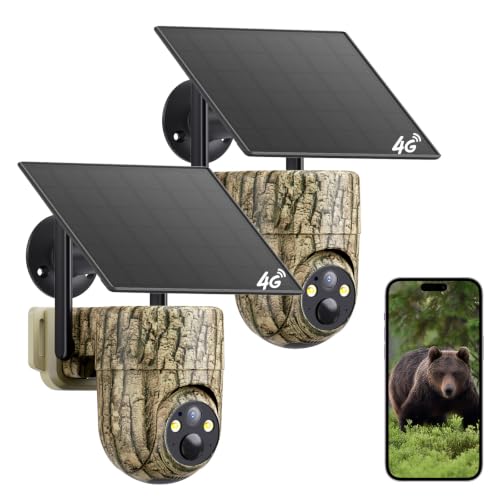
This is a two-camera cellular outdoor monitoring set for wildlife observation, a rural gate, or property where Wi-Fi is unavailable. Each camera is described in the available product manual as having a built-in US-only 4G LTE SIM, a 7,800mAh internal rechargeable battery, a separate 5W solar panel, PIR motion alerts, two-way audio, and remote pan and tilt control through the Ubox app. The manual states 2K live video, 355-degree pan, 120-degree tilt, optional local microSD recording up to 128GB, and IP65 weather resistance. These are manufacturer-stated specifications, not independently validated test results. Cellular service requires activation after a seven-day data trial, and the manual gives plan prices. No model-specific FCC authorization, NRTL electrical-safety listing, battery transport record, or independent controlled camera test was located in the verification work.
This product suits an owner monitoring a trail, farm entrance, hunting property, or remote outbuilding that has usable US 4G LTE coverage but no Wi-Fi. It is most relevant for someone who can mount a separate solar panel in direct sun, accepts app-based operation, and will install a microSD card for local backup. The two-camera format can cover two fixed areas, while remote pan and tilt may help check a broader scene. The buyer should budget for cellular service after the stated seven-day trial.
It is not suited to anyone needing independently documented electrical, battery, radio, weatherproofing, or capture-performance testing for a safety-critical deployment. Do not use it as the only safeguard for live-trapped animals, because transmission depends on power, cellular signal, and an active plan. It also is a poor fit for locations with weak LTE, persistent shade, temperatures outside the stated range, or a need for service outside the United States. People who cannot lawfully record visitors, neighbors, or audio should choose a less intrusive setup.
The product uses an internal rechargeable battery and separate solar panel, which may reduce disposable-battery use during normal operation. That benefit is limited by the lack of located instructions for replacing the internal battery, obtaining spare parts, or recycling the battery at end of life. Long cloudy periods may still require USB charging, according to the available manual. The camera can capture motion-triggered video, transmit it over cellular service, record audio, and provide live remote viewing. Position it only where recording is lawful and avoid aiming it toward homes, trails used by the public, or neighboring property. The available app disclosures indicate collection of account identifiers and location-related data. No model-specific NRTL safety listing, battery certification, FCC record, recall, or independent IP65 test report was located in the checked sources.
This is a two-pack of cellular, solar-assisted outdoor cameras intended for wildlife observation, hunting areas, farms, cabins, and remote-property monitoring. Each product uses a built-in 4G SIM, a fixed upper camera, and a remotely movable lower camera. The maker states that the lower camera pans 355 degrees and tilts 90 degrees, with live viewing and two-way audio through the CloudEye 365 app. The manufacturer specifies 2K video, an internal 7,800 mAh battery, a 5 W solar panel, IP66 weather protection, 850 nm low-glow infrared, and optional local microSD storage up to 128 GB. These are manufacturer claims, not independently confirmed test results. The companion app's store disclosures confirm cloud-connected monitoring and encrypted transmission, but also disclose collection and sharing of personal and app-performance data.
It suits a landowner or wildlife observer who needs occasional remote visual checks across a broad area where Wi-Fi is unavailable, has usable cellular coverage, and can install a separately purchased microSD card. It is most appropriate where the user can aim the camera away from neighboring homes, public paths, and sensitive areas, review local trail-camera rules, and accepts that solar output and cellular delivery will vary with site conditions. It also fits users willing to manage app permissions and cellular data service.
It is not suited to anyone who needs independently verified trigger speed, detection distance, night-image quality, weather resistance, battery safety testing, or FCC documentation before deployment. It is also a poor fit for locations with weak or uncertain LTE coverage, deeply shaded installations, or high nighttime activity that can exhaust stored power and consume data. Avoid using it where live video, audio, or person tracking could capture neighbors, visitors, workers, or public areas without clear notice and lawful consent.
The product has a built-in rechargeable battery and manufacturer-stated solar charging, which can reduce the stream of disposable batteries used by conventional trail cameras. The stated local microSD option may also preserve footage during connectivity interruptions. However, the battery is built in, and the available warranty page offers repair coverage for one year rather than clear battery replacement, recycling, or end-of-life instructions. Rechargeable electronics should be kept out of household trash and handled through an appropriate battery or electronics collection route. For wildlife, the maker states that users can select black-and-white 850 nm infrared instead of the visible spotlight mode. That is the lower-disturbance option for animal observation. The product also has live video, two-way audio, motion alerts, AI detection, and automatic tracking claims. Use those functions sparingly around wildlife, never use the camera as the sole check for a live-trapped animal, and avoid capturing people or neighboring property. No product-specific CPSC recall or safety warning was located during this review, but no model-specific third-party safety or weatherproofing evidence was found either.
This is a cellular, solar-assisted outdoor camera sold for wildlife observation, game scouting, and remote property monitoring. It has a built-in rechargeable lithium battery, a separate solar panel, a preinstalled SIM, app-controlled live video, pan and tilt movement, motion alerts, local microSD storage, cloud storage, two-way audio, and both infrared and white-light night modes. The manufacturer states that the unit has a 7,800mAh battery, 2.5K live streaming, 355-degree pan, 90-degree tilt, 65-foot motion detection, and multi-carrier service through Verizon, AT&T, and T-Mobile. A field-test video exists, but it was made with a provided product and does not provide controlled trigger, battery, weather, or cellular reliability measurements. Important published specifications conflict, including the solar-panel wattage, storage limits, waterproof rating, trial duration, and whether local recording can operate without paid cellular service.
It suits a landowner or wildlife observer who has reliable cellular coverage at the deployment point, can place the solar panel where it receives meaningful sun, and is comfortable managing an app-based data plan. Its remotely movable view can be useful for checking a broad clearing, gate, feeder area, pasture, or cabin approach without repeated site visits. It is more appropriate where periodic outages or missed events are acceptable and a separate local recording system is not required for essential monitoring.
It is not suited to anyone who needs dependable offline recording during a data-plan lapse, weak-signal period, or cellular outage. It is also unsuitable for safety-critical livestock, live-trap, security, or evidence-monitoring roles where a missed alert could cause harm or loss. Users deploying near neighbors, public paths, workers, tenants, or sensitive wildlife should avoid using audio, white-light night vision, and human auto-tracking unless they have a lawful, clearly disclosed monitoring purpose and can limit the camera's view.
The built-in rechargeable lithium battery and solar charging arrangement can reduce the repeated use of disposable batteries. The manufacturer offers a one-year warranty, but it does not publish a battery-replacement path, recycling directions, a battery transport test summary, or model-specific third-party electrical safety certification. Use the supplied charging equipment, keep damaged equipment out of service, and route the battery through an appropriate rechargeable-battery recycling program at end of life. For wildlife, remote checks and low-glow infrared can reduce visits and visible illumination compared with routine on-site retrieval or white-light night recording. However, the product also has a spotlight-capable color mode, two-way audio, and motorized tracking. Those functions can disturb animals or record people. Manufacturer specifications also conflict between IP66 and IP68 weather protection, and no model-specific independent weather test was located. The published policy permits disabling app location, storage, and notification permissions, but does not clearly define video retention or cloud-sharing limits.
This is a wall, pole, or tree-mountable outdoor camera intended for places without dependable mains power or Wi-Fi, such as a gate, cabin, barn, or work site. It uses a rechargeable 9,400 mAh battery, separate solar panel, mobile app, 4G LTE or 2.4 GHz Wi-Fi, pan and tilt controls, and an included 32GB microSD card for local recordings. A cellular data plan is required after the included 100MB introductory allowance. The exact product has an FCC equipment authorization and associated radio test documentation for its LTE and Wi-Fi hardware. Eufy states IP65 weather protection, 4K video, person and vehicle detection, color or infrared night modes, and 360-degree pan with 70-degree tilt. Independent hands-on testing confirmed usable 4K video, local recording, cellular operation, responsive pan and tilt, and a solar charge level that remained high through a summer test, but it also found digital zoom degrades quickly and winter solar performance will be less certain.
This product suits a property owner, land manager, or small job-site operator who needs event-based video at a gate, shed, driveway, barn, cabin, or seasonal property where household Wi-Fi is absent or unreliable. It is most suitable where cellular coverage has been checked in advance, a solar panel can receive direct sun, and the user can accept a data-plan cost. Local microSD recording provides a useful backup when the connection is interrupted, while remote pan and tilt can cover a broad open area without fixed wiring.
It is not well suited to users who need independently documented battery safety certification, an accredited test report for its weather rating, or a stated long-term firmware support period. It should not be treated as a continuous recording system or as the sole monitoring safeguard for live-trapped animals, injured wildlife, children, or other time-sensitive welfare situations. Avoid placing it where its microphone, spotlight, tracking, or broad pan range would capture neighbors or public areas without clear notice and lawful permission. Low-sun winter locations and weak cellular areas also need a manual charging and access plan.
The exact product has FCC authorization for its cellular and Wi-Fi radio hardware, but FCC authorization addresses radio compliance, not battery fire safety, waterproofing, or overall product safety. No recall or product-specific CPSC incident report was located for this camera. A recent consumer fire report involving a different eufy baby-monitor model should not be treated as evidence about this camera, but it reinforces the need to charge and inspect rechargeable electronics carefully. The bundled solar panel can reduce routine plug-in charging, and local microSD recording can limit dependence on cloud storage. The internal battery is not presented as user-replaceable, however, and no detailed spare-battery or repair program was found. Eufy's disposal information says electronics should go to appropriate collection facilities rather than household trash. Privacy deserves active setup: the app lists location, identifiers, diagnostics, and usage-related handling, and optional experience-improvement participation can include camera footage and motion-trigger data.
This is a two-camera cellular trail-monitoring set intended for remote property and wildlife observation where local Wi-Fi is unavailable. Each unit is marketed with 4G LTE access through a non-removable U.S.-only SIM, app viewing and control, a solar panel, motion alerts, 2K live video, pan and tilt movement, and cloud or microSD recording. The listing states 350° horizontal movement, 100° vertical adjustment, 850 nm infrared night illumination to 65 feet, a 0.2-second PIR trigger claim, a 120° detection range, and local cards up to 128GB. These are manufacturer-stated specifications, not independently measured results. The listing also discloses recurring cellular service of $19.90 monthly or $169.90 annually per camera, while cloud storage requires a separate subscription.
This product fits a landowner managing a remote U.S. cabin, gate, pasture, equipment area, or wildlife corridor who has usable cellular coverage and wants app access without installing Wi-Fi or mains wiring. It is particularly suited to someone prepared to supply a compatible microSD card, position the adjustable solar panel in direct sun, and budget for separate data service for each camera. Local card recording is useful for users who want an on-device copy of motion events rather than relying entirely on cloud delivery.
It is not well suited to live-trap monitoring, research projects, or sensitive wildlife sites where a documented low-disturbance operating mode and clear welfare instructions are required. It also does not fit users who need independently verified trigger performance, tested weather limits, documented battery safety certification, or a traceable radio authorization for the exact product. Avoid relying on it alone where cellular reception is weak, winter sun is limited, or a missed alert could create a safety, animal-welfare, or security risk.
The solar format can reduce dependence on disposable batteries, and the listing offers local recording, which can limit cloud reliance. However, no product-specific information was located on battery chemistry, capacity, replacement availability, recycling instructions, charger safety testing, or long-term parts support. The claimed IP65 housing was not matched to an independent test report or stated temperature limits. No product-specific CPSC recall notice was located in the public recall records reviewed. For wildlife use, 850 nm infrared is described as low-glow rather than no-glow, and the listing also includes a manually activated spotlight. Use illumination only when necessary, keep audible functions off around animals, and avoid placing a camera where its light, motion, or rotating body could repeatedly disturb a trail, den, nest, or feeding area. The associated app privacy policy says account, device, network, usage, and some location-related data may be collected. Aim cameras away from neighboring homes and public areas, restrict sharing, and review app permissions before deployment.
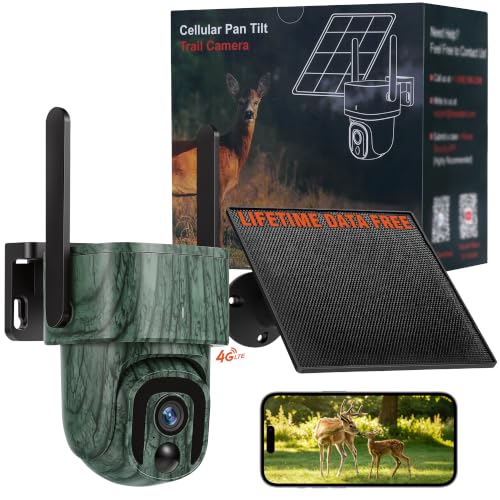
This is a cellular, pan-and-tilt trail camera for remote wildlife, farm, or property monitoring. It uses 4G LTE rather than Wi-Fi, has a built-in 9,000 mAh rechargeable battery, an external solar panel, low-glow infrared night imaging, and support for a separately purchased memory card up to 256GB. The manufacturer states 345-degree pan, 95-degree tilt, 2K live video, 0.5-second motion triggering, and a preinstalled SIM with lifetime data on this version. The clearest practical feature is local recording, because the manufacturer says motion footage can remain on a memory card when cellular service is unavailable. It also offers an optional paid cloud service. The stated two-year limited warranty covers the main unit, while the solar panel, strap, and memory card are covered for one year. No model-specific independent performance, radio, battery-safety, ingress-test, or certification records were located.
This product fits a landowner, wildlife observer, or hunter monitoring one remote location that has usable 4G LTE coverage but no Wi-Fi. It is especially relevant when avoiding a monthly cellular bill matters and when a solar panel can receive enough daylight. The pan-and-tilt function may help a user inspect a broader fixed area remotely. Use a memory card for local recording, and treat live view and alerts as conveniences rather than the only record of activity.
It is not suited to someone who needs independently validated detection range, night-image quality, weather sealing, radio authorization details, or battery-safety certification before deploying a camera. It is also a poor fit for locations with unreliable 4G coverage, deeply shaded sites that cannot support solar charging, or safety-critical monitoring such as checking live traps or vulnerable animals. Privacy-sensitive sites should avoid capturing neighboring property, roads, visitors, or audio without clear notice and lawful consent.
The rechargeable lithium battery and included solar panel may reduce disposable-battery consumption, but the manufacturer does not provide a model-specific recycling program, replacement-battery path, or independent battery safety documentation. At end of life, lithium-ion batteries and battery-containing electronics should not enter household trash or curbside recycling. They require separate battery or e-waste collection because damaged lithium batteries can create a fire hazard. Low-glow infrared operation and remote status checks may reduce disturbance compared with frequent site visits, based on the manufacturer's description. The product also has two-way audio and remotely controlled movement, which should be left off around wildlife unless necessary because those features can create disturbance. No recall, regulator warning, or model-specific independent safety or environmental test record was located in the reviewed sources. The manufacturer states that cloud storage is optional and encrypted, but does not publish detailed retention, deletion, or law-enforcement request terms.
This product is a two-camera cellular trail-camera package for wildlife observation, hunting scouting, and remote property monitoring. Each camera uses a motion sensor, low-glow infrared illumination, a 50-degree field of view, built-in storage, and the Moultrie app to transmit images over cellular networks. It runs on user-supplied AA batteries and has USB-C power input for compatible external power accessories. Moultrie states that each camera records 40MP stills and 1080p video, has a 0.50-second trigger speed, 100-foot detection and flash ranges, GPS, AI image tagging, on-demand capture, and automatic connection across four major networks. Independent testing found consistently quick triggering, detection of walking or jogging targets at long distance, and above-average photo quality. The same test found the app supports remote settings changes and downloading requested videos.
This product suits a landowner, hunter, or wildlife observer who needs two compact cameras for places visited infrequently and has usable cellular coverage. It is especially practical for monitoring feeding areas, scrapes, slow trail intersections, or property entrances where remote image delivery is more useful than immediate local retrieval. Buyers comfortable managing an app account and a recurring data plan can use the built-in storage, remote settings, on-demand capture, and cellular network selection to reduce trips to the camera locations.
It is not suited to anyone who needs a safety-critical alert system for people, pets, livestock, or live-trapped animals. Cellular messages may be delayed or fail, and the camera should not be the sole safeguard where prompt intervention matters. It is also a poor fit for privacy-sensitive locations, shared property without clear notice and permission, or users unwilling to share location, account, and captured-image data through an app platform. Fast-moving trail setups may require careful placement because capture quality is affected by subject speed and angle.
The product uses low-glow infrared rather than visible white-light flash, a useful feature for less conspicuous nighttime wildlife monitoring. Independent testing supports good motion detection and image capture, which can reduce unnecessary site visits. Remote status and settings controls may likewise reduce travel to deployed cameras. The camera is not a substitute for checking live traps or for responding to animal welfare issues in person. The camera uses replaceable AA batteries, which avoids a sealed internal battery but can create substantial disposable-battery waste across two units. Moultrie supports external solar power reporting when compatible solar packs are paired, but no model-specific runtime test, battery certification record, or solar charging safety report was located. Moultrie's privacy materials say its services can collect location and camera-captured sensory information, and its terms allow use of account images and videos for platform support, performance review, and future machine-learning features. No product-specific CPSC recall was located in the checked records.
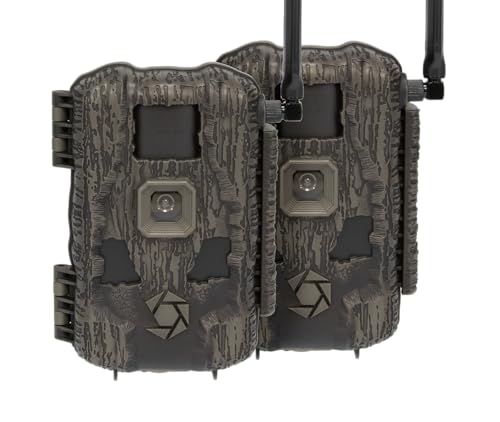
This is a two-camera cellular trail-camera package for remote wildlife or property monitoring. Each camera uses 16 AA batteries, has 16 GB of internal storage, sends captures through the Command app, and can accept optional external 12-volt or FieldMAX rechargeable and solar power accessories. The maker states that it records 36 MP photos and 1080p video with audio at 30 frames per second. Independent bench testing identified notably strong still-photo capture performance, including a 0.26-second trigger time, a measured 100-foot detection range, and a 40.7-degree field of view. The same test found the advertised 36 MP photos are interpolated. Its listing data describes 1440p video, but Stealth Cam's own product page and the independent test identify 1080p, creating a material specification conflict.
This product suits a landowner or wildlife observer who needs two remote camera positions, such as a defined game trail and a feeder area, and has dependable supported cellular coverage at both sites. It is especially suited to users who value quick still-photo capture and want local internal storage rather than regularly collecting memory cards. It also fits longer deployments when the owner is willing to use and properly manage 16 AA cells per camera, or add compatible external power.
It is not suited to users who need a documented IP rating, an independently verified safety certification, or clear public evidence of exact-model cybersecurity controls. It is also a poor fit where people may be recorded without appropriate notice or permission, because the app handles location, account, imagery, and camera data. Do not use it as the sole safeguard for a live-trapped animal. Users unwilling to maintain a cellular plan, replace many AA batteries, or tolerate coverage-dependent delivery should avoid this format.
The product runs on 16 replaceable AA batteries per camera. That large battery count can create substantial disposable-battery waste if alkaline cells are used, though independent testing indicates long runtime with lithium cells and shows that rechargeable AA cells can reduce replacement cycles. The camera also accepts optional external rechargeable battery and solar accessories, but those accessories are not included and no exact-model solar-runtime test was located. Its red-glow infrared flash supports night capture but is not the least visible illumination type, so careful placement away from dens, nests, feeding sites, and public paths remains important. Remote status checks can reduce site visits, yet the product should never be relied on as the only check for a live trap. No model-specific CPSC recall was identified in the reviewed records. The manufacturer manual includes FCC Part 15 compliance language, but a matching public FCC authorization record and third-party electrical or ingress certification were not located.
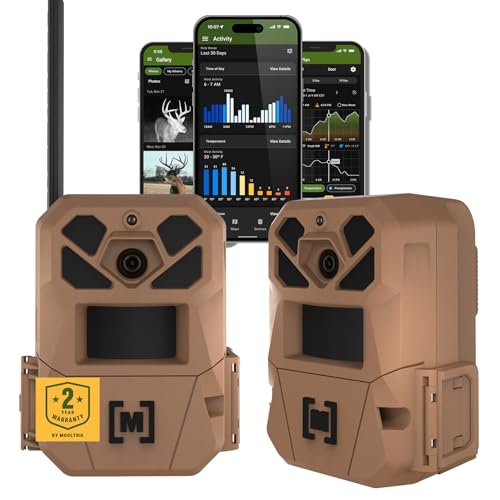
This is a cellular trail camera for remotely sending wildlife or property-monitoring captures to the Moultrie app. It has an integrated adjustable solar panel, built-in memory, low-glow infrared flash, a 50-degree field of view, and an included 2,600 mAh, 28 Wh rechargeable lithium battery pack. Moultrie lists 40 MP stills, 1080p video with sound, 0.40-second trigger speed, and 100-foot detection and flash ranges. Those performance figures are manufacturer-stated, not independently field-verified for this product. The manufacturer states an IP65 enclosure rating and USB-C solar input. It also states that the camera selects among four major networks and can receive remote photo, video, and setting requests. Cellular operation requires a paid plan. Moultrie’s own terms also caution that transmissions can be delayed, deleted, or not delivered, so app delivery should not be treated as a safety-critical alert system.
This product suits a landowner or hunter who wants an app-connected camera left outdoors for extended periods where there is usable participating cellular coverage and regular sun exposure. It is especially relevant for users who prefer a rechargeable solar-backed power system over buying and replacing AA batteries, and who can accept paid image and video service. Built-in memory and remote settings are practical where frequent physical checks are inconvenient. It is better suited to routine scouting and property observation than to emergency monitoring.
It is not appropriate as the only safeguard for a live-trapped animal, a vulnerable person, or a location needing guaranteed alerts. Moultrie’s terms say transmissions can be delayed, deleted, or not delivered. It also does not suit sites with persistent shade, obstructed cellular signal, or winter conditions that leave little solar input unless a backup power plan is in place. Privacy-sensitive shared spaces need careful placement because the app can process images, videos, camera location, and people tags. Users seeking independently documented battery, ingress, and performance testing will find important evidence gaps.
The integrated solar panel and included 28 Wh rechargeable lithium pack are the product’s clearest waste-reduction features. They can reduce dependence on disposable AA cells, although solar output and runtime have not been independently verified for this product. EPA advises keeping lithium-ion batteries out of household trash and curbside recycling, protecting terminals, and using a battery or electronics recycler that accepts them. Moultrie does not provide model-specific public battery certification or recycling instructions in the materials reviewed. Moultrie states an IP65 enclosure rating, low-glow night illumination, remote status functions, and automatic firmware updates. The low-glow flash may be less disruptive than a bright white flash, but it is not invisible no-glow lighting. The app can identify people, vehicles, and animals, and the company’s terms say it may access account images, videos, location, and device information for service, troubleshooting, system performance, and feature development. Place it only where recording and sharing are lawful, expected, and necessary.



