Best Overall
10% Coupon

ELLA BELLA 6 in 1 Professional Hot Air Styler
Versatile styling with six interchangeable attachments.
Quick and even heat distribution for efficiency.
Lightweight design for easy handling.
 Lauren Wilson
Versatile styling with six interchangeable attachments.
Quick and even heat distribution for efficiency.
Lightweight design for easy handling.
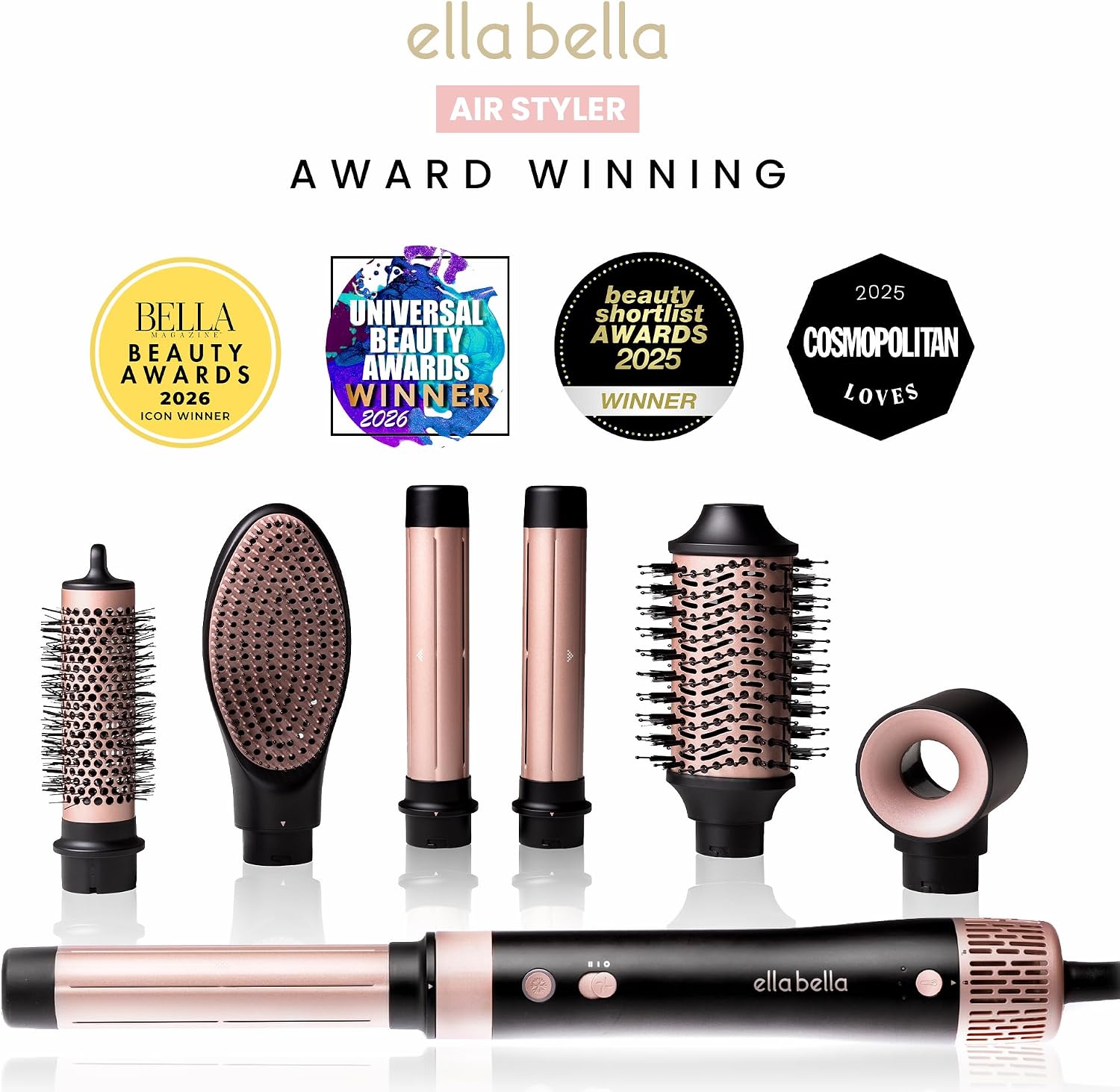
Six styling tools in one compact device.
Minimizes heat damage for healthier hair.
Includes protective travel case for convenience.

Creates salon-quality styles without extreme heat.
Versatile attachments for multiple styling options.
Attracts and wraps hair using air, not clamps.

Versatile styling with minimal heat damage.
Coanda airflow technology enhances styling precision.
Quick drying with efficient air control.

Versatile styling with five functions in one.
Fast drying without causing heat damage.
Includes convenient travel bag for portability.

Versatile styling with five functions in one.
Fast drying with 110,000 RPM motor.
Protects hair with no heat damage.

Versatile styling with three-in-one functionality.
Quick drying minimizes styling time.
Reduces frizz with no heat damage.

Multifunctional: curls, straightens, and volumizes effortlessly.
Fast drying: reduces styling time significantly.
No heat damage: maintains hair health with gentle airflow.

Fast drying with 110000 RPM motor.
Automatic wrap curlers for easy styling.
Frizz-free with no heat damage.

Powerful motor for fast drying speed.
Includes versatile attachments for styling.
Comes with a luxury travel bag.
What determines whether one works includes hair type, hair length, moisture level, attachment design, airflow, temperature, technique, and drying time. Several supplied products recommend drying hair to roughly 80% before curling or brush styling. A lower temperature can reduce heat exposure, but a tool that is too cool or slow may keep hot air on the hair longer. Independent testing in the supplied reviews found both fast drying at a measured average of 183°F for one multi-styler and effective curls on fine hair for another, while a separate review found one tool slow on thicker hair. Results therefore should not be inferred from motor speed, wattage, or a headline such as “fast drying.”
Heat claims also need careful reading. Manufacturer statements such as temperature monitoring hundreds or thousands of times per second, a ceiling below 302°F, or a 140°F hot setting describe design or stated operating limits; they do not prove that every hair type is protected from damage. Published hair research cited in the reviews indicates that temperature, distance, and drying time affect hair-shaft damage. “No heat damage,” “ionic,” “anti-frizz,” and similar wording should be treated as marketing claims unless accessible independent testing discloses its method and identifies the exact model or an equivalent configuration.
Electrical protection is especially important because these are corded handheld appliances often used in bathrooms. Look for an integral immersion-protection device such as an ALCI or PRCD plug, with test and reset controls described for the exact product. A retailer’s statement that a product is UL or ETL listed is weaker than a current record in an OSHA-recognized Nationally Recognized Testing Laboratory directory, such as UL Solutions Product iQ, Intertek’s ETL directory, or the CSA listing database, matching the model and product label. No accessible exact-product listing record was located for several supplied products, so a claimed certification was not treated as independently confirmed.
Other practical checks matter too: attachments should click or lock securely, hot parts should have safe handling guidance, filters should be cleanable, and thermal protection should address blocked airflow or overheating. Buyers should also confirm the included attachment set because one supplied product’s catalog description conflicted with the manufacturer’s current description. A serial-number system, authorized seller, warranty route, replacement attachments, and repair support make recalls and longer use more manageable.
Recurring safety caveats are significant. The supplied reviews repeatedly warn that heat control does not make styling damage-free, and that hot attachments can cause contact burns. Users should keep every tool away from baths, showers, sinks, and filled basins; test the protective plug when instructed; unplug after use; and allow attachments and the outlet area to cool. People with fragile, chemically treated, heat-sensitive, or scalp-sensitive hair should use the lowest effective setting and should not rely on “no damage” language. Products with unclear certification, warranty, repair, replacement-part, or seller information require additional caution. One review also warns that magnets may matter to people with pacemakers or defibrillators, so that product’s manual should be checked before use.
These topics distinguish a multi-styler that merely promises results from one with documented controls, maintainable construction, and evidence tied to the exact product. The scores below are relative to the supplied products, not a guarantee of risk-free use.
This measures temperature control, airflow settings, instructions, and the likelihood of hair-shaft damage, scalp discomfort, or contact burns. For this product type, selectable heat, cool-shot operation, movement through the hair, and clear hot-attachment guidance matter. Higher-scoring products generally documented more usable controls; lower scores were associated with unsupported “no heat damage” claims or limited temperature evidence.
This measures whether a corded handheld styler has verified integral immersion protection for U.S. bathroom use. An ALCI or PRCD plug with test and reset instructions can reduce shock risk if the appliance contacts water, but it does not make water contact safe. Supplied scores ranged from 70 to 90, reflecting differences in exact-product verification of the plug and its documentation.
This covers thermal cutoffs, safe handling, filter-blockage instructions, and cord or plug protections. A strong product should address what happens when airflow is restricted, a filter is missing, or the unit becomes too hot. Higher scores in the set were supported by documented thermal shutoff, filter alerts, or operating interlocks; lower scores reflected missing manuals or unverified cutoff and surface-temperature claims.
This measures whether barrels, brushes, diffusers, and fasteners stay secure, avoid sharp or snagging hazards, and can be removed safely when hot. Secure click-and-lock systems and cool handling areas support a higher score. Lower scores reflected reports that attachments could twist loose, uncertainty about locking behavior, or a related report of attachment retention failure and a burn.
This asks whether the exact model has a current U.S. safety listing from an independent NRTL, matched to the product label and model number. A retailer’s “UL” or “ETL” statement is not enough without a matching directory record. This was a major separator in the set: scores were generally only 68–74 because accessible issuer-directory confirmation was not found for the exact products.
This measures accessible testing with disclosed methods that identifies the exact model or a clearly equivalent configuration. It matters because airflow, drying speed, temperature, curl hold, and hair condition cannot be established reliably from brand claims. Higher-scoring products had Good Housekeeping hands-on or laboratory testing; lower scores lacked exact-product testing or had only limited results.
This measures whether claims such as “no heat damage,” “ionic,” “anti-frizz,” and “fast drying” are specific, qualified, and supported at the settings sold. A high score does not mean no heat exists; it means the wording better matches the evidence. Lower-scoring products used categorical damage-prevention language despite reviews finding heat exposure or no accessible substantiation.
This measures whether the seller, model, serial-number system, warranty route, and recall process can identify a genuine product and deliver a remedy. It matters for appliances with interchangeable parts and safety plugs, where the exact configuration affects the evidence. Higher scores reflected manufacturer registration, authorized-seller guidance, warranty, and support; lower scores lacked a clear seller, serial, or service route.
This measures filter cleaning, replacement attachments, repair access, warranty coverage, and avoidable failure points. Multi-stylers contain a motor and several specialized attachments, so replaceable parts can prevent the loss of the whole appliance when one piece fails. Higher scores in the supplied set reflected washable filters, service routes, warranties, and replacement parts; lower scores reflected no repair or parts information.
This considers transparent power draw, drying efficiency, material disclosure, and unnecessary accessories. Wattage alone does not show environmental performance: a higher-powered tool may finish sooner, while a lower-powered one may take longer. The supplied scores were higher where efficiency or power information was clearer, but no product-specific life-cycle assessment was found, and several products lacked detailed material disclosures.
This measures packaging reduction and recyclability, battery management, and accessible U.S. recycling or take-back instructions. These are corded, battery-free products, so they avoid rechargeable-battery disposal but still become electronic waste. Higher scores reflected some U.S. recycling or packaging guidance; lower scores reflected no product-specific packaging breakdown, take-back route, or clear end-of-life instructions.
This corded 120 V, 1200 W hot-air styling set combines a dryer handle with six functions for drying, air-wrapping curls, smoothing, straightening, and volume. The Champagne product is listed at about 5 by 5 by 13 inches and includes a protective case. Independent matching retail data confirms the stated power, dimensions, titanium material claim, color, and case. Ella Bella states that the tool uses a 110,000 RPM brushless motor, negative-ion technology, two airflow settings, and three temperature modes. Those are manufacturer performance claims, not independently published test results. The available product information does not provide measured outlet temperatures, drying-time tests, airflow data, or a model-specific safety certification record.
This set fits a home user who wants one corded tool for several styling routines and is comfortable learning interchangeable attachments. It is particularly relevant for someone who wants to rough-dry, smooth, add root volume, or make air-wrapped curls without storing separate tools. The case is useful for keeping the 5.6-pound set together between uses. Users should keep hair sections small, clean the inlet regularly, and select the lowest practical heat setting, since measured temperature performance is not published.
It is not suited to people who need independently documented low-temperature styling for fragile, chemically treated, heat-damaged, or scalp-sensitive hair. It is also a poor fit for households with young children or bathroom use where the buyer cannot inspect the plug for integral immersion protection, because a model-specific U.S. safety listing and plug documentation were not verified. People who need replaceable wear parts, formal repair access, or a confirmed recycling path should also look for better-documented support.
The main health positive is control rather than proof. Ella Bella states that this styler offers three temperature modes, two airflow settings, and a cool setting. Hair-dryer research supports limiting unnecessary heat exposure, but the company has not published the product's actual air temperatures or a test method showing that its no-damage language applies under real use. The manufacturer also claims ionic technology, but provides no independent output or hair-performance data for this unit. No matching U.S. recall or CPSC warning was found in the sources checked. That is not equivalent to a safety certification. CPSC identifies integral immersion protection as essential for hand-supported dryers, yet no model-matched UL, ETL, or CSA record was verified. Ella Bella advertises a three-year warranty, which may extend service life, but replacement parts, repair instructions, packaging specifications, recycled content, and end-of-life electronics recycling information were not located.
This is a corded 6-in-1 hot-air styling set for drying, curling, volumizing and smoothing damp hair. The manufacturer lists a 1200-watt brushless motor, a dryer nozzle, two 32 mm directional curling barrels, and three brush attachments in a protective case. It is intended as one powered handle with interchangeable styling heads rather than separate tools. The manufacturer states that the unit has 110,000 RPM airflow and a three-year warranty. An independently hosted copy of the product guide describes no-heat, low, medium and high heat selections, two airflow speeds, a removable attachment lock, filter cleaning, and an automatic thermostat shutoff if overheating occurs. No model-matched accredited laboratory report was located for electrical safety, air temperature, drying time, or hair-damage performance.
This suits a person who wants one corded tool for routine at-home drying and styling, especially someone who will use the dryer nozzle first and then switch among a curling barrel, round brush or smoothing brush. The selectable no-heat, lower-heat and cool settings make it more suitable for users willing to manage exposure by starting with damp, not soaking-wet, hair and reducing heat when possible. It also fits buyers who value a storage case and a manufacturer-stated multi-year warranty.
It is not appropriate for anyone who needs independently verified immersion protection for bathroom use, or who cannot confirm that the supplied plug includes the required water-contact protection. It is also a poor fit for households with young children who may access a plugged-in hot appliance or detachable parts. People with highly heat-damaged, fragile, chemically treated, or scalp-sensitive hair should not rely on the no-damage marketing claim, because no model-specific temperature or hair-damage testing was located. It is not designed for wet-environment use.
The safety guide advises keeping the appliance away from water, unplugging it when unused, avoiding blocked air openings, and cleaning the inlet filter. It also describes an automatic thermostat shutoff during overheating. Those are useful operating safeguards, but public records reviewed did not verify integral immersion protection or a matching UL, ETL, or CSA certification for this exact U.S. product. Recent CPSC actions involving unrelated multi-styler dryers show why that verification matters for powered hair tools used near water. Heat can damage hair surfaces as temperature rises, and the product's no-heat and lower-heat controls may help users reduce exposure. Still, the broad no-damage and fast-drying claims were not backed by a model-specific accredited test. The manufacturer lists a three-year warranty, which can extend service life, but no repair parts, recycling program, packaging-reduction details, or recycled-material documentation was located. End-of-life handling should use a responsible local electronics recycler rather than household disposal where local rules require otherwise.
This is a 120 V, 1,300 W corded air styler for drying, curling and shaping damp hair. Dyson lists three heat settings, three airflow settings, a cold shot, a 6.6 foot cord and a 1.5 pound body. Its styling approach uses airflow to wrap hair around a barrel rather than a conventional hot curling iron. Dyson states that temperature is sampled more than 40 times per second and controlled below 302°F. A Dyson support page for the Origin also documents a non-self-resetting thermal cutout and filter-cleaning guidance. The supplied product listing and Dyson's current Origin page conflict on the included attachments, so buyers should verify the contents on the box before use. No accessible independent laboratory report was found for this exact product's hair-protection performance.
It suits an adult who wants one corded tool to take freshly washed hair from damp to dry, then add curls or volume with controlled airflow. It is particularly relevant for someone who will clean the filter, use the cooler settings when practical and follow the cold-shot step to set a style. It also fits buyers who value a documented serial-number route, direct manufacturer service and a two-year limited warranty. Attachment contents should be confirmed before purchase because the available product descriptions conflict.
It is not suitable for anyone who needs a completely heat-free styling method, since this tool uses heated airflow even though Dyson limits extreme temperatures. It should not be used by children without close adult supervision, near a filled sink or bath, or with a damaged cord or plug. Buyers who require independently published test results for hair-damage reduction or an exact-model public NRTL listing should choose a product with those records available. It also may not suit buyers needing a clearly documented US take-back route at end of life.
The strongest safety evidence is manufacturer documentation of temperature control below 302°F, a non-self-resetting thermal cutoff and filter maintenance, plus retailer identification of an ALCI safety plug for bathroom shock protection. These controls reduce foreseeable overheating and water-contact risks, but they do not make ordinary precautions optional. Keep the plug and appliance dry, clean the filter when indicated and allow the tool to cool after a protective shutdown. The no heat damage claim needs careful reading. Peer-reviewed hair-dryer research found that surface damage increased with temperature, even though distance and continuous movement reduced damage. Dyson's controlled-temperature approach is relevant, but no independent exact-product testing was publicly available. The tool draws 1,300 W and uses aluminum, ceramic and polycarbonate. Repair support and replaceable accessories can extend use, but US-specific packaging and end-of-life recycling instructions were not clearly disclosed.
This is a corded, 120V, 1,700W air-powered multi-styler and dryer for straight to wavy hair. It uses interchangeable drying, curling, brush, and smoothing attachments to dry, curl, wave, smooth, straighten, and add volume. Dyson lists four heat settings, including a cold shot, three airflow settings, a 6.56-foot cord, and a 0.9-pound main body. The main defining feature is the redesigned airflow system, including intelligent attachments and an app-connected curl sequence. Those performance and hair-protection claims are manufacturer-stated, not supported by an accessible independent laboratory report for this exact product. Dyson's U.S. page calls the Ceramic Pink and Rose Gold configuration a 2025 edition, while this product is labeled 2026 in the catalog record, so buyers should confirm the product label and included attachments before registering it.
This product fits a person with straight to wavy hair who regularly wants to dry and style with one corded tool, has enough storage space for several attachments, and is comfortable learning airflow-based techniques. It is especially relevant for someone who values adjustable heat and airflow, wants curls or smoothing without hot plates, and will register the product for support. The premium price is better aligned with frequent use than occasional touch-ups.
It is not well suited to households that cannot verify the product's test and reset plug before bathroom use, or to anyone likely to use a corded styling tool close to a filled sink, tub, or shower. It also does not suit travelers needing dual-voltage operation, since the U.S. version is listed at 120V. Buyers who need independently documented hair-protection results, publicly verifiable electrical certification details, or compatibility with earlier attachments should look for clearer documentation.
The useful safety controls are documented by Dyson, including four heat settings, three airflow settings, a cold shot, attachment-specific settings, and filter-cleaning support. Dyson also instructs users to click attachments securely into the main body. However, public sources reviewed did not verify the exact product's NRTL certification record or its integral immersion-protection plug labeling. That confirmation matters because U.S. hand-supported hair dryers require immersion protection against shock if they contact water. Hair-dryer research finds that surface damage rises with higher-temperature exposure, so the no heat damage claim should not be read as a guarantee under every setting or technique. The product's 1,700W rating is transparent, but it is a substantial draw during use. A two-year limited warranty and official parts support can extend service life. Packaging composition, exact-product life-cycle data, and U.S. end-of-life take-back information were not publicly documented.
This corded 5-in-1 hot-air styling set is intended to dry, smooth, volumize, curl, and straighten hair with a dryer nozzle, two airflow curling barrels, a volumizing brush, and a round brush. Independently hosted manual material identifies the unit as a 1500-watt model with a ceramic-tourmaline-coated styling surface, three airflow settings, three stated heat levels of 120°F, 150°F, and 190°F, plus a cool-shot control. The manual also documents a locking attachment system, inlet-filter cleaning, and an ALCI plug with a reset procedure. Those are useful safety provisions, but they are documented in product instructions rather than independently certified test records. No current U.S. NRTL listing, exact-model independent performance report, or accessible manufacturer substantiation for its no-heat-damage and ionic hair-protection claims was located.
This product suits an adult household user who wants one corded tool for a basic blow-dry, root lift, smoothing, and airflow curling, and who is prepared to follow attachment-locking and filter-cleaning instructions. It is most appropriate for users who can begin on the stated low heat setting, use the cool shot, keep the tool moving, and stop use if airflow weakens or an overheating smell persists. The documented ALCI plug is relevant for normal bathroom use, not a substitute for keeping the appliance dry.
It is not suited to anyone who requires a product with a publicly verifiable U.S. electrical-safety listing, independently tested hair-protection claims, or a clear repair and replacement-parts system. Avoid it for children or users unable to manage a hot, corded appliance near water. It also warrants caution for highly heat-damaged, chemically treated, very fine, or scalp-sensitive hair, because the no-heat-damage claim is not substantiated and the instructions include a 190°F setting and high-heat curling guidance.
The strongest documented safety feature is the ALCI plug, which the instructions say can be reset after it trips. CPSC guidance identifies integral immersion protection as essential for handheld hair dryers because it reduces electric-shock risk if the appliance contacts water. The manual also tells users to avoid water, unplug before cleaning, inspect the cord, let the unit cool, and clear hair and dust from the inlet filter. Heat exposure remains the main health limitation. The product offers lower stated heat settings and cool air, but it also reaches a stated 190°F and markets no heat damage without accessible exact-model evidence. Published hair research found greater surface damage at higher dryer temperatures. Ecologically, the corded design avoids a battery, and filter cleaning plus a one-year warranty may extend use. Material disclosure, replacement parts, repair access, packaging details, and U.S. recycling or take-back information were not located.
The MESCOMB F16 is a corded hot-air styling system intended to dry, curl, smooth and add volume in one handheld unit. A published manual for this product identifies five attachments, a concentrator, two directional auto-wrap curlers, a round brush and an oval brush. It lists ceramic and metal construction, 1,200 watt power, three temperature settings and adjustable airflow. Its practical safety evidence is mostly manufacturer-stated. The manual gives water, cord, hot-air and blocked-vent warnings, and it directs users to clean the bottom inlet filter. It also claims temperature regulation 1,000 times per second, but no independent temperature test or exact-product performance report was located. Public F16 listings also conflict on power rating, with one resale listing showing 1,500 watts, so the electrical specification should be checked on the product label before use.
This product suits an adult who wants one corded tool for occasional at-home drying, brush styling and airflow curling, and who is willing to follow maintenance instructions. It is most appropriate for someone comfortable checking the product label, keeping vents clear and using lower heat where practical. The attachment set gives a concrete route to switch between rough drying, smoothing, root lift and directional curls without adding separate heated tools. It is better suited to a dry indoor styling area than to travel or bathroom use near water.
It is not a strong fit for buyers who need independently verified electrical certification, measured temperature limits or third-party proof of reduced hair damage. People with very fragile, chemically processed or heat-sensitive hair should not treat the heat-protection language as a guarantee, because no exact-product testing was found and heat exposure can damage hair surfaces. It is also unsuitable for households where children may access it unsupervised, for use beside a tub or sink, or for anyone unable to regularly clear hair and lint from the inlet filter.
The published instructions contain several useful basic safeguards. They say not to use the tool in a bath or shower, not to block air openings, to keep lint and hair out of the vents, to keep the cord away from hot surfaces and to unplug before cleaning. The manual also describes three temperature settings and a cleanable inlet filter. These are manufacturer-stated safeguards, not independently validated product testing. No product-specific CPSC recall or safety warning was located in the sources searched. However, no exact-model NRTL listing, independent performance test, disclosed surface-temperature data or public certification record was found. Hair-dryer research indicates that higher drying temperatures increase hair-surface damage, so keep the tool moving and avoid prolonged high-heat exposure. The product has no battery, but no U.S. take-back, recycling or packaging guidance was located. At end of life, use a local electronics recycler rather than household trash.
This corded, handheld hot-air styling tool combines a dryer, air-curling barrels and a brush, with a storage case. It is intended to dry damp hair and create curls or volume using moving heated airflow. A retailer reproducing the product specifications identifies model F3 as a 120 V, 1,400 W unit with 15 settings and an ALCI safety plug, though these remain manufacturer-originated specifications rather than independently tested results. The product marketing also claims temperature monitoring 1,000 times per second, 200 million negative ions, faster drying and reduced heat damage. No accessible manufacturer manual, accredited laboratory report, or exact-product performance test was found to verify those figures. The listing language also uses an absolute no-heat-damage claim that is not supported by the available evidence for this specific tool.
This product suits a user who wants one corded appliance for basic drying, air curling and brush styling, and who is prepared to treat the stated performance specifications as manufacturer claims rather than verified results. It is most appropriate for routine home styling where the user can keep the tool moving, avoid prolonged heat on one section, inspect the plug before use and store the attachments in the supplied case. It is not well documented enough for buyers who need confirmed salon-grade performance.
It is not suited to households that need independently verified electrical certification before using a hot-air appliance near bathroom water. Anyone with a damaged cord, loose plug, unreliable bathroom outlet, reduced hand sensation, or inability to follow appliance safety steps should avoid relying on unverified product documentation. It also does not suit users with highly heat-fragile, chemically processed, or already damaged hair who are relying on the no-heat-damage language. Those users need clearly substantiated temperature controls and instructions.
The strongest safety-related product detail found was a manufacturer-stated ALCI safety plug. CPSC guidance says hand-supported hair dryers need integral immersion protection because water contact can create a severe shock hazard. The product should still be kept away from sinks, tubs and other water, and its test and reset functions should be checked only according to verified instructions. The heat-protection marketing needs caution. Independent hair research found that hair-surface damage increased as drying temperature increased, while drying from about 15 cm away with continuous motion reduced damage. No independent report was found for this product's temperature-monitoring, ion-output, faster-drying or heat-damage-reduction claims. Environmental documentation is also limited. A power rating is stated, but there is no accessible repair, replacement-part, packaging or U.S. electronics take-back information, so long-term maintenance and disposal responsibility remain unclear.
This is a corded, five-attachment hot-air styling set intended to dry, curl, smooth, straighten and add volume to damp hair. The available product manual identifies a dryer nozzle, volumizing brush, detangling brush, and left and right curling barrels. It also describes cool, warm and hot settings, plus an attachment lock that should click into place. The documentation is manufacturer-stated rather than independently tested. It describes a 1,200 watt, 100 to 120 volt unit, while the marketplace record states 1,500 watts and a 210 F maximum temperature. That specification mismatch makes actual power draw and thermal output uncertain. Searches did not locate an exact-model public UL, ETL or CSA listing, accredited performance report, recall notice, or publicly accessible manufacturer service and recycling program.
This product suits a person who wants one corded tool for occasional at-home blow-drying, brush styling and air-wrap curls, and who is comfortable following detailed handling steps. It is most appropriate for someone able to keep the appliance dry, clean the intake, check that each attachment locks with a click, and use lower heat or cool air when practical. The multiple heads can reduce the need to switch among separate basic styling tools, although their performance has not been independently measured.
It is not suited to households that need confirmed third-party electrical certification or clearly documented immersion protection for bathroom use. People with very heat-damaged, bleached, fragile or scalp-sensitive hair should not rely on the no heat damage wording, since the product-specific claim has not been independently substantiated. It is also a poor fit for users who need verified temperature accuracy, a dependable repair network, readily purchasable replacement parts, or a clearly documented U.S. recycling and recall support route.
The available manual gives useful baseline safety directions. It says to keep the unit away from water, unplug it after use, avoid a damaged cord or plug, keep the cord away from heat, clean the air inlet when airflow is weak, and allow the unit to cool if it overheats. It also describes a click-lock attachment system. These are manufacturer-stated operating controls, not independent safety-test results. No exact product recall or public incident report was located in the searched U.S. safety sources. However, public records show that handheld dryers without integral immersion protection have been recalled as shock hazards, and an exact-model certification record or plug label was not available to verify this safeguard here. The product is corded and contains electronics and plastic. No brand take-back program or packaging-material disclosure was found, so disposal should use a local electronics recycler rather than curbside recycling.
This corded five-piece hot-air styling set is designed to dry, curl, smooth, straighten, and add volume. Available documentation describes two 1.25-inch auto-wrap curlers, an oval brush, paddle brush, concentrator nozzle, and travel case. The published instructions say styling heads should click into place, and direct users to work with small, mostly dry hair sections for curling. Its heat and electrical information is only partly consistent. Marketplace materials state 1,300 watts and a 210 F maximum, while an available instruction manual for the same named product states both 1,200 watts and 1,400 watts in different sections. That manual documents three heat settings, three airflow settings, a cool shot, inlet-mesh cleaning, and an ALCI plug reset procedure. These are manufacturer-stated details, not independently verified test results.
This product suits an adult user who wants one corded tool for basic drying, brush styling, and air-wrap curling, and who is prepared to follow its handling instructions. It is most appropriate for someone comfortable checking that heads have clicked into place, cleaning the inlet mesh regularly, and using cooler settings or the cool shot where possible. The documented ALCI reset instructions may also be useful to users who understand how to test and reset a bathroom-appliance safety plug.
It is not well suited to buyers who need independently verified heat-protection performance, a confirmed electrical safety certification record, or fully consistent technical specifications. People with fragile, chemically treated, heat-damaged, or highly heat-sensitive hair should not rely on the no heat damage claim. It is also a poor fit for households where the product may be used by children or anyone unable to follow corded-appliance, hot-surface, attachment, and inlet-cleaning instructions without close adult supervision.
The available instructions provide some useful safety directions. They describe an ALCI plug reset procedure, heat and airflow controls, a cool shot, attachment locking, and regular cleaning of the air-inlet mesh. U.S. safety guidance treats integral immersion protection as important for hand-supported hair dryers because water contact can create a shock hazard. The available manual supports the presence of such a plug, but the exact product label and an independent certification record were not verified. The health marketing is less dependable. The product is promoted as causing no heat damage and the manual also says negative ions can repair hair. No independent test report was located for these statements, and heat-dryer research does not support treating any heated styling use as damage-free. The product is a corded plastic appliance with no battery disclosed, but no verified packaging-material disclosure, spare-parts plan, repair program, or U.S. take-back route was located. Recycle it through an appropriate local electronics program at end of life.
This corded hot-air hair styler and dryer uses snap-on attachments to dry, curl, smooth and add volume. The product record describes a smaller Everyday Essential set with three attachments, while Dreame documentation for the AMF18A identifies the AirStyle Pro as a 1,300 W, 120 V model. That documentation also describes three airflow settings, three temperature selections and a cool-shot function. The strongest independently checked product-specific evidence is a laboratory-style review that measured average consumption of 1,326 W at maximum power and 790 W at minimum power. Its published test also found modest airflow and controlled heat. Separately, a Good Housekeeping hands-on review lists 113 F warm and 140 F hot settings. The product record has a material model-number conflict, so buyers should confirm the model on the product label and the included attachments before relying on documentation for this unit.
This product fits an adult user who wants one corded styling tool for everyday drying, loose curling, smoothing and volume work, and who values adjustable airflow and temperature over maximum heat. It is particularly relevant for users willing to clean the intake filter and use the cool shot to set a style. The documented 1,300 W rating and independently measured power draw also suit households looking to avoid the electricity demand of a high-wattage conventional dryer. Confirm the actual attachment bundle and product label at delivery.
It is not a good fit for households that need confirmed third-party U.S. electrical listing documentation before using a corded appliance in a bathroom. The visible product information does not verify the required immersion-protection plug or a current NRTL record for this exact model, even though U.S. rules require integral immersion protection for hand-supported hair dryers. It also requires caution around children, water, pacemakers or defibrillators because the manual says it contains magnets, and around anyone unable to safely handle hot attachments.
For heat management, the documented controls are meaningful but not a guarantee against damage. The manual provides natural, warm and hot settings, three airflow levels and a cool shot, while outside testing found relatively controlled heat. Hair research shows that hair-surface damage rises as drying temperature rises, so users should favor lower heat, keep the tool moving and avoid holding hot airflow close to hair or scalp. The manual documents a self-resetting thermal cutoff, filter cleaning and specific warnings about hot attachments. It also warns not to use the tool near water. U.S. hair dryers require an integral immersion-protection device, but the available product materials did not verify the exact plug marking or an independent U.S. listing. The tool is corded and battery-free, and independent testing found restrained power consumption. However, no product-specific U.S. packaging-material disclosure or electronics take-back route was found.


