Best Overall

Sonic X Electric Toothbrush for Kids
Dentist-designed for effective plaque removal.
Includes multiple brush heads for convenience.
Fun design encourages kids to brush.
 Lauren Wilson
Dentist-designed for effective plaque removal.
Includes multiple brush heads for convenience.
Fun design encourages kids to brush.

40,000 VPM motor for effective cleaning.
Comes with 8 replacement brush heads.
Travel case included for easy portability.
Gentle vibration designed for young children's teeth.
Built-in timer encourages proper brushing time.
Includes six replacement heads for long-term use.

Dual handle design for shared convenience
Comes with 10 brush heads
Wireless charging for easy use

AI smart screen for guided brushing.
Impressive 150-day battery life.
Includes convenient travel case.

Long-lasting battery with up to 180 days runtime.
Customizable with five modes and three intensities.
Comes with eight brush heads for extended use.

Voice-guided coaching simplifies brushing for kids.
Smart app reports track brushing habits effectively.
Extra-soft brush heads ensure gentle cleaning.

Long-lasting battery: 180 days on a single charge.
Powerful cleaning: 48000VPM motor with 5 modes.
Travel-friendly: Durable, waterproof, and includes 4 replacement heads.
Fun design encourages kids to brush.
Gentle bristles protect sensitive teeth.
Built-in timer promotes healthy brushing habits.

Fun design with cute Dino cover.
Smart LED timer encourages proper brushing.
Includes four brush heads for longevity.
For children, look first for a small head, soft or extra-soft rounded bristles, a manageable handle, and clear age guidance. A two-minute timer with 30-second prompts can support a complete routine, but a timer is a behavior aid, not proof that all tooth surfaces have been cleaned. Pressure control or lower-intensity settings may help a supervised child use gentle technique. Caregivers should still provide help or touch-up brushing when a child lacks the dexterity to clean effectively.
Evidence should identify the exact product, or a materially identical handle, head, and motion system. An ADA Seal of Acceptance listing is more meaningful than an unverified badge, but the registry entry should clearly match the product being considered. A product-specific, human clinical trial—especially one involving children of the stated age—provides stronger support for plaque removal or gingival health than claims based only on vibration speed. Claims such as “8× more plaque removal,” “90% less gingivitis,” whitening, deep cleaning, or cavity prevention should be treated cautiously unless the supporting study identifies the product and explains its methods and results.
Electrical and materials claims also need scope. IPX7 or IPX8, long battery life, USB charging, and automatic shutoff are manufacturer-stated features unless supported by model-specific testing. Look for searchable certification in UL Product iQ, Intertek’s ETL directory, or another OSHA-recognized testing directory, along with relevant water-ingress and battery-safety documentation. For a child-directed product, a Children’s Product Certificate and accredited testing for applicable lead, phthalate, and other regulated substances are stronger evidence than “food-grade,” “natural,” “recyclable,” or similar wording.
Replaceable genuine heads matter because worn bristles should not be used indefinitely. Confirm the recommended three- to four-month replacement schedule and that compatible heads remain available. A rechargeable handle may reduce disposable-battery use, but it still creates electronic waste when its sealed battery fails. A credible lower-waste choice has durable use, available heads, a warranty or repair route, and clear battery or electronics recycling guidance.
Recurring safety cautions in the supplied reviews deserve attention. Several products lack public electrical, battery, water-ingress, materials, bristle-retention, or head-retention reports. Detachable heads and other small parts require supervision, particularly for children who mouth, chew, pull apart, or cannot safely manage the brush. One child product carried an under-three small-parts warning, and reports of brush-piece detachment or a detached shaft appeared in the supplied reviews. A silicone U-shaped design should not be assumed to clean reliably merely because it covers the teeth. Product information also conflicted on age ranges, timer length, included parts, and battery life. Inspect the head before use, stop using any loose or damaged component, keep charging equipment dry, and follow a dentist’s advice for children with pain, injury, braces, significant sensitivity, or a clinician-directed hygiene plan.
These topics separate a child-friendly electric toothbrush from a product that mainly offers attractive features or broad marketing claims. Scores reflect the supplied reviews and documentation; a higher score means stronger evidence or support for that specific topic, not a guarantee of safety or effectiveness.
This measures credible human evidence that the exact brush safely improves plaque removal or gingival health. A high-scoring product in the supplied set had both a child clinical study and an ADA-related evidence base; lower-scoring products relied on vibration claims or unsupported plaque multiples. Category-level evidence for powered brushing cannot automatically validate one model.
This covers child-size heads, soft rounded bristles, gum comfort, and resistance to shedding or detachment. Higher scores were associated with extra-soft or soft child heads and clearer gentle-use guidance, while lower scores reflected medium or hard bristles, conflicting firmness information, or missing retention testing. A detachable head still needs supervision and inspection.
This measures age labeling, head and handle fit, power levels, timers, and caregiver instructions. The stronger products combined a child-focused age range with two-minute pacing, intensity choices, or age-specific modes. Lower-scoring products were adult brushes placed in a child category, lacked a minimum age or head dimensions, or had conflicting age guidance.
This measures resistance to shock, overheating, battery, charger, and water-ingress failures. Manufacturer IP ratings, USB charging, and long runtimes were not enough for a high result when model-specific UL, ETL, IEC, or battery reports were absent. The supplied products generally lacked public certification, so even relatively stronger scores still involve uncertainty.
This assesses detachable heads, caps, decorations, batteries, and other parts against choking, ingestion, and laceration risks. Higher scores reflected clearer traceability and fewer reported concerns; lower scores reflected young-child use, detachable components, small-parts warnings, or reports of a brush piece coming loose. Children who chew or mouth parts need close supervision.
This measures documented compliance for materials and components likely to contact a child’s mouth, including lead and phthalates where applicable. Across the supplied set, scores were limited because public Children’s Product Certificates and detailed accredited materials reports were usually unavailable. Terms such as silicone, food-grade, natural, or BPA-free were not treated as complete independent verification.
This measures cleaning, drying, scheduled head replacement, and continued access to genuine compatible heads. Higher-scoring products supplied several heads and had documented replacements available; lower scores involved non-replaceable heads, unclear replacement supply, or hygiene concerns after damp storage. Caregivers should rinse, dry, inspect, and replace worn heads on schedule.
This measures whether claims about plaque, gingivitis, whitening, deep cleaning, AI coaching, battery life, waterproofing, or braces are specific and supported for the exact product. Higher-scoring products separated practical manufacturer features from clinical findings. Lower scores reflected large plaque multiples, three-minute “dentist-recommended” routines, or performance claims without an identifiable study or test report.
This measures model-specific third-party verification. The strongest supplied example combined a child clinical trial with an ADA-listed product family; another child product had an exact ADA product-search listing. Lower-scoring products had only seller badges, manufacturer statements, or no searchable ADA, UL, ETL, NRTL, laboratory, or Children’s Product Certificate record.
This measures whether the maker, model, support route, warranty, recall contact, and relevant lot information are identifiable. For connected brushes it also covers child-data practices. Higher scores came from named models, support and warranty information, and app disclosures; app-free products avoid some child-data exposure, while connected products require caregiver review of consent, collection, and deletion choices.
This measures waste from handles, heads, batteries, electronics, packaging, and replacement parts over the useful life. Higher scores generally came from rechargeable handles, replaceable heads, warranties, and continued head availability. These benefits are limited when batteries are sealed, repair and take-back options are undocumented, or a whole brush must be discarded when a head or battery wears out.
This is a rechargeable sonic toothbrush for children and tweens age 7 and older. The Good Vibes Only version is sold with six soft-bristle heads, two brushing modes, a two-minute timer, 30-second zone reminders, and a USB charging cable. The handle is meant to be used twice daily with toothpaste, then fitted with a new head about every three months. The manufacturer states that Sonic X removes up to eight times more plaque than a manual brush and reduces gingivitis by 90% in two weeks. I did not locate a published human study, ADA Seal listing, or accessible test report identifying this brush or its motion system, so those outcome figures remain manufacturer claims rather than independently confirmed results. Genuine compatible replacement heads are sold separately by the manufacturer, which is a concrete maintenance advantage.
This product fits a child or tween age 7 or older who can safely manage a powered brush and benefits from a structured two-minute routine. It is especially practical for a household wanting several months of matching replacement heads in the box, plus an ongoing source of genuine replacements. The gentle and clean modes may help a child start gradually with sonic brushing. Caregivers should still supervise technique when needed and ensure the child uses a fluoride toothpaste appropriate to their dentist's advice.
It is not a strong fit for children under 7, children who still chew or pull at brush heads, or anyone unable to use a rechargeable electrical product safely around a sink. Families needing independently documented electrical certification, material testing, or a clinically published proof of the advertised plaque and gingivitis results should seek a product with those records available. It is also less suitable where electronic waste reduction is a priority, because no battery replacement or takeback route was identified.
The mouth-contacting portion is described by the manufacturer as soft-bristled, and the Sonic X routine includes a two-minute timer and 30-second prompts. The manufacturer also gives a specific three-month replacement interval and sells compatible heads separately. Those are practical hygiene supports, though no public bristle end-rounding, bristle-retention, head-retention, or child-material compliance report was located. The manufacturer advertises large plaque-removal and gingivitis improvements, but the verification work did not identify a published trial for Sonic X or an ADA Seal for this toothbrush. No product-specific U.S. recall or regulator warning was identified in the checked sources. Rechargeability can reduce disposable battery use, but the handle and replacement heads still create electronic and plastic waste. The manufacturer provides no identified battery-removal or takeback instructions. At end of life, rechargeable devices should go to an appropriate electronics or battery collection program, not household trash or curbside recycling.
This is a rechargeable sonic toothbrush for adults, with a slim handle, wireless charging base, travel case, four brushing modes, and detachable nylon-bristle heads. The manufacturer states that the Black Series uses a lithium-ion battery, produces 40,000 vibrations per minute, carries an IPX7 waterproof rating, and includes eight DuPont-engineered heads. It also states that a full charge can last about four weeks with twice-daily two-minute brushing. Its defining independently confirmed feature is current American Dental Association acceptance. The ADA says AquaSonic Toothbrush has been found safe and effective for plaque removal and for helping prevent and reduce gingivitis when used as directed. This is not a child-specific product. Its stated audience is adults, and the maker does not provide a child age grade, child head dimensions, or child-specific supervision instructions.
This product fits an adult or older adolescent who wants a rechargeable sonic toothbrush with a verified oral-health claim, a timer, a gentle-mode option, and readily available compatible replacement heads. It is particularly practical for someone who values a travel case and prefers to begin with a large supply of heads. It can also suit a household where the user can follow normal charging, drying, and head-replacement instructions. The evidence for plaque and gingivitis benefit is strongest when the product is used as directed.
It is not a well-documented choice for toddlers or younger children. Pediatric guidance favors a child-sized brush with a small head, soft bristles, and adult assistance or supervision, while this product is marketed for adults and lacks child-specific sizing and instructions. It is also not ideal for households that need independently searchable electrical certification, a removable battery, or documented material testing for a child-directed item. Children who mouth objects, chew brush heads, or cannot safely manage detachable parts need close caregiver control and a purpose-designed brush.
The key health highlight is the current ADA Seal acceptance for AquaSonic Toothbrush. The ADA states that its review found the product safe and effective for removing plaque and helping prevent and reduce gingivitis when used as directed. ADA guidance also supports soft bristles, and the manufacturer sells compatible soft replacement heads with a three-month replacement interval. The maker's whitening wording is more limited than a bleaching claim, describing removal of daily surface stains. The major child-safety limitation is fit, not a confirmed defect. This is sold as an adult product, whereas pediatric guidance calls for child-sized heads and handles, plus caregiver help for younger children. Environmentally, rechargeable use can avoid repeated disposable brush handles, and replacement heads extend handle use. However, eight plastic heads, electronics, and a non-user-replaceable lithium-ion battery still create waste. The EPA advises keeping lithium-ion batteries out of household trash and recycling them through appropriate channels.
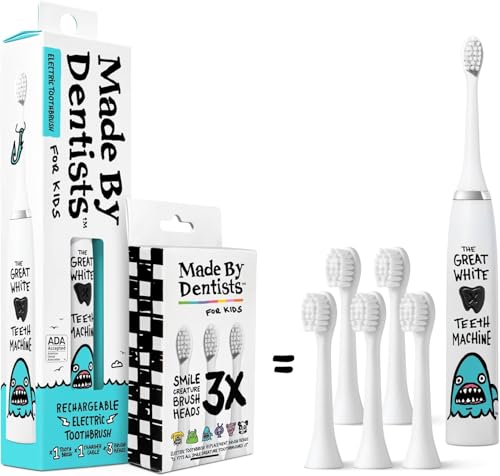
This is a rechargeable, vibrating children’s toothbrush with a shark-themed plastic handle, one two-minute timer setting, a charging cable, and six soft-bristle replacement heads. It is sold for ages 2 and older. The brand directs twice-daily two-minute use with toothpaste, and says the compact head and kid-sized grip are intended for smaller mouths and hands. Replacement heads twist off and on, and the brand recommends changing them every three months. The central evidence limitation is that the manufacturer calls this exact kids brush clinically proven for up to eight-times more plaque removal and 90 percent gingivitis reduction in two weeks. I found no published human study identifying this brush, no matching trial record, and no ADA Seal listing for it. Available product descriptions establish the design and care instructions, not independent performance, bristle-retention, water-ingress, battery, or charging-safety testing.
This product fits a caregiver seeking a simple rechargeable brush for a child age 2 or older who can be actively supervised during brushing. Its defining practical strengths are the two-minute timer, a compact soft-bristle head, and six included replacement heads. It is most appropriate where the goal is to make twice-daily brushing more routine, while the caregiver remains responsible for toothpaste amount, gentle technique, charging, cleaning, and checking the head for wear or damage.
It is not suited to households that require independently verified oral-health performance, searchable electrical certification, or documented child-product materials testing before introducing a rechargeable device near a sink. It is also not a substitute for caregiver-assisted brushing for toddlers or children who cannot reliably spit out toothpaste. Children who chew brush heads, pull at detachable parts, have recurring mouth injuries, or need individualized oral-care support should use a brush selected with their dentist or pediatric dentist.
The brush is marketed with soft replacement heads, a compact child-oriented head, and a two-minute timer. The manufacturer gives a clear three-month replacement interval and twist-and-lock head instructions. Those details are useful for hygiene, and the included six heads can cover a lengthy replacement cycle. However, the claimed clinical plaque and gingivitis results were not traceable to a published study for this exact product. The ADA’s current children’s Seal guide lists Made By Dentists toothpaste, but not this electric toothbrush. No product-specific UL, ETL, or other NRTL listing, battery-safety report, water-ingress rating, children’s compliance certificate, or accredited laboratory report was publicly located. Searches of CPSC recall materials and the public incident-report database did not identify a recall specific to this product. Environmentally, rechargeable use can avoid disposable toothbrush handles, but the brush still uses replaceable nylon-bristle heads and integrated electronics. No product-specific battery-removal, repair, packaging-material, or takeback information was found.
This is a two-handle rechargeable sonic toothbrush set for adults, with a black and a white handle, a dual wireless charging dock, two travel cases, and 10 replaceable brush heads. AquaSonic states that each handle runs at 40,000 vibrations per minute, has Clean, Whiten, and Massage modes, and has an IPX7 water-resistance rating. The oral-health evidence is stronger than the feature claims. The American Dental Association product registry lists the AquaSonic Toothbrush as safe and effective for plaque removal and for helping prevent and reduce gingivitis when used as directed. AquaSonic identifies this Duo set as ADA-accepted, though the public ADA reference guide names other AquaSonic series rather than this older Duo configuration specifically. This is an adult product, not a child-sized toothbrush, despite the search category in which it appeared.
This set suits two adults sharing a bathroom who want separate rechargeable handles on one charging base and enough included heads to cover routine replacement for an extended period. It is also practical for adults who value travel cases and a simple timed sonic-brushing format. The ADA registry supports the AquaSonic Toothbrush category claim for plaque removal and gingivitis reduction when used as directed. Users should still replace worn heads, and the ADA advises replacement about every three to four months or sooner when bristles fray.
It is not an appropriate first choice for young children, including households searching specifically for a kids electric toothbrush. The available product information identifies an adult audience and does not establish a child-sized head, soft child bristles, age grading, supervision instructions, or child-specific small-parts and materials documentation. It also may not suit people with very sensitive gums who need a documented low-power setting, since this version lists Clean, Whiten, and Massage rather than a Soft mode. Anyone requiring independently verified charger certification should seek a product with a searchable model-specific safety listing.
The key health finding is the ADA registry entry for the AquaSonic Toothbrush. It says the product is safe and has shown efficacy in plaque removal and helping prevent and reduce gingivitis when used as directed. ADA guidance explains that Seal review for powered toothbrushes includes safety and efficacy evidence, with ANSI/ADA safety standards used in evaluation. The public record reviewed does not disclose this Duo unit's underlying clinical report or its model-specific mechanical testing. This product is adult-directed, so it does not supply the child-focused fit and documentation expected for a child toothbrush. No matching CPSC recall was located in the public recall sources reviewed, but that is not a substitute for model-specific electrical or durability test reports. Ten included replaceable nylon-head assemblies can extend handle use, yet they create continuing plastic waste. AquaSonic lists compatible replacement heads, but does not provide a battery-removal or end-of-life recycling plan for this rechargeable product.
This is a rechargeable sonic toothbrush sold for children ages 6 to 15. The blue version is presented with a smart handle display, five modes, a travel case, soft nylon bristles, and a USB charging cable. It is meant for routine brushing, with a visual score and missed-area prompts intended to help the user cover the mouth systematically. The manufacturer’s current G5S page says the on-handle screen works without a phone, offers five modes, and claims up to 150 days per charge. A separate retailer description for the child version identifies rounded DuPont soft bristles, IPX8 water resistance, and a three-minute timer with 30-second prompts. These are product claims, not independently verified safety or clinical findings. No model-specific clinical trial, ADA Seal listing, or searchable NRTL electrical certification was located in this review.
This product fits a supervised school-age child or young teen who is comfortable with a powered brush and responds well to visible pacing cues. The stated soft-bristle head, gentle mode, timed prompts, travel case, and on-handle feedback may be useful for establishing a more structured routine, including during travel. It is also suited to a household that can reliably obtain the brand’s specific replacement heads and will inspect the detachable head and bristles for wear or damage.
It is not a strong fit for families that require independently verified oral-health performance, a current ADA Seal, or searchable electrical and battery safety certification before using a rechargeable appliance around sinks. It is also not ideal for children who still mouth or chew brush heads, cannot follow charging and brushing instructions, or need a clearly documented smaller head dimension. Children with gum pain, active mouth injuries, swallowing risk, or complex orthodontic needs should use their dentist’s specific guidance.
The stated child version uses soft, rounded DuPont bristles and includes a gentle mode, features that align in principle with the ADA preference for soft bristles and gentle pressure. However, no independent report was located for bristle end-rounding, tuft retention, head retention, biocompatibility, or materials compliance. No current recall or regulator warning specific to this product was located in the searches reviewed, but that is not equivalent to independent safety certification. Replacement heads are sold by the manufacturer, and general toothbrush guidance supports changing worn heads about every three to four months. That can extend the handle’s service life. The ecological limitation is the integrated rechargeable electronics and consumable plastic heads. The brand does not publish a battery-removal procedure, repair program, packaging-material disclosure, or a dedicated recycling route, so disposal should follow local battery and electronics recycling guidance.
This is a rechargeable sonic toothbrush with a vibrating handle, removable heads, a charging base or cable, and a wall hanger. The manufacturer states that it runs at 42,000 vibrations per minute, has five modes with three intensity settings, and provides a two-minute shutoff with 30-second pacing. Its manual identifies a rechargeable, non-user-replaceable battery, 3.7 V handle rating, and IPX7 water-resistance claim. For a child-focused listing, the key practical feature is brushing support rather than a child-specific brush design. The manual instructs supervision or guidance for ages 3 to 8 and says not to let children clean or maintain it unsupervised. The official product page says eight heads are included, seven standard and one deep-cleaning, with a stated three-month replacement interval. No exact-product human plaque study, ADA Seal, or searchable electrical-safety certification was located.
It is suited to a household seeking a rechargeable brush with manufacturer-documented timing prompts, adjustable intensity, and an included supply of replacement heads. For children ages 3 to 8, use should be active and supervised, as the manual directs. It may also fit an older child, teen, or adult who prefers a light vibrating brush and can follow the maintenance instructions, including rinsing the head, drying the handle, and keeping the charger away from water.
It is not appropriate for children under 3, or for children who will use, clean, charge, or store it without caregiver oversight. Households needing independently verified child-material testing, a searchable electrical certification, or an ADA-reviewed plaque and gingivitis claim should not treat the product's own statements as substitutes for those records. Anyone with persistent gum bleeding, pain, recent oral surgery, substantial dental treatment, or other active oral concerns should follow the manual's direction to stop use and consult a dentist.
The product is a powered toothbrush, a category that has evidence of modest plaque and gingivitis benefits versus manual brushing. That category evidence does not establish the performance or gentleness of this exact model. The manufacturer provides instructions for supervised use by children ages 3 to 8, a two-minute timer, head rinsing and dry storage. It also says to stop use and consult a dentist if discomfort or bleeding persists. The verification did not locate an ADA Seal, a public NRTL certification, public brush-head durability testing, or a child-product compliance certificate for this product. No product-specific CPSC recall was identified in the search. The lithium battery is sealed and may only be replaced by authorized service personnel, which limits repairability. Eight supplied heads can reduce near-term replacement purchases, but the electronics and battery still create end-of-life waste, and no product-specific recycling instructions were found.
The usmile Q30 is a rechargeable, connected sonic toothbrush with a small child-directed head, soft bristles, voice coaching, music, a two-minute timer, motion-based zone prompts, and an optional parent app. The manufacturer sells two compatible Q30 head types, Gum Protection and Cavity Defense. Its U.S. product page says the brush works without the app and provides brushing time and coverage reports when the app is used. The exact product has a verified FCC equipment authorization for its 2.4 GHz wireless function, under Guangzhou Stars Pulse Co., Ltd. That is not an oral-health, battery, water-ingress, or product-safety certification. No exact-model ADA Seal entry, clinical plaque-removal study, UL or ETL listing, battery test report, or U.S. children’s-product compliance certificate was located. The stated age range also conflicts across sales materials, with the U.S. brand page saying ages 3 to 8 while the catalog says 3 to 12.
This product fits a caregiver buying for a child roughly 3 to 8 years old who is learning a structured two-minute routine and responds well to audio prompts. It may be useful where a parent wants optional visibility into reported brushing duration and coverage, while still being able to use the brush without a phone. The child should be supervised and receive follow-up brushing as needed, especially in the preschool and early school years. The replacement-head options also make continuing use of the handle more practical than a fully disposable brush.
It is not suited to households that require independently verified plaque-removal performance, an ADA Seal for the exact product, or searchable third-party electrical safety certification for a rechargeable bathroom appliance. It is also not a good match where a child’s age is above 8 and the buyer needs a clearly supported 3 to 12 age claim. Families avoiding collection of app-related health, location, or media data should use it without the app or select a non-connected brush. Children who chew brush heads, have oral injuries, or need individualized dental advice need close caregiver and dental-professional guidance.
The Q30’s child-focused format includes manufacturer-stated soft bristles, small brush heads, gentle age-specific care, a two-minute timer, and voice-guided zone prompts. Those design choices align in principle with ADA guidance for child-sized, soft-bristled brushes and supervised two-minute brushing. However, the exact model does not have located clinical evidence or an ADA Seal showing plaque reduction or gingivitis benefit. The manufacturer’s stated RoHS and REACH compliance is encouraging, but the underlying laboratory reports and a U.S. children’s product certificate were not publicly located. The handle can remain in service because Q30 replacement heads are sold separately, and the manufacturer offers a one-year warranty for eligible direct U.S. purchases. That can reduce premature whole-product disposal. Still, the rechargeable electronic handle and its battery appear not to have a published repair, battery-removal, or recycling pathway. The optional app also warrants care, because its App Store disclosure reports possible collection of health information, coarse location, and photos or videos, although the disclosure says the data are not linked to identity.
This is a rechargeable sonic toothbrush sold for adults, with five modes, four detachable brush heads, a travel case, and a USB charging cable. The manufacturer manual identifies a built-in 2,500 mAh battery, 5 V 1 A charging input, an IPX8 water-resistance rating, and a claimed four-and-a-half-hour full charge. It also specifies a two-minute automatic shutoff and 30-second position reminders. Its most important limitation for this page is confirmed by its own instructions. This is not a child-directed toothbrush. The manual says to keep it out of reach of children, while the listing describes an adult product. Independent evidence supports powered toothbrushes as a category for plaque removal, but no clinical trial, ADA Seal listing, or model-specific independent plaque-removal evidence was located for this product.
This product suits an adult who wants a compact rechargeable sonic brush with a simple one-button control, timed brushing prompts, extra heads, and a travel case. It may fit a traveler or an adult household member who prefers infrequent charging, subject to the manufacturer's battery-life claim. It is most suitable for someone able to follow the manual's dry-port charging instructions, inspect the handle for damage, and obtain compatible original heads when replacements are needed.
It is not for children. The product is marketed for adults and the manual specifically says to keep it out of reach of children, so it should not be treated as a kids' brush merely because it has a timer or a sensitive mode. It is also not the right fit for buyers who require independently verified plaque-removal results, an ADA Seal, searchable U.S. electrical-safety certification, or documented testing for bristle retention and materials that contact the mouth.
The product has useful manufacturer documentation for basic safe use. The manual names Shenzhen Marlin E-Commerce Technology as manufacturer, directs users to check the batch number on the handle bottom, warns against charging with a wet port, and says not to use a damaged handle. It also identifies a built-in rechargeable battery, so users should not disassemble the handle or discard it casually if the battery fails. The manufacturer states IPX8 water resistance, EU RoHS 2.0 and FCC Part 15 compliance, but these are self-stated manual entries, not confirmation of model-specific third-party U.S. product-safety certification. No accessible independent report was found for oral-contact materials, bristle safety, battery testing, or the advertised plaque-removal multiple. The sealed rechargeable battery limits repairability, and the manual gives no battery-removal or electronics-recycling route. EPA guidance supports taking lithium-ion batteries and devices containing them to appropriate recycling collection systems rather than household trash.
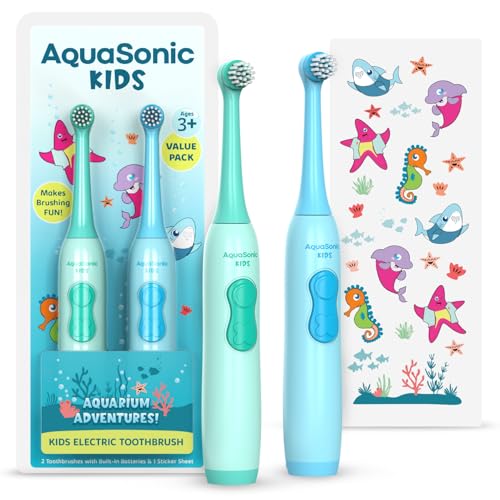
This is a two-brush, battery-powered set for children age 3 and older. Each brush has a soft-bristle oscillating head, a large on-off control, and aquarium-themed decoration stickers. The available product instructions say the brushes arrive ready to use with built-in, non-rechargeable batteries and advise adult supervision. They also direct caregivers to brush for two minutes, but do not document a built-in two-minute timer or pacing function. Powered toothbrushes as a category have moderate evidence of better plaque removal than manual brushes in children, especially oscillating-rotating designs. That evidence does not identify this product, its bristle layout, or its motor output. The available instructions state that the head and battery are not replaceable, so the entire brush is to be replaced when bristles fray or at about three months.
This product fits a caregiver seeking a simple, non-connected powered brush for a child age 3 or older who can brush only with close supervision. Its soft-bristle, single-control format may suit a child who finds a manual brush uninteresting and benefits from a themed routine. It is also practical for two children who each need their own brush. Caregivers should be prepared to guide brushing for the full two minutes and replace the complete brush, rather than only a worn head.
It is not a strong fit for households that need independently documented electrical safety certification, material compliance records, or clinical evidence for the exact child brush. Avoid relying on it where a child routinely chews, dismantles, or mouths objects without direct supervision, because public small-parts and durability test evidence was not located. It is also unsuitable for families seeking a long-lived rechargeable handle, readily available genuine replacement heads, or lower electronic waste over repeated three-month replacement cycles.
The main health positive is the general evidence base for powered brushing in children, not a product-specific clinical claim. The available instructions describe soft bristles, a child age grade of 3 and older, and adult supervision. ADA guidance supports soft, child-sized brushes, supervised brushing, and replacement when bristles fray. However, the exact child product was not found in the ADA Seal registry. The Aquasonic products listed there are separately named powered models. The product does not appear to use an app or collect child data. Its available instructions identify a built-in, non-rechargeable battery and a non-replaceable head, with complete-product disposal recommended after roughly three months or sooner if worn. That design creates recurring plastic and battery waste. Public material-compliance documents, battery test reports, NRTL listing records, and model-specific recall findings were not located in this review.
This is a battery-powered vibrating toothbrush intended for children ages 1 to 3. The four-head version includes a dinosaur-themed handle, soft nylon bristles, a brush-head cover, an LED light, an upright suction base, and a two-minute timer with 30-second prompts. It uses one AAA battery, rather than a charging dock. Papablic states that the brush vibrates at 18,000 movements per minute and is BPA-free, but it does not publish model-specific bristle-retention, head-retention, water-ingress, or materials test reports. The manufacturer also states that its toothbrushes meet CPSC and CPSIA safety requirements, yet a product-specific Children’s Product Certificate was not publicly located. No model-specific ADA Seal, NRTL electrical listing, or human clinical study for this toddler brush was found.
This product suits a caregiver brushing the teeth of a child aged 1 to 3 who responds well to lights, vibration, or a dinosaur design and needs a consistent two-minute routine. The built-in interval prompts can help an adult divide brushing across the mouth, while the four included heads reduce the need to immediately source replacements. It is most appropriate when a caregiver remains present, checks the head and battery compartment before use, and dries the brush after brushing.
It is not a strong fit for households that require independently verified oral-health performance or independently listed electrical safety before using a powered toothbrush with a toddler. Choose another approach if the child chews, throws, or repeatedly drops oral-care tools, because public retention and abuse-test evidence was not located and the maker advises avoiding drops. It also does not suit unsupervised use, children able to access the battery compartment, or buyers who want a rechargeable device with an established electronics recycling path.
The useful health features are practical rather than clinically proven. Papablic states that the product has soft bristles, 18,000 vibrations per minute, a two-minute timer, and 30-second prompts. Soft bristles are consistent with ADA guidance to reduce the risk of gum abrasion. The dry-storage instruction is also useful, since toothbrushes should be rinsed, stored upright, and allowed to air dry. Important evidence gaps remain. No exact-product clinical trial, ADA Seal, public CPC, or NRTL electrical listing was located. In 2026, the FDA classified an open recall for specified separately sold Papablic replacement-head lots after a potential head-breakage issue. The manufacturer says kits were excluded from that action. Ecologically, replaceable heads and a stated lifetime defect warranty can extend handle use, but the brush still creates replacement-head and disposable AAA battery waste, with no product-specific recycling guidance found.