Best Overall
9% off

AOSEED X-Maker Joy AI+ 3D Printer
Pre-loaded with 8,000+ diverse 3D models.
Operates at high speed, up to 400mm/s.
Includes 8 colorful PLA filaments for creativity.
 Daniel Kenitz
Pre-loaded with 8,000+ diverse 3D models.
Operates at high speed, up to 400mm/s.
Includes 8 colorful PLA filaments for creativity.

Easy-to-use interface for young creators.
Built-in AI assistance enhances learning experience.
Safe design tailored for children's use.

Fast printing speed enhances productivity.
Easy one-click setup simplifies use.
Multicolor printing adds creative versatility.

Easy setup with native 4-color printing.
Fast 600mm/s 3D printing speed.
Quiet operation at just 45dB.
Multicolor printing with CFS enhances design versatility.
High-speed printing at 600mm/s saves time.
Smart auto leveling ensures precise prints.

High-speed printing at 600mm/s enhances productivity.
Automatic leveling ensures precise and hassle-free setup.
Dual AI cameras provide advanced monitoring capabilities.

High-speed printing for efficient production.
Large build volume for bigger projects.
Multi-color capability enhances design versatility.

Fully auto leveling simplifies setup and use.
High-speed printing up to 600mm/s.
Easy-to-change 3S detachable nozzle.

Quick setup: start printing in 8 minutes.
User-friendly: app and WiFi control available.
Educational: 1500+ models and DIY modules.

Easy setup with fully assembled design.
Engaging STEM learning through hands-on printing.
AI-powered for smart, kid-friendly operation.
Material compatibility should be read carefully. PLA, PETG, TPU, ABS, ASA, nylon, PC, and fiber-filled filaments have different temperature and exposure considerations. A supported-material list is not the same as a safety assessment, and PLA is not emission-free simply because it is often described as plant-based, low-odor, or biodegradable. Buyers should look for model-specific temperature limits, material instructions, and accessible filament Safety Data Sheets. An enclosure may reduce direct access to hot and moving parts, but it does not prove that particles or volatile chemicals are captured.
Speed figures are especially easy to overread. A maximum such as 400 or 600 mm/s may describe a ceiling, travel movement, or manufacturer setting rather than reproducible finished-part speed and quality. Recommended speeds, independent tests using disclosed materials and profiles, surface quality, color-change time, and failure recovery are more useful. Multicolor systems also do not mean zero-waste color printing: single-nozzle systems can create purge towers and discarded filament during color changes.
For indoor-air claims, the meaningful evidence is an independent result for the exact printer, filament, settings, airflow, and chamber. A traceable ANSI/CAN/UL 2904 laboratory report, or a UL SPOT or GREENGUARD record covering the relevant printer or print media, is materially stronger than an enclosure, carbon compartment, “non-toxic” wording, or an odor claim. Buyers should also consider whether filtration has sealed airflow, HEPA particle filtration, gas-phase media, stated filter life, and available replacement filters. No supplied product had model-specific low-emission proof of that kind.
Electrical safety is a separate question. Look for the complete US model in UL Product iQ, Intertek’s ETL directory, or CSA’s listing database, and confirm that the listing covers the printer rather than only a component or radio. FCC authorization verifies wireless operation where applicable; it does not establish fire or electrical safety. Thermal warnings, automatic shutdown behavior, guards, power-loss recovery, filament-runout detection, and age-appropriate instructions help with burn, motion, and unattended-fault risks, but they do not replace a whole-product safety evaluation.
Repairability affects both ownership and waste. Model-specific nozzles, hot ends, belts, cables, plates, filters, service instructions, spare-part availability, and continuing firmware support can keep a printer in use. Published power ratings are not measured energy consumption: meaningful efficiency evidence identifies the model, material, profile, print, and measurement method, and reports standby or sleep behavior.
Across the supplied reviews, no printer established all of these protections. Repeated caveats include unproven ultrafine-particle and VOC emissions, missing or incomplete US electrical listings, and the need for ventilation rather than relying on an enclosure or carbon filter. Open models expose hot parts and moving mechanisms; enclosed models still require supervision. Products marketed for children require adult oversight, and connected models raise account, camera, cloud, location, and child-privacy concerns. Bedrooms, nurseries, poorly ventilated living areas, and occupied spaces with sensitive people or pets are recurring unsuitable settings. These printers should not be treated as emission-free household appliances or unsupervised toys.
## Health and Ecology The scores below compare the supplied products on the evidence available for each topic. A higher score indicates stronger documentation or controls in this set, not a guarantee that a printer is safe in every room, with every filament, or when left unattended.
This measures independent evidence that the exact printer-and-filament setup produces low ultrafine-particle and VOC emissions. It matters because heated filament can release particles and chemicals even when a printer is enclosed or uses PLA. Scores ranged from 54 to 70: the higher-scoring products still lacked exact low-emission certification or chamber reports, while the lowest-scoring open model had especially limited exposure evidence.
This covers overheating, short circuits, power supplies, heated beds, wiring, and fault protection for the complete US product. It matters because a radio authorization or low-voltage adapter does not certify the whole printer against electrical or fire hazards. Scores ranged from 68 to 73. Higher scores reflected better documented protections or verification, but no supplied product had a located complete UL, ETL, or CSA listing.
This measures guards, thermal warnings, shutdown behavior, and instructions addressing hot nozzles, beds, pinch points, and moving axes. It matters during setup, print removal, maintenance, and child use. Scores ranged from 58 to 76. Enclosed or shielded designs scored higher in this group, while open printers with accessible hot or moving parts scored lower; none should be treated as a child-operated appliance.
This assesses whether a printer captures emissions through sealed airflow, HEPA particle filtration, gas-phase filtration, external exhaust, stated filter life, and replacement filters. It matters because an enclosure alone can contain emissions without removing them. Scores ranged from 45 to 72. The higher-scoring enclosed products had carbon-filter or related controls, but the reviews repeatedly found no verified HEPA performance, capture efficiency, or external exhaust.
This measures clarity about supported materials, temperature limits, material-specific hazards, and accessible filament Safety Data Sheets. It matters because PLA, PETG, ABS, ASA, TPU, nylon, and filled filaments are not interchangeable from an exposure or operating perspective. Scores ranged from 54 to 77. Higher scores came with clearer material limits and SDS support; lower scores relied more on broad PLA or “harmless” claims without complete documentation.
This measures recall visibility, safety notices, remedies, warranty, support, and ongoing updates. It matters because printers can need firmware, replacement parts, or practical responses to faults after purchase. Scores ranged from 70 to 78. The stronger products had documented support, warranties, firmware, or parts and no located product-specific recall; absence of a located recall is not proof that every unit is risk-free.
This measures whether claims about speed, precision, noise, multicolor operation, cameras, AI monitoring, child safety, and filtration are specific, qualified, and supported for the exact product. It matters because maximum speeds and “safe” or “quiet” labels can omit settings, material limits, or conflicting specifications. Scores ranged from 50 to 76. Higher-scoring products had independent hands-on confirmation or clearer qualifications; lower-scoring products had conflicting figures or unsupported safety and performance language.
This measures traceable third-party records for important safety, emissions, radio, and performance assertions. It matters because a seller logo, internal test, or manufacturer declaration is weaker than a record for the exact US model in a recognized registry or laboratory report. Scores ranged from 68 to 78. Even the higher scores generally reflected FCC radio authorization or independent use testing, not the missing UL 2904, GREENGUARD, UL, ETL, or CSA evidence needed for stronger air and whole-product claims.
This measures data practices, camera and app permissions, cloud dependence, local-control options, security updates, and radio authorization. It matters because Wi-Fi printers may transmit account, device-operation, network, location, image, or print-history information. Scores ranged from 50 to 80. Higher-scoring products documented LAN, USB, SD-card, or offline options and had clearer radio records; lower-scoring products combined child-oriented marketing with unclear child privacy or security-update commitments.
This covers purge waste, failed prints, packaging, plastic use, e-waste, repair, recycling guidance, and take-back options. It matters especially for multicolor printers, where color changes can create purge towers and discarded filament. Scores ranged from 54 to 75. Higher-scoring products offered more repair or material-efficiency evidence, but the supplied reviews found no broad manufacturer take-back or filament-recovery program for the printers.
This measures power use during printing and idle periods relative to useful output, along with sleep, standby, and automatic shutdown features. It matters because large heated beds, chambers, dryers, and long prints consume resources. Scores ranged from 68 to 72, a narrow range that reflects limited evidence rather than comparable efficiency. The reviews repeatedly noted that rated wattage was available in some cases, but reproducible print and standby measurements were not.
This measures available wear parts, service procedures, spare-part pricing, durable components, and continuing firmware support. It matters because replacing a nozzle, belt, hot end, cable, plate, or filter can avoid discarding the whole printer. Scores ranged from 68 to 82. The highest scores belonged to products with substantial official parts and maintenance documentation; lower scores had only limited replacement support or unclear long-term service access.
This is a compact, enclosed filament printer aimed at children and beginners. AOSEED identifies the X-MAKER JOY AI+ as a PLA-only machine with a 120 x 120 x 120 mm build area, Wi-Fi control through the XMAKER app, a quick-swap nozzle, pre-leveling, and a built-in camera. The maker documentation also says it ships with a 200 g PLA Silk spool. Its strongest concrete safety feature is physical rather than air-cleaning based. The manufacturer describes a full enclosure and low-temperature nozzle, while the available quick guide tells users to let the machine cool below 45 C before removing a print. The listing's 400 mm/s speed claim is not independently supported here, and AOSEED's own JOY specification page instead states a 120 to 300 mm/s range for the related configured product page.
This product fits an adult-supervised home, elementary classroom, library, or homeschool setting that wants small PLA projects and guided app workflows rather than broad material compatibility. Its 120 mm cubic build area suits toys, labels, decorations, and modest school models. It is most appropriate where the printer can sit in a visible, ventilated shared area, an adult can handle first setup and maintenance, and users accept that Wi-Fi and app control are central to the workflow.
It is not suited to bedrooms, poorly ventilated rooms, or settings where a child would be expected to run long prints unattended. The product has no verified low-emission result and no documented HEPA, gas-phase filter, or outdoor exhaust path. It also does not suit users needing ABS, PETG, larger parts, independently verified electrical certification for the exact US configuration, or a workflow that remains dependable when the companion app has login or connection problems.
PLA-only compatibility is a useful material limit, because PLA often emits less particulate matter than ABS in 3D-printing research. It does not make the printer emission-free. EPA and NIOSH note that heated filament printing can release ultrafine particles and volatile organic compounds, and NIOSH recommends ventilation or effective engineering controls. No model-specific chamber emissions report or verified filtration design was found for this product. The full enclosure and cooling instruction are meaningful burn and moving-part controls, but the manufacturer’s broad claims about contained fumes, eco-friendly PLA, and safety certifications were not accompanied by public, traceable reports for this configuration. PLA’s plant-derived feedstock also does not solve print waste, failed prints, purge material, packaging, or end-of-life electronics. AOSEED supplies troubleshooting and replacement-part guidance, but no documented take-back or filament-recycling program was located.
This is a compact, enclosed filament 3D printer aimed at young makers, with a 150 x 150 x 150 mm build volume. It uses 1.75 mm PLA or ABS filament, includes a magnetic build plate, and can be operated through the AOSEED app. The maker’s current product page describes Wi-Fi control, a built-in camera, AI-assisted design tools, and a recommended age range of 9 to 16. The strongest documented practical features are the enclosure, the included PLA starter material, and a one-year warranty with listed US support contact details. A Federal Communications Commission filing supports radio compliance for a closely related X-MAKER wireless device, but no traceable UL, ETL, CSA, GREENGUARD, or model-specific indoor-air test record was located for this product. The marketplace claim of 400 mm/s also conflicts with the maker’s 300 mm/s maximum specification.
This product fits a parent, teacher, or supervised teen maker who wants a small desktop machine for PLA projects, ready-made models, and gradual entry into digital design. It is most suitable where there is a dedicated, well-ventilated work area, an adult who can handle setup and maintenance, and a willingness to use the supplied controls rather than treating the enclosure as complete air protection. The 150 mm build volume suits toys, small prototypes, classroom models, and multi-part projects rather than large single-piece prints.
It is not suited to bedrooms, poorly ventilated playrooms, or households that need independently demonstrated low-emission printing. It is also a poor fit for unsupervised use by younger children, especially when loading filament, clearing jams, removing prints, or using tools. Buyers needing a traceable US electrical safety listing, validated HEPA and gas filtration, or a confirmed emissions test for the exact printer and filament setup need more documentation. It is also unsuitable for users who require a dependable app-only workflow without account or connectivity concerns.
The enclosure and cooling instruction offer some practical protection from hot surfaces and moving components, but they do not establish indoor-air safety. Government research shows that filament printing can release ultrafine particles and VOCs, including when using PLA. ABS is supported by the manufacturer and generally warrants greater ventilation caution. Use the product in a ventilated dedicated area, keep children from opening it during operation, and do not rely on the enclosure as a substitute for exhaust or filtration. No model-specific low-emission certification, filter specification, replacement-filter program, or electrical safety listing was located. The manufacturer sells replacement heating beds and other accessories, which is a positive repair signal, and publishes one-year warranty and US support information. PLA is plant-derived, but printed parts, failed prints, supports, and worn electronics still create plastic and e-waste. No manufacturer take-back or filament-recycling program was found.
This is an open-frame, fused-filament 3D printer with a 260 x 260 x 260 mm build area, a hardened-steel 0.4 mm nozzle, a 100 C heated bed, and a stated 300 C maximum nozzle temperature. It uses an integrated four-color feeding system, with manufacturer-stated expansion to 19 colors through optional equipment. Supported materials listed by the manufacturer include PLA, PETG, TPU, PVA, carbon-fiber-filled PLA and PETG, and ASA. The manufacturer states a 300 mm/s recommended print speed, 600 mm/s maximum, automatic leveling, filament detection, power-loss resume, camera-based monitoring, app control, and USB printing. The manual independently confirms that this is a hot, moving machine requiring precautions. No model-specific third-party emissions report, UL SPOT or GREENGUARD record, or traceable US electrical safety listing was located during verification.
It suits an adult beginner or hobbyist who wants a relatively compact desktop filament printer for colorful models, organizers, display pieces, and moderate-size functional parts. The 260 mm cubed build area is useful when a small printer would force splitting a design. It also fits a buyer comfortable following setup, maintenance, material-temperature, and ventilation instructions. A dedicated, ventilated work area is important, because the product is open-frame and can print materials with different emission profiles.
It is not suited to bedrooms, nurseries, classrooms, or shared living spaces without practical ventilation or source capture. It is also unsuitable as an unsupervised children's appliance, despite beginner-oriented marketing, because the nozzle, bed, moving mechanism, cutter-related parts, and small accessories create burn, pinch, and choking hazards. Buyers needing independently verified low emissions, traceable electrical certification, a sealed filtered enclosure, or documented energy consumption should choose a product supported by those specific records.
The most important health point is that this is an open fused-filament printer, not a verified low-emission system. No model-specific emissions certification or chamber report was located, and the product does not state that it includes particle filtration, gas filtration, or external exhaust. NIOSH guidance recognizes ultrafine particles and chemical emissions from filament printing and recommends effective ventilation, local exhaust, or appropriately designed filtration. Use the product away from occupants, especially when printing ASA or other higher-temperature materials. The manual gives meaningful physical-safety instructions, including keeping hands and loose clothing clear of moving parts, avoiding the hot printhead and bed, using heat-resistant gloves for maintenance, disconnecting power in a malfunction, and keeping the product away from children. The manufacturer documents replaceable PTFE tubes, silicone wipes, blades, and maintenance needs, which can extend service life. Its stated multicolor purge-waste reduction has not been independently verified, and plastic purge waste, failed prints, electronics, and mixed-material parts still need responsible disposal.
This is an open-frame, desktop filament printer with a 260 x 260 x 260 mm build volume, direct-drive extrusion, a hardened-steel 0.4 mm nozzle, and a heated PEI spring-steel build plate. It accepts PLA, PETG, TPU, PVA, PLA-CF, PETG-CF, ASA, and, according to the manufacturer’s product FAQ, ABS for single-material printing. Its defining feature is native four-color printing through the integrated ACE GEN2 system, with a manufacturer-stated expansion path to 19 colors using added hardware. Anycubic also states a 300 mm/s recommended speed, 600 mm/s maximum speed, camera-based print monitoring, and local WLAN or cloud-connected operation. These are manufacturer claims, not independently confirmed performance or safety results. No model-specific low-emission laboratory report or traceable US electrical-safety certification was located.
This product suits a technically engaged home maker who wants multicolor PLA or PETG projects without adding a separate color feeder, has a stable workbench with space around an open machine, and is prepared to learn filament handling, nozzle care, and calibration. It also suits a user who values documented access to replacement parts and repair procedures. For indoor use, the appropriate buyer has a dedicated, well-ventilated workspace and intends to use lower-emission materials where practical.
It is not suited to bedrooms, nurseries, living areas, classrooms, or other occupied spaces without effective ventilation or local exhaust. It is especially unsuitable for routine ASA, ABS, or composite-filament printing indoors unless a separate, appropriately designed enclosure and exhaust strategy is in place. It is also a poor fit for buyers who need independently documented low emissions, traceable US electrical certification, independently verified performance figures, or a fully offline product with a published long-term security-support policy.
The main health limitation is the open-frame design. The manufacturer lists materials including ASA and, in its FAQ, ABS, while US EPA and NIOSH resources describe ultrafine-particle and VOC emissions from filament printing and recommend lower-emission material choices and effective ventilation. An enclosure alone is not an emissions-control result, and this product does not list an integrated particulate or gas-phase filter. No model-specific emissions chamber report or low-emission certification was located. The manual includes hot-surface precautions, including heat-resistant gloves for maintenance. Anycubic also offers a one-year printer warranty, product-specific troubleshooting, repair guides, and replacement accessories, which can support repair rather than replacement. Its stated reduction in multicolor purge length may reduce material waste, but this is a manufacturer claim without an independently disclosed measurement method. No take-back program, end-of-life recycling program, or published product energy-use test was located.
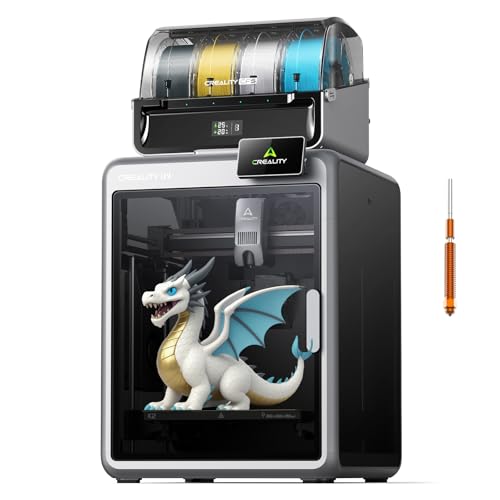
This is a fully enclosed desktop fused-filament printer with a 260 x 260 x 260 mm build volume and one four-spool Creality Filament System. It uses 1.75 mm filament, a direct-drive all-metal hotend rated to 300 C, and a heated bed rated to 100 C. Creality lists PLA, ABS, PETG, PLA-CF, and PET as supported materials. Files can be sent by USB or Wi-Fi, and cloud printing is available but not required. The included filament system is intended to automate color and material changes. Creality states that the printer can connect with up to four such units for 16-color work, although this package includes one unit. The claimed 600 mm/s maximum speed, quiet mode, automatic leveling, and monitoring functions are manufacturer-stated specifications. A traceable FCC authorization exists for the K2 printer's 2.4 GHz radio, but it is radio compliance, not a US electrical-safety certification.
It suits a home maker, hobbyist, or small workshop user who needs a moderately sized enclosed printer for PLA, PETG, or occasional ABS work, and who values automated four-spool color changes. It is also practical for a user prepared to learn routine nozzle, wiper, tubing, and hotend maintenance. The USB transfer option suits buyers who prefer a local file workflow, while Wi-Fi and Creality Cloud remain available for people who want remote workflow features.
It is not well suited to bedrooms, children's rooms, classrooms, or poorly ventilated living areas where printing will be frequent or long-running. Independent emissions evidence for this exact printer and filament setup was not located, and an enclosure alone does not establish indoor air control. Users planning regular ABS or filled-filament printing should use dedicated local exhaust or validated particle and gas filtration. It is also not for buyers who require a verified US UL, ETL, or CSA certification for the complete printer before operation.
The main health limitation is evidence, not a confirmed product defect. This printer can heat its nozzle to 300 C and bed to 100 C, and it supports ABS as well as PLA-CF. NIOSH advises ventilation or source controls for filament printing because printers can release ultrafine particles and gases. PLA may emit less than ABS in some conditions, but material, color, printer settings, and ventilation all matter. No independent low-emission test or certified filtration result was located for this product. The manual and enclosure provide some basic contact and motion protection, but hot surfaces and moving mechanisms still require adult supervision. A traceable FCC authorization supports the Wi-Fi radio compliance record. Creality offers a 12-month standard machine warranty, firmware updates, and service instructions for several replaceable wear parts. Those repair resources can extend service life, but no manufacturer take-back program, filament-recycling program, or model-specific energy measurement was located. Multicolor printing also inherently creates changeover and purge waste.
This is a large, enclosed fused-filament desktop 3D printer with a 350 x 350 x 350 mm build space. The Combo package adds the four-spool CFS material feeder for multicolor work. It uses 1.75 mm filament, a direct-drive extruder, a heated bed, dual cameras, Wi-Fi, Ethernet, USB transfer, and a claimed maximum nozzle temperature of 350 C. Independent hands-on testing confirmed the large build volume and operation with the four-color CFS. The same testing found that the larger nozzle creates substantial purge waste during color changes and that the bed needs roughly 15 minutes to warm. Creality documents many replaceable assemblies and service procedures, including the power supply, hotend, extruder, belts, motors, cameras, and mainboard. The advertised 600 mm/s speed is a manufacturer maximum, not a verified everyday print-rate result.
This product fits an experienced home maker, workshop user, or small design team that needs to print physically large parts or multicolor prototypes in one enclosed machine. It is particularly suited to users who can dedicate stable floor or bench space, manage a heavy machine, maintain nozzles and filters, and work through service instructions when needed. The CFS is useful when color changes are important enough to justify the extra purge material, setup complexity, and material handling.
It is not well suited to bedrooms, nurseries, classrooms, or poorly ventilated living areas where people spend long periods nearby. The product has no located exact-model low-emissions certification, and its carbon cartridge is not evidence of complete particle and gas control. It is also a poor fit for households needing a plug-and-play appliance with independently traceable US electrical certification, buyers who cannot lift or accommodate a large heavy enclosure, or users seeking low-waste multicolor printing.
Creality instructs users to operate the product in a well-ventilated area, use a grounded three-prong outlet, avoid touching the hot nozzle and bed, keep loose gloves and wraps away from moving parts, and supervise children under 10. Those are useful operational controls. No exact-product UL SPOT, GREENGUARD, or ANSI/CAN/UL 2904 emissions result was located, so low indoor-emission performance is unproven. NIOSH advises ventilation and source controls because fused-filament printers can release ultrafine particles and gases. The product has an activated-carbon filter cartridge that Creality says should be replaced monthly with frequent use, or every three months at eight printing hours daily. It is not documented as HEPA or independently tested for emissions capture. Its detailed repair guides and replacement-part procedures support longer service life. Conversely, multicolor printing creates purge waste, and no take-back program, filament-recycling program, or product-specific end-of-life recovery plan was located. No CPSC recall for this exact product was identified in the review.
The Anycubic Kobra X is an open-frame, filament-based desktop 3D printer with a 260 x 260 x 260 mm build volume. It has a 300 C nozzle, a 100 C heated PEI build plate, and a built-in four-filament system. The manufacturer says it can expand to 19 colors with separately purchased ACE 2 Pro units, supports PLA, PETG, TPU, PVA, carbon-fiber filled PLA and PETG, and ASA, and can print from USB as well as through its app. Independent hands-on reviews found it produced dependable first layers and good out-of-box results. Its headline 600 mm/s maximum speed and large reductions in multicolor purge waste remain manufacturer claims, although testing supports that the filament-switching arrangement works. This is a physically open machine with exposed hot and moving parts, not an enclosed air-controlled printer.
This product fits a hobbyist, classroom technician, or small maker operation that wants to make medium-sized prototypes, organizers, models, and multicolor display parts from PLA or PETG. It is particularly relevant where four colors are useful but an external feeder would consume too much desk space. The buyer should have a stable work surface, a separate well-ventilated work area, and be comfortable following setup, maintenance, and hot-tool precautions. USB printing is useful for users who prefer not to depend entirely on cloud controls.
It is not suited to bedrooms, nurseries, tightly sealed apartments, or shared living spaces without effective source capture or exhaust. The open nozzle, heated bed, moving axes, and small accessories make it unsuitable for unsupervised use around young children or pets. It is also a poor fit for buyers who need independently documented low emissions, a traceable US electrical safety listing, or verified air filtration. Users routinely printing ASA or carbon-fiber filled materials need a more deliberate ventilation and exposure-control setup.
The most important health fact is that this is an open filament printer. Federal NIOSH and EPA materials explain that heated filament printing can release ultrafine particles and volatile organic compounds, with emissions varying by material and conditions. The product has no stated built-in HEPA or gas-phase filtration, no enclosure, and no located model-specific low-emission certification or chamber test. Use ventilation or local exhaust, keep people away while it prints, and treat ASA and filled materials as needing more careful controls. The manual gives clear warnings for hot surfaces, moving parts, children, emergency shutdown, and the specified 250 V, 10 A replacement fuse. It also calls for heat-resistant gloves during maintenance. On longevity, the manufacturer sells numerous replacement parts, including the bed, nozzle, toolhead, camera, motherboard, and filament-path components. That availability can extend service life, although no manufacturer take-back or product-specific recycling program was located.
This is an open-frame, single-nozzle fused-filament 3D printer for household models, organizers, prototypes, and similar parts. Flashforge specifies a 220 x 220 x 220 mm build area, an all-metal CoreXY motion system, a 280 C direct-drive nozzle, a heated bed, automatic leveling, and compatibility with PLA, PETG, TPU, PLA-CF, and PETG-CF under stated nozzle conditions. The 600 mm/s figure is a manufacturer maximum-speed claim, not a verified everyday print-speed result. Independent hands-on testing supports its practical usability and measured about 130 W during a PLA print, while also finding substantial operating noise. It has replaceable quick-release nozzle assemblies, filament-runout detection, power-loss recovery, Wi-Fi and Ethernet connectivity. It is open rather than enclosed and has no built-in air-filtration system.
This product suits a home hobbyist, maker, or small workshop user who mainly prints PLA, PETG, TPU, or the stated carbon-fiber filled materials, and has a ventilated dedicated work area. Its 220 mm cube build volume fits many organizers, replacement parts, models, and prototypes. It also suits someone willing to perform ordinary maintenance, such as changing a nozzle, updating firmware, cleaning the bed, and using material-specific slicer profiles. The open layout gives direct access to the print area and replaceable parts.
It is not suited to bedrooms, nurseries, occupied offices, classrooms, or other poorly ventilated shared rooms where people may remain beside it during printing. The product lacks a built-in particle and gas filtration system, and no exact-model emissions certification or chamber test was found. It is also not the appropriate configuration for ABS or ASA work, which Flashforge identifies as outside this model's supported material range. Young children should not operate it unsupervised because the nozzle, heated bed, and moving mechanism create burn and entanglement hazards.
The important health limitation is its open construction. Flashforge states that this model has no air filtration, while NIOSH advises ventilation and engineering controls because fused-filament printing can release ultrafine particles and gases. PLA can be a lower-emitting option than ABS in some settings, but it does not establish zero exposure. Use the manufacturer-supported materials, place the printer in a ventilated work area, and avoid occupying the immediate printing space for long periods. The product has some life-extension support, including replaceable nozzle assemblies, support documentation, firmware downloads, and a one-year printer warranty. Independent testing found moderate PLA-printing power use, although warm-up peaks and idle electricity still matter. No product-specific recycling or take-back program, certified low-emissions record, or traceable US electrical-safety certification was located in the sources reviewed. No CPSC recall for this specific model was identified in the reviewed recall searches.
This is a compact, fully assembled filament 3D printer intended for small home, classroom, and beginner projects. The manufacturer states a 100 × 100 × 100 mm build volume, 0.4 mm nozzle, 1.75 mm PLA and TPU compatibility, flexible spring-steel plate, nine-point auto leveling, and a 60 W power rating. It can receive jobs through Wi-Fi and the PoloPrint Cloud app, USB, or microSD card. The product is physically suited to small toys, organizers, learning models, and prototypes rather than large functional parts. Its official instructions tell users to supervise younger children and avoid heated components during and shortly after printing. Entina sells a replacement integrated hotend for this model, which is useful for maintaining a common wear component. No exact-model independent emissions report, recognized electrical listing, or verified filtration specification was located in the reviewed records.
This product fits an adult-supervised household, teacher, or first-time maker who needs a compact printer for short PLA-based projects, small models, and introductory design work. The small build area suits desk placement and objects such as learning aids, toys, labels, simple organizers, and small prototypes. It is also relevant where offline microSD printing is preferred over cloud operation. The buyer should be comfortable treating the manufacturer’s app, noise, reliability, and startup claims as unverified rather than guaranteed performance results.
It is not suited to households seeking independently documented low indoor emissions, certified electrical safety, or built-in particle and gas filtration. It should not be placed in a child’s bedroom, a poorly ventilated classroom, or a shared living area for frequent unattended printing without additional exposure controls. Buyers needing large parts, engineering materials beyond the stated PLA and TPU support, detailed repair documentation, or a documented long-term firmware and security update policy should choose a product with those records. Young children should not operate heated or moving equipment without active adult supervision.
The product uses melted thermoplastic filament, and the manufacturer identifies PLA and TPU as supported materials. PLA is often lower emitting than some alternatives, but public health research still finds that filament printing can release ultrafine particles and volatile organic compounds. EPA notes particular concern about children’s potential exposure in confined classrooms and libraries. The product has an enclosure around the hot end and a warning to avoid contact with heated parts, but no verified filtration or source-exhaust system was found. Entina offers a replacement integrated hotend for this model and a one-year quality warranty, which can help extend service life instead of replacing the entire printer after a hotend failure. However, no take-back program, printer recycling plan, packaging disclosure, supplied-filament safety data sheet, or model-specific power-consumption test was located. PLA’s renewable feedstock origin does not make failed prints, supports, or discarded electronics automatically recyclable or suitable for ordinary home composting.
The Magic Jimmy Spark AI is a compact, fully assembled, Wi-Fi connected fused-filament printer aimed at children aged 8 and older. It accepts only PLA, includes 200 g of white PLA, and has a 120 mm cubic maximum build area, according to the maker. Prints are selected, created, or imported through the companion app, which also supports remote control and a built-in camera. The maker says library prints typically take one to three hours. Its defining design choice is a fully enclosed chamber intended to keep the hot nozzle and moving mechanism out of reach during printing. That is a manufacturer statement, not a certification result. The product has a model-specific FCC radio authorization for its wireless function, but no traceable UL, ETL, CSA, GREENGUARD, or model-specific emissions test record was located. Its PLA-only limitation may reduce emissions relative to ABS, but it does not establish clean indoor air.
This product suits a family with an adult who will set it up, supervise early use, and place it in a well-ventilated area away from bedrooms and main living spaces. It fits a child aged about 8 or older who wants a small, app-guided printer for figurines, keyrings, badges, and school projects within a 120 mm build volume. It is also suited to households that value guided PLA-only printing and want access to documented troubleshooting for common clogs, feeding issues, and print-head repairs.
It is not suited to households seeking independently verified low-emission indoor printing, particularly homes with asthma, respiratory sensitivity, infants, or limited ventilation. It is also unsuitable where an independently listed U.S. electrical safety certification is required. Children under 13 should not be treated as independent app users because the privacy policy says the services are not intended for them. Buyers who do not want Wi-Fi, cloud-connected features, camera-related data practices, or in-app purchases should choose a product with clear local-control and privacy options.
The enclosure can reduce accidental contact with the hot nozzle and moving mechanisms, but it is not evidence of emission capture. No replacement filter, sealed airflow path, HEPA filter, gas-phase filter, outdoor exhaust option, or model-specific air test was located. NIOSH and EPA materials indicate that filament printing can release ultrafine particles and VOCs, including when PLA is used. Run this product with fresh-air ventilation or external emission control, rather than relying on PLA or the enclosure alone. PLA is the only supported material, which avoids higher-emitting ABS use, but the maker provides no accessible safety data sheet or full additive disclosure for its filament. PLA should not be assumed biodegradable in normal household disposal conditions. The product has repair guides and a stated limited warranty, which can extend service life. No take-back program, electronics recycling plan, energy-use data, or packaging recovery information was located. No relevant U.S. recall was located in the searched records.



