Best Overall
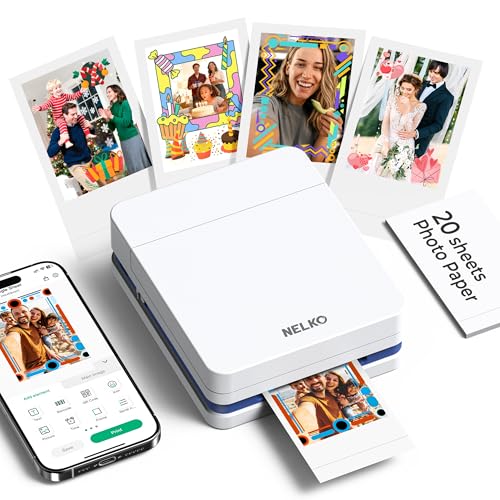
Nelko PP01 Portable Photo Printer
Sticky-back photos for easy display.
Compatible with iOS and Android devices.
Rechargeable for convenient portability.
 Daniel Kenitz
Sticky-back photos for easy display.
Compatible with iOS and Android devices.
Rechargeable for convenient portability.

Includes up to three years of ink.
Cartridge-free, refillable ink tank system.
Wireless printing and AI-capable features.

Easy wireless connectivity for seamless printing.
Compact design fits perfectly in small spaces.
Automatic duplex printing saves paper efficiently.

Compact design fits in small spaces.
Wireless printing for easy connectivity.
Duplex printing saves paper efficiently.

Easy wireless printing from any device.
Includes 6-month Instant Ink trial.
Compact design fits small spaces.

Fast and efficient duplex printing.
Convenient wireless connectivity options.
Includes trial of Instant Ink service.

Compact design fits any home space easily.
Cost-efficient printing saves money on ink.
Wireless setup simplifies connectivity and usage.

Compact design fits small spaces easily.
Intuitive control panel simplifies operation.
Wireless printing enables convenient connectivity.
Fast print speeds for efficient workflow.
Wireless connectivity for easy device integration.
High-quality color printing for vibrant documents.
Convenient wireless printing with touchscreen control.
Efficient automatic duplex printing saves paper.
Refresh Subscription Trial offers cost-effective ink solutions.
For ordinary documents, compare print speed and ink yield using recognized methods. ISO/IEC 24734 is used for productivity testing, while ISO/IEC 24711 covers ink-cartridge yield and ISO/IEC 24712 provides an inkjet test pattern. Photo output may use ISO/IEC 29102. A page-per-minute figure without its test method, paper size, print mode, or simplex/duplex condition is difficult to compare. Yield also varies with page coverage, cleaning cycles, setup, and the difference between starter and replacement supplies. “Up to” resolution describes a possible print setting, not necessarily everyday quality or speed.
Paper handling can matter more than resolution. Automatic duplex printing reduces paper use when it is genuinely supported, but some products only print two-sided on particular paper sizes, while scanning and copying may remain single-sided. A document feeder helps with multipage work; a flatbed alone requires each page to be placed manually. Tray capacity and output capacity should also be checked carefully, since the supplied reviews include conflicting retailer and official figures.
For energy claims, look for an exact U.S. model match in the ENERGY STAR Imaging Equipment Certified Products database, including operating-mode measurements such as sleep and off power. For environmental claims, EPEAT registration is stronger than an unqualified “eco-friendly” statement. Claims about recycled plastic, packaging, refillability, reduced waste, or recyclability should identify what is covered and provide quantities or program terms. A cartridge take-back program can reduce disposal burden, but it does not make disposable cartridges equivalent to refillable tanks.
Health and safety evidence needs the same model-level attention. A safety logo is not enough: the printer, external power supply, and charger should have a current NRTL listing traceable through UL Solutions Product iQ, Intertek’s ETL directory, or the CSA database. Ink, coatings, adhesives, and cleaning products should have current model- or supply-specific SDSs and handling instructions. Wireless models should have an exact FCC authorization and a credible route for firmware and security support. Portable photo printers add battery-specific questions, including matched charging instructions, overheating safeguards, and UN 38.3 transport-test documentation.
Across the supplied products, recurring limitations include disposable cartridges, restricted or non-HP/non-Epson supply compatibility, missing exact-model electrical listings, incomplete ink SDS disclosure, and no published long-term security-update commitment. Several models require manual duplexing or offer only single-sided scanning and copying. One portable model requires regular use because unused ink can dry and clog, while refillable-tank models still require careful ink handling and may have non-user-replaceable waste-ink parts. These are not proof that a product is unsafe, but they are reasons to verify the exact model, supplies, warranty, and intended workload before buying.
The supplied reviews assess printers by evidence that can be checked against model-specific certification records, manufacturer documentation, and recognized test methods. Higher scores indicate stronger documentation and verification within this set; lower scores usually reflect missing records, unresolved conflicts, or narrower disclosure.
This measures whether the printer, power supply, and charger have a valid U.S. NRTL listing rather than only a safety logo. It matters because these are mains-powered devices, and portable models add charging equipment. Among the supplied products, the highest scores were associated with traceable exact-model electrical records; lower scores generally reflect no located UL, ETL, or CSA listing, not proof of a defect.
This measures whether buyers can identify hazards from ink, coatings, adhesives, and cleaning chemicals through current SDSs and clear warnings. It matters when replacing cartridges, refilling tanks, cleaning print heads, or handling spills. The stronger products provide supply-specific SDSs and handling directions; lower-scoring products lacked current SDSs or had only general caution material. One cartridge also carried a Proposition 65 warning without clearly identifying the chemical or exposure route.
This applies mainly to rechargeable photo printers, not corded desktop models. It considers battery safeguards, matched charging instructions, overheating precautions, and UN 38.3 transport-test documentation. Most corded products scored 94 or 100 because this hazard does not apply to them. The portable photo printer had charging instructions but no located battery transport summary, so its score was lower despite an exact FCC radio authorization.
This measures whether speed and yield claims use recognized methods and disclose conditions. ISO/IEC 24734, 24711, 24712, and, where relevant, 29102 make comparisons more useful than headline pages-per-minute or cartridge claims. The highest-scoring products publish model- and supply-specific ISO conditions. Lower scores reflect missing test data, unexplained headline figures, or conflicts between catalog specifications and manuals.
This measures whether safety, energy, emissions, and environmental certifications match the exact U.S. product in an issuer-controlled register. High scores in this set came from traceable ENERGY STAR, EPEAT, UL, or similar records covering the product. Lower scores reflect brand statements, related-model records, or certifications that could not be matched to the exact model and market.
This measures whether listings clearly state limits on supplies, subscriptions, connectivity, paper sizes, included ink, warranty, and performance. It matters because omissions can change the practical cost and usefulness of a printer. Higher-scoring products disclose conditions and limitations more consistently. Lower scores were associated with conflicting tray capacities, warranty discrepancies, unclear regional supplies, or claims that conflicted with certification records.
This measures exact-model FCC authorization, supported software, firmware availability, and a credible security-update process. It matters because wireless printers join home or office networks and may receive data from phones and computers. Higher scores reflect traceable radio authorization plus current drivers, firmware, or security documentation. Lower scores reflect missing FCC records or no stated support lifetime, even when current downloads exist.
This measures verified electricity use in printing and idle modes, plus defaults such as automatic duplex printing. It matters because printers may remain connected for long periods and paper use accumulates quickly. Higher-scoring products combine ENERGY STAR records with low sleep or off power and confirmed duplex capability. Lower scores reflect manual duplexing, unresolved conflicts about whether duplexing is automatic, or no exact ENERGY STAR match.
This measures cartridge or bottle waste, paper and packaging burden, take-back access, and quantified recycled-content claims. Refillable tanks and high-yield supplies can reduce routine replacement waste, while mail-back programs provide a disposal route. The strongest supplied scores went to refillable or well-documented supply systems with recycling pathways. Cartridge printers scored lower when they relied on single-use supplies, even where take-back was available.
This measures whether support, drivers, troubleshooting, warranty coverage, replaceable consumables, service parts, and end-of-life recycling can keep the printer useful. Higher-scoring products have current support and a defined consumables or recycling path. Lower scores reflect non-user-replaceable print heads or waste-ink pads, unavailable spare parts, discontinued status, short or conflicting warranty information, or reliance on proprietary supplies.
This measures whether claims such as recyclable, recycled, cartridge-free, or reduced waste are quantified, scoped, and supported. It matters because refillability, recycled plastic, and packaging claims can describe only part of a product’s lifecycle. Higher scores reflect qualified claims backed by records or clear program terms. Lower scores reflect broad manufacturer language, unverified material percentages, or evidence that applies to a related model rather than the exact product.
This is a rechargeable Bluetooth inkjet photo printer for phone-only printing through the Nelko app. It uses 52 x 90 mm sheets with a stated printable area of 45 x 60 mm, rather than a full 2 x 3 inch image. The PP01 accepts up to 10 sheets at once and uses a replaceable color cartridge. Its paper is adhesive-backed, making the small prints suited to journals, scrapbooks, labels, and event keepsakes. The manufacturer states an 800 mAh battery, 5 V and 0.5 A charging input, 600 dpi output, and at least 55 prints per charge under unspecified standard conditions. FCC authorization is traceable for the Bluetooth version of this product. Independent hands-on coverage found it easy to connect and adequate for casual small prints, while noting that it is not intended for high-detail or archival photo output.
This product suits a phone user who wants occasional, small color stickers for a travel journal, scrapbook, planner, party table, or family gathering. The useful conditions are modest output needs, acceptance of a 45 x 60 mm printable area, and willingness to use the Nelko mobile app and matching paper and cartridges. It also fits users who value a lightweight rechargeable device more than large prints, exact color matching, or documented high-volume supply economics.
It is not for buyers who need large photos, archival output, formal color management, computer printing, or a published cost per standardized print. It is also a poor fit for households that need independently documented electrical certification, battery transport documentation, or complete ink and adhesive hazard disclosures before bringing a rechargeable printer indoors. Frequent printers should account for cartridge and adhesive-paper waste, plus the absence of a confirmed U.S. equipment or consumables take-back route.
The Bluetooth function has a traceable FCC authorization, and the available manual gives practical charging and overheating precautions. It specifies 5 V and 0.5 A input, advises charging within a stated temperature range, and instructs users to stop using the product if smoke or unusual odor occurs. These are useful operating controls, but an exact-product NRTL listing and a battery UN 38.3 test summary were not located. The manufacturer sells replaceable color cartridges and adhesive-backed photo sheets, but it does not publish a model-specific safety data sheet for the ink, coating, or adhesive that was located in this review. It also makes durability and reduced-misprint claims without quantified environmental evidence. No U.S. recall or regulator warning specific to this product was located. The absence of a disclosed take-back program means used cartridges, electronics, and packaging need local disposal and recycling options.
This is a compact desktop color ink tank printer with a flatbed scanner and copier. It uses four refillable bottles, one 135 ml black bottle and three 50 ml color bottles in the included set. It has a 100-sheet input tray, a 30-sheet output tray, USB, 2.4 GHz Wi-Fi, Wi-Fi Direct, and mobile printing support. Automatic document feeding and automatic two-sided printing are not included. HP documents black printing up to 10 pages per minute and color printing up to 5 pages per minute using ISO speed methods. Its published inbox-ink estimate is about 6,300 black pages and 6,500 composite color pages, but output varies with content and some ink is used during setup. The claimed three-year ink period is a manufacturer usage estimate, not a fixed service interval. Current HP support materials include drivers, firmware updates, troubleshooting, and a one-year or 30,000-page limited hardware warranty.
This product fits a household of one to three people that prints recurring schoolwork, forms, recipes, color handouts, or occasional photos and wants to refill ink bottles rather than replace cartridges. It is best matched to modest home volumes within HP's stated 400 to 800 pages per month range. The 100-sheet tray, flatbed scanner, phone printing, and legal-size support suit routine paperwork. It also works for a user comfortable manually turning pages for two-sided documents and loading each original onto the scanner glass.
It does not suit a home office that routinely scans or copies multi-page packets, because it lacks an automatic document feeder. It is also a poor fit for users who need automatic two-sided printing, fast color output, or sustained high-volume production. Buyers with strict procurement requirements for issuer-verifiable U.S. electrical, energy, indoor-emissions, or radio certifications should seek a product with records matched to the exact model. Households with young children should keep the liquid ink bottles secured and follow the included ink handling information.
HP supplies an ink caution flyer and makes Safety Data Sheets available for its printing supplies. Current HP Safety Data Sheets were located for compatible HP 31 color ink bottle series, while the product manual gives general fire, shock, cleaning, placement, and supplied-power-cord instructions. This is a mains-powered desktop printer, not a portable battery product. No product-specific HP support alert was listed when checked, and no relevant U.S. CPSC recall was identified in the reviewed recall sources. The refillable tank design can reduce cartridge waste, and HP offers U.S. recycling information for consumer printers and printing supplies. HP also documents power-management settings and says the product can use recycled paper. However, this product only offers manual duplexing, which reduces the practical paper-saving benefit. A retailer lists EPEAT Silver and ENERGY STAR status, but an issuer-controlled record for this exact U.S. product was not confirmed, so those certification claims should not be treated as independently verified here.
This is a compact, cord-powered color inkjet all-in-one for home or light home-office use. It prints, copies, and scans, has a 150-sheet input tray, a 20-sheet automatic document feeder, Wi-Fi and USB connections, and four separate LC501 ink cartridges. It supports automatic two-sided printing on letter-size paper, but not two-sided scanning or copying. Brother states maximum speeds of 16 black pages and 9 color pages per minute, measured using ISO/IEC 24734. Its listed LC501 cartridge yields also cite ISO/IEC 24711. Independent testing found strong document and scan quality, while noting modest color speed, ordinary cartridge yield, and inkjet clogging risk after long idle periods. The product is ENERGY STAR certified in the United States and Canada, including this model in the certified product family.
This product suits a household or light home office that prints and scans regularly, especially schoolwork, forms, mailing labels, and short color documents. The automatic document feeder is useful for stacks of single-sided pages, and automatic two-sided letter printing can reduce paper use. It is appropriate for users who can keep an inkjet active rather than leaving it unused for long stretches, who need legal-size input support, and who value official mobile printing, Wi-Fi, USB, driver, and firmware support.
It is not suited to households that print only a few times a year, because independent testing identifies inkjet clogging risk after extended inactivity and the printhead is not user-replaceable. It is also a poor fit for high-volume color work, frequent double-sided scanning, or large unattended output jobs. Those uses face modest color speed, cartridge replacement waste, manual handling of two-sided originals, and a 50-sheet manufacturer-specified output tray. People seeking detailed ink chemical disclosure or verified low-emission certification should seek clearer documentation.
The product has no rechargeable battery. Its safety guide gives grounded-outlet and power-use instructions, and Brother provides a U.S. FCC Supplier's Declaration of Conformity for this wireless product. However, a match to an NRTL electrical-safety listing for this exact product was not established. A CPSC recall search did not identify a recall for this model. The LC501 cartridges are enclosed supplies, but a retail listing for the color set carries a California Proposition 65 warning. Accessible documentation did not clearly explain the specific exposure basis for that warning. ENERGY STAR independently covers this model as an additional member of a certified family for the United States and Canada. Brother specifies automatic duplex printing, low listed ready and deep-sleep power, and EPEAT Silver registration, though the EPEAT issuer record was not independently retrieved here. Brother offers free U.S. return shipping for empty genuine cartridges and an end-of-life product mail-back route. High-yield LC501 cartridges can reduce replacement frequency, but the product still depends on four single-use cartridges and has a non-user-replaceable printhead.
This is a compact, corded home color inkjet that prints, copies, and flatbed-scans letter-size documents. It has one 100-sheet paper cassette, a 1.42-inch monochrome OLED panel, USB and dual-band Wi-Fi, and no rechargeable battery. Canon specifies a two-cartridge hybrid ink system, with a 6.7 ml pigment-black cartridge and a 9.9 ml dye-based tri-color cartridge. The strongest independently confirmed point is its U.S. ENERGY STAR certification. The EPA record identifies the TS6520 and its matching UPC, and reports 0.93 W sleep and 0.07 W off power. Canon states that it prints automatically on both sides, at up to 14 black and 9 color images per minute, and that those document-speed figures use ISO/IEC 24734 testing. Canon also provides current support, manuals, drivers, and a one-year limited warranty with InstantExchange service.
It suits a household, student, or low-volume home workspace that needs occasional color documents, copies, and single-page scans in a compact unit. The 100-sheet cassette, automatic two-sided printing, letter-size paper support, and mobile printing are practical for schoolwork, forms, recipes, and routine home administration. It is also suited to buyers who value verified low sleep and off power, and who can use Canon's cartridge collection program. It is designed for a modest recommended monthly print volume of 500 pages, not sustained production work.
It is not suited to people who scan or copy multi-page stacks often, because it has a flatbed scanner and no automatic document feeder. It is also a poor fit for high-volume households or workgroups, because it relies on small disposable cartridges, including a combined color cartridge, rather than refillable tanks. Buyers who require a publicly traceable NRTL electrical listing, exact-model EPEAT registry confirmation, published low-emission certification, or a clearly published firmware security-update policy should note that those forms of evidence were not established in this review.
The printer is a corded desktop model, not a portable battery product. Canon identifies the supplied inks as pigment black and dye-based cyan, magenta, and yellow, and maintains an online safety-data-sheet library for its consumer inks. Handling information is therefore more accessible than for products with no chemical documentation. However, no product-specific low-emission certification was established, and no exact-model public NRTL electrical listing was located in the reviewed directories. Its clearest environmental credential is independently verified ENERGY STAR certification for the U.S. and Canada. EPA records 0.93 W sleep and 0.07 W off power. Canon also states automatic two-sided printing. Cartridge waste remains relevant because this model uses replaceable black and tri-color cartridges, although XL supplies are available and Canon offers free used-cartridge drop-off at participating FedEx Office locations. Canon's one-year warranty, support materials, and consumer product recycling program provide some service-life and end-of-life support.
This compact color thermal-inkjet all-in-one is built for light home printing, copying, and flatbed scanning. HP specifies a 60-sheet input tray, 25-sheet output tray, USB and dual-band Wi-Fi, plus a recommended monthly volume of 50 to 100 pages. It has no automatic document feeder, fax, borderless printing, or automatic two-sided printing. HP states ISO print speeds of up to 7.5 black pages and 5.5 color pages per minute. Its replacement system uses one black and one tri-color cartridge, with stated standard yields of about 160 black pages and 120 tri-color pages. HP also states that firmware-based dynamic security can block cartridges using modified or non-HP circuitry, including cartridges that may previously have worked.
This product suits a household with occasional letters, schoolwork, forms, recipes, and basic color documents. It fits users who want one compact device for printing, copying, and placing single pages on a flatbed scanner, rather than processing stacks of documents. The stated 50 to 100 page monthly range, 60-sheet input tray, and modest ISO speeds align with intermittent home tasks. It also suits users who can use Wi-Fi or provide their own USB printer cable.
It is not suited to homes that routinely scan or copy multipage packets, because it has no automatic document feeder. It is also a poor fit for heavy print volumes, frequent large double-sided jobs, or photo projects requiring borderless prints. Buyers who rely on third-party cartridges with modified circuitry should take the dynamic-security disclosure seriously, because HP says later firmware updates can stop those cartridges from working. People needing independently matched electrical or radio certification records may need documentation beyond what was located here.
This mains-powered desktop printer has no rechargeable battery, so portable battery transport and charging hazards do not apply. HP specifies an internal 100 to 240 VAC power supply and lists 2.55 W ready, 1.31 W sleep, and 0.10 W off consumption. HP also identifies this exact product as ENERGY STAR certified and EPEAT Gold registered, although this review did not independently match it in the issuer-controlled product registers. No current product-specific CPSC recall was located in the recall search performed. HP says the unit contains at least 70% post-consumer recycled plastic and comes in FSC-certified packaging. It offers Planet Partners return service for original HP and Samsung cartridges, but excludes third-party, refilled, and remanufactured cartridges. The two-cartridge design includes a tri-color cartridge, which can create avoidable residual ink waste. HP publishes an SDS access route for print cartridges, but model-specific ink hazard documentation was not readily identifiable for the included supplies.
This is a wired or wireless desktop color thermal-inkjet all-in-one for home-office printing, copying, and scanning. It has a 225-sheet input tray, a 35-sheet one-sided automatic document feeder, Ethernet, USB, dual-band Wi-Fi, and automatic two-sided printing. HP specifies up to 20 black pages per minute and 10 color pages per minute in Professional Mode, plus a recommended monthly volume of up to 800 pages. It uses four individual HP 923 cartridges. The supplied starter cartridges are lower capacity, at about 255 black pages and 270 pages for each color according to HP. Replacement-cartridge yield information is more useful because HP ties it to ISO/IEC 24711 or stated HP test methods. The product has a one-year limited hardware warranty and no built-in rechargeable battery.
This product fits a home-office user who prints ordinary letters, forms, color handouts, and occasional photos within a moderate monthly workload. Its 225-sheet tray reduces refilling during routine use, while the 35-sheet feeder is useful for single-sided batches of forms or receipts. It also suits households that need print, copy, and scan functions in one desktop unit and want Ethernet available alongside Wi-Fi, USB, AirPrint, Mopria, and app-based printing.
It is not suited to buyers who need portable printing, since it is a mains-powered desktop machine without a rechargeable battery. It is also a poor fit for high-volume workflows beyond HP's recommended 800 pages per month, or for regular two-sided scanning because its feeder is one-sided. Buyers who require an issuer-controlled U.S. listing record for the exact model, independently verified low-emission credentials, or unrestricted use of third-party chipped cartridges should seek documentation that this product does not clearly provide.
This product does not carry a portable battery, removing battery transport and charging hazards. HP lists electrical conformity standards including UL 62368-1, and its U.S. product support page currently shows no product alerts. However, a current NRTL database record matching this exact U.S. product was not located, so the electrical-safety evidence remains less direct than an issuer-controlled listing. The printer uses replaceable HP 923 ink cartridges. HP provides standardized yield disclosures for replacements and a U.S. Planet Partners route for returning eligible original cartridges. Compatible standard black cartridges are described by HP as containing at least 50 percent recycled plastic and carrying UL ECOLOGO certification. Optional EvoMore cartridges are presented as a higher-yield route with recycled-content and return-program claims. The product's automatic duplex feature can reduce paper consumption, while HP's recycled-plastic and FSC packaging statements remain manufacturer claims rather than independently matched product-specific registry records.
This is a compact, mains-powered color inkjet multifunction product for letter-size home printing, flatbed scanning, and copying. Canon specifies a 100-sheet cassette, automatic two-sided printing, and a 500-page recommended monthly print volume. It uses two replaceable cartridges, a 6.7 ml pigment-black cartridge and a 9.9 ml tri-color dye cartridge. The printhead itself is not user-replaceable. Energy performance is the clearest independently confirmed point. The U.S. EPA ENERGY STAR register lists this exact TS4320 product for the United States and Canada, with 1.04 W sleep power and 0.07 W off power. Canon states speeds of 14 black and 9 color images per minute, plus dual-band Wi-Fi, USB, WPA3 wireless security, AirPrint, Mopria, and Canon's mobile app. It has no display or automatic document feeder.
This product suits a household with light, letter-size printing needs such as schoolwork, recipes, forms, occasional color documents, and simple photo prints. It is especially relevant where desk space is limited and the user needs copying and flatbed scanning without an automatic document feeder. A buyer who values independently verified low idle energy use, uses Wi-Fi or USB, and can keep output near Canon's stated 500-page monthly volume fits its documented operating range. The cassette also helps households that prefer to leave plain paper loaded.
It is not suited to people who routinely scan or copy multi-page stacks, because it has only a flatbed scanner and no automatic document feeder. It is also a poor fit for high-volume printing, heavy photo production, or users seeking low consumables waste, because it relies on small combined-color cartridges and has a non-user-replaceable printhead. Safety-sensitive institutional purchasers who require an issuer-verifiable NRTL electrical listing, a readily accessible cartridge SDS, or a traceable FCC authorization should obtain that documentation before deployment.
The product has no rechargeable battery, so battery transport and charging risks do not apply. Canon documents pigment black ink and dye-based cyan, magenta, yellow, and black color ink, plus the cartridge fill volumes. That gives buyers useful basic composition information, but does not substitute for readily available, current safety data sheets that identify handling and exposure details. No product-specific CPSC recall or safety action was identified in the searches conducted. Energy use is the strongest ecological evidence. EPA ENERGY STAR independently lists the exact U.S. product, including 1.04 W sleep power and 0.07 W off power. Canon also documents automatic two-sided printing and accepts genuine inkjet cartridges through its take-back program. The product page claims EPEAT Silver, but an exact active record was not located in the current EPEAT registry, so that environmental claim should be treated cautiously. Combined-color cartridges and the fixed printhead remain material life-cycle limitations.
This product is a corded, desktop color inkjet multifunction printer for home document, copy, scan, and occasional photo work. It uses two replaceable cartridges, a 6.7 mL pigment-black cartridge and a 9.9 mL dye-color cartridge. Canon specifies a 100-sheet paper cassette, a 35-sheet automatic document feeder, USB and dual-band Wi-Fi, and automatic two-sided printing. Its energy claim is independently supported. EPA's ENERGY STAR registry identifies the U.S. TR7120 as certified and reports 0.95 W sleep power and 0.07 W off power. Canon's stated 14 black and 9 color images per minute use the ISO/IEC 24734 office test in default simplex mode. Canon currently provides manuals and support downloads, although its store page marks the product discontinued.
It suits a household, student, or light home office that needs one compact corded machine for letters, forms, schoolwork, occasional photos, and single-sided originals that can be loaded in batches. The 100-sheet cassette and 35-sheet feeder make it more practical for intermittent multipage copying and scanning than a print-only unit. It also fits users who can benefit from Wi-Fi, USB, mobile printing, and automatic two-sided document printing, while keeping monthly volume near Canon's stated 500-page recommended limit.
It is not suited to people who need portable, battery-powered printing, because this is a mains-powered desktop product. It is also a weak fit for high-volume work, frequent legal-size batch scanning, or users who require a user-replaceable print head and well-documented supply yields. Households with young children should store cartridges out of reach and follow Canon's rinse and medical-advice instructions after accidental eye, skin, or ingestion exposure. Buyers needing assured long-term retail availability should account for Canon's discontinued status.
The product has no rechargeable battery. Its manual gives practical electrical and fire precautions, including avoiding damaged cords, overloaded outlets, flammable cleaners, and leaving it plugged in during lightning storms. It also directs users to keep ink away from children, rinse skin or eyes promptly after contact, and seek medical advice if irritation persists. Canon's manual identifies an FCC-approved wireless module and WPA3-SAE capability, but a product-specific public NRTL electrical listing was not located. Energy performance is the clearest independently verified environmental point. EPA lists the exact U.S. model as ENERGY STAR certified, with low sleep and off power. Canon also states automatic duplex printing and accepts recycled and chlorine-free paper. The cartridges remain single-use consumables, and model-specific standardized yield data was not found. Canon offers U.S. recycling pathways for eligible consumer products and genuine inkjet cartridges, though it does not provide a product-specific recycled-content or packaging claim.
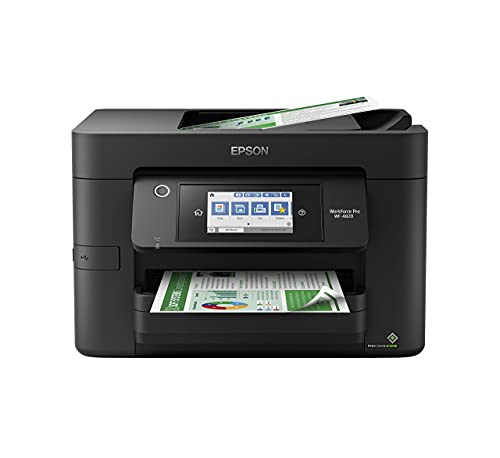
This is a wired or wireless color inkjet all-in-one for letter and legal paper, with printing, copying, scanning and faxing. It has one 250-sheet input tray, automatic two-sided printing, a 35-sheet automatic document feeder, Ethernet, Wi-Fi and USB connections. It uses four separate Epson 822 pigment-ink cartridges rather than refillable ink bottles. ENERGY STAR independently lists the exact U.S. model as certified, with automatic duplex output, 0.84 W sleep power and 0.07 W off power. Epson states 25 black and 12 color ISO pages per minute, plus 350 black or 240 color ISO-page yields for standard cartridges. Its XL cartridges are manufacturer-stated at 1,100 ISO pages each.
This product suits a home office or small workgroup that prints ordinary documents frequently enough to benefit from a 250-sheet tray, automatic two-sided printing and a 35-sheet feeder for one-sided originals. It is also appropriate where Ethernet is preferred over Wi-Fi, or where fax remains necessary. Buyers should expect to use genuine Epson 822 cartridges and should value published ISO speed and yield methods more than unusually low ink cost.
It is not suited to buyers specifically seeking a refillable ink-tank printer or the lowest possible consumables waste. It is also a poor fit for workflows that repeatedly scan, copy or fax double-sided originals because its feeder handles one side at a time. Households that rely on third-party cartridges should take particular care, since Epson says firmware updates may stop previously functioning non-Epson or altered cartridges. It is not a portable battery-powered printer.
The supported 822 cartridge range has model-specific Epson safety data sheets. The standard black cartridge sheet classifies the ink as not dangerous under the OSHA Hazard Communication Standard and shows no hazard pictogram or hazard statement. Ink should still be kept from children and handled as directed, particularly if a cartridge leaks or is damaged. The strongest independently confirmed environmental point is ENERGY STAR certification for this exact U.S. model, including 0.84 W sleep power and automatic duplex output. Epson also offers U.S. mail-in recycling for hardware, ink and packaging. That route should not be mistaken for closed-loop cartridge recycling, because Epson says collected inkjet and toner cartridges are sent to waste-to-energy disposal. Epson's broad recyclable-product statement is not quantified for this printer or its packaging.
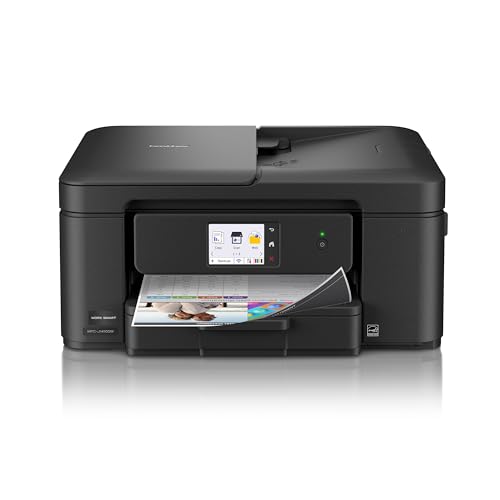
This is a compact, mains-powered color inkjet all-in-one for printing, copying, scanning, and faxing in a home or small office. It has a 150-sheet input tray, a 20-sheet single-sided document feeder, a 2.7-inch touchscreen, Wi-Fi and USB connections, and automatic two-sided printing. It uses four replaceable LC501 ink cartridges. Independent ENERGY STAR records confirm this exact U.S. model is certified, supports automatic duplex output, and is rated at 0.7 W in sleep and 0.1 W off. Brother states a recommended monthly print range of 50 to 1,000 pages, a one-year limited warranty, and starter cartridges rated at about 200 pages each. Its 16 ppm black and 9 ppm color speed claims are manufacturer-stated, but use the ISO/IEC 24734 methodology.
It suits a home worker, student household, or small office that prints within the stated 50 to 1,000-page monthly range and needs occasional copying or scanning of short, single-sided document stacks. The 150-sheet tray and automatic two-sided printing help with routine letters, forms, schoolwork, and invoices. It is also appropriate for users who want a compact wired or Wi-Fi printer with documented ENERGY STAR efficiency and standardized ink-yield disclosures, rather than a photo-focused or high-volume device.
It is not suited to high-volume environments that routinely exceed the manufacturer’s recommended monthly range, or to workflows that need automatic two-sided scanning or copying. Users who require an independently searchable NRTL electrical listing for procurement, institutional safety review, or a sensitive installation should seek a product with that exact record publicly available. It is also a poor fit for buyers avoiding cartridge waste, those who want refillable ink tanks, or Mac users who require a dedicated manufacturer printer driver rather than AirPrint.
Brother provides current safety data sheets that explicitly cover the LC501 and LC501XL ink series used by this product, including separate black, cyan, magenta, and yellow documents. The product safety guide also gives mains-power, servicing, placement, and maintenance instructions. No rechargeable battery is present. No product-specific CPSC recall or safety warning was located in the checks performed. The strongest independently confirmed environmental point is ENERGY STAR certification for the exact U.S. model, including low sleep and off-power figures and automatic duplex output. Brother also states that the product is EPEAT Silver registered, though an issuer-controlled model record was not located in this review. Higher-yield cartridges are available, Brother accepts used supplies for recycling, and it provides a voluntary U.S. mail-back route for end-of-life devices. These measures reduce waste but do not remove the use of disposable cartridges.



