Best Overall
20% off

Squad Hero Rechargeable Laser Tag Set
Rechargeable blasters eliminate the need for batteries.
Vest sensors enhance the immersive laser tag experience.
Suitable for both indoor and outdoor play.
 Daniel Kenitz
Rechargeable blasters eliminate the need for batteries.
Vest sensors enhance the immersive laser tag experience.
Suitable for both indoor and outdoor play.

Rechargeable for endless laser tag fun.
360° sensors enhance immersive gameplay experience.
LCDs provide clear game status updates.

Rechargeable blasters eliminate the need for batteries.
Docking station keeps everything organized and ready.
No vests required for a hassle-free experience.

Interactive play with realistic sound effects.
Adjustable team settings for versatile gameplay.
Long-range for exciting outdoor adventures.

Interactive team play enhances bonding and fun.
Adjustable settings suit all skill levels.
Durable build ensures long-lasting enjoyment.
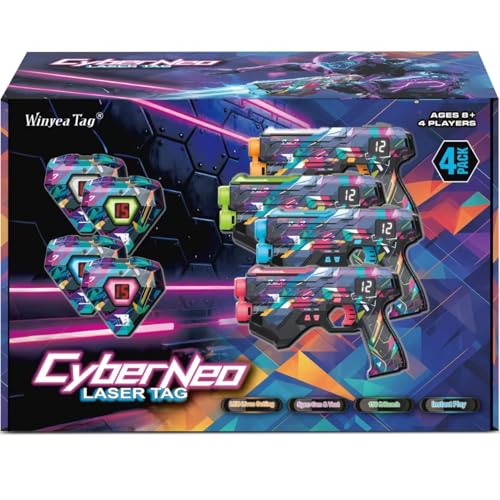
Multiple team settings for varied gameplay options.
Long-range capabilities enhance outdoor fun.
Durable design supports active play.

Interactive LED score display enhances the game.
Four-player set ideal for family fun.
Suitable for a wide age range.
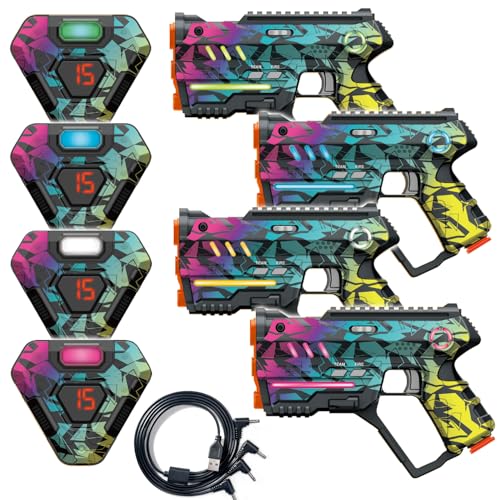
Rechargeable design means no constant battery buying.
Suitable for both indoor and outdoor play.
Fun for all ages, from kids to adults.

Realistic mist spray effect enhances gameplay.
LED digital display tracks scores easily.
Rechargeable feature offers eco-friendly convenience.

Real-time data display enhances gameplay experience.
Rechargeable design for eco-friendly play.
360° sensors offer immersive laser tag action.
The word “laser” is often used loosely. Several reviewed products describe infrared emission rather than a true laser. That distinction matters: a documented infrared LED system is not the same as a laser toy, while a true laser requires verifiable classification and emission evidence. For a real laser, look for FDA-compliant labeling and records under **21 CFR 1040.10 and 1040.11**, including model-specific wavelength, irradiance, accessible-emission, and classification testing from an **ISO/IEC 17025** laboratory. For an infrared system, a clear wavelength and accessible-emission report are still stronger than a generic “eye-safe” or “Class 1” statement.
Range figures are another common source of confusion. Claims such as 110, 130, 150, 190, or 300 feet are not directly comparable unless the maker explains test conditions. Sunlight and other infrared sources can reduce detection, while reflections in confined rooms can create unintended hits. A credible result should state the protocol and conditions, including line of sight, lighting, angle, obstructions, and the number of players. Independent field testing is more useful than a maximum-distance number alone. Claimed runtime and recharge times should likewise be treated as manufacturer figures unless independently tested.
For child-directed sets, look for a model-specific **Children’s Product Certificate (CPC)** citing current applicable rules, supported by testing from a **CPSC-accepted laboratory**. Relevant evidence includes ASTM F963-23 toy-safety testing, battery-operated toy requirements, small-parts and mechanical-abuse testing, lead and phthalate limits, and applicable lead-paint rules. A listing badge, “ASTM certified” image, CE mark, FCC logo, or “tested” statement is not equivalent to a checkable CPC and supporting report. If the set includes Bluetooth, Wi-Fi, or other wireless functions, verify the exact radio hardware through the **FCC Equipment Authorization System** and its Part 15 authorization or supplier documentation.
Also check the play design. Age grading, no-contact instructions, warnings about wet or slippery surfaces, darkness, collisions, damaged parts, small parts, and adult supervision should match the intended users. Wearable straps need secure fitting because multiple reviews identify loose or long straps as a potential strangulation concern. Battery compartments, supplied chargers, charging leads, overheating protection, and abnormal-use testing deserve particular attention in rechargeable products.
Across the supplied products, no public model-specific CPC and CPSC-accepted toy-safety report was located. Independent optical, battery-abuse, charger, chemical, and field-performance evidence was also commonly missing. Repeated cautions include supervising children, preventing wrestling and collisions, avoiding wet or slippery play, keeping equipment away from complete darkness and bright sunlight where applicable, and not assuming advertised range is reliable. Rechargeable sets commonly use internal, non-replaceable batteries, while replaceable-battery sets may require 12, 24, or 28 cells. No category-wide contraindication beyond these recurring supervision, environment, and documentation concerns was found in the supplied data.
The scores below compare the supplied products against the same health, ecological, and evidence criteria. A higher score indicates stronger supplied support for that topic; it does not turn an absent report or certificate into proof of safety.
This measures age grading, instructions, shape, controls, and warnings that reduce foreseeable injury during active play. For laser tag, no-contact rules, dry and open play areas, supervision, secure vest straps, and warnings about darkness or collisions matter. Supplied scores range from 62 to 74: higher-scoring products provide more concrete play guidance, while lower scores have weaker or inconsistent age and safety information.
This measures whether the product accurately identifies infrared or laser emission and provides eye-safety evidence. Infrared descriptions are more informative than using “laser” as a generic label, but wavelength, irradiance, accessible-emission, and classification testing are stronger support. Scores range from 68 to 78. The higher scores include a documented infrared description or related evidence; none of the supplied products had a complete model-specific optical report.
This covers battery access, overheating, short circuits, charging limits, supplied power equipment, and battery-abuse evidence. Rechargeable sets need clear charger and temperature testing; replaceable-cell sets need secure compartments and correct battery guidance. Scores range from 64 to 76. Higher-scoring products have safer documented compartment or charging details, while lower scores reflect missing charger certification, chemistry, or abnormal-operation testing.
This measures resistance to breakage, sharp edges, loose parts, hazardous coatings, lead, and phthalates for the stated age group. These concerns apply to blasters, vests, straps, battery doors, and displays that may be dropped during running play. Scores are tightly grouped from 70 to 72, reflecting that no supplied product had a publicly located model-specific mechanical, chemical, or CPSC-accepted test report.
This measures FCC authorization or supplier compliance for Bluetooth, Wi-Fi, 2.4 GHz synchronization, or other transmitters. It matters because a radio test for one related product does not automatically cover another model. Scores range from 70 to 88. The higher scores reflect a public FCC record or radio test tied more closely to the product, while lower scores lack model-matched authorization evidence or have no wireless feature documentation.
This measures whether safety and performance evidence comes from an accredited independent laboratory and matches the exact product. Full reports with sample identity, methods, dates, and report numbers carry more weight than self-issued CE, FCC, or “tested” logos. Scores range from 68 to 78. The higher scores include a public FCC or related laboratory record, but no supplied product had a complete independent toy-safety file.
This measures whether safety and performance evidence comes from an accredited independent laboratory and matches the exact product. Full reports with sample identity, methods, dates, and report numbers carry more weight than self-issued CE, FCC, or “tested” logos. Scores range from 68 to 78. The higher scores include a public FCC or related laboratory record, but no supplied product had a complete independent toy-safety file.
This measures whether claims about infrared or laser technology, range, player count, outdoor use, runtime, charging, and compatibility match the product and disclose limitations. Scores range from 50 to 74. Higher-scoring products state conditions or acknowledge sunlight and reflection limits; lower scores include contradictory battery or player-count information, unsupported range claims, or feature mismatches.
This measures consistent hit registration at stated distances across sunlight, room lighting, angles, obstacles, reflections, and multiple players. A maximum range is not a field-performance result. Scores range from 60 to 75. Higher-scoring products provide more practical limitations or supporting records, while lower scores rely mainly on seller claims; one reviewed rechargeable set had a customer report of materially shorter effective range.
This measures whether the responsible company, support route, durable product identity, batch information, instructions, and warranty are available if a safety issue emerges. Scores range from 68 to 77. Higher-scoring products identify a responsible company or provide U.S. support and warranty information; lower scores have limited maker, tracking, repair, or support documentation. A lack of a recall result is not proof of compliance.
This measures whether batteries and electronics can be replaced, collected, and recycled rather than discarded as one sealed set. Replaceable AAA or AA cells can be swapped without discarding the blaster, while internal lithium-ion packs may reduce disposable-cell use but limit repair and replacement. Scores range from 68 to 76. Higher scores reflect removable power or clearer recycling direction; most products lacked chemistry and collection details.
This measures durability, repairability, replacement parts, warranty support, packaging restraint, and substantiated recycled-content claims. For active laser tag, durable blasters, serviceable batteries, spare equipment, and repair routes can prevent a short-lived set from becoming electronic waste. Scores range from 68 to 72. The supplied products generally lacked public parts catalogs, repair instructions, packaging specifications, or product-specific durability evidence.
This is a four-player home laser-tag kit for ages 8 and up, with four wired blaster-and-vest pairs and a four-way USB charging cable. Players select a team or solo mode, aim at a chest sensor or blaster target, and use pistol, automatic, reload, and stealth controls during active indoor or outdoor games. The maker states that the product uses infrared emission rather than actual laser rays, has a claimed reach of up to 150 feet, and delivers about eight 30-minute games per charge. The available instructions also say bright sunlight can weaken the infrared signal. Rechargeable lithium-ion power is built into the gear, so users do not replace cells themselves. No product-specific optical-emission report, battery-abuse report, or independent field test was located in this review.
This set fits families, youth groups, and small gatherings that want a contained four-person active game for children at least 8 years old, teens, and adults. It is best suited to a dry yard, basement, gym, or large room where players can set boundaries and an adult can enforce no-contact rules. It also suits households that prefer charging equipment between sessions instead of buying disposable batteries. Treat the stated 150-foot reach as a favorable-condition maximum, especially outdoors.
It is not suited to children under 8, unsupervised younger children, or any play setting where vest straps, running, roughhousing, darkness, or slippery ground cannot be controlled. It is also a poor fit for households needing user-replaceable batteries, documented charger certification, or independently published toy-safety testing before use. Do not rely on the stated outdoor range for bright-sun conditions or tight indoor rooms, where the instructions say infrared performance and aiming can be affected.
The important health distinction is that the product is described by the manufacturer and its available instructions as infrared tag equipment, not a visible laser product. That reduces concern about a conventional toy laser beam, but the evidence reviewed did not include model-specific wavelength, irradiance, accessible-emission, or laboratory eye-safety results. The play instructions include useful practical controls, such as avoiding rough contact, darkness, water, and slippery surfaces. They also identify a small-parts warning for children under 3. For U.S. child-directed toys, CPSC guidance requires applicable third-party testing and a Children's Product Certificate. Neither a product-specific certificate nor substantive independent test report was publicly available in this review. No relevant CPSC recall or public safety-warning result was located. Rechargeable built-in lithium-ion batteries reduce disposable-cell use, but they are not user-replaceable. The instructions call for recycling the electronics through local options, without a documented take-back program or replacement-battery route.
This is a four-player home laser-tag set for ages 8 and up. It includes four handheld blasters, four wearable sensor vests, a charging station, and power adapter. Play is active and no-contact, with selectable teams, adjustable lives, LCD status screens, four game modes, and manufacturer-stated reach up to 150 feet. The product manual identifies the tag signal as invisible infrared, not a true laser beam. The same manual gives important operating limits, including avoiding wet or slippery areas, complete darkness, rough contact, and damaged charging equipment. An FCC equipment authorization record independently ties the SH-001 product family to Champion Games and a Part 15 low-power radio authorization. However, no product-specific Children’s Product Certificate, ASTM toy test report, optical-emission report, or charger safety certification was publicly located.
This set fits households seeking an organized, four-person indoor or backyard game for children age 8 and older, teens, or mixed-age family groups. It is most suitable where an adult can set boundaries for no-contact play, check vest fit, keep the area dry and well lit, and inspect the charger and cables. It also suits buyers who value rechargeable equipment and may want a practical route to replace a lost blaster, vest, or charging component rather than discard the full set.
It is not suited to children under 8, unsupervised younger children, or play spaces where running, wrestling, stairs, pools, darkness, wet surfaces, or traffic hazards cannot be controlled. Avoid it for households that need independently published toy-compliance, optical-emission, charger-certification, or battery-abuse reports before allowing child use, because those product-specific records were not publicly available. It is also a poor fit for users expecting dependable long-range outdoor tagging in direct sun, since the instructions acknowledge infrared interference.
The product is presented as an infrared game rather than a real laser product. Its instructions include concrete risk controls for active play, including no wrestling, no wet or slippery conditions, no complete darkness, adult supervision for young children, and attention to the vest straps. The FCC authorization record supports that the matching product family includes a compliant low-power wireless device, but it does not substitute for toy-safety, battery, charger, or optical-emission testing. The built-in lithium-ion batteries reduce disposable-battery use, but they cannot be removed or replaced by the user. Instructions direct users to recycle the electronics rather than put them in household trash. The manufacturer also lists replacement guns, vests, and charging equipment, a meaningful repairability positive. Publicly accessible evidence did not establish a model-specific Children’s Product Certificate, accredited toy test report, charger certification, or materials report for this product.
This is a four-blaster, rechargeable infrared tag set for ages 8 and up. Each plastic blaster has its own hit receiver, team selector, trigger, reload control, lights, vibration, and sound feedback. The included dock is intended to charge all four units together. Play is based on aiming at another blaster rather than using wearable vest targets. The manual states that these are not actual lasers, but infrared emitters. That distinction is meaningful because FDA treats LED laser-tag toys differently from true laser toys. The same manual recommends adult supervision, directs users to avoid moisture, heat, drops, and direct sunlight, and says to use only the supplied adapter. A retailer page reproduces manufacturer claims of up to six hours of play, one to two hours of charging, and a 130-foot maximum range, but no independent range, runtime, optical-output, or charger test report was located.
This set fits supervised family games, birthday gatherings, and indoor play spaces where four people can start with one shared kit. It is particularly suited to households with children age 8 or older who want tag play without managing vests, loose darts, or a separate scoring system. The dock can be useful where the set has a consistent indoor storage and charging spot. Buyers should treat the stated runtime and maximum distance as manufacturer figures, not independently verified performance guarantees.
It is not a strong fit for children under 8, unsupervised use, rough play, wet settings, or locations where blasters may be dropped, left in heat, or used in direct sun. Buyers who need confirmed electrical certification for the supplied adapter, independently verified eye-safety measurements, or a publicly available compliance certificate should choose a product with those records. It also does not suit buyers who expect proven outdoor range or consistently documented hit registration in bright daylight.
The most important health point is terminology. The manual says this product uses an infrared beam and does not contain an actual laser. FDA distinguishes LEDs from laser diodes, so the word laser tag does not by itself establish that the product is a regulated laser device. However, no model-specific optical-output or irradiance report was found, so the infrared claim should not be read as independent emission testing. The manual provides sensible use limits, including adult supervision, keeping the set dry, avoiding heat and direct sunlight, avoiding drops, and using only the supplied adapter. It also contains an FCC Part 15 statement, but no public equipment authorization, charger certification listing, Children's Product Certificate, or independent laboratory report was located. The rechargeable design can reduce disposable-battery use, but there are no product-specific instructions for battery removal, replacement, or U.S. recycling. No product-specific CPSC recall or safety warning was located in searches completed August 16, 2026.
This is a two-player electronic tag game with two handheld blasters and two adjustable sensor vests. Players install three AAA batteries in each unit, select teams, pair each blaster to a vest, and score hits through the vest or blaster target. The set has LCD life displays and four game modes. It is intended for children ages 8 and older. The maker states that the blasters and vests synchronize life and team data, support up to four teams, and can reach 125 feet. The available instructions narrow that range claim to 125 feet to a vest and 80 feet to a blaster target. Those instructions also identify the tag emitter as 950 nm infrared, not a true laser. A model-matched FCC authorization record and radio test documentation were located for its wireless hardware, but public model-specific toy-safety testing and a Children's Product Certificate were not located.
This set suits an adult-supervised household with two children or a child and adult who want a compact, physical indoor or backyard game. It is most appropriate for players age 8 or older who can follow no-contact rules, keep straps properly fitted, and understand that targets need a clear line of sight. It also fits buyers who prefer replaceable AAA power to charging cables and who can supply 12 batteries before the first game. Larger groups can use compatible sets, according to the maker.
It is not a good fit for children younger than 8, children who may chew or tangle vest straps, or settings where close-contact chasing is hard to supervise. Avoid it for wet lawns, poolsides, dim rooms, stairways, driveways, or crowded spaces where running raises collision risk. Buyers needing independently published toy-safety, optical-emission, material, or durability reports should choose a product with those records available. It also does not suit households seeking rechargeable power or low ongoing battery consumption.
The strongest safety documentation found is for the wireless electronics. A model-matched FCC authorization record and radio test submission identify the hardware as an authorized Part 15 device. The instructions give useful play warnings, including avoiding contact play, darkness, wet or slippery surfaces, and unsafe use of the long vest straps. They also state that the tag system uses 950 nm infrared rather than a true laser, though that statement was not backed by a public optical test report. All four units use replaceable AAA batteries behind screw-secured covers. This avoids a supplied charging adapter and lets depleted cells be replaced, but two-player use requires 12 batteries and no model-specific recycling instructions were located. No model-matched public Children's Product Certificate, accredited toy-safety report, chemical test report, repair instructions, or packaging-material disclosure was located. Searches did not locate a matching public CPSC recall or safety warning for this product.
This product is a four-player infrared tag game for children ages 8 to 13. It contains four plastic blasters and four wearable vests, and independent retail records list a requirement for 12 AA batteries. Players choose one of four teams, set lives from 1 to 99, and use the blaster and vest together to register hits. Retail records also list no darts or water-projectile play. An independent retail listing corroborates the four paired blasters and vests, plastic construction, AA battery requirement, and a claimed infrared range of up to 150 feet. The decisive limitation is the evidence trail. No model-specific Children's Product Certificate, CPSC-accepted laboratory report, optical-emission data, battery-compartment test, or published field test was located. The stated range remains a manufacturer claim without lighting, angle, obstacle, or outdoor-use conditions. Public records name the manufacturer, but do not establish a U.S. support contact, batch labeling, replacement parts, or recycling instructions.
This product suits households with roughly four children or mixed-age players who want a self-contained active game for indoor rooms, basements, backyards, or parties. It is most appropriate when a supervising adult can set boundaries around running, stairs, traffic, and aiming behavior. It also fits buyers who prefer replaceable standard batteries over charging downtime and accept that the stated long-range performance has not been independently substantiated. The labeled age range starts at 8 years.
It is not suited to homes seeking documented third-party toy testing, a readily available Children's Product Certificate, or independently verified eye-safety and performance data. Choose a different product for younger children, especially where battery access cannot be supervised, because no model-specific battery-compartment assessment was found. It is also a poor fit for buyers expecting dependable long-distance outdoor play in sunlit or obstructed spaces, or for families that need replacement vests, repair parts, a clear U.S. support route, or formal recycling instructions.
This battery-operated plastic toy is marketed for ages 8 and up and uses infrared tagging rather than darts. CPSC guidance makes ASTM F963 battery-operated toy requirements applicable to battery toys, including safeguards against battery access and overheating. No model-specific test report, Children's Product Certificate, optical-emission measurement, or independent mechanical and chemical test result was publicly located. No model-specific CPSC recall was identified in the searched recall database through August 16, 2026. The replaceable AA format can extend useful life because depleted cells need not make the blasters disposable. It also creates a recurring battery burden, with 12 AA cells required and no public chemistry disclosure or product-specific disposal instructions located. EPA identifies AA alkaline and zinc-carbon batteries as common household cells and recommends checking local recycling options. No public evidence was located for recycled material content, restrained packaging, spare parts, repair instructions, or a take-back program.
This is a four-player infrared tag set for indoor or outdoor active play. The product page identifies four blasters and four vests, with each vest wired to its blaster. It is labeled for ages 8 and up, carries a small-parts choking warning, and requires 24 AAA batteries across the set. The seller describes real-time hit and life synchronization, four selectable play modes, compatibility with same-model sets, and a 150-foot range. Those are manufacturer claims, not independently reproduced performance results. The listing calls the units infrared blasters, which is important because it does not establish that they contain a true laser. No model-specific optical output, wavelength, battery-abuse, mechanical-abuse, or chemical test report was publicly available in the verification work.
This set suits households, youth groups, or party hosts with four players age 8 or older who want a simple, physical indoor or dry-weather outdoor game without foam ammunition. It is most practical for buyers prepared to supply and manage 24 AAA batteries, keep play areas free of trip hazards, and supervise energetic running and aiming. The wired vest design may suit users who prefer each player’s equipment to remain directly linked rather than paired wirelessly.
It is not well suited to homes with children under 8, especially where small parts could reach younger siblings. It also does not fit buyers who require independently available U.S. toy-compliance records, optical-emission data, or verified range testing before use. Choose another format for wet-weather play, players who strongly dislike cables between equipment, or households that want rechargeable hardware and documented battery recycling guidance rather than managing 24 disposable AAA cells.
The product page names infrared blasters and gives an 8+ age grade, while also displaying a small-parts choking warning. Those disclosures are useful, but they are not substitutes for a model-specific safety file. Public verification did not locate a Children's Product Certificate, a CPSC-accepted laboratory report, or independent evidence covering mechanical abuse, restricted chemicals, battery safety, or optical emissions. No product-specific CPSC recall or safety warning was located in the public searches reviewed. The set relies on 24 AAA batteries. This allows replacement instead of dependence on an embedded battery, but it also increases disposable-battery use. The available product information does not identify battery chemistry, provide recycling instructions, or offer replacement blasters, vests, straps, or repair guidance. Store batteries away from young children, use matched cells as directed, and use an appropriate local battery collection route when cells are spent.
This is a battery-powered home laser-tag set sold as four handheld blasters with digital score-display vests, intended for active indoor or outdoor games by children eight and older. The supplied product record says the full four-player package needs 28 AAA batteries and includes no charger or rechargeable pack. An externally hosted IJO instruction document describes the underlying game format as infrared rather than an actual laser, with hit-vibration feedback, adjustable vest straps, display-based life tracking, and replaceable AAA cells. It does not provide an optical test report, battery-compartment test, or field-test data. It also describes a two-player package for ages six and up, rather than this four-player, age-eight-and-up product, so it cannot fully verify the exact package or its performance claims.
This product fits households planning occasional, supervised party or backyard games where users can supply and manage many AAA batteries. It is most suitable for families who want a screen-light group activity and can establish a clear play area away from roads, stairs, fragile objects, and water. It also suits buyers comfortable treating the infrared, range, durability, and age claims as manufacturer statements rather than independently validated performance specifications. Adults should check vest fit, battery doors, screws, and function before each session.
It is not well suited to buyers who require documented U.S. toy compliance, a model-matched Children's Product Certificate, or independently verified laboratory safety results. Avoid relying on it for unsupervised play by children who may run near traffic, pools, stairways, or breakable furnishings. It is also a weak fit for users who need proven outdoor distance or sunlight performance, households seeking rechargeable equipment with a supplied certified charger, or anyone who needs replacement parts and clear end-of-life collection instructions before purchase.
The main health-positive point is the stated infrared, non-laser tagging mechanism. FDA guidance notes that true toy lasers need careful controls and recommends Class 1 labeling for minimal-risk laser toys. Here, no accessible-emission data or Class 1 evidence was found, so the infrared description should not be treated as independently confirmed eye-safety testing. The instructions also call for dry use, no rough drops, secure vest straps, and routine checks for loose screws. The set uses removable AAA batteries rather than a sealed rechargeable pack. That can extend service life because depleted cells can be replaced, and the instructions advise removing batteries during storage to limit leakage. However, no battery chemistry disclosure, recycling program, replacement-parts catalog, packaging specification, or exact-model durability report was located. No product-specific CPSC recall or safety warning was identified in the searched official recall resources.
This is a rechargeable, four-player infrared tag game for active indoor or outdoor play. The set is listed with four handheld blasters and four wearable vests, a stated age range of 8 to 15, plastic construction, lights, vibration and sound effects, and indicators intended to show team, life and ammunition status. A separate retailer listing corroborates the four blasters, four vests and charging cables. The product is marketed as “laser tag,” but the available product description identifies infrared tagging rather than confirming a true laser emitter. The maker states a 150-foot range, synchronized blaster and vest status, and support for four teams. Those feature and distance claims were not supported by a published model-specific field test, optical report, or charging and battery-abuse report. The listing gives a small-parts choking warning and says it is not for children under 3.
This set suits supervised families, youth groups, and party hosts who need a ready-made four-person active game for children age 8 and older. It is most appropriate where players have a clear indoor room, yard, or other defined play area and can agree on boundaries before running. The paired vest format may suit buyers who want visible team and hit-status feedback rather than a game based only on honor-system calls. Buyers should treat the stated long range as conditional, not as independently demonstrated outdoor performance.
It is not suited to children under 8, especially households where a small-parts warning or rough handling creates added concern. It is also a poor fit for buyers who require checkable laboratory evidence before providing a rechargeable electronic toy to a child, because no public model-specific compliance certificate, optical report, battery report, or materials report was found. Choose another option for frequent unsupervised outdoor play, highly bright conditions, or situations where a documented warranty, replacement battery route, repair parts, and disposal instructions are essential.
The important safety distinction is that available product descriptions call this an infrared tag system, despite the common “laser tag” wording. That is more informative than treating the name alone as proof of a laser. However, there is no public model-specific optical output or classification report, so eye-safety performance cannot be independently confirmed. The product is age-graded for 8 to 15 and carries a small-parts choking warning, but its public materials do not provide a checkable Children's Product Certificate or third-party test report for mechanical, chemical, battery, or charging requirements. Rechargeable operation can reduce the flow of disposable batteries. The environmental limitation is that the battery chemistry, removability, replacement availability, and end-of-life instructions are not publicly disclosed. If the set uses lithium-ion cells, U.S. EPA guidance says batteries and devices containing them should not go in household trash or curbside recycling. No product-specific CPSC recall or safety warning was identified in the public records searched.
This is an eight-piece laser-tag play set for ages 8 and up, with four handheld taggers, four wearable vests, a multi-port charging cable, LED status displays, vibration feedback, and water-mist reservoirs. A separately hosted version of the product manual identifies the tagging system as infrared, rather than documenting a visible laser emitter. It also describes five game modes, four team colors, adjustable vest straps, and play with either the guns or vests as receivers. The manual states that the rechargeable units charge by USB in about two to three hours, while the brand site states typical continuous play time of six to seven hours. Those are manufacturer statements, not independently tested figures. Claimed maximum range is inconsistent across available materials, appearing as 40 meters in the marketplace record and up to 45 meters in the manual, with no stated test conditions.
This set suits supervised households with children at least 8 years old who want a four-person, screen-free party or backyard activity and can manage rechargeable electronics. It is most practical where adults can set team colors, check that vest straps fit securely, charge the units before play, and oversee the optional water-mist feature. The documented infrared receiver system also makes it appropriate for families that prefer non-projectile tag play, provided they accept that the claimed range has not been independently verified.
It is not well suited to households that require publicly checkable toy test reports, a product-specific compliance certificate, or documented optical-emission testing before allowing child use. Avoid relying on it for large-field or bright-sunlight games where dependable long-range tagging is essential, because no independent field protocol was located and the published range figures conflict. It also needs more care than dry-only indoor toys, since the vest reservoir must be filled with clean water, emptied afterward, and kept away from immersion.
The useful health distinction is that the available manual describes built-in infrared receivers. That supports treating this as an infrared tag system in normal use, not assuming that the word "laser" proves a visible laser beam. However, no model-specific wavelength, emission test, FDA laser classification, or Class 1 label was found. FDA guidance says a Class 1 label is the low-risk indicator for an actual children's laser toy. The set is age graded 8 and older, but publicly available evidence did not establish its mechanical, chemical, battery, or charging test results. Rechargeable batteries can reduce the stream of disposable cells during ordinary play. The tradeoff is that the battery chemistry is only broadly identified as lithium polymer, with no public removal instructions, replacement-cell listing, certified charging-adapter record, or end-of-life recycling instructions. No JakMean-specific CPSC recall or warning was located in the searched public recall material, but buyers still need to retain packaging and check the product itself for a tracking label, batch information, and importer contact details.
This is a four-player electronic laser tag set for children aged 6 and older. It includes four handheld blasters, four vests with back receivers, and two multi-port USB charging cables. VATOS describes the game as an infrared system with chest, back, and blaster target zones, real-time displays, and four weapon modes. Those play and range features are manufacturer-stated, not independently field tested. The word laser describes the game format, while VATOS says the blasters use invisible infrared rather than a visible laser beam. Independent evidence is stronger for the wireless link. A 2025 accredited-lab report covers BB5806B within an equivalent model family and records compliant 2.4 GHz testing under FCC Part 15C. The public report does not test impact resistance, chemical content, battery abuse, optical output, or live-game hit accuracy.
This set suits families or small groups who specifically want four people to start playing together without buying extra receivers, vests, or disposable cells. It is most appropriate for supervised indoor play in a clear room, or outdoor play in a defined area away from roads, stairs, pools, and traffic. The age 6 and older grading makes it a better fit for school-age children who can follow charging and active-play rules, alongside teens or adults who can help manage setup and inspect damaged gear.
It is not suited to households that require publicly available proof of full U.S. toy testing, a product-specific compliance certificate, or independently measured infrared eye-safety data. It also is not the right fit for unsupervised rough play, wet conditions, or play near hazards where running and reduced attention can lead to falls or collisions. Buyers seeking confirmed long-distance outdoor performance, repairable batteries, replacement parts, or documented recycling instructions should note that these details were not publicly substantiated for this product.
VATOS identifies the system as invisible infrared rather than a visible laser. That distinction is useful, but no product-specific optical wavelength, accessible-emission measurement, or laser classification report was publicly available. A published independent radio test does support the 2.4 GHz communications hardware, including Part 15C emissions testing for a declared model family that includes this product. It does not establish the safety of the infrared emitter or the toy as a whole. The set is described as rechargeable lithium-ion equipment, which can reduce disposable-battery use. However, no public battery-removal procedure, cell specification, replacement-battery route, or U.S. recycling instruction was found. EPA guidance says lithium-ion batteries should not go in household trash or curbside recycling. A December 4, 2025 CPSC recall involved a different Vatos Toys building set with accessible button cells, not this laser tag product. It is relevant to maker traceability, but it is not evidence of a defect in this set.