Best Overall
15% off

Alilo Talking Pen and Audio Books Set
Interactive learning through engaging audio stories.
Durable design, safe for young children.
Easy to use with intuitive touch controls.
Members Only
Checked by ReviewTier
 Daniel Kenitz
Interactive learning through engaging audio stories.
Durable design, safe for young children.
Easy to use with intuitive touch controls.
Engaging audio for interactive learning experience.
Supports early education and autism-friendly features.
Durable and safe design for young children.

Interactive learning with talking pen feature.
Includes comprehensive phonics book collection.
Dual boards for versatile educational play.

Engaging dinosaur design captivates young learners.
Interactive phonics cards enhance language skills.
Suitable for diverse learning needs, including autism.

Engaging audio enhances learning experience.
Suitable for diverse learning needs.
Encourages interactive play and education.

Engaging light-up feedback enhances learning experience.
Compatible with a variety of educational sets.
Durable design suitable for classroom use.

Interactive learning with self-checking technology.
Engaging content tailored for kindergarten readers.
Promotes independent study and confidence-building.

Interactive audio enhances reading engagement.
Encourages independent learning and exploration.
Includes a diverse selection of books.

Encourages early literacy through interactive play.
Durable materials designed for young learners.
Engaging activities captivate children's attention.

Engaging audio pen enhances learning experience.
Screen-free design encourages imaginative play.
Suitable for a wide age range.
Start with the learning task. A set aimed at phonics should identify what children practice—such as letter-sound links, short and long vowels, or decodable words—and provide a clear sequence rather than only a large word count. Vocabulary and nursery-rhyme sets can support listening and language play, but plausible exposure is not proof of improved reading, speech, or school readiness. Claims about autism, speech disorders, sensory needs, or therapeutic benefit require independent human evidence for the product or a genuinely equivalent intervention. A high word, game, or lesson count may describe marketing content rather than independently reviewed material, and public descriptions can conflict about how many books are included.
For a safety-focused purchase, look for a current Children's Product Certificate for the exact model and production run. The certificate should identify the manufacturer or importer, production date and place, applicable rules, test dates, and a CPSC-accepted laboratory. Relevant U.S. requirements can include 16 CFR Part 1303 for lead-containing paint, 16 CFR Part 1307 for prohibited phthalates, 16 CFR Part 1501 for small parts, 16 CFR Part 1505 for electrically operated toys, and the applicable ASTM F963-23 requirements under 16 CFR Part 1250. A seller's statement that a product is “tested,” “non-toxic,” or compliant with European standards is not the same evidence.
Audio deserves separate attention. Volume buttons, mute settings, or several volume levels are useful controls, but they do not establish a safe maximum output. Look for sound-producing-toy testing under ASTM F963-23 Section 4.5 and clear instructions for volume and headphone use. For wireless or Wi-Fi-enabled pens, check the FCC Equipment Authorization System, an FCC ID where applicable, or a Supplier's Declaration of Conformity. Charging instructions should identify the correct cable or power source and explain supervision, damaged-cable precautions, and battery handling.
Environmental claims also need specifics. A rechargeable pen may reduce routine disposable-battery use, while replaceable AAA batteries can avoid dependence on a sealed battery and may extend useful life. Neither proves that the product is repairable or recyclable. Look for battery-service, repair, replacement-parts, take-back, and end-of-life instructions. “Recycled,” “eco-friendly,” or responsibly sourced packaging claims should state the material, percentage, scope, and disposal route, with supporting certifications such as FSC or named recycled-content verification where claimed.
Across these products, the recurring limitation is missing public, product-matched U.S. certificates and laboratory reports. Sound output, material chemistry, battery safety, and small-part testing therefore often remain unconfirmed. Several sets also lack independent learning studies, repair or recycling programs, and clear age guidance. Do not treat therapeutic language as established benefit, and use extra supervision with young children, batteries, charging cables, detachable accessories, or any set whose advertised age range conflicts with its specifications.
These topics reflect the supplied reviews and scores, not a guarantee that any product is safe or effective. A higher score means the available evidence was stronger relative to the other products reviewed; it does not replace checking the exact product's documents, instructions, age guidance, and condition.
This measures evidence that accessible plastics, coatings, inks, adhesives, cards, and pen parts meet U.S. lead, phthalate, and soluble-element limits. It matters because children handle and sometimes mouth books and pens. Scores were tightly grouped: the strongest was Tappi at 75, while many products scored 70-72. High scoring here reflects better documented material safety, not merely a “non-toxic” claim.
This covers choking, sharp edges, loose parts, overheating, shock, charging, and battery access. Talking pens add electronic and battery hazards to ordinary books, especially when used by preschoolers. Supplied scores ranged from 69 to 76. The higher-scoring LeapFrog set had specific adult charging, cable, heat, moisture, and battery instructions; lower-scoring products generally lacked product-matched reports or clear battery-safety documentation.
This measures sound-output testing and practical volume control for speech, songs, and effects. A mute button or adjustable volume helps, but does not prove that maximum output is safe. Scores ranged from 69 to 76. Tappi's eight stated volume levels and some Educational Insights products' documented low, high, and mute settings distinguish them from products with no public volume specification, although measured output was generally unavailable.
This considers whether books, prompts, pronunciation, feedback, and challenge levels suit the stated age and support learning without confusing or overloading children. Scores ranged from 67 to 80. The strongest sets had defined early-literacy sequences or substantial documented lesson structures, while lower-scoring sets had incomplete content access, inconsistent age guidance, or broad claims without a curriculum map or qualified content review.
This measures documentation for charging electronics and any Bluetooth, Wi-Fi, or other radio functions. It matters because a talking pen may be an electrically operated toy or intentional radiator. Scores ranged from 69 to 79. LeapFrog scored highest because its manual included an FCC Part 15 Supplier's Declaration of Conformity; Tappi's Wi-Fi claim lacked a matching public authorization or identifier.
This asks whether independent human studies demonstrate gains in reading, phonics, vocabulary, language, or school readiness for the product or a genuinely equivalent intervention. Scores ranged from 68 to 72, showing little separation. None had a product-specific study located in the review materials. A plausible phonics sequence or interactive format is not the same as demonstrated educational benefit.
This measures whether advertising stays within what the supplied specifications, testing, content, and evidence can support. Scores ranged from 52 to 78. LeapFrog scored highest among the set, while lower-scoring products used broader therapeutic, safety, battery, or learning language than their documentation supported. Conflicting book counts, ages, battery claims, and unsupported autism or speech claims are important warning signs.
This measures whether the exact U.S. product has a current Children's Product Certificate and passing reports from a CPSC-accepted laboratory for every applicable rule. Scores ranged from 68 to 76. Tappi scored highest because more compliance claims were supplied, but its underlying certificate and reports were still not public. Most products lacked the documents needed to verify chemical, mechanical, electrical, battery, and sound compliance.
This measures whether the responsible company and production run can be identified and whether recalls, warnings, or recurring safety patterns are addressed. Scores ranged from 69 to 78. LeapFrog and Tappi scored highest for identifiable responsible companies, support or warranty information, and no identified product-specific recall in the supplied checks. A clean search is not proof that every production run is compliant.
This measures durability, replaceable or serviceable batteries, repair support, replacement parts, warranties, and real reuse or recycling routes. It matters because books may outlast the electronic pen. Scores ranged from 69 to 75. Replaceable AAA designs scored well for avoiding sealed batteries, while LeapFrog's support and recycling contact helped its score; most products still lacked documented repair or take-back programs.
This measures specific, supported claims about paper sourcing, recycled content, reduced plastic, packaging, recyclability, and disposal. It matters because these sets combine printed materials with electronics. Scores ranged from 62 to 72. Products with identified paper or packaging claims scored somewhat higher, but the supplied reviews repeatedly noted that broad recycled, responsible, or eco-friendly statements were not product-specific or independently substantiated.
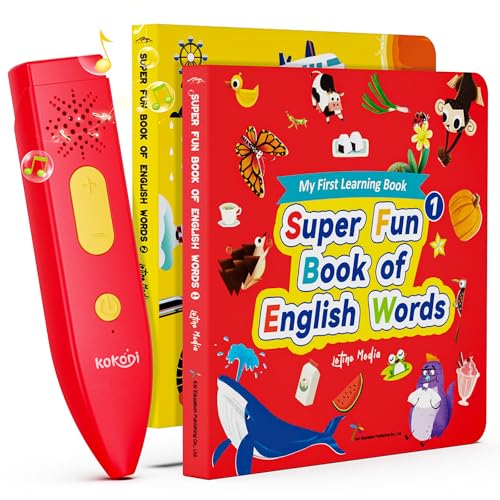
This product is a rechargeable, touch-activated audio pen set for children ages 3-6. It is used by touching the pen to its three nursery-rhyme books, 100 picture flash cards, alphabet and piano card, or 540 recordable stickers. The published manual describes pronunciation, songs, stories, games, recording, volume buttons, a child lock, USB-C charging, and a lithium-ion battery. It lists about six hours of use per charge, while another alilo product page says up to five hours. The accessible material is primarily English vocabulary, rhymes, stories, and sound activities. The content list is concrete, including 47 nursery rhymes, 16 stories, and 14 sleep-music tracks. The manufacturer and a European distributor state ABS plastic and silicone components and compliance with European toy standards, but no product-matched U.S. compliance certificate or third-party laboratory report was publicly supplied for this review.
This set suits a caregiver who wants a screen-light, English-language activity for a child roughly 3-6 years old and plans to participate at least initially. It offers repeated touch-and-listen practice with familiar topics such as animals, colors, food, vehicles, letters, rhymes, and recorded family messages. It also fits households that can charge the pen by USB-C and use the volume buttons deliberately. Its value is in guided vocabulary, listening, music, and play, rather than in a demonstrated reading curriculum.
It is not a good fit for families that require independently documented U.S. toy-safety testing before bringing a rechargeable electronic toy into the home. It is also unsuitable for unsupervised high-volume listening because no measured sound-output limit was found. Buyers seeking a structured phonics program, evidence of school-readiness gains, Spanish or multilingual content, or a child-specific adaptive curriculum should look elsewhere. Families needing a replaceable battery, formal recycling program, or clear end-of-life instructions will find those details missing.
The pen is described in published product materials as ABS plastic with silicone controls and an integrated lithium-ion battery. A European distributor claims CE, EN 71, and EN 62115 compliance, but these are not substitutes for a current U.S. product certificate and third-party reports. No matching U.S. CPSC recall or public warning was identified in the searches performed. The available instructions do provide volume adjustment, a child lock, dry-cleaning guidance, and direction to use the supplied USB-C cable. The rechargeable design can avoid disposable-battery use, and alilo provides troubleshooting, downloadable content, and a repair-video link. However, the battery is built in, no replacement-battery or take-back route was found, and no material-recycled-content, paper-source, packaging, or recyclability evidence was supplied. At end of life, the product should be handled through an appropriate electronics or lithium-ion battery collection route, not household trash or curbside recycling.
This is a battery-powered, tap-to-hear learning set for young children. A child touches pictures or words in the supplied books with the electronic pen to hear spoken vocabulary, sounds, and activities. The manufacturer describes a vocabulary version with two books, 22 themes, more than 450 words, sound effects, and games. Those content counts are manufacturer-stated, not independently audited. An independently hosted manual for this product describes a pen using two replaceable AAA batteries, with a battery door secured by a screw. That is a practical design choice for a child-directed electronic toy. However, publicly accessible product-specific safety certificates, laboratory reports, sound-output results, material disclosures, and a curriculum review were not located. Public documentation also gives inconsistent book counts, so buyers should confirm the included package version before relying on advertised content totals.
This suits a household seeking a compact, screen-free activity for a child roughly two to five years old who enjoys pressing, tapping, and repeating familiar words. It is most concrete as a casual vocabulary and listening activity for supervised use at home or during travel. The replaceable AAA power arrangement may also suit caregivers who prefer not to manage proprietary charging cables or an aging internal battery. Buyers should confirm exactly which book variant and language content are included before purchase.
It is not appropriate for families seeking a documented intervention for autism, speech delay, language disorder, or school-readiness outcomes. The marketing uses therapeutic language, but no product-specific human study or qualified clinical support was located. It is also a poor fit for buyers who require public proof of chemical, sound, and toy-safety testing before introducing an electronic toy to a young child. Children who mouth objects or cannot use the pen under supervision need particular care around the AAA battery compartment.
The clearest health-positive design detail is the screw-secured compartment for two AAA batteries, described in an independently hosted manual. The product does not appear to use a button or coin cell, which avoids that particular ingestion hazard. Still, this review did not locate public evidence for the exact product's Children's Product Certificate, CPSC-accepted laboratory testing, sound-level testing, or chemical testing. The accessible materials also do not establish the plastics, coatings, inks, adhesives, or book-board composition. The replaceable AAA batteries can extend the pen's usable life compared with a sealed battery design. Used AAA batteries have local disposal and recycling options, depending on chemistry and local rules. No verified replacement-books policy, repair service, paper certification, recycled-content disclosure, lower-plastic packaging detail, or manufacturer take-back route was located. The therapeutic autism and speech claims should not be treated as established health benefits.
This is an early-literacy set for children ages 3 to 6. It combines a rechargeable handheld reading pen with eight tap-responsive books, two general-knowledge books and six phonics storybooks. The product page states that the pen includes four nursery rhymes and that the books provide more than 600 illustrated words, 700-plus questions or games, and letter-sound activities. Amazon product details independently confirm a plastic pen, a cardboard-edition book set, and one included rechargeable battery. The listed content sequence, tapping a letter, word, or picture to hear audio, is plausible for supported phonics and vocabulary practice. However, the full books, audio files, sound level, curriculum review process, and learning outcomes were not publicly available for independent assessment.
This set suits a caregiver seeking a structured, screen-free-feeling shared activity for a child around ages 3 to 6 who enjoys tapping pictures and hearing immediate feedback. It is most useful as supervised practice alongside ordinary read-alouds, conversation, and adult help with pronunciation or game prompts. The stated six phonics storybooks and two general-knowledge books give a family a compact way to rotate vocabulary and letter-sound activities without needing a subscription or frequent disposable batteries.
It is not suited to children under 3, who fall outside the stated age range and may be at greater risk from a damaged pen, cable, or small detached component. It is also a poor fit for households that require documented chemical testing, a product-matched safety certificate, verified sound limits, or named curriculum experts before offering an electronic toy to a child. Families needing replaceable batteries, repair support, or a defined electronics recycling route should look for those policies in writing.
The most important health limitation is documentation, not a confirmed defect. The product is sold for young children and uses a rechargeable electronic pen, but no public exact-product Children's Product Certificate, CPSC-accepted laboratory report, sound test, or battery-safety report was located. A search did not locate a CPSC recall or product safety warning under the product or brand name, but that is not evidence that every production run has been independently verified. The available product information identifies a plastic pen and a cardboard-edition book set. It does not disclose the plastics, inks, coatings, adhesives, paper source, or recycled content. Rechargeability can reduce disposable-battery use, yet no public instructions were located for battery replacement, repair, take-back, or end-of-life recycling. The environmental description therefore remains limited to the stated physical format, rather than a substantiated lower-impact materials program.
This is a plastic dinosaur-shaped audio pen and flash-card learning set. Independent retail records identify one pen, 74 cards, six stickers, a language-skills objective, and dimensions of about 8.46 by 4.33 inches. The pen is intended to be touched to images or words for spoken responses and sound effects. The advertised content covers letters, numbers, everyday objects, and vocabulary. Retail descriptions derived from manufacturer copy state that it has adjustable volume and roughly 800 spoken words, but no full card set, audio library, curriculum map, or qualified content review was available for independent checking. The stated age range is inconsistent, with title copy extending to age 8 while manufacturer specifications and independent listings indicate 36 months to 6 years.
This set fits a caregiver or early-childhood educator seeking a compact, screen-free sounding-out and naming activity for a child roughly 3 to 6 years old. Its card-and-pen format can support short, supervised vocabulary or letter-sound sessions at home, in travel bags, or in a quiet classroom station. It is most suitable when an adult can check pronunciation, model language, keep volume low, and treat the prompts as a supplement to conversation, shared reading, writing, and physical play.
It is not a substitute for speech-language services, autism support, hearing assessment, or an evidence-based literacy program. Families needing documented chemical, electrical, battery, choking, or sound testing should not rely on the available listing information alone because a product-matched certificate and laboratory reports were not located. It is also a poor fit for children over the independently repeated 6-year upper age, for children who mouth cards or accessories without close supervision, or for households that need repairable electronics and a defined recycling route.
The accessible product information identifies plastic construction, a named manufacturer, and a card-and-pen format, but it does not provide a product-matched Children's Product Certificate, laboratory name, testing dates, or reports for lead, phthalates, soluble elements, small parts, electrical safety, battery access, or sound output. CPSC rules require children’s-product certification based on third-party testing, but the required documentation was not publicly available here. No CPSC recall or safety warning specific to this product was identified in the checks performed. The learning format has a plausible basis because guided work on letter-sound links and vocabulary is consistent with early-literacy guidance. That does not validate the product’s broader autism, sensory, speech-practice, or learning-benefit language. No recycled-content, paper-source, packaging, repair, replacement-parts, battery-removal, take-back, or recycling documentation was found. Plan for ordinary electronic and battery recycling through local approved programs when the pen reaches end of life.
This is a battery-powered talking-pen set intended for young children. The pen is meant to be pressed on words or pictures in included printed books to play recorded speech, sounds, and activities. A separately indexed retailer describes two books, 22 topics, more than 450 words, more than 300 sound effects, 500 activities, voice recording, and AAA battery power. Those are manufacturer-stated specifications, not independently tested performance figures. The stated age range is unclear. The product title markets it for ages 2 through 5, while externally indexed specifications list a manufacturer minimum age of 12 months and a maximum age of 60 months. No public copy of the full books, audio files, instructions, curriculum review, or exact-product safety certificate was located. The seller also makes claims about autism, speech delays, language development, non-toxic materials, and eco-friendly construction without supporting documentation.
This set suits a caregiver seeking a compact, offline language-play activity for a child roughly 2 to 5 years old who enjoys pressing pictures and hearing words or effects. It is most appropriate when an adult can sample the vocabulary, monitor volume, inspect the pen and books regularly, and choose suitable activities. Replaceable AAA batteries can be convenient for homes that prefer not to manage charging cables. Its claimed two-book format may fit short car, travel, or quiet-time sessions.
It is not a suitable choice for buyers who need documented chemical testing, a readily available exact-product safety certificate, verified sound-output data, or clear production traceability. Families with children who mouth objects, have hearing sensitivity, or require tightly controlled sensory input should not rely on the listing alone, because battery access, small-part testing, and volume limits are not publicly documented. It also should not be treated as speech therapy, autism support, or a proven reading intervention without guidance from a qualified clinician or educator.
The product is described as plastic and powered by AAA alkaline batteries. Replaceable batteries can extend the usable life of the pen compared with a sealed battery, but the public materials do not explain battery-compartment security, repair options, replacement pen availability, recycling instructions, or an electronics take-back route. A retailer reproduces a two-year limited warranty claim, though its terms were not publicly located. Claims of non-toxic ink, child-safe construction, tear resistance, rounded corners, and eco-friendly materials were found in retailer-republished marketing. No exact-product CPC, third-party laboratory report, material specification, recycled-content evidence, forest certification, or sound test was found to substantiate them. Searches of public CPSC recall and warning sources did not identify this product, but no result is not a substitute for documented compliance or a traceable production label.
This product is a pack of six plastic, battery-powered Hot Dots answer-checking pens for children ages 3 and up. Books and activity cards are not included. Each pen is intended to touch the printed answer dots in separately sold Hot Dots materials, then provide light and sound feedback. Educational Insights states that the pens work with all Hot Dots books and require two AAA batteries per pen, which are not included. The defining practical feature is shared use, since six individual pens can serve a classroom, learning center, or several children using compatible materials. The maker also states that the pens have a mute option. No product-matched public Children’s Product Certificate, third-party laboratory report, sound-output measurement, or independent study of this six-pen product was located during this review.
This pack fits a preschool, early-elementary classroom, tutoring setting, library learning center, or multi-child household that already owns compatible Hot Dots books or cards. It is most practical where several children need to complete answer-checking activities at the same time. Buyers should be comfortable supplying 12 AAA batteries for a full six-pen setup and supervising children at the manufacturer’s stated age of 3 and up. It also suits settings where the stated mute function may be useful during quieter work periods.
It is not suited to a buyer seeking a complete ready-to-use literacy kit, because no books, cards, or other activity content come with the pens. It is also a poor fit for households that want published independent safety documentation, measured hearing-safety information, or proof of educational gains for the exact product. Children who mouth objects, have difficulty handling battery-operated items safely, or need close support with printed activity tasks require attentive adult supervision and age-appropriate materials.
The accessible product description identifies plastic pens powered by two AAA batteries each, with lights, sounds, and a mute option. However, public product-matched documentation was not found for lead, phthalate, soluble-element, mechanical, electrical, battery-compartment, or sound-output testing. That absence does not establish a defect, but it prevents independent confirmation of the safety details that matter for a children’s electronic product. A CPSC search located a 2008 Educational Insights recall for a different ring-toss game with excessive lead paint. It does not identify this pen pack as recalled. No product-specific recall or warning was located in the searches performed. Replaceable AAA batteries avoid a sealed rechargeable battery, but the maker does not publicly describe repair parts, a take-back program, recycled content, certified paper sourcing, or packaging disposal guidance for this product.
This product is a screen-free kindergarten reading practice set for children age 5 and older. It includes two spiral-bound workbooks and a battery-powered Hot Dots pen. The pen is pressed to printed answer dots and gives green or red light feedback with sounds. The manufacturer states that the set contains 85 kindergarten lessons and 15 challenge activities, covering letter recognition, reading readiness, sight words, phonics, punctuation, and grammar. Two AAA batteries are required and are not included. Its defining benefit is immediate answer checking during individual workbook practice, rather than narrated instruction or a full reading curriculum. The manufacturer provides a mute option for quiet use. Public materials describe the books and pen, but do not provide a product-matched safety certificate, laboratory report, sound-output measurement, full curriculum map, or independent study of this specific set.
This set suits a family, tutor, or classroom center seeking structured, low-screen literacy review for a child already working on kindergarten-level letter recognition, phonics, sight words, and simple language conventions. It is most practical where a child can independently point, choose an answer, and respond calmly to right-or-try-again feedback. The compact two-book format also fits short practice sessions, summer review, or supplemental homeschool work. Buyers should be comfortable supplying and replacing two AAA batteries and treating the set as practice support rather than complete reading instruction.
It is not well suited to children younger than 5, children who mouth objects, or households needing publicly available documentation of the exact product's chemical, mechanical, electrical, and sound testing. It is also a limited fit for children who are distressed by error signals, need individualized teaching and spoken explanation, or have hearing sensitivities that require a verified output limit. Families seeking a comprehensive, research-validated reading intervention, reusable digital updates, repairable electronics, or substantiated low-impact materials will need a product with those records and services.
The set has some practical risk-reducing features, including an age 5-plus designation, replaceable AAA batteries, and a mute option for the pen. A manufacturer Hot Dots pen guide also states compliance with FCC Part 15, though a product-matched declaration or authorization record was not publicly available. The product does not charge, connect by Bluetooth, or use a button or coin cell based on the available specifications. Its audio level has not been publicly quantified, so the mute setting is the clearest practical control for noise-sensitive settings. Public product materials did not provide an exact-product Children's Product Certificate, laboratory report, detailed material chemistry, recycled-content claim, certified paper claim, or end-of-life program. A CPSC search located a 2008 Educational Insights recall for lead paint on a different ring-toss toy, not this reading set. Educational Insights does offer direct-purchase refunds or replacements within 365 days, but no dedicated repair parts or recycling pathway for this pen was identified.
This is a reading activity set for children ages 4 to 8. It includes a rechargeable LeapReader pen, ten printed Learn to Read books, a USB cable, and downloadable audio content. Children touch words, letters, and pictures with the pen to hear page text, individual words, and letter sounds. The manufacturer describes the first five books as short-vowel phonics practice and books six through ten as long-vowel practice. The product-specific manual independently confirms that setup requires a computer, LeapFrog Connect software, a parent account, and downloading the book audio before use. It also documents a built-in rechargeable lithium-polymer battery, adult-only cable use around children under 3, and detailed charging precautions. The manual includes an FCC Part 15 Supplier's Declaration of Conformity, but no public product-matched Children's Product Certificate or third-party toy test report was located.
This set fits a caregiver-led home reading routine for a child roughly ages 4 to 8 who is beginning phonics practice and benefits from hearing printed text, individual words, and letter sounds on demand. It is most practical where an adult can complete the initial computer setup, maintain the parent account, download audio, and supervise charging. Its ten-book progression is especially relevant for children working through short and long vowel patterns rather than looking for a general tablet or an independent streaming audio device.
It is not suited to households that cannot reliably use a compatible Windows or macOS computer, internet connection, USB port, and parent account for setup and content downloads. It is also a poor fit for children under 3 around the USB cable, or for any child likely to mouth or direct the stylus tip toward the face without close supervision. Families needing independently published chemical, toy-safety, sound-level, or learning-outcome test reports should not treat the available manufacturer instructions as substitutes for those documents.
The manual gives meaningful use safeguards. It says the rechargeable battery is built in and should not be removed by the user. Charging is limited to the supplied USB cable connected to a computer, with adult supervision, a dry hard surface, cable inspection, and a stated three to five hour typical charging window. The cable is identified as a strangulation hazard for children under 3, and the pen tip and stylus light carry face and eye cautions. For hearing, the manual warns that high-volume, long-duration listening can cause permanent loss and gives lower-volume and time-limit advice for headphones. The product has an FCC Part 15 Supplier's Declaration of Conformity for electronic interference compliance. It also provides a recycling contact, but the battery is not user-serviceable and no verified recycled-content, FSC paper, reduced-plastic, or packaging-material claim was located. No product-specific CPSC recall or safety warning was located in the search performed, though older unrelated LeapFrog products have had recalls.
This is a screen-free early-literacy activity set for children ages 4 and up. It pairs two spiral-bound workbooks with Ace, a talking electronic answer-checking pen powered by two AAA batteries that are not included. Children touch the pen to printed answer dots, then receive colored-light and optional audio feedback. Educational Insights states that the books contain 85 pre-K lessons and 15 challenge activities covering letter recognition, reading readiness, phonics, sight words, punctuation, and grammar. Independent retail listings corroborate the two-book, 100-lesson format. The maker's instructions for the Ace pen document low, high, and mute volume settings, plus a coin-opened battery door. No product-specific learning trial, public compliance certificate, or matching third-party laboratory report was located.
This set suits families, preschool classrooms, and homeschool users who want a structured, screen-free way for a four-year-old or older child to practice early literacy activities. It is most practical for a child who can follow simple workbook prompts, point accurately at answer dots, and benefit from immediate right-or-wrong feedback. The mute setting can help it fit shared rooms or classroom centers. An adult should handle battery replacement and use the books to discuss errors rather than treating the feedback as full reading instruction.
It is not suited to children under age 3 because retail safety information identifies a small-parts choking hazard. It also may not fit households seeking independently documented low-toxicity materials, independently published toy-safety testing, measured low sound output, or a product-specific recycling program. Children who are distressed by wrong-answer signals, need highly individualized teaching, have motor challenges that make precise dot contact difficult, or require accessible audio content may need adult support or a differently designed learning tool.
The pen runs on two removable AAA batteries and has a battery door opened with a coin, rather than a built-in rechargeable pack or wireless connection. Its documented low, high, and mute settings give caregivers a direct way to manage sound exposure. A retailer identifies a small-parts choking hazard and the product is intended for ages 4 and up. No matching public certificate, CPSC-accepted lab report, chemical-material disclosure, or sound-level test was located. Searches of U.S. recall sources did not identify an exact-product recall. Educational Insights says it uses responsibly sourced paper, has introduced some post-consumer recycled plastic, and has reduced packaging across its line. Those are company-wide statements, not verified specifications for this particular set. The books may offer a long usable life if kept intact, and the AAA cells can be removed for recycling through local battery programs. However, no product-specific replacement-parts, pen-repair, take-back, or end-of-life instructions were located.
This is a $110 interactive early-learning set with three 8.3-inch board books, Animals, Let’s Play Music, and The Wheels on the Bus and Other Songs, plus a rechargeable USB-C audio pen. A child taps pictures and pages to trigger narration, sounds, songs, simple prompts, and games. The pen is also stated to work with the wider Tappi book library. Tappi states that the pen has about six hours of playtime, Wi-Fi for content updates, and eight volume levels. The brand also states that the set is ASTM F963 toy safety tested and CPSIA compliant, but it did not publish a product-matched Children’s Product Certificate, lab report, test laboratory, FCC identifier, or measured sound-output results for independent review. Its age messaging is inconsistent, ranging from 0-4+, 0-6+, and 2-6, while also saying children under two need supervision.
This set fits a caregiver seeking guided, screen-free audio play for a child who can safely handle chunky board books and follow simple prompts with adult support. It is most concrete for shared reading, travel, quiet play, animal vocabulary, nursery-rhyme sing-alongs, and basic listening games. The $110 set includes three books and one rechargeable pen, so it also suits households that expect to use the same pen across additional Tappi books. Given the conflicting age statements, close supervision is especially sensible for children under two.
It is not a strong fit for families who need independently documented proof of learning gains, measured safe sound output, or public third-party safety records tied to the exact product. Choose another option if a child mouths or throws small electronics, cannot use a rechargeable pen under supervision, or needs a clearly established minimum age. It is also unsuitable for buyers avoiding Wi-Fi-connected toys, or for households requiring user-replaceable batteries, published repair support, or a documented e-waste take-back route.
Tappi states that its books are printed on recycled paper with soy ink, and that the pen and books are ASTM F963 toy safety tested, CPSIA compliant, durable, and volume-limited. Those are useful material and safety claims, but the brand did not make the underlying certificate, test reports, laboratory identity, production information, chemical results, or acoustic measurements public. The published eight-level volume control is a practical feature, not confirmation that every setting meets a measured child-safe limit. The pen recharges by USB-C and is designed for use across the broader book library, both of which may reduce replacement purchases. However, no public guidance was found for battery service, disassembly, replacement parts, take-back, or recycling. Searches of public U.S. recall resources did not identify a Tappi recall or safety warning at the time checked, but a clean search result is not the same as independently verified compliance.