Best Overall

BuilderButler Adjustable Puzzle Table with Wheels
Adjustable height and tilting for comfort.
Convenient drawers for organized puzzle pieces.
Wheels allow easy movement and storage.
 Daniel Kenitz
Adjustable height and tilting for comfort.
Convenient drawers for organized puzzle pieces.
Wheels allow easy movement and storage.

Convenient rotating design for easy puzzle access.
Built-in drawers for organized puzzle storage.
Protective cover keeps puzzles safe and intact.

Tilting and rotating design enhances puzzle experience.
Convenient storage with four built-in drawers.
Accommodates large puzzles up to 1500 pieces.

Adjustable angle enhances puzzle-solving comfort.
Four drawers provide organized piece storage.
Clear cover protects puzzles from dust.
Adjustable angles enhance puzzle-solving comfort.
Built-in drawers offer convenient piece storage.
Portable design allows easy puzzle relocation.

Height adjustable for comfortable puzzling experience.
Includes drawers for organized puzzle storage.
Portable design with wheels for easy movement.

Spacious design fits large puzzles comfortably.
Convenient drawers for easy puzzle piece storage.
Portable and sturdy for flexible puzzle sessions.

Adjustable height and tilt for comfort.
Lockable wheels for easy mobility.
Built-in drawers for organized storage.

Convenient adjustable angle and height for comfort.
Ample storage with six drawers and cover.
Easy mobility with four roller wheels.
Convenient rotating design for easy access.
Four drawers for organized puzzle storage.
Portable size for flexible puzzle play.
Start with the actual usable work area, not the advertised piece count. A “1,000-piece” or “1,500-piece” capacity is only a general compatibility claim because finished puzzle dimensions vary by maker. Published dimensions also commonly conflict: the supplied products include listings that disagree about board size, outer footprint, or even overall thickness. Check the finished dimensions of the puzzles you buy, distinguish the work area from the full footprint, and allow room for drawers, covers, legs, and movement.
Drawers, covers, rotation, and tilt are convenience features, not proof of safety or therapeutic benefit. For a rotating or tilting surface, look for a stated operating range, locking instructions, and a product-specific stability or load report covering the actual configuration. For a wheeled or adjustable table, a credible report should identify the exact model and test the raised, tilted, and locked-wheel positions. Relevant independent evidence includes ANSI/BIFMA X5.5-2021 or X6.5-2022 testing, a BIFMA Compliant registry entry, or an ISO/IEC 17025-accredited laboratory report. No supplied product had that kind of public product-specific safety report.
For indoor-air concerns, a wood or engineered-wood label is not enough. Look for finished-product evidence, such as GREENGUARD or GREENGUARD Gold in UL SPOT, SCS Indoor Advantage documentation, a TSCA Title VI compliance label or supplier record for applicable composite wood, or a current CDPH Standard Method v1.2 chamber report. A generic “non-toxic,” “chemical-free,” or natural-wood statement does not identify the board, adhesive, lacquer, felt, plastic, or metal finishes used in the finished product.
Environmental claims need the same specificity. “Sustainable,” “eco-friendly,” and “recyclable” should identify the material, product portion, amount, and supporting evidence. For wood, seek a product-linked FSC, PEFC, or SFI chain-of-custody claim rather than an unsupported sourcing statement. For durability, look for warranty terms, assembly instructions, replacement parts, and a service route for drawers, wheels, legs, covers, or tilt hardware. A longer warranty can help, but it is not independent testing.
Across the supplied reviews, the recurring safety caveat is that no product-specific independent testing was found for stability, load, tipping, drawer retention, pinch points, folding legs, casters, tilt hardware, or rotating bases. Use these products only on stable, level supports or floors as applicable, secure wheel locks and adjustment hardware, keep fingers clear during movement, and do not treat a cover as a locked transport case. Children and pets should not operate or climb on drawers, wheels, folding legs, tilt mechanisms, or covered boards. Do not rely on strain-relief or posture claims as medical advice, and do not use any of these products as a seat, step, mobility aid, or heavy-duty workbench.
The scores below are comparative signals from the supplied reviews, not certifications. A higher score means the product record offered stronger evidence or more careful claims on that topic; it does not mean the product passed the named registry or test. Across this set, most documentation gaps concern finished-product emissions, exact materials, load and stability testing, and traceable wood sourcing.
This measures evidence about the finished table’s VOC and formaldehyde emissions, including coatings, adhesives, panels, felt, and plastics. It matters because these products are used indoors and may sit near the user for long sessions. Scores were generally 68–70: the higher end reflects more useful material descriptions, but no supplied product had public GREENGUARD, Indoor Advantage, TSCA Title VI, or chamber-test evidence.
This measures resistance to wobble, tipping, collapse, detachment, and overload in the table’s actual height, tilt, wheel, or rotation configuration. It matters most for freestanding and adjustable designs. Scores ranged from 62 to 72. Higher-scoring records gave somewhat clearer use guidance or simpler tabletop formats; none supplied a model-specific BIFMA or accredited-laboratory stability report.
This measures safeguards against pinch, shear, trapping, sudden drops, runaway movement, drawer detachment, and sharp edges. It matters because drawers, folding legs, casters, rotating tops, and tilt supports add moving interfaces. Scores ranged from 64 to 74. The stronger records included practical instructions such as locking casters or adjusting slowly, while no product had independently checked moving-part controls.
This measures whether the buyer can identify panels, wood species, adhesives, coatings, felt, plastics, and metal finishes rather than relying on vague safety language. It matters for assessing formaldehyde, VOC, and other chemical uncertainty. Scores ranged from 50 to 73. Higher scores came from products naming materials such as pine, MDF, ABS, rubber, or particleboard; even those records remained incomplete.
This measures whether height, tilt, rotation, and reach claims stay within what the stated adjustments can support, without promising pain relief or therapeutic outcomes. It matters because several listings linked positioning features with neck, back, shoulder, or wrist comfort. Scores ranged from 52 to 78. Higher scores reflected restrained descriptions or clearer adjustment details; no supplied product had human evidence for a health outcome.
This measures current, publicly checkable certification or accredited testing that names the actual product. It matters because seller claims cannot establish emissions, structural safety, or sustainability performance. Scores ranged from 68 to 70, yet the supplied reviews located no exact-product BIFMA, UL, SCS, or accredited-laboratory record. In this category, a relatively high score still represents limited independent proof.
This measures whether work area, footprint, capacity, drawers, cover, wheels, tilt, height, and materials are stated consistently and reproducibly. It matters because piece count does not guarantee fit, and conflicting dimensions can create storage or safety problems. Scores ranged from 52 to 76. Higher scores had corroborated dimensions or features; lower scores had conflicting listings or implausible measurements.
This measures whether the maker and model are identifiable, reachable, and free of unresolved recalls or recurring public incident patterns. It matters when a drawer, wheel, cover, or tilt mechanism fails and the buyer needs corrective action. Scores ranged from 70 to 75. Higher-scoring records included clearer contacts, warranties, or model identity; a lack of located recalls is not proof of safety.
This measures whether wood or wood fiber is linked to a valid FSC, PEFC, or SFI chain-of-custody claim for the exact product. It matters because “sustainable wood” does not show traceability. Scores ranged from 68 to 80, but the reviews found no product-linked certificate for any supplied table. The higher scores therefore indicate relatively better records, not verified responsible forestry.
This measures documented durability, warranty coverage, replacement hardware, instructions, and service support for drawers, wheels, legs, covers, and tilt mechanisms. It matters because repair can keep a table in use rather than sending it to disposal. Scores ranged from 68 to 74. Higher-scoring products offered a warranty, contact route, or stated spare parts; public durability testing and complete parts programs were still uncommon.
This measures whether claims such as recyclable, eco-friendly, sustainable, or low-impact identify the material, amount, product portion, and evidence. It matters because plastic, wood, lacquer, rubber, and composite panels have different environmental questions. Scores ranged from 50 to 76. Higher scores reflected more qualified or better-described claims; broad recyclability and sustainable-wood statements were often unsupported.
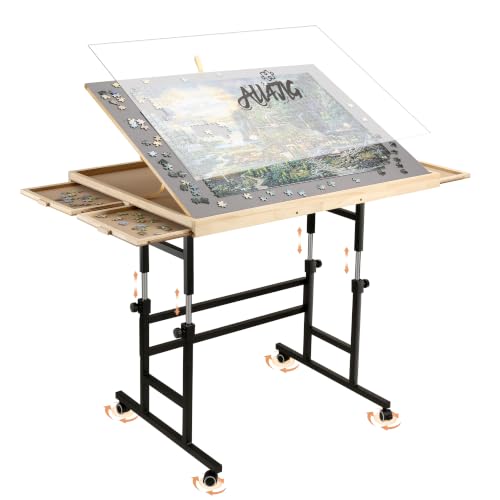
This is a mobile, wood-and-metal puzzle worktable intended for puzzles up to 1,500 pieces and other flat crafts. It has a felt-lined work surface, six drawers, a removable translucent cover, caster wheels, an adjustable-height base, and a tilting top. Independent retail reproductions describe a 29 to 37.4 inch height range, tilt up to 45 degrees, and two locking casters, but these are manufacturer-stated specifications rather than independently tested performance figures. The product's defining practical feature is its combination of vertical adjustment, tilt, storage, and a cover in one table. Its advertised dimensional information is not fully traceable. Published listings conflict on the work-surface dimensions, while the catalog record also contains an implausibly thin overall-depth measurement. No product-specific load rating, stability test, emissions certificate, assembly manual, or accredited laboratory report was located.
This table suits an adult hobbyist who wants to keep a mid-size puzzle in progress without occupying a dining or coffee table. It is most relevant for someone who values drawer-based piece sorting, a cover for dust or pets, and the ability to reposition the work surface in a home hobby room. The stated height and tilt adjustment may help users tailor the setup to their chair and reach. Buyers should measure the actual available footprint carefully because published dimensions are inconsistent.
It is not the right choice for households that need independently documented furniture stability, weight limits, pinch-point controls, or low-emission materials. Children should not operate the tilt hardware, drawers, or wheeled base without close adult supervision. It also does not suit buyers who need verified FSC or PEFC wood sourcing, a documented repair-parts program, or a clearly supported warranty. Anyone selecting a table for a tightly constrained alcove or a specific puzzle size should avoid relying on the listed dimensions alone because the published measurements conflict.
The available evidence does not establish that this finished table has low formaldehyde or VOC emissions. The product is described only broadly as wood and metal, with felt and a cover, but its panel type, adhesives, coatings, and emissions test results are not identified. If composite wood is used, U.S. rules require regulated composite-wood products and finished goods containing them to meet TSCA Title VI requirements, but no product-linked compliance label or supplier document was found. No FSC, PEFC, SFI, recycled-content, or other traceable wood-source claim was found. No product-specific BIFMA, UL, SCS, or accredited laboratory certification was located. Searches also did not locate a BuilderButler recall or public incident report for this product. That is not proof of safety, particularly for a table with drawers, locking wheels, adjustable legs, and a tilting surface. Use the locks before use, keep fingers clear during adjustments, and do not infer a therapeutic posture or strain-relief benefit from the adjustment features.
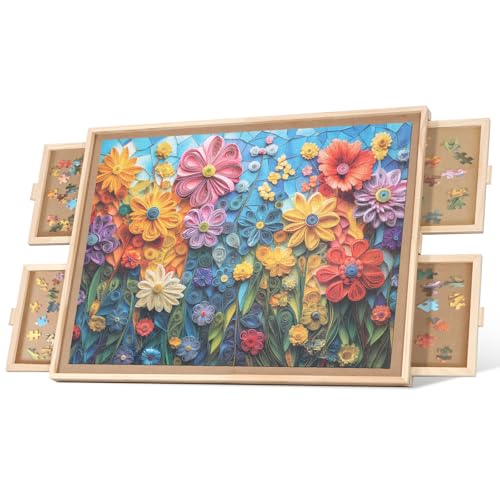
This product is a low-profile, manually rotated wooden puzzle board intended to sit on another stable surface. It is marketed for puzzles up to 1,500 pieces and has four sliding sorting drawers, a protective cover, and a rotating Lazy Susan base. Independent retail records identify the board as approximately 26 by 35 inches overall and about 13.6 pounds, while the seller describes the usable puzzle area as roughly 25 by 34 inches. The manufacturer identifies pine wood and, in its product FAQs, P2-grade MDF and adhesives as part of its wooden-board construction. It also states that the board rotates 360 degrees, provides a one-year limited defect warranty, and stocks spare parts. No publicly checkable certification or accredited test report was located for this specific product’s emissions, load rating, drawer safety, or rotation mechanism.
This product suits an adult puzzler who works at a sturdy dining table, desk, counter, or other broad, level support and wants to leave a medium to large puzzle in progress without mixing all pieces together. The four drawers are especially relevant for users who sort by color or edge pieces. Its low-profile format also fits someone who needs to slide a covered project under furniture between sessions. It is best used for puzzles whose completed dimensions fit within the stated work area, rather than selected by piece count alone.
It is not appropriate for households needing independently verified low-emission furnishings, especially where a buyer is trying to minimize formaldehyde or VOC uncertainty. It is also not a freestanding ergonomic table, and should not be treated as one. People with limited hand dexterity, young children who may access drawers or loose pieces, or users who need documented pinch, load, and tip-resistance safeguards should choose a product with explicit safety instructions and product-specific testing. Avoid relying on it for unusually oversized puzzles without confirming finished puzzle dimensions.
The manufacturer now identifies solid New Zealand radiata pine, P2-grade MDF, adhesives, and reinforced construction across its wooden puzzle-board range. That is more useful than an unspecified wood description, but it does not disclose the coating, adhesive formulation, felt, plastic cover, metal hardware, or finished-product emissions. No public low-VOC certification, formaldehyde compliance label, or chamber-test result was found for this product. The seller uses a sustainably sourced New Zealand pine claim, but no product-linked FSC, PEFC, or SFI chain-of-custody documentation was located. The maker provides a U.S. contact address, a one-year limited warranty, and states that it stocks spare parts, which may support repair after a drawer or rotating-base issue. No matching CPSC recall or public safety action was located in the search conducted. The available safety evidence remains seller-issued rather than independently verified.
This is a portable, tabletop puzzle work surface intended for puzzles up to 1,500 pieces and other flat crafts such as diamond painting and fuse beads. Seller-reproduced product information describes a wood board with four sorting drawers, a clear cover, a tilting surface, and a rotating base. The stated product weight is 5.92 kg, or about 13 pounds. The defining feature is the combined tilt and rotation mechanism, which is manufacturer-stated rather than independently tested. The four-drawer layout and cover can help contain pieces and protect an unfinished project between sessions. Dimensions are not consistently documented. Product copy presents a 34.25 by 25.2 inch board, while reproduced specifications list both 34.4 by 26.4 inches and 36.8 inches long. No public load limit, tilt-angle range, stability test, or model-specific safety report was located.
This product suits an adult hobbyist who works on standard large puzzles or flat crafts at a dining table, desk, or other stable support surface and values keeping pieces contained between sessions. It is particularly relevant when four built-in sorting drawers and a protective cover are more useful than a permanently installed puzzle table. Buyers should measure their intended support surface and their preferred puzzle sizes carefully because the published dimensions are inconsistent. The tilt and rotation functions are best treated as convenience features, not as medically established ergonomic controls.
It is not a strong fit for households with young children or pets who could access the drawers, moving top, cover, or loose small pieces without active supervision. It is also unsuitable for anyone needing a documented weight rating, a verified tilt angle, tested anti-pinch controls, or confirmed resistance to wobble during use. People with significant neck, back, shoulder, or hand symptoms should not rely on its strain-relief marketing as a health intervention. Buyers seeking verified low-VOC materials, traceable wood, repair parts, or a clearly documented warranty need more documentation than is publicly available.
The available product information identifies wood as the main material, but it does not identify the wood species, whether the panels are solid wood or composite wood, the adhesive, coating, felt or fabric composition, or the metal and plastic content. No public certification was located for GREENGUARD, Indoor Advantage, FSC, PEFC, BIFMA, or a model-specific accredited test report. If composite wood is present, U.S. rules require applicable formaldehyde compliance documentation and labeling, yet none was publicly supplied for this product. The listing calls the wood construction eco-friendly, but does not state a recycled content percentage, wood-source certificate, life-cycle basis, or other specific environmental benefit. That is not enough to substantiate a broad environmental claim. No product-specific U.S. recall or public incident pattern was located in the searched consumer-safety sources, but the maker's public service, warranty, parts, and corrective-action information remains limited.
This is a tabletop jigsaw-puzzle work board for puzzles marketed at up to 1,500 pieces. The stated 34.2 by 25.2 inch wood board combines an adjustable easel-style tilt with a rotating base, four piece-sorting drawers, and a clear cover. It is intended to sit on an existing table or other stable surface, not to function as a freestanding furniture table. An independent retail listing corroborates the 1,500-piece variation, wood material, 34.2 by 25.2 inch format, four drawers, cover, adjustable tilt, and 360-degree rotation. These remain seller-provided product specifications, not laboratory-verified performance results. ALL4JIG also states that its broader range uses radiata pine, P2-grade MDF, upgraded adhesives, and reinforced construction, but it does not publish a model-specific bill of materials or test report for this unit.
This product suits an adult puzzler who already has a stable dining table, desk, or craft table and wants a dedicated work surface for larger projects. It is especially relevant for someone who sorts pieces by color or edge type and benefits from four nearby drawers rather than loose trays. The tilt and rotation features may help a seated user change viewing angle or bring the far edge closer. It fits users who can leave the board flat between sessions and who will verify that their particular puzzle's finished dimensions fit the usable surface.
It is not suitable for young children, unsupervised households with pets, or anyone who may place weight on the board, drawers, cover, or tilt support. Buyers needing an independently verified load rating, anti-tip testing, pinch-point assessment, or certified low-emission materials should choose a product with public documentation. It is also a poor fit for users who need a truly sealed, travel-ready puzzle case, a freestanding height-adjustable table, or a work surface that can safely be stored vertically with an unfinished puzzle in place.
The health evidence is limited by missing product-specific documentation. No public GREENGUARD, Indoor Advantage, CDPH chamber-emissions report, or other independently checkable low-emission certification was located. The seller describes wood construction, while the manufacturer broadly refers to radiata pine, P2-grade MDF, and upgraded adhesives. That is not enough to identify the actual composite wood, coating, adhesive, textile surface, or formaldehyde and VOC exposure profile of this particular board. The rotating base, drawers, cover, and tilting support create moving interfaces, yet no public accredited test report was found for stability, load, drawer retention, pinch hazards, or sudden movement at tilt. No relevant ALL4JIG recall or public consumer-product incident record was located in the searched United States safety databases. The manufacturer states that it stocks spare parts and provides a one-year limited warranty, which could support repair, but no model-specific parts catalog was published. No FSC or PEFC chain-of-custody claim, recycled-content detail, or other product-specific wood-sourcing evidence was located.
This wooden puzzle work surface is intended for projects up to 1,500 pieces, with a stated 24.53 by 33.19 inch surface or frame size. It is designed to hold an in-progress puzzle off a dining table, then provide drawers for loose pieces and a cover between sessions. The manufacturer’s current product page identifies two foldable legs, three adjustable tilt positions, four drawers, and one protective cover. The maker also states that its puzzle tables use New Zealand radiata pine, P2-grade MDF, adhesives, and reinforced construction, but these are family-level statements rather than a published bill of materials or independent report for this exact product. No public load rating, stability test, chamber-emissions test, or accredited product-specific test report was located. The maker promotes tilting as a way to reduce neck and back strain, but does not provide human evidence for that health outcome on this product.
This product fits an adult puzzler who regularly works on projects stated to be up to 1,500 pieces and needs a dedicated place to leave them in progress. Its stated drawers and cover are useful for separating pieces and protecting a puzzle from normal household dust or disturbance. It is also suited to someone who values a choice of three viewing angles and can inspect, position, and operate folding furniture carefully on a level floor. The stated warranty and direct service contact add practical value for a buyer willing to rely on manufacturer support.
It is not a good match for households where young children may access folding legs, tilt hardware, drawers, or loose puzzle pieces without supervision. People with chemical sensitivity, asthma concerns, or a requirement for documented low-emission furniture should look for finished-product emissions certification or a chamber-test report, neither of which was found here. It also does not suit users who need a verified weight limit, independently tested stability at every tilt position, or clearly published instructions for safe loading and adjustment. Avoid treating it as a medically validated ergonomic aid.
The available manufacturer information identifies New Zealand radiata pine, P2-grade MDF, adhesives, and a wood-based construction. That is more material detail than a generic wood claim, but it is not enough to establish low indoor-air emissions. No GREENGUARD, Indoor Advantage, finished-product formaldehyde report, or product-specific TSCA Title VI documentation was located. Buyers who want lower-emission furniture need evidence for the assembled table, not only a panel grade. The manufacturer calls the pine sustainably sourced, but no linked FSC or PEFC chain-of-custody certificate was found for this product. A one-year warranty, stated repair or replacement for defects, and claimed spare-parts availability support continued use if service is actually provided. Searches of US recall and public incident-report resources did not identify a matching recall or public incident pattern, but that does not substitute for independent safety testing of the folding and tilting design.
This is a manually adjusted indoor puzzle workstation with a felt-covered board, four magnetic drawers, locking casters, a clear cover, and a bonus puzzle. It is intended to hold an in-progress jigsaw off a dining or coffee table, then roll it between rooms. The maker states nine height settings and tilt up to 45 degrees. The manufacturer-supplied manual provides the clearest concrete limits. It lists a 35.04 by 26.57 inch inner work area, a 20-pound tabletop limit, New Zealand pine, MDF, felt, and a powder-coated iron base. It also requires a flat, non-slip floor and locked wheels during use. The table has meaningful adjustment and storage features, but no public independent stability, load, emissions, durability, or mechanism test report was located. Its published dimensions and minimum height are inconsistent across the product page, retail listing, and manual, so confirm fit before setting up a puzzle.
It suits an indoor adult puzzler who wants a dedicated project surface rather than using a shared table, especially someone who benefits from changing the working height or modestly tilting the board. The documented inner area is about 35 by 26.6 inches, so it is most appropriate for puzzles whose finished dimensions fit within that boundary. It also fits households able to keep it on a level, non-slip floor and follow the maker's 20-pound tabletop limit, wheel-locking, and inspection instructions.
It is not appropriate as a child-operated table, a seat, step stool, or climbing surface. The manual warns of choking parts, tipping and fall hazards, and pinch or entanglement risks around moving hardware. It is also unsuitable for stairs, sloped floors, elevated surfaces, damp locations, or outdoor storage. Buyers needing independently verified low-emission materials, tested load stability, confirmed furniture-standard compliance, replacement-part availability, or exact minimum-height certainty should not rely on the current published information alone.
The material disclosure is better than a generic wood claim, but remains incomplete. The maker identifies New Zealand pine, MDF, felt, and a powder-coated iron base. MDF is a composite wood product, yet no product-specific low-VOC, formaldehyde, GREENGUARD, Indoor Advantage, or comparable indoor-air certification was located. There is also no disclosed coating, adhesive, felt-fiber, or composite-panel compliance documentation. The manual gives useful use-safety boundaries, including locked wheels, a 20-pound limit, adult assembly, regular fastener inspection, and keeping fingers, hair, and toes clear of moving parts. No JoyBerri-specific CPSC recall was located in the checked public recall search. A five-year warranty and lifetime support are stated, but no spare-parts catalog, repair instructions beyond inspection and tightening, FSC or PEFC chain-of-custody evidence, or product-specific environmental certification was found.
This is a flat, tabletop puzzle board for projects up to 1,500 pieces. Independent product records identify a 26 x 35-inch work surface and a roughly 16-pound jumbo board. It is meant to sit on an existing stable, level table or other support, providing a contained area for assembling and storing a puzzle in progress. The maker currently describes the matching wooden plateau line as hardwood board and drawers, four wooden-reinforced sliding drawers, a smooth fiberboard work surface, and a lacquer seal intended to limit warping. These are manufacturer statements, not material test reports. The product has no legs, height adjustment, tilt function, wheels, or electrical parts. I found no publicly checkable certification or accredited test report for the finished board's emissions, load safety, durability, or chemical content.
This product suits an adult puzzler who already has a sturdy dining table, coffee table, desk, or other flat support and wants to keep a large project organized between sessions. Its independently corroborated 26 x 35-inch workspace is relevant for many 1,500-piece puzzles, provided the finished puzzle dimensions fit. The four drawers are most useful for someone who sorts by color, edge pieces, or sections and wants loose pieces contained. It also suits households that can store a wide, approximately 16-pound board safely.
It is not suited to young children using it unsupervised, or to homes where the board may be placed on an unstable bed, lap, lightweight tray, or shaky folding table. There is no published emissions certification for the finished board, so buyers seeking verified low-formaldehyde or low-VOC furniture should not treat its wood construction or lacquer seal as proof. It is also unsuitable for people needing standing-height work, tilt adjustment, or a fully documented ergonomic setup. Anyone unable to safely lift a broad 16-pound board should avoid relying on its portability.
The useful health and safety feature here is simplicity. This is a flat board with drawers rather than a powered, wheeled, folding, height-adjustable, or tilting table, so it does not introduce those mechanism-specific hazards. The maker instructs users of the wooden plateau line to use it on a flat, level, stable surface. The brand is identifiable and publishes customer-service and return channels. Searches did find historical recalls involving unrelated lamps and decorative products sold by Bits and Pieces or its distributor, but no recall or public safety warning for this puzzle board. Material disclosure is limited. Bits and Pieces says the board and drawers are hardwood, the work area is fiberboard, and the unit is lacquer-sealed. It does not provide a finished-product low-emissions certification, fiberboard formaldehyde documentation, coating data sheet, FSC or PEFC chain-of-custody claim, or product-specific durability test report. Its general sustainability language therefore cannot establish responsible wood sourcing or a lower-impact finish for this product.
This is a freestanding, wheeled puzzle workstation for projects marketed at 300 to 1,500 pieces. Its listed tilted work surface measures 32.4 by 23.5 inches, excluding the frame. The unit has a wood top and base, a metal frame, felt work surface, five drawers, lower shelf, locking casters, and protective covers. The seller states that height adjusts from 29 to 41 inches and the top has seven positions from 0 to 45 degrees. Those figures are corroborated by a separate retailer listing, but not by independent performance testing. The product page also claims stable hinges, lockable wheels, raised edges, and a rope-driven adjustment system. No product-specific load rating, stability test, emissions report, or accredited safety test report was located.
It suits an adult hobbyist who needs a dedicated indoor station for a large puzzle, has room for a roughly 34 inch by 26 inch tabletop, and values drawers for sorting pieces between sessions. It is most appropriate for light, seated or standing puzzle work where the user can assemble it carefully, lock the casters before use, check all fasteners, and stay within the maker's unstated load limit. The covers and storage are useful for projects left out over several days.
It is not a good fit for households needing independently verified furniture safety, especially where children may pull drawers, climb on the table, or access the tilt mechanism. Avoid relying on it as a desk, support surface, mobility aid, or standing workstation because no load rating or product-specific stability testing was found. People with significant neck, back, balance, hand-strength, or dexterity limitations should not assume the angle and height adjustments provide therapeutic benefit or will be easy to operate safely.
The available listings describe pine wood, a metal frame, a felt surface, and a polypropylene protective cover. A separate retailer calls the wood New Zealand pine and gives a 29 to 41 inch height range with seven tilt positions. Neither source identifies the wood finish, adhesive system, felt fiber content, metal coating, or formaldehyde and VOC emissions. No GREENGUARD, Indoor Advantage, BIFMA, FSC, PEFC, or product-specific accredited test record was located. The product should therefore not be treated as certified low-emission, responsibly sourced, or independently safety tested. A search of the U.S. Consumer Product Safety Commission recall resources did not identify a recall for this product or brand. That is not evidence that the table has passed safety testing. Public feedback includes a report of loose-function concerns, so regular checks of locks, fasteners, drawers, and height hardware are prudent.
This freestanding puzzle table is a 35 by 26.8 inch wooden work surface intended for puzzles up to 1,500 pieces. It has a single pedestal base, four swivel casters, six drawers, a felt-topped board, and a transparent cover sheet. The product detail page states that its handwheel-adjusted work height ranges from 26.9 to 36.4 inches and that the board has three tilt positions. The most defining features are manufacturer-stated rather than independently tested. The listing says all four casters lock, the felt helps pieces grip on a tilted board, and the drawer arrangement includes four wooden drawers plus two plastic drawers. Its safety directions specifically tell users to turn the handwheel slowly, lock casters during use, and avoid heavy objects that could cause tipping. No product-specific load limit, tilt angle, stability test report, or independent certification was located. The listing also conflicts on assembly, showing both assembly required and no required assembly.
This table suits an adult puzzle hobbyist who wants a dedicated indoor work surface instead of occupying a dining or coffee table. It is most relevant for someone working on puzzles advertised up to 1,500 pieces who values sorting space, a dust cover, and the ability to reposition the table on a smooth floor. The stated height adjustment may also help a user align the board with a preferred chair height. It is better suited to careful, stationary use after the casters are locked than to frequent rolling while loaded.
It is not well suited to households needing independently verified furniture stability, quantified load capacity, or low-emission material documentation. Buyers sensitive to formaldehyde, coatings, or other indoor-air exposures will not find enough material detail to assess the finished table. It also calls for caution in homes with young children or pets that may climb, pull drawers, release caster locks, or interact with a raised tilted board. Anyone needing clear replacement parts, a longer documented warranty, or a confirmed repair pathway should consider that those details were not located.
The product detail page identifies wood for the base, top, and frame, and describes a felt layer on the puzzle board. It also identifies four wooden drawers and two plastic drawers. That is useful basic composition information, but it does not identify the wood type, whether any wood is composite, or the adhesives, coatings, felt backing, and formaldehyde or VOC emissions of the finished table. No exact-product low-emission certification or chamber-test report was located in the checked certification sources. No product-specific FSC, PEFC, BIFMA LEVEL, or similar wood-source or sustainability documentation was located. The product makes practical protection claims about its cover and locking casters, not therapeutic health claims. Searches of the CPSC recall database and public incident-report resources did not identify a recall or public incident report for this product or brand, which is not the same as independent safety validation. Ropoda publishes customer support contact information and states a generally six-month warranty, but no spare-parts catalog was found.
This is a flat, tabletop puzzle workstation for projects advertised up to 1,000 pieces. The product listing states a 28.74 by 20.94 inch wooden board with a Lazy Susan style rotating base, four sliding sorting drawers, and a translucent cover. It is intended to keep an unfinished jigsaw project together between sessions, while letting the user turn the work surface rather than reach across it. The four-drawer configuration, cover, 360 degree rotation, and 15-and-up minimum age are manufacturer-stated and are independently repeated by a separate reseller listing. The listing also promises a one-year repair or replacement remedy for quality issues. However, it does not publish a load limit, usable-work-surface drawing, material bill, assembly or care manual, or independent test report for the rotating assembly, drawers, cover, finishes, or durability.
This format suits a teen or adult jigsaw puzzler who works on standard-size projects at a stable table and wants a contained place to sort pieces and leave an unfinished puzzle between sessions. The four stated drawers are most useful for sorting by edges, color, or image section. It also suits someone who values turning a tabletop board to reach the far side of a puzzle. Measure both the planned puzzle and the supporting table first, because the stated 1,000-piece capacity does not define the maximum finished puzzle dimensions.
It is not suited to households needing independently documented child safety, low-emission wood, or full chemical disclosure. Respect the stated 15-and-up age designation, particularly where younger children may pull drawers, handle loose pieces, or rotate the board. Choose another format if it must carry heavy craft materials, be used on an unstable or soft surface, fit an exact shelf opening, or withstand frequent transport. Buyers who need a verified load limit, publicly documented replacement parts, tested drawer retention, or a confirmed non-slip base also need more specific evidence.
The listing describes the board as hardwood, sustainable, biodegradable, chemical-free, and safe, but it does not identify the wood species, whether the construction includes composite panels, or the finish and adhesive chemistry. No product-specific GREENGUARD, Indoor Advantage, CDPH chamber-test, TSCA Title VI label, or comparable indoor-air document was located. People with chemical sensitivities should therefore treat the low-emission and non-toxic language as unverified marketing claims, not exposure evidence. The listing also claims that the wood is sustainable, but no FSC, PEFC, or SFI chain-of-custody claim tied to this product was located. A CPSC recall search did not surface a matching BuilderButler recall, but the available listing does not provide a detailed maker address, manual, named test standard, or public laboratory report. Its moving drawers and rotating base should be used only on a stable tabletop, with attention to fingers and loose puzzle pieces.