Best Overall
14% off

HUANUO Dual Monitor Desk Mount
Adjustable arms for personalized monitor positioning.
Sturdy construction supports heavy monitors securely.
Easy installation with included hardware and instructions.
 Daniel Kenitz
Adjustable arms for personalized monitor positioning.
Sturdy construction supports heavy monitors securely.
Easy installation with included hardware and instructions.

Easy height and angle adjustments.
Sturdy build supports heavy monitors.
Saves desk space efficiently.

Easy installation with included tools and instructions.
Sturdy build supports monitors up to 27 inches.
Flexible arm allows for versatile positioning.

Supports large and heavy monitors with ease.
Adjustable for perfect screen positioning.
Versatile mounting options for any desk setup.

Supports large screens up to 40 inches.
Smooth, adjustable positioning with mechanical spring.
Sturdy build ensures stable monitor support.

Easy, tool-free VESA mount installation.
Fully adjustable for optimal screen positioning.
Supports dual monitors up to 19.8 lbs each.

Supports three monitors for enhanced productivity.
Adjustable arms allow flexible screen positioning.
Strong construction ensures stable monitor support.

Easy height adjustment with gas spring mechanism.
Sturdy build supports heavier monitors securely.
Cable management keeps workspace neat and organized.
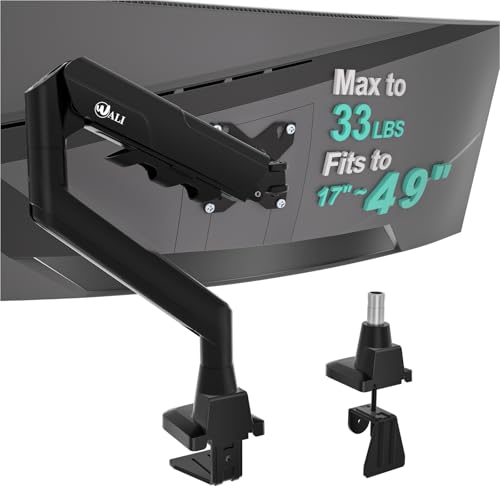
Supports large, ultrawide monitors up to 49 inches.
Sturdy design holds up to 33 lbs securely.
Flexible gas spring for easy height adjustment.

Supports ultrawide monitors with ease.
Adjustable for optimal viewing angles.
Sturdy build ensures secure monitor placement.
Start with the monitor itself, not its diagonal measurement. Check the monitor’s actual weight with its stand, adapters, and attached accessories included; its VESA mounting pattern; screw thread and depth; rear-panel shape; and center of gravity. The supplied products commonly support 75 × 75 mm and 100 × 100 mm VESA patterns, but screen size alone does not establish safe fit. Curved, ultrawide, recessed, unusually deep, or forward-heavy monitors may need spacers, longer screws, an adapter, or a lower practical load limit.
Then check the support surface. A clamp or grommet must match the desk’s thickness, edge clearance, underside access, hole size, and construction. The reviewed products specify desk ranges from roughly 0.39 to 3.54 inches, but several warn against glass, plastic, particle board, soft wood, hollow-core, damaged, or weak desks. A thickness number is not a structural approval. Wall-mounted products require the correct substrate: one reviewed wall arm specifies wood studs or concrete, while drywall alone, metal studs without an engineered anchoring plan, weak masonry, and uncertain walls are not established as suitable.
Movement claims should be read as dimensions and conditions, not as a promise of ergonomic benefit. Useful specifications include vertical travel, reach, tilt, swivel, rotation, clearance, and any limit on keeping the display over the desk. OSHA-oriented positioning means the primary display is generally directly ahead, the top is at or slightly below eye level, and viewing distance is commonly around 20 to 40 inches. The chair, desk depth, monitor size, and user still determine whether those positions are achievable.
Capacity claims need conservative interpretation. Several products advertise limits from about 17.6 to 44 pounds per arm, but the reviews repeatedly found no publicly traceable model-specific independent load or fatigue report. A credible report should identify the exact model, monitor mass, center-of-gravity offset, arm extension, test fixture, laboratory, acceptance criteria, and report date. For applicable wall-mounted configurations, look for an exact-product record under ANSI/UL 2442. Structural certification should be traceable in UL Product iQ, Intertek ETL, CSA, or TÜV Rheinland directories; a VESA compliance listing would address the interface, not the entire arm’s structural safety.
Finally, check service support. A clear warranty, replacement VESA plates, fasteners, clamp pads, cable covers, or spring assemblies can keep a repairable arm in use. Treat claims such as “heavy-duty,” “zero sag,” “50,000 cycles,” recycled content, or reduced packaging as unsubstantiated unless the relevant test report, warranty terms, material declaration, certification, or environmental documentation is available.
Recurring safety cautions in the supplied reviews are substantial: do not rely on screen size alone; do not mount to uncertain or unsuitable desks or walls; verify weight, VESA fit, screw engagement, recesses, and center of gravity; and install security hardware and periodically check fasteners. Pressurized gas springs must not be punctured, heated, or adjusted incorrectly. Arms can tip when extended beyond a desk edge, and heavy displays may require assistance during installation. No supplied product had independently verified structural certification or a model-specific accredited load-and-durability report.
The review topics below separate useful, documented compatibility from broad marketing claims. The supplied products generally scored more strongly for basic adjustment, VESA information, and non-powered design than for independently verified structural testing or environmental documentation.
This measures whether the arm can place the actual monitor at a comfortable height, distance, tilt, and viewing angle. It matters because an adjustable arm only helps if the monitor can reach a neutral position for the user. Among the supplied products, the stronger scores were around 78–80 for documented height, reach, and angle ranges; lower scores reflected missing travel, clearance, or monitor-configuration details.
This measures whether the joints, VESA head, spring, and base can retain the stated monitor without sagging, loosening, detaching, or falling. It is especially important for heavy, deep, curved, or extended monitors. The supplied products ranged from the mid-50s to the high-70s: higher-scoring reviews had hands-on support or clearer conservative limits, while lower scores relied mainly on unverified capacity claims or conflicting figures.
This measures whether the clamp, grommet, wall hardware, surface limits, and installation instructions match the real supporting structure. It matters because a strong arm can still pull out or damage a weak desk or wall. Higher-scoring products documented thickness, hole, fastener, pad, stud, or concrete requirements. Lower scores omitted construction limits or left glass, hollow-core, weak, or damaged surfaces unresolved.
This measures compatibility with the monitor’s VESA pattern, weight, screw depth, rear shape, recesses, spacers, and center of gravity. It matters because a 32- or 49-inch label does not prove safe attachment. Higher-scoring products specified 75 × 75 and 100 × 100 mm patterns, screw options, and spacers. Lower scores omitted screw-depth, recessed-back, curved-display, or center-of-gravity limits.
This measures whether pivots, springs, rotation stops, and cable routing remain controlled through repeated adjustment. It matters when screens drift, wobble, rise, drop, or damage cables. The supplied scores were generally around 70–78. Higher scores reflected clearer adjustment procedures, service support, or practical testing; lower scores lacked disclosed cycle methods, fatigue reports, torque retention, or replacement-wear-part information.
This measures the electrical safety documentation for USB hubs, chargers, power supplies, and supplied cables. A non-powered arm is not applicable to this hazard and scored 100 across the supplied products. The exception was a dual ultrawide arm with USB-A and USB-C charging ports, which scored 68 because no traceable certification for the complete arm and USB accessory was located.
This measures whether screen-size, load, durability, desk-fit, and ergonomic claims include complete conditions and agree with the manual and listing. Higher-scoring products, reaching 80, gave clearer limits and fewer conflicts. Lower scores, near 48–55, reflected contradictory screen-size or capacity figures, vague “heavy-duty” language, or claims that treated diagonal size as proof of compatibility.
This measures whether the complete mounting product and intended configuration can be traced to a credible independent certification register. Every supplied product scored 70, but the reviews did not locate an exact-product UL, ETL, CSA, or TÜV structural certification record. VESA interface compatibility would not by itself certify the arm, desk attachment, wall anchoring, or complete load-bearing configuration.
This measures whether a model-specific independent report discloses load, center-of-gravity offset, extension, cycles, fixture, laboratory, conditions, and pass criteria. Supplied scores ranged from 68 to 75, but no reviewed product had the requested publicly traceable report. Manufacturer claims such as 20,000 or 50,000 cycles therefore remain claims unless the test method and report can be independently checked.
This measures robust construction, warranty support, replaceable parts, and repair options that can keep an arm in use instead of sending metal and hardware to waste. Scores ranged roughly from 70–76. Higher-scoring products had longer or clearer warranties, replacement-part routes, or service provisions. Lower scores lacked parts catalogs, spring-service information, or repair instructions, even when the arm was described as metal.
This measures specific, supportable claims about materials, coatings, recycled content, packaging, take-back, and end-of-life handling. The supplied products clustered around 68–70 because most had no material declaration, packaging specification, recycled-content certification, or recycling program. A metal or aluminum description alone does not establish lower impact, and an environmental certification claim needs a public issuer record tied to the exact product.
This product is a dual gas-spring desk monitor arm for two monitors with 75 by 75 mm or 100 by 100 mm mounting patterns. It uses two C-clamps at a desk edge or one grommet bolt through the desktop. The current manufacturer manual specifies a 4.4 to 19.8 lb load range per arm, a 0.59 to 3.54 inch supported desk thickness, M4 mounting screws, and spacers for curved monitor backs. The manufacturer states that the arms provide 360-degree screen rotation, 180-degree swivel, and +85/-50-degree tilt. That range can help place compatible screens within OSHA's general guidance of a top screen line at or below eye level and a 20 to 40 inch viewing distance. The product includes a five-year manufacturer warranty. Its published cycle claim is 20,000 gas-spring adjustments, but no model-specific independent load or fatigue report was located.
This product suits a two-monitor desk setup using ordinary VESA-equipped screens that each weigh between 4.4 and 19.8 lb including attached accessories. It is most appropriate for a stable desk with a solid edge or a properly placed grommet hole, within the stated 0.59 to 3.54 inch thickness range. It can serve users who need to change screen height, portrait orientation, or viewing angle during computer work, provided they first confirm each monitor's VESA pattern, screw requirements, weight, and rear-panel shape in the monitor manual.
It is not appropriate for any screen over the stated per-arm limit, with a VESA pattern outside 75 by 75 mm or 100 by 100 mm, or with an unusually deep body or forward center of gravity that has not been confirmed with support. Avoid it on fragile glass, hollow-core, damaged, or poorly supported desktops, and on desks where the clamp cannot make full contact above and below. It is also unsuitable where independent certification and publicly traceable structural test documentation are required by workplace policy, procurement rules, or risk management procedures.
The main health benefit is positional flexibility, not a proven health treatment. The current manual documents separate height adjustment, tilt, swivel, and portrait rotation, which can help a user position compatible screens in line with OSHA monitor-placement guidance. Safe use depends on the desk and monitor, not screen size alone. The manual calls for confirming monitor weight, using the correct fasteners and spacers, keeping monitors within the desktop edge, and adjusting gas-spring tension only after mounting. No matching CPSC recall was located in checks completed on August 16, 2026. No UL, ETL, CSA, TÜV, or other independently traceable structural certification for this desk-mounted product was located. HUANUO identifies aluminum-alloy arms and offers a five-year warranty, but does not publish recycled-content, coating, packaging, take-back, or detailed replacement-parts information for this product. Those omissions limit confidence about material impacts and repair beyond basic warranty support.
This is a single, desk-mounted gas-spring monitor arm for one 13 to 32 inch display. It attaches by C-clamp or through a grommet hole, then uses a four-screw VESA plate to hold the monitor. The manufacturer states a maximum monitor weight of 19.8 lb, support for 75 x 75 mm and 100 x 100 mm VESA patterns, and supplied M4 screws and spacers for flat or curved monitor backs. Its main practical strength is adjustment range. HUANUO's current product page and manual document rotation, swivel, tilt, and up to 15.75 inches of height adjustment. This can help place a compatible screen near OSHA's recommended height and viewing position. Those are manufacturer documents, not independent structural or durability tests. No traceable third-party load, fatigue, or certification record for this exact product was identified in the checked certification directories.
It suits a single-monitor desk user with a conventional 13 to 32 inch flat or curved display that has a centered 75 x 75 mm or 100 x 100 mm VESA interface and weighs no more than 19.8 lb including accessories. It is particularly relevant where the desk has enough depth to keep the screen at a comfortable viewing distance and has a sound edge or a suitable grommet location. The adjustment range is useful for changing between seated tasks, standing work, sharing a screen, or portrait orientation.
It is not for a monitor outside the stated VESA patterns, a display over the stated weight limit, or a monitor with an unusually offset center of gravity that cannot remain balanced. It also is unsuitable for damaged, unstable, glass, or otherwise questionable desk surfaces, and for desks without a safe clamp edge or correctly positioned grommet hole. Buyers who need independently certified structural performance, documented fatigue testing, or known replacement availability for individual wear parts need more evidence than this product provides.
For workstation health, the product offers the kinds of adjustments OSHA identifies as useful, including height, distance, tilt, and side-to-side positioning. OSHA still recommends setting the screen directly in front of the user, generally 20 to 40 inches away, with the top at or slightly below eye level. An adjustable arm enables that setup but does not ensure it. The manual also warns that the gas spring is pressurized, that small parts can pose a choking hazard, and that maximum load must not be exceeded. No integrated powered USB hub or power supply was identified. The manual depicts optional USB lines as not included, so there is no supplied energized accessory requiring electrical certification. HUANUO states warranty coverage of up to five years and says replacement parts can be requested, which may extend useful life. However, no public parts catalog, materials declaration, recycled-content claim, packaging specification, recycling program, recall, or product-specific independent structural test was identified in this review.
This is a non-powered, desk-mounted stand for two monitors. The manufacturer specifies screens from 17 to 32 inches, a 22 lb maximum per arm, and VESA 75 by 75 mm or 100 by 100 mm mounting patterns. It mounts with either a C-clamp or a grommet base and is intended to lift displays off the desk while allowing their position to be changed. The manufacturer documents 45-degree forward and backward tilt, 90-degree side swivel, and 180-degree rotation in each direction. Those adjustments can help place compatible screens near eye height, centered in front of the user, and at a usable angle. However, the published product page does not state the available height range, arm reach, permitted desk thickness, monitor screw depth, or a model-specific structural test result.
This product suits a home or office user with two conventional flat-panel monitors that each weigh no more than 22 lb without their original stands, use a 75 by 75 mm or 100 by 100 mm VESA pattern, and have a solid desk that can safely accept a clamp or grommet mount. It is especially relevant when the goal is to clear desk space and move screens between side-by-side, stacked, portrait, and landscape arrangements. The user should be willing to measure the desk and verify monitor hardware before installation.
It is not a suitable default choice for people using monitors above the stated per-arm limit, displays with non-VESA backs, deeply recessed mounting holes, unusual rear housings, or heavy curved screens with a forward center of gravity. Avoid relying on it for fragile glass desks, hollow-core desktops, damaged particleboard, desks with uncertain thickness, or desks whose underside is blocked by frames or drawers. It also does not suit buyers who require independently documented load testing, structural certification, long warranty coverage, or readily listed replacement parts.
The health value is mechanical positioning rather than a medical effect. OSHA recommends placing the top of a monitor at or below eye level, keeping it generally 20 to 40 inches from the eyes, and avoiding sustained neck turning. The manufacturer-stated tilt, swivel, rotation, and articulated-arm adjustments could support that setup, but the missing published height and reach dimensions mean the actual ergonomic fit remains desk and monitor dependent. The product is described by its manufacturer as heavy-duty steel, with no powered accessories. A product-specific manual and a one-year manufacturer warranty are publicly available. No CPSC recall or public safety warning for this product was located in the reviewed databases. No independent structural certification, model-specific load or cycle test report, replacement-parts catalog, recycled-content statement, material declaration, packaging specification, or end-of-life program was located. Those omissions limit confidence about long-term repairability and environmental claims.
This is a single, desk-mounted gas-spring monitor arm for one flat or curved display. It uses either an edge clamp or a through-desk grommet base, then attaches to a 75 mm or 100 mm VESA interface. The current manufacturer manual specifies a 2 to 20 kg, or 4.4 to 44 lb, monitor range, plus 0.47 to 1.78 inch clamp-desk thickness and 0.47 to 1.97 inch grommet-desk thickness. Manufacturer-stated adjustment is substantial, with 22.4 inches of maximum reach, 8.7 to 18.7 inches of height range, +50 to -20 degree tilt, side-to-side swivel, and screen rotation. These ranges can help place a compatible monitor at an OSHA-style viewing height and distance, but the actual result depends on desk depth, monitor dimensions, center of gravity, and user height. The manual includes a detachable VESA plate, locking hardware, tension adjustment instructions, and warnings not to rotate the display past the rear desk edge.
It suits a user with one VESA-equipped flat or curved monitor that weighs, including attached accessories, within the manufacturer-stated 4.4 to 44 lb range. The desk needs a solid, usable edge within the stated 0.47 to 1.78 inch clamp range, or a suitable 0.47 to 1.97 inch grommet mounting area. It is most practical for someone who needs to pull a monitor forward, move it back to free desk space, alter height, or reduce glare through tilt. Installation is safer with a second person for heavy ultrawide displays.
It is not suited to a monitor without a 75 mm or 100 mm VESA pattern unless a separately selected adapter is confirmed safe for that exact monitor. Avoid it for displays whose installed mass exceeds 44 lb, or whose curved chassis and center of gravity prevent stable positioning. It is also unsuitable where the desk edge is fragile, hollow, damaged, glass, unusually thick, obstructed underneath, or cannot safely accept clamp force or a drilled hole. Buyers needing independently certified structural capacity or documented laboratory fatigue testing need stronger evidence than this product provides.
The manual offers useful safety instructions. It tells users to keep total display weight within the stated range, secure the monitor before adjusting spring tension, use a second person during installation, and avoid rotating the display past the rear edge of the desk. Its documented height, reach, tilt, swivel, and rotation range can support monitor placement near eye level and at a workable distance, which is consistent with OSHA workstation guidance. Correct setup still depends on the desk, chair, display size, and user. The arm is manufacturer-described as steel and aluminum, with cable routing and a replaceable-looking VESA plate, fasteners, clamp parts, and cable clip shown in the manual. The manufacturer also says it can provide parts or replacement support. However, no material declaration, recycled-content claim, packaging specification, take-back program, or recycling instructions were located. No relevant CPSC recall or safety warning was identified in the sources checked as of August 16, 2026. The product has no built-in USB or powered accessory.
This is a white, single desk-mounted mechanical-spring arm for one monitor. It uses either a C-clamp or grommet base and supports VESA 75 by 75 mm or 100 by 100 mm mounting patterns. The stated configuration has cable routing and no built-in USB accessory. The manufacturer states that it fits 17 to 40 inch flat or curved monitors weighing up to 26.4 pounds. It also states a 9.17 to 19.05 inch height range, -45 to +60 degree tilt, ±90 degree swivel, and ±180 degree screen rotation. Those ranges can support individualized monitor placement, but compatibility still depends on the monitor's actual mass, VESA screws, rear shape, and center of gravity. No model-specific independent load or cycle-test report was located.
This product suits a single-monitor desk setup where the buyer has a conventional, sturdy desktop and can verify their monitor's actual weight and VESA pattern before installation. It is most relevant for a 17 to 40 inch display that is comfortably below the stated 26.4 pound maximum, rather than merely within the advertised screen-size range. It also fits users who want broad manual tilt, swivel, rotation, and height adjustment without needing a powered USB hub in the monitor arm.
It is not appropriate for buyers who cannot confirm desk thickness, internal construction, edge clearance, or the suitability of a grommet hole. Avoid treating 40 inches as automatic compatibility for heavy, deep, curved, or unusually rear-weighted displays. It is also a poor fit where procurement rules require independently traceable load testing or third-party structural certification. Buyers expecting a clearly documented two-year warranty should obtain written confirmation first, because the brand's current warranty page says one year.
The practical health benefit is positional flexibility. The manufacturer states that the arm provides a substantial height range plus tilt, swivel, and rotation, which can help a user place a compatible display nearer to an individually neutral viewing position. That benefit depends on correct desk installation and on staying within the monitor's real weight, VESA, and center-of-gravity limits. No powered USB component is included in this configuration, so there is no integrated charging or hub electrical system to assess. The manufacturer describes an aluminum build and a mechanical-spring, bearing-based motion system, but no model-specific independent fatigue or load report was found. No substantiated recycled-content, packaging-reduction, material declaration, take-back, or repair-parts program was located. The current general warranty page says one year, while the catalog record says two years, so warranty coverage should be clarified before relying on it as a service-life support.
This is a dual gas-spring desk arm for two flat or curved monitors. It uses a C-clamp or bolt-through grommet base, separate tool-free VESA plates, and cable clips. The published product information identifies alloy steel construction and support for 13 to 32 inch screens with 75 by 75 mm or 100 by 100 mm mounting patterns, up to 19.8 lb per arm. The manufacturer-stated adjustment range is up to 17.5 inches of height travel, 18.1 inches of extension, +80 and -50 degree tilt, 90 degree swivel each way, and 360 degree rotation. Those ranges can help place screens at OSHA's recommended eye-height and viewing-distance targets, but actual fit still depends on the monitor's weight, VESA screw depth, center of gravity, desk structure, and cable slack. A five-year warranty is stated. No model-specific independent load or cycle-test report was located.
It suits a home or office user mounting two conventional VESA-equipped monitors that each weigh no more than 19.8 lb and fit within the stated 13 to 32 inch range. The desk should be a sound wooden top with enough flat material under the rear edge for either the 0.39 to 2.56 inch clamp or the 0.39 to 2.95 inch grommet mount. It is most appropriate for users prepared to measure monitor weight, VESA pattern, desk thickness, underside obstructions, and cable travel before installation.
It is not appropriate for glass desks, unstable desks, hollow or damaged worktops, or desks with crossbeams that obstruct the clamp contact area. Choose another mounting approach for monitors above the stated per-arm load, displays without 75 by 75 mm or 100 by 100 mm VESA mounting, or unusually deep curved screens whose center of gravity could overload the arm despite meeting a screen-size claim. It also does not suit buyers who require publicly traceable third-party structural certification or independently published load and fatigue testing before placing expensive displays over a desk.
The useful health feature is positional adjustment, not a demonstrated therapeutic effect. OSHA advises placing the top of the screen at or below eye level and generally keeping the display 20 to 40 inches away. The published lift, reach, tilt, swivel, and rotation ranges can support that setup when the desk and monitor dimensions allow it. The manufacturer also instructs users to adjust gas-spring tension and periodically inspect screws and connections, which is relevant because incorrect tension can allow a display to rise, sag, or drift. No powered ports are included, so there is no charger or USB electrical certification issue for this product. No product-specific recall or public CPSC safety warning was found during review. However, no independently traceable structural certification or model-specific lab report was located, and the 20,000-cycle statement remains manufacturer-stated. Material disclosure is limited to alloy steel. No verified recycled-content, packaging, repair-parts, take-back, or recycling program information was found.
This is a desk-mounted, three-screen monitor arm with three gas-spring arms, a clamp base, and a grommet-mount option. HUANUO states that each arm fits a 13 to 32 inch display weighing 4.4 to 17.6 lb, with 75 by 75 mm or 100 by 100 mm VESA mounting holes. It is a mechanical product with cable clips, not a powered hub or charging stand. The installation manual documents 26.18 inches of pole height, 360 degree rotation, 180 degree swivel, plus 85 and minus 90 degree tilt. Those adjustments can help place a primary screen directly ahead and at a workable height, but the practical fit of three 32 inch screens depends on screen width, VESA location, monitor depth, and desk clearance. The manufacturer provides detailed compatibility and desk limits, but no model-specific independent load, fatigue, or certification report was located.
It suits a user with three conventional flat or moderately curved monitors that each weigh 4.4 to 17.6 lb including attached accessories and have 75 by 75 mm or 100 by 100 mm VESA holes. The desk should have a solid edge or a properly sized grommet opening, adequate rear clearance, and enough depth to maintain a comfortable viewing distance. It is particularly relevant where one display is used most often and can be placed in front, with the other two immediately beside it.
It is not suited to desks made from particle board or other soft wood, according to the manufacturer manual, nor to fragile glass, hollow-core, damaged, or poorly supported work surfaces. It is also unsuitable for any screen above 17.6 lb per arm, displays without the specified VESA pattern, or extra-wide and heavily curved screens whose center of mass or combined width compromises arm travel. Buyers needing independently certified capacity, published fatigue testing, or confirmed spare gas-spring and clamp-pad availability should require that documentation first.
Adjustability is relevant to workstation health because OSHA advises placing the primary monitor in front of the user, generally at least 20 inches away, with the top at or slightly below eye level. This product's documented arm movement can support that arrangement when the desk and displays fit, but it does not itself prove an ergonomic setup. Screen placement, chair height, keyboard position, glare, and the user’s visual needs still determine the result. The manual includes useful safety restrictions, notably the per-arm load ceiling and a warning not to mount to particle board or other soft woods. A search of the U.S. CPSC recall database found no HUANUO monitor-mount recall located as of August 16, 2026. No independent structural certification or model-specific load and cycle report was located. HUANUO advertises warranty coverage of up to five years, which may help retain products in service, but it does not publish material declarations, recycled-content figures, packaging specifications, take-back details, or a replacement-parts catalog for this product.
This is a single, desk-mounted monitor arm for one 13 to 32 inch display. It uses a mechanical spring rather than a powered or gas-spring system, and attaches by edge clamp or through a desk grommet. The maker specifies a 4.4 to 19.8 pound monitor range, 75 by 75 mm or 100 by 100 mm VESA mounting, and included M4 screws and spacers for flat, curved, or recessed monitor backs. Manufacturer-stated movement is 16.5 inches of maximum height, 18.7 inches of extension, +85 and -25 degrees of tilt, plus 90-degree swivel and rotation. That range can help place a compatible screen at or below eye level and about arm's length away, which matches OSHA workstation guidance. The manufacturer also states more than 50,000 motion cycles with 98 percent performance retention, but no model-specific independent test report was made available for verification.
This product suits a person using one conventional VESA-equipped monitor that weighs from 4.4 to 19.8 pounds, on a sound wood desk with a compatible edge or grommet hole. It is most appropriate for a home office, study, or shared workstation where the user needs to alternate screen height, distance, portrait orientation, or viewing angle. The stated 16.5-inch height and 18.7-inch reach can help users set a screen near the eye-level and viewing-distance guidance OSHA describes, provided the chair, desk, and monitor dimensions also permit it.
It is not for displays outside the stated weight range, displays without 75 by 75 mm or 100 by 100 mm VESA mounting, or unusually deep and front-heavy screens unless the manufacturer confirms the configuration. Avoid relying on an unsupported glass, hollow-core, damaged, unusually thin, or irregular-edged desktop. It is also unsuitable where the arm must extend behind the desk, because the instructions expressly warn that this can tip the unit. Buyers requiring independently traceable structural certification or published load and fatigue reports should seek documentation before installation.
For workstation health, the useful evidence is the adjustment range, not the broader ergonomic marketing. OSHA advises placing the top of a monitor at or slightly below eye level and generally at least 20 inches away. This arm's stated height, reach, and tilt may enable that setup for a compatible monitor. Installation remains safety-critical. The instructions require securely tightening fasteners, locking the monitor onto its connector, adjusting spring tension only with a monitor attached, and keeping the load from moving behind the desk edge. The arm is non-powered, so it adds no USB charger or power-supply electrical risk. HUANUO describes it as metal construction and offers a lifetime warranty for this product, which could support extended use if replacement support is honored. However, no detailed material declaration, coating disclosure, recycled-content claim, packaging specification, take-back program, or product-specific recycling guidance was located. The claimed 50,000-cycle durability result and TÜV statement were not supported by a publicly traceable independent report or certification record.
This is a non-powered, single gas-spring desk arm for one flat, curved, or ultrawide monitor. WALI states that it fits 17 to 49 inch screens, supports up to 33 pounds, uses 75 by 75 mm or 100 by 100 mm VESA mounting, and attaches by C-clamp or grommet base. Its documented adjustment range is substantial. The product materials state a screen-height range of 10.12 to 20.79 inches, 4.33 to 21.14 inches of horizontal reach, plus tilt, swivel, and rotation. This should allow many seated or standing-desk setups to place the display near OSHA guidance for a screen at or below eye level and at a suitable viewing distance. WALI also states that the arm uses steel and aluminum construction and includes cable routing. Its 20,000-cycle durability statement is manufacturer-stated, not supported by a publicly available independent report.
This product suits a user with one VESA-equipped monitor whose actual weight, including any adapter, is within WALI's stated 33-pound limit. It is most appropriate for a solid wood or suitable composite desk with an accessible edge or grommet hole, enough underside clearance, and a monitor that uses 75 by 75 mm or 100 by 100 mm mounting holes. It can be useful where the original stand prevents a comfortable screen height or distance, provided the monitor is positioned directly ahead and the tension is adjusted after installation.
It is not appropriate for a glass, hollow-core, damaged, unstable, or poorly supported desk, or for a desk with an underside crossbeam that obstructs the grommet hardware. Do not treat a 49 inch screen claim as automatic approval for every large ultrawide. Buyers whose monitor exceeds the stated weight, has a nonstandard VESA pattern, needs unusual screw lengths, has a deeply recessed rear panel, or has a forward-heavy center of gravity need a mount with documented compatibility. It also does not suit anyone needing a powered USB or charging hub.
The health benefit here is positional rather than therapeutic. OSHA guidance supports placing the screen directly in front of the user, generally 20 to 40 inches away, with the top at or below eye level. The stated height, reach, tilt, swivel, and rotation range can help achieve that arrangement, but only if the desk, chair, screen size, and user are fitted together. Large displays should normally be tilted modestly to avoid glare and awkward neck posture. The product is a metal, non-powered arm, so it avoids charger and USB electrical hazards. Its instructions contain meaningful desk and load warnings, including the risk of instability if the monitor is extended behind the desk. No WALI monitor-arm recall was located in the checked CPSC recall sources. However, no public independent structural certification, traceable load report, or durability report was found. WALI states a three-year warranty, but public evidence of replaceable wear parts, materials disclosure, low-impact packaging, or recycling support was not located.
This is a desk-mounted, vertically stacked dual-monitor arm with two gas-spring arms, a central pole, quick-release VESA plates, and a base with USB-A and USB-C ports. It is intended for two flat or curved displays using 75 by 75 mm or 100 by 100 mm mounting patterns. The manufacturer specifies 2 to 20 kg, or 4.4 to 44 lb, per arm, plus clamp or grommet installation. The model-specific manual documents a 0.47 to 1.78 inch clamp range, a 0.47 to 1.97 inch grommet range, and grommet holes from 0.39 to 2.36 inches. Manufacturer materials also state 22.4 inches of extension, 27.9 inches of maximum height, swivel, rotation, and adjustable tilt. No publicly traceable independent structural certificate or model-specific laboratory load and cycle report was located.
It suits a user installing two compatible VESA monitors on a solid desk with a verified clamp edge or suitable grommet hole. The user should weigh each finished monitor, including any adapter, confirm it falls within the stated 4.4 to 44 lb range, and be prepared to tune the spring tension after installation. It is particularly relevant where vertically stacked displays need independent reach and height adjustment, and where the user can keep the screens within a comfortable eye-level and viewing-distance setup.
It is not for a desk with uncertain internal structure, fragile glass, a damaged edge, or thickness outside the stated clamp and grommet limits. It also is not appropriate for displays without 75 by 75 mm or 100 by 100 mm mounting, unless the monitor maker approves a suitable adapter. Buyers who require independently certified structural capacity, traceable fatigue testing, or independently documented electrical safety for the USB base should choose a product with those records. Do not install it alone if the monitors are difficult to control safely.
The product has useful ergonomic adjustment on paper. Its manual specifies a 22.4-inch reach, adjustable height, swivel, rotation, and tilt, while OSHA advises positioning screens at least 20 inches away and with the top line at or below eye level. These adjustments can support a neutral setup only after the actual screen size, desk depth, and user position are checked. The manual includes load, VESA, desk-thickness, and tension-adjustment warnings, including a caution that the pressurized arm can move unexpectedly if adjusted before a monitor is attached. No CPSC recall or product safety warning specific to ARES WING was located in the review. No public independent certification was found for the arm or USB base, and no material declaration, recycled-content claim, packaging specification, recycling program, or replacement-parts catalog was located. The current brand warranty page states one-year coverage and support, while the manual directs users with missing or damaged parts to customer service.



