Best Overall
$5 Coupon

Physician's CHOICE Probiotics 60 Billion CFU
High CFU count supports effective gut health.
Includes diverse strains for comprehensive benefits.
Organic prebiotics enhance probiotic effectiveness.
 Lauren Wilson
High CFU count supports effective gut health.
Includes diverse strains for comprehensive benefits.
Organic prebiotics enhance probiotic effectiveness.
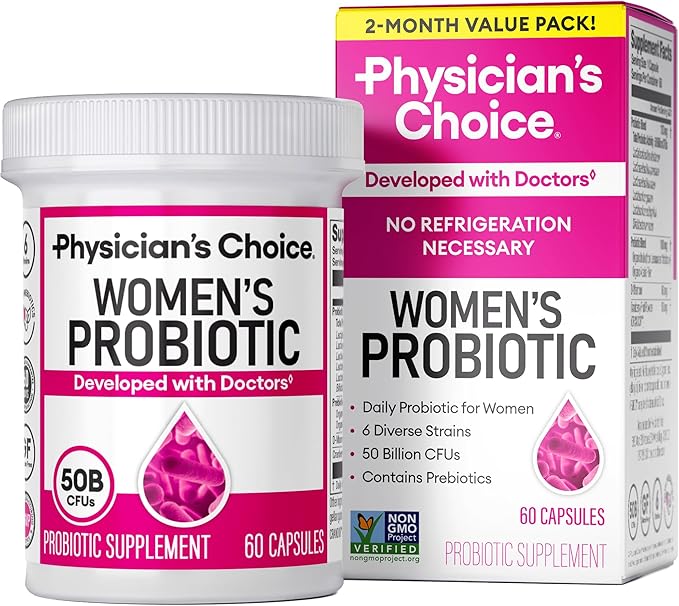
Supports digestive and feminine health with 6 strains.
Contains organic prebiotics and cranberry extract.
Suitable for women with 50 billion CFU.

High potency with 60 billion CFU per serving
Includes prebiotics to support probiotic effectiveness
Non-GMO verified and gluten-free formula

Contains 6 diverse probiotic strains.
Includes cayenne and green tea extract.
Promotes gut health and weight management.

High potency with 100 billion CFU.
Includes digestive enzymes and prebiotics.
Shelf stable for convenient storage.

High CFU count for enhanced gut health.
Includes 40 diverse strains for comprehensive support.
Contains prebiotics for improved digestion benefits.

Delicious Hawaiian pineapple flavor enhances enjoyment.
Vegan and gluten-free for dietary inclusivity.
Supports women's health and immune system effectively.

Supports gut health with Lactobacillus Plantarum.
Includes prebiotics for enhanced digestive benefits.
Suitable for vegans, catering to diverse dietary needs.

High-potency formula with 112.5 billion CFUs.
Multi-strain probiotic supports diverse gut health.
Effective for IBS and UC symptom relief.

High potency formula supports digestive balance effectively.
Clinically studied strains enhance gut health reliability.
Quick relief for bloating and digestive discomfort.
Start with the intended outcome. A product for general digestive support should not be treated as interchangeable with one studied for IBS, antibiotic-associated diarrhea, vaginal symptoms, or another defined use. Look for the full genus, species, and strain designation, plus a meaningful amount for each strain. A label that says “many strains” or gives one large total without individual doses makes independent comparison difficult. A published human study is most useful when it tests the same finished formula, daily dose, and outcome. Clinical-trial records, PubMed or MEDLINE records, NIH probiotic guidance, and systematic reviews can help distinguish direct evidence from claims borrowed from unrelated products.
CFUs—or colony-forming units—also need context. A total such as 16, 50, 60, 100, or 120 billion does not show how much of each organism is present, and a larger number does not by itself establish greater benefit. Some products state potency only at manufacture; stronger labeling guarantees the stated amount through expiration under specified storage conditions. A delayed-release capsule, moisture-tight bottle, or shelf-stable format may support handling, but it does not replace an expiry-date potency result or a lot-specific certificate.
Look for finished-product verification rather than only a company statement that testing occurs. A credible certificate should identify the tested lot and methods, and address microbial identity, live potency, and contaminants. Independent laboratories should have an ISO/IEC 17025-accredited scope relevant to the testing. Publicly checkable programs such as USP Verified, NSF Certified Dietary Supplements, Informed Sport, or Informed Choice provide more accountability than an uncheckable “third-party tested” claim. Finished-product testing may include specified microorganisms, heavy metals, allergens, and other contaminants, but a manufacturing-facility certification is not the same as verification of the bottle you buy.
A complete Supplement Facts panel should name every probiotic, prebiotic, botanical, enzyme, excipient, capsule material, and major allergen. This matters because inulin, FOS, XOS, acacia, and other fermentable fibers can worsen gas or bloating for some people; botanical ingredients can add medication or medical-condition concerns. Also check the lot, expiration date, responsible company, contact route, directions, warnings, and storage requirements. Repeated claims across the supplied products—such as immune, vaginal, urinary, weight, menopause, or disease-adjacent benefits—are not established merely because a label uses them.
For safety, these products are intended for adults unless clearly indicated otherwise. The supplied reviews repeatedly caution against self-selecting live-microbe products for premature infants, hospitalized infants, severely ill or immunocompromised people, people with central lines, or people recovering from major surgery; serious invasive infections have been reported in higher-risk groups. Pregnancy, breastfeeding, prescription medicines, and significant medical conditions commonly warrant clinician advice. Persistent or severe bowel, vaginal, urinary, fever, pain, bleeding, discharge, or infection symptoms need medical assessment rather than supplement-based self-treatment. One supplied bundle also raised a serious liver-safety concern and specific warnings for liver and biliary disease. Do not assume “natural,” shelf-stable, or medical-food marketing means risk-free.
These topics separate a convenient probiotic label from a product that can be meaningfully assessed. The supplied scores show that higher-scoring products generally disclose more of the formula, provide stronger documentation, and use narrower, better-supported claims; many products still lack public lot-level verification even when their marketing says testing occurs.
This measures whether the exact strains, daily dose, formulation, and intended use have credible human evidence. For probiotics, a high score requires a close match to the product sold—not evidence borrowed from a different strain or dose. Among the supplied products, scores range from 49 to 89; the higher end includes a full-formula digestive trial, while lower scores reflect broad claims without a reliable clinical match.
This asks whether the live count is guaranteed and supported through expiry under realistic storage and shipping conditions. A manufacturing-time CFU figure can overstate what reaches the buyer. Scores range from 68 to 90. Higher-scoring products include an expiry-date guarantee or published batch result; lower-scoring products rely on a manufacturing count, general shelf-stability statement, or testing claim without public expiry evidence.
This measures whether the finished product contains its declared organisms and ingredients and is screened for harmful microbes and relevant chemical contaminants. That matters because live cultures, botanicals, fibers, and enzymes add multiple opportunities for mix-ups or contamination. Scores range from 70 to 90. The strongest supplied documentation reports pathogens and heavy metals; lower scores rely mainly on manufacturer claims without a public finished-product report.
A high score means the label does not leave vulnerable buyers to infer safety from general marketing. It should address premature or hospitalized infants, severe illness, immunocompromise, pregnancy, breastfeeding, medicines, allergies, and relevant conditions. Scores range from 52 to 78. Higher scores provide clearer consultation or exclusion guidance; lower scores omit specific warnings for immunocompromised or severely ill users despite recognized infection concerns.
This measures whether every strain, fiber, botanical, enzyme, excipient, capsule material, and major allergen is plainly disclosed. It matters because ingredients such as inulin or FOS may aggravate digestive symptoms, while botanicals and capsule materials can affect suitability. Scores range from 52 to 88. Higher scores provide a complete panel and allergen information; lower scores include conflicting ingredient lists or incompletely described blends.
This measures whether the label gives genus, species, strain identifier, and meaningful amount for each organism. It is especially important because probiotic research cannot be matched reliably from species names alone. Scores range from 52 to 89. The strongest products name strains and total or serving-level amounts; lower-scoring products use species-only blends, hide per-strain doses, or create ambiguity between formula versions.
This measures publicly checkable outside certification or batch testing of the finished product for identity, potency, and contaminants. A GMP facility statement or “third-party tested” claim is not equivalent to a product report. Scores range from 70 to 91. Higher scores are supported by a published certificate or accountable certification evidence; lower scores lack a registry entry, named report, or lot-specific results.
This asks whether digestive, immune, vaginal, urinary, weight, menopause, or disease-adjacent claims stay within evidence for the exact formula. Scores range from 48 to 82. Higher-scoring products use narrower claims that align more closely with available studies; lower-scoring products promise rapid relief, infection support, broad whole-body effects, or treatment-like outcomes without matching strain, dose, or finished-formula evidence.
This measures whether the responsible company, lot, expiration date, contact route, manufacturing information, and product classification are traceable, and whether relevant FDA recalls or enforcement actions are absent or responsibly resolved. Scores range from 55 to 78. Higher scores reflect clearer company and product traceability; lower scores reflect unresolved regulatory history, incomplete public records, or concerns about formula and claim accountability.
This measures whether bottles, blister packs, desiccants, shipping materials, refill systems, and disposal claims reduce waste without compromising culture stability. Most supplied products use conventional bottles and provide no package-specific recycling, recycled-content, or refill evidence, so scores cluster tightly from 68 to 76. A higher score reflects documented reuse or reduced-material features, while a shelf-stable claim alone does not prove lower environmental impact.
This is an 84-capsule adult probiotic supplement intended for one capsule daily. The formula is marketed for routine digestive comfort, regularity, occasional gas and bloating, and immune support. The manufacturer states that each daily capsule supplies 60 billion CFUs across 10 Lactobacillus and Bifidobacterium species, plus a 150 mg organic prebiotic blend, in an acid-resistant capsule. Independent retailer label records support the listed species, the 60 billion total CFU claim, and the 150 mg blend of Jerusalem artichoke inulin, acacia fiber, and chicory inulin. However, neither the label record nor the manufacturer page identifies alphanumeric strain codes or CFUs for individual organisms. That prevents matching the actual blend and doses to human trials. The brand states it is third-party tested, but does not identify a certifier, laboratory, test method, batch report, or public certificate for this product.
This product is most suited to a healthy adult who wants a once-daily, shelf-stable probiotic and can tolerate fermentable fibers. It has a clearly listed multi-species blend and a modest 150 mg prebiotic component, which may fit someone seeking general digestive routine support rather than treatment for a diagnosed gastrointestinal condition. It may also suit people avoiding dairy, soy, gluten, wheat, eggs, fish, shellfish, peanuts, tree nuts, and sesame, while recognizing the product is made in a facility that also processes those allergens.
It is not a good self-directed choice for premature infants, children, people who are severely ill, immunocompromised, hospitalized, or using central venous access, because live microorganisms can rarely cause serious infection in higher-risk settings. Pregnant or lactating people, anyone taking medicines, and people with a medical condition should follow the label's advice to consult a healthcare professional. People with a known sensitivity to inulin or other fermentable fibers may prefer a formula without prebiotics, because gas and bloating can occur. It also does not suit buyers requiring strain-specific clinical evidence or independently published batch testing.
The product provides substantially better ingredient visibility than a probiotic that only names a proprietary blend. Independent retailer label information lists 10 Lactobacillus and Bifidobacterium species, three organic prebiotic fibers, and the capsule and processing ingredients. It also warns that manufacturing occurs in a facility processing multiple major allergens, which matters despite the formula's stated allergen exclusions. The manufacturer states that the product is Non-GMO Project Verified, made in the United States with global ingredients, and third-party tested for safety, quality, and potency. A product-specific public certificate or test report was not located, so those quality claims cannot confirm finished-product identity, contaminant screening, or live potency through expiration. No relevant FDA recall or warning letter was located in the searches performed. No verified information was found on bottle resin, recycled content, refill options, shipping materials, or disposal guidance, so environmental impact cannot be meaningfully assessed.
This is a 60-capsule, once-daily dietary supplement for adult women. Each capsule is labeled with a total of 50 billion CFUs from six probiotic species, plus 100 mg of organic inulin and acacia fiber, 60 mg D-mannose, and 50 mg cranberry fruit powder. It is sold for digestive, regularity, immune, urinary tract, and feminine-health support. An independent retail label record identifies the six species and the quantities of the nonprobiotic ingredients. An older package label also identified strain codes, but the current manufacturer page lists species only and does not assign CFUs to each strain. The manufacturer states that the bottle protects potency without refrigeration and that the product is third-party tested, but no public batch certificate, expiration-date potency report, or certifier registry entry was located.
This product suits an adult who wants a simple, shelf-stable daily probiotic and prefers a formula that combines probiotic species with small amounts of prebiotic fiber, cranberry, and D-mannose. It may fit someone seeking general digestive support who understands that 50 billion is a total blend count, not a dose verified for each strain or for a specific condition. Those sensitive to added fermentable fiber should introduce it cautiously and monitor for gas or bloating.
It is not appropriate for premature infants or for use in a neonatal setting. FDA has warned that live microorganisms can pose serious risks in preterm infants. People who are severely ill, immunocompromised, have central venous catheters, or have a history of probiotic-related infection should seek clinician guidance before using live-culture supplements. It is also not a substitute for medical evaluation of recurrent urinary symptoms, vaginal symptoms, fever, flank pain, or blood in urine.
The formula is relatively transparent about its nonprobiotic ingredients. It lists organic inulin and acacia fiber, D-mannose, cranberry fruit powder, and a vegetable capsule with rice-based and plant-derived processing ingredients. It is labeled gluten-free, and retail label material reports no soy, milk, egg, wheat, peanut, GMO, color-additive, or preservative ingredients. Users should still check the bottle they receive because label presentations have changed over time. The maker states that the product is made in a cGMP-certified facility and third-party tested, but public certification registry confirmation and a finished-product laboratory report were not available. The manufacturer describes a light- and moisture-blocking bottle, which may support culture stability, but it provides no package-specific recycled-content, refill, or U.S. recyclability evidence. A 2021 FTC warning letter to JB7, LLC addressed unsupported COVID-19 claims for Physician's Choice probiotic advertising.
This is a 30-serving adult probiotic supplement. The suggested use is one delayed-release vegetable capsule daily with food. Independent retailer label records list a 285 mg proprietary blend of 12 Lactobacillus, Lactococcus, and Bifidobacterium organisms, totaling 60 billion CFU, plus a 60 mg fiber blend of acacia gum, apple fiber, and inulin. The label names only one strain-level identifier, Lactobacillus rhamnosus GG. It does not disclose individual CFU amounts or strain codes for the other organisms, so the full blend cannot be matched reliably to human trials. The maker states the 60 billion CFU count is guaranteed through expiration and that the product is third-party tested, but no lot-specific certificate or publicly checkable finished-product laboratory report was located. Certified Vegan status is supported by Vegan Action's company logo registry.
This product fits a healthy adult who wants a once-daily, shelf-stable capsule for general digestive support and values a plant-based capsule. It may also suit someone who prefers a formula that discloses its species list, supporting fibers, and other ingredients rather than leaving the entire formula unspecified. The one-capsule daily use and 30-serving bottle are practical for a one-month trial. Expectations should stay modest because the total CFU number does not reveal the dose of each organism or establish a specific clinical outcome for the blend.
It is not a suitable self-directed choice for premature infants, hospitalized infants, or people who are severely ill or immunocompromised. FDA and NIH sources describe rare but serious invasive infections from probiotics in higher-risk settings. People who are pregnant, nursing, managing a diagnosed gastrointestinal condition, using prescription medicines, or reacting to fermentable fibers should seek clinician advice first. It is also a weak fit for buyers seeking a probiotic for a defined outcome, such as antibiotic-associated diarrhea or irritable bowel syndrome, because nearly all strain identifiers and every per-strain dose are missing.
The label presents a vegan, gluten-free, soy-free formula in a delayed-release vegetable capsule. Vegan Action's registry confirms that Sports Research Corporation is authorized to use the Certified Vegan logo. Retailer label records identify the nonactive ingredients as potato starch, hypromellose, gellan gum, purified water, L-leucine, and pectin. The label also lists organic sources within the small fiber blend, but this does not make the whole product certified organic. The maker states that the bottle has moisture control, needs no refrigeration, and provides 60 billion CFU through expiration. Those are useful handling claims, but a public lot-specific potency or contaminant report was not found. No product-specific FDA recall or warning letter was located in the reviewed FDA searches. The package is a conventional single-use bottle with no verified refill, recycled-content, or package-specific recycling evidence, so its material impact remains largely undocumented.
This is a 30-capsule, once-daily adult supplement combining a 15-billion-CFU probiotic blend, prebiotic fibers, digestive enzymes, green tea extract, apple cider vinegar, and cayenne extract. The manufacturer identifies six organisms, including L. plantarum Lp-115, L. rhamnosus Lr-32, L. acidophilus La-14, B. infantis Bi-26, B. lactis BL-04, and L. gasseri without a strain identifier. Its defining weight-management ingredient is 300 mg Greenselect Phytosome, a caffeine-free green tea extract, as manufacturer-stated. Human studies of Greenselect at comparable total daily amounts found outcomes alongside calorie restriction or prior lifestyle-led weight loss, not with this finished combination. The brand also states the bottle is shelf-stable and the capsules are delayed release, but it does not publish a lot-specific potency certificate or independent finished-product laboratory report for buyers to check.
This product fits an adult who wants a one-month, once-daily capsule that combines a modest multi-strain probiotic with prebiotic fiber and a caffeine-free green tea phytosome. It is most relevant to someone already following a clinician-appropriate calorie and activity plan, who treats it as a supplement rather than a weight-loss treatment. It may also suit people who prefer a formula stated to avoid several common food allergens and who can tolerate capsules containing green tea extract, cayenne, and fermentable prebiotic fibers.
It is not appropriate for premature infants, children, or people seeking treatment for obesity, digestive disease, or unexplained persistent bloating. People who are severely ill, immunocompromised, hospitalized, or have a central venous catheter should seek clinician guidance before using live-microorganism supplements. Pregnant or breastfeeding people, and anyone taking medicines, should follow the product warning and consult a healthcare professional. Those sensitive to green tea extracts, cayenne, fermentable fibers, or capsule ingredients should select a more suitable product.
The formula uses a vegetable capsule and identifies its main active blends and inactive ingredients. Several fiber inputs are described as organic, including acacia, chicory inulin, and Jerusalem artichoke inulin. That ingredient-level wording does not establish that the complete supplement is certified organic. Current retailer information also lists the formula as free of numerous major allergens, although the manufacturing facility reportedly processes those allergens. The manufacturer says the product is third-party tested for potency and purity, uses a shelf-stable bottle, and does not require refrigeration. However, no public lot certificate, independent finished-product microbiology result, or public certification listing was located to verify potency through expiration, contaminant testing, or bottle material claims. No product-specific FDA recall or warning letter was located in the searched records. Probiotics can cause mild gas in healthy users, while serious infections have been reported mainly in severely ill or immunocompromised people and preterm infants.
This is a 30-capsule adult synbiotic supplement sold as a daily probiotic product for women and men. The manufacturer describes a formula with 100 billion CFU, 34 microbial strains, prebiotic fibers, digestive enzymes, and fruit and vegetable ingredients. It is promoted for digestion and a much wider set of wellness uses. The most important limitation is that the formula does not provide strain identifiers or CFU amounts for individual organisms. Human probiotic evidence is strain and dose specific, so the blended total cannot be reliably matched to clinical studies. A related label in NIH's Dietary Supplement Label Database says its 100 billion CFU count is formulated at manufacture and that loss can occur over time, rather than clearly guaranteeing live potency through expiration. The manufacturer says the product is shelf stable and third-party tested, but no public finished-product report or recognized certification listing was located.
This product may suit a healthy adult who wants a convenient, shelf-stable daily capsule that combines a broad microbial blend with small amounts of prebiotic ingredients and digestive enzymes. It is most aligned with someone seeking general digestive-wellness support rather than treatment for a diagnosed condition. The 30-capsule format is intended for a month of use at one capsule daily, based on the marketed product format. Users should treat the 100 billion CFU figure cautiously because publicly available labeling does not establish that amount through expiration.
It is not a suitable self-treatment for persistent diarrhea, significant abdominal pain, inflammatory bowel disease, recurrent urinary or vaginal symptoms, infection, depression, autoimmune disease, or other conditions promoted on the product page. Those uses need clinical evaluation and, where appropriate, evidence-matched treatment. Premature infants must not receive probiotic supplements outside specialist medical direction. People who are severely ill, immunocompromised, hospitalized, have a central venous catheter, or have major underlying disease should consult their clinician before taking live microorganisms. Pregnant or nursing users and people taking medicines should also follow the label's consultation advice.
The product is a dietary supplement, not an FDA-approved treatment. NIH notes that meaningful probiotic benefits depend on the exact microorganism, strain, dose, and intended outcome. This product's species-level and blended-CFU disclosure is therefore not enough to verify its broad health claims. The available NIH label includes a general consultation warning for pregnancy, nursing, medical conditions, and medicines, but it does not specifically address immunocompromised people or premature infants, groups for whom live microorganisms can pose greater risk. Wholesome Wellness states that the product is organic, vegan, non-GMO, shelf stable, manufactured in the United States, and third-party tested. Public documentation located for this assessment did not verify a product-specific organic certificate, finished-product test report, NSF or USP listing, or packaging recyclability claim. No product-specific FDA recall was located. FDA did issue the company a warning letter in 2021 concerning unlawful disease claims for a different supplement.
This is a 240-count adult vegetarian-capsule supplement taken as two capsules daily, providing 120 servings. Its current Supplement Facts panel lists a 450 mg probiotics and postbiotics blend labeled as 200 billion CFU per serving, plus 150 mg of psyllium husk, acacia fiber, and inulin, and a 50 mg enzyme blend with bromelain, papain, amylase, protease, and lipase. The formula names its microbial species and its other ingredients, which is useful for ingredient screening. It does not provide alphanumeric strain identifiers or CFUs for individual organisms, so the formula cannot be matched to strain-specific human research. NatureBell states that it is made in a cGMP-compliant facility and third-party tested, but the public material reviewed does not provide a lot-specific, independently checkable finished-product report or an expiration-date potency guarantee.
This product fits a healthy adult who specifically wants a long-duration capsule routine and wants the label to disclose a broad mix of microbial species, fiber ingredients, enzymes, and inactive ingredients. It may also suit someone avoiding dairy, soy, or gluten, based on the manufacturer’s statement. The practical use case is general digestive support rather than treatment of a diagnosed condition. A buyer should be comfortable with uncertainty about which organisms are present at meaningful doses and whether the stated potency persists through expiration.
It is not well suited to people seeking a probiotic for a specific outcome, such as antibiotic-associated diarrhea, irritable bowel syndrome, constipation, vaginal symptoms, or immune support, because the needed strain identifiers and per-strain doses are not disclosed. Infants and especially premature infants should not use it. People who are severely ill, immunocompromised, in intensive care, have a central venous catheter, or have a history of probiotic-related infection should consult their treating clinician before using live-microbe products. People with fiber-sensitive digestive symptoms should also note the psyllium, acacia, and inulin blend.
The product provides more ingredient detail than a simple proprietary blend label. The current panel names microbial species and identifies the prebiotic fibers, digestive enzymes, rice flour, magnesium stearate, silicon dioxide, and vegetable-cellulose capsule. NatureBell states that the formula is non-GMO, made without gluten, soy, and dairy, manufactured in a cGMP-compliant facility, and third-party tested. Those manufacturing and testing statements could not be independently confirmed through a public certification registry or a batch-specific laboratory report. Live probiotics are usually low risk for healthy people, though temporary gas can occur. NIH and FDA materials note rare serious bloodstream infections in severely ill or immunocompromised people, and FDA specifically warns against probiotic use in premature infants. The package is a single-use rigid bottle with a plastic cap. No refill program, verified recycled-content claim, material identification, or US-specific recycling instructions were found. California litigation filed in 2025 alleged lead exposure from several other NatureBell supplements, not this probiotic product.
This product is a pineapple-flavored, pectin-based gummy supplement sold in a 60-gummy pouch, intended as a 30-day supply. The suggested use is two gummies daily, with or without food. It is marketed for vaginal-flora, odor, pH, digestive, and immune support. An independent retailer's label listing identifies 5 g pineapple fruit powder, 15 mg Bacillus coagulans described as 1 billion CFU, 20 mg vitamin C, and 10 mg sodium per daily serving. The label names Bacillus coagulans only at the species level, not with a strain identifier. The brand states that the product is vegan, gluten-free, non-GMO, and made in the United States, but the review found no public product-specific certification or finished-product laboratory report to independently confirm those claims.
This product suits an adult who specifically wants a convenient, plant-based gummy routine and understands that it is a dietary supplement, not treatment for an infection or persistent symptoms. The 60-count pouch provides 30 daily servings at the listed two-gummy dose, which may fit someone who prefers a short, simple routine over capsules. It is most suitable for buyers comfortable with a species-level Bacillus coagulans listing and manufacturer-stated vaginal wellness claims, rather than buyers seeking clinically traceable probiotic strains.
It is not appropriate as self-treatment for bacterial vaginosis, yeast symptoms, pelvic pain, unusual discharge, strong odor, urinary symptoms, fever, or recurrent symptoms, which need clinical assessment. Pregnant or nursing people, people taking medicines, and those with medical conditions should follow the brand's advice to consult a clinician first. People who are severely ill or immunocompromised should be particularly cautious with live-microbe supplements. It also does not suit buyers who require strain-level evidence, lot-specific potency proof, independent contaminant testing, or verified allergy facility controls.
The retailer-listed formula provides meaningful basic disclosure. A daily serving contains 1 billion CFU of Bacillus coagulans, alongside pineapple fruit powder, vitamin C, sodium, and a named list of gummy ingredients. However, the probiotic has no strain code. That matters because probiotic effects are strain-specific, and the available human bacterial-vaginosis study used Bacillus coagulans Unique IS-2 at 2 billion CFU daily alongside antibiotics, not this gummy formula. The brand states that the gummies are vegan, gluten-free, non-GMO, and made in the United States. No USP, NSF, Informed Choice, or comparable public certification entry, and no public finished-product laboratory report, was located during verification. The package is a flexible pouch, but no verified recycling guidance, recycled-content claim, refill system, or compostability certification was found. A Florida corporate record provides an accountable U.S. company listing, and no product-specific FDA recall or warning letter was located in the reviewed searches.
This is a 60-capsule synbiotic supplement for digestive and immune support. The current product label lists a two-capsule serving with 5 billion CFU of Lactobacillus plantarum OM, plus fructooligosaccharides, stabilized rice bran, and a plant-cellulose capsule. It provides 30 labeled servings. The manufacturer directs adults to take two capsules with a meal and two at bedtime, which would use a bottle in 15 days at that regimen. The formula identifies its single probiotic as L. plantarum OM, and company material links it to OM 55981. That strain-level identification is useful, but searches did not locate human clinical trials of this exact strain and product dose for the advertised digestive, immune, mood, or metabolic outcomes. Public, lot-specific independent testing for finished-product identity, live count through expiry, or contaminants was not located.
This product is most relevant to an adult who wants a simple, single-strain probiotic rather than a broad blend and values being able to identify the microorganism and stated CFU count. It may suit someone experimenting with general digestive support who can tolerate fructooligosaccharides and has no major medical vulnerability. The capsule format is convenient for people who prefer a shelf-stable product and can follow the manufacturer's multi-capsule routine. Expectations should stay modest because direct human outcome evidence for this exact strain and dose was not located.
It is not well suited to premature infants, infants generally, or people who are severely ill or immunocompromised without specialist guidance. FDA and NIH materials warn that live probiotics can rarely cause invasive infection in vulnerable groups. People with milk allergy should seek clarification before use because the brand's dairy-free language sits alongside a statement that the culture was grown on milk-containing medium. Anyone with persistent abdominal pain, fever, vomiting, bloody diarrhea, suspected ulcer or gastritis, or unexplained bowel changes needs medical evaluation rather than relying on a probiotic.
The product has a clearly named live culture, L. plantarum OM, and a stated 5 billion CFU per two-capsule serving. Its public label also identifies FOS, stabilized rice bran, and the vegetable-capsule materials. This level of formula disclosure is more useful than a proprietary multi-strain blend, although the exact amount of FOS is not stated. The manufacturer describes the capsules as vegan, gluten-free, soy-free, shelf-stable, and made in the United States with globally sourced ingredients. No public registration was found for this finished product in major independent supplement-certification directories, and no current lot-matched third-party report was located for potency, identity, heavy metals, or microbial contaminants. No product-specific FDA recall or warning letter was identified in the checked sources. Environmental documentation was also limited. No refill system, recycled-content claim, package-specific recycling instruction, or independently verified lower-impact packaging claim was located. The bottle-and-capsule format remains a conventional single-use package.
This is a refrigerated, adult capsule probiotic sold here as two 60-capsule bottles. The maker states that each capsule provides 112.5 billion CFU from eight bacterial species, with a usual adult dose of one to two capsules as directed by a physician. It is marketed as a medical food for dietary management of IBS and ulcerative colitis, rather than as a general daily supplement. Its defining practical feature is cold-chain handling. The manufacturer says it ships cold, should be refrigerated, and can remain at room temperature for up to two weeks. The formula lists eight species and all listed nonmicrobial ingredients, but it does not disclose strain identifiers or CFU amounts for each organism. That prevents a precise match between this capsule and strain-specific clinical evidence.
This product is most suited to an adult already working with a gastroenterologist on IBS or ulcerative colitis who specifically needs a refrigerated, high-CFU multi-species probiotic and can reliably maintain refrigeration. It may also fit people avoiding dairy, gluten, soy, nuts, or animal capsule materials, based on the maker's formula claims. The listed two-bottle supply is substantial, so it better matches an established clinician-guided routine than a casual first experiment with probiotics.
It is not well suited to infants, especially preterm infants, or to people who are severely ill, hospitalized, immunocompromised, or using central venous access without explicit medical guidance. These groups can have a higher risk of invasive infection from probiotics. It is also a poor fit for people who travel frequently without reliable cold storage, want a shelf-stable daily probiotic, or require a formula whose exact strain identities and per-strain doses can be independently checked against clinical studies.
The maker lists a relatively complete nonmicrobial ingredient panel and states that the capsules are dairy-free, vegan, gluten-free, soy-free, and nut-free. It also claims FODMAP Friendly, halal, and kosher status. Public searches did not produce a readily checkable finished-product certification record or lot-specific independent test report for this capsule, so those quality and suitability claims remain primarily manufacturer-stated. The product needs refrigeration and cold shipping to protect live cultures. The maker says its insulated shipping materials are recyclable and ice packs reusable, which could reduce some single-use waste, but package-specific independent verification was not found. A key health context is the product's formulation history. Court records found misleading claims linking later VSL#3 with the earlier De Simone formulation, so older VSL#3 research should not automatically be treated as proof for the current product.
VSL4 Gut is a 30-capsule, adult, once-daily probiotic supplement. One capsule supplies a proprietary 210 mg blend listed as 30 billion CFU, with eight named bacterial entries. The disclosed nonactive ingredients are corn starch, a hydroxypropyl methylcellulose vegetable capsule, and magnesium stearate. It is intended for everyday digestive comfort and regularity, not for treatment of a diagnosed gastrointestinal disease. The maker states that the 30 billion CFU count is guaranteed through the best-by date, that the capsule is shelf-stable, and that refrigeration is unnecessary. An independent FODMAP Friendly listing confirms certification for low-FODMAP use. The key evidence limitation is that published studies found for related VSL#3 formulas used different named strain identifiers and substantially higher doses, commonly 450 billion CFU or more, rather than this product's 30 billion CFU blend.
This product fits an adult seeking a simple 30-day, one-capsule probiotic routine for general digestive comfort or regularity, rather than care for a diagnosed gastrointestinal condition. It is especially relevant for a person following a low-FODMAP diet, because that certification is independently listed. It may also suit people avoiding dairy, soy, gluten, or nuts based on the manufacturer's disclosed formula. Expectations should remain modest because the product-specific daily dose and strain combination have not been matched to human outcome trials located in this review.
It is not designed for infants or children, and it should not be selected as a substitute for medical care for ulcerative colitis, pouchitis, IBS, persistent bowel symptoms, or other diagnosed digestive disorders. People who are severely ill, immunocompromised, hospitalized, or using a feeding tube should seek clinician guidance before using probiotics, because infections have occurred in higher-risk groups. Pregnant or nursing people, people taking medication, and those with a medical condition should also follow the product warning and consult a clinician first.
The strongest independently verified health-related point is its FODMAP Friendly certification. That program reports independent laboratory testing for FODMAP content, which supports its suitability for a low-FODMAP diet. The maker also provides a concrete ingredient list and identifies eight bacterial entries, although it does not disclose the CFU allocation for each one. Its dairy-free, gluten-free, soy-free, nut-free, vegan, and non-GMO statements remain manufacturer claims rather than certifications located in this review. The manufacturer says the capsules are shelf-stable and provide 30 billion CFU through the best-by date. However, no public lot-specific certificate of analysis or independent finished-product test report was located for potency, microbial identity, or contaminants. FDA materials caution that probiotics can cause serious infections in some severely ill or immunocompromised people, and FDA warns against probiotic use in preterm infants without appropriate clinical oversight. No relevant U.S. recall or FDA warning letter was located in the searches performed. Packaging sustainability evidence was not provided.


