Best Overall

ALL4JIG Rotating Puzzle Board with Drawers
Convenient rotating design for easy puzzle access.
Built-in drawers for organized puzzle storage.
Protective cover keeps puzzles safe and intact.
 Daniel Kenitz
Convenient rotating design for easy puzzle access.
Built-in drawers for organized puzzle storage.
Protective cover keeps puzzles safe and intact.

Convenient tilting and rotating for easy access.
Includes four drawers for organized storage.
Portable design with a protective cover.

Convenient tilting and rotating design for easy access.
Built-in drawers for organized puzzle piece storage.
Portable with a protective cover for safe transport.

Height adjustable for comfortable puzzling experience.
Includes drawers for organized puzzle storage.
Portable design with wheels for easy movement.
Convenient detachable board for easy transport.
Non-slip surface keeps pieces in place.
Includes sorting trays for efficient organization.
Adjustable angles for comfortable puzzle solving.
Includes six trays for organized pieces.
Transparent cover keeps puzzles dust-free.

Tilting and rotating design enhances puzzle experience.
Convenient storage with four built-in drawers.
Accommodates large puzzles up to 1500 pieces.

Adjustable height and tilting for comfort.
Convenient drawers for organized puzzle pieces.
Wheels allow easy movement and storage.
Convenient storage keeps puzzles organized and secure.
Large surface fits most standard puzzles.
Portable design for easy puzzle transport.

Spacious design fits large puzzles comfortably.
Convenient drawers for easy puzzle piece storage.
Portable and sturdy for flexible puzzle sessions.
Start with the puzzle’s finished dimensions, then compare them with the stated working area rather than the product’s outside footprint. A “1,000-piece” or “1,500-piece” capacity is not a universal fit: supplied listings include conflicting dimensions, inconsistent thicknesses, and, in one case, a manufacturer description that says a board marketed for 1,500 pieces holds up to 1,000. Look for a measured usable surface, qualified dimensions, and clear instructions. A cover can contain an unfinished puzzle, but it does not prove that pieces will remain in place during vertical carrying. Foldable products may need to stay flat, while broad wooden or plastic boards can be difficult to lift even when called portable.
Then match the mechanism to the way you work. Rotation can bring distant edges closer without moving the whole board, but buyers should look for a stated load limit, safe-use limits, wheel or rotation-lock information, and product-specific stability testing. Tilt and height adjustment can change viewing position, but a listed angle or adjustment range is not evidence that a product reduces neck, back, wrist, or joint strain. Freestanding tables also need attention to caster brakes, tilt retention, pinch points, and the stability of the assembled frame. A simple fixed board avoids some moving-part risks, but it will not provide elevated or adjustable support.
Material claims need similar scrutiny. “Wood” does not identify whether a product uses solid wood, plywood, MDF, particleboard, fiberboard, adhesives, or finishes. For composite-wood components, look for a finished-good or packaging label with the fabricator name, production date, and TSCA Title VI compliance statement, traceable to an EPA-recognized third-party certifier. For child-focused products, a Children’s Product Certificate and applicable CPSC-accepted laboratory records matter. Claims such as lead-free, phthalate-free, recyclable, sustainable, or low-emission should identify the exact material, product, test, certification program, or recycled-content percentage rather than relying on a badge or broad wording. FSC and SFI claims should be publicly checkable for the relevant wood input; GREENGUARD claims should be checkable in UL SPOT.
Durability is more than a warranty headline. Useful evidence includes product-specific load, cycle, humidity, warp, drawer, bearing, or fastener testing; a clear warranty; an assembly manual; and replacement drawers, wheels, covers, or hardware. A short defect warranty, contradictory warranty language, or no repair pathway gives less confidence that a failed mechanism can be maintained instead of discarded. Likewise, “waterproof,” “warp-resistant,” or “recyclable” remains a seller claim unless the construction, test method, resin or fiber information, and practical end-of-life route are explained.
Across the supplied products, recurring cautions are substantial. No product had a located independent laboratory report covering all relevant stability, load, emissions, edge, pinch, or durability questions. Several products had conflicting dimensions, capacity, weight, age, material, or warranty information. Moving boards can expose fingers to drawers, tilt joints, rotating bases, wheels, covers, and fasteners; products marketed to adults should not be assumed safe for young children. Users with lifting limitations should not rely on “portable” wording, and anyone seeking ergonomic relief should not treat rotation, tilt, or height adjustment as a proven health intervention. Use a stable support, follow the supplied instructions, lock wheels where applicable, keep children and pets away from moving mechanisms, and confirm the delivered product’s dimensions and materials before use.
The supplied reviews generally found useful organization and storage features, but little product-specific testing. The scores below therefore distinguish documented design information from independent proof; a higher score means stronger evidence within this reviewed set, not a guarantee of safety or environmental performance.
This measures disclosure and evidence for wood panels, coatings, plastics, felt, and adhesives, including formaldehyde and VOC limits and, where child use is claimed, lead and phthalates. It matters because boards may use composite wood, finishes, rubber, or plastics indoors. Scores were mostly around 70; the lower 58 reflected vague fabric, cardboard, backing, adhesive, and coating information, while the strongest records identified materials more clearly but still lacked emissions testing.
This covers resistance to tipping, rolling, collapse, or unexpected movement during puzzling and transport. It is central to rotating bases, tilt joints, casters, and freestanding tables. Scores ranged from 68 to 78: the higher results reflected clearer footprints, weights, or stated mechanisms, while lower results reflected missing load limits, tilt angles, lock specifications, and stability reports. A listed 360-degree rotation or wheel brake is not independent stability proof.
This measures whether drawers, covers, hinges, tilt joints, rotating bases, fasteners, and board edges avoid pinches, cuts, splinters, and detached parts. It matters especially when a product is described for children or has several moving components. Most products scored around 70; the lower 62 was associated with a folding case whose age information and construction were unclear. No supplied product had located product-specific pinch or child-testing evidence.
This considers weight, handles, foldability, height, tilt controls, and reach demands. A board can be called portable while weighing about 13.7 or 15.8 kilograms, or lack handles altogether. Scores ranged from 69 to 76. Higher scores reflected a stated usable height range, handle, or concrete weight; lower scores reflected missing lifting guidance or unreliable weight data. Rotation and adjustment claims do not establish reduced pain or strain.
This measures whether usable dimensions, piece capacity, materials, drawers, covers, rotation, tilt, weight, and accessories match the delivered product. It matters because the category repeatedly uses headline capacities that may not fit every puzzle. Scores ranged from 48 to 76. Higher scores came from cross-listed dimensions or clearly stated features; lower scores reflected contradictory footprints, thicknesses, capacities, materials, or included components.
This asks whether a current report identifies the exact model, test method, date, results, laboratory, and manufacturer or importer. It matters because seller statements, badges, and repeated retailer listings do not establish stability, emissions, pinch, or durability performance. Scores were mostly 68–70, with no supplied product showing a located independent report. A high-looking score here should not be read as proof that testing was found.
This measures whether MDF, particleboard, or plywood components can be traced to TSCA Title VI compliance through a finished-good or packaging label and an EPA-recognized certifier. It matters because “wood” and “P2 MDF” do not by themselves document U.S. formaldehyde compliance. Plastic and textile products scored higher where composite wood was not identified; wood products generally remained near 68–70 because labels and panel records were missing.
This measures whether safety, low-emission, forestry, or quality badges identify a real program, the exact product or input, and a public certificate. It matters because environmental or safety seals can be mistaken for testing. Scores ranged from 70 to 78, with higher results reflecting fewer unsupported badge claims or clearer material positioning. No supplied product had a publicly verified FSC, SFI, GREENGUARD, or equivalent certificate tied to the reviewed item.
This measures whether claims about comfort, reduced neck or back strain, easier access, portability, child suitability, or other uses match the actual design and settings. It matters because rotating, tilting, and height-adjustable boards are often presented as ergonomic solutions. Scores clustered around 68–72. The stronger records described concrete features; lower results reflected unsupported health, child-development, stress-relief, or wrist-strain claims and absent human-factors evidence.
This measures resistance to warping, sagging, drawer and bearing failure, damaged covers, and stripped fasteners, along with repair support. It matters because a large board with moving storage can become waste if one drawer or mechanism fails. Scores were generally 69–74. The better results reflected stated warranties, spare-parts support, or clearer construction; lower results reflected no warranty, no parts catalog, reported staple problems, or no cycle and load testing.
This covers disclosed wood, plastic, metal, textile, and packaging inputs, responsible-fiber or recycled content, and realistic disassembly or recycling. It matters because mixed boards combine panels, felt, rubber, plastic, covers, and hardware. Most products scored near 70, but one plastic board scored 58 because recycled content, resin identification, and end-of-life guidance were absent. No supplied product had publicly checkable FSC, SFI, or comparable material certification.
This product is a low-profile wooden puzzle board intended for up to 1,500-piece jigsaw puzzles. It has a rotating base, four sorting drawers, and a protective cover, so an unfinished puzzle and loose pieces can remain together between sessions. The listed working footprint is about 24.92 by 33.58 inches, and the board is meant to sit on another stable surface rather than function as a freestanding table. The manufacturer identifies the board material as pine wood and states that it rotates 360 degrees. Its product-family page also identifies a Medium-1500pcs, four-drawer option. These are manufacturer statements, not independently tested performance figures. No public load limit, rotating-base stability result, material emissions report, or product-specific laboratory safety report was located.
This suits an adult puzzler who works on a stable table, countertop, or other level support and wants to keep a medium to large puzzle assembled across multiple sessions. The four drawers are useful for separating edge pieces, colors, or sections without spreading them around the room. It is also relevant for homes where dust or pets can disturb an unfinished puzzle, because the manufacturer includes a cover. Users should be comfortable handling a broad board rather than expecting a height-adjustable puzzle table.
This is not well suited to households needing a verified child-safe activity surface, especially for unsupervised younger children who could access drawers, moving parts, or small puzzle pieces. It also does not suit anyone needing documented low-emission materials because no public formaldehyde, VOC, coating, or adhesive records were found for the exact product. Avoid using it as a lap desk, carrying it while loaded, or placing it on an unstable card table. Buyers needing tilt adjustment, wheels, or a specified ergonomic working height need another format.
The manufacturer describes this product as pine wood, but does not publicly identify the exact wood layers, finish, adhesive system, drawer materials, or packaging inputs. No FSC or SFI chain-of-custody claim, recycled-content claim, UL GREENGUARD listing, or other publicly checkable environmental certification was identified for the product. Pine by itself is a material description, not evidence of responsible forestry or low emissions. This matters because composite wood panels and finished goods containing them are subject to the EPA TSCA Title VI formaldehyde framework when regulated panels are used. No finished-good TSCA Title VI label, panel supplier record, or certifier information was located for this board. That missing public evidence does not establish noncompliance. Searches of CPSC recall resources did not identify a recall for this product or brand, but no independent testing report was located for the rotating mechanism, drawer edges, or structural durability.
This is a tabletop wooden puzzle board intended for puzzles up to 1,500 pieces. It combines a rotating base, a tilting easel-style support, four sorting drawers, and a clear cover for pausing a project. The manufacturer describes 360-degree rotation, a tiltable surface, and a portable format. A separate retail listing also describes an integrated handle and a non-slip rotating base, but those details are seller claims rather than independently tested specifications. Material disclosure is incomplete. ALL4JIG says its boards use New Zealand radiata pine, P2-grade MDF, adhesives, and reinforced construction, but it does not provide a model-specific panel certificate, formaldehyde label, laboratory report, load limit, tilt angle, or assembly manual for this product. Published dimensions also vary across listings, so confirm the usable puzzle area against the puzzle box before setup.
This product suits an adult puzzler who works mainly at a stable dining or coffee table, regularly pauses multi-day projects, and needs drawers to separate loose pieces. It is most appropriate for someone using standard puzzles whose completed dimensions fit comfortably within the confirmed usable area, rather than relying on the 1,500-piece label alone. The rotation may be useful for reaching far edges without repeatedly moving around the table. Buyers should be comfortable handling a board weighing roughly 5.9 kg and should verify dimensions on arrival.
It is not well suited to households where young children may access the tilt support, drawers, rotating base, hardware, or cover without supervision. The available evidence does not document child-product testing, pinch-point evaluation, or small-part controls. It is also a poor fit for users who need a medically supported posture aid, a defined tilt angle, a verified load rating, or a board that can be safely moved while assembled. Anyone with limited lifting capacity should avoid treating its portable claim as a one-handed transport guarantee.
The key health uncertainty is the wood-panel construction. ALL4JIG identifies pine and P2-grade MDF in its broader product information, but no product-specific TSCA Title VI compliance label, panel certification, formaldehyde-emissions result, or low-VOC coating record was located. EPA rules require regulated composite-wood finished goods sold in the United States to be certified and labeled when applicable. The marketplace's broad claims about being lead-free, phthalate-free, and environmentally friendly were not backed by a certificate or test report. ALL4JIG states that it uses New Zealand radiata pine and stocks spare parts, plus a one-year defect warranty. Those are potentially useful durability and repair claims, but no FSC or SFI chain-of-custody certificate, recycled-content disclosure, packaging specification, replacement-parts catalog, or disassembly guidance was found. No ALL4JIG-specific CPSC recall or public safety action was located in the checked U.S. recall sources.
This is a large, manual puzzle work surface marketed for puzzles up to 1,500 pieces. The listed format is a 35 by 27 inch plastic board with four slide-out sorting drawers, a protective cover, a rotating base, and a claimed tilt function. It is intended for tabletop indoor use rather than as a freestanding table. WELGEE's own product page independently confirms a 35 by 27 inch ABS-plastic rotating board, four color-coded drawers, a natural-rubber mat cover, a snap-on locking Lazy Susan, and a stated 14 pound weight. That page does not document the tilt mechanism, its angle, load limit, or stability testing. No product-specific independent laboratory report, safety certificate, assembly manual, or replacement-parts listing was located.
This suits an adult puzzler who regularly works on standard puzzles up to the stated 1,500-piece capacity and needs a broad, dedicated surface with separate sorting storage. It is most relevant for someone who can place a 35 by 27 inch, manufacturer-stated 14 pound board on a stable table and wants to cover an unfinished puzzle between sessions. The rotating base may be useful for a seated user who wants to reach distant sections without repeatedly shifting the entire board.
It is not well documented for households seeking independently verified child safety, chemical testing, or formal safety records. Families with young children should not assume the drawers, rotating base, cover, and any tilt hardware have been evaluated for pinch, detachment, or small-part hazards. It is also a poor fit for anyone with a lifting limitation, a small tabletop, or a need for a proven ergonomic aid, because no load limit, tilt angle, setup manual, or product-specific evidence for pain or strain reduction was located.
The disclosed construction is ABS plastic with a natural-rubber mat cover, rather than MDF, particleboard, or plywood. On the evidence available, that means a TSCA Title VI composite-wood panel label is not expected for this product. However, WELGEE does not provide product-specific low-emission, phthalate, lead, or other chemical test results for the plastic, rubber, coatings, or adhesives. WELGEE describes the ABS construction as recyclable, lightweight, durable, and warp-resistant. Those are manufacturer statements, not traceable lifecycle evidence. No FSC or SFI fiber certification is relevant to the disclosed plastic construction, and no public certification, recycled-content percentage, take-back program, disassembly guidance, replacement-parts support, recall, or regulatory safety action specific to this product was located. The rotating and claimed tilt mechanisms add potential pinch and stability considerations that remain unverified by an independent report.
This is a manually adjusted rolling puzzle desk with a felt-topped work surface, four drawers, a cover, wheeled legs, and a steel base. JoyBerri's manual states that the usable inner surface is 35.04 by 26.57 inches, the desk has nine height positions from 27.17 to 37.4 inches, tilts to 45 degrees for use, folds to 90 degrees for storage, and has a 20 pound maximum load. The construction is manufacturer-stated as New Zealand pine, MDF, felt, and powder-coated iron. Its manual directs users to lock all four wheels before use and warns that moving the top too far back can let it slide off the support arms. A five-year defect warranty and an official replacement-parts catalog are available, but no product-specific independent safety, stability, emissions, or durability test report was located.
This suits a dedicated adult or supervised older child puzzler who wants a fixed, medium-large work area that can be rolled aside between sessions. It is especially relevant for someone who needs to raise the work surface from a standard table height, work with the board tilted, or protect an in-progress puzzle with a cover. The stated 20 pound load limit and 35.04 by 26.57 inch inner surface make it better aligned with ordinary jigsaw use than with heavy craft equipment or oversized puzzle formats.
It is not suited to children under 3, and children who cannot reliably follow safety directions should not use it. The manual requires adult assembly and says children should not sit, stand, move, disassemble, or adjust the desk. It is also a poor fit for anyone who needs independently verified low-emission MDF, tested anti-tip performance, or confirmed pinch-point safety. Users with limited lifting ability may need help during assembly and height changes, since the manual recommends two adults for adjustment.
The important health consideration is the MDF tabletop and drawer construction. MDF is regulated composite wood in the United States, yet JoyBerri does not publicly provide a finished-product TSCA Title VI compliance label, panel certification trail, or emissions test for this desk. That is missing verification, not evidence that the product exceeds a formaldehyde limit. No FSC, SFI, UL GREENGUARD, recycled-content, or comparable material certification was found for the stated pine, MDF, felt, or steel inputs. The manual provides practical safety directions, including wheel locks, a 20 pound load limit, adult assembly, and warnings not to move the top too far back. It also calls for indoor, dry storage and seasonal inspection. Repair support is a relative strength because parts are listed individually, which can extend service life. Searches of CPSC recall materials did not identify a product-specific recall or safety warning for this desk.
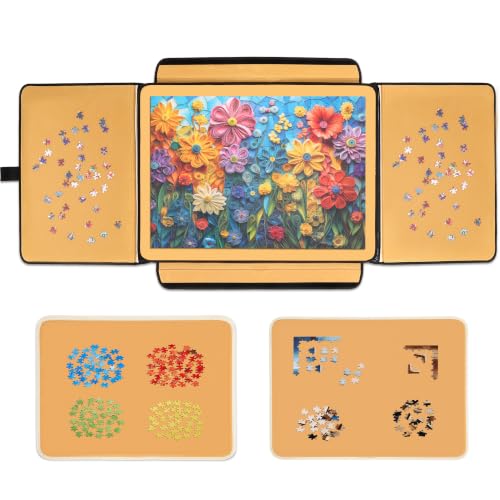
This is a soft-sided, foldable puzzle caddy for projects described as up to 1,500 pieces. Its stated working area is about 25 by 35.43 inches, and it includes removable sorting trays plus a detachable board. The product is intended to let a user puzzle on a fabric-lined surface, then close and carry the project using a handle and Velcro closure. The available independent retail record identifies the material only as fabric and repeats claims for a flat, non-slip, waterproof surface. Those are manufacturer-stated properties, not laboratory-verified performance results. It is a portable board, not a raised table, and no rotation, tilt mechanism, wheels, load rating, or height adjustment are described for this version. No public instruction manual, safety test report, or replacement-parts listing was located.
This fits a tabletop puzzler who needs to reclaim a dining table, coffee table, or other flat surface between sessions. It is most relevant for a person working on a puzzle advertised as up to 1,500 pieces who wants separate areas for sorting and a way to carry the project short distances. It also suits households that need to close away an unfinished puzzle from pets or routine activity. Use it as a portable organizer, rather than as a stand-alone elevated work table.
This is not the right format for someone needing a height-adjustable, tilt-adjustable, or rotating surface to reduce reaching. Buyers with hand, shoulder, or back limitations should not assume that the handle makes a loaded board easy or safe to carry, because no carrying limit or ergonomic test evidence was provided. It is also a poor fit for young children who may mouth or pull at detachable parts, or for households needing independently documented chemical, lead, phthalate, or formaldehyde compliance.
The product is marketed for ages 12 and up, rather than primarily for younger children. That reduces the relevance of children's-product certification rules, but it does not establish material safety. Public product information identifies fabric, while leaving the fiber type, backing, waterproof treatment, dyes, adhesives, and any rigid internal reinforcement unspecified. No public independent laboratory report, Children’s Product Certificate, low-emission certification, or product-specific chemical test result was located. No recall or regulatory action was located in the CPSC recall resources searched for ALL4JIG and the product name. That is not proof of safety. Environmental information is similarly thin. No FSC or SFI source claim, recycled-content percentage, certified low-emission claim, packaging specification, repair program, or recycling instructions was found. The folding fabric format may use less rigid material than a full puzzle table, but its material sourcing and end-of-life options remain undocumented.
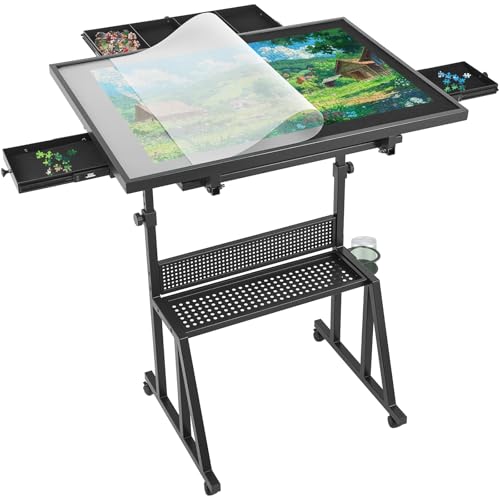
This is an adult-oriented, freestanding puzzle table with a stated 1,500-piece capacity, six felt sorting trays, an under-table shelf, a drawer, a cup holder, a removable transparent polypropylene cover, and four locking casters. It requires assembly. The product page describes a metal structure, felt working surface, 13 tilt settings, and a height range of 34.44 to 39.76 inches. Those are manufacturer statements, not independently verified measurements. The listed load guidance is also manufacturer-stated, over 50 pounds when the tabletop is horizontal at its lowest height. The sales page did not provide a product-specific stability, cycle, load, emissions, or laboratory safety report. Its catalog specifications conflict with the sales page on height, because the catalog gives a fixed 34.46-inch maximum while the page claims adjustment to 39.76 inches.
This format suits an adult puzzler who regularly works on puzzles advertised up to 1,500 pieces, has room for a roughly 35.44 by 24.62-inch freestanding table, and wants to keep a project contained between sessions. It is especially relevant for someone who benefits from moving the work surface between rooms, adjusting a work height within the stated range, or sorting pieces into separate trays. Users should be comfortable assembling and periodically checking a wheeled, tilting furniture item.
It is not a good fit for households expecting independently documented child safety, low-emission materials, or verified furniture stability. The listing identifies the product for adults and does not supply a Children's Product Certificate or child-use testing. It also may not suit anyone who needs a confirmed maximum load at every height and tilt setting, or who cannot safely assemble, reposition, and inspect a wheeled table. Buyers needing reliable replacement parts or a verified repair path should note that neither was located.
The clearest material information is manufacturer-stated rather than independently verified. The sales page identifies a metal structure, felt surface, and removable polypropylene cover, but does not disclose the felt fiber, coatings, adhesives, panel composition, formaldehyde status, or supplier traceability. No TSCA Title VI finished-good label, EPA-recognized panel certifier, low-emission certification, FSC certificate, SFI certificate, recycled-content claim, or public environmental badge was located. The page claims that height and tilt adjustment reduce fatigue and relieve knee pressure. General ergonomics guidance supports adjusting work height and angle to reduce awkward neck and torso postures, but it does not validate these benefits for this exact table or every user. No product-specific recall, regulatory action, or exposure warning was located in the reviewed CPSC search results. The table has moving tilt joints, a drawer, cover, and locking casters, so hands and fingers should be kept clear during adjustment and the brakes should be engaged before use.
This is a tabletop puzzle workstation for puzzles marketed at up to 1,500 pieces. It is intended to sit on an existing table or other stable surface, then let the user rotate the board or raise it on its tilt support while sorting pieces in four drawers. A separate retailer corroborates the core configuration of tabletop, clear plastic cover, Lazy Susan base, and four drawers. The advertised usable puzzle area is 34.25 by 25.2 inches and listed weight is about 13 pounds, but these are manufacturer-stated specifications rather than independently measured results. Independent listings also identify the same model as wood and describe tilt and rotation, yet none provide the board's tilt angle, load limit, lock performance, material construction details, or a product-specific safety test report.
It suits an adult or teen puzzler who works on a stable dining table, desk, or other broad support and wants to keep a medium to large puzzle together between sessions. It is most practical for someone who values contained sorting drawers, a cover that separates the project from dust or pets, and the ability to rotate the work rather than walk around the table. The stated roughly 13-pound weight is also more appropriate for a user comfortable lifting and storing a flat board with both hands.
It is not suited to households that need documented low-emission wood, verified child-product compliance, or independently tested pinch and stability protection. Young children should not operate the drawers, cover, rotating base, or tilt mechanism unsupervised because no product-specific child safety documentation was located. It is also a poor fit for users with substantial lifting restrictions, people needing a medically supported ergonomic aid, or anyone planning to use it on a narrow, soft, uneven, or unstable surface. The absence of published load and tilt limits matters for these uses.
The main health uncertainty is material disclosure. Retail listings call the board wood and identify a plastic cover, but they do not specify whether its panels are solid wood or regulated composite wood, nor do they identify coatings, adhesives, felt composition, or formaldehyde emissions. EPA rules require qualifying finished goods containing regulated composite wood to carry TSCA Title VI compliance information, but no such label or panel certification was found for this product. No public product-specific CPC, accredited-laboratory report, FSC or SFI chain-of-custody claim, GREENGUARD listing, repair-parts listing, or sustainability disclosure was located. Searches of CPSC recall resources and SaferProducts.gov did not identify a BuilderButler recall or warning for this board. That is not proof that the board has been tested or is free of hazards. Generic ergonomics research indicates a sloped work surface can alter neck posture, but the product's actual tilt angle and setup have not been studied.
This is a freestanding wooden puzzle table for adult-sized jigsaw projects, marketed for puzzles up to 1,500 pieces and other tabletop crafts. The published product description says it has a felt work surface, a semi-transparent cover, four wooden drawers, two deeper fabric drawers, four casters, and a top adjustable to 45 degrees. Those are manufacturer-stated specifications reproduced by a third-party retailer, not independently tested findings. The product is listed at roughly 30 pounds, so it is not a lightweight board to carry. Published dimensions are inconsistent. Listings for this same product show work-surface figures of 33.58 by 24.92 inches or 34.25 by 25.2 inches, while another listing gives overall dimensions of 35.4 by 26.4 inches. Published height ranges also conflict. That uncertainty matters when fitting a puzzle, seating position, or storage space.
It suits an adult puzzler who wants a dedicated, mobile work station for a medium to large jigsaw project and who has enough clear floor area to move a roughly 30-pound rolling table. The drawers and cover are most useful for a puzzle that remains in progress for days or weeks, especially in a shared room where pieces need to be contained. Buyers should measure their own puzzle box and intended storage area rather than relying on a single published dimension, because the available listings disagree on size and height range.
It is not well suited to households seeking independently documented low-emission materials, verified formaldehyde compliance, or third-party mechanical safety testing. It also needs caution around young children, who may encounter drawers, moving casters, tilt joints, and accessible hardware, because no child-product certificate or product-specific pinch and small-part testing was located. People with limited grip strength, balance limitations, or lifting restrictions should not assume the tilt and height controls are easy to operate without first checking the delivered unit and instructions.
The available listing identifies the main material only as wood. It does not identify whether the large panels are solid wood, plywood, particleboard, or MDF, and it does not disclose the coating, adhesive, felt composition, or plastic cover composition. No finished-good TSCA Title VI label, panel-supplier record, EPA-recognized certifier reference, FSC or SFI certificate, recycled-content claim, or low-emission certification was located. EPA rules require compliant composite wood in covered finished goods, but public evidence for this particular product was not found. No BuilderButler-specific recall or regulatory warning was identified in the CPSC recall resources searched. That is not a substitute for testing. The table’s adjustable height and tilt may help some users position a task surface, but the available marketing does not provide human-factors evidence showing reduced neck or back strain at this product’s actual settings. Its materials, durability testing, repair support, and end-of-life options remain largely undocumented.
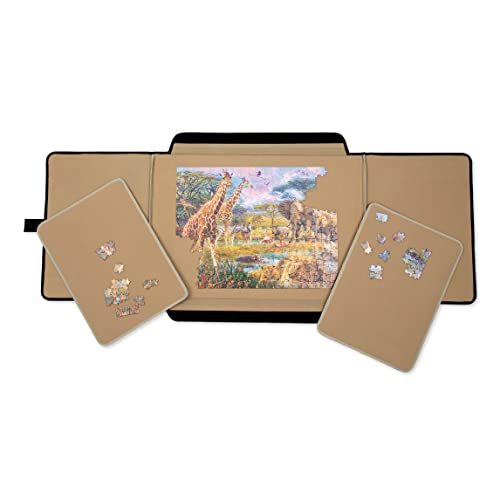
This is a foldable cardboard puzzle caddy with a fabric-lined interior, not a rigid puzzle table. It is designed to let a user assemble a puzzle on a table, sort pieces on removable side panels, then place the panels inside, fold the caddy, and secure it with Velcro straps for storage or transport. The manufacturer states that the regular version has a 32 by 22.5 inch centerboard, two 16 by 22.5 inch side panels, and capacity for puzzles of up to 1,000 pieces. It also states that the folded caddy weighs about 9 pounds and should be used on a table for stability. The size claim is usefully qualified by dimensions, because 1,000-piece puzzles vary substantially in finished footprint. No public product-specific laboratory report, emissions report, or certified material documentation was located.
This suits an adult or teen puzzler who works at a dining table or other stable flat table and needs to reclaim that surface between sessions. It is especially relevant for standard rectangular puzzles whose completed dimensions fit within the manufacturer-stated 32 by 22.5 inch centerboard. The format also suits users who value having two removable sorting areas and can comfortably carry, store, and keep a roughly 9-pound folded caddy flat. It is a storage-oriented accessory, not an adjustable work station.
It is not suited to people needing a rigid board, a freestanding easel, height adjustment, tilt controls, wheels, or documented ergonomic support. It is also a poor fit for puzzles with a completed footprint larger than the stated centerboard, including many panoramic, square, or unusually large 1,000-piece designs. Households seeking a product specifically documented for children under 13, independently tested for small-part and folding-mechanism hazards, or supported by verified low-emission material records should use a product with those records available.
The main material disclosure is limited. The manufacturer describes this model as a cardboard caddy with a fabric lining and says it is manufactured in China. It does not identify the cardboard or textile feedstocks, adhesives, coatings, recycled content, forestry certification, or end-of-life instructions. No FSC, SFI, GREENGUARD, or comparable product-specific certification claim was located in the reviewed product information. The public listing also does not provide an emissions test, a formaldehyde compliance label, or a traceable panel supplier record. EPA rules require documentation and labeling for finished goods containing regulated composite wood in applicable circumstances, but the available listing does not establish whether this caddy contains regulated composite-wood panels. No product-specific CPSC recall, regulatory action, or exposure warning was identified in the sources reviewed. The practical safety limit provided by the manufacturer is to use it on a table for stability and keep it flat when stored.
This is a large, fixed tabletop puzzle board for working on and storing a jigsaw puzzle in progress. The jumbo version is listed as roughly 26 by 35 inches of work area, designed for up to a standard 1,500-piece puzzle, with four sliding drawers for sorting pieces. It is not a tilting table, a wheeled cart, or a rotating board. The manufacturer states that the board and drawers are hardwood, the work surface is fiberboard, and the unit has a lacquer finish intended to reduce warping from minor spills and humidity. The published weight is about 16 pounds. Independent laboratory testing, a formaldehyde-compliance label, and product-specific safety reports were not located in the public materials reviewed.
This product suits an adult puzzler who regularly works on standard large puzzles and needs to clear a dining table, coffee table, or hobby surface between sessions. Its stated 1,500-piece capacity and four drawers are practical for someone who sorts edge, color, or image-area pieces before assembly. It is best used on a broad, flat, stable support surface and by a person comfortable lifting about 16 pounds, ideally with the puzzle pieces removed or secured before moving it.
It is not well suited to anyone seeking an adjustable ergonomic workstation, since it has no legs, height adjustment, tilt control, or included rotation mechanism. People with lifting restrictions, limited grip strength, shoulder or back pain, or an unstable table should avoid treating it as easily portable. It also deserves extra caution in homes with young children, because public product-specific test records for coatings, accessible edges, drawer pinch hazards, and formaldehyde emissions were not located. Buyers needing documented low-emission materials or certified wood traceability need more evidence than is available here.
The key material disclosure is useful but incomplete. The manufacturer identifies hardwood for the frame and drawers, fiberboard for the work surface, and a lacquer finish. Fiberboard can be a composite-wood material, yet no finished-product TSCA Title VI formaldehyde-compliance label, panel supplier documentation, or EPA-recognized certifier trace was located. The catalog's broad material-safety statements were not supported by a publicly available product-specific certificate or test report. The manufacturer says the lacquer finish helps resist warping from minor spills and humidity, and the board has reinforced sliding drawers. Those are durability-oriented design claims, not independently verified lifetime evidence. No FSC or SFI chain-of-custody claim, recycled-content disclosure, recycling guidance, replacement-parts catalog, product-specific CPSC recall, or public safety warning was located in the sources reviewed. The adult-oriented use case reduces the relevance of children's toy testing, but it does not substitute for emissions and materials documentation.