Best Overall
13% off

ANSQUE Wireless Outdoor Security Camera Kit
No subscription fees save ongoing costs.
Solar powered for eco-friendly energy use.
360° PTZ provides comprehensive surveillance coverage.
 Daniel Kenitz
No subscription fees save ongoing costs.
Solar powered for eco-friendly energy use.
360° PTZ provides comprehensive surveillance coverage.
No subscription fees required, saving ongoing costs.
Solar-powered for continuous, eco-friendly operation.
360° pan and tilt for comprehensive home coverage.

Solar-powered for continuous, eco-friendly operation.
360° panoramic view for comprehensive coverage.
Human auto-tracking enhances security monitoring.

Solar-powered for continuous, eco-friendly operation.
360° pan and tilt for complete coverage.
No monthly fee required for operation.

Crisp 4K resolution for clear surveillance.
Solar-powered for energy efficiency.
360° pan tilt for comprehensive coverage.

Solar-powered for continuous, eco-friendly operation.
360° pan and AI tracking for comprehensive coverage.
2K clarity provides sharp, detailed video footage.

Solar-powered for continuous, eco-friendly operation.
Clear 2K+ color night vision enhances security.
Dual-band WiFi ensures stable connectivity.

Solar-powered, no frequent battery changes needed.
360° view with pan and tilt feature.
Local recording, no subscription required.

Battery and solar charging for extended use.
Magnetic mount allows easy repositioning.
Subscription-free local storage option available.

High-resolution 2K video for clear monitoring.
Pan/tilt feature covers wider areas.
Wireless setup for easy installation.
Whether one works depends less on the word “solar” than on the installation and workload. Direct sunlight, panel angle, seasonal weather, temperature, Wi-Fi or cellular signal, motion frequency, live viewing, night lighting and clip length all affect battery demand. A panel rating in watts, a battery capacity in watt-hours or clearly stated amp-hours, operating and charging temperatures, and test conditions are more useful than “forever,” “365-day,” or “year-round” claims. A runtime estimate should say how much sun, how many events and how much recording it assumes. Continuous recording is a particularly important distinction: several battery products record only when motion is detected, while interval snapshots marketed as “24/7” are not the same as continuous full-motion video.
For outdoor durability, look for a specific IP rating under IEC 60529, stated operating limits and evidence for the complete camera-and-panel installation. IP65 or IP66 can be useful manufacturer specifications, but an accredited test report for the exact model is stronger. The same principle applies to the battery, charging path and mount. UL, ETL or CSA listings should be verifiable for the relevant product or component; an FCC authorization confirms radio compliance, not fire safety, battery safety, weather resistance or cybersecurity. Secure mounting matters because these products are elevated, exposed to wind and sometimes fitted with magnetic or moving mounts.
Privacy and security deserve equal attention. Check for privacy zones, microphone controls, retention and deletion settings, sharing controls, local-storage options, encryption, unique credentials, two-factor authentication and a published firmware-support or vulnerability-reporting process. A privacy notice or app-store disclosure may reveal collection of video, audio, location, identifiers or usage data. Local storage reduces cloud dependence, but it does not automatically prevent account or app data collection. Exact-model confirmation in FCC records, UL Product iQ, Intertek ETL, CSA listings, the FCC Cyber Trust Mark registry, ioXt or UL cybersecurity records is more meaningful than seller badges.
Headline coverage figures also need careful reading. “360 degrees” may mean pan rotation rather than full-sphere coverage; a camera with 355-degree pan and limited tilt still has blind spots. Digital zoom is not optical zoom. Resolution claims can conflict within one listing, and night-vision range or AI accuracy may be manufacturer-stated rather than independently tested. Motion detection has a defined range and can miss activity outside the detection zone or before a battery camera wakes. Storage capacity may be fixed, non-expandable or dependent on a separately purchased card.
Recurring cautions in the supplied reviews are significant. No category-wide product had complete independent certification for electrical, battery, weather and cybersecurity performance. Built-in or non-user-serviceable batteries, unclear replacement and recycling routes, and missing firmware-support commitments recur. Solar charging is conditional and may require USB charging in shade, winter, cloudy weather or high-activity scenes. Buyers should also treat conflicting privacy disclosures, unresolved service-cost claims, historical security findings, weak or default credentials, and magnetic or elevated mounting hazards as reasons to verify the manual and settings before installation. Battery cameras should not be treated as continuous, safety-critical or sole security systems unless those capabilities are specifically documented and tested.
The products were assessed across physical safety, privacy, security, durability, evidence quality and end-of-life concerns. Scores are comparative signals from the supplied reviews, not certifications or guarantees.
This measures the lithium-ion battery, solar charging path, enclosure and mounting instructions, including fire, burn, puncture and falling-device risks. Solar cameras are mounted outdoors and may charge in heat or cold, so clear limits and secure anchors matter. Supplied scores ranged from 70 to 76; higher-scoring products provided more concrete charging, temperature or mounting guidance, while none had complete independent electrical-safety verification.
This covers account protection, encrypted connections, MFA, vulnerability disclosure and update support. A connected camera can expose live views, recordings and household information, while an abandoned app can leave known weaknesses unresolved. Scores ranged from 52 to 76. Higher-scoring products documented controls such as two-step verification or stronger security disclosures; lower-scoring products lacked support periods, MFA commitments or independent cybersecurity assessment.
This measures control over what the camera captures, hears, stores, shares and retains. Pan-and-tilt views, microphones and cloud apps can capture neighboring property or shared spaces, so privacy zones, sharing controls and clear retention terms matter. Scores ranged from 55 to 78. Higher-scoring products offered local storage, encryption or privacy controls; lower-scoring products had inconsistent app and privacy disclosures or unclear retention practices.
This measures whether rain, dust, heat, cold, UV and wind-mounted use are supported by a specific rating, operating range and credible test documentation. Outdoor cameras face conditions that can damage batteries, seals and panels. Scores ranged from 70 to 78. Higher-scoring products gave specific IP and temperature information, but the reviews repeatedly noted that exact-model accredited weather reports were not found, so a rating alone is not proof of whole-installation durability.
This measures detection, person or vehicle classification, notification delay, night capture, clip duration and recovery from weak connectivity. For solar cameras, missed events can result from limited PIR range, wake-up delay, low battery or poor Wi-Fi. Scores ranged from 54 to 80. Higher-scoring products had hands-on testing or defined detection limits; lower-scoring products relied mainly on unsupported accuracy and runtime claims.
This measures whether panel output and battery capacity are disclosed alongside realistic recording limits, sunlight assumptions and seasonal conditions. High scores require more than “forever power,” because clouds, shade, winter sun, frequent alerts and live viewing can exceed charging. Scores ranged from 62 to 80. Better-supported products disclosed panel power and laboratory assumptions; lower-scoring products lacked wattage, battery energy or independent runtime testing.
This measures whether resolution, zoom, coverage, night vision, AI, storage and subscription claims include their important limits. Solar-camera listings often blur digital and optical zoom, pan range and full coverage, or use conflicting resolution figures. Scores ranged from 50 to 80. Higher-scoring products had clearer manuals and independent checks; lower-scoring products contained material contradictions or broad claims unsupported by testing.
This measures whether exact-model safety, radio, weather, cybersecurity and performance claims can be confirmed in authoritative registries or accredited reports. FCC records verify radio compliance only; they do not certify battery, weather or software security. Scores ranged from 69 to 82. Higher-scoring products had exact-model FCC or other traceable records, while the reviews still found few complete third-party certifications.
This measures whether live view, event recording, playback, export and storage remain usable without undisclosed subscriptions, forced cloud use or sudden service loss. Local microSD, hub or NVR recording can reduce dependence on cloud plans, but cards, fixed storage and app access still have limits. Scores ranged from 54 to 81. Higher-scoring products clearly documented local recording and fees; lower-scoring products had conflicting service or storage information.
This measures serviceability, support duration, spare parts and a practical route for batteries and electronics at end of life. Integrated lithium batteries can turn a functioning camera into waste when capacity falls, especially if no replacement path exists. Scores ranged from 58 to 72. Higher-scoring products supplied clearer warranty or recycling guidance; lower-scoring products lacked repair, battery-replacement or U.S. take-back details.
This asks whether solar benefits are bounded by panel output, battery life, standby demand, electronics waste and realistic sunlight rather than inferred from a panel alone. Scores ranged from 66 to 73. Higher-scoring products disclosed figures such as panel wattage, battery size or sunlight assumptions; lower-scoring products made broad autonomy claims without seasonal runtime, low-light testing or quantified lifecycle information.
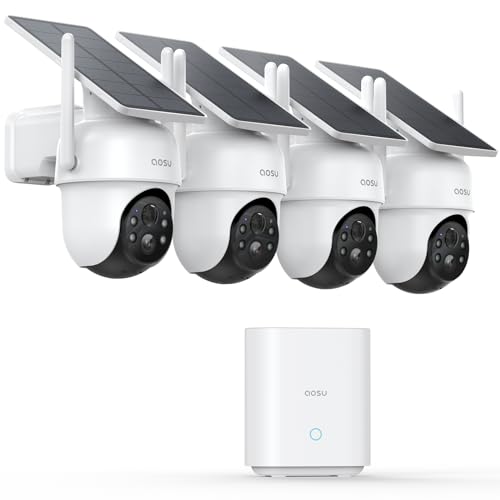
This is a four-camera outdoor surveillance kit with solar-assisted, battery-powered pan and tilt cameras, a wired HomeBase, and app control. The maker specifies 2K, 2304 by 1296 video, 360-degree horizontal and 90-degree vertical movement, four spotlights per camera, motion-triggered recording, and 32GB of non-expandable HomeBase storage. It is not a continuous-recording system. The manufacturer states that event clips can remain locally recorded when the internet is unavailable, while remote viewing requires the product to be online. A regulatory filing tied to the GU01 model family supports that its radio hardware was authorized for U.S. use. Important performance figures, including IP65 weather resistance, night range, person detection, tracking, storage duration, and solar runtime, remain manufacturer-stated rather than independently tested for this product.
This product fits a homeowner who needs up to four exterior viewing points, can place the HomeBase on Ethernet, and accepts motion-triggered clips rather than continuous video. It is most suitable where each camera has relatively open sun exposure and a strong connection to the HomeBase. The buyer should be comfortable checking battery status, adjusting detection zones and recording duration, and manually charging cameras during cloudy periods or unusually busy activity. Local event storage and app-based multi-camera viewing are central to this setup.
It is not suited to sites needing independently verified intrusion capture, continuous 24-hour recording, expandable storage, or direct integration with an NVR, RTSP, ONVIF, or a computer. It is also a poor fit for shaded installations, winter low-light locations, or entrances with frequent motion, because the manufacturer says high triggering and cloudy conditions can exceed solar charging. Privacy-sensitive households that require a documented security-update lifetime, multi-factor authentication, or third-party cyber certification need more published assurance than this product provides.
The product contains rechargeable battery-powered cameras, solar panels, a mains-powered HomeBase, and plastic outdoor housings. The manufacturer instructs owners to use the supplied 5V, 2A charging accessories, charge cameras before setup, mount them securely, and retain weather sealing around the charging connection. It states an IP65 rating and gives outdoor operating guidance, but no exact-model UL, ETL, CSA, or accredited IP test record was found. No U.S. recall or regulator warning specific to this product was located in the checks performed. Solar charging can reduce routine wired charging, but it is conditional rather than self-sustaining in every installation. The manufacturer says direct sun, panel positioning, event frequency, and clip duration affect charge balance, and USB charging may be necessary. It provides a one-year warranty and replacement support, but does not publish spare-parts availability, battery replacement instructions, a firmware-support end date, or U.S. battery and electronics recycling guidance.
This product is a four-camera outdoor surveillance kit with a base station, solar-charged battery cameras, Wi-Fi connectivity, two-way audio, motorized pan and tilt, and app control. It is intended for property monitoring where running power cables would be difficult. Each camera is listed as 3MP, and the base station has 32GB of built-in local storage. An FCC filing independently links this camera model to an authorized Wi-Fi and Bluetooth radio design with a 5Ah rechargeable lithium-ion battery. The manufacturer states that recordings are encrypted and retained locally in the base station without a required subscription, with up to four months of loop recording. Its published specifications also state IP65 ingress protection, a -10 C to 55 C operating range, 355-degree horizontal pan, 90-degree tilt, and human-motion detection. Those performance and weather claims were not backed by an accredited test report located for this product.
This product suits a homeowner who needs four app-controlled viewpoints around a modest property, has reliable Wi-Fi at every mounting location, and can place the cameras where their integrated solar panels receive regular direct sun. It is particularly relevant for people who want recordings retained in a separate indoor base station rather than on a camera that could be removed or damaged. The stated IP65 rating and -10 C to 55 C operating range make it better aligned with ordinary outdoor exposure than with severe winter or coastal conditions.
It is not well suited to homes with prolonged snow cover, deep shade, short winter days, or mounting locations that cannot receive direct sun. It is also a weak fit for security-sensitive households that require independently certified cybersecurity, a published security-update lifetime, verified multi-factor authentication, or tested event-response timing. Avoid relying on it as the sole evidence source for high-consequence areas, such as remote gates, business entrances, or locations needing guaranteed capture, because no controlled reliability testing was located and app users have reported playback and notification problems.
The camera uses rechargeable lithium-ion battery power and wall mounting, so installation quality matters. The FCC record confirms radio authorization and identifies a 5Ah battery design, but FCC authorization does not evaluate the full electrical, battery, charger, solar-panel, or mounting safety system. No UL, ETL, CSA, or exact-model accredited safety report was located. No U.S. CPSC recall was found in the search performed. Use the supplied anchors and screws only in a sound mounting surface, keep charging parts dry, and inspect the housing after storms or impacts. Solar charging can reduce routine grid charging, but it does not establish a low-impact product by itself. The cameras contain batteries and electronics that need proper end-of-life handling. Aosu offers a 12-month warranty and describes general electronics recycling practices, but it does not provide a clear U.S. battery take-back route, replacement-battery program, parts catalog, or firmware-support end date. The manufacturer states that video is stored locally by default, while thumbnails and enabled smart functions can use cloud infrastructure.
This is a wall-mounted, battery-powered outdoor Wi-Fi camera with an integrated solar panel, pan and tilt control, two-way audio, motion alerts, color or infrared night viewing, and optional local microSD recording. It uses 2.4 GHz Wi-Fi, not 5 GHz Wi-Fi. The radio hardware and 5,000 mAh rechargeable lithium-ion battery specification are supported by an FCC filing for this exact product configuration. The manufacturer states 2K, or 2304 by 1296, video, 360-degree pan coverage, human tracking, IP65 protection, and operation from minus 10 C to 55 C. The product can record locally, while cloud recording is optional. Independent hands-on coverage found useful solar charging in fair conditions, but also reported sluggish app response and delays in viewing and camera control. The broad claim of continuous solar power should therefore be read as installation and activity dependent, not unconditional.
This product fits a homeowner who needs flexible coverage of a driveway, yard, gate, or detached structure where an outlet is unavailable but stable 2.4 GHz Wi-Fi and regular direct sunlight are available. It is better suited to someone comfortable adjusting motion settings, checking battery status, and installing a microSD card for local event storage. The stated IP65 rating and minus 10 C to 55 C operating range make it more appropriate for ordinary exposed outdoor locations than for fully sheltered indoor monitoring.
It is not well suited to locations with weak Wi-Fi, winter shading, north-facing placement, prolonged cloudy conditions, or frequent motion activity, because solar output and battery endurance have not been independently characterized for those conditions. It is also a poor fit for households that require independently certified electrical safety, a published cybersecurity support lifecycle, or consistently fast event retrieval. People needing continuous recording, 5 GHz Wi-Fi, professional monitoring, or highly reliable evidence capture should not assume this battery camera provides those functions.
The product contains a 3.7 V, 5 Ah rechargeable lithium-ion battery according to its FCC test documentation. Its wireless hardware is independently documented through an FCC authorization for the product configuration, including Bluetooth and 2.4 GHz Wi-Fi testing. No relevant CPSC recall was located in the U.S. recall database search performed for this review. However, no exact-product UL, ETL, or CSA electrical-safety listing was located, so the IP65 and weather claims remain manufacturer-stated rather than independently certified. Solar charging can reduce routine cable charging when the panel receives adequate direct sun, but the manufacturer does not publish panel wattage, expected battery cycle life, or a quantified environmental impact. The internal battery and electronics eventually require appropriate recycling, not household trash disposal. AOSU's current privacy notice says recordings are stored on the device by default except for event-preview thumbnails, while cloud-enabled functions can process video, audio, environmental, and biometric data through its cloud infrastructure.
This product is a screw-mounted outdoor Wi-Fi camera with a built-in rechargeable lithium-ion battery and a removable solar panel. It uses a 3K wide camera plus a 2K telephoto camera, records motion-triggered clips to 8GB of internal storage, and pans through 360 degrees horizontally with 70 degrees of tilt. It works on 2.4 GHz Wi-Fi, not 5 GHz, and needs the eufy Security app and account for setup and remote use. Its radio authorization is independently documented through the FCC for the exact product. Independent hands-on testing found sharp daytime and night video, useful dual views, and generally effective person detection. The included panel kept charge high in two real-world tests, but this is not continuous-recording hardware. Solar output, motion volume, live viewing, shade, and season all affect whether it avoids cable charging.
It suits a homeowner or renter who can screw-mount a camera 7 to 10 feet high, has stable 2.4 GHz Wi-Fi at the installation point, and wants motion-triggered coverage of a driveway, porch, yard, or side path without running mains power. It is especially practical where the solar panel can receive regular direct light, including a separate sunny wall position. It also fits users who want ordinary clips stored on the product instead of paying a recurring fee for basic event history.
It is not suited to locations with persistent shade, very short winter daylight, heavy motion traffic, or frequent live viewing, because those conditions can outpace solar charging and require manual charging. It is also unsuitable where continuous 24 hour recording is required, since this product records on motion rather than continuously. Choose another setup if you need 5 GHz Wi-Fi, a user-replaceable battery, a published IP rating, or documented third-party cybersecurity certification for the exact camera.
The product contains a built-in rechargeable lithium-ion battery, so it should not be opened, punctured, crushed, or placed in household trash at end of life. The installation guide specifies drilling, anchors, firm attachment, and a recommended 7 to 10 foot mounting height. Its FCC authorization independently confirms that the wireless radio was tested for US authorization. I found no CPSC recall specific to this product in the checked recall sources. Solar charging can reduce routine cable charging when sunlight and motion load are favorable. Independent outdoor tests found the panel maintained a high charge under their conditions, but that is not proof of year-round autonomy at every property. The non-replaceable battery and lack of a stated product-specific repair or firmware-support period are durability limitations. Eufy does offer local storage, privacy zones, optional two-factor authentication, encrypted data handling, and user-managed sharing, although cloud features and thumbnail previews can send selected media to the cloud.
This is a battery-powered outdoor pan and tilt camera with an included or compatible solar-panel setup, depending on the package. It records up to 3840 by 2160 video at 15 frames per second, uses a 21.6Wh rechargeable battery, and supports local microSD recording up to 512GB. The camera can pan 355 degrees and tilt 140 degrees, rather than mechanically turning a full 360 degrees. Reolink states an IP65 weather-resistance rating, a 14 to 131 F operating range, dual-band Wi-Fi 6, motion zones, person, vehicle and pet alerts, spotlights for color night vision, and optional cloud storage. The radio authorization is independently traceable through FCC documentation. Product performance figures, solar claims, weather rating, detection range, and most privacy and security features remain manufacturer-stated rather than confirmed by an accredited product test.
It suits a homeowner who needs motion-triggered coverage at a gate, driveway, garden, shed, or other place where wiring is impractical. The useful fit is a location with dependable Wi-Fi, an unobstructed mounting surface, and enough sun to supplement a rechargeable battery. It is also suited to someone who wants to keep ordinary event clips on their own microSD card rather than make cloud storage essential. The owner should be comfortable checking charge level, firmware, mounting screws, and detection settings after installation.
It is not well suited to a high-risk entrance, isolated property, or critical evidentiary use where every second of footage must be captured. This battery camera records on motion triggers, relies on Wi-Fi, and has no independently verified event-capture or solar-runtime result for the exact installation. It is also a poor fit for deeply shaded, snowy, heavily overcast, or very cold locations where solar charging can fall short. Households seeking independently certified cybersecurity, a published update-support date, or a readily replaceable battery should choose a product with those records.
The product contains a rechargeable lithium-ion battery, a solar charging path, a spotlight, radio equipment, and outdoor mounting hardware. Reolink specifies IP65 weather resistance and a 14 to 131 F operating range. FCC filings independently identify the model's U.S. radio authorization. No matching CPSC recall was located in the searched U.S. recall resources, but no UL, ETL, or CSA safety listing for the complete product was located either. Solar power can reduce routine USB charging when the panel has sufficient exposure, but it does not remove battery aging or electronics waste. Reolink's own support material says battery life varies with settings, activity, and temperature. The company provides a two-year limited warranty, but no clear product-specific battery replacement path, spare-parts catalog, firmware-support end date, or U.S. recycling program was found. Treat the camera as battery-containing e-waste at end of life, and use a qualified battery or electronics recycling route rather than household trash.
This is a screw-mounted outdoor Wi-Fi camera with pan and tilt movement, a removable solar panel, microphone and speaker, and a user-supplied microSD card slot. eufy lists 2K, 2304 by 1296 video, 2.4 GHz Wi-Fi, and a 10,000 mAh battery. It can connect directly to a router or to a compatible HomeBase. Its defining practical feature is local event storage to a separately purchased microSD card up to 128 GB, without a required subscription, according to eufy. The maker also states that two hours of daily sun can sustain charging, but its own battery estimate is about three months at 300 seconds of recording daily and varies with events and conditions. Exact-model FCC authorization verifies its U.S. radio authorization, not product safety or cybersecurity certification.
This product suits a homeowner or renter who can screw-mount a camera around 7 to 10 feet high, has dependable 2.4 GHz Wi-Fi, and mainly needs event clips for a porch, driveway, or yard rather than constant surveillance. It is especially relevant where a clear, low-shade position can be found for the removable panel. The owner should be comfortable supplying and managing a microSD card, checking saved clips, and enabling account protections such as two-factor authentication.
It is not suited to a property needing dependable round-the-clock recording on battery or solar power, because eufy specifies direct power for 24/7 capture. It is also a poor fit for very cold locations where charging commonly occurs below 0 C, heavily shaded installations, or sites with weak 2.4 GHz Wi-Fi. Privacy-sensitive households, shared driveways, and homes near neighbors should not rely on default setup alone. They need carefully configured activity and privacy boundaries, controlled sharing, and an informed acceptance of app and cloud-connected account use.
The guide gives useful lithium-battery safeguards. It limits charging to 0 C through 40 C, warns against incorrect battery replacement, crushing, cutting, fire, and extreme heat, and provides detailed screw-and-anchor mounting steps. The exact product has FCC equipment authorization and an RF exposure instruction to keep 20 cm separation. That authorization is for radio compliance, not a substitute for independent battery, electrical, or weatherproof safety certification. Solar charging can reduce wall-power use when the panel receives enough sunlight, but it does not remove the environmental cost of a battery camera, solar panel, electronics, and eventual disposal. eufy provides a 12-month limited warranty in the guide, but no product-specific replaceable-battery, spare-parts, long-term firmware-support, or U.S. recycling pathway was identified. Battery and e-waste disposal planning remains important at end of life.
This is a rechargeable, Wi-Fi outdoor pan and tilt camera intended for motion-triggered monitoring of a driveway, yard, gate, or entrance. The product has a built-in microphone and speaker, uses a removable microSD card for local event recording, and can also use optional cloud storage. It is designed for wall mounting and solar charging through Reolink's 3 W panel. Reolink's current support record for the 5 MP dual-band version specifies 2880 by 1616 video at up to 15 frames per second, 355-degree pan, 140-degree tilt, a 21.6 Wh rechargeable battery, and IP64 weather resistance. Those are manufacturer specifications, not independent lab results. Independent hands-on testing supports useful local recording and flexible coverage, but also found that battery endurance and video responsiveness vary with usage, signal conditions, and settings.
This product suits a homeowner who needs event-based coverage at a gate, shed, driveway, porch, or backyard location where running a power cable is impractical. It is most appropriate for someone willing to install a microSD card, mount the camera securely, keep its Wi-Fi signal strong, and position the solar panel where it receives regular direct light. It also fits users who want local recordings and basic alerts without making a cloud plan necessary, while accepting that footage is triggered rather than continuously captured.
It is not suited to households that need evidentiary 24-hour recording, guaranteed capture of fast activity, or reliable coverage in a heavily shaded location, northern winter conditions, or a weak Wi-Fi area. It is also a poor fit where an independently verified IP65 or higher enclosure rating, third-party electrical safety listing, or independently certified cybersecurity program is required. Buyers who cannot safely screw-mount a moving, battery-powered camera at a reachable height should use professionally installed equipment instead.
The important safety point is installation and charging discipline. Reolink specifies a rechargeable lithium battery, 5 V charging, a compatible 3 W solar panel, IP64 weather resistance, and a 14 to 131 F operating range. Use the supplied mounting hardware on a sound surface, route the solar cable to avoid abrasion and trip hazards, and do not treat the product as a continuously powered camera. No relevant U.S. CPSC recall was located in the review work. Solar charging can reduce routine wall charging, but it is not proof of low overall environmental impact. Real output depends on sunlight, camera activity, temperature, and Wi-Fi conditions. The battery is not clearly documented as user-replaceable, and no model-specific U.S. recycling or parts program was located. At end of life, the camera and its lithium battery should be taken to an appropriate battery or electronics recycler, not placed in household trash.
This product is a four-camera outdoor surveillance kit with separate solar panels, rechargeable battery cameras, a 10-channel network video recorder, and a 500GB internal hard drive in this configuration. It is intended for property monitoring with motion alerts, live remote viewing, two-way audio, pan and tilt control, and recorder-based playback. The maker states 4MP, 2560 by 1440 video, color night vision, PIR motion detection, IP66 protection, and local recording. The camera family has a verified FCC authorization for its Wi-Fi transmitter, including 5 GHz operation and a 20 cm minimum separation condition. The supplied manual also says core recorder functions can operate without network connectivity. Important claims remain manufacturer-stated, including weather rating, detection behavior, encryption, night range, and solar runtime. The listed camera battery is 5200mAh and cannot be replaced.
This product fits an owner who wants four fixed installation points around a small home, outbuilding, driveway, or detached garage and has suitable sunny mounting locations. It is better suited to someone comfortable drilling into sound wall material, positioning panels for seasonal sun, and using a local recorder connected to a display. It also fits users who value local playback and backup, and who can accept that remote access depends on the app and home network configuration.
It is not suited to renters or households unable to make secure drilled mounts, especially where panels and cameras could be exposed to high winds or falling hazards. It is also a poor fit for shaded sites, northern winter conditions, or locations with sustained activity that may exhaust a battery more quickly than claimed. Privacy-sensitive homes, shared driveways, and properties near neighbors should seek equipment with documented privacy masking, retention controls, and independently assessed account security. It is not a substitute for life-safety monitoring.
The strongest independently checkable safety item is the Wi-Fi radio authorization for the camera family. It includes a 20 cm minimum separation condition for radio-frequency exposure. The installation guide gives useful practical directions for initial charging, use of the included power supply, camera height, masonry anchors, and solar-panel placement. No product-specific CPSC recall or warning was located in the reviewed public recall sources, but no independent electrical-safety listing for the complete solar camera kit was located either. The solar panels can reduce reliance on routine plug-in charging, but the environmental benefit is not quantified. The manufacturer lists a 5200mAh camera battery and the manual says it cannot be replaced. That limits maintenance and means battery aging can shorten the usable life of each camera. Hiseeu offers a one-year hardware warranty, while pan and tilt moving parts have six months of coverage. Clear battery recycling instructions, spare battery access, and a published electronics take-back program were not found.
This is a wire-free outdoor camera with an integrated 10,000 mAh lithium-ion battery, magnetic wall or ceiling mount, and a separate 2.5 W solar panel. It connects by 2.4 GHz or 5 GHz Wi-Fi and records 4K video at 15 frames per second. The camera accepts a separately purchased microSD card up to 512 GB, with a paid cloud option rather than a required subscription. Manufacturer documentation gives the camera an IP66 rating, the panel an IP65 rating, and limits charging to 32°F to 122°F. Independent hands-on testing found quick motion responses and reported that the solar panel kept the battery at full charge during heavy use, though that result depends on placement and local sunlight.
This suits a homeowner or renter who needs a camera where outlet wiring is impractical, has a solid Wi-Fi signal at the mounting point, and can place the panel for regular direct sun. It is especially relevant for monitoring a driveway, porch, yard gate, or detached structure with event-based recording and a local microSD card. Users willing to check charge status seasonally and tune detection zones can make better use of its solar and battery design.
It is not well suited to locations with prolonged shade, very short winter daylight, frequent cold below -4°F, or unreliable Wi-Fi, because the camera depends on solar input and wireless connectivity for normal remote use. Choose a different setup if uninterrupted high-frame-rate video is essential, since this product records at 15 fps and its Continuous Capture mode uses timed snapshots between events. It also does not fit buyers who require a replaceable battery, an independently listed complete safety system, or a physical privacy shutter.
The camera contains a built-in rechargeable lithium-ion battery, so installation and charging limits matter. The quick-start guide calls for a full initial charge, use of a 5 V, 2 A USB charger, solid-wall mounting, and a 7 to 10 foot mounting height for detection. It also says to keep ports covered for waterproofing. The product page lists FCC compliance, and radio test documentation for the exact camera model was located, but no UL, ETL, or CSA listing for the complete solar kit was found. Solar charging can reduce routine plug-in charging when the panel is well placed. The maker usefully discloses a 2.5 W maximum panel output and test conditions behind its sunlight and battery claims. The environmental limitation is longevity, the battery is integrated and no model-specific replacement-parts or recycling program was located. Plan for responsible battery and electronics recycling when the product reaches end of life.



