Best Overall
15% off
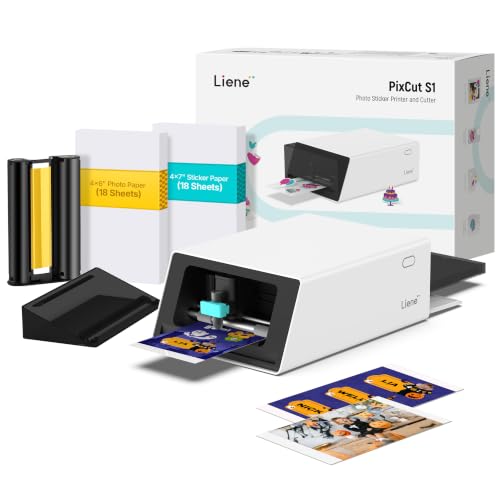
Liene PixCut S1 Photo Sticker Printer
High-quality 300 DPI prints for crisp images.
Precise AI auto-cutting for perfect stickers.
Easy DIY crafts with thermal dye-sublimation.
 Daniel Kenitz
High-quality 300 DPI prints for crisp images.
Precise AI auto-cutting for perfect stickers.
Easy DIY crafts with thermal dye-sublimation.

Produces vivid, full-color photos quickly.
Supports both iPhone and Android devices.
Includes 100 sheets and 3 cartridges.

Easy wireless printing with Bluetooth connectivity.
Compact and portable for small business needs.
Compatible with major shipping platforms.

Compact and portable for easy mobility.
Bluetooth connectivity simplifies wireless printing.
Versatile for various labeling needs.

Inkless printing for mess-free sticker creation.
Compact size perfect for on-the-go use.
Bluetooth connectivity simplifies wireless printing.

Compact design makes it highly portable.
Easy Bluetooth connectivity with smartphones.
Wide range of customizable label options.

Easy wireless printing from multiple devices.
Compatible with major e-commerce platforms.
Compact and stylish pink design.

Compact design, easy to carry anywhere.
Bluetooth connectivity for seamless device pairing.
Includes multiple templates for creative printing.

Versatile label size options for various needs.
Includes three rolls of stickers for convenience.
Compact design suitable for home and office use.

High-resolution 300DPI printing for clear labels.
Bluetooth connectivity for easy wireless printing.
Compact and portable design for on-the-go use.
Headline resolution and speed figures do not establish usable results. Dots per inch do not prove that small text, barcodes, color images, adhesion, or fade resistance will perform well. Claimed labels-per-minute or millimeters-per-second figures may use conditions that differ from a complete print cycle. Look for repeatable testing that names the exact printer, media, conditions, and measured result. Barcode claims should be supported by ISO/IEC 15416 testing; photo-permanence claims by ISO 18924; and speed claims by ISO/IEC 24734 where applicable. In the supplied products, independent evidence was often limited or absent for barcode grade, adhesion, water resistance, scratch resistance, fade resistance, and archival life.
Consumables are part of the product, not an afterthought. Direct-thermal printing avoids ink, toner, and ribbon cartridges, but it still creates paper, adhesive, and release-liner waste. Thermal-transfer and dye-sublimation systems add ribbons or cartridges. ZINK and other adhesive photo systems use coated multilayer sheets. Before buying, look for a manufacturer SDS or technical data sheet, full formulation or chemical disclosure, and product-relevant testing for bisphenols, PFAS, color developers, coatings, dyes, and adhesives. “BPA-free” alone does not establish broader chemical safety. Recycled-content and responsible-fiber claims should be traceable through FSC or Global Recycled Standard records, or substantiated under the FTC Green Guides.
For electrical and wireless safety, distinguish radio authorization from whole-product safety. An exact-model FCC Equipment Authorization record supports lawful wireless operation, but does not confirm protection against shock, fire, overheating, or charging faults. Stronger evidence would identify the exact printer, battery, and adapter in UL Product iQ, Intertek ETL, or CSA records, with relevant IEC 62368-1 and, for rechargeable products, IEC 62133-2 or UL 2054 evidence where applicable. Check the CPSC recall database and SaferProducts.gov as well.
Finally, check the companion app before sending photos, documents, or location data through it. Compare the privacy policy with Apple and Google disclosures, including permissions, retention, deletion, sharing, encryption, and security-support practices. Confirm warranty, firmware and app support, battery service, repair options, consumable compatibility, and take-back or recycling arrangements. Across the supplied products, recurring caveats include missing whole-product electrical certification, poorly disclosed thermal or adhesive chemistry, single-use media waste, app privacy concerns, and unclear battery recycling or replacement. Child-oriented marketing also did not consistently come with age grading or independent child-safety evidence; sharp blades, heated print heads, batteries, cables, and small media require supervision where relevant.
The scores below reflect the supplied reviews, with electrical and independent-verification topics weighted more heavily than the others. A high score means the product had stronger model-specific evidence or clearer safeguards in that area; it does not mean every relevant risk was eliminated.
This measures disclosure and testing for the paper, coatings, dyes, ribbons, and sticker adhesives, including bisphenols and PFAS. It matters because thermal and adhesive media are handled directly and may leave recurring chemical exposure questions. Scores among the supplied products ranged from 68 to 72: higher-scoring products had clearer claims or evidence gaps that were somewhat narrower, but none supplied full formulation and independent migration evidence.
This covers charging, overheating, fire, shock, battery, and radio-compliance evidence for the exact product and power equipment. An FCC record verifies wireless authorization, not complete electrical safety. Supplied scores ranged from 70 to 87. The strongest examples combined traceable FCC evidence with a published product-specific safety test; lower scores generally had radio evidence only or no complete listing for the printer and adapter.
This asks whether marketing to children, schools, or portable users is matched by age guidance, supervision instructions, and safeguards for batteries, heat, cables, blades, and small parts. Scores ranged from 62 to 82. Higher-scoring products supplied clearer misuse warnings, such as adult operation or supervision; lower-scoring child-oriented products lacked clear age grading or independent child-use testing.
This measures whether printing can work with limited permissions and whether the app clearly explains collection, sharing, retention, deletion, encryption, and security support. It matters because most supplied products depend on an app for photos, templates, or label design. Scores ranged from 52 to 78. Higher scores reflected clearer or more limited disclosures; lower scores involved broad data collection, sharing, tracking, unclear deletion, or conflicting store and policy statements.
This measures demonstrated resolution, speed, color quality, barcode readability, adhesion, and resistance to fading or damage on the sold media. It matters because a high DPI number alone cannot show that a sticker will remain readable or attached. Scores ranged from 70 to 85. The highest supplied result had independent testing of detailed photo output; most label products lacked model-specific laboratory testing for barcodes, permanence, adhesion, or speed.
This measures whether phone, computer, operating-system, app, media, cartridge, subscription, and account requirements are stated before purchase. Scores ranged from 52 to 80. Higher-scoring products documented supported platforms and media limits more consistently. Lower scores reflected conflicts such as uncertain macOS Bluetooth support, app-only workflows, unsupported computers, proprietary consumables, or unclear platform claims.
This measures whether claims about inkless operation, resolution, speed, permanence, AI features, sustainability, safety, and child or health benefits are specific and properly qualified. Scores ranged from 52 to 76. Higher-scoring products clearly identified limitations, such as non-sticky photo output or monochrome printing; lower-scoring products made broad performance, durability, or safety implications without matching independent evidence.
This measures whether model-specific certificates, test reports, registrations, and issuer records can be publicly verified. Because independent traceability is weighted heavily, supplied scores ranged from 68 to 86. The strongest products had exact FCC records and, in one case, a published safety test identifying the model and battery configuration. A wireless filing alone is not evidence of complete product safety or media safety.
This measures identifiable U.S. responsibility, support access, warranty, recalls, incident history, and corrective-action responsiveness. Scores ranged from 70 to 78. Higher-scoring products had named support channels, warranties, firmware guidance, or clearer manufacturer accountability. A lack of located recalls is not proof that a product is risk-free, and many supplied reviews still lacked detailed public corrective-action or take-back information.
This measures the burden of disposable rolls, sheets, cartridges, ribbons, liners, and packaging, along with verified recycled or responsibly sourced content and disposal guidance. Scores ranged from 58 to 72. Higher-scoring products avoided some cartridge streams or accepted less proprietary media, but nearly all still generated single-use label or photo-sheet waste. No supplied product had strong, verified evidence across recycled content, liner reduction, and end-of-life handling.
This covers replaceable consumables, warranty, firmware and app support, repair or battery service, take-back, and recycling options. Scores ranged from 70 to 78. Higher-scoring products had documented warranties, current software, or replaceable blades and cartridges; lower practical confidence remained where batteries were non-replaceable and no manufacturer take-back, repair route, or product-specific recycling program was located.
The Liene PixCut S1 is a plugged-in desktop photo printer and cutter for making small photo prints, labels, and contour-cut stickers from the Liene app. It uses dye-sublimation thermal transfer, takes 4 x 7 inch sticker sheets or 4 x 6 inch photo sheets, and has a preinstalled blade. Liene states a 300 dpi resolution, 59-second print time, Bluetooth 5.0 connection, 36-sheet paper and ribbon capacity, and no internal battery. The Bluetooth transmitter is independently traceable to an FCC equipment authorization for the DHP700, issued October 18, 2024. The supplied manual also gives concrete adult-use warnings for its sharp blade, moving mechanism, cable, water exposure, and use of the specified adapter. However, public evidence did not establish a U.S. UL, ETL, or CSA listing for the printer or its power adapter, nor public chemical disclosure for the paper, adhesive, or dye ribbon.
This product fits an adult hobbyist, home organizer, teacher preparing materials themselves, or small creator who wants to make modest-size photo stickers, labels, ID photos, or craft graphics without pairing a separate printer with a cutting machine. It is most suitable where Bluetooth phone or tablet workflow is acceptable, 4 x 7 inch sticker sheets are large enough, and the user can keep the unit on a dry, stable desk away from children. It also suits users willing to use Liene's specified cartridges and paper.
It is not appropriate as a child-operated craft device. The manufacturer says it is for adult use only, warns that blades and small parts are choking hazards, and instructs adults to supervise children around the machine. It is also a poor fit for privacy-sensitive users who do not want an app to process printing, cutting, device, and network information. Avoid it for large-format labels, shipping-label workflows, users needing independently certified electrical safety evidence, or buyers who need verified low-toxicity and lower-waste consumables.
The strongest health evidence is operational rather than materials-related. The manual warns of injury, fire, and electric-shock risks, requires the official adapter, says to keep hands and loose items away from moving parts, and limits operation to adults. The DHP700 Bluetooth radio is traceable to an FCC authorization, which supports its wireless compliance record. No battery is fitted. Important gaps remain. Public materials did not identify a full chemical formulation or safety data sheet for the dye ribbon, glossy photo paper, sticker coating, or adhesive. There was also no verified U.S. electrical listing for the printer or adapter. The app policy describes broad collection tied to printing and device operation. Ecologically, each 36-sheet cycle uses coated paper or sticker stock, a dye-ribbon cartridge, and for stickers, a disposable release liner. Liene provides a one-year warranty and replacement parts guidance, but no verified U.S. take-back, recycled-content, or media-recycling program was found.
This product is a mains-powered desktop dye-sublimation photo printer for borderless 4 by 6 inch prints. The 100-print package includes 100 photo sheets, three proprietary ribbon cartridges, and an AC adapter. It is not a dedicated sticker or shipping-label printer. Liene's own specifications list a 20-sheet cassette, 40-print cartridge capacity, 300 by 300 DPI output, and about 59 seconds per photo. The unit has Wi-Fi Direct and USB connectivity, with manufacturer-stated support for Android, iOS, Windows, macOS, AirPrint, and Mopria. Its Wi-Fi transmitter is independently traceable through an FCC authorization for this model. It has no battery, so it needs wall power. The companion app is optional for basic photo-album printing, although app editing features involve the company's broader data practices.
This product suits a household, hobbyist, or small office that wants occasional physical 4 by 6 inch photo prints from a phone or computer and has a nearby outlet. It is most practical for users prepared to stay with Liene paper and ribbon cartridges, who value a supplied 100-print starter set, a 20-sheet input capacity, and Wi-Fi Direct or USB printing. It also fits people who want basic phone-album printing without needing the editing app.
It does not suit buyers who need ready-made stickers, shipping labels, barcode labels, or documented adhesive performance. Liene's published specifications identify photo-only 4 by 6 inch media and proprietary cartridges. It is also a poor fit for households seeking independently listed electrical safety evidence, or for privacy-sensitive users who want a companion app with minimal telemetry. Young children should not operate the wall-powered printer and adapter unsupervised, especially during printing when sheets repeatedly move through the unit.
The strongest independently checkable safety evidence is for wireless compliance. The exact model has an FCC equipment authorization, and the filing identifies 2.4 GHz Wi-Fi testing and an RF exposure evaluation. This version has no battery, removing rechargeable-battery aging and charging risks. However, no public UL, ETL, or CSA listing was located for the printer or included adapter, so FCC evidence should not be read as a complete electrical-safety certification. Liene does not publicly disclose the formulation of its photo sheets, dye ribbon, coatings, or any adhesive media. There is no product-specific BPA, PFAS, or broader chemical test evidence available for review. Each print uses a coated photo sheet and a proprietary ribbon cartridge, creating recurring material waste. The company provides a one-year warranty, replaceable consumables, support pages, and current app updates, but no product-specific take-back or recycling program was found. No CPSC recall for Liene or Hannto photo printers was identified in the searched U.S. recall records.
This is a compact, mains-powered direct-thermal shipping-label printer for black-and-white labels, not a color sticker or photo printer. Phomemo states that it accepts thermal media from 1.57 to 4.1 inches wide, prints at 203 dpi, connects by USB or Bluetooth, and uses a 24 V, 2.5 A power adapter. It is intended for shipping labels and basic custom labels. The Bluetooth radio has model-relevant third-party traceability. PM-241-BT is named in an FCC RF-exposure test report for FCC ID 2ASRB-B246D, with a passing result. Phomemo also maintains downloadable drivers, firmware, calibration guidance, and platform instructions. Print-life, speed, fade resistance, barcode readability, and label adhesion claims remain manufacturer-stated because no independent model-specific performance report was located.
This product suits a home seller or small business that mainly needs black-and-white shipping labels, uses standard direct-thermal media, and wants both USB computer printing and Bluetooth phone or tablet setup. It is especially relevant where labels are no wider than 4.1 inches and where the buyer is prepared to calibrate media, adjust density or speed, and use Phomemo's driver or app resources. The documented support center is useful for buyers comfortable with basic printer troubleshooting.
It is not suited to buyers who need color stickers, photo-quality output, or independently demonstrated barcode grades and adhesive durability for a demanding workflow. It also warrants caution in homes or workplaces seeking fully documented electrical certification for the supplied adapter, or fully disclosed low-exposure label chemistry. People printing sensitive documents from a phone should consider the app's stated logging, device, Bluetooth, storage, photo, and location-related permissions before granting access. It is not a toy or a child-focused device.
The clearest independently traceable safety evidence is for the wireless function. The named model appears in a passing FCC RF-exposure report. However, no publicly verifiable UL, ETL, or CSA certification for the exact printer and supplied adapter was located. The product uses external mains power rather than a user-carried battery. Keep cables, the adapter, and the heated print mechanism out of casual child use, and follow the manual's loading and cleaning guidance. Direct thermal operation removes ink and toner cartridges, but it shifts ongoing material use to coated, adhesive-backed labels and their release liners. Phomemo does not publish a full chemical formulation or third-party BPA, BPS, PFAS, or adhesive testing for its labels. This matters because research on thermal papers shows that some color-developer chemicals can transfer to skin. Phomemo documents drivers and firmware support, but no dedicated take-back, recycling, or battery-service program for this product was located.
This product is a small, rechargeable direct-thermal label printer for short-run organization, name, barcode, price, and inventory labels. It prints in black only and uses heat-sensitive rolls rather than ink or toner. The available M110 instruction sheet states a 20 to 50 mm printable width, 203 dpi resolution, Bluetooth connection, 5 V 2 A input, and support for 1D and 2D barcodes. Those are manufacturer specifications, not independent performance results. A public FCC filing identifies the exact M110 as a Bluetooth smart label printer under FCC ID 2ASRB-M110, providing traceable U.S. radio authorization. The companion Print Master app is actively updated and supports iOS 14 or later. Its store listing also shows in-app purchases, advertising, and developer-reported collection of contact information, user content, identifiers, and usage data for app functions or personalization.
This product fits an adult home organizer, classroom staff member, or small seller who needs occasional black labels for bins, files, jars, price tags, basic inventory, or compact barcodes. It is most suitable when labels are kept indoors and the user is comfortable creating them through a Bluetooth companion app. The stated 20 to 50 mm print width suits small containers and shelf identifiers better than large shipping or signage tasks. It also suits users who prefer cartridge-free direct thermal printing and can manage electronic recycling locally at end of life.
It is not suited to people who need independently verified barcode grades, outdoor permanence, photo-quality output, or large-format shipping labels. Avoid treating the supplied labels as proven food-contact or child-safe materials because their developer chemicals and adhesive formulation were not publicly disclosed. Households seeking a clearly child-rated device should note that the product has school and child-oriented marketing, while the companion iOS app is rated 18+. It is also a poor fit for privacy-sensitive users unwilling to grant or manage app permissions and account-related data collection.
The strongest safety evidence is limited but meaningful. The exact printer has a public FCC authorization for its Bluetooth transmitter. That does not verify the safety of the lithium battery, charging cable, or adapter, and no public U.S. UL, ETL, or CSA listing was found for those items. No U.S. recall or regulatory action specific to this product was located in the checked public sources. Thermal labels deserve attention because the printer works by heating coated paper. Published research shows that BPA and replacement developers, including BPS, can occur in thermal papers and transfer to skin. No product-specific SDS, bisphenol test result, PFAS disclosure, or adhesive chemistry was found for the included roll. Direct thermal printing eliminates ink cartridges, but every label roll and release liner remains single-use waste. No verified recycled-content, FSC, take-back, battery-service, or end-of-life program was found for this product.
The Memoking T02 is a palm-size, rechargeable Bluetooth thermal printer for narrow black-and-white prints such as journal inserts, notes, lists, simple photos, and cut-to-size stickers. It uses 53 mm roll media and connects through the Phomemo app rather than a computer driver. Memoking states that it works with iOS and Android devices, prints at 203 dpi, and needs no ink or toner. Its Bluetooth hardware has a publicly traceable FCC equipment record for a T02 Mini Printer made by Zhuhai Quyin Technology. That confirms radio authorization, not a full electrical safety certification. The manufacturer also sells T02 paper described as BPA-free, but no product-specific chemical disclosure, safety data sheet, or independent laboratory result was located for the supplied rolls or adhesive media.
This product suits an adult or supervised older child who wants a very small, low-detail printer for monochrome study notes, to-do lists, journal pieces, simple line art, and occasional labels. It is most appropriate when prints are short, narrow, and disposable or archival life is not important. The Bluetooth connection and app-based workflow fit a phone-first user with an iPhone, iPad, or Android device. It also fits users who prefer buying thermal rolls over handling ink cartridges.
It is not suited to households that need independently verified charging safety, clearly documented battery protection, or a child product with a stated age grade and tested safeguards. It is also a poor fit for privacy-sensitive users who do not want to rely on an app that reports data collection and sharing in its Google Play disclosure. Choose another type of printer for color images, formal photo prints, durable outdoor labels, barcode-critical work, or documents that must remain legible for years under heat, sunlight, or frequent handling.
The main health question is the paper, not ink. Memoking describes one T02-compatible non-sticky thermal roll product as BPA-free, odorless, and non-toxic, but this is a manufacturer claim without a chemical formulation, safety data sheet, PFAS disclosure, or independent testing. That gap matters because thermal-paper studies show that BPA and some substitutes can transfer to skin. The available claim does not establish what developer or adhesive is used in the supplied sticker rolls. The device has a traceable FCC record for its Bluetooth radio, but no public UL, ETL, or CSA listing was found for the printer, battery pack, or charging supply. No T02 recall was found in the searched CPSC recall resources. Thermal printing avoids disposable ink cartridges, but it still requires consumable paper rolls and potentially adhesive liner waste. No recycled-content, responsible-forestry, take-back, battery-service, or electronics-recycling program specific to this product was located.
This is a portable, Bluetooth and USB thermal-transfer label printer for labels 20 to 50 mm wide. It uses a ribbon to transfer an image to compatible label stock, rather than directly darkening ordinary direct-thermal paper. NIIMBOT identifies supported label materials as PP synthetic paper, PET, and PVC, and states a 48 mm effective print width and 300 dpi resolution. The Bluetooth radio is publicly documented in an FCC equipment authorization for the M2_H family, which is meaningful traceability for its wireless function. NIIMBOT also states that ribbon-printed labels can resist fading for 8 to 10 years, but no model-specific independent permanence or barcode test report was located. Manufacturer pages conflict on battery capacity, listing both 1,200 mAh and 2,000 mAh for M2_H materials, so buyers should confirm the capacity of the unit supplied.
It suits an office, workshop, lab support area, cable-management setup, or small inventory operation that needs narrow, durable labels rather than full shipping labels. The 20 to 50 mm media range and 48 mm effective print width fit asset tags, folders, containers, cable markers, and equipment identification. It is most appropriate for buyers comfortable using the NIIMBOT mobile or computer software and who can confirm the specific ribbon and label material required for their task before ordering.
It is not appropriate where independently verified electrical certification, battery testing, or a documented safety listing is a procurement requirement. It also needs caution in households seeking fully documented low-chemical consumables, because the manufacturer BPA-free and RoHS statements are not backed by publicly located, media-specific certificates or chemical disclosures. Avoid relying on it for regulated medical, food-contact, safety-critical, or high-volume barcode work without validating the exact label stock, adhesion, scan quality, and required recordkeeping separately.
The strongest independently traceable safety item is the FCC authorization for the M2_H Bluetooth radio. The manual gives sensible battery precautions, including avoiding fire, heat, and high-temperature charging or storage. However, no public UL, ETL, or CSA listing was located for the complete product or charging setup. A search of U.S. CPSC recall material did not identify a recall for this model or brand. NIIMBOT markets compatible labels as BPA-free and RoHS certified, and identifies PP, PET, and PVC media support. Those are manufacturer statements, not publicly verifiable consumable-specific chemical evidence. No SDS, full adhesive formulation, PFAS disclosure, recycled-content certification, liner-reduction program, battery replacement instructions, or U.S. take-back program was located. The label rolls, ribbon, release liner, and plastic-based media therefore remain ongoing waste streams with unclear end-of-life routes.
This is a compact, mains-powered direct-thermal label printer for black-and-white shipping, address, barcode, and product labels. It takes direct-thermal media from 1.57 to 4.3 inches wide and connects by USB or Bluetooth. MUNBYN lists a 203 DPI printhead, 24V and 2.5A power adapter, 0.8 kg weight, and 25 test labels in the box. The Bluetooth radio is independently traceable through an FCC authorization issued for this exact model in December 2023. MUNBYN documents a 150 mm/s maximum speed, although its product marketing elsewhere states 180 mm/s. Phone and tablet Bluetooth setup requires the Munbyn Print app, while the manual describes USB driver installation for computers. The printer has no ink or toner cartridges, but it still depends on single-use thermal labels and their adhesive liners.
This product fits a home-based seller, small office, or occasional shipper who needs monochrome labels rather than color stickers or photographs. It is suited to users printing standard shipping and barcode labels within the stated 1.57 to 4.3 inch media range, especially where USB printing from a computer is acceptable. It can also suit phone or tablet users who are comfortable pairing through the companion app and accepting its cloud-template functions. The compact size and cartridge-free thermal mechanism are practical for a limited desk or packing station.
It is not suited to buyers who need color output, photo printing, wide-format labels, or independently verified long-term image permanence. It is also a poor fit for privacy-sensitive work involving customer addresses, inventory, or proprietary designs if cloud storage, app collection of device and personal information, and unencrypted app data transmission are unacceptable. Households with young children should keep it inaccessible during use because the printhead becomes hot. Users requiring a publicly verifiable UL, ETL, or CSA safety listing for the printer and included adapter need more documentation.
The exact Bluetooth model is publicly traceable to an FCC authorization, and the manual gives concrete misuse warnings. It says the printhead can become very hot, directs users to keep the printer out of children’s reach, avoid water, stop use if abnormalities occur, and unplug it during long periods of nonuse. No battery is described for this mains-powered unit. Direct thermal printing eliminates ink and toner cartridges, but it shifts ongoing material use to adhesive label stock and release liners. MUNBYN claims some separately sold thermal labels are tested free of BPA and BPS. It does not publish a test report, full chemical formulation, PFAS disclosure, adhesive disclosure, recycled-content certification, or end-of-life guidance for the included test labels. This matters because thermal-paper studies identify dermal exposure to BPA and replacement developers as a category concern. No CPSC recall or California Proposition 65 search result for this product was located.
This is a compact, rechargeable Bluetooth thermal printer for narrow black-and-white stickers, notes, journal elements, and simple image prints. It uses self-adhesive thermal rolls rather than ink, toner, or ribbons. Nelko specifies 54 mm by 3.5 m rolls for its matching paper, and the product is supplied in a bundle with three rolls. Its mobile workflow relies on the Nelko app for pairing, editing, and printing. Nelko documents iOS 13 or later and Android 7 or later support, with Windows and macOS software also listed for this model. The Bluetooth transmitter is independently traceable to a July 25, 2024 FCC equipment authorization for this exact model. The manufacturer manual also warns that the print head remains hot after use and that its built-in rechargeable battery must not be exposed to fire, heat, or charging misuse.
This product suits an adult or supervised teen who needs occasional, small black-and-white sticky labels for drawers, school materials, planners, journals, files, and personal-item identification. Its compact roll format and app-based layout tools fit users who already print from a current iPhone, iPad, or Android phone and can accept a mobile-first workflow. It also fits users who value avoiding ink cartridges and who only need narrow labels, notes, or decorative monochrome image prints rather than color photographs or full-page documents.
It is not suited to households that need a children’s toy with independently documented age grading and toy-safety testing. The hot print head, rechargeable battery, charging cable, and small paper rolls require adult handling and supervision. It is also a poor fit for privacy-sensitive users who do not want an app that may collect print content, device identifiers, usage information, and other device data. Choose another format for color photos, wide shipping labels, durable industrial marking, or independently tested barcode and permanence requirements.
The strongest independently checkable safety evidence is the model-specific FCC authorization for its Bluetooth transmitter. Nelko’s manual provides meaningful use warnings, including avoiding contact with the hot print head, keeping the rechargeable battery away from fire and heat, and stopping use if smoke or unusual odors occur. Public records did not establish a model-specific UL, ETL, or CSA listing for the printer, battery, or supplied charging adapter. Thermal printing eliminates ink, toner, and ribbon cartridges, but it shifts recurring material use to adhesive thermal-paper rolls and their packaging. Nelko does not publicly disclose the paper coating or adhesive chemistry, and no model-relevant bisphenol, PFAS, recycled-content, or FSC evidence was found. That uncertainty matters because published research shows some thermal papers can transfer bisphenol-based color developers to skin. The product’s app also has notable privacy implications, with its policy describing collection of print content and device-related data.
This is a compact, rechargeable direct-thermal label printer supplied in this listing with three label rolls. It prints monochrome labels without ink cartridges, connects to a phone by Bluetooth, and can also work with NIIMBOT desktop software. The product is intended for household organization, small-business tags, storage labels, and similar indoor labeling tasks. Model-specific FCC documentation independently identifies the B1 as a Bluetooth 5.2 label printer tested for FCC Part 15.247 radio compliance. NIIMBOT's U.S. product page states 203 dpi output, a maximum 50 mm per second print speed, and printing width up to 48 mm. Those specifications are useful for text, simple graphics, and compact barcodes, but no model-specific independent testing was found for barcode grades, adhesion, abrasion resistance, or fade resistance. Published speed figures also conflict, because the catalog says 60 mm per second while NIIMBOT's U.S. page says 50 mm per second.
This product suits an adult home organizer, teacher, hobby seller, or small office user who needs compact black-and-white labels for bins, pantry containers, files, pricing, or inventory. It is particularly practical for someone comfortable using a phone app or NIIMBOT desktop software, and whose label designs fit within the stated 20 to 48 mm print width. The three supplied rolls make it ready for initial organization projects, although buyers should confirm the roll size and material before planning a specialized job.
It is not well matched to buyers who need safety documentation for a workplace, school procurement program, children's program, food-adjacent use, or chemically sensitive household. Those users lack public material disclosure for the supplied thermal labels and adhesives, plus public third-party battery safety certification for this exact unit. It also does not suit archival, outdoor, high-heat, or compliance barcode work where documented fade, adhesion, abrasion, and barcode-grade testing is required. Privacy-sensitive users may also prefer a printer that does not rely on a data-collecting companion app.
The strongest independently checkable safety evidence is radio compliance. The B1 appears in a model-specific FCC Part 15.247 test report, and the filing identifies Bluetooth 5.2 operation. That does not establish equivalent third-party certification for the rechargeable battery, charging system, or any wall adapter, so normal charging precautions remain important. The manual advises against printing while charging. No CPSC recall for NIIMBOT was surfaced in the recall search reviewed, and NIIMBOT publishes U.S. service contact details and a vulnerability reporting channel. Thermal printing avoids disposable ink cartridges, but it still uses single-use adhesive label rolls and release liners. NIIMBOT provides broad descriptions of many consumable materials, yet no public model-specific SDS, full chemical formulation, PFAS disclosure, recycled-content validation, FSC record, or practical U.S. take-back program was located for the supplied rolls. The labels should therefore be treated as ordinary mixed-material waste unless the particular roll's packaging provides more specific local disposal guidance.
The NIIMBOT B21 Pro is a rechargeable, direct-thermal label printer for small adhesive labels, notes, simple graphics, barcodes and limited red-and-black or photo-label media. Its manual identifies a 1,500 mAh battery, USB-C charging, Bluetooth connection, 300 dpi resolution and a 48 mm maximum print width. It includes a USB-C cable and one label roll, not a power adapter. Its wireless radio is independently traceable to a 2024 FCC equipment authorization. A publicly available third-party report also identifies this exact model and records passing EN IEC 62368-1 safety testing. NIIMBOT currently lists the model in its Windows software support page. The published performance figures, barcode claims and photo-oriented media claims remain manufacturer-stated, without located model-specific independent print, adhesion, fade or barcode test results.
This product suits an adult home, craft, classroom or small-office user who needs compact labels rather than full-page printing. It is most appropriate for storage bins, pantry containers, notebook organization, price tags, simple QR labels and short-run graphics that fit within a 48 mm print width. It also fits users who can work from a Bluetooth phone app or NIIMBOT's currently supported Windows software, and who are comfortable buying purpose-made thermal label rolls as an ongoing consumable.
It is not well suited to households that need independently documented low-chemical media for frequent skin contact, food-contact use, or child handling. Adults should supervise children because the manual warns about the exposed tear-off blade, battery risks and keeping the product and accessories out of reach. It is also a poor fit for privacy-sensitive users unwilling to grant app permissions or accept disclosed data collection. Choose a different format for durable archival photographs, outdoor labels, broad shipping labels or color images needing independently verified permanence.
The strongest safety evidence is for the device rather than its media. The wireless hardware has a traceable FCC authorization, and a public report for the exact model documents EN IEC 62368-1 evaluation, including battery-related safeguards, flammability provisions and construction checks. The manual also directs users to use a safe, regulatory-compliant adapter and to keep the printer away from children unless supervised. NIIMBOT describes compatible thermal labels as BPA-free and RoHS certified, but no model-relevant SDS, full adhesive formulation, certificate record, PFAS disclosure or independent BPS testing was located. Direct thermal printing avoids ink and cartridge waste, but still relies on single-use adhesive rolls and backing liners. No verified recycled-content claim, end-of-life guidance for labels, battery-service instructions, take-back program or product-specific recycling pathway was located. The companion app's disclosed location, identifier and usage-data practices are also relevant for users printing personal photos or household information.



