Best Overall

Rhino USA Adjustable Trailer Hitch Silver
Durable aluminum construction ensures long-lasting use.
Offers versatile 6-inch drop/rise adjustment.
Includes weatherproof anti-theft locking pin.
 Daniel Kenitz
Durable aluminum construction ensures long-lasting use.
Offers versatile 6-inch drop/rise adjustment.
Includes weatherproof anti-theft locking pin.

Versatile tri-ball mount for various towing needs.
Heavy-duty construction ensures long-lasting durability.
Convenient tow hook for added utility.
Durable aluminum construction resists rust and corrosion.
Double locks provide enhanced security and stability.
Easy height adjustment for versatile towing needs.

Durable aluminum construction ensures long-lasting use.
Dual ball mount offers versatile towing options.
Includes hitch locks for added security.

Durable aluminum build ensures long-lasting use.
Weatherproof design protects against harsh conditions.
Anti-theft features provide added security.

Dual ball design accommodates various trailer sizes.
High weight capacity for heavy-duty towing.
Adjustable height for versatile towing needs.

Versatile with three ball sizes for towing.
Durable aluminum construction ensures long-lasting use.
Anti-theft pin enhances security and safety.

Versatile with 8" drop or rise adjustment.
Durable build for long-lasting performance.
Easy to install on 2" receiver.

Durable aluminum build ensures long-lasting use.
Versatile with adjustable 6-inch drop/rise.
Includes anti-theft pins for added security.

Versatile fit for different towing needs.
Durable construction supports heavy loads.
Easy installation with secure receiver fit.
The usable capacity is never simply the largest number in the product title. It is limited by the lowest rating among the tow vehicle, receiver label, selected ball, coupler, trailer GVWR, tongue weight, safety chains, tires, brakes, and any weight-distribution equipment. A gross trailer weight figure does not establish a tongue-weight limit. Ball-specific ratings matter too: the smaller ball can have a lower limit than the larger ball, even on the same mount. A headline such as 12,500, 18,000, or 20,000 pounds should therefore be treated as conditional until the complete system and the exact adjustment position are checked.
Height range is equally important. Measure the vehicle receiver and the trailer coupler with the trailer loaded as it will be towed, then select a rise or drop position that keeps the trailer level without reducing ground clearance or causing bumper, trailer, or equipment interference. The supplied products commonly offer four to six inches of adjustment, often in one-inch steps. That range does not make a hitch universal, and it does not correct sway, poor loading, inadequate braking, or a receiver that is not rated for the load.
For a substantiated product, look for durable capacity and manufacturer markings, a specific part or model number, installation instructions, positive retention hardware, and clear pre-tow checks. The strongest evidence in this set includes instructions that explain leveling, pin and clip engagement, the lowest-rated-component rule, and inspection for cracks, corrosion, wear, or damage. Replaceable balls, pins, shanks, bumpers, and locks also make a product more serviceable than one with no parts or repair information.
Certification claims need checking against the exact product and part number. A current AMECA VESC V-5 or SAE trailer-hitch listing, matching manufacturer markings, class, and capacity would be independently checkable evidence; a seller's phrase such as “tested,” “certified,” or “heavy duty” is not equivalent. SAE J684 is especially important context because the supplied reviews note a 10,000-pound scope; ratings above that need a model-specific test report identifying the part number, load, setup, method, and result rather than a general reference to the standard.
Across the supplied reviews, the recurring caveats are incomplete tongue-weight and weight-distribution information, absent model-specific static or fatigue testing, and no exact independent VESC V-5 or SAE listing. Several products also lack inspection intervals, wear limits, retirement criteria, or replacement-part support. Do not use any product when the load, tongue weight, receiver fit, ball size, adjustment range, or weight-distribution compatibility is unknown. Conflicting capacity figures—especially claims above 10,000 pounds—should be treated as unresolved, with the lower stated limit controlling until reliable documentation is available.
For adjustable hitches, health and ecology are closely tied to mechanical reliability, material disclosure, service life, and the quality of safety evidence. The supplied scores are comparative signals from the reviewed documentation, not proof that any product is safe for a particular vehicle or trailer.
This measures whether trailer-weight and tongue-weight limits, receiver size, ball size, adjustment range, and weight-distribution limits are clearly identified and compatible with the whole tow system. A high-scoring product gives buyers more concrete limits to check; the strongest supplied score was 86, while lower-scoring products had missing tongue limits or conflicting capacity claims.
This measures whether the receiver pin, adjustment pins, clips, locks, and reassembly instructions resist unintended release and excessive movement. It matters because an adjustable head has more retention points than a fixed drawbar. Higher-scoring products include dedicated locking or retaining hardware and pre-tow checks; lower scores reflect missing instructions, unclear replacement guidance, or unresolved hardware details.
This measures protection against corrosion, cracking, deformation, worn pin holes, ball wear, and receiver wear, along with inspection and replacement guidance. A high score combines a stated material or finish with practical care instructions and damage limits. Among these products, scores were higher where cleaning, inspection, and replacement parts were documented, and lower where coatings and retirement criteria were unspecified.
This measures whether the rise/drop range and instructions can produce a level trailer without unsafe clearance or interference. It matters because an adjustable hitch is useful only when the measured, loaded setup fits its available positions. Higher-scoring products explain how to measure height and select a hole; lower scores mainly state a range without showing how to preserve clearance or confirming the needed position.
This measures whether relevant coating or material hazards and legally appropriate warnings are identified without treating a warning as proof of unsafe use. It matters when buyers handle plated, painted, powder-coated, or anodized towing hardware. Products scored higher when no specific disclosure gap was identified, while lower scores reflected generic Proposition 65 warnings or warnings that did not name the chemical or exposure route.
This measures model-specific evidence that the shank, channel, platform, pins, and balls withstand stated static and cyclic loads. It matters because a capacity label alone does not show fatigue performance. Higher scores in this set generally reflected clearer product documentation, but no supplied product had a located model-specific laboratory report; low scores were especially associated with unsupported high-capacity claims.
This measures whether the exact product and part number have a current, checkable independent certification or listing, with matching markings, manufacturer, class, and rating. It separates a registry record from a seller assertion. Scores were generally limited because the reviewed products were not identified in the current AMECA VESC V-5 and SAE trailer-hitch compliance materials.
This measures whether capacity, tongue weight, ball-size, fit, anti-rattle, theft-deterrence, recovery, and weather-resistance claims are precise and supported. Higher-scoring products distinguish ball-specific and system limits and avoid broad universal-fit implications. Lower scores reflected headline figures that conflicted with other specifications, omitted tongue weight, or suggested that adjustment could solve sway or loading problems.
This measures whether buyers can identify the maker, exact product, part number, capacity markings, safety contact, warranty, and recall pathway. It matters if a defect or safety remedy emerges. Higher-scoring products supplied identifiable manufacturers, part numbers, registration or support routes, and warranty information; lower scores lacked direct contacts, parts support, or a visible registration process.
This measures whether the hitch can remain safely usable through durable materials, corrosion resistance, replaceable balls, pins, locks, shanks, or bumpers, and repair support. A high score indicates documented ways to maintain or repair the product rather than discard the whole assembly. The highest supplied score was 83, supported by documented replacement components; lower scores lacked parts catalogs or retirement guidance.
This is an adjustable aluminum ball mount for a vehicle with a 2-inch receiver. The reviewed silver version provides a 6-inch drop or rise range, uses a sliding dual-ball platform, and includes two locking pins. It is intended to position a trailer coupler at a more level towing height while accommodating either a 2-inch or 2-5/16-inch coupler. Rhino USA states a 1,250-pound maximum tongue weight and 12,500-pound maximum trailer weight. Those figures must still be limited by the lowest rating of the vehicle, receiver, ball used, trailer coupler, safety chains, and loaded trailer. The maker also states that the 2-inch ball is rated lower than the larger ball. No model-specific laboratory report or current independent VESC V-5 or SAE listing was located for this product.
This product suits an owner of a properly rated light truck or SUV with a 2-inch receiver who alternates between trailers using 2-inch and 2-5/16-inch couplers, and whose measured coupler height calls for about 6 inches of rise or drop. It is most appropriate where the actual loaded tongue weight, trailer weight, receiver rating, vehicle towing limits, and safety-chain ratings have all been checked before each trip. The included locking pins may also suit an owner who removes or readjusts the ball mount regularly.
It is not suited to a 2.5-inch receiver, a trailer requiring more than 6 inches of correction, or any setup that needs a weight-distribution hitch unless the vehicle, trailer, and hitch makers specifically approve that configuration. It is also unsuitable where any component has a lower trailer-weight or tongue-weight limit than the product claim. Users needing independently documented compliance or a published model-specific fatigue-test report should not treat the manufacturer rating alone as equivalent evidence. Do not use a worn, cracked, corroded, loose, or deformed mount or pin.
The significant health disclosure is the manufacturer’s California Proposition 65 warning for di(2-ethylhexyl) phthalate, or DEHP. California lists DEHP for cancer and developmental and male reproductive toxicity. A warning identifies a potential exposure concern, not the amount released during normal towing or a measured personal risk. The manufacturer does not provide a material declaration or exposure measurement that would clarify the source or dose of DEHP in this product. The mount is described as aluminum, a widely recyclable metal, and Rhino USA offers lifetime defect coverage with a one-time replacement process. Those policies can reduce premature disposal if a manufacturing defect occurs. However, the maker does not publish a parts catalog, alloy specification, coating specification, or measurable retirement criteria for pin-hole wear, ball wear, cracking, or corrosion. Regular visual checks and retirement of damaged components remain important for safe service life.
This is a heavy adjustable ball mount for a 2-inch receiver, intended for truck towing with one of three fixed ball sizes, 1-7/8 inch, 2 inch, or 2-5/16 inch. The supplied configuration also includes a receiver lock, adjustment hardware, a hitch tightener, and a tow hook with shackle. Independent retailer mirrors consistently reproduce the seller's alloy-steel construction, 4.5-inch rise or drop range, and 10,000-pound gross trailer weight and 1,000-pound tongue-weight claims. Those figures are manufacturer-stated, not independently certified for this exact product. No model-specific laboratory fatigue report, installation manual, or current AMECA V-5 or SAE listing was located. The 10,000-pound claim must therefore be treated as conditional on the tow vehicle, receiver, trailer coupler, safety chains, and lowest-rated component all being rated for the actual load.
This product suits an owner of a light or medium-duty truck with a confirmed 2-inch receiver who alternates among trailers using the three stated ball diameters and needs only a modest 4.5-inch height correction. It is most appropriate when the user can verify the vehicle's tow limit, receiver label, trailer gross weight, coupler rating, tongue weight, chain rating, and ground clearance before every trip. It also requires a user willing to inspect pins, lock engagement, ball wear, receiver movement, and coating damage routinely.
It is not suited to anyone who needs independently documented V-5 or SAE compliance, a model-specific laboratory test report, or written approval for weight-distribution towing. It is also unsuitable where a trailer requires more than 4.5 inches of correction, where the loaded trailer will not remain level with safe clearance, or where the receiver, vehicle, coupler, chains, or trailer has a lower rating than the claimed product rating. Do not treat the tow hook and shackle as proof of a rated vehicle-recovery system without separate recovery documentation.
The accessible product information identifies alloy steel, but it does not provide a steel grade, coating chemistry, safety data sheet, or product-specific chemical warning. California guidance notes that some motor-vehicle parts can involve listed chemicals such as lead or phthalates, but that does not establish exposure from this particular product. If there is a label warning, follow it, wear gloves during dirty or corroded handling, and wash hands afterward. Steel construction can be recycled through metal-recycling streams, which is a material advantage if the product is retired. Its useful life will depend heavily on keeping damaged coating from progressing to rust, checking for cracks, bent parts, elongated pin holes, worn balls, and receiver wear. No replacement-parts catalog, repair instructions, or retirement criteria was located. Public searches also did not return a product-specific recall or regulatory action, but the available manufacturer accountability information remains limited.
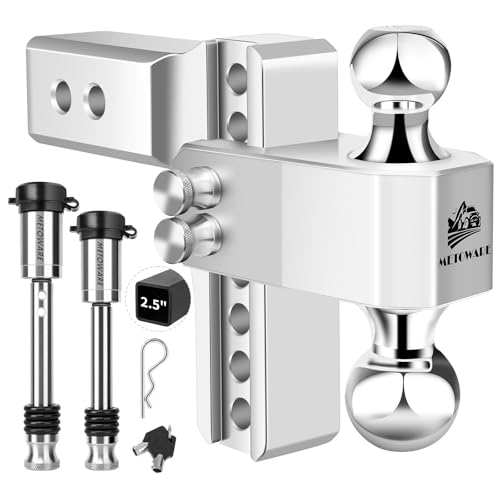
This product is an adjustable aluminum ball mount for a vehicle with a 2.5-inch receiver. It is marketed with an integrated reversible head carrying 2-inch and 2-5/16-inch balls, plus a channel offering up to 6 inches of drop or rise in 1-inch positions. Its purpose is to help match a trailer coupler height without changing to a separate fixed ball mount. Retail listings independent of the supplied catalog repeat the aluminum construction, roughly 19.8-pound product weight, dual-ball format, 6-inch adjustment range, and included locks. These are listing claims, not laboratory verification. The central load rating is unresolved. Resold descriptions market 18,000 pounds GTW, while product-detail data also states an 8,000-pound maximum towing capacity. No ball-specific capacity table, tongue-weight rating, weight-distribution limit, installation manual, or model-specific test report was located.
This format is directed at an owner of a heavy-duty vehicle that already has a labeled 2.5-inch receiver and tows trailers with differing coupler heights or either of the two stated ball sizes. It is most appropriate only where the vehicle, receiver, trailer coupler, trailer rating, safety chains, ball size, and actual tongue weight are all documented and compatible. The owner should be able to inspect the product markings and resolve the applicable ball-specific capacity before coupling a trailer.
It is not appropriate for anyone who needs a clearly documented 18,000-pound towing system, a known tongue-weight limit, or verified approval for commercial, fleet, or regulated use. Do not rely on it where the trailer uses a different coupler size, the receiver is not 2.5 inches, the trailer needs weight distribution, or road clearance is tight. It also does not suit users unable to confirm the marked capacity on the delivered product, because the published 8,000-pound and 18,000-pound figures conflict.
The product is marketed as aluminum with stainless locking hardware and an oxide-finish corrosion treatment. Those material choices can support corrosion resistance and, because aluminum and stainless steel are recyclable metals, may reduce material loss if the product remains in safe service. However, the maker did not provide a material grade, recycled-content figure, coating specification, corrosion-test result, replacement-parts catalog, warranty terms, or retirement instructions. Long service life therefore remains unverified. No product-specific Proposition 65 warning, material declaration, or safety data sheet was located in the checked listings. That does not establish that there is no chemical exposure. California guidance explains that a warning concerns exposure to a listed chemical, rather than simply whether a product contains one. No product-specific recall notice was located in the public search results, but no product registration process or dedicated safety contact was found either. The current AMECA list also did not provide independent compliance confirmation for this product.
This is an adjustable aluminum ball mount for a 2-inch receiver. It uses a height-adjustable channel with a reversible dual-ball platform, giving 2-inch and 2-5/16-inch coupling options. The seller states a 6-inch rise or drop range, two locking pins, and four pads intended to reduce movement and rattle. The published manufacturer details assign up to 12,500 lb gross trailer weight to the 2-5/16-inch ball and 8,000 lb to the 2-inch ball. Those claims were independently corroborated only as reproduced retailer specifications, not by a test report. A tongue-weight limit, weight-distribution compatibility, adjustment-position rating, and accessible installation or inspection instructions were not located. The product is listed as aluminum with a powder-coated finish and a two-year warranty, but the precise aluminum alloy, temper, and coating specification were not published.
This product suits an owner of a light-duty truck with a confirmed 2-inch receiver who alternates between trailers using 2-inch and 2-5/16-inch couplers, and who has already checked every limiting rating in the system. It is most appropriate where the needed hitch height falls within its stated 6-inch adjustment range and the trailer can be kept level with adequate ground clearance. The user should independently confirm loaded trailer weight, tongue weight, receiver label, vehicle payload, coupler rating, safety chains, and brake requirements before towing.
It is not suited to anyone who needs an independently certified, model-specific towing component for commercial work, repeated maximum-load towing, or a safety-managed fleet. It is also unsuitable when the vehicle has a 1-1/4-inch, 2-1/2-inch, or 3-inch receiver, when a weight-distribution system is required but compatibility is unconfirmed, or when a safe level-trailer position lies outside the stated range. Do not use it where the trailer's loaded tongue weight cannot be measured and checked, because this product's published tongue-weight rating was not found.
The product is manufacturer-described as aluminum with a powder-coated finish, plus stainless-steel locking pins. Those material choices can help resist ordinary outdoor corrosion, but the manufacturer did not publish the alloy, temper, coating chemistry, salt-spray testing, or instructions for managing coating loss and wear. Users should inspect the balls, adjustment holes, pins, locks, receiver shank, and pads before towing, and retire damaged components rather than relying on appearance alone. The current AMECA trailer-hitch compliance list did not identify this product or its manufacturer. No model-specific independent test report, recall notice, or product-specific chemical exposure declaration was located in the sources checked. The listed two-year warranty is the only published service-life commitment found. Aluminum is a durable metal component, but no replacement-parts catalog or documented repair pathway was located for the pins, locks, balls, or pads.
This is an adjustable tri-ball mount for a truck with a 2-inch receiver. It provides 1-7/8-inch, 2-inch, and 2-5/16-inch ball sizes on a reversible head, with up to 6 inches of rise or drop in 1-inch positions. The seller states gross trailer weight limits of 3,500, 8,000, and 12,500 pounds by ball size. Those limits still must not exceed the lowest rating of the vehicle, receiver, coupler, safety chains, trailer, and any weight-distribution equipment. The available product information states anodized aluminum arms and medium-carbon-steel balls, plus locking hardware intended to secure both the receiver and adjustable head. I found no model-specific laboratory load or fatigue report, installation manual, tongue-weight rating, weight-distribution guidance, replacement-parts catalog, or independently checkable VESC V-5 or SAE listing for this product.
This product suits an owner of a light truck with a standard 2-inch receiver who routinely changes among trailers with 1-7/8-inch, 2-inch, and 2-5/16-inch couplers, and needs a modest 6-inch height correction. It is most appropriate only after the buyer confirms the vehicle, installed receiver, trailer coupler, trailer weight, tongue weight, chains, and ball rating all support the selected position. It also suits owners prepared to inspect pins, locks, ball surfaces, and adjustment holes before each tow.
It is not for towing setups that need a documented tongue-weight rating, weight-distribution approval, independently verified compliance listing, or published fatigue-test evidence. Avoid using it for trailers above the lowest component rating, even if the 2-5/16-inch ball claim appears sufficient. It is also unsuitable where 6 inches of rise or drop cannot level the loaded trailer while retaining safe road clearance. Buyers who need replacement locks, pins, balls, or formal service instructions should seek a product with an accessible parts and support program.
The relevant health issue is not normal skin contact with a finished hitch, but incomplete chemical disclosure. The product is stated to use aluminum, steel, anodizing, and coated components, yet no product-specific material declaration, safety data sheet, or California exposure warning was located. A Proposition 65 warning, if one is supplied on packaging or at checkout, signals a listed-chemical exposure assessment and does not by itself establish unsafe ordinary use. Aluminum and steel are durable, widely recyclable metals, and an anodized finish can help delay corrosion-related replacement. Those are potential material-life advantages, not proof of a defined service life. No accessible warranty terms, replacement-parts catalog, inspection schedule, or retirement criteria were found. I also did not locate a product-specific recall or regulatory action in the sources checked, but the available maker traceability and public safety documentation remain limited.
This is an adjustable steel ball mount for a vehicle with a 2-inch receiver, using a reversible shank and a dual-ball head. It is intended to connect trailers with either a 2-inch or 2-5/16-inch coupler, while allowing the ball height to be repositioned for a level trailer. The supplied adjustment hardware uses two pins secured by one retaining clip. A separate receiver hitch pin and clip are required. CURT states a 15,000-pound gross trailer-weight limit and 1,500-pound tongue-weight limit for the mount, while the 2-inch ball is rated to 10,000 pounds and the 2-5/16-inch ball to 15,000 pounds. Its instructions explicitly require use within the lowest-rated component in the whole tow system. CURT also states 5-1/2 inches of drop or 4-1/2 inches of rise. No model-specific independent fatigue test report or current third-party listing for this exact product was located in the reviewed sources.
This product suits an experienced trailer owner whose tow vehicle has a properly rated 2-inch receiver and whose trailers use 2-inch or 2-5/16-inch couplers. It is most applicable when one vehicle tows trailers with different coupler sizes or different tongue heights, and the required level position falls within the stated 5-1/2-inch drop or 4-1/2-inch rise range. The user needs to verify vehicle, receiver, trailer, coupler, ball, and tongue-weight limits before every setup, and supply a suitable receiver pin and clip.
It is not for towing above 10,000 pounds with the 2-inch ball, or above the lowest rating anywhere in the complete tow system, even if the larger ball and mount have higher stated limits. It is also unsuitable where the needed level trailer height falls outside its stated rise and drop range, where ground clearance becomes poor, or where a vehicle uses a receiver other than 2 inches. Buyers needing independently documented model-specific fatigue testing or a checkable third-party certification should seek documentation before relying on this product.
The main direct health disclosure is a California Proposition 65 cancer and reproductive-harm warning on CURT's product page. The page does not identify the chemical, concentration, or exposure route for this particular product. California explains that such a warning is a right-to-know disclosure, not by itself a finding that a product is unsafe. A 2024 California settlement concerning Curt-branded products identifies DEHP in its prescribed warning language, but that document does not establish that this particular ball mount contains or exposes users to DEHP. CURT states that the product is carbon steel with powder coating and chrome-plated balls. Steel is readily recyclable, and corrosion resistance can help avoid premature replacement. The manual advises gentle cleaning to protect the finish and provides a warranty and replacement-pin direction. It does not provide a full material declaration, coating chemistry, repair program, or specific end-of-life and damage-retirement criteria.
This is an adjustable aluminum ball mount for a 2-inch receiver. It combines a reversible tri-ball head with 1-7/8-inch, 2-inch, and 2-5/16-inch balls, and is intended to provide up to 6 inches of rise or drop. The supplied hardware is stated to include a receiver lock, an adjustment pin, snap pins, O-rings, and an Allen wrench. Kingfun states gross trailer weight limits of 3,500 pounds for the 1-7/8-inch ball, 8,000 pounds for the 2-inch ball, and 12,500 pounds for the 2-5/16-inch ball. Those claims are reproduced by an independent retailer, but no model-specific laboratory report, tongue-weight limit, or weight-distribution approval was located. The current AMECA trailer-hitch compliance list reviewed did not show this product or maker.
This product is suited to an owner of a tow vehicle with a properly rated 2-inch receiver who uses conventional ball-coupled trailers and has already confirmed the vehicle, receiver, coupler, safety chains, trailer brakes, payload, and tongue weight. Its stated tri-ball layout is practical for a household or work user who alternates among small utility, boat, or cargo trailers with the three listed coupler sizes. The 6-inch adjustment range is relevant where measured coupler height calls for rise or drop.
It is not suited to towing plans that depend on the advertised 12,500-pound figure without independently confirming tongue weight and every lower-rated part of the system. It is also unsuitable where a vehicle manual prohibits towing, limits use of adjustable ball mounts, requires a weight-distribution system, or has a receiver below the needed capacity. Buyers who need documented fatigue testing, a current independent compliance listing, repair parts, or detailed corrosion inspection instructions need more traceable product support.
No product-specific Proposition 65 warning, material declaration, or coating safety data sheet was located. Aluminum itself is not listed as a California Proposition 65 chemical, but that does not establish the composition or exposure profile of this complete product, which also includes pins, locks, coatings, and lubricating O-rings. California provides a general warning framework for handling motor-vehicle parts, including handwashing after handling, but it cannot confirm exposure from this product. The manufacturer states that the body is aluminum with a powder-coated finish and offers a 365-day warranty. Aluminum can have value in metal recycling streams, and corrosion resistance can support longer use, but no documented replacement balls, pins, locks, repair process, or end-of-life guidance was found. No product-specific recall or regulatory action was located in the sources reviewed, but the lack of a visible registration process limits proactive recall contact.
This is an adjustable steel ball mount for an existing 2-inch vehicle receiver, not a vehicle-specific receiver hitch. The listed configuration combines fixed 1-7/8-inch, 2-inch, and 2-5/16-inch balls with a height-adjustable channel. Seller materials state nine roughly 1-inch-spaced positions provide up to 8 inches of drop or rise. The supplied hardware is described as two adjustment pins and a locking receiver pin. The published towing claims are 8,000 pounds on the 1-7/8-inch ball, 10,000 pounds on the 2-inch ball, and 12,500 pounds on the 2-5/16-inch ball. Those are seller-stated figures, not independently confirmed ratings. No tongue-weight limit, weight-distribution compatibility statement, model-specific instructions, or laboratory load and fatigue report was located. The exact product also was not found in AMECA's current public VESC V-5 and SAE trailer-hitch list.
This product is suited to an owner who already has a correctly rated 2-inch receiver and tows conventional trailers with 1-7/8-inch, 2-inch, or 2-5/16-inch couplers. It is most relevant where the owner needs to change ball size or coupler height between trailers and can independently confirm every limiting rating, including the vehicle, receiver, trailer, coupler, safety chains, tires, and brakes. The claimed adjustment range may be useful where a measured setup can remain level with adequate road clearance.
It is not appropriate for anyone who needs independently documented compliance, a confirmed tongue-weight limit, or a published weight-distribution rating before towing. Avoid treating the recovery hook as a verified recovery point because no model-specific proof of that use was located. It is also unsuitable where the vehicle receiver is not 2 inches, where the trailer needs a ball size outside the three listed, or where an 8-inch position would reduce ground clearance, interfere with the vehicle, or leave the trailer unlevel.
The product is described as alloy steel with powder coating and electroplating. Steel is widely recyclable and a protective finish can extend service life, but neither the coating chemistry nor a material declaration was located. No product-specific Proposition 65 warning or exposure documentation was found in the accessible materials. That absence does not establish that the coatings are free of listed chemicals. The listed two-year warranty may support repair or replacement through the seller, but no replacement ball, pin, lock, or wear-component documentation was located. Public AMECA materials explain that listed VESC V-5 products are traceable to a manufacturer, accredited testing laboratory, and retained test data. This exact product was not present in the current public list checked. No product-specific recall, regulatory action, or safety notice was located in the searches performed, but a clear public registration or recall-contact process was also not found.
This product is an adjustable, dual-ball drawbar for a standard 2-inch receiver. Its aluminum channel carries a reversible chrome-plated steel ball platform, with 2-inch and 2-5/16-inch balls. The listing says the 2-inch ball is rated to 8,000 lb gross trailer weight and the larger ball to 12,500 lb. It also says the head has seven positions across 6 inches of rise or drop and includes two locking pins. Those are manufacturer-stated specifications published on the marketplace page, not independently validated ratings. The listing does not state a tongue-weight limit, weight-distribution compatibility, or a model-specific test report. It hosts a user manual, but the accessible listing does not show a V-5 or SAE certification claim, and the current public AMECA hitch list did not identify this product.
This product suits an owner of a light truck or SUV with a confirmed 2-inch receiver who needs to switch between trailers using 2-inch and 2-5/16-inch couplers. It is most appropriate when the vehicle, receiver, trailer, coupler, safety chains, and ball are all independently verified to support the intended loaded weight. The seven-position design is useful where a modest 6-inch correction can bring a conventional trailer closer to level, while still preserving adequate road clearance.
It is not suited to anyone who cannot verify tongue weight, receiver capacity, coupler capacity, and loaded trailer weight before each towing setup. It is also a poor fit for weight-distribution use unless LWCH or the vehicle manufacturer specifically confirms compatibility. Buyers planning routine towing near 12,500 lb, commercial service, severe off-road use, or prolonged road-salt exposure need documented test evidence, defined inspection limits, and accessible replacement support that this listing does not establish.
The product is presented as an aluminum hitch body with chrome-plated steel balls. Those metals can offer a long-lived, recyclable construction, but LWCH does not publish an alloy grade, recycled-content claim, plating specification, safety data sheet, or replacement-parts catalog on the reviewed page. Two locks and six keys are included, yet no source for replacement locks, pins, balls, or a defined warranty term was identified. That limits confidence in repairability and long service life. No California Proposition 65 warning appeared in the reviewed marketplace content. Its absence does not establish zero chemical exposure, because no detailed coating or material declaration was published. No product-specific NHTSA recall result, enforcement action, or independently checkable AMECA V-5 or SAE hitch listing was located in the reviewed public records. Inspect the balls, locking pins, adjustment holes, and receiver contact surfaces for corrosion, cracking, distortion, and wear before towing.
This is a steel adjustable ball mount for a 2-inch receiver. It uses a rotating three-ball head with 1-7/8-inch, 2-inch, and 2-5/16-inch balls, plus a reversible shank intended to provide up to 4 inches of drop or rise in 1-inch positions. It is meant to let one tow vehicle connect to trailers with different coupler sizes and heights. The 13,500-pound gross-trailer-weight figure, alloy-steel construction, reinforced rear gusset, powder-coat finish, and dual locking pins are manufacturer-stated claims reproduced by independent marketplace listings. The product is traceable by a manufacturer part number and UPC, but no model-specific laboratory report, tongue-weight rating, installation manual, inspection schedule, or current independent V-5 or SAE listing was located. The stated weight rating also exceeds the 10,000-pound scope of SAE J684, so it should not be treated as evidence of J684 conformity.
It suits a tow-vehicle owner with a confirmed 2-inch receiver who alternates among light and medium-duty trailers using the three listed coupler sizes, and who needs about 4 inches of height correction to tow level. The user should already know the vehicle, receiver, trailer, coupler, safety-chain, and tire limits, and should be prepared to inspect the pins, lock engagement, ball, shank, and adjustment holes before every trip. It is most appropriate when the actual loaded trailer and tongue weights remain below every applicable component limit.
It is not suited to anyone who needs documented third-party load testing, a confirmed V-5 listing, or a published tongue-weight rating before selecting towing hardware. It is also unsuitable where a weight-distribution hitch is required, where the trailer needs more than 4 inches of correction, or where the required ball-specific rating is unknown. Do not use it for recovery pulling, lifting, or commercial configurations governed by separate coupling rules unless the exact use is expressly rated and approved. Corroded, bent, cracked, loose, or worn hardware requires removal from service.
The visible construction is described as alloy steel with a textured black powder coat, plus stainless-steel locking hardware. Steel is broadly recyclable and a corrosion-resistant coating may extend useful life, but no manufacturer documentation was found for coating chemistry, recycled content, corrosion testing, spare balls, pins, locks, or a repair program. The supplied information therefore does not establish a low-impact manufacturing or end-of-life plan. No product-specific recall, regulator action, or exposure warning was located in the sources reviewed. That is not proof that none exists. California requires a clear and reasonable warning when exposures to listed chemicals are significant, but no product-specific Proposition 65 disclosure or material declaration was found. Handle metal parts and coatings with normal workshop hygiene, especially during installation, cleaning, or any abrasion that creates dust.


