6% off

EVIQO Level 2 EV Charger - Tesla Compatible
Compatible with Tesla's NACS charging system.
Long 25-foot cord for flexible parking.
High 40 Amp output for faster charging.
 Daniel Kenitz
Compatible with Tesla's NACS charging system.
Long 25-foot cord for flexible parking.
High 40 Amp output for faster charging.
Smart app and RFID card control.
Long 25-foot durable charging cable.
Compatible with NEMA 14-50 plug.

Compatible with both Level 1 and 2 charging.
User-friendly interface with clear LCD screen.
Durable build for long-lasting performance.

High-speed charging up to 80 amps.
Integrated AI for smarter charging management.
Durable for indoor and outdoor installation.

High charging speed with up to 50Amp power.
Wi-Fi and Bluetooth for easy connectivity.
Durable 25-foot flexible cable for convenience.

Convenient 16 ft extension for flexible charging.
ETL certified for tested safety standards.
Portable design for easy on-the-go use.

Dual voltage for flexible charging options.
Long 28-foot cable for easy reach.
Compatible with SAE J1772 EVs.

Adjustable charging speed up to 50 amps.
Compatible with all electric vehicle models.
Easy installation and user-friendly interface.

25-foot cable offers flexible charging options.
Fast charging at up to 40 amps.
Suitable for both indoor and outdoor use.

High-speed charging for quicker EV readiness.
Bluetooth/WiFi integration for convenient monitoring.
Durable for both indoor and outdoor use.
The first buying decision is connector and installation format. J1772 equipment fits vehicles with J1772 inlets; NACS equipment fits vehicles with NACS inlets. A vehicle using the other connector generally needs a separate, vehicle-approved adapter. Plug-in units also depend on the exact receptacle and branch circuit. A charger set to 40 A is a continuous load and generally needs a dedicated 50 A circuit; 48 A generally needs a dedicated 60 A circuit; and 50 A generally needs a dedicated 70 A circuit. An 80 A charger reviewed here calls for a dedicated 100 A circuit, 3 AWG copper conductors, grounding, and hardwired installation. These are not interchangeable assumptions: the manufacturer’s nameplate and installation manual, the local authority having jurisdiction, and a qualified electrician should determine the final setup.
Headline power figures need similar care. At 240 V, 40 A corresponds to 9.6 kW, 48 A to 11.52 kW, 50 A to 12 kW, and 80 A to 19.2 kW, but a vehicle may accept less. “Up to” miles per hour is therefore not a universal result. Adjustable current is useful only when it is matched to the installed circuit and vehicle. A NEMA 14-50 plug does not make an existing outlet suitable, and an adapter, dryer outlet, extension cord, worn receptacle, or ordinary household outlet may create an overheating risk if the current is not properly limited.
For safety evidence, look for a listing for the complete, exact charger—not just its cable, plug, or a product family—under ANSI/UL 2594 and, where applicable, ANSI/UL 2231-1 and -2. The issuing laboratory should be traceable through an OSHA-recognized testing laboratory directory such as UL Product iQ, Intertek’s ETL directory, or the CSA Group database. A seller’s “UL,” “ETL,” “CSA,” CE, or FCC statement is not equivalent to a searchable exact-product certification record. Also check the installation manual for breaker, wire, receptacle, grounding, continuous-load, and hardwiring instructions.
Fault protection should be documented rather than inferred from a feature list. Useful evidence includes ground-fault or leakage detection, overcurrent and overvoltage response, overtemperature sensing, relay and control-pilot fault handling, and automatic shutdown. Outdoor claims should identify an enclosure rating, temperature range, mounting limits, and cable and connector durability; IP66, NEMA 4, NEMA 4X, and Type 4 are not interchangeable without knowing what the specific record covers.
Finally, check recall traceability, warranty and support contacts, model and serial identification, app privacy and update practices, and the product’s standby-energy and service-life evidence. EPA ENERGY STAR records can provide measured no-vehicle power; the supplied products range from 1.11 W to 6.31 W where such records were available. Across these products, recurring cautions are significant: continuous-load installation must be verified by a qualified electrician; exact-model certification is often less clear than the listing suggests; NACS/J1772 adapters are frequently required; outdoor ratings and thermal protections may be manufacturer claims; and app-connected products may collect location, vehicle, network, account, or charging data. Do not use an undersized, shared, damaged, or unverified circuit, and do not treat a plug-in format as permission to skip electrical assessment.
These topics distinguish a charger that merely advertises a current and connector from one with evidence about electrical protection, installation fit, environmental burden, and accountability. Scores are relative to the supplied products: a high score reflects stronger documented or reviewed performance for that topic, while a low score signals important evidence or use limitations.
This measures whether the EVSE is designed and documented to stop shock, ground-fault, overheating, and fire hazards. It matters because charging is a sustained, high-current load. Among the supplied products, scores range from 48 to 95: the higher-scoring units document stronger fault safeguards and installation controls, while lower-scoring products leave more uncertainty around circuit loading or whole-product protection.
This measures whether amperage, breaker, wire, plug, receptacle, and hardwiring instructions agree with continuous-load requirements. It matters because a charger can be electrically sound yet unsafe on an unsuitable branch circuit. High-scoring products provide usable current-to-circuit guidance, such as 40 A on a 50 A circuit; low-scoring products contain ambiguous or conflicting 40 A, 120 V, plug-in, or receptacle instructions.
This measures whether the supplied plug and adapters are correctly current-limited and matched to the outlet. It matters because attachment plugs and receptacles are common heat points during long charging sessions. The supplied scores span 45 to 94. Higher-scoring hardwired or clearly matched systems avoid or better control this risk; lower-scoring products do not clearly explain safe current limits for household adapters or outlet configurations.
This measures documented sensing, fault indication, and automatic shutdown at the plug, receptacle, cable, connector, relays, and control box. High scores in the supplied set reach 91 where fault responses and thermal protections are described; lower scores around 70-75 reflect manufacturer claims without independent response data, unclear sensor locations, or incomplete fault-code documentation. A feature name alone does not establish how quickly protection acts.
This measures whether the enclosure, cable, connector, strain relief, and temperature limits suit the claimed indoor or outdoor use. It matters because water, UV exposure, impact, cold, and repeated handling can become electrical hazards. Scores range from 52 to 87. Higher scores are supported by records such as Type 4 or stated operating ranges; lower scores reflect conflicting IP claims or reported cold-weather cable stiffness.
This measures whether the connector and charging-control compatibility are accurately stated for the intended vehicle. It matters because J1772 and NACS are different vehicle inlets, and an adapter adds another component whose rating must be checked. Supplied scores range from 78 to 94. Higher-scoring products clearly identify the connector and adapter requirement; lower scores are associated with broad or potentially misleading universal-fit language.
This measures whether the maker, exact model, serial information, warranty, support contacts, and recall path are clear. It matters because a buyer needs to identify a defective charger and obtain a correction. Scores range from 68 to 88. Higher-scoring products publish identifiable support and warranty routes; lower-scoring products have less certain listing identity, inconsistent warranty language, or limited evidence of accountable long-term support.
This measures whether the exact charger—not only a component, family, or seller claim—is listed by an OSHA-recognized laboratory to the applicable U.S. EVSE standard. Scores range from 70 to 98. The strongest evidence names the product in an Intertek ETL or CSA record and identifies the applicable standard; lower scores reflect family-level certificates, unmatched retail designations, or no public exact-product listing.
This measures whether current, kilowatts, miles per hour, scheduling, load management, app functions, and weather claims are technically plausible and qualified by vehicle and circuit limits. Scores range from 38 to 88. Higher-scoring products have ratings corroborated by ENERGY STAR or clear manuals; lower-scoring products use incorrect units, unsupported speed claims, conflicting 40/48 A descriptions, or ambiguous two-vehicle and weather claims.
This measures whether connected functions have documented account controls, privacy practices, firmware updates, and security support—or are absent when unnecessary. Scores range from 68 to 88. Higher-scoring products either avoid cloud connectivity or disclose useful controls and updates; lower-scoring products collect broad location, vehicle, network, or account data without a clear security-support lifetime or vulnerability process.
This measures standby energy, durability, repairability, replacement parts, and end-of-life handling. It matters because a connected charger can consume electricity while idle and eventually become electronic waste. Scores range from 69 to 90. Higher-scoring products have ENERGY STAR records with measured no-vehicle power or stronger service documentation; lower-scoring products lack standby measurements, parts information, repair pathways, or take-back programs.
This is a wall-mounted Level 2 home EV charging station with a NACS vehicle connector, a NEMA 14-50 plug, Wi-Fi app functions, and a 25-foot charging cable. It is intended for 240 V charging from a dedicated 50 A circuit, with 40 A and 9.6 kW as its maximum plug-in output. EPA ENERGY STAR independently lists the exact 40 A NACS version with those electrical ratings and cable length. The manufacturer documents adjustable 16 A, 32 A, and 40 A settings, plus ground-fault, overcurrent, overtemperature, surge, and control-pilot protections. It also claims an IP66 and NEMA 4 enclosure and UL and ETL certification. Those safety-listing claims could not be matched to a public exact-product record in the searched NRTL directories, so they should not be treated as independently confirmed here.
This product fits a Tesla or other NACS-vehicle household that already has, or will have installed, a dedicated 240 V NEMA 14-50 receptacle on a 50 A circuit. It is suited to overnight home charging where 40 A, or up to 9.6 kW, matches the vehicle's onboard charging limit. The long cable can help where the parking position is offset from the outlet. It also suits users who want scheduling and charging-cost tracking, and who are comfortable connecting a charger to 2.4 GHz Wi-Fi.
It is not appropriate for a household with an older, damaged, loose, shared, or incorrectly wired 14-50 receptacle, or a circuit below 50 A when operating at 40 A. Those conditions require electrical assessment and possibly a lower current setting or different installation. It is also not a direct fit for a J1772 vehicle unless the owner separately obtains a suitable NACS-to-J1772 adapter. Buyers who require a publicly verifiable exact-product UL or ETL safety certificate, or a clearly consistent three-year written warranty, need additional documentation before relying on those claims.
The main safety positive is the documented installation fit. The manufacturer specifies a dedicated 50 A breaker for 40 A charging and offers 16 A and 32 A settings for appropriately sized circuits. Its documentation also describes ground-fault, surge, overcurrent, overtemperature, and charging-control fault protection. Outdoor IP66 and NEMA 4 claims are useful only when the mounting, cable handling, and local electrical-code requirements are followed. EPA ENERGY STAR independently certifies the exact NACS plug-in product. Its recorded no-vehicle draw is 2.36 W, which limits idle electricity use compared with a charger that remains substantially powered between sessions. However, no public repair-parts or take-back program was identified, and the product page's three-year warranty conflicts with the 24-month term published in the manufacturer's terms. No EVIQO recall was located in the searched CPSC results.
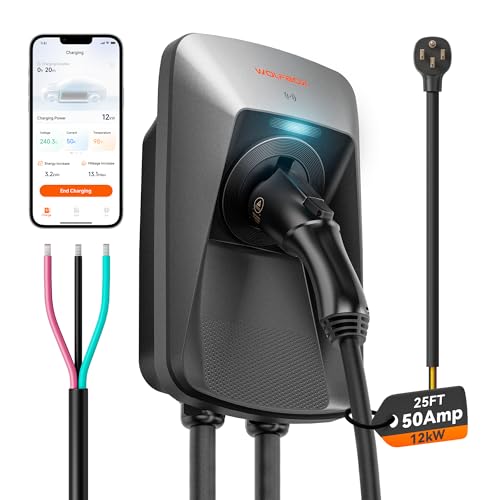
This is a wall-mounted Level 2 EV charging product for 240 V service, using a J1772 vehicle connector and a 25-foot charging cable. It can be configured for 40 A, 48 A, or 50 A output according to the manufacturer materials, with Wi-Fi app functions, RFID cards, and plug-and-charge operation. Tesla vehicles need a suitable J1772-to-NACS adapter. The maker claims CSA and FCC certification, UL 2594 compliance, NEMA 4X weather protection, and multiple electrical protections. An EPA ENERGY STAR record independently confirms a closely named WOLFBOX E50, sold in the United States and Canada, at 240 V and 50 A, but it does not establish that the marketplace product name WE50 is the same certified model. Installation guidance is the key limitation. Full 50 A output requires hardwiring on a 70 A or larger circuit, while plug-in use is limited to 40 A on a 50 A circuit.
This product suits an owner of a J1772-equipped EV or plug-in hybrid who has a licensed electrician confirm a dedicated 240 V circuit and set the charger to the circuit's permitted continuous load. It is especially relevant where a 25-foot cable is needed to reach a vehicle parking position, and where household members value RFID access or scheduled charging. A buyer seeking the advertised 50 A setting needs a hardwired installation on a correctly sized 70 A or larger circuit, subject to local electrical-code approval.
It is not suited to a buyer who plans to treat a normal NEMA 14-50 outlet as a route to the full 50 A setting. The available installation information limits plug-in operation to 40 A on a 50 A circuit, and full output needs a professionally designed hardwired circuit. It is also a weaker fit for households that cannot obtain reliable Wi-Fi but expect app scheduling, or for privacy-sensitive users who do not want a connected account collecting device, usage, and potentially location-related data. Tesla owners need an appropriate adapter.
The main safety positive is that the manufacturer documents selectable current levels and a circuit-sizing table. It also claims leakage-current, overcurrent, short-circuit, grounding, over-temperature, and surge protections, plus a NEMA 4X enclosure for indoor or outdoor mounting. Those are manufacturer statements, not independent confirmation of the exact product's complete safety listing. No WOLFBOX EV charger recall was located in the CPSC recall search during this review. Energy use has some independent support, but with a naming caveat. EPA's ENERGY STAR record for the WOLFBOX E50 reports 3.7 W in no-vehicle mode and 8.52 W in idle mode, and identifies a 50 A, 240 V, 25-foot-cable charger. The record does not explicitly link that E50 name to this WE50 product. WOLFBOX states a three-year manufacturer warranty in the marketplace record, while public parts, repair, and take-back information was not found.
This is a portable J1772 electric-vehicle charging unit with a 25-foot cable, a detachable household-outlet adapter, and a NEMA 14-50 connection for 240V charging. It is intended to serve as a movable home or travel charging cord rather than a permanently hardwired station. Product information reproduced by independent retailers describes selectable output up to 40A and up to 9.6 kW on 240V, plus lower-power 120V operation. The listing states ETL certification, IP66 weather resistance, adjustable 6A to 40A output, on-unit delayed charging, and a three-year warranty. Those are manufacturer claims. I could confirm that Intertek provides an official public directory for ETL-listed products, but I could not locate a public exact-product certification record establishing its listing scope to UL 2594 and personnel-protection standards. A 40A EVSE is a continuous load, so full-power use requires a dedicated circuit correctly sized for that load, commonly a 50A circuit.
This product fits an owner of a J1772-equipped vehicle who needs one portable cord for occasional 120V charging and regular charging from an already installed, dedicated 240V receptacle. It is especially relevant where the parking position changes or where a fixed wall unit is not practical, because the cable is manufacturer-stated to be 25 feet long and the current is adjustable. Full 40A operation suits only a home whose circuit, receptacle, wiring, service capacity, and local code approval have been checked for continuous EV charging.
It is not for someone planning to use 40A from a general-purpose household outlet, an extension cord, a worn receptacle, or a circuit shared with other loads. It is also unsuitable for a buyer who requires independently searchable proof that this exact product is listed to the applicable U.S. EVSE and personnel-protection standards before installation. Owners of NACS-only vehicles need a vehicle-compatible adapter. For an exposed outdoor location, the plug, receptacle, mounting arrangement, and cable routing need protection beyond an enclosure rating claimed for the control unit.
The primary health issue is electrical installation. EV charging is treated as a continuous load under the National Electrical Code, so a 40A charging setting normally calls for a dedicated circuit sized for continuous duty. The product's adjustable-current claim can help match output to a suitable circuit, but it does not make an undersized circuit or aging receptacle safe. The listing claims ETL certification, error indication, IP66 protection, and a three-year warranty, yet an exact-product public certification record and model-specific safety manual were not located. No product-specific CPSC recall or safety warning was found in the searched federal recall and unsafe-product resources. This is not proof that none exists. Environmental documentation is thin. WOLFBOX has an ENERGY STAR record for a different E40 product, not this portable PE40, so that record does not establish this product's standby energy use. No verified replacement-parts, repair, recycling, or manufacturer take-back program for this product was found.
This product is a wall-mounted, hardwired Level 2 EV charging station for North American vehicles with the J1772 inlet. It delivers up to 80 amps at 208 or 240 volts, or 19.2 kW at 240 volts, and uses a 25-foot charging cable. The current can be reduced through a hardware dial or app, which matters when the available circuit is smaller than the product’s maximum setting. Its 19.2 kW, single-port configuration is independently listed on EPRI-vetted utility equipment lists. EPA ENERGY STAR records also include this configuration. Autel’s current manual documents 20 mA ground-fault detection, overcurrent, voltage, temperature, and surge protections, plus a NEMA 4X, IK10 enclosure rating. The manual also requires a licensed electrician, a dedicated 100 amp breaker for full output, and copper conductors sized for the continuous load.
This product suits an owner of a J1772 electric vehicle or plug-in hybrid that can actually accept high Level 2 current, and who has a licensed electrician confirm a dedicated 100 amp circuit and sufficient panel and service capacity. It is also appropriate for an outdoor wall or pedestal installation where a weather-resistant enclosure, long cable, adjustable current setting, and access to utility time-of-use schedules are useful. Buyers should expect the vehicle’s onboard charger, not the station alone, to determine actual charging speed.
It is not suited to homes with only a 40, 50, or 60 amp EV circuit unless the product is permanently commissioned to a lower compatible current by a qualified installer. It is also unsuitable for renters or users needing plug-in portability, because it is hardwired. Buyers with a NACS-inlet vehicle who do not have an approved J1772 adapter should choose a native compatible connection instead. Households unwilling to use a connected app or cloud account should account for reduced smart-function convenience and review Autel’s data practices first.
Electrical safety depends heavily on installation here. Autel’s manual calls for a licensed electrician, permanent grounding, a dedicated circuit, and 125 percent continuous-load sizing. At full output, that means a 100 amp breaker and appropriately sized copper wiring. The product is hardwired, which avoids outlet and adapter heating risks. Autel documents ground-fault detection, overtemperature response, surge protection, and fault guidance. Its NEMA 4X and IK10 claims, temperature range, and high-temperature derating are manufacturer-documented rather than independently confirmed in this review. EPA ENERGY STAR records include this configuration, which is meaningful for no-vehicle-mode energy controls. The manufacturer states a five-year warranty for the main charger and internal parts, but only one year for the cable and connector, which are common wear items. The product supports over-the-air software updates, while connected use entails cloud data collection. Searches of CPSC recall and SaferProducts resources did not surface a product-specific recall or public safety notice during this review.
This is a wall-mounted, hardwired Level 2 home EV charging station for 208 or 240 V single-phase service. It supplies a J1772 vehicle connector on a 24.6-foot cable, with Wi-Fi, Bluetooth, Ethernet, RFID, scheduling, and a physical current selector. It is intended for indoor or outdoor installation by a licensed electrician. EPA ENERGY STAR independently lists this exact product at 50 A maximum output, 12 kW maximum power, and a 25-foot maximum cord length. Its measured no-vehicle standby input is 3.5 W. The installation manual, a manufacturer document, specifies a NEMA 4X enclosure, a 20 mA charging-circuit ground-fault function, and overcurrent, overvoltage, undervoltage, surge, and overheat fault handling. The same manual requires a 70 A breaker for its full 50 A setting because EV charging is a continuous load.
This product suits an owner of a J1772-equipped EV or plug-in hybrid who has a licensed electrician installing a dedicated 208 or 240 V hardwired circuit. It is particularly appropriate where the vehicle can use close to 12 kW and the electrical service can support a 70 A breaker for the full 50 A setting. The physical current selector also makes it practical where the electrician must configure a lower output, such as 32 A or 40 A, to match the available branch circuit. Its long cable helps with a garage or driveway where the charge port location varies.
It is not for a household expecting full 50 A charging from an existing 50 A receptacle circuit, dryer outlet, extension cord, or outlet-conversion adapter. The manual limits plug-in configurations to lower current settings and calls for hardwiring at the full 50 A setting. It is also unsuitable for vehicles with a native NACS inlet unless the vehicle maker approves an appropriate J1772-to-NACS adapter. Buyers who need a publicly searchable exact-model NRTL safety certificate, a documented security-support lifecycle, or published repair-parts and recycling arrangements need more evidence than was located for this product.
Electrical safety depends heavily on installation. The manufacturer manual calls for a grounded dedicated circuit, copper conductors, licensed installation, and branch-circuit protection at 125 percent of the selected continuous charging current. It documents a 20 mA charging-circuit ground-fault function plus overvoltage, undervoltage, surge, ground-fault, residual-current, and overheat fault indications. It also specifies a NEMA 4X enclosure and operation from minus 40 to 131 degrees Fahrenheit. These are meaningful manufacturer-stated safeguards, although a public exact-model NRTL listing record was not located in the reviewed directories. On energy use, EPA ENERGY STAR independently certifies the exact product and reports 3.5 W no-vehicle input power. That is useful for a charger that remains energized between sessions. The manufacturer provides a three-year warranty and reachable US support, and the manual identifies the product by label, serial number, and setup PIN. No CPSC recall for this product was located in the reviewed recall search. Public evidence of replacement parts, repairability, take-back, and a detailed connected-device security lifecycle remains limited.
This is a portable Level 1 EV supply device for vehicles with a J1772 inlet. It has a NEMA 5-15 household plug, a 16-foot charging cable, four status lights, and a stated maximum output of 15 amps at 120 volts. EPA ENERGY STAR records independently confirm the exact non-connected version at 15 amps, 1.8 kW maximum output, a 16-foot cord, and 12 AWG output cable. The defining concern is circuit fit. Its own manual states that it draws 15 amps continuously, while the current product page says it can use any standard 120 V NEMA 5-15 outlet. EV charging is a continuous load under NEC Article 625, which requires branch-circuit overcurrent protection sized to at least 125 percent of the load. A 15-amp continuous load therefore needs a properly assessed 20-amp circuit, not an assumed ordinary 15-amp household circuit.
This product fits a J1772 vehicle owner who needs a portable, non-connected Level 1 cable with 16 feet of reach and has access to a dedicated, electrician-assessed 120 V circuit that is suitable for a 15-amp continuous EV load. It also suits drivers who prefer simple on-device status lights rather than an app or cloud account. The vehicle's charging settings should be checked to confirm that its requested current does not exceed the circuit's safe continuous capacity.
It is not suited to households planning to plug into an unknown, shared, worn, or ordinary 15-amp garage or outdoor outlet for unattended overnight charging. A standard NEMA 5-15 receptacle does not by itself establish that the branch circuit, breaker, wiring, and receptacle condition support 15 amps continuously. It is also not for Tesla or NACS vehicles unless an appropriate vehicle-side adapter is separately used, or for buyers who require an independently searchable safety-listing record before relying on a portable EV supply device.
The strongest independently confirmed environmental point is efficiency. EPA ENERGY STAR lists this exact non-connected product at 1.11 W with no vehicle connected, 1.16 W in partial-on mode, and 2.9 W idle input power. The same record confirms 120 V input, 15 A nameplate output, 1.8 kW maximum output, a 16-foot cord, and 12 AWG output cable. Lectron states that the product is ETL-certified, IP65 weather-resistant, and protected against overvoltage, overcurrent, and short circuits. Its manual also describes ground-fault, leakage, high-temperature, and relay-related indications. Those claims are relevant safety features, but the exact safety-listing certificate scope was not independently located. No product-specific CPSC recall was identified in the recall search performed. The key electrical-health issue is the documented 15-amp continuous draw paired with broad standard-outlet guidance, so circuit capacity and receptacle condition matter more than convenience claims.
This is a portable J1772 EV charging cord set for plug-in vehicles, built around a NEMA 6-20P plug for 240V service and a supplied adapter for a standard NEMA 5-15 outlet. The maker describes a 16A maximum, a 28-foot cable, app-based monitoring, and a 1 to 12 hour charging schedule. It is intended to be carried, plugged into a suitable grounded outlet, then connected to the vehicle. A closely related VEVOR manual documents 16A at 240V, 12A at 120V, a 20A breaker for the 6-20 outlet, and a 15A breaker for the 5-15 adapter. That circuit guidance fits continuous EV charging. The product record claims ETL compliance, but an exact product listing to the applicable EV charging safety standard could not be independently confirmed in Intertek's public directory.
This product fits a J1772 EV or plug-in hybrid owner who already has a correctly grounded NEMA 6-20 receptacle on a dedicated 20A circuit and wants a portable 16A charging cord for a garage, driveway, or travel use. It can also suit a user who needs slower 120V charging from a sound 5-15 outlet, provided the product is set and documented for that circuit. The buyer should be comfortable checking outlet condition, circuit capacity, and vehicle charge settings before routine use.
It is not suited to households with unknown, worn, loose, ungrounded, shared, or improvised outlets. It is also a poor fit for anyone needing a publicly verifiable exact-model safety listing before connecting a sustained high-current load. Tesla or other NACS vehicle owners need an appropriate vehicle-side adapter, which is not included with this J1772 version. Drivers needing faster overnight recovery than 16A at 240V can provide should use equipment sized and installed for that need. Avoid relying on it unattended in severe rain, snow, or when either plug shows heat damage.
The main safety positive is the documented circuit fit in a closely related manual. It specifies 16A at 240V on a 20A circuit and 12A at 120V with the 5-15 adapter on a 15A circuit. That is consistent with EV charging as a continuous load. The maker also claims leakage, grounding, voltage, current, and overheat protections, but those functions were not independently tested for this exact product in the material located. The claimed ETL status was not independently traceable to an exact public certification record. I found no CPSC recall or VEVOR recall notice specifically naming this charger. VEVOR publishes a general 12-month warranty and support process, which helps defect reporting, but no standby-energy measurement, repair-parts listing, take-back program, or exact-model ENERGY STAR certification was located. The long cable may reduce placement strain, but it should be inspected for abrasion, heat damage, and water intrusion.
This product is a wall-mounted, hardwired Level 2 EV charging station for a 208 or 240 V residential circuit. It uses a 23-foot J1772 vehicle connector, rather than a Tesla-style plug, and its app can configure charging from 16 to 50 amps. At the full 50 A setting, the manufacturer specifies up to 12 kW, subject to the vehicle's onboard charger and a correctly sized home circuit. Its core safety credentials are independently traceable. UL's public certification record includes the CPH50 Home Flex family, while ChargePoint's documentation identifies compliance with UL 2594 and the UL 2231 personnel-protection standards. The hardwired version avoids a high-current wall receptacle and does not include an outlet adapter. ChargePoint documents ground-fault, open-ground, overcurrent, relay, and self-test fault indications and responses.
It suits a homeowner with a J1772-equipped EV, a planned professionally installed 208 or 240 V hardwired circuit, and a need to match charging output to available panel capacity. It is especially appropriate where the charging location is outdoors or where avoiding a continuously loaded plug and receptacle is desirable. The 16 A to 50 A configuration range can accommodate homes that cannot support maximum output immediately, provided an electrician selects the circuit, conductor, breaker, and app setting together.
It is not for do-it-yourself installation, homes with uncertain panel capacity, or buyers expecting 50 A charging from a 50 A breaker. The product is hardwired, so it does not suit someone who needs a portable charger or a simple outlet connection. It also is not a direct fit for a vehicle requiring NACS unless the vehicle maker permits the necessary J1772 adapter. Buyers unwilling to maintain a connected device and apply firmware updates should favor a non-networked charging arrangement.
The electrical-safety evidence is concrete. The CPH50 Home Flex family appears in UL's public directory, and UL is an OSHA-recognized Nationally Recognized Testing Laboratory. ChargePoint also documents personnel-protection standards, a Type 3R outdoor enclosure, and fault responses for ground faults, open-ground monitoring, overcurrent, relay, and self-test problems. The hardwired format removes the supplied outlet plug and adapter pathway, but safety still depends on licensed installation and selection of the charging current that matches the branch circuit. ChargePoint provides a three-year parts warranty, a replaceable 23-foot cable, support resources, and product registration. No product-specific CPSC recall was located in the searched federal recall resources. ENERGY STAR certification is documented for Home Flex plug-in variants, while the hardwired variant's separate database record was not confirmed. Connected ownership adds a maintenance responsibility because NIST records an older affected firmware version for a disclosed Home Flex command-injection vulnerability. Firmware status should be checked after installation.
This is a wall-mounted Level 2 EV charging station with a 25-foot SAE J1772 vehicle cable and a NEMA 14-50 input plug. It is intended for a pre-existing, correctly installed 240 V receptacle and can be set from 6 to 40 A through its controls and app. A 40 A charging setting is a continuous load, so the installation instructions require a properly sized branch circuit, typically 50 A for full output. The EPA ENERGY STAR record independently confirms this exact configuration as a 240 V, 40 A, 9.6 kW single-output charger, with Wi-Fi or Ethernet networking. Autel states that it has a NEMA 4X enclosure, operates from -40 to 131 F, and includes overcurrent, overvoltage, undervoltage, and surge protection. Autel also represents its residential MaxiCharger range as UL and CSA certified, but a public issuer-directory record tying this exact plug-in model to a specific safety listing was not located in this review.
It suits a homeowner with a permitted 240 V, 50 A NEMA 14-50 circuit, a sound EV-rated receptacle, and a vehicle with a J1772 inlet. It is also appropriate where a 25-foot cable is needed to reach a driveway or garage parking position. The adjustable 6 to 40 A setting can be useful when a vehicle, circuit, or electrical-service calculation requires a lower charging rate. Buyers who value measured standby-power data and schedule charging around time-of-use rates have independently documented support for those uses.
It is not for households that only have a dryer outlet, a worn or unknown receptacle, a 40 A branch circuit intended to support 40 A continuous charging, or any plan to use an extension lead or outlet adapter. It also does not directly connect to a NACS vehicle without a vehicle-appropriate J1772 adapter. Renters and buyers needing a portable travel charger should account for the wall-mount format and fixed NEMA 14-50 input. Privacy-sensitive users who do not need scheduling or remote monitoring may prefer to avoid connecting it to Wi-Fi.
The principal health and safety issue is installation. EV charging runs for hours at continuous load, and Autel’s instructions specify 125 percent branch-circuit sizing. At the full 40 A setting, that generally means a correctly installed 50 A circuit and receptacle. The product uses a J1772 coupler, and Autel states that the enclosure is NEMA 4X rated with electrical protections including overcurrent, voltage, and surge safeguards. The brand also states that residential MaxiChargers are UL and CSA certified, though this review did not locate a public issuer record for the exact plug-in model. For electricity use, the exact product is ENERGY STAR certified. EPA reports 4.98 W in no-vehicle mode and 6.86 W idle input power, which limits always-on consumption relative to the program limits. The three-year limited warranty provides a defined support period, but publicly documented repair parts, take-back, and end-of-life recycling arrangements were not found. The optional smart functions add data collection and cloud-account exposure, although the app store states data are encrypted in transit and deletion can be requested.
This is a hardwired Level 2 home EV charging station for a 208 V or 240 V dedicated circuit. Its J1772 vehicle connector, 25-foot cable, configurable 16 A to 50 A output, and Wi-Fi and Bluetooth connection are intended for fixed indoor or outdoor garage and driveway use. The manufacturer specifies a maximum 12.0 kW output at 50 A, with a licensed electrician required for installation and current-setting changes. The exact product is independently listed in the ENERGY STAR database as a 240 V, 50 A, 12.0 kW Level 2 charger. That record also confirms measured no-vehicle input power of 2.14 W. The manufacturer documents LED fault indications for leakage, voltage irregularities, overcurrent, overtemperature, ground fault, and relay fault. A publicly verifiable NRTL product listing record for this exact charger was not located during this review.
This product suits an owner with a J1772-equipped EV, or a Tesla owner using an appropriate vehicle-side J1772 adapter, who wants a permanently installed charger and has room in the electrical service for a dedicated circuit. It is particularly appropriate where a licensed electrician can hardwire it, use the manual's 6 AWG copper-wire requirement, and set output to the breaker size. The 25-foot cable and manufacturer-stated raintight, IP66 enclosure are useful for a garage or a sheltered exterior parking position.
It is not suited to renters, temporary charging needs, or households relying on an existing 50 A dryer-style outlet, because this version is hardwired rather than plug-in. It is also unsuitable for anyone expecting 50 A charging from a 50 A breaker. The manual calls for a 70 A or 80 A dedicated breaker at that setting. Buyers who require an easily verifiable NRTL listing record, published firmware-security commitments, or direct NACS compatibility should select a product that documents those conditions clearly.
The key electrical-safety evidence is the detailed installation and fault documentation. Schumacher requires licensed installation, specifies 6 AWG, 90 C copper wire, and maps permitted charging current to dedicated breaker size. The guide identifies leakage, ground fault, relay, voltage, overcurrent, and overtemperature conditions through LED patterns. These are useful documented protections, but this review could not independently confirm a full-product NRTL safety listing for this exact charger through a public certification directory. ENERGY STAR independently lists this exact charger as certified and reports 2.14 W in no-vehicle mode, below its 3.6 W allowance. That limits ongoing standby electricity use. Schumacher provides a three-year limited warranty, registration, replacement-parts information, and a U.S. support address. The connected app reports collecting account contact information, while Google Play reports encrypted data in transit and a deletion-request option. Public security-update and firmware-lifecycle commitments were not located.


