Best Overall
13% off

ECO-WORTHY 12V 100AH Bluetooth Lithium Battery
Bluetooth connectivity for easy monitoring.
Low temperature protection enhances battery lifespan.
Built-in 100A BMS for safety assurance.
Limited Time Deal
Checked by ReviewTier
 Daniel Kenitz
Bluetooth connectivity for easy monitoring.
Low temperature protection enhances battery lifespan.
Built-in 100A BMS for safety assurance.

Reliable low-temp protection for cold environments.
Bluetooth 5.0 for convenient battery monitoring.
High-capacity 100Ah suitable for various applications.
Bluetooth monitoring for easy battery management.
Low temperature cut-off protects battery lifespan.
Supports up to 15,000 charge cycles.
Extended lifespan with up to 15000 cycles.
Built-in protection for low temperatures.
Lightweight design for easy transportation.

Long lifespan ensures reliable performance for years.
High cycle count means more power over time.
Low-temp protection enhances safety and durability.

Low-temperature protection enhances battery durability.
High capacity ideal for off-grid applications.
Built-in 100A BMS ensures reliable safety.

Bluetooth connectivity for easy monitoring.
Low temperature protection enhances battery safety.
Compatible with power inverters for versatility.

Bluetooth connectivity for easy monitoring.
Long-lasting with 4000+ deep cycles.
Low-temp protection for reliable performance.

Dual bank charging for versatile battery management.
Waterproof design ensures durability in marine environments.
Built-in temperature compensation prevents overcharging.

Bluetooth monitoring for easy status checks.
Lightweight and compact for effortless transport.
Long-lasting performance with 3000+ charge cycles.
Start with system compatibility. Match the battery voltage to the motor—one 12-volt battery is not automatically suitable for a 24- or 36-volt system. Check the motor maker’s maximum current and compare it with the battery’s **continuous** discharge rating, not only a brief peak or BMS number. Several supplied products state 100 A continuous output; others state 50 A. A one-second or five-second surge figure does not prove that a battery can sustain the motor’s demand. Confirm cable gauge, fuse or circuit-breaker sizing, terminal hardware and torque, charger voltage, and mounting instructions from the battery and motor manuals.
Capacity also needs careful reading. A claimed 100 Ah or 1,280 Wh is nominal energy, not independently verified runtime. A meaningful performance report should identify the exact model and test conditions, including discharge rate, temperature, cutoff voltage, measured watt-hours, voltage sag, continuous current and BMS cutoff and restart behavior. Cycle-life claims are similarly conditional. “4,000,” “15,000,” or “10-year” claims need depth of discharge, temperature, charge and discharge rates, and an end-of-life capacity threshold. In the supplied reviews, some long-life claims were inconsistent or lacked those conditions.
For pack safety, look for certification of the complete battery—not merely its cells or factory. A matching, current listing in UL Product iQ for UL 1973, the Intertek ETL Product Directory, or the CSA Group database is stronger evidence than a listing that only says “UL tested.” The laboratory should be an accredited third party, and its manufacturer, model and listing should match the product being purchased. A model-specific UN 38.3 test summary is also important for transport traceability, but transport compliance is not the same as pack-safety certification.
A documented BMS should address overcharge, over-discharge, over-current, short circuit and cell imbalance, with protection limits and reset behavior explained. Cold-weather charging deserves special attention: many supplied products state a cutoff at 32°F, with restart around 41°F; one states a 41°F cutoff. Do not assume a generic “low-temperature protection” claim works unless the manual gives limits and charger requirements. IP65 or similar claims are not submersion ratings, and marine marketing does not replace exact-model ingress, vibration, shock, corrosion or mounting evidence.
Finally, plan for damage, support and retirement. Look for clear warnings, a real warranty, a responsible U.S. contact, model or serial traceability, and instructions for a swollen, damaged or failed battery. Lithium batteries should not go in household trash or curbside recycling; terminals should be insulated and the battery taken to an appropriate recycler or household hazardous-waste program. Across the supplied products, no category-wide contraindication was found beyond recurring requirements: do not use these batteries as engine starters unless explicitly permitted, do not charge below the stated temperature limit, do not exceed continuous-current limits, and do not treat unverified marine or waterproof claims as permission for immersion or exposed installation.
The scores below compare the supplied products on the specific health, ecology and evidence questions defined for this category. A higher score means the review found stronger documentation or safer, more accountable product information; it does not turn an unsupported marketing claim into an independently verified result.
This measures whether the battery-management system documents protection against overcharge, over-discharge, over-current, short circuit and cell imbalance, including reset behavior. That matters because a trolling-motor battery can face high current and wiring faults. Among the supplied products, scores ranged from 72 to 79: higher-scoring products supplied more concrete BMS and recovery information, while lower-scoring products left thresholds or testing unclear.
This measures low-temperature charge cutoff, temperature limits, overheating protection and charger compatibility. LiFePO4 batteries should not be charged below their permitted cell temperature. Higher-scoring products, reaching 79, gave specific cutoffs such as 32°F and restart temperatures; lower-scoring products offered less complete conditions. These remain manufacturer-stated safeguards unless supported by exact-model test evidence.
This measures resistance to water entry, corrosion, vibration, shock and terminal loosening, plus realistic mounting limits. A boat battery may encounter spray, movement and vibration, but an IP65 claim does not establish submersion resistance. Scores ranged from 53 to 76. Higher scores reflected more useful marine documentation, though the supplied reviews repeatedly found no exact-model ingress, vibration, shock or corrosion report.
This measures continuous and surge current, voltage range, terminals, fuse and cable requirements against the intended motor. It matters because a peak BMS number can exaggerate real motor compatibility. Scores ranged from 52 to 80. Higher-scoring products gave concrete continuous-current and wiring limits; lower-scoring products had conflicting ratings or incomplete fuse and cable guidance. Buyers still need to check the motor manual.
This measures warnings, installation and emergency instructions, warranty terms and a reachable responsible company. Clear guidance can reduce reverse-polarity, loose-terminal, short-circuit, unsuitable-charger and improper-disposal risks. Scores ranged from 70 to 82. Higher-scoring products supplied fuller manuals, support contacts and defined warranties; lower-scoring products offered less complete documentation or less clearly accountable after-sales support.
This measures model and batch traceability, an obtainable UN 38.3 test summary, and unresolved recall or safety-alert status. It matters when batteries are shipped, replaced or investigated after a fault. Scores were mostly 69 to 74. Higher scores reflected better warranty or serial support and cleaner review results, but the supplied reviews commonly could not obtain a model-specific UN 38.3 summary.
This measures certification of the exact complete battery pack by an accredited third party to a relevant safety standard such as UL 1973 or an equivalent NRTL listing. It matters because cell or factory claims do not certify the assembled product used on a boat. Every supplied product scored 68 to 70, yet the reviews found no matching public UL, ETL or CSA pack listing.
This measures an independent, model-specific report covering usable watt-hours, continuous current, voltage sag and cutoff behavior under stated conditions. It is the clearest way to distinguish runtime and motor claims from nominal specifications. Scores were 70 to 72, but no supplied product had a located accredited report confirming delivered capacity and sustained trolling-motor output.
This measures whether Ah, Wh, current, cycle-life, Bluetooth, low-temperature and IP claims state their conditions and agree with the evidence. It matters because several supplied products paired large cycle or peak-current headlines with incomplete or conflicting specifications. Scores ranged from 52 to 77. Higher-scoring products were more qualified; lower-scoring products had notable claim conflicts or missing test conditions.
This measures whether the seller provides a practical U.S. take-back or recycler route, disposal instructions and evidence supporting durability claims. A longer verified service life could reduce replacement waste, but cycle claims need test conditions. Scores ranged from 68 to 76. Higher-scoring products included clearer disposal or trade-in guidance; no supplied product had both a clearly documented take-back route and an independent cycle-life report.
This measures whether chemistry, materials and environmental claims are specific and substantiated rather than broadly described as green, recyclable or non-toxic. Chemistry was generally identified as LiFePO4, but material declarations were uncommon. Scores ranged from 68 to 76. Higher scores reflected clearer chemistry and more qualified claims; lower scores were associated with broad environmental language lacking supporting documentation.
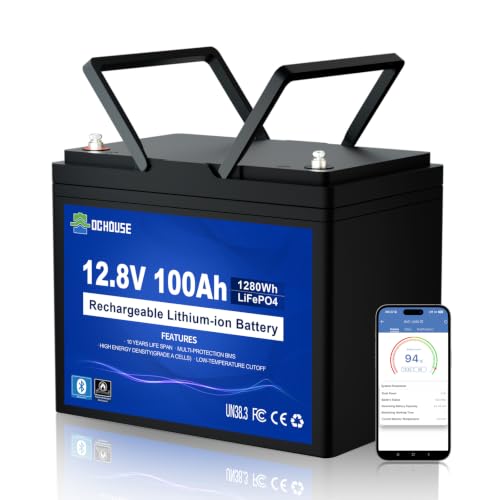
This is a 12.8V, 100Ah lithium iron phosphate battery in a Group 24-sized ABS case, with M8 terminals and a listed weight of about 23 pounds. It is intended as a 12V energy source for trolling motors, RV and boat house loads, and small off-grid solar systems. Its nominal stored energy is 1,280Wh, calculated from the stated 12.8V and 100Ah rating. The manufacturer documentation specifies Bluetooth monitoring, a 100A maximum continuous discharge rating, 100A maximum charging current, and a built-in BMS. It also states that charging is blocked below -7°C and resumes at -2°C, with charge overheat protection at 65°C. These are manufacturer-stated specifications, not independently verified delivered-capacity or abuse-test results. No matching public UL or other NRTL pack-safety listing was located for this particular 12V product.
It suits a technically capable owner building a modest 12V setup who can confirm the trolling motor's maximum current, install a correctly sized fuse close to the battery, select suitable cable, and keep the battery protected from standing water and mechanical damage. It is also a practical format for RV house loads, solar storage, or portable power systems that remain within the manufacturer-stated 100A continuous limit. Cold-weather users should value the stated charge cutoff, while still arranging an appropriate charger and a dry, temperature-managed location.
It is not for anyone who needs a publicly verifiable NRTL safety listing for an insurer, marina, commercial installation, or code-sensitive project. It is also unsuitable for an installation exposed to submersion, persistent spray, severe vibration, or unsupported mounting, because model-specific marine environmental testing was not located. Avoid treating it as a direct replacement for every starting battery or for high-draw inverter and motor applications without calculating continuous current, surge demand, cable voltage drop, fuse protection, and charger settings. It should not be charged when its cell temperature is below the manufacturer-stated cutoff.
The product documentation identifies lithium iron phosphate chemistry and describes BMS functions for overcharge, over-discharge, over-temperature, short-circuit, and low-temperature charging protection. It provides specific temperature thresholds for thermal protection and cold-charge cutoff. However, these protections are manufacturer-stated. No public independent abuse-test report or matching NRTL pack-safety listing was located for this 12V product. For disposal, lithium-ion batteries should not enter household trash or curbside recycling. EPA guidance calls for a separate battery recycler or household hazardous-waste collection point, with terminals protected using nonconductive tape or separate bagging. ECO-WORTHY provides support contact details, but a product-specific U.S. take-back program and an obtainable model-matched UN 38.3 test summary were not located. The chemistry disclosure is clear, while the long-life claim lacks the operating conditions needed to assess its environmental benefit.
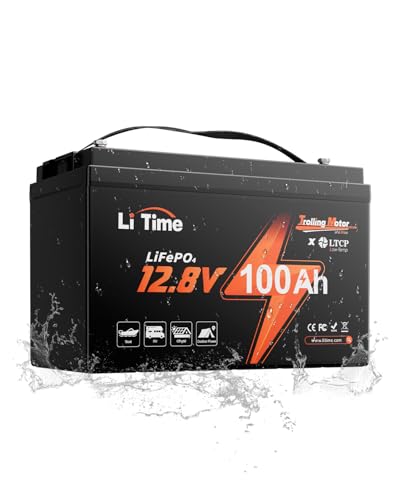
This is a two-battery pack of 12.8V, 100Ah lithium iron phosphate deep-cycle batteries in a Group 31 sized case. Each battery is intended for 12V trolling motors, boat electronics, RV loads, and similar DC systems. LiTime lists each unit at 1,280Wh, 22.2 pounds, with M8 terminals, Bluetooth 5.0 monitoring, and a 100A battery management system. The manufacturer documents a 100A continuous discharge rating, 300A for five seconds, and 500A for one second. It also documents a low-temperature charging cutoff below 32°F, with automatic charge recovery at 41°F or above. These are manufacturer-stated specifications, not independently verified performance results. No publicly accessible, model-specific accredited capacity, voltage-sag, abuse-test, or pack-safety certification report was located during this review.
This product suits a boat owner building a 12V trolling-motor setup within the manufacturer-stated 30 to 70 pound thrust range, who can confirm the motor's current draw stays within 100A continuous discharge. It also fits users who value on-phone status monitoring and need a stated cold-charge lockout for seasonal fishing. The two-pack is most practical where two separate 12V battery positions or a carefully planned series or parallel installation are needed, with matched batteries purchased together and correctly fused cabling.
It is not for anyone who requires documented third-party pack certification for an insurer, marina, commercial vessel, regulated installation, or risk-managed home energy system. It is also unsuitable as a starting battery unless the engine and battery requirements specifically permit it. Avoid using it with a 12V trolling motor or inverter that can exceed the stated 100A continuous limit. Buyers without the ability to install proper fusing, cable sizing, terminal protection, secure mounting, and a compatible LiFePO4 charge profile should use a professionally specified system instead.
The disclosed cell chemistry is lithium iron phosphate, and the manufacturer describes a built-in BMS intended to respond to overcharge, over-discharge, over-current, overheating, and short circuits. It also states the case is IP65 and that charging is disabled below 32°F. Those features can reduce misuse risk, but they remain manufacturer-stated because no public independent abuse-test report, IP test report, or exact-model NRTL pack-safety listing was located. LiTime states the product meets UN 38.3 transport requirements, yet a model-specific test summary was not publicly obtainable. U.S. transport guidance says manufacturers and distributors must make that summary available on request. At end of life, do not place either battery in trash or curbside recycling. Tape or isolate the terminals and use a battery recycler or household hazardous-waste program that accepts this battery size. LiTime publishes general recycling guidance, but no product-specific take-back program was identified.
This is a 12.8V, 100Ah lithium iron phosphate deep-cycle battery in a 23.8-pound Group 24 style case with M8 terminals. It is intended for 12V trolling motors, boats, RV loads and solar systems. The catalog record identifies Bluetooth monitoring, a 100A battery-management system, and low-temperature protection. Manufacturer material for a closely matching 12V 100Ah Bluetooth model states 1,280Wh, 100A continuous charge and discharge, 14.6V charging, and an ABS case. A public copy of the product-specific manual states that charging stops below 32°F and discharge stops below -7.6°F, and lists protections for overcharge, over-discharge, short circuit, over-current and temperature. These are manufacturer-stated specifications, not independently measured results. No model-specific accredited capacity, voltage-sag, vibration, water-ingress, or abuse-test report was located.
It suits a technically capable owner building a modest 12V system for a trolling motor, fish finder, RV auxiliary load, or solar storage, where the motor's documented maximum draw remains within the manufacturer-stated 100A continuous limit. The buyer should be able to select a compatible 14.6V lithium charger, install appropriately sized external overcurrent protection, secure the battery against movement, and monitor operating temperature. It is most appropriate where the battery can be kept dry and charged above freezing.
It is not for a buyer who requires independently verified pack certification, accredited performance testing, or a published marine ingress and vibration rating for insurance, commercial, or high-consequence use. It also does not suit installations that need more than 100A continuous battery output, have undocumented wiring or motor demand, or may charge the battery below 32°F. Avoid using it as an engine-starting battery unless the engine and boat system documentation specifically permits that application.
The chemistry is identified as lithium iron phosphate, a specific and useful disclosure compared with a generic lithium label. The available instructions also state cold-charge cutoff, BMS fault protections, a dedicated lithium-charger requirement, secure mounting, ventilation, and use of external fuses or breakers. Those are practical safeguards, but they are manufacturer statements rather than independently verified safety-test results. The manufacturer materials claim UL and UN 38.3 status, yet no matching public pack-safety listing or model-specific transport test summary was located. U.S. transport rules require lithium battery test summaries to be made available on request. No public recall or regulatory action for this product was located in the searched sources, but absence of a located record is not proof of safety. For disposal, do not put this battery in household trash or curbside recycling. Tape terminals and use a dedicated battery recycler or household hazardous-waste program.
This is a 12.8V, 100Ah lithium iron phosphate deep-cycle battery in a Group 31 sized case for a 12V trolling motor, onboard electronics, RV use, or off-grid storage. LiTime specifies 1,280Wh nominal energy, a 100A continuous discharge limit, M8 terminals, and a roughly 13 by 6.77 by 8.5 inch enclosure. It is not intended to start an engine. The manufacturer documents low-temperature charge cutoff below 32°F, with charging resuming at 41°F, plus an IP65 enclosure claim and a five-year warranty. Those are manufacturer statements, not independently verified pack test results. The exact product was not found in an accessible UL, ETL, or CSA pack-safety listing, and no accredited, model-specific capacity, voltage-sag, or abuse-test report was located.
This product fits a boat, kayak, or small RV owner building a 12V deep-cycle system whose trolling motor stays within the manufacturer's 70 lb thrust and 100A continuous-current limits. It is also suited to a buyer who can install M8 connections correctly, follow the stated terminal torque, use a compatible 14.2V to 14.6V lithium battery charging setup, and protect the battery from conditions beyond its stated enclosure limits. Cold-weather users may value the manufacturer-stated charge cutoff, provided they understand it is not self-heating.
It is not for starting a boat, car, or other engine, because LiTime explicitly identifies it as a deep-cycle battery rather than a starter battery. It also does not suit buyers who require independently verified UL, ETL, or CSA pack certification, an accredited capacity report, or documented vibration and salt-spray testing before putting a lithium battery aboard. Avoid using it with a motor that can exceed its 100A continuous rating, with unknown wiring protection, or where charging may occur below freezing without confirming the cutoff works.
The product uses lithium iron phosphate chemistry, which LiTime identifies in its manual, and its published operating information includes a 32°F low-temperature charging cutoff, temperature ranges, insulating terminal caps, terminal-torque guidance, and instructions for recovering a protection-triggered battery. These are useful safety details, but they remain manufacturer documentation. The verification search did not locate a matching U.S. third-party pack-safety listing, a public model-specific UN38.3 test summary, or an accredited performance or abuse-test report. No matching CPSC recall was located in the searched records. LiTime publishes long cycle-life claims, including 4,000 cycles at full depth of discharge and higher figures at lower depth of discharge, but independent cycle testing for this product was not located. The company identifies the chemistry but does not present a practical U.S. take-back route in the located documentation. At end of life, lithium batteries should not go in household trash or curbside recycling. Tape or isolate terminals and use a qualified battery recycler or local household hazardous-waste program.
This is a 12.8V, 100Ah lithium iron phosphate deep-cycle battery for 12V loads, including trolling motors, RV auxiliary power, solar storage and backup systems. The current manufacturer manual identifies 1,280Wh nominal energy, 100A maximum continuous charge and discharge, 1,280W continuous output, M8 terminals, and a compact 10.24 by 6.61 by 8.46 inch enclosure. The manufacturer supplies unusually detailed operating instructions, including a 0°C to 55°C charging range, a -20°C to 55°C discharge range, compatible charging voltages, low-voltage reconnect settings, cable ampacity guidance, and a warning not to use it for engine starting. Its claimed pack-safety certification and delivered capacity were not independently confirmed through a matching public certification listing or accredited test report.
It suits an informed owner building a protected 12V deep-cycle system with a load at or below the manufacturer-stated 100A continuous limit. Relevant uses include a modest 12V trolling motor, RV house loads, or solar storage where the battery can remain upright, dry, secured, and connected through correctly sized copper cable and a compatible lithium iron phosphate charger. The supplied instructions make it more workable for someone prepared to follow voltage, temperature, terminal-cover, and storage requirements.
It is not suited to engine starting, which the manufacturer expressly prohibits. It is also unsuitable for unprotected deck, bilge, open-transom, or saltwater locations where rain, spray, seawater, or immersion are likely, because the manual directs users to avoid those exposures despite its IP65 statement. Buyers needing independently certified pack safety, independently measured capacity, a documented transport test summary, or a fully substantiated 15,000-cycle service-life claim need evidence not currently supplied for this product.
The documented chemistry is lithium iron phosphate, and the current manual identifies a flame-retardant ABS enclosure. It gives clear warnings about electric shock, short circuits, puncture, overheating, damaged housings, electrolyte exposure, fire sources, and improper charging. It also specifies that charging should occur from 0°C to 55°C, so charging below freezing is outside the stated operating range. The manual says not to place the battery in household trash and to recycle it under local rules. That is useful disposal guidance, but no manufacturer take-back route or model-specific UN 38.3 transport test summary was located. No recall or regulatory action for this product was located in the searched U.S. records. The manufacturer describes the cells as UL tested, but an independently verifiable certification listing for the complete battery was not found.
This is a 25.6V, 100Ah lithium iron phosphate deep-cycle battery for 24V RV, solar, marine and off-grid electrical systems. The published dimensions are about 20.94 by 8.13 by 8.56 inches and the listed weight is about 41.5 pounds. Its stated energy figure is 2,560Wh, with M8 terminals and a 100A battery-management system. These are manufacturer-stated specifications, not independently measured results. The product details state that charging pauses below 32°F and discharging stops below -4°F, with recovery after temperatures rise. They also state that the battery supports up to two in series and four in parallel. The manufacturer publishes a five-year limited warranty and California contact details. No model-specific accredited performance report, public pack-safety certification record, or independently verified marine environmental test was located.
This product fits a buyer building a compact 24V RV, solar, backup or light marine house-power system who can confirm that the connected load remains within the manufacturer-stated 100A BMS limit. It is most appropriate where the buyer has a LiFePO4-compatible charger, can mount and protect a 41.5-pound battery securely, and values the stated cold-weather charging cutoff. It also suits a system designer who wants a single 24V pack rather than wiring two 12V batteries in series.
It is not suited to engine starting, life-support equipment, or any application where a documented independent pack-safety certification is required. Boat owners expecting proven immersion resistance, salt-spray durability or vibration qualification should choose a product with those exact test records. It is also unsuitable for a trolling motor or inverter whose sustained current can exceed the stated 100A BMS rating. Buyers who need verified capacity at a specified discharge rate and temperature need a model-specific lab report.
The disclosed chemistry is lithium iron phosphate, and the manufacturer states that its BMS manages charge, discharge, current and temperature conditions. It also states that charging stops below 32°F and discharging below -4°F. These are useful safeguards if they operate as claimed, but no exact-product certification or independent abuse-test report was found to confirm their performance. The manufacturer provides a five-year limited warranty, support email, phone number and California address. No CPSC recall or public warning matching this brand and product was located in the sources searched, but that is not proof of an absence of risk. A model-specific UN 38.3 transport test summary and battery recycling take-back route were not publicly obtainable. At end of life, lithium batteries should not enter household trash or curbside recycling. Their terminals should be protected and the battery taken to the manufacturer, a specialist recycler or a household hazardous-waste program.
This is a compact 12.8V, 50Ah lithium iron phosphate battery intended for portable 12V power, including camping loads, vehicle accessories, inverters, and 30 to 50 lb thrust trolling motors. The stated energy is 640Wh. It has screw terminals plus an XT60 connection, and the manufacturer states that the XT60 input or output must not exceed 30A. Its defining features are manufacturer-stated Bluetooth 5.1 monitoring and a low-temperature BMS cutoff. The stated cutoff blocks charging below -7°C and discharge below -15.6°C, then resumes above 0°C. A three-year battery warranty and published support contact are available. No exact-product UL, ETL, or CSA pack-safety listing, accredited performance report, enclosure IP test, or publicly obtainable UN 38.3 test summary was located during verification.
This product fits a buyer building a portable 12V power box for modest loads, such as communications equipment, small electronics, campsite charging, or a 30 to 50 lb thrust trolling motor, provided the complete current draw is kept within the documented connector limit. It is also suited to users who value manufacturer-stated app monitoring and who can install an appropriately sized external fuse, cables, and charger. It is most appropriate where the battery can be kept dry, restrained securely, and operated within its stated cold-temperature limits.
It is not well suited to boat owners who need verified water ingress protection, corrosion resistance, vibration qualification, or documented compliance with marine electrical installation practices. It is also unsuitable for users who need independently demonstrated capacity, high continuous-current delivery, or confirmed BMS restart behavior under a demanding motor load. Do not treat it as a drop-in choice for large trolling motors, high-power inverters, golf carts, or 48V systems. Buyers who cannot obtain a product-specific transport test summary or clear installation instructions should avoid shipping or modifying it themselves.
The chemistry is identified as lithium iron phosphate, often written LiFePO4, rather than an unspecified lithium battery chemistry. The manufacturer also provides specific low-temperature cutoff claims, which are more useful than a general cold-weather claim, but those protections were not independently tested for this exact product. Public verification did not locate an exact-product UL, ETL, or CSA safety listing, nor an accredited report confirming usable capacity, abuse protection, or cycle life. The brand publishes support contact details and a three-year LFP battery warranty. No product-specific recall, CPSC warning, or public incident record was located in the sources checked. A product-specific UN 38.3 test summary was not obtainable, even though U.S. transport guidance requires such summaries for lithium battery designs. At end of life, do not place this battery in household trash or curbside recycling. EPA recommends isolating terminals and using a specialist battery recycler or household hazardous-waste program.
This is a compact 12.8V, 50Ah lithium iron phosphate battery intended for a 12V trolling motor, fish finder, or similar low-voltage boat electronics. LiTime lists 640Wh of nominal energy, 11.27 pounds of weight, Bluetooth status monitoring, M8 terminals, and a 7.68 by 6.54 by 6.77 inch ABS case. These are manufacturer-stated specifications, not independently measured results. Its supplied manual gives relatively concrete operating limits, including 50A continuous discharge, 60A for 30 minutes, 250A for one second, and a recommended 10A charge current. It also states that the battery stops charging below 32°F and resumes at 41°F. No matching UL, ETL, or CSA pack-safety listing, accredited capacity test, or model-specific marine vibration report was located.
This product fits a boater or kayak angler who has a 12V trolling motor within the stated 70-pound-thrust limit, or who needs a compact dedicated battery for electronics such as a fish finder. It is most appropriate when the buyer can match the motor's actual current draw to the documented 50A continuous limit, use a compatible LiFePO4 charger, secure the terminals to the specified torque, and value phone-based status checks. Cold-weather users may also value the stated charge cutoff.
It is not suited to engine starting, high-surge electric outboards, or any motor whose sustained current demand exceeds the stated 50A continuous rating. It is also unsuitable for buyers who require a publicly verifiable NRTL pack-safety listing, independent capacity testing, or documented marine vibration and immersion testing. Avoid it where the battery might be submerged, mounted with the terminals facing downward, installed without correct overcurrent protection, or charged below freezing without relying on its cutoff protection.
LiTime identifies this product as lithium iron phosphate chemistry in an ABS enclosure. Its manual states a 32°F low-temperature charge cutoff, a 41°F charge-restart point, stated discharge and storage temperature ranges, terminal-torque guidance, and instructions to stop use if an insulating cap melts. Those are useful operating details, but they are manufacturer documentation rather than independent safety-test evidence. LiTime lists FCC, CE, RoHS, and UN38.3 among its claims, but no matching U.S. NRTL pack listing or product-specific UN38.3 test summary was located. Searches did not surface a CPSC recall or safety warning for this product. LiTime documents serial-number traceability and a five-year limited warranty, but no brand take-back program was located. At end of life, keep terminals insulated and use a battery recycler or household hazardous-waste program, not household trash or curbside recycling.
This is a hard-wired, two-bank onboard charger and maintainer for two separate 12V batteries. It supplies up to 10A total, split as 5A per bank, and has selectable 12V, AGM, lithium, repair, and force modes. It is intended for boat starter, deep-cycle, and trolling-motor battery systems, not a lithium trolling-motor battery itself. NOCO documents IP68 housing protection, isolated banks, a stated operating range of -20°C to 40°C, and a lithium profile rated 14.6V at 5A. The manual explicitly limits lithium mode to batteries with a built-in battery-management system. Its own instructions also warn that Force Mode disables safety features for five minutes and can expose live connector power. An ETL mark appears in NOCO documentation, but an exact public directory record and applicable standard were not independently confirmed in this review.
This fits a boat owner who already has two separate 12V battery banks, such as a starter battery plus one trolling-motor or house battery, and needs permanently mounted shore-power charging. It is most appropriate where each battery accepts a 5A charge rate and the lithium battery maker confirms compatibility with a 14.6V lithium charger profile. The user should be able to select the right mode, follow fixed-installation wiring guidance, and keep the charger within its stated ambient-temperature range.
It does not suit someone seeking a lithium trolling-motor battery, because this product stores no energy and cannot provide motor runtime or discharge current. It is also unsuitable for a 24V or 36V trolling-motor battery system unless that system is made from separately charged 12V batteries and the battery manufacturer permits this arrangement. Avoid using lithium mode with batteries lacking a built-in battery-management system. People who need independently published charging-performance data or a publicly matched certification listing should seek that documentation before installation.
The main safety-positive evidence is documentary rather than independent performance testing. NOCO's manual gives voltage, current, chemistry, temperature, fault-indicator, connection, and emergency-risk information. It specifically tells users to confirm the battery maker's charging limits and limits lithium mode to batteries with a built-in battery-management system. The manual also warns that Force Mode can create a spark, fire, explosion, injury, or death risk if used incorrectly. This charger is not a battery, so battery-pack certification, UN 38.3 transport summaries, cell chemistry disclosure, capacity testing, and battery recycling programs do not apply to the unit itself. No product-specific recall was identified in the CPSC recall search reviewed. The manual includes a California Proposition 65 warning concerning possible exposure to lead and exhaust fumes. NOCO's documentation shows an ETL mark, but this review did not independently match the exact product to a public listing record or test standard. No end-of-life take-back or environmental-material declaration for the charger was found.
This is a 12 V, 100 Ah lithium iron phosphate deep-cycle battery in a compact Group 24 format. The published instructions list 1,280 Wh, dimensions of 10.2 by 6.6 by 8.2 inches, a built-in 100 A battery management system, M8 terminal hardware, Bluetooth monitoring, and support for up to four batteries in series and four in parallel. It is marketed for RV, solar, backup, boat, and trolling-motor use. The accessible instructions state a 100 A continuous discharge limit, low-temperature charge protection below 32°F, an IP67 enclosure claim, and up to 15,000 cycles at 60 percent depth of discharge. Those are manufacturer-stated specifications, not independently confirmed test results. Verification did not locate an exact-product UL, ETL, or CSA pack-safety listing, an accredited capacity or load-test report, or a product-specific UN 38.3 test summary available to buyers.
This product suits a technically capable RV, solar, or small-boat owner who needs a compact 12 V battery in a Group 24 space and can design the installation around a stated 100 A continuous limit. It is most appropriate where the owner already has a compatible lithium iron phosphate charger, correctly sized overcurrent protection and cables, secure mounting, and a way to monitor temperature and state through Bluetooth. The buyer should treat the published specifications as manufacturer-stated rather than independently verified performance.
It is not suited to buyers who require third-party certified battery-pack safety for an insurer, commercial vessel, regulated installation, or risk-sensitive household backup system. It also is not suitable for a trolling motor or inverter setup whose sustained draw, startup surge, wiring, fuse, or charger requirements have not been calculated from the motor and system manuals. Avoid charging below freezing unless the stated cutoff has been checked in the installed system. Do not rely on the enclosure claim for submersion or unverified harsh-marine duty.
The product is identified in accessible instructions as lithium iron phosphate, a rechargeable lithium-ion chemistry. Its published safety features include protection claims for overcharge, over-discharge, over-current, short circuit, overheating, and low-temperature charging. The instructions also say to use a charger designed for lithium iron phosphate batteries, inspect terminals for corrosion or looseness, and keep the battery in a cool, dry place during storage. Independent verification did not locate an exact-product NRTL pack-safety listing, accredited abuse-test report, or accessible transport test summary. No product-specific recall or regulatory action was located in the public U.S. searches performed. The seller's published material did not reveal a take-back program or recycler pathway. At end of life, keep terminals insulated and use a specialized battery recycler or household hazardous-waste program, never household trash or curbside recycling.


