Best Overall

Rhino USA Retractable Ratchet Tie Down Straps
Easy auto-retract feature for quick storage.
Padded handles enhance comfort during use.
High 1,209lb break strength for reliability.
 Daniel Kenitz
Easy auto-retract feature for quick storage.
Padded handles enhance comfort during use.
High 1,209lb break strength for reliability.

Padded handles provide extra comfort and grip.
Auto-retract feature simplifies strap storage.
High break strength ensures secure load holding.

Auto-retraction feature for effortless use.
High 1,800lb break strength ensures security.
Fluorescent color enhances visibility and safety.
Convenient auto-retract feature for easy storage.
Durable design ensures secure load transportation.
Quick setup with self-contained ratchet mechanism.

Convenient self-retracting feature for easy storage.
High break strength ensures secure transport.
Ideal for various vehicles and cargo types.

Seamless integration with Ford BoxLink system.
360° swivel for versatile tie-down options.
Heavy-duty construction for reliable cargo security.

Auto retracting feature simplifies tie-down process.
High 1,200lb break strength ensures reliability.
Versatile use for trucks, trailers, and motorcycles.

Easy one-handed operation for quick securing.
Durable construction ensures long-lasting reliability.
Self-retracting feature prevents strap tangling.

UPGRADED STAINLESS‑STEEL RETRACT MECHANISM: Most other models use standard iron springs, which are prone to rust, jamming, or poor retraction. Our straps feature stainless steel spring assemblies that are waterproof and rust-resistant, specifically designed to provide reliable and durable automatic retraction.
ONE‑CLICK AUTO‑RETRACT DESIGN: Retractable ratchet straps feature one‑button auto‑reel function to pull excess webbing back automatically. No manual rolling, tangled straps or flapping loose ends at highway speeds. Keep your truck bed, trailer and toolbox tidy after every hauling task, and cut down prep‑and‑pack time versus traditional non‑retractable tie‑down straps.
COMPLETE PREMIUM KIT: 4 retractable ratchet straps (12 ft x 1 in), 1 carrying handbag, 4 figure-eight soft loop straps, 3 hanging air fresheners (Vanilla, Ocean, Black Ice), 1 user manual, 1 after-sales service card. Our dedicated after-sales team is available 24/7 to assist you with any inquiries or technical support you may need.

Easy and quick self-retracting mechanism.
Durable with 1500lb break strength.
Convenient two-pack for multiple uses.
The first number to find is the **working load limit (WLL)** for the complete strap assembly. A breaking-strength figure describes ultimate failure strength, not the amount the strap should routinely restrain. In the supplied products, advertised break strengths range from 1,200 to 5,208 pounds, while stated working limits range from 400 to 1,736 pounds; some listings present the larger number as “load capacity,” and one does not clearly identify whether its 1,500-pound figure is a WLL or break strength. Plan from the lower, explicitly stated working limit and from the lowest-rated hook, ratchet, stitching, webbing, or anchor point.
A credible product should also identify the maker, rated capacity, warnings, and relevant traceability information on a durable, permanent label. For cargo securement, check the physical assembly rather than relying only on an online title or package headline. The product should not be presented as lifting, towing, recovery, or fall-protection equipment unless it has separate ratings and instructions for those uses. Vehicle, trailer, rack, and E-track anchors must be rated and compatible; a strong strap cannot compensate for a weak or damaged anchor.
Independent evidence is another important separator. A meaningful report would test the complete, exact configuration—not just loose webbing—and identify the laboratory, method, samples, results, and applicable ISO/IEC 17025 accreditation scope. Relevant methods include WSTDA-T-1 for synthetic web tie-downs and WSTDA-TM-1 for webbing strength and elongation. A seller’s statement that a product is “DOT approved,” “heavy duty,” or tested for thousands of cycles is not equivalent to a publicly available, model-specific report. The same distinction applies to claims of corrosion, UV, abrasion, or weather resistance.
For the retracting mechanism, look for clear instructions covering tension release, rewind, pinch points, snap-back, hook engagement, inspection, and retirement. Safe operation depends on the full ratchet and rewind system, not merely on the presence of a button. Chemical and environmental claims also need detail: material declarations or safety data, named coatings and finishes, and accredited chemical testing are more useful than unexplained warnings or broad “environmentally friendly” language. Recycled content, reduced packaging, repair or replacement parts, warranty support, and life-cycle claims should be documented rather than assumed from a retracting design.
Across the supplied reviews, no product had a public model-specific independent report covering complete-assembly strength and retracting-cycle performance. Permanent capacity and warning markings, detailed inspection and retirement criteria, and complete anchor compatibility were also commonly unverified. Several products carried California chemical warnings or had incomplete chemical disclosure. The supplied products are not appropriate for lifting, towing, recovery, fall protection, suspended loads, or use with unknown, damaged, or unrated anchors; heavy, sharp-edged, commercial, or high-consequence loads require stronger documentation and an appropriate complete securement plan.
The topics below distinguish a convenient retracting feature from evidence that the complete cargo-securement system is appropriately rated, transparent about materials, and supported through its service life.
This measures whether the complete tie-down is appropriately rated, configured, and warned so cargo is less likely to shift or release. For retractable straps, the WLL, hook engagement, stitching, ratchet, anchor, and tie-down arrangement all matter. Supplied scores were generally moderate to good, with higher results around 74–76; lower results reflected unclear ratings, missing warnings, or unverified anchor compatibility.
This measures whether rewind, ratchet, release, and lock functions limit accidental release, uncontrolled snap-back, strap jams, and pinch hazards. A higher result requires credible loaded-operation or endurance evidence plus clear instructions and warnings. Supplied products scored about 69–72: the listings commonly describe button-operated retraction, but none supplied a public model-specific cycle or loaded-release report.
This measures disclosure and control of chemicals in webbing, coatings, hooks, hardware, and packaging. For a strap handled during loading, named materials, safety information, and current accredited chemical testing are more useful than a warning without context. Scores ranged roughly from 48 to 70. The lowest results involved DEHP or Proposition 65 concerns without identifying the component, concentration, or exposure route.
This measures whether the complete assembly states a usable WLL—not only breaking strength—and permanently identifies capacity, maker, and warnings. It is weighted more heavily because it directly affects load planning. Higher-scoring products published distinct WLL figures, often around 74–78; lower results reflected break-strength-led listings or no proof that the physical strap carries a permanent, consistent label.
This measures whether an independent competent laboratory tested the actual complete assembly for strength and relevant durability, with method, samples, results, and laboratory identity. It is also weighted heavily. Scores clustered around 68–70 because the supplied reviews found no public model-specific ISO/IEC 17025 report for complete assembly strength, retracting endurance, corrosion, or weathering—even where sellers claimed testing.
This measures whether hooks, ratchet, webbing, stitching, mounting hardware, and vehicle anchors are compatible and rated as one system. A strong webbing headline is not enough if an S-hook or anchor is weaker. Scores were approximately 68–73. Better-scoring products included soft loops or clearer configurations, but all still required the buyer to verify the vehicle or trailer anchor and the weakest component.
This measures evidence that webbing, stitching, hooks, and ratchet parts withstand abrasion, cuts, UV, moisture, and corrosion, along with clear discard criteria. Supplied scores were about 69–74. Products often named polyester, coated hooks, zinc plating, or anodized hardware, but the reviews generally found no product-specific abrasion, UV, corrosion, or weathering report and no detailed retirement guidance.
This measures whether “heavy duty,” self-retracting, vehicle, safety, and regulatory claims match the evidence and clearly separate WLL from breaking strength. Scores ranged from 52 to 76. Higher results used a distinct usable rating; lower results involved break strength presented as capacity, inconsistent dimensions, unsupported “DOT approved” or standards language, or missing exclusions for lifting, towing, and fall protection.
This measures whether a buyer can identify the responsible maker or importer, lot or date information, contact route, warranty, and corrective-action path. Scores ranged roughly from 69–76. Lifetime or multi-year warranties and published support contacts improved results, but permanent lot coding, assembly identification, repair routes, and fully usable return or recall processes were often not demonstrated.
This measures whether construction, warranty, repairability, replacement parts, corrosion and UV resistance, and packaging practices could reduce waste without weakening safety. A retracting housing may reduce loose-tail damage, but it does not prove longer life. Supplied scores were mostly 68–74 because warranties were sometimes documented, while repair programs, recycled content, packaging reductions, and life-cycle evidence were generally absent.
This measures whether the seller identifies webbing polymers, metal finishes, coatings, and disposal-relevant substances well enough for buyers to avoid unnecessary hazardous or difficult-to-manage materials. Higher-scoring products named broad materials such as polyester, nylon, steel, or alloy steel; lower-scoring products left coatings, additives, finishes, and packaging unexplained. Scores ranged about 53–71, and none had complete test-supported disclosure.
This is a four-pack of 1-inch by 10-foot retractable ratchet tie-downs for securing cargo such as motorcycles, ATVs, UTVs, and general trailer or truck-bed loads. Each strap uses polyester webbing, a steel S-hook arrangement, a ratchet housing, and a button-operated rewind system intended to contain unused webbing rather than leave a loose tail. Rhino USA states a 403 lb working load limit and 1,209 lb break strength per strap. Those figures are also published by Costco and Lowe's, which supports consistency of the retail specification but is not a substitute for a disclosed independent test report. The product is stated to have coated S-hooks with keeper clips, an anodized ratchet, padded handle, and lifetime warranty. No complete assembly endurance report, permanent-label evidence, or detailed anchor compatibility document was located.
This product suits a consumer securing moderate loads in a pickup bed, utility trailer, cargo trailer, or recreational vehicle setup, where 10-foot straps and a 403 lb working load limit per strap fit the planned securement arrangement. It is particularly relevant for users who value contained excess webbing and can inspect each strap before use. The user should know the cargo weight, use appropriately rated anchors, and account for the required number and geometry of tiedowns rather than treating four straps as one combined rating.
It is not for lifting, towing, recovery, fall protection, or any task where the load path and safety factor require purpose-built rated equipment. It is also unsuitable for buyers who need a disclosed accredited-laboratory test report, verified corrosion or UV endurance results, documented permanent markings, or complete chemical disclosure. Avoid using it where anchors are unmarked or questionable, where sharp edges can cut webbing, or where a 10-foot strap cannot provide an appropriate tie-down angle and routing.
The central health finding is the manufacturer’s California Proposition 65 warning for DEHP. California lists DEHP for cancer and reproductive toxicity, but the warning alone does not establish a user’s actual exposure or identify which product component contains it. Rhino USA provides no material declaration, safety data sheet, chemical test report, or exposure estimate that would resolve those questions. Polyester webbing and steel hardware are identified by retailers, while the manufacturer describes an anodized ratchet and coated hooks. Those details may support ordinary outdoor service, but no independent abrasion, UV, corrosion, or complete-mechanism endurance report was found. The published lifetime warranty can extend service life through replacement support, yet there is no documented recycled content, repair-part program, packaging reduction plan, or disposal guidance. No relevant CPSC recall was located in the search performed.
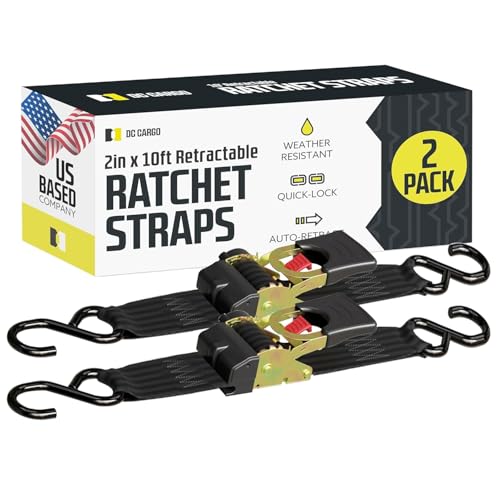
This product is a two-pack of 2-inch by 10-foot retractable ratchet tie-downs with coated full-bend S-hooks. It is intended to secure cargo on trucks, trailers, motorcycles, and off-road equipment. The catalog identifies polyester webbing. Rhino USA states that each strap has a 1,011 lb working load limit and 3,033 lb minimum break strength, which appropriately separates the everyday load rating from break strength. The defining convenience feature is the manufacturer-stated push-button self-retracting webbing system, intended to contain loose strap after use. Rhino USA also states that the ratchet is anodized and the hooks are coated. No model-specific independent laboratory report, WSTDA conformity record, or publicly available test results for the complete assembly were located in this review.
This product fits a homeowner, rider, or recreational equipment owner securing ordinary cargo with suitable rated vehicle or trailer anchors. Its 10-foot length and retracting webbing are practical where managing loose strap tails matters, such as repeated loading of motorcycles, UTV gear, furniture, or boxed cargo. The buyer should plan around the manufacturer-stated 1,011 lb working load limit per strap, inspect webbing and hardware before each trip, and understand the anchor ratings and tie-down arrangement.
It is not suited to lifting, towing, recovery, fall protection, or any use where a tie-down is not the correct equipment. It is also a poor fit for users who require a publicly available accredited-laboratory report, verified permanent marking, detailed chemical disclosure, or documented long-term retracting-mechanism endurance. Do not rely on it alone for a load that needs a higher calculated aggregate working load limit, specialized vehicle wheel restraint, or anchors whose rating and compatibility are unknown.
The central health disclosure is Rhino USA’s California Proposition 65 warning for DEHP. California lists DEHP for cancer and reproductive toxicity. The warning is more transparent than silence, but it does not establish how much DEHP is present, where it occurs, how exposure may happen, or whether normal handling reaches a meaningful dose. No safety data sheet, full material declaration, or accredited chemical test report was located. The catalog identifies polyester webbing, while Rhino USA describes coated hooks and an anodized ratchet. These constructions may support ordinary outdoor service, but the company does not publish product-specific UV, abrasion, corrosion, recycled-content, packaging, repair-part, or life-cycle documentation. A stated unlimited lifetime warranty may extend service life through support or replacement, although repairability of the retracting mechanism is not documented. No CPSC recall specific to this product was located in the review search.
This is a four-pack of bolt-on, self-retracting ratchet tie-downs with 1-inch-wide, 13-foot polyester webbing, steel hardware, hooks, and a storage bag. It is intended to secure cargo such as motorcycles, ATVs, trailers, boats, and general equipment. The retailer information corroborates the basic 1-inch by 13-foot format and identifies polyester webbing, while the supplied product record identifies alloy-steel hardware. The product record states a 600-pound load capacity and 1,800-pound tensile strength per strap. Other listings describe 1,800 pounds as break strength, which is not the same as a working load limit. The seller also states that the mechanism retracts slowly and that zinc-coated hardware resists weather, but no model-specific independent strength, cycle, corrosion, or retraction-safety report was located. Permanent product marking, anchor limits, and the full operating instructions could not be independently confirmed.
This product suits a recreational user securing relatively light equipment who wants four compact, 13-foot straps with webbing that stores inside the ratchet body. It is most appropriate where the user can inspect every strap before use, use known load-rated anchors, protect webbing from sharp edges, and keep the actual load forces below the stated 600-pound working-load figure. The buyer should treat the supplied instruction manual and any permanent product label as essential safety documents, not rely only on retailer claims.
It is not suited to commercial or high-consequence transport where documented, assembly-specific testing, durable traceability, confirmed marking, and defined anchor compatibility are required. It is also unsuitable for lifting, towing, personal fall protection, or any use that depends on a tested release mechanism or stated resistance to salt, ultraviolet exposure, abrasion, and long service intervals. Do not use it on unknown, damaged, improvised, or unrated vehicle and trailer anchors, because the published rating does not establish the capacity of the complete installed system.
No LynxHold recall or safety warning for these straps was identified in the CPSC recall search performed, but the absence of a located recall is not independent evidence that the assembly is tested or free of defects. Federal cargo-securement guidance treats the working load limit of a tie-down as the lowest limit among its webbing, tensioner, connectors, and anchor points. That makes verified mounting and anchor ratings important for this bolt-on format. Available information identifies polyester webbing and steel hardware, with a manufacturer-stated zinc coating. Polyester can support a long service life when inspected and protected from cuts, abrasion, sunlight, and contamination, but no model-specific weathering, corrosion, or retirement criteria were located. There is also no located chemical declaration, safety data sheet, accredited chemical test, recycled-content evidence, packaging disclosure, repair program, or replacement-parts path. California maintains a current list of chemicals requiring Proposition 65 consideration, but no product-specific exposure assessment or warning documentation was located.
This product is a two-pack of 2-inch-wide, 10-foot self-retracting ratchet tie-downs with polyester webbing, steel S-hooks, and PE rubber-coated steel hardware. It is intended to restrain cargo on trucks, trailers, vans, boats, and similar anchor-equipped equipment. The user hooks both ends to suitable anchor points, pulls out the needed webbing, uses the red control to collect slack, then ratchets it tight. The manufacturer lists a 1,100-pound working load limit and 3,300-pound assembly break strength per 10-foot strap. Lowe's independently publishes the same working load limit, length, material, hook type, and break-strength figure. The product page also carries a California Proposition 65 warning, but it does not identify the chemical or provide a material declaration or exposure test report. No model-specific independent mechanical test report was located in the reviewed public sources.
This product suits a recreational hauler or homeowner securing ordinary equipment, furniture, yard machines, or boat-related cargo where 10 feet of reach and S-hooks fit known, structural anchor points. It is most appropriate for someone who can determine the actual tie-down geometry, protect the webbing from edges, use enough securement points for the load, and keep each strap at or below its stated 1,100-pound working load limit. The retracting format is practical when loose excess webbing would otherwise be inconvenient.
It is not suited to lifting, towing, recovery, fall protection, or any job where a tie-down must have a specifically verified certification or independently published endurance testing. It is also a poor fit for commercial or high-consequence cargo work when the buyer cannot verify permanent markings, anchor ratings, inspection criteria, and the complete securement plan on the physical product. Avoid using it with sharp, unprotected edges, questionable anchors, incompatible hook points, or loads whose movement cannot be controlled by the available strap angles and quantity.
The key health issue is the manufacturer-posted California Proposition 65 warning. It states that the product can expose users to chemicals associated with cancer, birth defects, or other reproductive harm, but it does not identify the chemical, component, route of exposure, or exposure level. California guidance explains that businesses determine the basis for their own warnings, so the warning alone does not establish the amount of exposure. No product-specific chemical test report or safety data sheet was located. Material disclosure is partial. The manufacturer identifies polyester webbing and PE rubber-coated steel hardware, while an independent retailer identifies polyester webbing and steel hook and handle materials. That supports basic disposal and maintenance awareness, but not a full accounting of coatings, dyes, additives, packaging, recycled content, or repair parts. The listed limited lifetime warranty may support a longer service life, but no repair program, replacement-component documentation, life-cycle assessment, or verified recycled-content claim was found. No CPSC recall or regulatory action for this product was located in the reviewed public sources.
This product is a four-pack of 1-inch by 10-foot retractable ratchet tie-downs for securing cargo on trucks, trailers, motorcycles, ATVs, and UTVs. Each strap uses an S-hook arrangement, and the set includes four 17-inch soft loops plus a storage bag. It is intended for cargo restraint, not as lifting equipment. The product listing states a 550-pound safe working load and 1,650-pound break strength per strap, with polyester webbing and a zinc-plated carbon-steel ratchet. It also states that spring-loaded hook clips help retain the hooks at anchor points and that a latch retracts excess webbing. Those are manufacturer-provided claims, not independently verified test results. The listing provides no model-specific third-party strength, cyclic mechanism, corrosion, UV, abrasion, or chemical test report, and no visible evidence confirming permanent on-product load and warning labels.
This set suits a household user securing relatively light, noncommercial cargo where four compact 10-foot straps are useful, such as a motorcycle, lawn equipment, bins, or gear in a truck bed or utility trailer. The stated 550-pound safe working load per strap should be treated as a manufacturer claim and used only after confirming that the vehicle anchors, cargo contact points, tie-down geometry, and number of straps are appropriate. It is most practical for users who value contained webbing and can inspect every component before each trip.
It is not suited to lifting, towing, recovery, personal fall protection, or securing loads where an independently documented assembly rating, permanent marking, lot traceability, and formal inspection criteria are required. Commercial operators subject to cargo-securement rules should not rely on the listing alone, because the available evidence does not confirm permanent working-load labels or the rating of every component and anchor interface. It is also unsuitable for damaged, sharp-edged, abrasive, or weather-exposed loads unless suitable edge protection and regular inspection are used.
The available listing identifies polyester webbing, carbon-steel hardware, zinc plating on the ratchet, rubber-coated S-hooks, and a two-year manufacturer warranty. Zinc plating may support corrosion resistance, and a warranty can reduce premature replacement, but neither claim is backed here by corrosion, UV, abrasion, cyclic-use, or repairability documentation. No recycled-content, minimal-packaging, replacement-parts, life-cycle, or disposal information was located. No product-specific accredited chemical test report, safety data sheet, or detailed material declaration was located. That means the listing does not establish the chemical content of coatings, rubber hook covers, webbing dyes, or packaging. No Lamwerol-specific recall was located in the CPSC recall search reviewed, but that is not evidence of testing or freedom from hazards. Users should keep hands clear during rewind, inspect webbing, stitching, hooks, and ratchets before use, protect straps from sharp edges, and retire any damaged tie-down.
This is a two-piece, bed-mounted tie-down system with 1-inch by 9-foot retractable ratchet straps for Ford F-150 trucks from 2015 onward and F-250 trucks from 2017 onward, when equipped with factory BoxLink mounting points. It is intended to secure cargo in the truck bed, using bolt-on mounts, swivel ratchets, and webbing that rewinds into each housing. Rhino USA states that it installs without drilling, swivels 360 degrees, and can be removed between uses. A separate retailer listing identifies a 1,209-pound breaking-strength claim, but neither the manufacturer page nor the reviewed listing provides a numeric working load limit for this exact configuration. Ford documentation confirms that BoxLink cleats have direction-specific force limits, 275 pounds between opposing cleats and 600 pounds diagonally, so cargo arrangement and the truck's own anchor limits remain central to safe use.
This product suits an owner of a 2015 or newer F-150, or a 2017 or newer F-250, that has factory BoxLink mounting points and regularly secures moderate truck-bed cargo such as tools, camping equipment, lumber, or recreational gear. It is most relevant where tidy storage and fast setup matter, because the manufacturer states that the webbing retracts and the assemblies can be removed. The user still needs to check the vehicle manual for the applicable BoxLink anchor direction and force limit.
It is not suited to trucks without the specified factory BoxLink mounting points, nor to users who need an independently documented assembly rating for commercial cargo securement. It also is not the right setup for lifting, towing, fall protection, or any use where a published working load limit, permanent capacity marking, and validated hardware rating are required. Households seeking to avoid phthalate-related exposure should note the disclosed DEHP warning and seek component-specific chemical information before handling or storing it in enclosed spaces.
Rhino USA identifies the webbing as nylon and the hardware as carbon steel through retailer product information, while its own product page confirms a removable, bed-mounted format and lifetime replacement coverage. Removing and storing the units when unused could reduce weather exposure and potentially extend service life, but no recycled-content, packaging, repair-part, corrosion-test, UV-test, or life-cycle documentation was located for this configuration. The manufacturer displays a California Proposition 65 warning for di(2-ethylhexyl) phthalate, or DEHP. California identifies DEHP as a chemical listed for cancer and developmental and male reproductive toxicity. The warning provides useful disclosure, but it does not state which component contains DEHP, how much is present, the exposure route, or whether the product has been chemically tested. No product-specific CPSC recall or independent mechanical test report was located during verification.
This product is a two-pack of 1 inch by 10 foot self-retracting ratchet tie-downs for cargo on trailers, truck beds, roof racks, motorcycles, ATVs, and similar light-duty hauling setups. An independent retail listing identifies coated S-hooks, two soft loops, a storage bag, a stated 500 pound working load limit per strap, and 1,500 pound break strength. RETRUE states that the internal mechanism stores excess webbing and provides quick tightening and release. That is a useful handling claim, but it is manufacturer-stated. No model-specific independent laboratory report, endurance testing, operating manual for these straps, or evidence of permanent capacity and warning labels was located. The stated 500 pound working limit is more decision-useful than the break-strength headline, but buyers should confirm the label on the received assembly and use only rated anchor points.
This product suits a homeowner, recreational rider, or occasional trailer user securing relatively light, non-commercial cargo who can work within the stated 500 pound working load limit for each strap. It is especially relevant when 10-foot straps and a compact self-retracting format help keep spare webbing out of the way. The buyer should inspect the received labels, use suitably rated vehicle and cargo anchors, protect webbing from sharp edges, and avoid relying on the straps as the only restraint for cargo that can roll or shift.
It is not suited to buyers who need documented compliance evidence for commercial cargo operations, jobsite procedures, fleet use, or a safety-critical securement plan. Choose a product with accessible model-specific test records, durable working-load labels, detailed inspection instructions, and clear retirement criteria for those settings. It is also not appropriate for lifting, towing, vehicle recovery, personal restraint, or fall protection. Do not use it where the anchor point is unrated, the webbing contacts sharp edges without protection, or the load exceeds the stated system capacity.
The main safety positive is that a separate retail listing gives this product a 500 pound working load limit per strap and a 1,500 pound break strength. That 3 to 1 relationship aligns with the design factor commonly used for new synthetic web tie-downs. The product page also describes self-retraction, but no independent evidence was found for loaded release behavior, spring endurance, pinch protection, or resistance to accidental opening. Published chemical and environmental information is limited. An independent retailer identifies alloy-steel hardware, while publicly available product materials do not provide a complete webbing, coating, finish, or packaging declaration. No chemical test report, Proposition 65 warning, recycled-content claim, repair-parts program, or life-cycle documentation was located. RETRUE does publish a defect-support process, although its warranty excludes normal wear, corrosion, extreme weather, and overload damage. No product-specific CPSC recall was identified in the review search.
This product is a four-pack of 1-inch by 10-foot retractable ratchet tie-down straps for securing ordinary cargo on vehicles, trailers, racks, motorcycles, ATVs, and similar equipment. Each unit uses a ratchet tensioner, a self-retracting webbing housing, and S-hooks for attachment. The product page states a 550-pound working load limit and 1,650-pound breaking strength. A separate reseller presents the same size, four-pack format, capacity figures, retracting mechanism, and S-hooks, but this is corroboration of retail specifications, not independent strength testing. The listing distinguishes working load from breaking strength, which is important. It does not provide a test report, confirm a permanent rating tag on the actual assembly, identify rated anchor compatibility, or publish loaded-operation instructions for the retraction and release mechanism.
This format suits a driver, camper, homeowner, or recreational vehicle user securing routine gear such as luggage, boxed equipment, a kayak, or lighter motorcycle accessories, where four separate 10-foot straps help create a balanced restraint plan. It is most appropriate for buyers who can inspect the webbing, stitching, hooks, ratchet, and vehicle anchor points before every use, and who will treat the published 550-pound figure as a manufacturer-stated working-load limit rather than an independently verified system rating.
It is not suited to lifting, towing, fall protection, recovery, or any use where failure could expose people to severe injury. It is also a poor fit for commercial securement, high-value loads, heavy machinery, or loads requiring documented compliance, because no model-specific third-party test report, permanent-label confirmation, or component-by-component rating was found. Buyers needing outdoor long-term deployment should seek documented corrosion, UV, abrasion, and mechanism-cycle evidence. Do not rely on these straps where anchor ratings are unknown or damaged.
No matching recall or product safety warning for this brand was located in the searched CPSC recall resources. That search result is not proof that the product is defect-free. The listing states a working load limit and breaking strength, but no accessible instruction manual or permanent-label image confirmed inspection, retirement, loaded release, pinch, snap-back, lifting, or towing warnings. Safe use therefore depends heavily on the user inspecting the whole tie-down and choosing anchors that are adequately rated. Material and chemical transparency is limited. The retail page identifies alloy-steel hardware but does not identify webbing polymer, metal finish, coatings, plastic housing composition, packaging, or any chemical test report. No specific Proposition 65 exposure warning was found on the product page. There is also no documented recycled content, minimal-packaging claim, repair program, spare-part program, warranty evidence, or life-cycle assessment. Durable use should mean retiring the product if webbing, stitching, hooks, or ratchet parts show damage.
This product is a two-pack of 1 inch by 10 foot self-retracting ratchet straps for holding cargo on vehicles, trailers, roof racks, and similar anchors. Each strap uses an S-hook and ratchet tensioner, with webbing intended to wind back into the mechanism after use. The product page identifies polyester webbing and zinc-plated hardware, while its material field is not a usable composition declaration. The stated 1,500 pound figure is breaking strength, not a published working load limit. That distinction matters because a tie-down system is limited by its weakest part and by the anchor point. The seller also claims auto-retraction, rubber-coated handles, galvanized S-hooks, and corrosion resistance. No model-specific independent laboratory report, permanent-label photo, operating manual, or documented loaded-cycle test was located during verification.
This product suits a buyer securing light, noncritical household or recreational cargo who values a compact 10-foot strap that is claimed to rewind after use. It is most appropriate where the buyer can inspect the webbing, hooks, ratchet, and vehicle anchors before every trip, can use more than one restraint where needed, and can avoid sharp load edges. The two-piece package can be useful when separate anchor points are available. Its stated 12-month warranty may also matter to buyers who retain purchase records and packaging.
It is not suited to commercial motor-vehicle cargo securement, heavy machinery, or any use that needs a documented working load limit and traceable assembly label. It also is not appropriate for lifting, towing, recovery, personal fall protection, or holding a load above people. Buyers transporting motorcycles, ATVs, boats, or valuable cargo at highway speed should not rely on the breaking-strength headline alone. Choose a system with published assembly ratings, compatible anchor guidance, inspection instructions, and independent evidence for its complete configuration.
No product-specific CPSC recall or regulatory action was located during the verification search, but that is not proof of safety. Ratchet tie-down recalls have occurred when handles failed and released loads, showing why a retracting ratchet needs credible loaded-use evidence. This product provides no published report for that mechanism, and no instruction or warning document was available for review. The page states polyester webbing with zinc-plated hardware and says stored webbing is protected from UV exposure and road grime. Those are manufacturer claims, not independently verified durability results. No recycled-content claim, repair-part program, packaging-material disclosure, life-cycle assessment, chemical declaration, or accredited chemical test report was found. As a result, buyers cannot determine exposure-relevant coating contents or disposal-relevant materials from the published information.


